*
Ricardo F. Morín,
March 10, 2026
Oakland Park, Florida
*
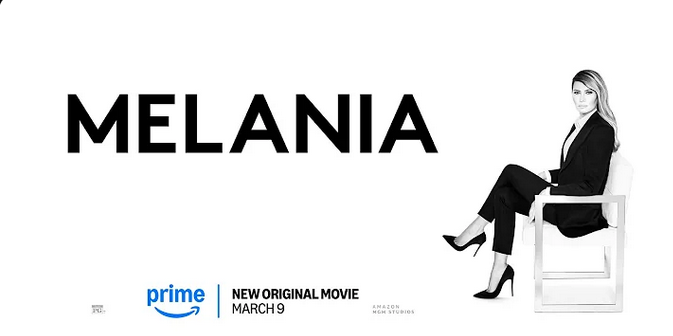
The documentary “Melania” unfolds within the ceremonial landscape surrounding Donald Trump’s return to the presidency. Melania Trump’s voice carries the narrative thread. She begins with an account of inheritance. She credits her mother’s strength and devotion to family with shaping the person she has become. She presents that inheritance as the ground of her public role.
That account of her origin is set within settings that unfold its meaning. At St. Patrick’s Cathedral a priest offers his blessing. The moment enters the language of national ceremony. Melania declares that she will use her influence and power to defend those in need. She links that promise to the discipline that guided her earlier career in Paris and Milan, where high personal standards first shaped her ambitions.
From the cathedral the narrative moves to the transfer of authority. President Joe Biden and Jill Biden escort Donald Trump and Melania Trump toward the White House. The procession advances through the familiar choreography of inauguration.
At that moment a reporter breaks through the press line and shouts a question: “Will America survive the next president?” Its resonance lends the sequence an unexpected candor.
The narrative then returns to Melania’s voice as she enters the Capitol’s Rotunda. She describes the moment as the meeting point between national history and her own journey as an immigrant. She speaks of rights that must be protected and of a humanity shared across different origins.
As the ceremony moves toward the swearing of the presidential oath to the Constitution, Jill Biden remains centered in the camera’s view until Trump’s daughter Tiffany steps forward and blocks her from sight.
Donald Trump then takes the oath. He announces that a golden age begins immediately. He promises national flourishing, international respect, and the restoration of impartial justice under constitutional rule. He names peace and unity as the marks of his future legacy.
Although the production bears Melania’s name, the material before the camera consists of ceremony, prepared language, and public display. Under such conditions a portrait cannot reveal a private figure. It records the symbolic role assigned to her within the spectacle surrounding Trump’s return to power.
Donald Trump tells her that she looks like a movie star. The camera returns to her face. The attempt to soften her beauty does not succeed. Her eyes narrow. The line of her mouth tightens into a strain that refuses the ease of a ceremonial smile.
The recurring presence of stiletto shoes of approximately twelve centimeters becomes part of the visual composition. The effect suggests an effort to augment physical presence in a setting where stature is already symbolically constructed.
Seen in the second year of Trump’s second term, the promises heard throughout the documentary: constitutional fidelity, respect for rights, pride in the immigrant’s contribution to national life, and the assurance that plurality remains united within one civic community, stand in contrast with the conduct of governance that followed.
The montage preserves more than a portrait of Melania Trump. Ceremony frames power with language drawn from inheritance, constitutional duty, and civic unity. When events test the promises attached to that language, the ceremony remains while the substance weakens.
Beauty, piety, and patriotic symbolism stand in the foreground of the ceremony and lend the moment dignity and continuity. When the record of governing enters the frame, those same elements remain after the promises attached to them have failed. The documentary leaves the image of the surface on which those promises were written.
*
Epilogue
*
The documentary does not construct a language capable of recognizing its own artifice. The ceremony remains at the level of presentation. It does not become conscious representation.
Artistic precedents in the documentary genre and in the exercise of governmental power have shown that power can be exposed through its own theatricality. When that language is established, the spectacle becomes legible as construction. Artifice no longer conceals itself and becomes part of the meaning.
Here the opposite occurs. The staging, the wardrobe, the choreography, and the discourse are presented without distance. There is no register that allows them to be observed as construction. The result is not an interpretation of power, but its reiteration.
The very condition of the the work contributes to this result. It is a commissioned production. Its cost, at approximately forty eight million dollars, intensifies the presentation of the surface without expanding the field of language.
That condition alters the meaning of what is seen. The ceremony retains its forms, but loses the capacity to produce awareness of itself. Language continues to assert legitimacy, but does not reach the point of examining it.
The production, without intending to do so, exposes this limitation. It does not reveal the artifice of power. It shows, instead, a form of power that lacks the language necessary to recognize itself as artifice.
*
Tags: authority and spectacle, constitutional oath, donald-trump, Jill Biden, Melania Trump, political ceremony, political symbolism, presidential inauguration, public rhetoric, Tiffany Trump
 Observations On Perception
PLease leave a Reply