Posts Tagged ‘donald-trump’

“The Dispossession of a Nation”

August 30, 2026

Still One
Medium: Oil On Linen
Size: 16 by 20 by 1 1/2inches
Year: 2010

Venezuela is not undergoing the democratic transition proclaimed by the government of the United States.  Venezuela is being dispossessed.  The electoral mandate asserted against Nicolás Maduro has been denied operative authority; the succession to Maduro is being negotiated under foreign supervision; petroleum production and sale are being reorganized according to foreign requirements; national revenue is being held within a system controlled outside the Nation; and rights over Venezuela’s natural patrimony are being prepared for private beneficiaries whose claims may endure beyond the lives of everyone now arranging them.  Each measure is presented separately as stabilization, reconstruction, investment, or energy security.  Taken together, the measures describe the despojo of a nation.

The removal of Maduro did not restore the constitutional agency previously taken from Venezuelans.  It changed the custodian of that deprivation.  The Venezuelan electorate had already been invoked as the source of the authority claimed by Edmundo González Urrutia and defended by María Corina Machado.  Yet the United States has proceeded as though recognition of that electoral claim also conferred upon Washington the power to determine when the claim may become effective, which Venezuelans may act upon it, and what political accommodation must precede its exercise.  An electorate recognized when recognition served the removal of Maduro ceased to be decisive when the same electorate obstructed the administration preferred after his removal.

The contradiction is not resolved by describing the preferred arrangement as temporary.  A foreign power that selects the Venezuelan officials with whom political and economic terms will be negotiated does more than influence a transition.  The foreign power occupies the constitutional interval in which Venezuelans would otherwise determine the identity, authority, and limits of their government.  The occupation need not assume the visible form of annexation.  The operative fact is the displacement of national decision by an external decision whose consequences are imposed upon the national territory, treasury, and future.

This displacement explains why the political and economic arrangements cannot be examined as separate questions.  Control over the political succession conditions who may consent to the petroleum arrangement.  Control over petroleum revenue materially conditions which political authority can govern.  Control over the recognition of that authority shapes whether resistance to the arrangement will be treated as constitutional opposition or as obstruction of a transition already defined elsewhere.  The same power therefore participates in selecting the Venezuelan interlocutor, defining the permissible political process, administering the principal source of national revenue, and allocating access to the resource from which that revenue proceeds.

The structure is already visible.  The United States has asserted control over the channels through which Venezuelan petroleum is sold and over the accounts into which the proceeds are received.  Executive Order 14373 describes the protection of those funds as serving American and Venezuelan interests.  The description does not answer the antecedent question: by what authority does the executive of one nation become the custodian of another nation’s principal revenue?  Protection against attachment may explain a mechanism.  It does not confer constitutional title upon the protector, and it does not convert foreign custody into Venezuelan consent.

The petroleum agreement announced on August 28 makes the problem more exact.  The reported arrangement encompasses 65 billion barrels in seventeen fields, contemplates a controlling American interest, and may extend for a century.  The private operator has not been identified publicly, and the complete agreement has not been made available for public examination.  A transaction of such magnitude is therefore being presented as an accomplished national benefit before the identity of the beneficiary, the terms of control, the disposition of revenue, the allocation of risk, and the constitutional authority of the Venezuelan signatories can be tested.  Publicity has preceded disclosure because the political conclusion is being demanded before the juridical facts are supplied.

The Constitution of Venezuela does not treat hydrocarbons as an ordinary asset available to whichever government possesses temporary command.  Article 12 declares hydrocarbon deposits to be public property, inalienable and imprescriptible.  Article 302 reserves petroleum activity to the State for reasons of national interest.  Articles 150 and 187 require legislative participation in contracts of national public interest concluded with foreign states or entities.  Until the complete agreement, the identity and authority of its signatories, and the required approvals are disclosed, no final legal judgment about every provision can be made.  The contest over the acting president’s title does not place Venezuela outside its Constitution or enlarge the authority of a provisional officeholder.  The contest makes demonstrable compliance with the Constitution more, not less, necessary before national patrimony is encumbered beyond the tenure of the authority purporting to act for it.  The information already announced nevertheless presents a direct constitutional question: whether an authority formed under foreign supervision may burden inalienable national patrimony for generations without the demonstrable authorization of the Venezuelan constitutional order.

That question cannot be answered by the magnitude of the promised investment.  Capital does not cure a defect in public authority.  Nor can a later contract erase the coercive conditions that made the contracting arrangement possible.  If force removes a government, foreign supervision determines its successor, foreign custody controls the resulting revenue, and selected private parties then receive durable economic rights, the contract is not an event independent of the force.  The contract is the instrument through which the result of force is given a transferable legal form.

The sequence is therefore more consequential than an unlawful intervention considered in isolation.  Military and executive power produce political submission.  Political submission produces contractual access.  Contractual access produces private entitlements.  Those entitlements may then be defended in courts, arbitration proceedings, financial markets, and diplomatic negotiations as acquired rights.  Coercion disappears from the final vocabulary.  Property, reliance, investment, and commercial stability take its place.  Force manufactures the entitlement, and law is subsequently invoked to protect the entitlement from the nation upon which the force was exercised.

The duration of the proposed arrangement makes this a temporal dispossession as well as a material one.  A century-long concession does not merely govern the extraction of petroleum today.  It removes choices from Venezuelans not yet born, binds governments not yet elected, and assigns the economic consequences of the present intervention to generations that could not have consented to it.  The mortality of Donald Trump is therefore beside the essential point.  The legal interests established during his administration can survive his influence because corporate rights, financial obligations, and institutional habits are designed to survive the officials who create them.

Trump is neither the sole author nor a sufficient explanation of the order now being constructed.  The President is an unusually explicit agent of a governing culture that equates financial capacity with public authority while detaching both from civic responsibility proportionate to their reach.  The relevant accusation is not directed indiscriminately at every American.  It concerns the narrow economic and political stratum capable of converting access to the executive into access to the assets of another nation.  That stratum claims the private liberty of an owner when profit is examined, the public prerogative of a ruler when markets and governments are rearranged, and the innocence of neither office when responsibility is assigned.

The distinction matters because oligarchy does not operate only through the possession of wealth.  Oligarchy operates through the capacity to translate wealth into governmental selection, governmental selection into exceptional access, and exceptional access into additional wealth.  The resulting circuit is internal to the United States, but its object in this instance is Venezuelan.  Venezuelan petroleum becomes the material through which American political patronage may be rewarded, concentrated, and made durable.

The first Venezuelan oil sale after the intervention supplied a concrete reason for scrutiny.  A congressional inquiry reported that Vitol and Trafigura stood to profit from an initial sale valued at approximately $500 million, and that Vitol senior trader John Addison had previously donated $6 million toward Trump’s campaign.  The inquiry does not by itself establish that the still-unidentified operator of the seventeen-field agreement is a political crony, and the absence of disclosure prohibits such a conclusion.  The combination of prior patronage, present secrecy, extraordinary executive discretion, and the scale of the proposed transfer does establish the necessity of the question.  Secrecy is not neutral when public coercion creates private opportunity.

The announced promise of lower oil and gasoline prices performs a different function within the same arrangement.  It supplies the American public with an anticipated personal benefit through which the foreign taking may be experienced as domestic policy.  The citizen is invited to evaluate the control of Venezuelan petroleum not by the authority under which the control was obtained, but by the possible price displayed at an American fuel pump.  The proposed benefit becomes retrospective justification: if the consumer eventually pays less, the means by which the advantage was produced are expected to recede from judgment.

The economic promise is itself uncertain.  Petroleum reserves beneath Venezuelan soil are not equivalent to immediately marketable supply.  Much of Venezuela’s crude is heavy, its production infrastructure requires extensive rehabilitation, substantial investment must precede sustained increases in output, and specialized refining capacity affects where and how the crude can be processed.  A vast statement of underground reserves can create an impression of immediate abundance while omitting the time, expense, and market constraints between geological possession and retail price.

Even an eventual increase in Venezuelan production would not establish that the benefit must reach American consumers.  The price of petroleum is formed within a global market, while the distribution of any lower acquisition cost depends upon refining, transport, contracts, competition, taxation, and the decisions of private intermediaries.  The corporations receiving privileged access may retain the margin as profit.  A possible reduction in price is thus presented as though it were a guaranteed transfer to the public, while the enforceable rights are transferred first to firms whose obligations run to owners and investors.

The propaganda does not fail only if the promised reduction fails to occur.  The premise would remain defective even if prices declined.  An economic advantage accruing to one population cannot supply title to the resources of another.  A benefit may explain why an act obtains political tolerance; the benefit cannot determine whether the act was constitutionally or internationally authorized.  The proposed price reduction is therefore not merely a questionable forecast.  It is a category error through which prospective utility is substituted for lawful authority.

The same substitution governs the invocation of regional security and the Monroe Doctrine.  A unilateral doctrine of American policy is treated as though the doctrine were a source of jurisdiction over the political and material disposition of the hemisphere.  No doctrine announced by one state can amend the Charter of the United Nations, displace the prohibition against intervention in the Charter of the Organization of American States, or extinguish the permanent sovereignty of a people over its natural resources.  The Monroe formula supplies a historical vocabulary for power.  The formula supplies no international title to Venezuelan petroleum and no constitutional capacity to act for Venezuelans.

The constitutional distortion within the United States is equally precise.  The executive has moved from coercive measures preceding Maduro’s removal to military action, control of foreign revenue, supervision of political succession, and the organization of a long-term petroleum regime without a comparably explicit act of Congress authorizing the whole structure.  Authorities granted for emergencies, sanctions, and the protection of assets have been assembled into something greater than their stated parts: an executive capacity to administer the political economy of another nation.  The absence of a formal annexation does not reduce the constitutional significance of that capacity.  It makes the capacity less visible while leaving its effects intact.

Congress possesses powers over war, appropriations, foreign commerce, and the legal commitments of the United States.  The Congressional Research Service has identified questions concerning the authority, reporting, auditing, and agreements involved in the post-Maduro arrangement.  Yet congressional silence, delay, or fragmented objection can allow executive facts to harden into commercial expectations.  Once capital has been committed and contracts have been performed, reversal will be described as instability, confiscation, or injury to investors.  The constitutional omission of the present becomes the asserted economic necessity of the future.

The arrangement consequently resembles concessionary imperialism more closely than democratic reconstruction.  Its object is not simply obedience from a foreign government.  Its object is the reconstitution of the foreign nation’s authority so that control of strategic resources can be exercised through local signatures, private instruments, and externally supervised revenue.  The flag need not change.  The legal personality of Venezuela may remain formally intact while the decisions that give that personality substance are made elsewhere.

This is why the language of transition is inadequate.  A transition identifies a movement from one Venezuelan constitutional condition to another.  The present process transfers the power to determine that movement away from the Venezuelan constitutional subject.  Political figures may change, elections may eventually be held, and Venezuelan officials may execute the documents.  None of those facts independently establishes that the Nation recovered the capacity to decide.  Procedure performed after agency has been displaced can ratify the displacement while supplying its democratic appearance.

The injury is correspondingly larger than the extraction of petroleum.  Venezuela is being deprived of political authority, constitutional agency, revenue, natural patrimony, and time.  The Nation is also being deprived of the language required to identify the unity of those losses.  Political control is called transition.  Custody of revenue is called protection.  Preferential allocation is called investment.  Long-term encumbrance is called reconstruction.  Expected consumer advantage is called the national interest of the United States.  When each part receives a separate administrative name, the total condition disappears from official description.

The total condition is dispossession.  The term does not depend upon nostalgia for Maduro, hostility to commerce, or a denial that Venezuela requires investment and institutional reconstruction.  Maduro’s removal does not authorize the removal of Venezuela’s agency.  The need for capital does not authorize a foreign executive to determine who may commit the resource, on what terms, and for whose durable advantage.  The existence of national weakness does not transform external capacity into national consent.

No institution presently directing the arrangement appears capable of resolving the central contradiction because each has incorporated the disputed premise into its conduct.  The American executive treats power as authority.  The selected Venezuelan administration treats external recognition as operative capacity.  Private beneficiaries may treat the resulting contracts as title.  Congress may treat facts already established as limits upon what can still be contested.  Markets may assign value to the arrangement before either nation has determined its legitimacy.

The material arrangements may determine the movement of petroleum, the custody of revenue, and the allocation of corporate rights.  The arrangements cannot determine the judgment by which those facts are recognized as authority or as dispossession.  That unresolved jurisdiction remains in the mind of every American asked to mistake prospective advantage for lawful title, and in the mind of every Venezuelan asked to mistake imposed administration for national consent.  The responsibility is not identical, because the power and the injuries are not identical.  The question confronting both populations is nevertheless the same: whether an accomplished fact becomes legitimate merely because institutions with the capacity to impose it have also acquired the capacity to name it.

A nation is not restored when its ruler is removed but its authority is transferred elsewhere.  A nation is not assisted when its resources are placed under arrangements the nation did not freely determine.  A nation is not enriched when private corporations receive durable rights over its patrimony in exchange for promises made on its behalf.  A nation is not made democratic when the power to decide its future is exercised by those who possess the force to impose it.  Venezuela is being stripped of authority, resources, revenue, and time.  To describe that condition as transition does not alter the condition.  The description completes the despojo by taking from Venezuela even the recognized fact of what is being done to it.

Ricardo F, Morin

August 30, 2026

Bala Cynwyd, Pennsylvania


“A Letter from a President”

May 19, 2026
White House


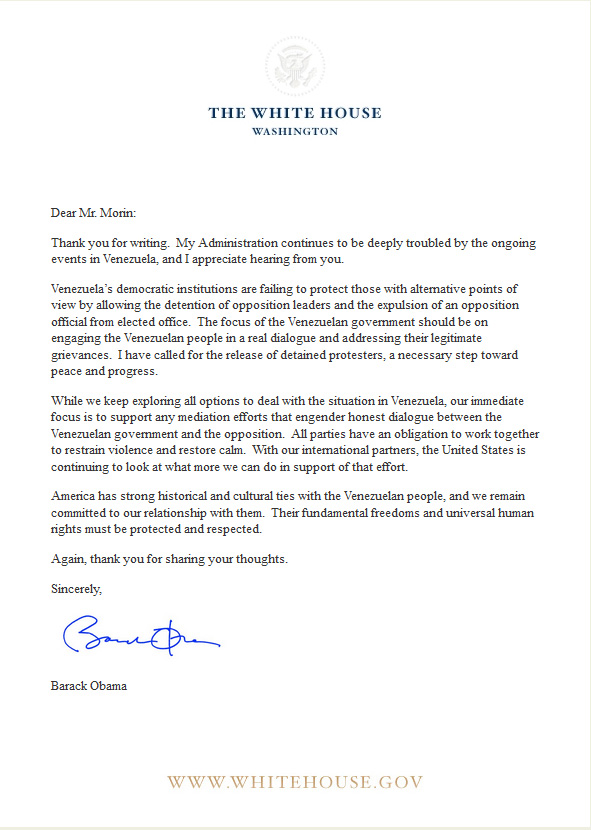
For decades I wrote to different Presidents of the United States as an American-Venezuelan citizen concerned with the progressive institutional deterioration of Venezuela.  Most of those letters never received a response.  In 2014, amid protests, detentions, and political fractures that were beginning to transform the country irreversibly, a reply arrived from the White House signed by Barack Obama.

Read today, the letter is less significant for what it explicitly states than for the nature of its language itself.  The text recognizes the deterioration of Venezuela’s democratic institutions, mentions the detention of opposition leaders, and calls for dialogue, mediation, and the containment of violence.  Yet, as frequently occurs in diplomatic language, precision diminishes as proximity to the consequences such statements might require increases.  Viewed retrospectively, that caution also revealed the difficulty of an American administration openly recognizing the degree to which Venezuela had ceased to be merely an internal crisis and was beginning to form part of a broader dispute over hemispheric influence.

The letter appeared to reflect a broader contradiction within American foreign policy:  the difficulty of sustaining democratic language while economic dependencies, energy commitments, and geopolitical rivalries increasingly limited the willingness of the United States to confront directly the expansion of foreign influence across Latin America.  What for years remained formulated through the language of mediation, dialogue, and regional stability would ultimately reveal a deeper tension between the declared principles of American foreign policy and the progressive strategic reconfiguration of the hemisphere.


Barack Obama’s letter:

Dear Mr. Morin:

Thank you for writing.  My Administration continues to be deeply troubled by the ongoing events in Venezuela, and I appreciate hearing from you.

Venezuela’s democratic institutions are failing to protect those with alternative points of view by allowing the detention of opposition leaders and the expulsion of an opposition official from elected office.  The focus of the Venezuelan government should be on engaging the Venezuelan people in a real dialogue and addressing their legitimate grievances.  I have called for the release of detained protesters, a necessary step toward peace and progress.

While we continue exploring all options to address the situation in Venezuela, our immediate focus is to support any mediation efforts that generate an honest dialogue between the Venezuelan government and the opposition.  All parties have an obligation to work together to restrain violence and restore calm.  Together with our international partners, the United States continues to examine what more we can do to support that effort.

The United States has strong historical and cultural ties with the Venezuelan people, and we remain committed to our relationship with them.  Their fundamental freedoms and universal human rights must be protected and respected.

Again, thank you for sharing your thoughts.


Sincerely,

(Illegible signature of)

Barack Obama


This White House letter was sent on May 7, 2014 through my personal email address.


My response on the same date:

Honorable President Barack Obama:

Thank you for your kind and generous response.

What remains implicit in your response is that the United States maintains economic and strategic commitments that limit any direct confrontation with the Venezuelan government.  An intervention intended to remove a power regarded as illegitimate could alter agreements, contracts, and international balances whose stability forms part of an American economy already subjected to considerable strain.

A structural dependency on oil appeared to lie at the center of that dilemma and its unwanted consequences.  Yet a country immersed in a growing process of institutional and economic disintegration could eventually cease to satisfy either international demands or the needs of its own population.

Ultimately, regional stability and the strategic security of the United States itself might depend not only upon calls for dialogue, but also upon a clearer recognition of the external forces and political dependencies contributing to Venezuela’s progressive deterioration.


Sincerely yours,

Ricardo F. Morín


“Melania”

March 10, 2026

The documentary “Melania” unfolds within the ceremonial landscape surrounding Donald Trump’s return to the presidency.  Melania Trump’s voice carries the narrative thread.  She begins with an account of inheritance.  She credits her mother’s strength and devotion to family with shaping the person she has become.  She presents that inheritance as the ground of her public role.

That account of her origin is set within settings that unfold its meaning.  At St. Patrick’s Cathedral a priest offers his blessing.  The moment enters the language of national ceremony.  Melania declares that she will use her influence and power to defend those in need.  She links that promise to the discipline that guided her earlier career in Paris and Milan, where high personal standards first shaped her ambitions.

From the cathedral the narrative moves to the transfer of authority.  President Joe Biden and Jill Biden escort Donald Trump and Melania Trump toward the White House.  The procession advances through the familiar choreography of inauguration.

At that moment a reporter breaks through the press line and shouts a question:  “Will America survive the next president?”  Its resonance lends the sequence an unexpected candor.

The narrative then returns to Melania’s voice as she enters the Capitol’s Rotunda.  She describes the moment as the meeting point between national history and her own journey as an immigrant.  She speaks of rights that must be protected and of a humanity shared across different origins.

As the ceremony moves toward the swearing of the presidential oath to the Constitution, Jill Biden remains centered in the camera’s view until Trump’s daughter Tiffany steps forward and blocks her from sight.

Donald Trump then takes the oath.  He announces that a golden age begins immediately.  He promises national flourishing, international respect, and the restoration of impartial justice under constitutional rule.  He names peace and unity as the marks of his future legacy.

Although the production bears Melania’s name, the material before the camera consists of ceremony, prepared language, and public display.  Under such conditions a portrait cannot reveal a private figure.  It records the symbolic role assigned to her within the spectacle surrounding Trump’s return to power.

Donald Trump tells her that she looks like a movie star.  The camera returns to her face.  The attempt to soften her beauty does not succeed.  Her eyes narrow.  The line of her mouth tightens into a strain that refuses the ease of a ceremonial smile.

The recurring presence of stiletto shoes of approximately twelve centimeters becomes part of the visual composition.  The effect suggests an effort to augment physical presence in a setting where stature is already symbolically constructed. 

Seen in the second year of Trump’s second term, the promises heard throughout the documentary:  constitutional fidelity, respect for rights, pride in the immigrant’s contribution to national life, and the assurance that plurality remains united within one civic community, stand in contrast with the conduct of governance that followed.

The montage preserves more than a portrait of Melania Trump.  Ceremony frames power with language drawn from inheritance, constitutional duty, and civic unity.  When events test the promises attached to that language, the ceremony remains while the substance weakens.

Beauty, piety, and patriotic symbolism stand in the foreground of the ceremony and lend the moment dignity and continuity.  When the record of governing enters the frame, those same elements remain after the promises attached to them have failed.  The documentary leaves the image of the surface on which those promises were written.

*

Epilogue

*

The documentary does not construct a language capable of recognizing its own artifice.  The ceremony remains at the level of presentation.  It does not become conscious representation.

Artistic precedents in the documentary genre and in the exercise of governmental power have shown that power can be exposed through its own theatricality.  When that language is established, the spectacle becomes legible as construction.  Artifice no longer conceals itself and becomes part of the meaning.

Here the opposite occurs.  The staging, the wardrobe, the choreography, and the discourse are presented without distance.  There is no register that allows them to be observed as construction.  The result is not an interpretation of power, but its reiteration.

The very condition of the the work contributes to this result.  It is a commissioned production.  Its cost, at approximately forty eight million dollars, intensifies the presentation of the surface without expanding the field of language.

That condition alters the meaning of what is seen.  The ceremony retains its forms, but loses the capacity to produce awareness of itself.  Language continues to assert legitimacy, but does not reach the point of examining it.

The production, without intending to do so, exposes this limitation.  It does not reveal the artifice of power.  It shows, instead, a form of power that lacks the language necessary to recognize itself as artifice.

*

Ricardo F. Morín, March 10, 2026, Oakland Park, Florida


“Viability”

January 11, 2026

Ricardo F. Morín
Viability
Watercolor frottage and white corrector on drafting vellum
20″x30″
2005


The question is often posed as to why certain corrupt regimes become objects of political action while others, no less compromised, do not.  At first glance, this appears to demand a comparative moral explanation.  In fact, it does not.  The difficulty lies not in the absence of information, but in the assumption that such actions are guided by a coherent and generalizable system of principles.

What can be observed is not the application of a principle across cases, but decisions taken one case at a time.   Political action does not follow a rule that can be applied in advance to different regimes.   For that reason, comparisons between Venezuela, Saudi Arabia, Russia, or Argentina obscure more than they clarify.  They assume a standard of decision-making that is not, in practice, a guiding action.

The actions examined here are those taken by Donald Trump in his capacity as a political actor.  His name is introduced not to explain behavior through personality or intention, but to locate responsibility.  The analysis proceeds from observable decisions and the circumstances in which those decisions were taken, rather than from suppositions about character, motive, or disposition.

The more relevant question is therefore not why some regimes are confronted and others ignored, but under what circumstances a country presents few obstacles to action, and which immediate interests align to make that action feasible.  This reframing shifts the analysis away from moral judgment and toward observable circumstances.

Understood in these terms, the issue admits a response—not as a rule, but as an account of how decisions are made in specific cases.   There is no way to infer, from the level of corruption alone, whether action will occur.  There is, however, a way to explain why, in particular circumstances, action proceeds.

In the Venezuelan case, several conditions converge.

First, immediate external resistance is limited.  Venezuela lacks allies willing to impose material, military, or economic consequences in response to pressure or limited intervention.

Second, state institutions do not act in a coordinated manner.  Administrative agencies, security forces, and political authorities do not reliably operate under a single command, reducing the ability to mount a unified response and making external action easier to pursue.

Third, Venezuela can be publicly described as an exceptional case—marked by collapse, criminal conduct, and administrative failure—which allows actions to be presented to domestic audiences without invoking a general principle that would need to apply elsewhere.

Fourth, economic interests operate through short-term negotiation rather than long-term alignment. Venezuelan oil, under sanctions and administrative disorder, can be folded into ad hoc bargaining without requiring stable commitments or enduring partnerships.

Finally, pressure on Venezuela does not trigger immediate disruption to major markets or strategic balances. Unlike cases involving Saudi Arabia or Russia, action does not risk cascading economic or military responses.

None of these factors amounts to a moral explanation or a guiding doctrine. Taken together, they describe when an administration acts through foreign policy: not because corruption is greater, but because resistance is limited, interests converge quickly, and a domestic account of the action can be sustained—conditions absent in many cases of equally severe corruption.

This does not explain the world.  It explains a decision.


“Portrait of a President: Series III”

January 9, 2026
Ricardo F. Morín
Portrait of a President III
Watercolor, gouache, black ink, and white corrector on paper
14″x20″
2003

Ricardo F. Morín

January 7, 2026

Oakland Park, Fl

The present moment does not register as a crisis of ideology, but as a crisis of sequence.  What is being tested is not the content of declared principles, but the order in which authority, review, and justification are made to occur.  Decisions are advanced before the conditions that would ordinarily authorize them have been articulated, and coherence is asked to follow action rather than govern it.  This inversion does not abolish law, institutions, or legitimacy.  It displaces them.  What once determined whether action should proceed now intervenes after action has already been declared.

In Venezuela, this inversion becomes visible through the widening separation between legitimacy and enforceable authority.  Electoral victory, moral credibility, and international recognition continue to exist, but they no longer determine who is treated as operable.  Engagement instead centers on those capable of compelling compliance in the present tense.  Authority is identified not through mandate, but through continuity with the administrative, financial, and coercive mechanisms that currently exert control.  The effect is not confusion but selection.  Those able to deliver immediate outcomes are elevated as interlocutors regardless of ethical record, while those whose legitimacy lacks immediate enforcement capacity are bypassed.

This preference has been articulated through assessment rather than implication.  Reporting on a classified briefing presented to Donald Trump indicates that U.S. intelligence concluded that figures drawn from within the existing Maduro apparatus were best positioned to assume control if Maduro were removed.  Vice President Delcy Rodríguez was identified not because of democratic standing or public credibility, but because of her continuity with the administrative, financial, and extractive mechanisms that continue to function within Venezuela.  Her experience overseeing the oil sector and engaging directly with commercial actors was treated as evidence of reliability in practice rather than legitimacy in principle.  What was evaluated was not character, but enforceability.  Criminal implication did not disqualify; it indicated command of the systems through which compliance could be compelled.  Opposition figures whose authority derived from electoral legitimacy but lacked immediate control over those mechanisms were treated as non-operable.  The selection privileged negotiability under pressure.

This mode of selection is not confined to a single theater or moment.  It recurs wherever authority is exercised ahead of coordination.  Operability outweighs normative qualification.  Authority is derived from the capacity to transact, enforce, and stabilize outcomes in compressed timeframes.  Legitimacy is acknowledged but does not determine engagement.  What governs is the ability to act now and to absorb consequence later.

The same inversion appears in Ukraine under different conditions.  Public declarations affecting military assistance, diplomatic posture, and negotiation have been issued without prior coordination with allies or institutions tasked with planning and review.  These statements do not clarify direction in advance; they compel response after the fact.  Allies recalibrate commitments once consequences are already in motion.  Planning follows assertion.  Coordination adjusts to announcement.  The question is not whether support exists, but whether its terms are introduced before or after the processes that would ordinarily govern them.

This ordering is also visible within the American system itself.  On multiple occasions over several years, Donald Trump has acted on the basis of assurances issued by Vladimir Putin despite the existence of contrary assessments produced by U.S. intelligence agencies.  Those institutions were not dismantled or silenced.  Briefings continued.  Analysis persisted.  What changed was their position in time.  Intelligence no longer governed whether action proceeded; it reconciled itself to commitments already made.  Verification trailed assertion.  Agencies designed to anticipate risk were required to manage consequences they had not authorized.

Once this ordering becomes perceptible, it does not remain confined to decision-makers.  Institutions, allies, and adversaries adjust their behavior accordingly.  Diplomatic actors treat public declarations as operative even when their durability is uncertain.  Agencies tasked with planning model scenarios around positions that may shift without notice.  Allies hesitate between waiting for clarification and acting to protect their own exposure.  Adversaries are instructed not by declared policy, but by the demonstrated sequence:  that commitments may precede review, that reversals may follow assertion, and that coherence cannot be assumed in advance.

What emerges is not paralysis, but recalibration.  Systems continue to function by absorbing volatility as a standing condition.  Stability is no longer produced by predictability, but by the capacity to adjust rapidly to decisions introduced before their governing terms have been settled.  This adaptation does not resolve the inversion; it normalizes it.  Governance continues, but its coordinating force weakens.  Motion persists without measure.

The consequence of this pattern bears directly on how authority and legitimacy relate to one another.  Legitimacy continues to be articulated through elections, alliances, and formal acknowledgment.  Authority, however, is exercised through immediacy—through the ability to set terms in motion that others must then accommodate.  This does not negate legitimacy; it sidelines it.  Authority no longer requires justification in order to operate.  Legitimacy survives as language, while authority consolidates through sequence.

When authority is exercised independently of legitimacy, governance may still function, but it ceases to persuade.  Decisions are carried forward not because they are accepted, but because they are already underway.  Review becomes accommodation.  Law becomes explanation after action rather than guidance before it.  The danger here is not lawlessness, but displacement.  Constraint remains formally intact while losing its capacity to govern timing.

This condition does not resolve into immediate collapse.  It endures.  Constitutional systems assume cooperation without being able to compel it in advance.  They rely on restraint exercised voluntarily, sequentially, and often against immediate interest.  When that restraint falters, institutions remain standing but lose coordinating force.  Authority fills the gap left by cooperation, often in the name of continuity.  What persists is governance without convergence, power without persuasion, and action without settled measure.