*
*
A review of Mark Rosenblatt’s Giant, directed by Nicholas Hytner
*
Ricardo F. Morín
November 23, 2026
Oakland Park, Florida
*
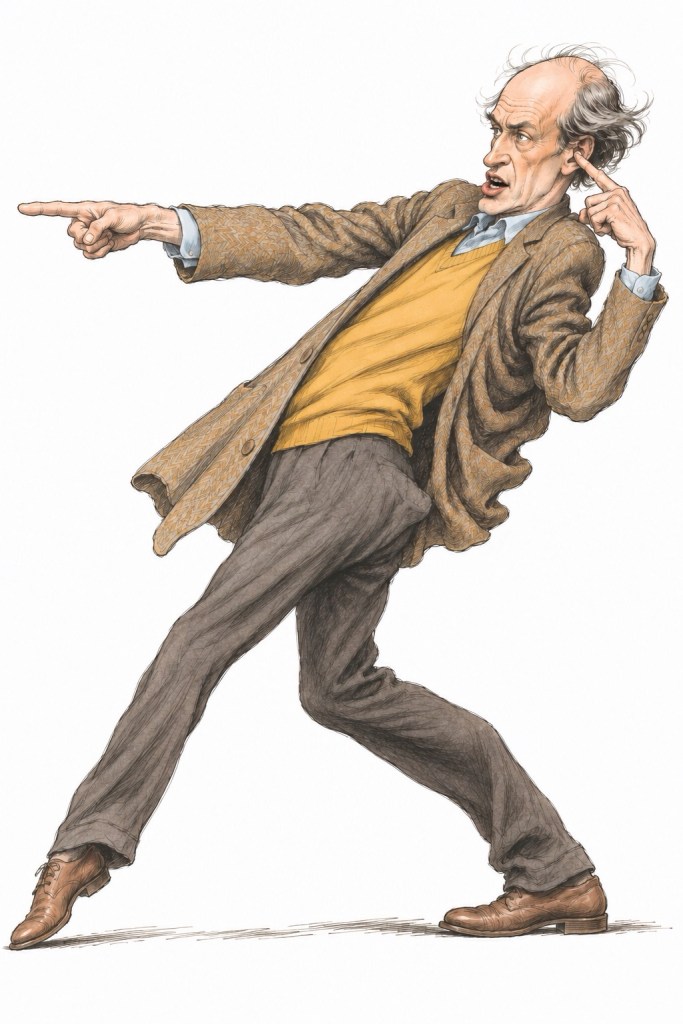
I saw Mark Rosenblatt’s Giant on screen in Boca Raton, in a performance filmed live at London’s Harold Pinter Theatre. John Lithgow played Roald Dahl opposite Aya Cash as the American publisher Jessie Stone.[1] Nicholas Hytner’s production subsequently moved to Broadway’s Music Box Theatre, where its sixteen-week engagement ended on Sunday, June 28, 2026.[2]
Rosenblatt imagines Dahl at home in the summer of 1983 with his publishers after the appearance of his review of a book about Israel’s invasion of Lebanon.[3] The suffering of Lebanese and Palestinian civilians gave Dahl grounds for indignation. In a 1983 interview with the New Statesman, Dahl claimed that a trait of Jewish character provoked hostility toward Jews, assigning to the people who suffered that hostility responsibility for its existence.[4] In the gathering Rosenblatt imagines, Dahl’s antisemitism enters the conversation as a presumption about the person across the table. In holding Jews everywhere answerable for the conduct of the Israeli state, he presumes, before his listener has spoken, to know what that listener believes. For anyone at that gathering who shares his indignation, there is still the question of what to say to a man who takes it upon himself to decide what a Jewish person is obliged to say.
I thought Dahl had judged each of the people he criticized with a cruelty none of them deserved. What remained uncertain was whether he could hear, in anything they said to him, an account of his own conduct that he was capable of recognizing. The uncertainty mattered because Dahl himself appeared to be the person best equipped to bridge the differences between him and the people he had accused.
Rosenblatt gives each person at the gathering an equal claim to be heard. Each understands something about the encounter that the others, from where they stand, have reason to see differently. The difficulty for the viewer is that no one’s own perception, however sincerely held, is sufficient to judge what passes between them. Dahl can tell the others what he meant by what he wrote. Only the person he addresses can tell him what it is to sit across from him and hear one’s convictions pronounced upon before one has had a chance to speak. The viewer can attend to both people in the exchange. For Dahl to learn what the viewer learns, he has to hear how the other person understood his words and reconsider what he has said about that person.
With Lithgow as Dahl, one can feel the peculiar hope that attaches to an eloquent man at such a gathering. Since he can make others understand what has moved him so deeply, one expects that, once someone has made an objection plain to him, he will find the words to acknowledge it. Yet each occasion for Dahl to hear another person becomes a further occasion for that person to hear Dahl. His speeches give an increasingly full account of why he spoke as he did. The person he has judged unfairly may understand every word of that account and still be waiting for an answer.
It would be easy to attribute that failure to an unwillingness to listen. What troubled me more was the possibility that pride makes Dahl incapable of hearing what, under other circumstances, he might readily understand. He wants the good opinion of the very people he criticizes. Their regard matters to him because he values their judgment, yet that judgment becomes almost unbearable to him the moment they exercise it on his conduct. His pride can withstand the loss of their good opinion more readily than it can admit that any one of them has just cause to withdraw it.
The more public the affront, the greater the obstinacy. A person whom Dahl has judged in company has reason to answer him before the people who heard the judgment. Silence would leave the others free to suppose the judgment was deserved. Yet the presence of those same witnesses makes it more difficult for Dahl to acknowledge what the answer asks him to see. He would have to allow everyone whose esteem he desires to witness the correction. The circumstances that make it necessary for one person to speak are precisely those that make it hardest for the other to hear. Dahl can take the public correction as an injury to himself and feel obliged to defend the very judgment that made the correction necessary.[5] We have enough experience of that kind of pride in public life to recognize how a disagreement can persist long after the people involved have said enough to understand one another.
I wanted Rosenblatt to let me see how much of his own cruelty Dahl could perceive. Only afterward, thinking back on the performance, did I begin to understand what the play had given me by leaving that question open. Dahl could have acknowledged an injustice done to one person in that room without surrendering his judgment of the injustice that had moved him to speak. The others could then have continued to disagree with him in the knowledge that he had heard them. From my seat, that possibility seemed almost painfully easy to see. What gives Giant its tragic force is how readily any of us might lose sight of the same possibility once the room falls silent and the judgment being questioned is our own.
Giant — Broadway trailer · Cinema trailer for the filmed West End performance
*
Source notes
1. Royal Court Theatre identifies the Harold Pinter Theatre as the filming location, names the cast, and credits Trafalgar Releasing as a partner in the cinema release. Read the cinema release announcement.
2. The Broadway production lists the Music Box Theatre, the limited engagement, and the June 28 closing. Visit the Broadway production site.
3. The production background identifies Dahl’s book review, the 1982 war in Lebanon, and the imagined meeting with his publishers in 1983. Read the account in WhatsOnStage.
4. The Guardian reproduces Dahl’s remarks about Jewish character from his 1983 interview with the New Statesman. Read the account and Dahl’s words.
5. Ricardo F. Morín, October 9, 2025. The Grammar of Conflict, sections 8 and 9. Section 8 describes how the belief that one is acting defensively can obscure responsibility for an action. Section 9 identifies the choice concealed in what feels like an inevitable reaction.
*
Tags: antisemitism, collective blame, Giant, John Lithgow, Mark Rosenblatt, Nicholas Hytner, pride, public judgment, Roald Dahl


PLease leave a Reply