*
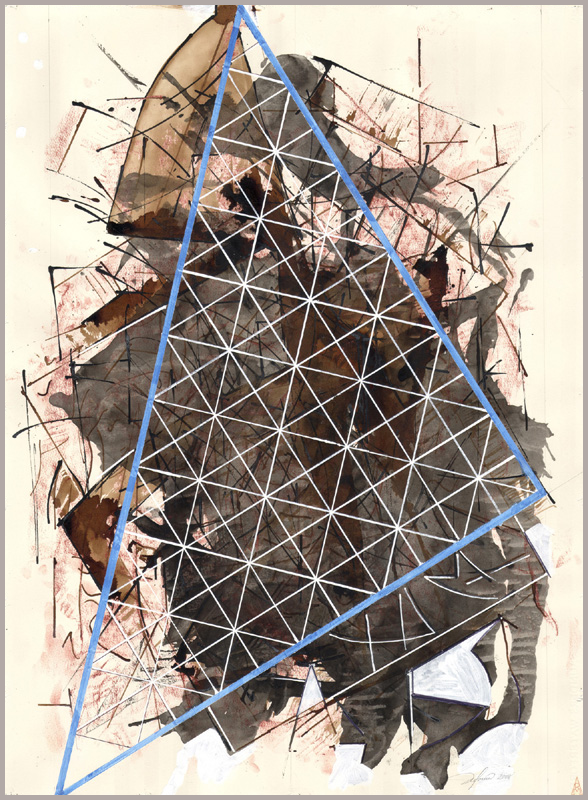
22″ x 30″
Body color, sanguine, sepia and Sumi ink on paper
2008
The Power of Myth and Storytelling
Storytelling has long served as a way to make sense of the unknown, an enduring thread that gathers aspiration, fear, and endurance into narrative form. Myths such as those of Jupiter reflect a search for power, resilience, and the divine; they echo the struggles that shape human experience. Whether in the trials of gods and heroes or in the ordeals of ordinary lives, these narratives offer a way to move through what cannot be readily understood.
Mystery settles within the folds of nature and provokes the impulse to explain, to justify, to believe. Superstition emerges where uncertainty prevails; it offers a sense of orientation, a way to interpret what resists control. But where does it lead? Does it remain a private refuge, or does it extend into the decisions of those who govern? Even in societies where public life appears ordered, the attraction to the esoteric persists, visible in its expressions, yet often concealed in its influence.
As mythologies once shaped entire civilizations, superstition remains present within modern cultures. It appears in rites and rituals, in discrete observances, in gestures that seek certainty where reason falters. Yet for all its reassurance, does it guide or does it hinder? A society moving between superstition and rationality stands at a threshold, suspended between inherited forms and the demands of a changing world.
Santería and Spiritism in Venezuela
Santería and Spiritism have taken root in Venezuela, their presence becoming more visible in times of crisis. Santería, an Afro-Caribbean synthesis of Catholic, Indigenous, and African traditions, is expressed through rituals intended to commune with spirits and to bridge the worlds of the living and the dead. Spiritism, in turn, centers on communication with unseen entities through mediums and prescribed practices. The two often converge, forming part of a broader spiritual landscape that accompanies daily life.
The Religious Sect of María Lionza
At the center of these traditions stands María Lionza, a figure situated at the intersection of Indigenous, African, and Catholic belief. She is invoked in ceremonies that call upon spirits of varied origin, among them the physician José Gregorio Hernández, pre-Columbian leaders, Simón Bolívar, and more recent political figures such as Hugo Chávez.
Among the sect’s recognized mediums is Edward Guidice, who is said to channel the spirit of Emeregildo, a figure associated with healing. As Venezuela’s healthcare system becomes strained, reliance on such practices increases. Where medical resources are limited, these rituals take on greater significance, and offer guidance, relief, or the possibility of intervention.
Superstition and Modernization
Superstition and modernity exist in close proximity, the former offering refuge from uncertainty, the latter pressing forward with its demands. In Venezuela, these beliefs extend beyond private life into health, governance, and social organization. Their presence can be sensed in decisions, in expectations, and in the ways individuals respond when formal systems fall short.
Alongside superstition, there are practices described as acts intended to influence outcomes through unseen forces. These are approached with both caution and reliance, spoken of quietly, yet sought in moments of need. Unlike passive belief, such practices imply intervention, an attempt to alter what might otherwise unfold.
As Venezuela confronts ongoing challenges, superstition remains near at hand. It explains, it reassures, it invites. Yet between its promise and its limits, a question persists, does it strengthen, or does it constrain? The answer remains unsettled, suspended between what is observed and what is believed.
Ricardo F Morin, February 8, 2025, Oakland Park, Fl.
Tags: beliefs, education, History, Hugo Chávez, life, Politics, Spiritism, Superstition, Witchcraft


PLease leave a Reply