*
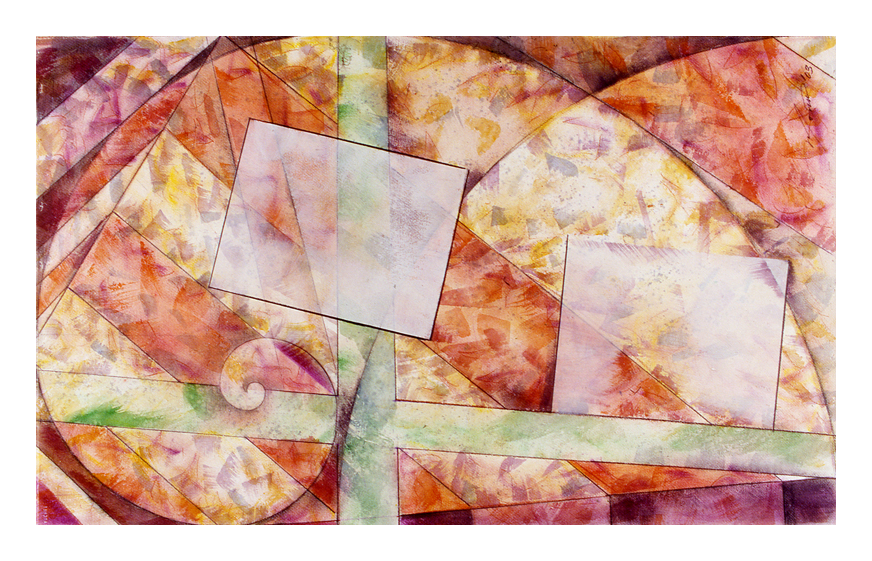
Golden Tent
40″h. x 26″w
Watercolor on paper
2005
People try to understand the world while living inside it. They rely on rules that must hold and on words that must make sense. Some things cannot contradict each other. Some outcomes follow necessarily from given conditions. At the same time, people need meaning to be communicated, shared, corrected, and lived with over time. These two demands do not coincide. Rules alone do not explain experience, and meaning alone cannot hold without limits.
Mathematics shows constraint in its clearest form. When a relation is proven, it holds regardless of who considers it or when it is considered. Time does not alter a proof. Perspective does not change necessity. Mathematics shows what must be true independent of circumstance. Yet because of this independence, mathematics says little about what it is like to live under those constraints or to apply them within experience.
Language works differently. Meaning arises through use rather than through necessity. Words gain sense as people employ them across situations that change. Language carries memory, absorbs disagreement, and adapts as conditions shift. Its strength lies in allowing meaning to remain intelligible even when context cannot be removed. But this same flexibility prevents language from settling meaning once and for all. What is understood remains open to revision and dispute.
Rules by themselves do not produce understanding. Constraint must be carried into language so that meaning can be tested, shared, and corrected. Without language, rules remain abstract. Without constraint, language loses coherence.
Human understanding takes shape in the tension between these two demands rather than in their resolution. Logic without language remains detached from lived experience. Language without constraint dissolves into arbitrariness. Their refusal to collapse into one another is not a failure, but the condition under which understanding becomes possible.
This tension can be pictured through the idea of a horizon. When people look across a landscape, the horizon is not a wall but a meeting point. Different lines of sight converge there and make depth visible. No single line explains the horizon. The horizon explains how many perspectives can belong to the same space.
When perspective shifts, the horizon shifts with it. In curved or multidimensional space, there is no single fixed vanishing point. Structure remains, but position matters. Understanding develops through movement and reorientation rather than through arrival at a final viewpoint.
The sequence of diagnostic axes examined elsewhere—memory, identity, testimony, judgment, responsibility, and authorship—does not resolve into a single conclusion. Each axis shows how human capacities fail to remain fully governable over time. Only after tracing these failures does the horizon become visible. The horizon does not explain the axes or correct them. It names the space in which their limits can be understood.
What appears here is not meaning itself, but the condition under which judgment can form without collapsing into rigid necessity or unchecked arbitrariness. To recognize this horizon is not to remove uncertainty, but to locate it. Rules continue to limit what can be true. Language continues to shape what can be lived. Their coexistence, marked by friction rather than harmony, reflects the conditions under which human understanding remains possible.
Ricardo F. Morín
January 31, 2026
Oakland Park, Fl
Tags: constraint, epistemology, horizon, human condition, intelligibility, judgment, language, meaning, rules, understanding


PLease leave a Reply