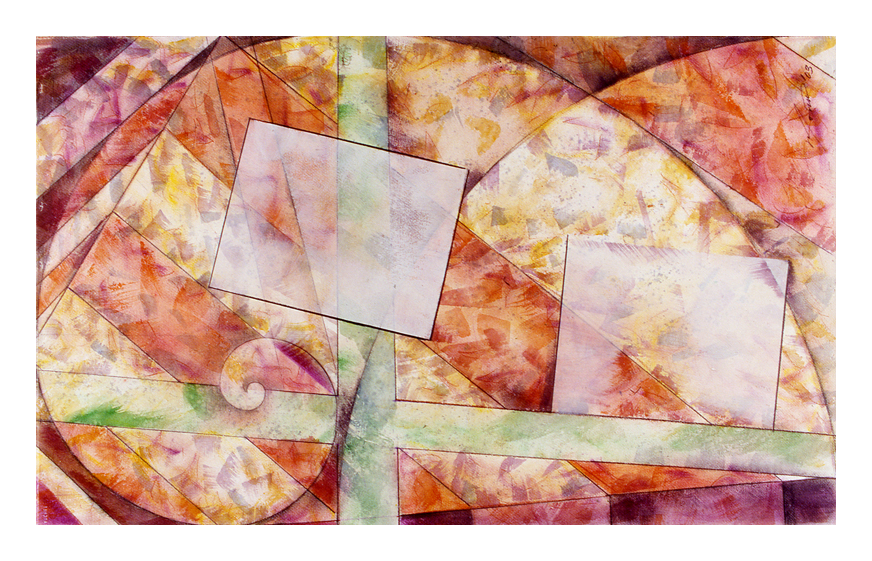
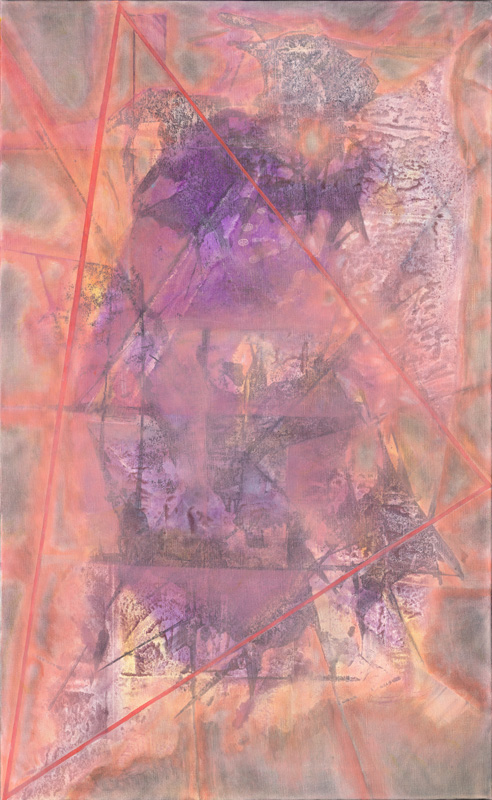
Ricardo F. Morín Golden Tent 40″h. x 26″w Watercolor on paper 2005
People try to understand the world while living inside it. They rely on rules that must hold and on words that must make sense. Some things cannot contradict each other. Some outcomes follow necessarily from given conditions. At the same time, people need meaning to be communicated, shared, corrected, and lived with over time. These two demands do not coincide. Rules alone do not explain experience, and meaning alone cannot hold without limits.
Mathematics shows constraint in its clearest form. When a relation is proven, it holds regardless of who considers it or when it is considered. Time does not alter a proof. Perspective does not change necessity. Mathematics shows what must be true independent of circumstance. Yet because of this independence, mathematics says little about what it is like to live under those constraints or to apply them within experience.
Language works differently. Meaning arises through use rather than through necessity. Words gain sense as people employ them across situations that change. Language carries memory, absorbs disagreement, and adapts as conditions shift. Its strength lies in allowing meaning to remain intelligible even when context cannot be removed. But this same flexibility prevents language from settling meaning once and for all. What is understood remains open to revision and dispute.
Rules by themselves do not produce understanding. Constraint must be carried into language so that meaning can be tested, shared, and corrected. Without language, rules remain abstract. Without constraint, language loses coherence.
Human understanding takes shape in the tension between these two demands rather than in their resolution. Logic without language remains detached from lived experience. Language without constraint dissolves into arbitrariness. Their refusal to collapse into one another is not a failure, but the condition under which understanding becomes possible.
This tension can be pictured through the idea of a horizon. When people look across a landscape, the horizon is not a wall but a meeting point. Different lines of sight converge there and make depth visible. No single line explains the horizon. The horizon explains how many perspectives can belong to the same space.
When perspective shifts, the horizon shifts with it. In curved or multidimensional space, there is no single fixed vanishing point. Structure remains, but position matters. Understanding develops through movement and reorientation rather than through arrival at a final viewpoint.
The sequence of diagnostic axes examined elsewhere—memory, identity, testimony, judgment, responsibility, and authorship—does not resolve into a single conclusion. Each axis shows how human capacities fail to remain fully governable over time. Only after tracing these failures does the horizon become visible. The horizon does not explain the axes or correct them. It names the space in which their limits can be understood.
What appears here is not meaning itself, but the condition under which judgment can form without collapsing into rigid necessity or unchecked arbitrariness. To recognize this horizon is not to remove uncertainty, but to locate it. Rules continue to limit what can be true. Language continues to shape what can be lived. Their coexistence, marked by friction rather than harmony, reflects the conditions under which human understanding remains possible.
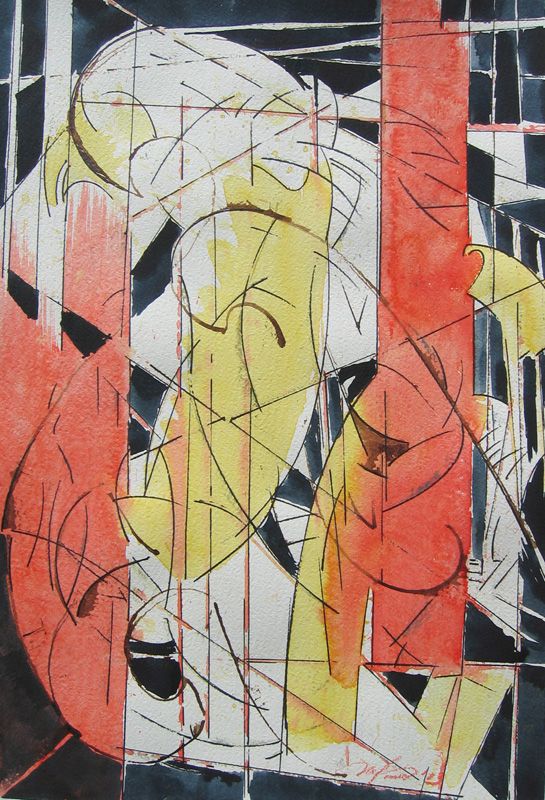
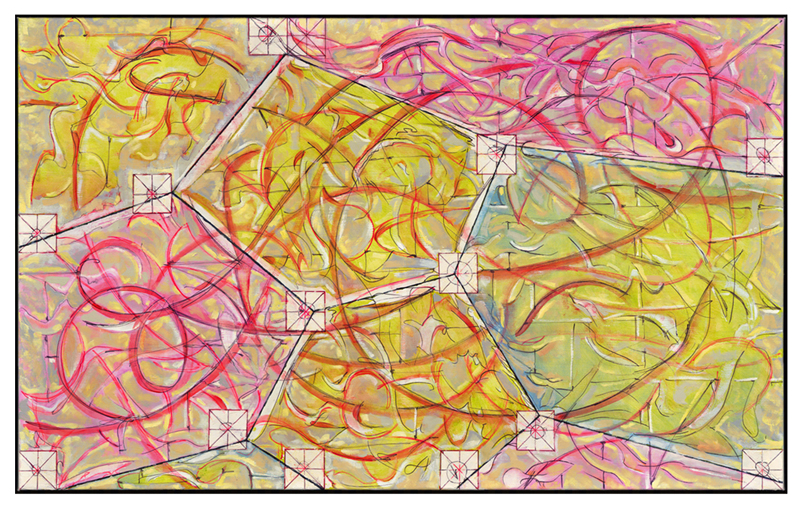
Ricardo F. Morín Templates III 14” x 20” Watercolor and ink on paper 2003
People often discover that what they say or do does not remain where they placed it. A remark made in passing is repeated elsewhere. A decision taken for one purpose is later cited for another. Words meant to clarify are reused to justify actions the speaker never anticipated. Once expressed, what has been authored moves beyond the situation in which it was produced and enters contexts the author does not control.
What is written, declared, or enacted does not retain its meaning by remaining tied to intention. Readers, listeners, colleagues, and institutions receive what has been authored through their own expectations, needs, and circumstances. As situations change, the same words or actions are taken up differently. Meaning migrates not because authors relinquish care, but because interpretation unfolds wherever what has been authored circulates.
As interpretation accumulates, the link between origin and significance loosens. What an author sought to express does not vanish, yet it no longer governs how the expression will be understood or used. Each act of reception introduces new relations, drawing on conventions and pressures that exceed the author’s horizon. Over time, layers of meaning form that cannot be reduced to a single originating moment without loss.
Under these conditions, authority persists without control. Authored material continues to shape understanding and guide action even as the author’s capacity to direct its meaning diminishes. Texts, decisions, and gestures acquire standing not because their origin remains present, but because their effects endure within systems that rely on them. Authority attaches to circulation and use rather than to command.
When authorship is mistaken for sovereignty over meaning, confusion follows. Attempts to fix interpretation by appealing to origin fail to account for the fact that meaning arises through use rather than preservation. Efforts to reclaim control often generate conflict instead of clarity, as different contexts assert incompatible claims on what has been authored. What collapses in such moments is not meaning itself, but the assumption that meaning can be governed from a single point.
Authorship therefore functions as an unavoidable condition rather than a position of mastery. To author is to introduce words or actions into a field where interpretation proceeds independently of intent. What remains with the author is not ownership of meaning, but exposure to its unfolding. Authorship binds the author to consequences that continue to develop as what has been authored acquires significance beyond its initial articulation.
Authorship persists not as sovereignty over meaning, but as exposure to the ongoing movement of significance as what is authored circulates beyond its origin.
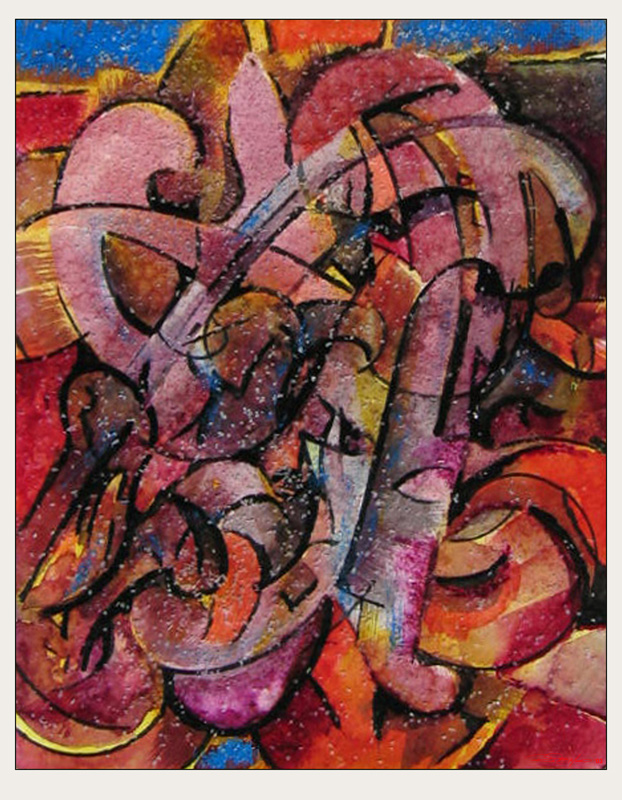
Ricardo F. Morín Templates III 8” x 10” Watercolor and ink on paper 2003
People rarely experience events alone. What someone sees, hears, or notices is soon spoken about, compared, or questioned by others. An experience becomes an account when it is told, and once it is told, it enters a space where other accounts already exist. From that moment on, perception is no longer singular. It becomes intelligible only in relation to what others perceived, remembered, or expected under different conditions.
When a person gives an account of what they witnessed, that account does not preserve the experience intact. It places the experience alongside other perceptions that do not fully coincide with it. Differences of position, attention, memory, language, and expectation shape what each person noticed and how it was understood. Even when people attend to the same event, emphasis and significance do not align completely. Testimony therefore moves within a plural field where meaning arises through comparison rather than through preservation.
Within this field, agreement is provisional rather than assured. Accounts may overlap at certain points while diverging at others. No single account can absorb the rest without remainder. Testimony does not naturally settle into a single meaning because perception itself is distributed across distinct vantage points that cannot be merged without loss.
In such conditions, misunderstanding does not signal bad faith. It persists even when everyone involved intends to be accurate. Divergence arises not from deception or carelessness, but from the fact that each account reflects a different relation to the same event. Attempts to clarify one account by reference to another often increase awareness of difference rather than resolving it, as explanation introduces distinctions that were not previously visible.
As plural accounts accumulate, pressure grows to secure agreement. Shared meaning begins to be treated as a requirement rather than as a result. Consensus is taken as a stand‑in for accuracy, and what many affirm is assumed to be what most closely reflects what occurred. Yet numerical agreement does not eliminate perceptual difference. It stabilizes one interpretation long enough for coordination to proceed.
Under this pressure, testimony is often reshaped to favor legibility over fidelity. Accounts are simplified, aligned, or muted so they can fit within an accepted framework of understanding. What resists integration is set aside as confusion or irrelevance. The field of testimony narrows not because differences have been resolved, but because they have been excluded.
What testimony provides, then, is not direct access to events, but a negotiated surface across which perceptions are compared and provisionally aligned. The stability produced by this process is practical rather than final. It allows people to act together, even as unresolved differences remain. Testimony stays open to revision not because sincerity is lacking, but because perception cannot escape the plurality through which it becomes shared.
When shared meaning is demanded from plural perception, agreement can be reached, but convergence cannot be guaranteed. Testimony coordinates perspectives without dissolving the differences that make coordination necessary.
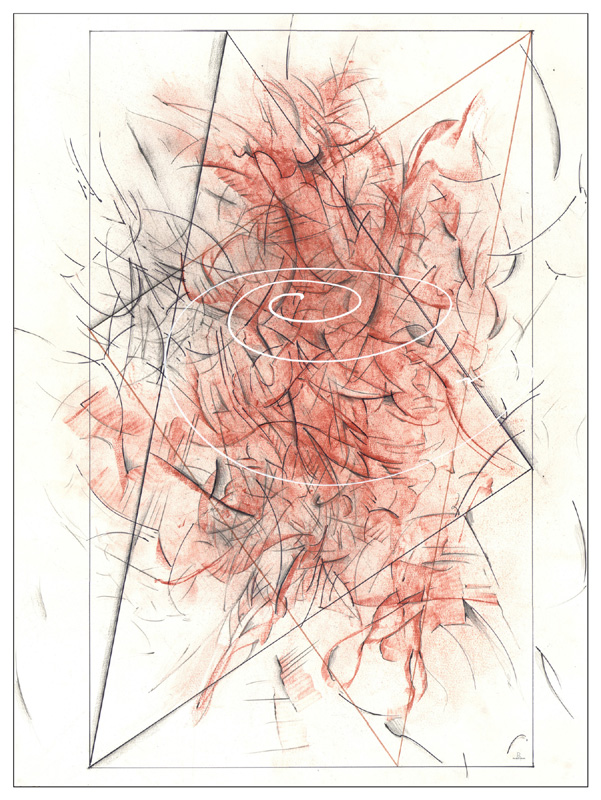
Ricardo Morín Triangulation III: The Quiet Room 22″ x 30″ Body color, sanguine, sepia and Sumi ink on paper 2008
Author’s Note
This story takes place in a room marked “Quiet Room,” a term that in English is usually understood as a neutral space: a place for silence, rest, or reflection, without any implied ritual purpose. But spaces do not mean the same thing to everyone. In some cultures and languages, silence suggests prayer; the absence of furniture implies prostration; and the presence of a textile can signal ritual use.
These differences in meaning can create misunderstandings where no conflict is intended. What I recount here is not about religion, but about how the meaning of a shared space can shift without warning, and how people interpret the same room through frames of reference that may collide without notice.
Ricardo F Morín
November, 2025
Oakland Park, Florida
1
My driver and I had been talking about the way executive power often disguises its motives—how it presents itself as a force of rescue while pursuing forms of exploitation. We passed the time considering these contradictions and felt, briefly, that we understood our world a little more clearly.
2
We were accompanied by the brisk morning air as we moved through congested traffic toward the Philadelphia airport. I was returning home to Fort Lauderdale after two days of cardiological testing not available to me back home. Without baggage, I went directly to TSA PreCheck with only a shoulder bag. Shortly after I reached the departure gate, a six-hour delay was announced. I decided to buy a backpack and set out in search of a place to reorganize my things in private.
3
I soon found a room marked Quiet Room—plainly identified as a space for silence, rest, or reflection. I entered with that expectation. The room was divided into several intimate areas with benches along some of the walls. The lighting was subdued and the air held a stillness that contrasted with the restlessness of the terminal. Though furnished sparingly, the rooms were lined with pleated curtains that absorbed and muffled sound, and this softening of the acoustics created a muted perimeter that stood apart from the noise outside. Only one of the smaller sections had a vanity with a faucet, a faint glow reflecting off its surface.
4
Atop what appeared to be a tall storage unit, several folded textiles were stacked. Their textures and patterns varied—some silk-like, others woolen or synthetic. At first glance they looked more like blankets than anything else. Nothing in the room suggested any purpose beyond what the sign indicated. It was, in every visible sense, a quiet room open to anyone.
5
I stood facing one of several benches and began to transfer my belongings from the shoulder bag into the new backpack. The simple act of rearranging objects formed its own small rhythm within the subdued quiet. I was nearly finished when a voice behind me broke the stillness. I turned and saw a man repeating with certainty:“This is a place for prayer”.
6
His certainty overrode the posted meaning of the room. There was no courtesy, no explanation, and no acknowledgment of the sign that defined the space I had entered. I turned back to complete what I had nearly finished. The man walked into one of the adjoining sections. A woman remained in the larger space that I stood in, silent, waiting for me to leave. I stepped out. For a moment I felt like a transgressor, though nothing I had done justified it.
7
I was startled by how quickly confidence had given way to a sense of diminishment.
8
I had become a participant in an unexpected encounter. A single assertion—neither explained nor negotiated—had shifted the atmosphere without warning.
9
A short time later and still unsettled, I returned impulsively to the Quiet Room, perhaps to find closure. In the smaller section with the vanity, several men were washing their hands as they murmured chants or prayers, barely audible yet perceptible enough to alter the atmosphere. Their voices blended with the sound of running water, forming a low, continuous undertone. In the larger section, the same woman stood quietly, facing one of the textiles she had placed diagonally across the narrow space she occupied. The room’s physical features had not changed, but its public meaning had been recast. What had been neutral now felt defined by a significance I had not been prepared for or invited to share.
10
I left again and returned to my departure gate. In time the emotion eased, though the moment remained vivid as I wrote it.
11
Later, I replayed the scene and the reply I had not managed to speak:“This is a place for prayer. I am praying myself”.
12
But I found no certainty in the memory of it—only questions that lingered with persistence: how can a plainly posted meaning, “Quiet Room,” be superseded by an unspoken one? Was it grievance or exclusivity that redrew the boundaries of a public room without a single word of justification? How quickly can a neutral space become contested before anyone knows how to meet the shift itself? How does one face the responsibility of communicating with clarity? By any measure, none of us had succeeded.
Ricardo Morín Triangulation Series Nº 10: Method 37″ x 60″ x 2″ Oil on linen 2006
*
PREFACE
i
Clarity begins where boundaries appear. A boundary is not a restraint but a distance, an interval in which perception can separate itself from emotion long enough for understanding to take shape. When that distance collapses, experience is reorganized by impulse; the world becomes an extension of what one feels rather than what one sees.
ii
Boundaries are the only defense against this collapse. They prevent meaning from dissolving into reaction and keep perception from being redirected by purpose. Purpose, when allowed to speak first, narrows the field of vision and turns inquiry into confirmation. A boundary interrupts this tendency; it holds intention in suspension so that attention can return to what is actually present.
iii
Inquiry depends on this interruption. Without boundaries, the movement of thought cannot be distinguished from the movement of desire, and doctrine quietly replaces observation. Boundaries do not resolve uncertainty, but they make uncertainty legible. They create the conditions in which questions can be asked without predetermining their answers.
iv
Humility is inseparable from this act. It is not a posture but a condition that allows perception to proceed without the weight of intention. Clarity requires more than sincerity or restraint; it requires a mind that is not driven by the need to accumulate, whether knowledge, virtue, certainty, or self-justification. Accumulation reorganizes perception around a desired result. Discipline, in this sense, is not the pursuit of an ideal but the maintenance of boundaries that protect perception from being redirected by purpose. It is a discipline of subtraction rather than achievement: an effort that becomes effortless when it no longer seeks reward.
This preface introduces the method that follows. Method is not a technique, nor is it a path toward improvement. It is the sustained practice of observing without coercion, distinguishing structure from projection, and permitting meaning to emerge without forcing it into preexisting shapes. Boundaries make that discipline possible. They are the ground on which clarity stands.
Ricardo F. Morín
November, 2025
Oakland Park, Florida
1
Every attempt to understand the world begins with a simple but often overlooked fact: we see in fragments. Human perception operates like a lamp in a large room; perception illuminates what is near, dimming what is distant, and leaves most of the room in shadow. We navigate life with the assumption that our partial view is complete, even though experience repeatedly proves otherwise. Knowledge helps us organize what we see, but it also defines the edges of our understanding; it clarifies one portion of the room while it obscures another. No one escapes this condition. No historian, philosopher, commentator, or citizen sees the world in its entirety, and acknowledging this is not an act of modesty but the foundation of honest inquiry.
2
Two different intellectual traditions help illuminate the tension between seeing and understanding. One comes from the kind of clarity found in Krishnamurti’s observations: the discipline of perceiving without the distortion of fear, motive, or the narratives we inherit without noticing. He insisted that much of what we call “knowledge” is actually memory, habit, or reaction, and that these patterns cloud perception rather than sharpen it. The second tradition, rooted in Western civic philosophy and historical analysis, insists that societies cannot be understood without structure: without categories that describe institutions, without distinctions between authority and power, or between law and the decisions made in its name. This tradition demands reasoning, evidence, and articulation.
3
Neither tradition is sufficient on its own. Pure perception can become impressionistic; it dissolves the world into sensations without offering any explanation of how things work. Pure structure can become rigid; it treats human experience as an abstraction, flattening its subtleties into neat but inaccurate theories. A method emerges when these approaches intersect. Its first movement is subtraction. It asks the observer to remove the noise that interferes with perception: the assumptions that rush ahead of reality, the narratives that interpret the world before we have actually seen it, the emotional recoil that transforms a fact into a grievance, or a possibility into a threat. Subtraction does not eliminate complexity; it makes room for it. It allows us to look at familiar situations, conflict, political argument, civic breakdown, inequality, without immediately reaching for slogans or for the explanations we already prefer.
4
The second movement is structure: identifying the patterns that persist once distortion has been removed. Structure appears in the way institutions operate, in the incentives that shape public behavior, in the stories societies tell to justify their actions, and in the consequences that repeat themselves across time. A society punishes in one way rather than another for reasons that can be traced. A population interprets progress according to a set of assumptions that can be examined. A system favors certain outcomes because its design makes other outcomes unlikely. Structure is not the enemy of perception; it is what perception reveals when it is clean.
5
Meaning arises from the interplay between these two movements. It does not remain stable; it shifts when the conditions that hold it together change. Words like “justice,” “freedom,” “security,” or “progress” acquire new meanings not because thinkers redefine them, but because societies reorganize themselves around different fears, expectations, or pressures. To assume that these meanings are fixed is to mistake living processes for static definitions. The task is not to declare what these concepts should mean, but to examine how they function in the real world; how they guide action; how they justify authority; and how they shape the limits of what people consider possible.
6
This approach allows writing to become neither abstract nor ideological. It is not a performance of expertise nor a confession of personal experience. It is an effort to look at the world as it is lived: how people respond to harm; how institutions drift from their original purpose; how fear transforms into policy; how progress becomes a story that conceals as much as it reveals; how public judgment forms under conditions of uncertainty. These are not theoretical questions but everyday realities, observable to anyone who pays sustained attention.
7
The method does not claim special insight. It does not elevate the observer above the events being described. It argues something simpler and more democratic: that clarity is available to anyone willing to examine both perception and structure without surrendering to either. The observer remains part of the world being studied, affected by its pressures, limited by its uncertainties, and shaped by its histories. The goal is not to escape this condition, but to see it clearly enough that understanding becomes possible.
8
In this sense, method is not a technique but a form of discipline. It is the discipline of perceiving without leaning on the crutch of inherited narratives; the discipline of thinking without allowing ideology to rush ahead of evidence; the discipline of naming structures without pretending they are inevitable; and the discipline of allowing meaning to remain flexible enough to reflect the movement of time. Its purpose is not to simplify the world but to make it legible, without illusion, without theatricality, and without the desire to be right.
9
Such a method offers no certainty. What it offers is honesty: an acknowledgment that truth is not a possession, that the world exceeds every attempt to capture it, and that clarity emerges not from authority but from attention.
Ricardo F. Morín Dodecahedron 60″x 37″ Oil on linen 2005
Ricardo F. Morín
June 12, 2026
Bala Cynwyd, Pennsylvania
All living entities persist through relations. No organism exists in complete isolation from the conditions that sustain it. Life proceeds through continuous exchanges with surrounding environments and with other living systems. These exchanges need not be deliberate, conscious, or symbolic. They need only permit the registration of differences and the adjustment of behavior in response to them.
Communication emerges within this condition. It is not limited to speech, writing, or symbolic expression. More broadly, communication arises through correspondence, within which differences are registered and relations are established, maintained, or modified. Signals constitute one manifestation of such correspondence, but the forms through which correspondence occurs vary widely. Chemical gradients, electrical impulses, physical gestures, vocalizations, and symbolic systems all participate in communicative processes under different conditions.
Language occupies a distinct place within this broader field. Human language permits abstraction, symbolic reference, recursion, and the transmission of information beyond immediate circumstances. These capacities expand the range of what can be communicated. They do not, however, constitute the origin of communication itself. Rather, language represents a specialized manifestation of communicative processes that already operate throughout living systems.
The distinction is important because language often becomes identified with communication as such. Human beings naturally experience the world through linguistic categories and therefore tend to privilege language when considering the conditions of understanding. Yet much of what sustains relational life occurs without language. Organisms coordinate, adapt, compete, cooperate, and respond to changing conditions through forms of correspondence that precede symbolic representation.
Differences among communicative systems are differences of form, scope, and complexity. They do not necessarily imply absolute divisions between categories of existence. A signal that coordinates the movement of a colony, a vocal call that alerts a group to danger, and a sentence describing a future possibility all perform communicative functions despite substantial differences in structure. The means differ. The correspondences through which those differences are registered remain prior to the communicative forms that express them.
Observation permits the study of these processes but remains constrained by the capacities through which observation occurs. Instruments may extend perception, and conceptual frameworks may organize what is perceived, yet description remains distinct from the realities it attempts to describe. Every account reflects both the conditions observed and the limitations of the observer.
For this reason, communication is best approached descriptively rather than hierarchically. Human language possesses distinctive capacities, but those capacities do not require communication to begin with language nor to be exhausted by it. Language belongs within a broader communicative field that arises from forms of correspondence present throughout relational life.
The question is therefore not whether communication exists where language is absent. The more instructive question concerns the many forms through which relational life becomes possible before language appears. Attention to those forms reveals communication not as a uniquely human achievement but as a condition through which living systems participate in, respond to, and persist within the circumstances they inhabit.
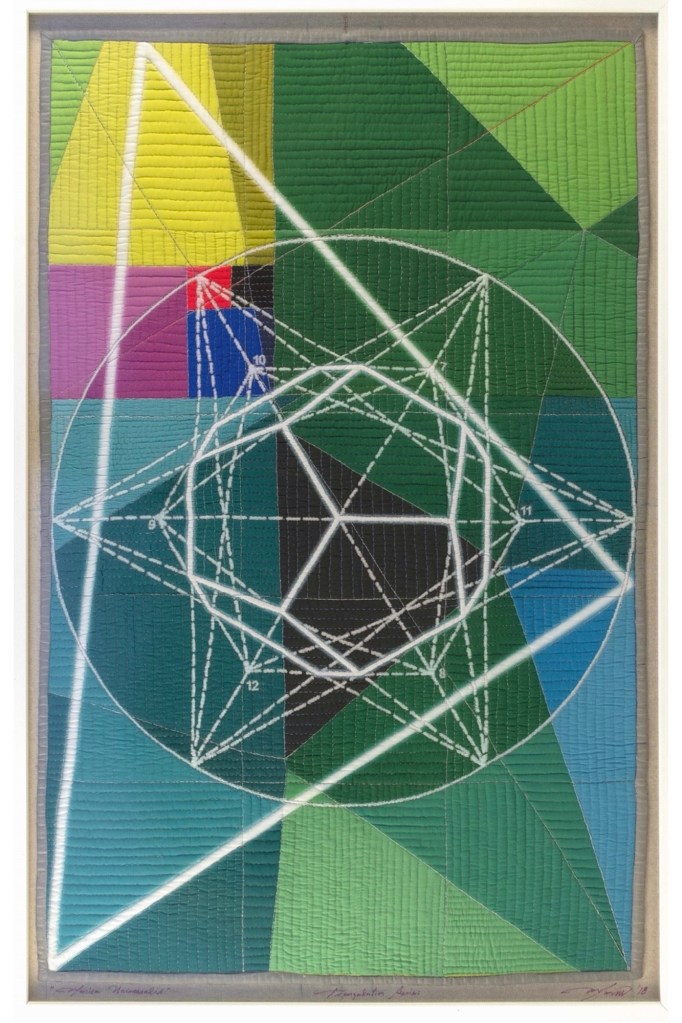
Ricardo Morín (Triangulation Series) Musica Universalis Silk quilt streched over linen 37″ x 60″ 2013-18
A geometrical construction of a dodecahedron within a Fibonacci composition, reinforced by a right-angle triangle: A meditation on the harmony of the universe, where mathematics and language converge yet never fully enclose reality.
Ricardo Morin, August 20, 2025
Abstract
This essay examines the interdependence of language and mathematics as the twin pillars of knowledge, each indispensable yet incomplete without the other. While mathematics secures precision and abstraction, language renders reasoning intelligible and shareable; together they approximate, but never fully capture, a reality richer than any formulation. The discussion situates artificial intelligence as a vivid case study of this condition. Marketed at premium cost yet marked by deficiencies in coherence, AI dramatizes what happens when mathematical power is privileged over linguistic rigor. Far from replacing human thought, such systems test our capacity to impose meaning, resist vagueness, and refine ideas. By weaving philosophical reflection with contemporary critique, the essay argues that both mathematics and language must be continually cultivated if knowledge is to progress. Their partnership does not close the gap between comprehension and reality; it keeps it open, ensuring that truth remains an unending pursuit.
Language, Mathematics, and the Price of Artificial Intelligence
Every society advances by refining its tools of thought. Two stand above all others: mathematics, which distills patterns with precision, and language, which gives form and meaning to reasoning. Neither is sufficient alone. To privilege one at the expense of the other is to weaken the very architecture of knowledge.
Artificial intelligence dramatizes both their promise and their limitations. The announcement of a $200 monthly fee for access to ChatGPT-5 is revealing. Marketed as a luxury service “for those who can afford it,” it underscores the widening gap between technological privilege and cultural necessity. Those with resources can fine-tune their productivity; those without are left behind. Yet even for the well-equipped, the question persists: what exactly is being purchased?
The machine dazzles with speed and scale, but its deficiencies are equally striking. Engineers may be virtuosos of algorithms, but grammar is not their instrument. The results are too often colloquial, vague, or lacking in rigor. To extract coherence, the user must not be a passive consumer but an editor—capable of clarifying, restructuring, and imposing meaning. The paradox is unmistakable: the tool marketed as liberation demands from its operator the very discipline it cannot supply.
This paradox reflects the larger truth about knowledge itself. Mathematics and language are both indispensable and both incomplete. Mathematics achieves abstraction but leaves its results inert unless language renders them intelligible and shareable. Language conveys thought but falters without the rigor that mathematics provides. What one secures, the other interprets.
Yet both are bound by a deeper condition: reality exceeds every formulation. Our theories—whether mathematical models or linguistic descriptions—are approximations shaped by the observer. Language cannot exhaust meaning; mathematics cannot capture finality. Knowledge is never absolute: it is a negotiation with a reality richer than any model or phrase.
Artificial intelligence exposes this condition with particular clarity. It can automate structures without supplying wisdom; it can reproduce language without securing meaning. Its proper value lies not in replacing the thinker, but in enlarging the field upon which judgment acts: disclosing relations, testing distinctions, formulating objections, establishing comparisons, resisting vagueness, imposing coherence, and refining thought. That enlargement demands vigilance in two directions: refusal may preserve familiar habits at the expense of intellectual reach, while submission may acquire fluency at the expense of autonomy.
To dismiss language and the humanities as secondary, or to imagine mathematics and computation as sufficient unto themselves, is to misunderstand their interdependence. These disciplines are not rivals but partners, each refining the other. AI magnifies both their strengths and their deficiencies; they remind us that progress depends on the continual refinement of both—mathematics to model reality, language to preserve its meaning.
The path of knowledge remains open-ended. Language and mathematics do not close the gap between our finite comprehension and the inexhaustible richness of reality; they keep it open. They allow us to approach truth without presuming to possess it. Artificial intelligence, as every tool of thought, shows us not the end of knowledge but its unending condition: a dialogue between what can be measured, what can be spoken, and what forever exceeds us.
*
Annotated Bibliography
Arendt, Hannah: The Life of the Mind. Vol. 1: Thinking. New York: Harcourt, Brace, Jovanovich, 1971. (Arendt examines the act of thinking and the limits of expression, which shows how thought requires language to become shareable while never able to exhaust reality. Her work reinforces the essay’s claim that reasoning without expression cannot advance knowledge.)
Bender, Emily M., and Koller, Alexander: “Climbing towards NLU: On Meaning, Form, and Understanding in the Age of Data.” Proceedings of ACL, 2020. (Bender and Koller argue that large language models process form without true understanding; this highlights the gulf between mathematical pattern recognition and linguistic meaning—it supports the essay’s caution that AI dazzles with form but falters in coherence.)
Chomsky, Noam: Language and Mind. 3rd ed. Cambridge: Cambridge University Press, 2006. (Chomsky explores the innate structures of language and their role in shaping cognition; this affirms that language conditions the possibility of thought while it still remains limited in capturing reality.)
Devlin, Keith: Introduction to Mathematical Thinking. Stanford: Keith Devlin, 2012. (Devlin explains how mathematical reasoning distills structure and pattern while acknowledging abstraction as approximation; this reinforces the idea that mathematics, as a safeguard of precision, cannot exhaust the world it models.)
Floridi, Luciano: The Fourth Revolution: How the Infosphere Is Reshaping Human Reality. Oxford: Oxford University Press, 2014. (Floridi situates digital technologies and AI within a broader history of self-understanding, which enriches the essay’s argument that mathematics and language—extended into computation—remain approximations of a reality beyond full control.)
Lakoff, George, and Núñez, Rafael: Where Mathematics Comes From: How the Embodied Mind Brings Mathematics into Being. New York: Basic Books, 2000. (Lakoff and Núñez argue that mathematics arises from metaphor and embodied cognition, which reveals how dependence on human interpretation and the affirmation that mathematical theories, as linguistic ones, remain bound to the observer.)
Mitchell, Melanie: Artificial Intelligence: A Guide for Thinking Humans. New York: Farrar, Straus and Giroux, 2019. (Mitchell provides a critical overview of AI’s capabilities and limits; it shows how the advancement of pattern recognition does not close fundamental gaps in understanding and parallels the essay’s critique of AI’s grammatical poverty.)
Polanyi, Michael: Personal Knowledge: Towards a Post-Critical Philosophy. Chicago: University of Chicago Press, 1962. (Polanyi emphasizes tacit knowledge and the need for articulation in validation; it echoes the view that mathematics and language refine understanding but never achieve closure.)
Snow, C. P.: The Two Cultures. Cambridge: Cambridge University Press, 1993 [1959]. (Snow diagnoses the divide between sciences and humanities; this undergirds the essay’s call to treat language and mathematics as complementary pillars of understanding.)
… Power, Storytelling, and the Fear of Losing Significance“
By Ricardo Morin, July 2025
Ricardo Morin The Stilobato of Zeus Underwater CGI 2003
Abstract
This essay examines the human mind’s compulsion to invent stories—not merely to understand reality, but to replace it. It explores how narrative becomes a refuge from the void, a form of self-authorship that seeks both meaning and control. The tension between rational observation and imaginative projection is not a flaw in human reason, but a clue to our instability: we invent to matter, to belong, and to assert that we are more than we fear we might be. At its core, this is a reflection on the seductive authority of story—the way it offers not just identity but grandeur, not just comfort but a fragile illusion of power. Beneath every myth may lie the terror of nothingness—and the quiet hope that imagination might rescue us from the fear of a diminished understanding of our own importance.
.
The Delusion of Authority: Power, Storytelling, and the Fear of Losing Significance
We tell stories to make sense of life. That much seems obvious. But if we look a little deeper, we may find that the stories we tell—about ourselves, our beliefs, our traditions, even our suffering—aren’t just about sense-making. They’re about power. Not always power over others, but something more private and often more dangerous: the power to feel central, secure, and superior in a world that rarely offers those guarantees.
This need shows up in ways that often appear noble: tradition, loyalty, virtue, cultural pride, spiritual clarity. But beneath many of these lies a hunger to be more than we are. To matter more than we fear we do. To fix the feeling that we are not quite enough on our own.
We don’t like to think of this as a thirst for power. It sounds selfish. But in its quieter form, it’s not selfishness—it’s survival. It’s the need to look in the mirror and see someone real. To look at the world and feel part of a story that means something. And when we don’t feel that, we make one up.
Sometimes it takes the shape of tradition: the rituals, the mottos, the flags. These things give us the illusion that we are part of something lasting, something sacred. But often, what they really do is offer us borrowed certainty. We repeat what others have repeated before us, and in that repetition we feel safe. We mistake performance for truth. This is how belonging becomes obedience—and how ritual becomes a mask that hides the absence of real thought.
Sometimes it takes the shape of insight. We adopt the language of spiritual clarity or mystical knowing. We speak in riddles, or listen to those who do. But often, this too is about authority: the idea that we can bypass doubt and land in a place of higher understanding. When we hear phrases such as “listen with all your being,” or “intellectual understanding isn’t real understanding,” we are being invited to give up reason in exchange for what feels like truth. But the feeling of truth is not the same as the hard work of clarity.
And sometimes, this hunger for centrality shows up in identity. We claim pain, pride, or history as a kind of moral capital. We say “my people” as if that phrase explains everything. And maybe sometimes it does. But when identity becomes a shield against criticism or a weapon against others, it stops being about belonging and starts being about authority—about who gets to speak, who gets to be right, who gets to be seen.
Even reason itself is not immune. We use logic, not only to understand, but to protect ourselves from uncertainty. We argue not only to clarify, but also to win. And slowly, without noticing, we turn the pursuit of truth into a performance of control.
All of this is understandable. The world is confusing. The self is fragile. And deep down, most of us are terrified of being insignificant. We fear being one more nameless voice in the crowd. One more moment in time. One more life that ends and disappears.
So we reach for authority. If we can’t control life, maybe we can control meaning. If we can’t escape time, maybe we can tell a story that lasts. But this, too, is a delusion—one that leads to suffering, to isolation, and to conflict.
Because when everyone is the center of their own story, when every group insists on its own truth, when every insight claims to stand above question—no one listens. No one changes. And no one grows.
But what if we gave up the need to be right, to be central, to be superior?
What if we didn’t need to be grand in order to be real?
What if we could tell stories not to control reality, but to share it?
That would require something more difficult than intelligence. It would require humility. The willingness to be small. To be uncertain. To live without authority and still live meaningfully.
This isn’t easy. Everything in us pushes against it. But perhaps this is the only path that leads us out of performance and into presence. Out of delusion and into clarity. Not the clarity of slogans or doctrine, but the clarity of attention—of seeing without needing to rule over what is seen.
We don’t need to be gods. We don’t need to be heroes. We just need to be human—and to stop pretending that being human isn’t already enough.
*
Annotated Bibliography
Arendt, Hannah: The Origins of Totalitarianism. New York: Harcourt, Brace & World, 1951. (A foundational study on how ideological certainty and group identity can undermine thought, clearing the way for emotional conformity and mass control.)
Beard, Mary: Twelve Caesars: Images of Power from the Ancient World to the Modern. Princeton: Princeton University Press, 2021. (Explores how images and stories of rulers are crafted to sustain the illusion of divine or inherited authority.)
Frankl, Viktor E.: Man’s Search for Meaning. Boston: Beacon Press, 2006. (Reflects on the will to meaning as a basic human drive, particularly under extreme suffering, showing how narrative can sustain dignity and life.)
Kermode, Frank: The Sense of an Ending: Studies in the Theory of Fiction. Oxford: Oxford University Press, 1967. (Examines how people impose beginnings, middles, and ends on chaotic experience, seeking structure through storytelling.)
Nietzsche, Friedrich: On the Genealogy of Morality. Translated by Carol Diethe. Edited by Keith Ansell-Pearson. Cambridge: Cambridge University Press, 2007. (Argues that moral systems often arise from resentment and masked power struggles rather than pure virtue or reason.)
Oakeshott, Michael: Rationalism in Politics and Other Essays. Indianapolis: Liberty Fund, 1991. (Critiques the rationalist impulse to systematize human life, warning against overconfidence in reason’s ability to master reality.)
Todorov, Tzvetan: Facing the Extreme: Moral Life in the Concentration Camps. Translated by Arthur Denner and Abigail Pollack. New York: Metropolitan Books, 1996. (Offers insight into how identity and morality hold—or collapse—under conditions that strip away illusion, highlighting the limits of narrative.)
Wallace, David Foster: This Is Water: Some Thoughts, Delivered on a Significant Occasion, about Living a Compassionate Life. New York: Little, Brown, 2009. (A short meditation on how default thinking shapes our perception and how awareness—not authority—offers a path to freedom.)