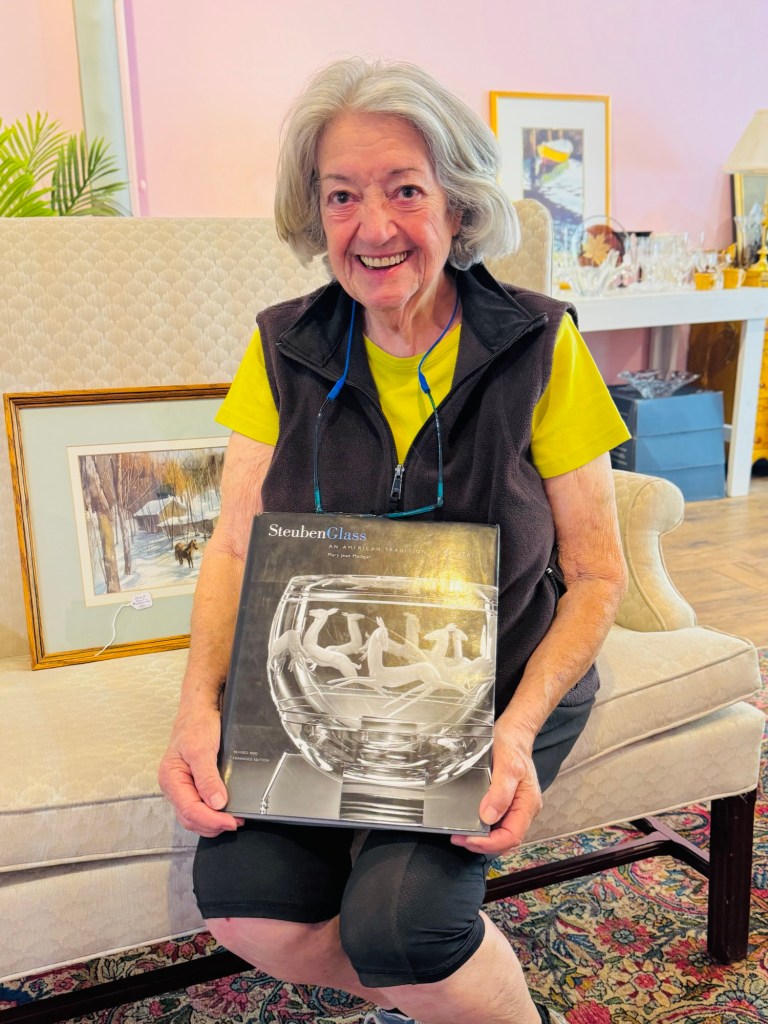
Kitty is holding the book Steuben Glass: An American Tradition in Crystal by Mary Jean Madigan.
This appears to be the revised and expanded edition, as indicated in the lower left corner of the cover
*
For Kitty O’Bryan-Erlacher, whose friendly grace, profound clarity, and genial wit made a brief moment feel like a lasting gift.
Ricardo Morin — Corning, New York, August 2025
In transit to our cousin Shayna’s wedding to Johnny, we passed through Corning, New York, and spent a few unhurried hours browsing the shops along West Market Street. The sky had the muted softness of a Monday unbothered by haste. On a quiet corner, we came upon the Erlacher Steuben Glass Shop—a space luminous with its own kind of luster.
Inside, we found what would become the wedding gift: a round crystal plate titled Vesta Plate (1993) by Peter Drobny (born 1958). It was displayed simply but with taste, as museum art waiting patiently to be understood. Alongside it stood two glass vases—bold and elegant: one translucent ultramarine, the other an opaque, intense lavender. We decided they too should come with us.
The shop, we learned, was founded in 1960. Its steward now is Catarina (“Kitty”) O’Brian-Erlacher, born in 1938—a woman of 87, with a deep well of charm, intellect, and quiet fortitude. Her husband, Mr. Roland (Max) Erlacher (1933, Vienna – July 2022), had arrived from Vienna in 1957 to work for Steuben Glass (founded in 1903 by Frederick Carder). There, in Corning, he met Kitty. Their story became the store’s story—one of craft, beauty, and the steady guardianship of glass as both object and art.
When I first approached Kitty, I mistook her for a fellow client. We began talking easily, without expectation. Art turned into astrology; numerology followed. I was caught in the kind of exchange that slows time—until my husband, David, interrupted, suggesting I was perhaps being too talkative. I teased, calling him “the boss.” Kitty, smiling, said, “You’re very smart.” I replied, “We should aim to be smarter,” and turned the compliment back to her. She graciously demurred.
As it happened, the cost of our three selections (including one from the Vitrix Hot Glass Studio and another from the Corning Museum of Glass) would, in Kitty’s words, “cover the shop’s needs for the entire month of August.” That small admission made our brief encounter feel suddenly momentous. The wrapping of the pieces—particularly the Vesta Plate—proved difficult. The oversized plate resisted all the available box sizes. Instinctively, I offered help and reassembled one of her boxes to fit the plate precisely. Kitty, watching with both amusement and admiration, called it brilliant.
She then brought out a reference book on her husband’s work. The exuberance of his designs, rooted in the lineage of Art Nouveau, seemed to fill the room with light. But when she spoke of him, words failed. Her eyes grew teary, and all she could manage was, “He was the kindest man.” I paused, gave her a long, knowing glance, and offered only silence in return—more interested in cheering her up than inviting grief.
When David and I finally parted from her, I lingered a moment amid the quiet exchange of goodbyes. Then, slowing my pace as we crossed the threshold, I turned and said softly, “God bless you, dear.”
*
 Observations On Perception