*
Introduction
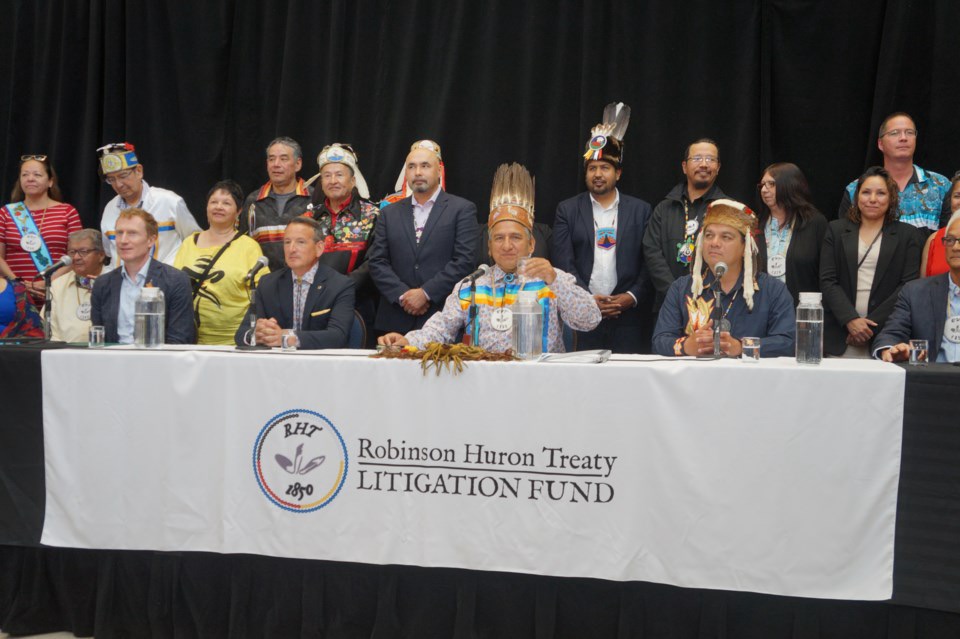
The 2023 Robinson Huron Treaty settlement announcement—captured in a widely circulated image of leaders and Elders assembled in solidarity—marks a moment of continuity in Indigenous governance once silenced by colonial displacement. I write not as a member of these communities, nor as a Canadian citizen, but as an observer who engages with testimony and documented evidence. Beneath the natural serenity of Parry Sound lies a wound deepened by continued neglect, one that requires not only recognition but structural change.
The Truth and Reconciliation Commission’s 94 Calls to Action, issued in 2015, outlined a comprehensive plan across justice, health, and education. Nearly a decade later, the Yellowhead Institute reports that only 13 of the 94 have been completed—and none in 2023. This inaction reveals the gap between commitment and execution, showing how reconciliation remains more rhetorical than structural.
It is telling that the tensions between First Nation tribes and Canadian institutions reveal how a country that celebrates cultural diversity can remain in conflict with its Indigenous peoples.
By Ricardo Morin, August 6, 2025; Isabella Island, Parry Sound, Ontario, Canada.
*
The boat across Parry Sound glides over still water, southward to Isabella Island. The surrounding beauty—dense pines, scattered rock formations, and open sky—stands in sharp contrast to what my cousin Marc reveals once we disembark: that beneath this serene northern Ontario landscape lies a persistent story of abuse, erasure, and systemic abandonment. Marc, a seasoned youth justice specialist in Ontario’s legal system, has spent over thirty years advising police departments and courts on indictments involving minors. His experience covers nearly every youth murder case in the province, but his most wrenching insights, he says, do not come from what the law sees—but from what it omits.
This omission is not accidental. The First Nations peoples of this region—the Anishinaabeg, including the Ojibway, Odawa, and Potawatomi—have lived for generations under policies that turned colonial violence into institutional neglect. Residential schools, operated primarily by churches and endorsed by the Canadian government, aimed to assimilate Indigenous children by forcibly removing them from their families and culture. Physical and sexual abuse, malnutrition, and psychological trauma were widespread. The Truth and Reconciliation Commission of Canada, which published its final report in 2015, called this system “cultural genocide.” Yet despite official acknowledgment, its legacy remains embedded in law enforcement, education, housing, and incarceration.
As Marc recounts, the present-day effects are not merely residual—they are cumulative. Indigenous communities in the Parry Sound district, he explains, are often subjected to outright racist harassment. He described instances where Indigenous people have been kidnapped by white residents, driven miles from their communities, and abandoned in the freezing wilderness—half-dressed, humiliated, and physically endangered; some have died. These are not rare stories. They are carried in silence, in mistrust, in patterns of disappearance and criminalization. “Depression and petty crimes,” Marc continues, “lead Indigenous youth to prison. But it is Indigenous women who suffer most.”
Today, nearly 70 percent of Ontario’s incarcerated female population is Indigenous—a figure that defies proportionality and demands scrutiny. The equivalent male figure is 20 percent, itself shockingly high. What accounts for the extreme overrepresentation of Indigenous women? Neutral data suggest a convergence of risk factors: intergenerational trauma, poverty, lack of access to healthcare, disrupted education, and systemic police bias. Indigenous women are also the most frequent targets of domestic and sexual violence, often left unprotected by a justice system that fails to recognize their vulnerability until it criminalizes their survival. They are far more likely to be imprisoned for crimes rooted in trauma—substance-related offenses, minor thefts, or breaches of conditional release. In these cases, incarceration substitutes for care; silence substitutes for accountability.
Legal frameworks fail to acknowledge this chain of causation. Where the justice system claims impartiality, it often operates as a mechanism of historical amnesia. Political neutrality becomes moral indifference. The courtroom speaks in terms of individual guilt, severed from social context. What justice omits is precisely what history insists upon: that a wound, left untreated, does not heal—it deepens.
Resistance has not been absent. Local First Nations have organized to reclaim land rights, restore language, and establish health services rooted in traditional knowledge. Movements as Idle No More and the work of leaders such as Cindy Blackstock and Tanya Talaga have elevated the national conscience. Yet the machinery of redress moves slowly. Reports are written, apologies are issued, commissions are concluded. Meanwhile, communities remain under-resourced, youth remain vulnerable, and women continue to disappear—sometimes into institutions, sometimes into obscurity.
This essay does not indict any single actor. It seeks to illuminate what institutions routinely fail to see: that harm is not only historical but structured; that healing is not only personal but political; and that justice, without history, risks becoming an empty performance.
The waters of Parry Sound appear peaceful, yet they conceal the contradiction of a nation that pledges reconciliation while leaving it incomplete. Between 2015 and 2023, only 13 of the Truth and Reconciliation Commission’s 94 Calls to Action were implemented—none in the last year. Such inaction does not erase testimony; it amplifies the wound. I cannot claim to speak for First Nations, but I can bear witness to the record, to the words of those who live these realities, and to the silence that persists when promises remain unmet. Healing requires more than acknowledgment; it requires accountability and the structural change that Indigenous voices have long demanded. The role of an outsider, if it has any legitimacy, is not to dictate, but to listen, to learn, and to make visible what is already being said.
Appendix: Sources and Monitoring Data
- Truth and Reconciliation Commission of Canada, Final Report: Volume 5: The Legacy. Montreal & Kingston: McGill‑Queen’s University Press, 2015. (This report includes 94 Calls to Action across justice, education, health, etc.)
- Yellowhead Institute, Calls to Action Accountability: 2023 Status Update. Toronto Metropolitan University, 2023. (Finds only 13 of 94 Calls to Action completed since 2015—and none in 2023.) https://www.cultureally.com/blog/how-to-support-truth-and-reconciliation?utm_source=chatgpt.com and https://themanitoban.com/2024/01/zero-calls-to-action-were-completed-in-2023-report-finds/46550/?utm_source=chatgpt.com
- AFN (Assembly of First Nations), TRC Report Card, 2024. (This report also underscores stagnant progress and advocacy for indigenous oversight and accountability.) https://afn.bynder.com/m/2fb4a0c35e36cfb2/original/TRC-Report-Card-2024.pdf?utm_source=chatgpt.com
*
Footnotes
[1]. Office of the Correctional Investigator, “Annual Report, 2020–2021.” Ottawa: Office of the Correctional Investigator, 2021. (This report documents that Indigenous women represent over 50% of federally incarcerated women in Canada. It contrasts this alarming rise with the still-high but less sharply increasing incarceration of Indigenous men.)
[2]. Truth and Reconciliation Commission of Canada, Final Report, Volume 5: The Legacy. Montreal and Kingston: McGill-Queen’s University Press, 2015. (This volume establishes a historical continuum between residential school trauma and present-day legal inequities. Drawing on survivor testimony, it details the systemic removal of children, cultural suppression, and intergenerational psychological effects.)
[3]. Statistics Canada, “Women in Canada: A Gender-based Statistical Report.” Ottawa: Government of Canada, 2020. (This statistical overview highlights gender-specific incarceration trends and emphasizes the overrepresentation of Indigenous women in custody, often for administrative or non-violent infractions.)
[4]. Public Safety Canada, “Risk Assessment and Indigenous Offenders.” Ottawa: Government of Canada, 2016. (This government report analyzes how standard risk assessment tools disproportionately assign higher security levels to Indigenous offenders—especially women—owing to trauma-linked factors that are misread as criminogenic.)
[5]. Parliamentary Budget Officer, “Costing Restorative Justice Programs.” Ottawa: Office of the Parliamentary Budget Officer, 2020. (This study notes the disparity in funding and access to restorative justice programs, which shows how Indigenous women receive fewer diversionary options than men or youth and reflects systemic neglect.)
[6]. Department of Justice Canada, “Indigenous Overrepresentation in the Criminal Justice System.” Ottawa: Government of Canada, 2018. (This policy brief provides statistical data on pretrial detention, bail denial, and sentencing outcomes; it underscores administrative causes of Indigenous overrepresentation in prison, particularly among women.)
[7]. Tanya Talaga: Seven Fallen Feathers: Racism, Death, and Hard Truths in a Northern City. Toronto: House of Anansi Press, 2017. (Through the investigation of seven Indigenous youth deaths in Thunder Bay, this book exposes a pattern of institutional failure and systemic racism within policing, education, and the Canadian justice system.)
[8]. Idle No More, “About the Movement.” Saskatoon: Idle No More, 2012–present. https://idlenomore.ca/about-the-movement/. (This official web page traces the origins, aims, and activities of the Idle No More movement, which arose in defense of Indigenous sovereignty and the environment. It emphasizes the vital leadership role of Indigenous women in mobilization and education.)
 Observations On Perception