*
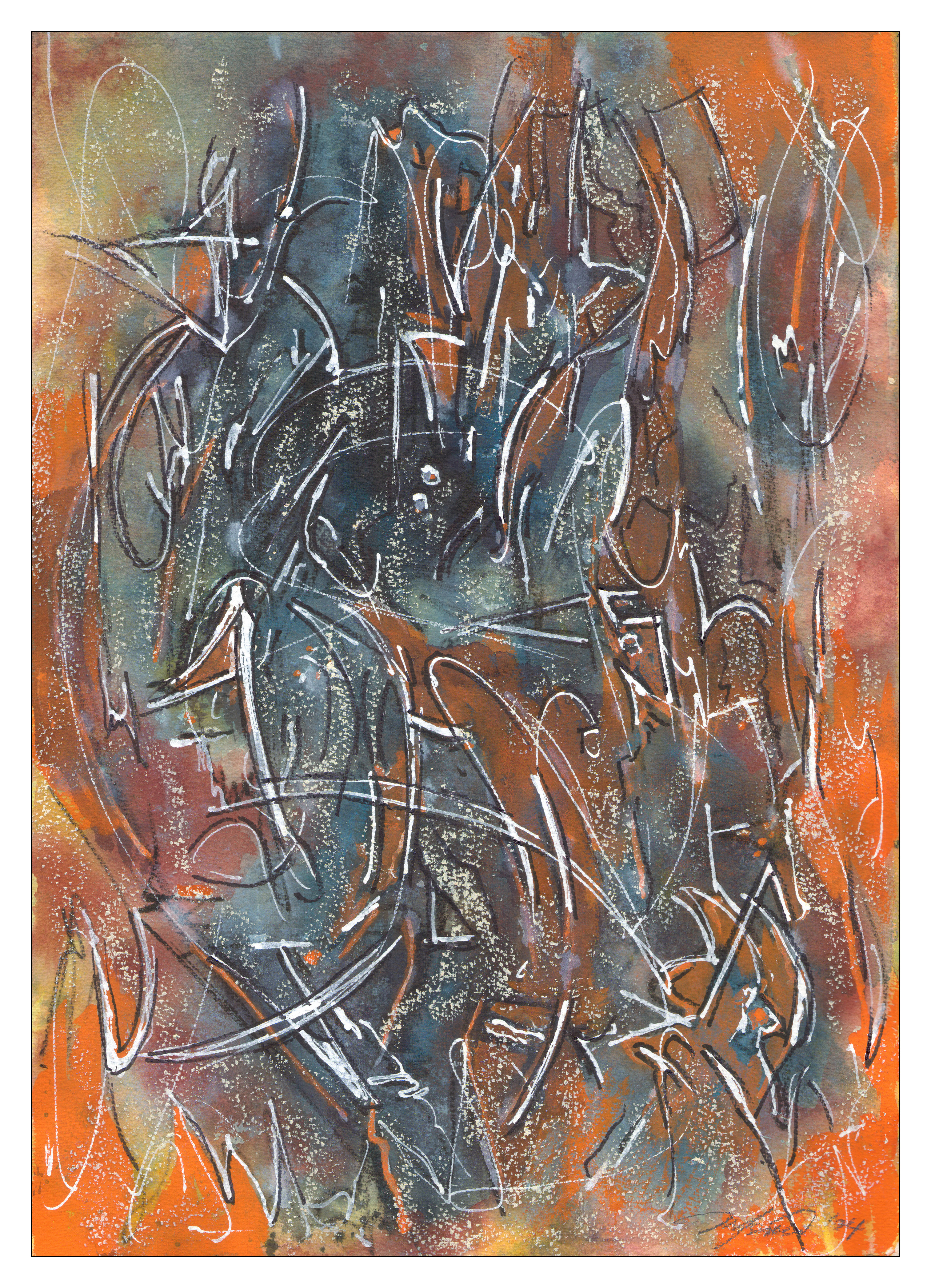
Eschatology
Watercolor, gouache, oil sticks, white correction fluid, and black ink on paper
14″ x 20″
2004
Ricardo F. Morín
January 11, 2026
Oakland Park, Fl
*
Civilizations periodically describe their present as uniquely perilous. Such claims are rarely grounded in historical comparison or institutional analysis. They arise instead from a failure of scale: the inability to distinguish disruption from collapse, uncertainty from termination, and incoherence from apocalypse.
Moments of genuine civilizational danger are not hypothetical. The Black Death removed a third of Europe’s population. The Thirty Years’ War devastated entire regions. The twentieth century combined industrialized warfare, genocide, and the advent of nuclear annihilation. These events did not require prophetic language to be understood as catastrophic. Their magnitude was measurable. Their effects were material. Their causes were traceable.
Apocalyptic rhetoric appears not when danger is greatest, but when comprehension falters. It converts uncertainty into moral drama. When political processes appear opaque, when outcomes resist prediction, and when authority behaves without an intelligible pattern, explanation withdraws. In its place enters eschatology: a narrative that simplifies complexity, assigns absolute blame, and promises closure.
The figure of the Antichrist belongs to this register. It is not an analytical category. It is a symbolic condensation of fear. By locating total danger in a single person, eschatological thinking relieves societies of the obligation to examine institutions, incentives, and limits. It replaces causal inquiry with revelation.
Such framing also distorts responsibility. Civilizations do not disintegrate because of individuals alone. They deteriorate through cumulative failures of governance, adaptation, and legitimacy. These processes unfold unevenly, often reversibly, and without finality. They do not announce themselves with signs. They do not culminate on schedule.
Eschatology thrives where explanation retreats. It offers emotional certainty where analysis requires patience. It persuades by promising an end to ambiguity, not by clarifying causes. By transforming political disorder into cosmic struggle, it diverts attention away from conditions that can be examined and toward myths that cannot be corrected.
The danger of apocalyptic thinking is not that it exaggerates risk, but that it misdirects attention. It trains citizens to search for omens rather than causes, villains rather than conditions, destiny rather than decisions. In doing so, it deepens the very helplessness it claims to describe.
What the present requires is not prophecy, but proportion. Not moral theater, but discernment. Not the language of revelation, but the discipline of understanding how power operates, where it fails, and how it can be constrained.
Where explanation returns, superstition recedes. Where clarity is restored, apocalypse loses its hold.
 Observations On Perception