Posts Tagged ‘political philosophy’

“Unmasking Disappointment: Series III, Part I”

February 4, 2026

Allegory, Virtue, and the Measure of Governance


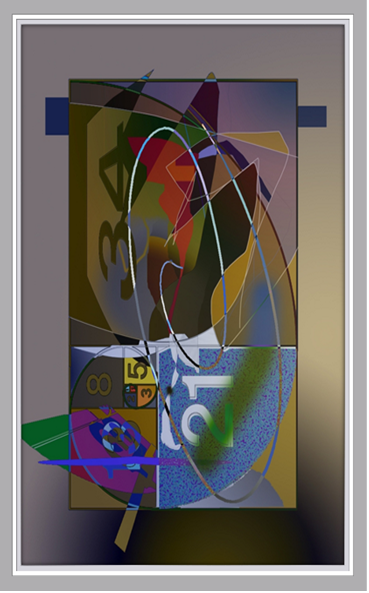
“Geometric Allegory” digital painting 2023 by Ricardo Morin (American visual artist born in Venezuela–1954)

This installment marks a transition in the Unmasking Disappointment series.   The chapters that follow move from symbolic orientation to institutional diagnosis—from the ethical measures by which governance may be assessed to the historical mechanisms through which those measures were steadily displaced.

The opening chapters do not propose an ideal government as a program, nor do they advance allegory as metaphysical instruction.   They establish, instead, a standard of measure.    Without some articulation of justice, restraint, and judgment as relational constraints, disappointment risks collapsing into mere grievance or retrospective outrage.    Allegory appears here not as escape from political reality, but as a means of identifying when political language has been emptied of substance.

The chapters that follow trace how resentment, military authority, and party asymmetry gradually supplanted those constraints in Venezuela.    What emerges is not a singular rupture but an accumulation:    ideals invoked without limit, institutions mobilized without restraint, and power exercised without symmetry.   Disappointment, in this sense, is not an emotional response but a structural outcome—one produced when virtue survives only as symbol, no longer as practice.

The Allegorical Mode

Resistance to authority often makes use of symbolism that requires interpretation and thereby detaches meaning from responsibility.   In the spirit of Plato, I propose that the true philosopher is an inverted allegorist.   Rather than merely deciphering symbols, the philosopher distinguishes between what signifies and what governs.  

Symbols and allegories are not mere reflections of the material world but serve as gateways to something beyond it.   Allegory functions as recognition only where symbols have ceased to orient conduct—an orientation toward that with which the philosopher strives to align.


The Ideal Government and the Power of Virtue

~
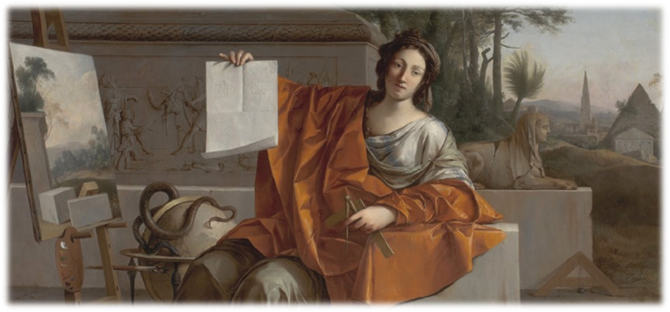
Allégorie de la Géométrie by French Baroque artist Laurent de La Hyre [1606-56], oil painting circa 1649 (40 7/8 x 86 1/8 in.) – Fine Arts Museums of San Francisco. Museum purchase, Roscoe and Margaret Oakes Income Fund.

~

Allégorie de la Géométrie, by Laurent de La Hyre (1649), evokes a conception of ideal government understood as a geometry of virtues, in which balance depends on proportion rather than invocation.   Justice, temperance, and wisdom form a triad whose significance lies not in their enumeration but in the relations they establish.    As in geometry, stability is maintained only so long as those proportions hold.

Just as the philosopher moves beyond symbols toward discernment, so too must governance be assessed by standards not governed by the whims of power.   In the spirit of Plato’s Forms, an ideal government reflects justice, temperance, and wisdom—principles that do not fluctuate with circumstance.    Such a government stands in contrast to politics organized around power alone.

The concept of virtue in governance transcends moral abstraction; it operates as a relational condition between rulers and the governed.    Virtue does not belong exclusively to either, but emerges in the form that relation takes and the limits it sustains.    Where virtue operates, governance is not organized around the accumulation of power but around constraints that regulate its exercise—justice to restrict arbitrariness, temperance to contain excess, and wisdom to discipline decision.

Government understood as a form structured by virtue exposes abuses of power not as exceptional deviations but as structural failures.    When symbols such as equity or plurality are detached from their regulating functions, they become available for use as instruments of control.    Where virtue retains an operative role, such symbols cease to obscure power and resume their function as limits on its exercise.

Chavismo, as it emerged under Hugo Chávez and continued under Nicolás Maduro, stands in direct contrast to these conditions.    Although the regime relied extensively on the language of justice and equity, those references ceased to function as constraints on power.   Symbols associated with virtue were detached from their regulating roles and redeployed as mechanisms of legitimization.    Governance thus persisted in the vocabulary of virtue while operating without its limiting functions.

Virtuous governance assumes the form of a balanced structure: one not governed by the current of power but constrained by justice.    Such a system does not privilege the will of the ruler over the common good, nor does it rely on appeals that fluctuate with circumstance.    Where these constraints hold, order becomes possible—not as aspiration, but as condition.


“The Constitution Within”

August 10, 2025

*

Ricardo Morin
The Constitution Within
GCI
2025

*

Politics (from the Greek politikós, “of, by, or relating to citizens”) is the practice and theory of influencing people at the civic or individual level.

*

By Ricardo Morin

August 10, 2025.

~

From their earliest formulations, constitutional frameworks have been more than foundational legal agreements; they have stood as declarations of political philosophy, and defined how power should be organized, how it should be restrained, and to whom it must be answerable. Contemporary governance, to a large extent, continues those experiments, shaped over centuries of trial and adaptation. Yet these forms can endure in appearance while being emptied of substance. In more than a few States today, constitutions proclaim liberty while they narrow its scope, define rights in ways that exclude, and preserve the interests of a governing elite. Partisanship exploits the perceived limitations and vulnerabilities of others as grounds for exclusion; self-righteousness becomes a tool for domination, silences opposition, and suppresses dissent. The worth of a constitutional framework, therefore, is measured not only by its letter but by the ethical integrity of those who sustain it. Without ethics, politics loses its meaning; without civic virtue, the law ceases to serve peace and becomes an instrument of dominion.

The separation of powers, vigorously defended by Montesquieu, rests on the conviction that liberty survives when power is compelled to check power. This principle is distorted when institutions are subordinated to partisan or personal interests. In recent years, several States have formally preserved an independent judiciary while, in practice, subjected it to appointment processes controlled by the Executive or the ruling party. Such hollowing-out is not merely a technical failure; it reflects a political culture in which ambition, fear, or indifference among citizens permits the disfigurement of the very mechanisms designed to protect them. It also reveals how institutional strength and civic responsibility are bound together in ways that cannot be separated.

Historical constitutions continue to shape how political communities imagine authority. They bequeath principles that, at their best, offer adaptable frameworks for meeting new challenges without renouncing their essential core: that the legitimacy of a Government rests not on the strength of its rulers but on the solidity of the structures that limit them.

Yet these structures endure only when citizens reject duplicity and sectarianism. Divisions of ideology must not harden into exclusive loyalty to one’s own group at the expense of a shared civic framework. They endure only when citizens resist the idolatry of power, because authority loses its legitimacy once it is treated as sacred or unquestionable. And they endure only when citizens repudiate the cult of personality, in which a leader is raised above criticism through image-making, propaganda, and personal loyalty.

The durability of constitutional order, then, does not lie solely in written texts or institutional arrangements. It rests equally on the civic ethic of those who inhabit them. When ambition, fear, or indifference allow citizens to tolerate duplicity or surrender to sectarian loyalty, the limits on power become fragile. Conversely, when vigilance and responsibility prevail, constitutions retain their strength as both shield and compass—guarding against arbitrary rule while orienting political life toward justice and restraint.

True reform is not solely institutional but also internal: a revolution in the individual and collective sphere, in which each person accepts the responsibility to act with integrity, openness, and commitment to the common good, in harmony with oneself and with others. Only through the alignment of institutional structures with civic responsibility can any Constitution preserve its meaning and endure as a safeguard against arbitrary power.

*


Annotated Bibliography

~

  • Ginsburg, Tom, and Aziz Z. Huq.; How to Save a Constitutional Democracy. Chicago: University of Chicago Press, 2019. (Ginsburg and Aziz examine the legal and institutional pathways through which democracies weaken, from court-packing to the erosion of independent oversight. They draw on comparative examples from the United States, Hungary, and elsewhere to show how constitutional mechanisms can be used to consolidate power while preserving a façade of legality.)
  • Landau, David: “Abusive Constitutionalism.” UC Davis Law Review 47 (1), 2013: 189–260. (Landau develops the concept of “abusive constitutionalism” to describe how incumbents exploit constitutional change to entrench their rule. Uses Latin American and other global cases to illustrate how amendments and reinterpretations weaken checks and balances, alter electoral systems, and undermine judicial independence.)
  • Levitsky, Steven, and Way, Lucan A.: Competitive Authoritarianism: Hybrid Regimes after the Cold War. Cambridge: Cambridge University Press, 2010. (Levitsky and Way analyze regimes that preserve the formal institutions of democracy but manipulate them to ensure ruling-party dominance. They introduce the concept of “competitive authoritarianism” as a framework for understanding how constitutional norms are hollowed out while democratic forms are maintained.)
  • Levitsky, Steven, and Ziblatt, Daniel: How Democracies Die. New York: Crown, 2018. (Levitsky and Ziblatt argue that modern democracies often decline through the gradual decline of norms rather than coups. The book shows how leaders exploit constitutional ambiguities, stack courts, and weaponize law to suppress opposition, eroding both civic trust and institutional integrity.)

~