*
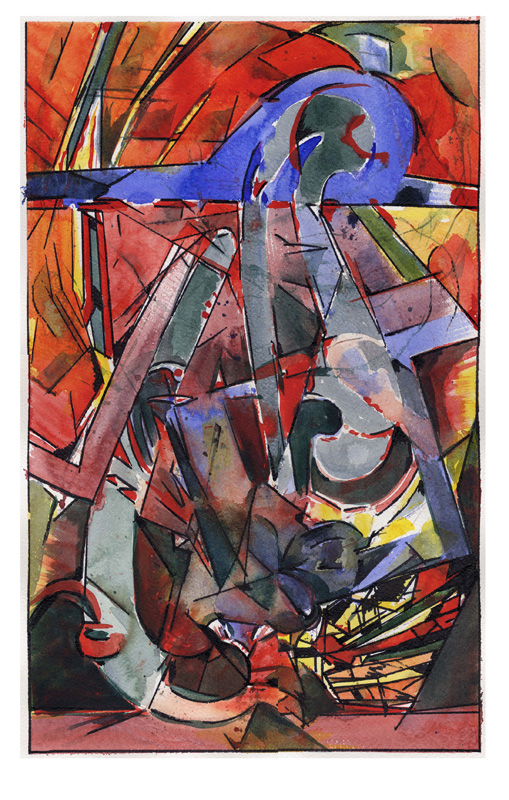
Ricardo Morín, Watercolor, and ink on paper
14” x 20″
2003
*
Prologue
The Quiet Turning
In the fading light of a world obsessed with spectacle, she endures—not as a relic of past sacrifices, but as a living, evolving force. The desire for attention has always been a double-edged sword in her life: both a demand imposed by a society fixated on appearances and a tool she has learned to wield with fierce determination. Every public gaze, every moment magnified by the glare of expectation, has shaped her journey and molded not only her destiny but also that of the visionary she helped nurture.
She does not merely recall the weight of expectation; she transforms it. Her life is not a static ledger of sacrifices but a dynamic chronicle of adaptation—of a woman whose responses shift with time, whose convictions evolve with every challenge, and whose internal conflicts are as fluid as the changing tides of public adulation. There were moments when the burden of spectacle pressed heavily upon her, yet she never allowed it to define her entirety. Instead, she learned to let the circumstances speak and allowed the ever-changing world to refine her purpose.
In a culture where every gesture is scrutinized and every act measured by its ability to capture the spotlight, she chose to forge an authenticity that defies constant performance. Amid the relentless pursuit of recognition, she discovered that resilience is not about enduring static hardships but about embracing change—to be both the guiding light when needed and the adaptable spirit who reinvents herself as life demands.
Her legacy is woven into the very fabric of the visionary’s rise, yet it is not confined to the ephemeral glow of public applause. It lives in the decisions yet to be made, in the quiet defiance against a world intent on reducing complex lives to mere performances. As the storm of public attention recedes, one truth remains: while the spectacle may return with renewed fervor, so too will her unyielding, ever-shifting light—ever responsive to the world, ever true to her evolving self.
~
*
Chapter 1
The Origins of Strength
She was not born into privilege, nor was she shaped by an easy path. Strength, in her world, was not inherited—it was constructed, piece by piece, through necessity, through the quiet urgency of survival. The home she knew was one of expectations, where resilience was not a virtue but a requirement.
Her parents, figures of discipline and quiet ambition, did not speak of success in terms of indulgence or grandeur. They spoke of perseverance, of self-sufficiency, of the kind of fortitude that does not wait for the world’s permission. The values they instilled in her were not gentle reassurances but firm, unwavering truths: that beauty alone is fleeting, that intellect is a tool to be sharpened, that hard work is the currency of progress.
The first adversities she faced were not singular, dramatic upheavals, but the steady, relentless challenges of making oneself indispensable in a world that often overlooks those who do not demand attention. She learned early that admiration is conditional, that approval must be earned again and again, and that the only certainty lay in one’s ability to adapt.
Beyond the walls of her upbringing, the world around her was shifting. The socio-economic landscape offered few guarantees, especially for a woman determined to carve her own space. Success was not simply a matter of talent or intelligence—it was a performance, a negotiation, a test of endurance. The weight of expectation pressed upon her from all sides: to conform, to excel, to be both formidable and gracious, independent yet admired.
Yet, she did not recoil from these pressures; she absorbed them, studied them, and found within them a rhythm she could move to. While others saw obstacles, she saw opportunities to refine her instincts, to wield resilience not as a defense, but as a weapon. Every closed door was a lesson in persistence. Every rejection, a refinement of her strategy.
She did not yet know what shape her life would take, nor could she have predicted the enormity of the path ahead. But one truth had already taken root: survival was not enough. If she was to endure, she would do so on her own terms.
~
*
Chapter 2
A Woman in a Man’s World
She learned quickly that talent alone was not enough. In a world where men dictated the terms of power, a woman had to be twice as prepared, twice as composed, twice as relentless. Her ambitions did not align neatly with the roles assigned to her—not the ones whispered by tradition, nor those imposed by an industry that measured a woman’s worth by the fleeting currency of youth and allure.
Her career was not handed to her; it was negotiated, fought for in spaces where her presence was tolerated but not welcomed. She had to navigate the subtle dismissals, the unspoken ceilings, the expectation that she should be grateful for whatever space she was allowed to occupy. To be assertive was to risk being labeled difficult. To be strategic was to be called calculating. And yet, to be anything less was to disappear.
But she would not disappear.
The spectacle was always present, shaping her choices as much as her ambitions. Visibility was power, and she understood that better than most. She learned to wield attention, to control the narrative before it controlled her. If she was to succeed in a man’s world, she had to become more than just competent—she had to be seen.
Yet, the gaze was fickle. It admired strength but punished defiance. It celebrated beauty but scorned aging. It permitted ambition, but only if it did not overshadow the ambitions of men. She walked this tightrope daily: she adjusted, adapted, and never allowed herself the luxury of complacency.
Independence was her quiet rebellion. Every choice she made—where she worked, whom she trusted, how she carried herself in a room—was a declaration. The tension between expectation and desire was relentless. The world wanted her to conform, to soften, to submit. But she had already seen what submission offered: silence, erasure, irrelevance.
So she carved her own space, one decision at a time. She played the part when necessary, and knew when to perform, when to retreat, when to push forward. But beneath the careful facade was a woman who refused to be reduced to an image.
She had become part of the spectacle, but she was also its master.
~
*
Chapter 3
The Birth of a Titan
She did not set out to shape a legend. She set out to prepare a child for a world that did not bend easily, a world that would test him, discard him if he faltered. She had seen enough to know that brilliance alone was not enough—resilience was the true currency of survival. And so, she became both the architect and the adversary, the foundation upon which he would build and the force that would push him to withstand the weight of expectation.
Her guidance was a paradox: fiercely protective, yet unsparing. She did not indulge fragility, though she understood its presence. There were no idle comforts, no assurances that the world would be kind. Instead, she instilled an unshakable creed—one did not wait for permission to take up space; one carved it, owned it, refused to apologize for it.
But strength, once given, takes on a life of its own. She watched as he absorbed her lessons, sometimes with gratitude, sometimes with defiance. He was not a child who followed; he was one who questioned, who tested the limits of every rule, including hers. He did not always see the wisdom in her distance, the purpose behind her expectations. To him, love should have been softer, less conditional.
She knew better.
The spectacle had already begun to shape him, as it had shaped her. Attention became both validation and weapon, which sharpened his confidence and his restlessness. He saw the world not as something to navigate, but as something to master. And yet, she wondered—had she given him too much certainty? Had she fortified him so well that he no longer knew how to doubt, to hesitate, to seek counsel outside himself?
There were moments when she questioned. In the rare silences between them, in the brief flickers of vulnerability he quickly buried, she wondered if she had built not just a titan, but a fortress—one that would one day struggle to let anything in.
She told herself it was necessary. That the world had no use for the unprepared. That he would thank her in time.
And yet, as she watched him step further into the glare of the spectacle, as the weight of his own myth grew heavier, she could not shake the quiet thought that gnawed at the edges of her certainty:
Had she given him everything except the ability to stop?
~
*
Chapter 4
Sacrifice and Distance
She had always known he would leave. It was, after all, what she had prepared him for—to move forward with unrelenting momentum, to step beyond the boundaries of what was known, to belong not to a single place or person, but to the vision that consumed him. And yet, knowing did not make it easier.
At first, the distance was practical, a byproduct of ambition. His world expanded at a pace hers could not match, each success widened the space between them. Conversations became brief, punctuated by time zones and obligations, his voice measured, always moving toward the next thing. He spoke in ideas, in projects, in revolutions yet to come. Rarely did he speak of himself.
But distance is rarely just physical. She saw it in the way he carried himself, in the careful detachment of his gaze when the cameras were on him. The spectacle had fully claimed him now—not just as an audience but as an identity. Attention was no longer something he sought; it was something he commanded, something he wielded. He had become larger than life, and in doing so, he had begun to shrink the parts of himself that did not serve the myth.
She recognized the toll, though he would never name it. The weight of scrutiny, the exhaustion of living up to a persona that left no room for hesitation, for frailty, for uncertainty. He was brilliant, polarizing, untouchable—an architect of impossible things. But he was also her son. And that was the one role he no longer had time to play.
She had always understood sacrifice. She had made her own, time and time again, choices that had cost her comfort, companionship, a quieter kind of life. But she had not anticipated this: the realization that her greatest success—his unshakable independence—had also made her dispensable.
She would not chase him. She had taught him to walk alone, and she would not contradict that lesson now. Instead, she watched from afar, her pride and her sorrow intertwined, knowing that he was too far gone to look back, but she still hoped—one day—he might.
~
*
Chapter 5
Shadows and Echoes
She was no longer a presence in his world, but her shadow remained. It stretched across his decisions, his mannerisms, the unspoken rules he followed even as he pretended they were his own. She saw it in the way he carried himself in a room—how he mastered attention, held silence just long enough for discomfort to become intrigue. He had learned that from her.
Yet, influence is a slippery thing. Once released into the world, it takes on a life of its own; it bends and reshapes itself in ways the originator never intended. She wondered, at times, if he had misunderstood her lessons or if she had failed to articulate them well enough. Had she armed him with resilience or simply taught him to endure at any cost? Had she instilled vision or merely a hunger for dominance?
She had always believed in independence, in the power of carving one’s own path. But watching him now—uncompromising, relentless, willing to set fire to bridges before anyone could cross them—she questioned whether she had emphasized too much the need to stand apart, and not enough the importance of standing with.
And yet, despite his defiance, he could not fully sever what bound them. She glimpsed traces of her voice in his words, echoes of her own battles in the way he faced down adversaries. He may have long since left her behind, but he carried fragments of her wherever he went.
Still, influence is not ownership. She had shaped him, but she did not control him. The choices he made were his own, and she had no claim over them—neither the triumphs nor the failures. She could only watch, aware that what she had given him was both foundation and burden, a blueprint he had long since altered to fit a design only he could see.
And so, she did what all who shape the future must eventually do: she let go and knew that her presence in his life was no longer defined by proximity, but by the weight of what had already been left behind.
~
*
Epilogue
The Silent Architect
She was never the one at center stage. That was never her role, never her desire. And yet, in the hushed spaces between history’s grand pronouncements, she remained—unseen but undeniable, a force imprinted on the architecture of a life that reshaped the world.
There is a certain power in being forgotten. The world rarely remembers the hands that steady the foundation, only the ones that raise the monument. But she had never needed recognition to know her presence endured. She saw it in the echoes of her words, in the contours of a mind sharpened by her lessons, in the restless ambition that had been, at least in part, her doing.
Yet power, she had learned, is not a gift—it is an affliction, a hunger that grows even as it devours. She had taught him to reach, to question, to never yield to the weight of convention. But had she, in doing so, unleashed something beyond even her understanding? He had become an architect of the future, but was he building a world of brilliance or ruin? Had she given him wings, or simply made him blind to the ground beneath him?
The burden of vision is that it rarely allows for stillness. She had spent her life in motion, forged her own path, and demanded her own place. But now, standing at the edges of a world that no longer looked back at her, she allowed herself a moment of pause. Not to claim victory, nor to lament what could not be undone, but simply to acknowledge what was.
Love and legacy are rarely pure. They are made of sacrifice and silence, of pride and regret, of truths that remain unspoken. She had played her part, and though the stage belonged to another, she knew the script still bore traces of her hand.
And so she stepped back, into the quiet. Not erased, not forgotten—simply unseen. The architect, no longer needed, but always present in the walls of what had been built.
~
*
Author’s Note
This is a work of fiction. While inspired by the complexities of ambition, legacy, and the forces that shape extraordinary lives, the characters and events depicted are products of imagination. Any resemblance to actual persons, alive or deceased, is purely coincidental. This story is not an account of any individual but rather an exploration of the universal tensions between sacrifice, power, and the silent architects behind great destinies.
Ricardo F. Morín Tortolero, February 11, 2025
Oakland Park, Florida
Editor, Billy Bussell Thompson
New York City, February, 14, 2025
 Observations On Perception