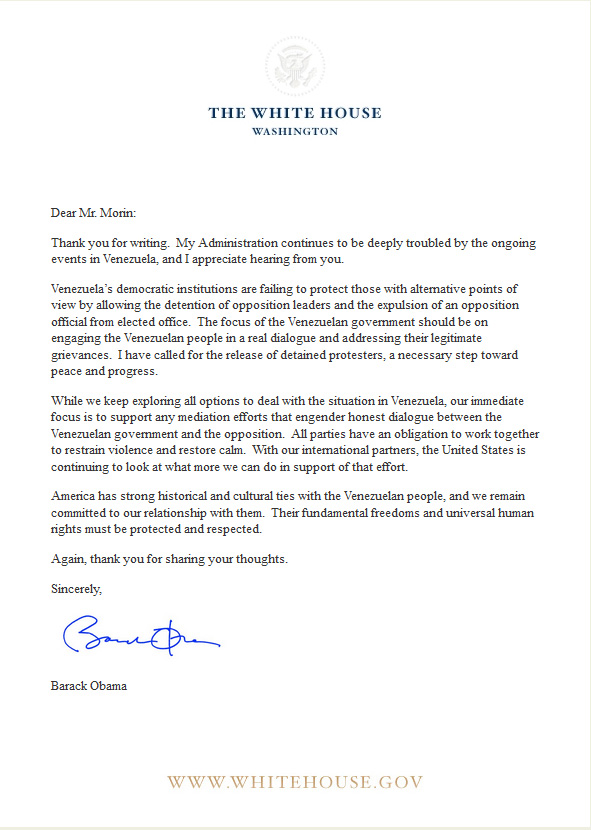
For decades I wrote to different Presidents of the United States as an American-Venezuelan citizen concerned with the progressive institutional deterioration of Venezuela. Most of those letters never received a response. In 2014, amid protests, detentions, and political fractures that were beginning to transform the country irreversibly, a reply arrived from the White House signed by Barack Obama.
Read today, the letter is less significant for what it explicitly states than for the nature of its language itself. The text recognizes the deterioration of Venezuela’s democratic institutions, mentions the detention of opposition leaders, and calls for dialogue, mediation, and the containment of violence. Yet, as frequently occurs in diplomatic language, precision diminishes as proximity to the consequences such statements might require increases. Viewed retrospectively, that caution also revealed the difficulty of an American administration openly recognizing the degree to which Venezuela had ceased to be merely an internal crisis and was beginning to form part of a broader dispute over hemispheric influence.
The letter appeared to reflect a broader contradiction within American foreign policy: the difficulty of sustaining democratic language while economic dependencies, energy commitments, and geopolitical rivalries increasingly limited the willingness of the United States to confront directly the expansion of foreign influence across Latin America. What for years remained formulated through the language of mediation, dialogue, and regional stability would ultimately reveal a deeper tension between the declared principles of American foreign policy and the progressive strategic reconfiguration of the hemisphere.
Barack Obama’s letter:
Dear Mr. Morin:
Thank you for writing. My Administration continues to be deeply troubled by the ongoing events in Venezuela, and I appreciate hearing from you.
Venezuela’s democratic institutions are failing to protect those with alternative points of view by allowing the detention of opposition leaders and the expulsion of an opposition official from elected office. The focus of the Venezuelan government should be on engaging the Venezuelan people in a real dialogue and addressing their legitimate grievances. I have called for the release of detained protesters, a necessary step toward peace and progress.
While we continue exploring all options to address the situation in Venezuela, our immediate focus is to support any mediation efforts that generate an honest dialogue between the Venezuelan government and the opposition. All parties have an obligation to work together to restrain violence and restore calm. Together with our international partners, the United States continues to examine what more we can do to support that effort.
The United States has strong historical and cultural ties with the Venezuelan people, and we remain committed to our relationship with them. Their fundamental freedoms and universal human rights must be protected and respected.
Again, thank you for sharing your thoughts.
Sincerely,
(Illegible signature of)
Barack Obama
This White House letter was sent on May 7, 2014 through my personal email address.
My response on the same date:
Honorable President Barack Obama:
Thank you for your kind and generous response.
What remains implicit in your response is that the United States maintains economic and strategic commitments that limit any direct confrontation with the Venezuelan government. An intervention intended to remove a power regarded as illegitimate could alter agreements, contracts, and international balances whose stability forms part of an American economy already subjected to considerable strain.
A structural dependency on oil appeared to lie at the center of that dilemma and its unwanted consequences. Yet a country immersed in a growing process of institutional and economic disintegration could eventually cease to satisfy either international demands or the needs of its own population.
Ultimately, regional stability and the strategic security of the United States itself might depend not only upon calls for dialogue, but also upon a clearer recognition of the external forces and political dependencies contributing to Venezuela’s progressive deterioration.
Sincerely yours,
Ricardo F. Morín
Tags: American foreign policy, Barack Obama, diplomatic language, documentary prose, donald-trump, geopolitical tension, hemispheric influence, institutional decline, Latin America, Monroe Doctrine, oil dependency, political correspondence, Ricardo Morin, Silence, Venezuela, White House
 Observations On Perception
May 26, 2026 at 7:40 pm |
Well done Ricardo. Most people (myself included) would not make the effort to write to a politician yet alone the President. I’m certain you awestruck to have received a thoughtful response, indicating he not only read your letter, but gave serious response to it.
Bravo!
Joel Samitz