
Posts Tagged ‘Monroe Doctrine’

“The Dispossession of a Nation”

August 30, 2026

Still One
Medium: Oil On Linen
Size: 16 by 20 by 1 1/2inches
Year: 2010

Venezuela is not undergoing the democratic transition proclaimed by the government of the United States.  Venezuela is being dispossessed.  The electoral mandate asserted against Nicolás Maduro has been denied operative authority; the succession to Maduro is being negotiated under foreign supervision; petroleum production and sale are being reorganized according to foreign requirements; national revenue is being held within a system controlled outside the Nation; and rights over Venezuela’s natural patrimony are being prepared for private beneficiaries whose claims may endure beyond the lives of everyone now arranging them.  Each measure is presented separately as stabilization, reconstruction, investment, or energy security.  Taken together, the measures describe the despojo (dispossession) of a nation.

The removal of Maduro did not restore the constitutional agency previously taken from Venezuelans.  It changed the custodian of that deprivation.  The Venezuelan electorate had already been invoked as the source of the authority claimed by Edmundo González Urrutia and defended by María Corina Machado.  Yet the United States has proceeded as though recognition of that electoral claim also conferred upon Washington the power to determine when the claim may become effective, which Venezuelans may act upon it, and what political accommodation must precede its exercise.  An electorate recognized when recognition served the removal of Maduro ceased to be decisive when the same electorate obstructed the administration preferred after his removal.

The contradiction is not resolved by describing the preferred arrangement as temporary.  A foreign power that selects the Venezuelan officials with whom political and economic terms will be negotiated does more than influence a transition.  The foreign power occupies the constitutional interval in which Venezuelans would otherwise determine the identity, authority, and limits of their government.  The occupation need not assume the visible form of annexation.  The operative fact is the displacement of national decision by an external decision whose consequences are imposed upon the national territory, treasury, and future.

This displacement explains why the political and economic arrangements cannot be examined as separate questions.  Control over the political succession conditions who may consent to the petroleum arrangement.  Control over petroleum revenue materially conditions which political authority can govern.  Control over the recognition of that authority shapes whether resistance to the arrangement will be treated as constitutional opposition or as obstruction of a transition already defined elsewhere.  The same power therefore participates in selecting the Venezuelan interlocutor, defining the permissible political process, administering the principal source of national revenue, and allocating access to the resource from which that revenue proceeds.

The structure is already visible.  The United States has asserted control over the channels through which Venezuelan petroleum is sold and over the accounts into which the proceeds are received.  Executive Order 14373 describes the protection of those funds as serving American and Venezuelan interests.  The description does not answer the antecedent question: by what authority does the executive of one nation become the custodian of another nation’s principal revenue?  Protection against attachment may explain a mechanism.  It does not confer constitutional title upon the protector, and it does not convert foreign custody into Venezuelan consent.

The petroleum agreement announced on August 28 makes the problem more exact.  The reported arrangement encompasses 65 billion barrels in seventeen fields, contemplates a controlling American interest, and may extend for a century.  The private operator has not been identified publicly, and the complete agreement has not been made available for public examination.  A transaction of such magnitude is therefore being presented as an accomplished national benefit before the identity of the beneficiary, the terms of control, the disposition of revenue, the allocation of risk, and the constitutional authority of the Venezuelan signatories can be tested.  Publicity has preceded disclosure because the political conclusion is being demanded before the juridical facts are supplied.

The Constitution of Venezuela does not treat hydrocarbons as an ordinary asset available to whichever government possesses temporary command.  Article 12 declares hydrocarbon deposits to be public property, inalienable and imprescriptible.  Article 302 reserves petroleum activity to the State for reasons of national interest.  Articles 150 and 187 require legislative participation in contracts of national public interest concluded with foreign states or entities.  Until the complete agreement, the identity and authority of its signatories, and the required approvals are disclosed, no final legal judgment about every provision can be made.  The contest over the acting president’s title does not place Venezuela outside its Constitution or enlarge the authority of a provisional officeholder.  The contest makes demonstrable compliance with the Constitution more, not less, necessary before national patrimony is encumbered beyond the tenure of the authority purporting to act for it.  The information already announced nevertheless presents a direct constitutional question: whether an authority formed under foreign supervision may burden inalienable national patrimony for generations without the demonstrable authorization of the Venezuelan constitutional order.

That question cannot be answered by the magnitude of the promised investment.  Capital does not cure a defect in public authority.  Nor can a later contract erase the coercive conditions that made the contracting arrangement possible.  If force removes a government, foreign supervision determines its successor, foreign custody controls the resulting revenue, and selected private parties then receive durable economic rights, the contract is not an event independent of the force.  The contract is the instrument through which the result of force is given a transferable legal form.

The sequence is therefore more consequential than an unlawful intervention considered in isolation.  Military and executive power produce political submission.  Political submission produces contractual access.  Contractual access produces private entitlements.  Those entitlements may then be defended in courts, arbitration proceedings, financial markets, and diplomatic negotiations as acquired rights.  Coercion disappears from the final vocabulary.  Property, reliance, investment, and commercial stability take its place.  Force manufactures the entitlement, and law is subsequently invoked to protect the entitlement from the nation upon which the force was exercised.

The duration of the proposed arrangement makes this a temporal dispossession as well as a material one.  A century-long concession does not merely govern the extraction of petroleum today.  It removes choices from Venezuelans not yet born, binds governments not yet elected, and assigns the economic consequences of the present intervention to generations that could not have consented to it.  The mortality of Donald Trump is therefore beside the essential point.  The legal interests established during his administration can survive his influence because corporate rights, financial obligations, and institutional habits are designed to survive the officials who create them.

Trump is neither the sole author nor a sufficient explanation of the order now being constructed.  The President is an unusually explicit agent of a governing culture that equates financial capacity with public authority while detaching both from civic responsibility proportionate to their reach.  The relevant accusation is not directed indiscriminately at every American.  It concerns the narrow economic and political stratum capable of converting access to the executive into access to the assets of another nation.  That stratum claims the private liberty of an owner when profit is examined, the public prerogative of a ruler when markets and governments are rearranged, and the innocence of neither office when responsibility is assigned.

The distinction matters because oligarchy does not operate only through the possession of wealth.  Oligarchy operates through the capacity to translate wealth into governmental selection, governmental selection into exceptional access, and exceptional access into additional wealth.  The resulting circuit is internal to the United States, but its object in this instance is Venezuelan.  Venezuelan petroleum becomes the material through which American political patronage may be rewarded, concentrated, and made durable.

The first Venezuelan oil sale after the intervention supplied a concrete reason for scrutiny.  A congressional inquiry reported that Vitol and Trafigura stood to profit from an initial sale valued at approximately $500 million, and that Vitol senior trader John Addison had previously donated $6 million toward Trump’s campaign.  The inquiry does not by itself establish that the still-unidentified operator of the seventeen-field agreement is a political crony, and the absence of disclosure prohibits such a conclusion.  The combination of prior patronage, present secrecy, extraordinary executive discretion, and the scale of the proposed transfer does establish the necessity of the question.  Secrecy is not neutral when public coercion creates private opportunity.

The announced promise of lower oil and gasoline prices performs a different function within the same arrangement.  It supplies the American public with an anticipated personal benefit through which the foreign taking may be experienced as domestic policy.  The citizen is invited to evaluate the control of Venezuelan petroleum not by the authority under which the control was obtained, but by the possible price displayed at an American fuel pump.  The proposed benefit becomes retrospective justification: if the consumer eventually pays less, the means by which the advantage was produced are expected to recede from judgment.

The economic promise is itself uncertain.  Petroleum reserves beneath Venezuelan soil are not equivalent to immediately marketable supply.  Much of Venezuela’s crude is heavy, its production infrastructure requires extensive rehabilitation, substantial investment must precede sustained increases in output, and specialized refining capacity affects where and how the crude can be processed.  A vast statement of underground reserves can create an impression of immediate abundance while omitting the time, expense, and market constraints between geological possession and retail price.

Even an eventual increase in Venezuelan production would not establish that the benefit must reach American consumers.  The price of petroleum is formed within a global market, while the distribution of any lower acquisition cost depends upon refining, transport, contracts, competition, taxation, and the decisions of private intermediaries.  The corporations receiving privileged access may retain the margin as profit.  A possible reduction in price is thus presented as though it were a guaranteed transfer to the public, while the enforceable rights are transferred first to firms whose obligations run to owners and investors.

The propaganda does not fail only if the promised reduction fails to occur.  The premise would remain defective even if prices declined.  An economic advantage accruing to one population cannot supply title to the resources of another.  A benefit may explain why an act obtains political tolerance; the benefit cannot determine whether the act was constitutionally or internationally authorized.  The proposed price reduction is therefore not merely a questionable forecast.  It is a category error through which prospective utility is substituted for lawful authority.

The same substitution governs the invocation of regional security and the Monroe Doctrine.  A unilateral doctrine of American policy is treated as though the doctrine were a source of jurisdiction over the political and material disposition of the hemisphere.  No doctrine announced by one state can amend the Charter of the United Nations, displace the prohibition against intervention in the Charter of the Organization of American States, or extinguish the permanent sovereignty of a people over its natural resources.  The Monroe formula supplies a historical vocabulary for power.  The formula supplies no international title to Venezuelan petroleum and no constitutional capacity to act for Venezuelans.

The constitutional distortion within the United States is equally precise.  The executive has moved from coercive measures preceding Maduro’s removal to military action, control of foreign revenue, supervision of political succession, and the organization of a long-term petroleum regime without a comparably explicit act of Congress authorizing the whole structure.  Authorities granted for emergencies, sanctions, and the protection of assets have been assembled into something greater than their stated parts: an executive capacity to administer the political economy of another nation.  The absence of a formal annexation does not reduce the constitutional significance of that capacity.  It makes the capacity less visible while leaving its effects intact.

Congress possesses powers over war, appropriations, foreign commerce, and the legal commitments of the United States.  The Congressional Research Service has identified questions concerning the authority, reporting, auditing, and agreements involved in the post-Maduro arrangement.  Yet congressional silence, delay, or fragmented objection can allow executive facts to harden into commercial expectations.  Once capital has been committed and contracts have been performed, reversal will be described as instability, confiscation, or injury to investors.  The constitutional omission of the present becomes the asserted economic necessity of the future.

The arrangement consequently resembles concessionary imperialism more closely than democratic reconstruction.  Its object is not simply obedience from a foreign government.  Its object is the reconstitution of the foreign nation’s authority so that control of strategic resources can be exercised through local signatures, private instruments, and externally supervised revenue.  The flag need not change.  The legal personality of Venezuela may remain formally intact while the decisions that give that personality substance are made elsewhere.

This is why the language of transition is inadequate.  A transition identifies a movement from one Venezuelan constitutional condition to another.  The present process transfers the power to determine that movement away from the Venezuelan constitutional subject.  Political figures may change, elections may eventually be held, and Venezuelan officials may execute the documents.  None of those facts independently establishes that the Nation recovered the capacity to decide.  Procedure performed after agency has been displaced can ratify the displacement while supplying its democratic appearance.

The injury is correspondingly larger than the extraction of petroleum.  Venezuela is being deprived of political authority, constitutional agency, revenue, natural patrimony, and time.  The Nation is also being deprived of the language required to identify the unity of those losses.  Political control is called transition.  Custody of revenue is called protection.  Preferential allocation is called investment.  Long-term encumbrance is called reconstruction.  Expected consumer advantage is called the national interest of the United States.  When each part receives a separate administrative name, the total condition disappears from official description.

The total condition is dispossession.  The term does not depend upon nostalgia for Maduro, hostility to commerce, or a denial that Venezuela requires investment and institutional reconstruction.  Maduro’s removal does not authorize the removal of Venezuela’s agency.  The need for capital does not authorize a foreign executive to determine who may commit the resource, on what terms, and for whose durable advantage.  The existence of national weakness does not transform external capacity into national consent.

No institution presently directing the arrangement appears capable of resolving the central contradiction because each has incorporated the disputed premise into its conduct.  The American executive treats power as authority.  The selected Venezuelan administration treats external recognition as operative capacity.  Private beneficiaries may treat the resulting contracts as title.  Congress may treat facts already established as limits upon what can still be contested.  Markets may assign value to the arrangement before either nation has determined its legitimacy.

The material arrangements may determine the movement of petroleum, the custody of revenue, and the allocation of corporate rights.  The arrangements cannot determine the judgment by which those facts are recognized as authority or as dispossession.  That unresolved jurisdiction remains in the mind of every American asked to mistake prospective advantage for lawful title, and in the mind of every Venezuelan asked to mistake imposed administration for national consent.  The responsibility is not identical, because the power and the injuries are not identical.  The question confronting both populations is nevertheless the same: whether an accomplished fact becomes legitimate merely because institutions with the capacity to impose it have also acquired the capacity to name it.

A nation is not restored when its ruler is removed but its authority is transferred elsewhere.  A nation is not assisted when its resources are placed under arrangements the nation did not freely determine.  A nation is not enriched when private corporations receive durable rights over its patrimony in exchange for promises made on its behalf.  A nation is not made democratic when the power to decide its future is exercised by those who possess the force to impose it.  Venezuela is being stripped of authority, resources, revenue, and time.  To describe that condition as transition does not alter the condition.  The description completes the despojo by taking from Venezuela even the recognized fact of what is being done to it.

Ricardo F, Morin

August 30, 2026

Bala Cynwyd, Pennsylvania
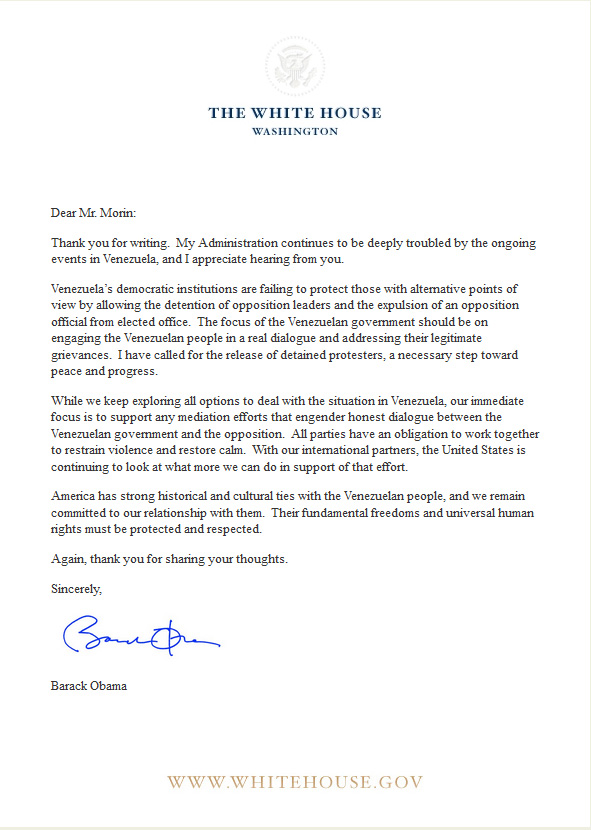

“A Letter from a President”

May 19, 2026
White House


For decades I wrote to different Presidents of the United States as an American-Venezuelan citizen concerned with the progressive institutional deterioration of Venezuela.  Most of those letters never received a response.  In 2014, amid protests, detentions, and political fractures that were beginning to transform the country irreversibly, a reply arrived from the White House signed by Barack Obama.

Read today, the letter is less significant for what it explicitly states than for the nature of its language itself.  The text recognizes the deterioration of Venezuela’s democratic institutions, mentions the detention of opposition leaders, and calls for dialogue, mediation, and the containment of violence.  Yet, as frequently occurs in diplomatic language, precision diminishes as proximity to the consequences such statements might require increases.  Viewed retrospectively, that caution also revealed the difficulty of an American administration openly recognizing the degree to which Venezuela had ceased to be merely an internal crisis and was beginning to form part of a broader dispute over hemispheric influence.

The letter appeared to reflect a broader contradiction within American foreign policy:  the difficulty of sustaining democratic language while economic dependencies, energy commitments, and geopolitical rivalries increasingly limited the willingness of the United States to confront directly the expansion of foreign influence across Latin America.  What for years remained formulated through the language of mediation, dialogue, and regional stability would ultimately reveal a deeper tension between the declared principles of American foreign policy and the progressive strategic reconfiguration of the hemisphere.


Barack Obama’s letter:

Dear Mr. Morin:

Thank you for writing.  My Administration continues to be deeply troubled by the ongoing events in Venezuela, and I appreciate hearing from you.

Venezuela’s democratic institutions are failing to protect those with alternative points of view by allowing the detention of opposition leaders and the expulsion of an opposition official from elected office.  The focus of the Venezuelan government should be on engaging the Venezuelan people in a real dialogue and addressing their legitimate grievances.  I have called for the release of detained protesters, a necessary step toward peace and progress.

While we continue exploring all options to address the situation in Venezuela, our immediate focus is to support any mediation efforts that generate an honest dialogue between the Venezuelan government and the opposition.  All parties have an obligation to work together to restrain violence and restore calm.  Together with our international partners, the United States continues to examine what more we can do to support that effort.

The United States has strong historical and cultural ties with the Venezuelan people, and we remain committed to our relationship with them.  Their fundamental freedoms and universal human rights must be protected and respected.

Again, thank you for sharing your thoughts.


Sincerely,

(Illegible signature of)

Barack Obama


This White House letter was sent on May 7, 2014 through my personal email address.


My response on the same date:

Honorable President Barack Obama:

Thank you for your kind and generous response.

What remains implicit in your response is that the United States maintains economic and strategic commitments that limit any direct confrontation with the Venezuelan government.  An intervention intended to remove a power regarded as illegitimate could alter agreements, contracts, and international balances whose stability forms part of an American economy already subjected to considerable strain.

A structural dependency on oil appeared to lie at the center of that dilemma and its unwanted consequences.  Yet a country immersed in a growing process of institutional and economic disintegration could eventually cease to satisfy either international demands or the needs of its own population.

Ultimately, regional stability and the strategic security of the United States itself might depend not only upon calls for dialogue, but also upon a clearer recognition of the external forces and political dependencies contributing to Venezuela’s progressive deterioration.


Sincerely yours,

Ricardo F. Morín


“The Monroe Axiom: What It Is and What It Is Not”

January 4, 2026
Ricardo F. Morin
What It Is; What Is Not
CGI
2026

Ricardo F. Morin

January 4, 2026

Oakland Park, Fl

Wannabe Axiom I

*

The Monroe Doctrine is often treated as a historical policy.  It operates, however, as something more elemental:   an axiom.  In this form, it no longer argues its case.  It establishes the conditions under which argument is permitted.  An axiom does not persuade.  It assumes.  

When the Monroe Doctrine functions as an axiom, it ceases to appear as a contingent claim about hemispheric order and becomes an unspoken premise about who may decide, when intervention is justified, and what forms of consent count as sufficient.  What requires examination is not the doctrine as written, but the axiom as it circulates.  

The Monroe Axiom asserts unilateral authority while presenting itself as regional responsibility.  It presumes that stability in the Western Hemisphere depends on U.S. primacy, and that this primacy does not require reciprocal authorization.  Consent is not sought;  necessity is declared.  Decision precedes deliberation.  

Attempts to rehabilitate the Monroe Doctrine by assigning it a benevolent purpose do not alter its structure.  Such revisions change tone, not authorization.  A claim of unilateral authority does not become mutual through intention.  Benevolence serves as reassurance offered after power has been exercised, not as a limit operating before it.  Political fatigue may explain acquiescence, but it does not supply authorization.  What is endured is not endorsed.

In its contemporary articulation, the axiom does not declare dominance openly.  Instead, it presents itself as reluctant, unavoidable, or benevolent.  Intervention is framed not as choice, but as consequence.  Exhaustion replaces consent.  Democracy is invoked not as a process to be preserved, but as an outcome promised in advance.  Once inevitability replaces argument, the axiom becomes self-sealing.  Opposition is no longer disagreement;  it is reclassified as denial.  

The Monroe Axiom fails the test of reciprocity.  A principle that justifies intervention outward but rejects reversal is not a principle.  It is asymmetry protected by habit.  When unilateral authority no longer justifies itself, normative language ceases to clarify and begins to anesthetize.  

Hegemony does not normally operate through open domination.  It operates through consent.  Power becomes durable not because it is feared, but because it is accepted as legitimate.  The central mechanism is not repression, but agreement:  the willingness to recognize an authority as natural, necessary, or unavoidable.  

In this condition, governance no longer depends primarily on force.  It depends on institutions, economic structures, technical systems, and narratives that define what appears normal and reasonable.  Over time, these arrangements narrow what can be questioned.  Authority no longer justifies itself.  It comes to define the terms under which justification occurs.  

What emerges is a form of rule whose primary objective is continuity rather than the public good.  Stability becomes the overriding value.  Accountability becomes subordinate to preservation.  The preservation of existing arrangements takes precedence over the purposes those arrangements were meant to serve.  

Such systems do not collapse through confrontation.  They weaken when consent withdraws.  The decisive change occurs when people no longer believe the narratives that sustain authority, no longer accept the inevitability of existing structures, and no longer participate in their maintenance.  At that point, power is forced to justify itself.  And once justification becomes necessary, hegemony has begun to fail.  

On Self-Authorizing Executive Judgment

As hegemonic justification weakens, authority shifts from consensual legitimacy to executive judgment.  What an axiom enables at the level of doctrine, executive practice completes at the level of justification.  Authority no longer presents itself as procedurally derived.  It presents itself as self-authorizing.   Decisions are framed as judgments rather than actions subject to institutional review.  The language of prudence—stability, timing, coordination—serves not as an articulated framework, but as a justificatory surface applied after the fact.

In this mode, power does not describe a process by which decisions were tested, constrained, or evaluated.  It describes internal certainty.   Judgment is treated as sufficient warrant.   Review is recast as delay.   Constraint is reframed as irresponsibility.  The executive becomes both actor and auditor, collapsing the distinction between discretion exercised within a republic and sovereignty asserted by an individual.  What persists is not the absence of the law, but a reordering of when the law is permitted to speak.

This transformation does not reject democratic language.   It inhabits it.   At that point, justification is treated as unnecessary.   Authority no longer explains itself to institutions.  It explains itself to itself.

This displacement does not stop at intervention.  It extends into how moral authority is articulated in relation to executive power. 

What once appeared as rhetorical excess has been confirmed as formal executive communication.  In a documented text exchange with Norway’s prime minister, later shared by the Norwegian government, Donald Trump linked his failure to receive the Nobel Peace Prize to a withdrawal of moral restraint and a reassertion of territorial entitlement.  He stated that because Norway had “decided not to give me the Nobel Peace Prize for having stopped 8 wars,” he no longer felt obliged “to think purely of peace,” and could instead focus on what was “good and proper for the United States of America.”  From that premise, he dismissed Denmark’s sovereignty over Greenland as historically arbitrary, asserted an equivalent U.S. claim, and concluded that “the world is not secure unless we have complete and total control of Greenland.”   

This is not a metaphorical slippage of tone; it is an axiomatic substitution enacted in plain language.  Moral recognition becomes a precondition for continued restraint.  Legal sovereignty is reframed as folklore.  Collective security obligations under NATO are inverted into a debt relationship owed to executive initiative.  The structure of justification no longer proceeds from treaty, the law, or institutional reciprocity, but from unilateral narrative authority.  The episode does not illustrate a policy position; it reveals a mode of reasoning in which executive power ceases to argue its case and declares the conditions under which argument itself will be recognized.


A recent procedural illustration of this logic appears in the treatment of Venezuela’s 2024 electoral outcome.  That election produced a determinate locus of constitutional legitimacy grounded in publicly documented tallies, corroborated by international observation, and reinforced by prior external recognition of the opposition coalition represented by María Corina Machado’s party.  Together, these elements constituted a juridical fact:  authority derived from electoral procedure rather than from bilateral negotiation or executive preference.

Subsequent engagement by the United States executive branch with Delcy Rodríguez as Venezuela’s acting executive did not contest that electoral outcome.  It displaced the outcome operationally.  This displacement did not arise from a competing evidentiary claim about the vote count or from a legally articulated challenge to the election’s validity.  It arose from an external strategic preference for transactional stability over constitutional continuity.  Recognition was detached from electoral legitimacy and reassigned on the basis of expedient functionality.

This maneuver reflects a category error with institutional consequences.  Diplomatic leverage authorizes negotiation, pressure, and conditional engagement.  Policy discretion authorizes the selection of strategies aligned with national interests.  Neither authorizes redefinition of the internal locus of sovereignty within another State.  By treating these domains as interchangeable, U.S. executive policy practice converted foreign-policy discretion into a surrogate sovereignty-assigning authority.  What was presented as pragmatic statecraft functioned as jurisdictional substitution.

The displacement cannot be stabilized by invoking realism.  Realism explains why States behave instrumentally.  It does not supply a legal warrant for nullifying electoral outcomes.  The American executive branch did not demonstrate that the 2024 Venezuelan election failed to generate legitimate authority.  It demonstrated that the authority produced by that election was operationally inconvenient for the strategy pursued by the American administration.  In institutional terms, this constitutes not correction but override of another country’s sovereignty.

The structural consequence extends beyond Venezuelan governance.  When electoral legitimacy is superseded by bilateral endorsement, elections cease to function as determinative acts and become advisory signals contingent on foreign approval.  Sovereignty is no longer derived from domestic mandate but from external recognition calibrated to strategic utility.  Authority shifts from constitutional process to diplomatic transaction.

This transformation does not announce domination.  It normalizes it.  Recognition becomes an instrument for reallocating jurisdiction.  Intervention becomes a method for reassigning legitimacy.

On Recognition Substitution and Jurisdictional Drift

In this register, moral authority no longer functions as an external constraint on power.   Distinction ceases to operate as a limit placed on authority and becomes an accessory of it.  When moral standing is derived from proximity to executive certainty, independence dissolves without coercion.   What appears as endorsement is, structurally, a transfer of judgment from the moral sphere to the political one.

The failure of the Monroe Axiom is not confined to its original doctrinal form.  It persists because the axiom no longer needs to appear as doctrine.  Its logic circulates in a different register, one that does not argue for unilateral authority but presupposes it by altering the terms under which legitimacy is evaluated.

In this register, political conflict is no longer treated as a relation among agents operating under shared constraints.  It is reclassified as a condition to be managed rather than a position to be answered.  Once this shift occurs, reciprocity no longer functions as a test of legitimacy.  Action is justified not by reversibility but by asserted necessity.

Within this framework, intervention is no longer judged against reversible standards.  It is judged against urgency.  Delay becomes negligence.  Restraint becomes complicity.  The language of limits gives way to the language of care, and coercive force is presented not as domination but as treatment.  The axiom is not rejected.  It becomes unnecessary.

This shift produces asymmetry.  Where reciprocity once constrained legitimacy, diagnosis now authorizes action.  The governing question is no longer whether an act could be defended word for word if positions were reversed, but whether the condition has been declared terminal.  Once that declaration is made, consent becomes secondary, proportionality becomes implicit, and accountability is deferred to an undefined recovery phase.

This transformation has a structural consequence.   When political communities are redescribed as incapacitated, authority no longer justifies itself in relation to equals but in relation to asserted necessity.   Measures that would otherwise require justification are absorbed into administration.

Authority proceeds by classification rather than justification.   Once legitimacy is grounded in declared condition, the criteria for ending intervention no longer operate in advance.

Under this displaced logic, material claims can be advanced without appearing as seizures, and control can be asserted without being named as such.  What follows is not an exception to the axiom but one of its most concrete expressions.

Under this logic, nationalization is no longer interpreted as a sovereign act.  What had been established within Venezuelan territory, regulated by Venezuelan authority, and later incorporated into the Venezuelan law is reclassified as an asset whose ownership is said to precede Venezuelan authority.  Past participation is invoked not as historical involvement but as proof of continuing entitlement.  Time is not treated as a boundary but as confirmation. This conversion treats prior participation as if it conferred a residual claim that survives its own settlement, a claim that neither contract nor sovereignty sustains.

Once this redefinition is accepted, the decline of Venezuela’s oil industry is no longer understood as a domestic failure affecting Venezuelans.  It is described as damage to U.S. interests.  Mismanagement inside Venezuela is translated into harm to the United States.  Venezuela’s inability to maintain its industry becomes evidence that it should no longer control it.  

From there, the reasoning shifts.  The claim is restated in corrective terms.  Control is framed as reestablishment of a prior condition rather than initiation of a new one.  What is transferred is described as something that never ceased to belong elsewhere.   Performance replaces consent as the measure of legitimacy.   Ownership becomes conditional, evaluated against outcomes rather than jurisdiction.  

The argument adopts the language of vulnerability.  Disruption within Venezuela is described as exposure elsewhere.  Energy production is treated as a condition of stability rather than an object of agreement.   What had been governed through jurisdiction is presented as a requirement of continuity.   Under this framing, intervention aligns with prevention.   Choice becomes indistinguishable from obligation.  

In this sequence, ownership is no longer treated as a settled legal condition.   Jurisdiction is referenced, insofar as outcomes meet external expectations.   Control persists while its legal basis becomes contingent.

Claims initially framed as interests are restated as standing expectations.   Those expectations are treated as conditions that must be met in advance of consent.