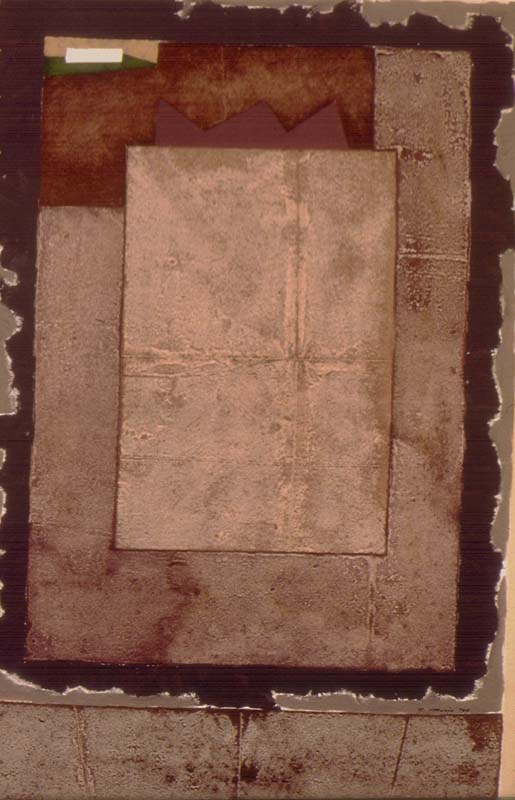
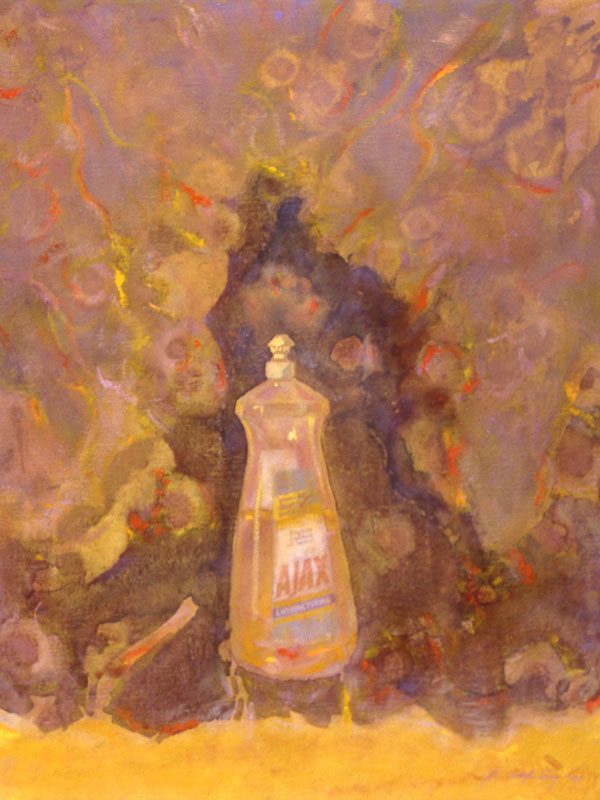
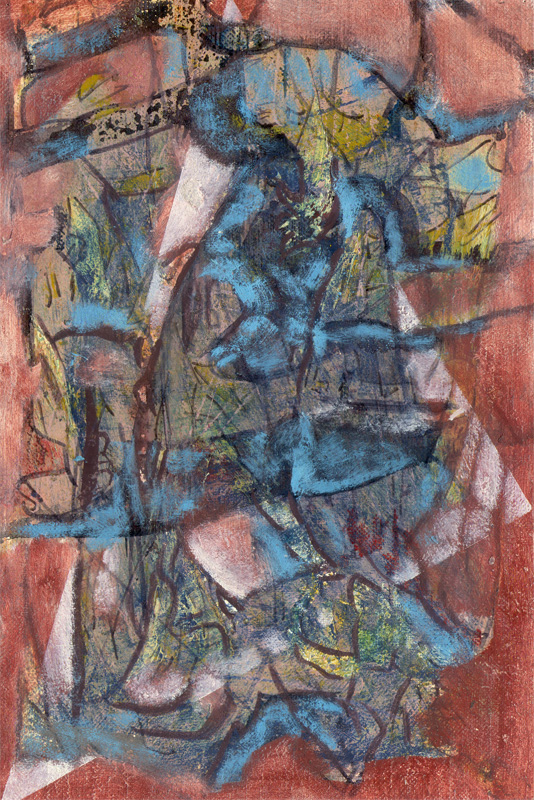
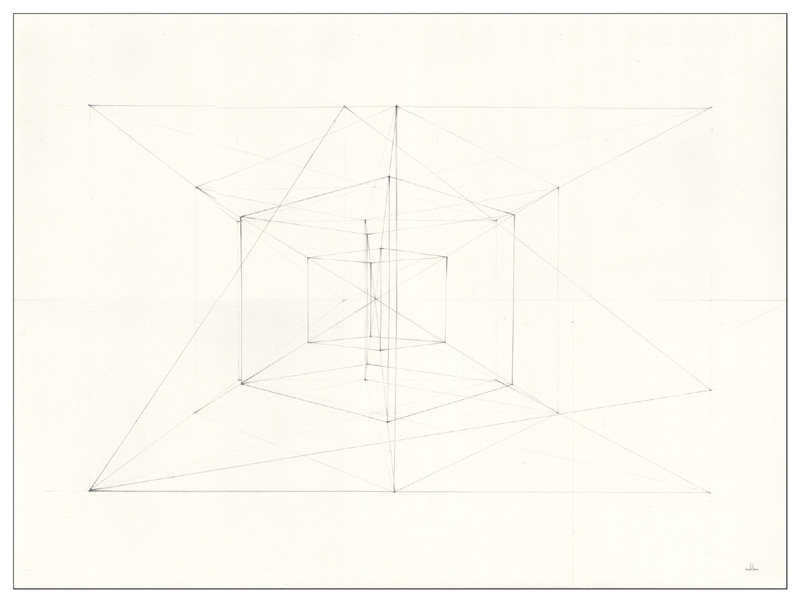
Ricardo F. Morin New York Series, Untitled 24″ x 36″ Oil on canvas 1992
1. A person withdrawn from interruption, judgment, dependency, and noise may begin to believe that solitude clarifies the self. Removed from the continual presence of others, one becomes more aware of habits, memories, reactions, and inward movement ordinarily dispersed through daily relation. Silence appears to gather experience into greater clarity. Yet prolonged isolation reveals something less expected: inward life does not remain still simply because it happens alone.
2. Thought begins circling within its own continuity without resistance. Reflection loses proportion when nothing interrupts it from beyond itself. A memory repeated often enough begins to feel increasingly complete when it is not. A fear unanswered by another perspective deepens within its own enclosure. Even silence changes character. No response arrives. No interruption. Nothing enters from outside oneself.
3. This may be why solitude eventually begins searching for relation again, even where no person is present. The hermit speaks to God, to memory, to nature, or to silence itself. The mind reaches beyond its own enclosure not necessarily from weakness, but because inward life alone cannot fully restore proportion to itself.
4. We do not discover ourselves in abstraction alone. Much of what we call individuality becomes perceptible through relation. Patience, resentment, tenderness, vanity, courage, forgiveness, and responsibility do not fully disclose themselves in separation from others. They emerge through contact, disappointment, affection, misunderstanding, dependence, and care. Another person does not diminish individuality. Something in us becomes more visible in relation than in withdrawal.
5. Communication does not eliminate distance between human beings. It reveals it. No person entirely crosses the interior distance separating one consciousness from another. Suffering, mortality, memory, and perception remain singular experiences. Yet it is often through the effort to communicate that this separateness becomes recognizable at all. We discover how far we remain from one another precisely in the attempt to reach across that distance.
6. Another person is neither an extension of oneself nor a symbolic abstraction. The other remains distinct, vulnerable, and finite. Love therefore cannot consist merely in attachment, possession, or dependence. Its deeper force lies in the capacity to recognize another existence without attempting to dissolve it into one’s own needs, fears, or projections. Compassion arises quietly from this condition.
7. Isolation becomes impossible not because solitude lacks value, but because human life continually reaches beyond private continuity. Even withdrawal retains traces of relation: language, memory, longing, recognition, prayer, imagination. The mind does not merely enclose itself. It responds. Seeks. Recalls. Addresses what remains beyond it.
8. Perhaps this is why the deepest forms of love do not abolish aloneness. They allow it to stand without hardening into enclosure. Compassion does not overcome distance by eliminating difference. Each person remains singular and ultimately unreachable in totality, yet still worthy of care. In that recognition, isolation no longer appears possible as a final condition of human life.
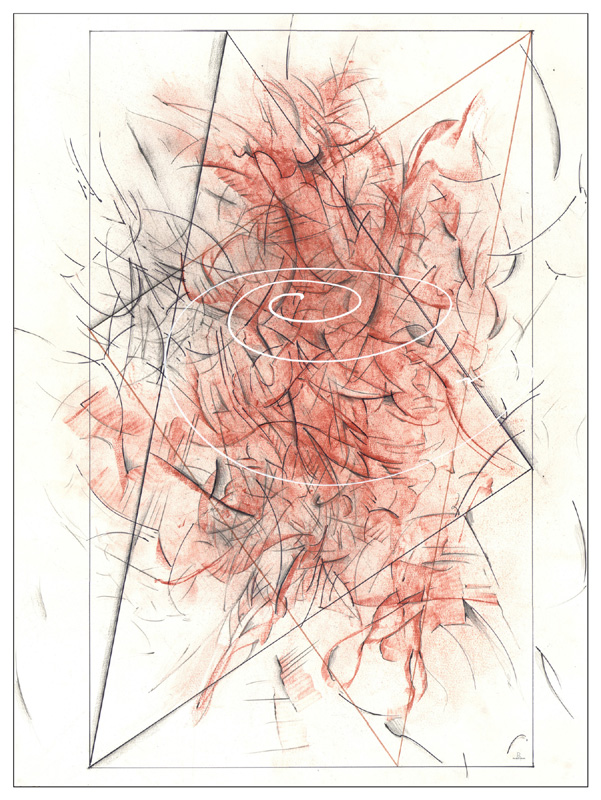
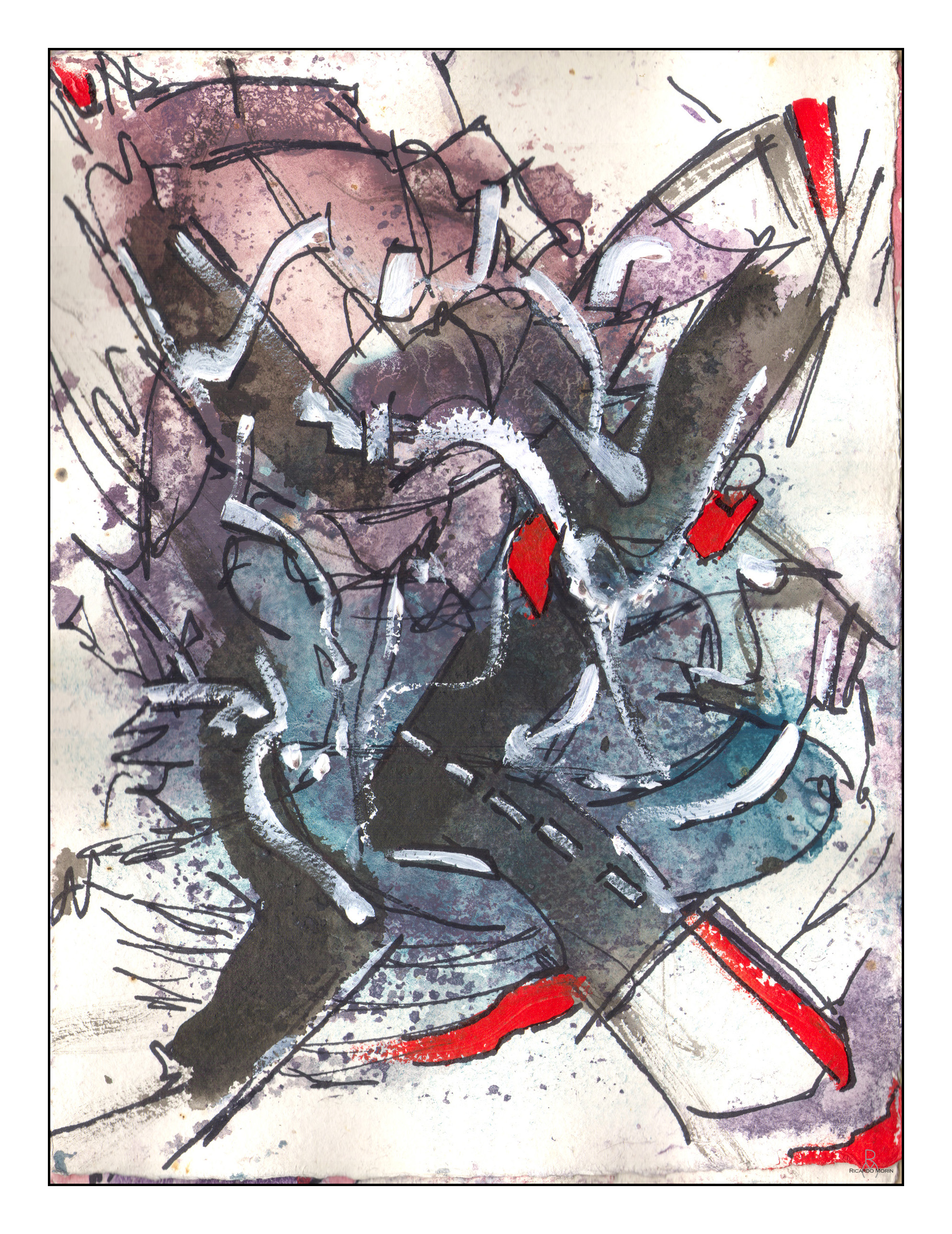
Ricardo Morín Triangulation III: The Quiet Room 22″ x 30″ Body color, sanguine, sepia and Sumi ink on paper 2008
Author’s Note
This story takes place in a room marked “Quiet Room,” a term that in English is usually understood as a neutral space: a place for silence, rest, or reflection, without any implied ritual purpose. But spaces do not mean the same thing to everyone. In some cultures and languages, silence suggests prayer; the absence of furniture implies prostration; and the presence of a textile can signal ritual use.
These differences in meaning can create misunderstandings where no conflict is intended. What I recount here is not about religion, but about how the meaning of a shared space can shift without warning, and how people interpret the same room through frames of reference that may collide without notice.
Ricardo F Morín
November, 2025
Oakland Park, Florida
1
My driver and I had been talking about the way executive power often disguises its motives—how it presents itself as a force of rescue while pursuing forms of exploitation. We passed the time considering these contradictions and felt, briefly, that we understood our world a little more clearly.
2
We were accompanied by the brisk morning air as we moved through congested traffic toward the Philadelphia airport. I was returning home to Fort Lauderdale after two days of cardiological testing not available to me back home. Without baggage, I went directly to TSA PreCheck with only a shoulder bag. Shortly after I reached the departure gate, a six-hour delay was announced. I decided to buy a backpack and set out in search of a place to reorganize my things in private.
3
I soon found a room marked Quiet Room—plainly identified as a space for silence, rest, or reflection. I entered with that expectation. The room was divided into several intimate areas with benches along some of the walls. The lighting was subdued and the air held a stillness that contrasted with the restlessness of the terminal. Though furnished sparingly, the rooms were lined with pleated curtains that absorbed and muffled sound, and this softening of the acoustics created a muted perimeter that stood apart from the noise outside. Only one of the smaller sections had a vanity with a faucet, a faint glow reflecting off its surface.
4
Atop what appeared to be a tall storage unit, several folded textiles were stacked. Their textures and patterns varied—some silk-like, others woolen or synthetic. At first glance they looked more like blankets than anything else. Nothing in the room suggested any purpose beyond what the sign indicated. It was, in every visible sense, a quiet room open to anyone.
5
I stood facing one of several benches and began to transfer my belongings from the shoulder bag into the new backpack. The simple act of rearranging objects formed its own small rhythm within the subdued quiet. I was nearly finished when a voice behind me broke the stillness. I turned and saw a man repeating with certainty:“This is a place for prayer”.
6
His certainty overrode the posted meaning of the room. There was no courtesy, no explanation, and no acknowledgment of the sign that defined the space I had entered. I turned back to complete what I had nearly finished. The man walked into one of the adjoining sections. A woman remained in the larger space that I stood in, silent, waiting for me to leave. I stepped out. For a moment I felt like a transgressor, though nothing I had done justified it.
7
I was startled by how quickly confidence had given way to a sense of diminishment.
8
I had become a participant in an unexpected encounter. A single assertion—neither explained nor negotiated—had shifted the atmosphere without warning.
9
A short time later and still unsettled, I returned impulsively to the Quiet Room, perhaps to find closure. In the smaller section with the vanity, several men were washing their hands as they murmured chants or prayers, barely audible yet perceptible enough to alter the atmosphere. Their voices blended with the sound of running water, forming a low, continuous undertone. In the larger section, the same woman stood quietly, facing one of the textiles she had placed diagonally across the narrow space she occupied. The room’s physical features had not changed, but its public meaning had been recast. What had been neutral now felt defined by a significance I had not been prepared for or invited to share.
10
I left again and returned to my departure gate. In time the emotion eased, though the moment remained vivid as I wrote it.
11
Later, I replayed the scene and the reply I had not managed to speak:“This is a place for prayer. I am praying myself”.
12
But I found no certainty in the memory of it—only questions that lingered with persistence: how can a plainly posted meaning, “Quiet Room,” be superseded by an unspoken one? Was it grievance or exclusivity that redrew the boundaries of a public room without a single word of justification? How quickly can a neutral space become contested before anyone knows how to meet the shift itself? How does one face the responsibility of communicating with clarity? By any measure, none of us had succeeded.
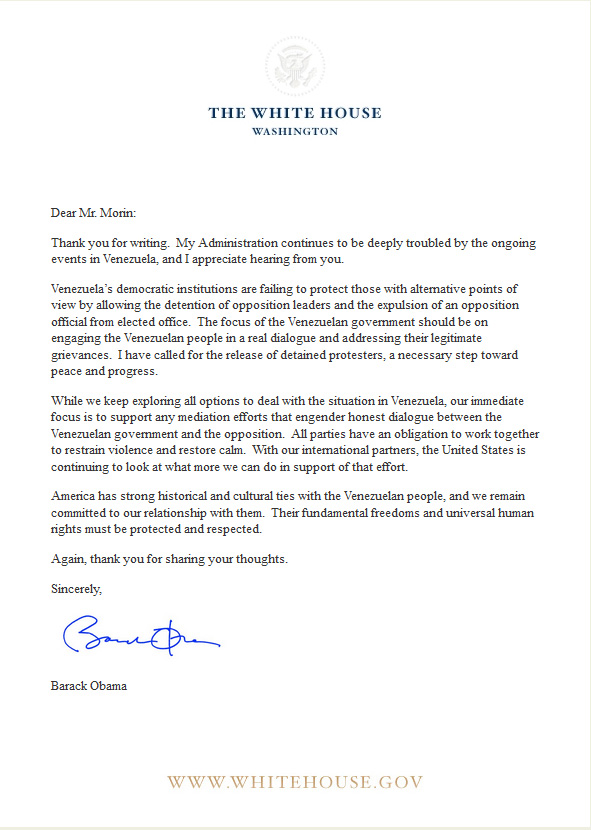
For decades I wrote to different Presidents of the United States as an American-Venezuelan citizen concerned with the progressive institutional deterioration of Venezuela. Most of those letters never received a response. In 2014, amid protests, detentions, and political fractures that were beginning to transform the country irreversibly, a reply arrived from the White House signed by Barack Obama.
Read today, the letter is less significant for what it explicitly states than for the nature of its language itself. The text recognizes the deterioration of Venezuela’s democratic institutions, mentions the detention of opposition leaders, and calls for dialogue, mediation, and the containment of violence. Yet, as frequently occurs in diplomatic language, precision diminishes as proximity to the consequences such statements might require increases. Viewed retrospectively, that caution also revealed the difficulty of an American administration openly recognizing the degree to which Venezuela had ceased to be merely an internal crisis and was beginning to form part of a broader dispute over hemispheric influence.
The letter appeared to reflect a broader contradiction within American foreign policy: the difficulty of sustaining democratic language while economic dependencies, energy commitments, and geopolitical rivalries increasingly limited the willingness of the United States to confront directly the expansion of foreign influence across Latin America. What for years remained formulated through the language of mediation, dialogue, and regional stability would ultimately reveal a deeper tension between the declared principles of American foreign policy and the progressive strategic reconfiguration of the hemisphere.
Barack Obama’s letter:
Dear Mr. Morin:
Thank you for writing. My Administration continues to be deeply troubled by the ongoing events in Venezuela, and I appreciate hearing from you.
Venezuela’s democratic institutions are failing to protect those with alternative points of view by allowing the detention of opposition leaders and the expulsion of an opposition official from elected office. The focus of the Venezuelan government should be on engaging the Venezuelan people in a real dialogue and addressing their legitimate grievances. I have called for the release of detained protesters, a necessary step toward peace and progress.
While we continue exploring all options to address the situation in Venezuela, our immediate focus is to support any mediation efforts that generate an honest dialogue between the Venezuelan government and the opposition. All parties have an obligation to work together to restrain violence and restore calm. Together with our international partners, the United States continues to examine what more we can do to support that effort.
The United States has strong historical and cultural ties with the Venezuelan people, and we remain committed to our relationship with them. Their fundamental freedoms and universal human rights must be protected and respected.
Again, thank you for sharing your thoughts.
Sincerely,
(Illegible signature of)
Barack Obama
This White House letter was sent on May 7, 2014 through my personal email address.
My response on the same date:
Honorable President Barack Obama:
Thank you for your kind and generous response.
What remains implicit in your response is that the United States maintains economic and strategic commitments that limit any direct confrontation with the Venezuelan government. An intervention intended to remove a power regarded as illegitimate could alter agreements, contracts, and international balances whose stability forms part of an American economy already subjected to considerable strain.
A structural dependency on oil appeared to lie at the center of that dilemma and its unwanted consequences. Yet a country immersed in a growing process of institutional and economic disintegration could eventually cease to satisfy either international demands or the needs of its own population.
Ultimately, regional stability and the strategic security of the United States itself might depend not only upon calls for dialogue, but also upon a clearer recognition of the external forces and political dependencies contributing to Venezuela’s progressive deterioration.
During those first years through 1976, Buffalo accumulated heavier snowfalls than usual, with blizzards exceeding those of previous winters. In some neighborhoods the snow rose beyond the rooftops of houses. The wind crossed the streets with an intensity unfamiliar to someone who had grown up in Valencia, Venezuela. In the art studios of Bethune Hall, at the State University of New York at Buffalo, canvases leaned against one another while students worked for hours in silence or beneath scattered conversations. The smell of oil, turpentine, and damp wood continuously permeated the interiors.
He had arrived in the United States in 1972 at seventeen years of age. Displacement did not consist solely in leaving one country behind. It also altered the daily perception of the simplest things: the scent of cities, winter light entering through windows, the relation between the body and climate, the constant sound of a language still only partially familiar.
Before Buffalo there had been Valencia. The Arturo Michelena School of Fine Arts. The first hours of drawing during childhood. Later, during adolescence, the summers studying painting in the private studio of the Hungarian painter Lazlo Lenyel. Even then, however, painting seemed less a future profession than a form of attention. Preparing the surface of a canvas produced an experience difficult to explain outside the act of painting itself.
During those years canvases began accumulating rapidly. Some were destroyed. Others remained leaning against walls for months before receiving another layer of paint. The organization of the studio changed constantly. Painting did not yet follow a precise theory. There was instead a physical insistence: returning each day to observe relations of color, spatial tension, surface, and rhythm.
In 1976 he returned briefly to Venezuela. There he studied privately with the Málaga-born artist José Luis Montero before returning once again to Buffalo under the guidance of Herta Kane and James Jipson. Gradually the first exhibitions began. In May of that same year he presented “Works by Ricardo Morin” at the Villa Maria College Gallery.
Conversations about art during those years frequently revolved around movements, historical legitimacy, abstraction, expressionism, or formal theory. Yet many of the most intense hours occurred far from any discourse. Remaining alone in the studio, slowly shaping how certain surfaces retained or rejected light, seemed to contain an experience more concrete than many of the explanations later constructed around the work.
In 1977 the Venezuelan Ministry of Education awarded him a full scholarship to complete a B.F.A. at SUNY Buffalo. The thesis exhibition, Buffalo Series 1979, was later curated by Seymour Drumlevitch at the Alamo Gallery of the State University of New York at Buffalo. [1] Shortly afterward, Buffalo Series No. 1, 1980, received the Birge Wall Covering Award and the Reed Foundation Award at the 38th Western New York Show at the Albright Knox Art Gallery. [2]
Awards, exhibitions, and scholarships briefly made continuity seem attainable. During certain periods it seemed possible to imagine a relatively stable professional trajectory. Yet that stability coexisted with another sensation more difficult to name: the persistent impression that the real work was taking place elsewhere, far from the forms through which it was publicly interpreted.
In 1979 he attended stage design seminars taught by Gunther Schneider-Siemsen at the Internationale Sommerakademie für Bildende Kunst Salzburg. There he received the Förderungspreis Leistung der Stadt Salzburg award. Shortly afterward Drumlevitch recommended that he apply to the M.F.A. program of the Yale School of Drama.
At Yale the theater workshops functioned on another scale of production. Constructions, lighting, scenic architecture, models, and technical equipment occupied spaces inside buildings adapted for the stage. Physical labor was continuous. Stage design also offered a concrete possibility of economic survival within New York.
During the first years after Yale he worked as a set designer in New York’s Off-Off-Broadway circuit, collaborating with Irene Fornés and Max Ferrá at INTAR. [3] At the same time he worked as principal assistant to established Broadway designers. Workshops, constructions, and rehearsals occupied much of the days and nights.
By the late 1980s he obtained a loft in Tribeca devoted exclusively to painting. Large-format canvases leaned against high walls while painting once again began occupying the center of daily life. The studio was filled with accumulated materials: stretchers, pigments, tools, fragments of canvas, and drawings tacked against the walls.
At certain moments it seemed possible to sustain both lives simultaneously: theater and painting. New York still retained industrial areas where some artists could work within relatively spacious environments. Yet even during those years of greatest professional activity, a tension persisted between the public continuity of a career and the quieter experience of the work itself.
In 1993 interruption appeared. Due to AIDS he was forced to abandon the loft, suspend professional activity, and return to Venezuela seeking refuge with his family. The diagnosis rapidly altered the entire structure of daily life. Many previous continuities disappeared within a few months: work, economic stability, studio, city, professional rhythm.
Between 1993 and 1996 his health deteriorated considerably. He spent long periods inside the family home with little physical energy and frequent medical interruptions. It was then that the Aposentos series began. The second painting of the series, Aposento No. 2, was selected for the “XIV Municipal Painting Salon: Homage to Carlos Cruz-Diez,” held in 1994 at the Municipal Art Gallery of Maracay. [4]
He painted slowly. Canvases remained stacked against the walls for entire weeks before receiving another intervention. The body fatigued quickly. Light shifted inside the room while the paintings remained motionless for hours or entire days. At times the work advanced only a few centimeters.
Painting then began acquiring another rhythm. It no longer seemed to respond solely to the continuity of a career or to the possibility of exhibition. Some works emerged more as accompaniment than affirmation.
During those same years he worked voluntarily at Fundación Metaguardia, created in Valencia as a center of information and support for people with terminal illnesses, many of them also living in conditions of indigence. The foundation integrated emotional support, activities connected to the arts, and pro bono medical services.
Silent conversations, long periods of waiting, weakened bodies, and shared vulnerability slowly altered the perception of many previous categories. Illness seemed to render secondary many differences that had previously organized much of daily attention.
In 1996 he finally returned to New York in order to access the new antiretroviral treatment. His immunity was practically nonexistent. Soon afterward he sought assistance from the Department of Human Resources because of his condition of destitution. He first stayed at the transitional Paradise Hotel in the Bronx and later at the Common Ground program at the Hotel Times Square.
Paradise was a profoundly unstable place. Narrow corridors, moldering rooms, and constant precariousness altered the perception of time. Some people disappeared suddenly. Others remained locked inside their rooms for entire days. The noise of doors, televisions, and arguments continuously crossed through the walls of the building.
Even so he continued painting. Small canvases rested against walls or on improvised furniture near the window. The continuity of the work no longer depended upon ideal conditions. It depended only upon continuing to work within whatever circumstances were available.
During those years an unexpected sensation of emptiness also appeared. Not necessarily as absolute loss, but rather as a gradual reduction of the interior noise through which ambition, identity, or permanence had once been sustained. Within that emptiness certain forms of attention slowly began acquiring greater intensity: breathing, light upon surfaces, the rhythm of the body while walking through the city, the noise of certain rooms, the momentary presence of familiar faces.
In September 1998 he received support from the New York organization Visual AIDS, which organized a joint exhibition based on watercolor and oil portraits together with Nicolo Cataldi at St. Mark’s Church. Later came other collective exhibitions and alternative platforms. Some of the paintings from the early 1990s were later described by the artist Jo-ey Tang as “love letters to the city of New York”.
In 2000 he received a VESID rehabilitation grant that included specialized training in digital tools and computer equipment. The computer then slowly became incorporated into the visual work. Between 2000 and 2003 he used digital media combined with watercolor and hand drawing to reinterpret fifteenth-century Persian miniatures through geometric processes of reconstruction. [5]
Later, between 2005 and 2012, he taught a course titled Pictorial Perspective at Pratt Institute. Meanwhile he developed the Triangulation Series, working with suspended geometries, reduced spaces, and hanging formats. [6]
After completing chemotherapy in 2008 for an AIDS-related Non-Hodgkin lymphoma, systemic muscular disorders began preventing him from even stretching large canvases. The hanging canvases then emerged also as a direct consequence of physical limitations. The body slowly began imposing another relation to space, time, and work.
The canvases remained suspended for weeks while light varied across the surfaces. Physical movements were slower. Material reduction altered perception as well. Silence ceased feeling like absence and began functioning as another form of attention.
Between 2009 and 2010 he initiated the Metaphors of Silence series. [7] Many of the works emerged slowly within prolonged periods of physical stillness. The need to explain aesthetic experience intellectually gradually began losing intensity before the experience of observation itself.
During those same years he collaborated with Dr. Andrew Irving in an experimental project on art, anthropology, and human experience related to New York Stories. Part of those dialogues were later incorporated into The Art of Life and Death: Radical Aesthetics and Ethnographic Practice. [8]
With the passing of years certain tensions slowly began losing sharpness. Illness remained present, although it no longer organized each moment of the day in the same way. Certain forms of ambition or anxiety surrounding continuity, recognition, or permanence seemed gradually to diminish without disappearing entirely.
Painting continued occupying a central place, though no longer necessarily as an exclusive affirmation of identity. Other things also remained: conversations, walks, reading, physical exercise, breathing finding rhythm again, the momentary attenuation of certain aches, light changing across the surfaces of the city, brief encounters throughout the day.
Some afternoons he continued walking slowly while breathing found rhythm and light descended across the buildings. Aging, fragility, and the proximity of death did not disappear. Neither did they remain completely separate from the movement of existence itself.
Ricardo F. Morín My Nest 24′”x30″ Oil on linen 1999
*
Help was not offered casually. It was offered over time, shaped by history, familiarity, and a belief that loyalty required staying present when circumstances were unsettled. Unclear commitments were accepted with the expectation that steadiness might compensate for instability, and that patience would allow clarity to arrive where it had not yet appeared.
As time passed, those commitments became harder to anticipate. Plans shifted after they were accepted. Expectations changed without being stated. What had been agreed to one week was revised the next. Each adjustment was absorbed rather than challenged. Meetings no longer produced decisions. Agreements no longer survived the week. The effort to remain fair became an effort to remain adaptable. What was not confronted was carried.
There was hesitation in naming what was occurring. Doing so felt severe. It risked appearing uncharitable or impatient. Silence often seemed preferable to objection, not because nothing was seen, but because what was seen resisted easy articulation. Silence, once a form of restraint, had ceased to clarify anything. Endurance appeared safer than judgment.
Gradually, the effects of that endurance became visible. Loyalty did not stabilize the situation. It prolonged it. The more uncertainty was accommodated, the more it became the organizing condition. Commitments lost their edges. Responsibility dispersed. Care, extended without limit, ceased to correct anything and instead made instability easier to sustain.
At one point, a friend chose a different posture. He remained attentive, but at a distance. He did not intervene repeatedly or attempt to steady what showed no sign of holding. At the time, that distance was easy to misread. Commitment, as it was then understood, appeared to require proximity. Restraint looked like withdrawal.
Only later did the significance of that posture become clear. What had appeared passive was a form of orientation. Limits had been recognized earlier, and conduct adjusted accordingly. Distance had not signaled indifference, but an understanding that presence, under unstable conditions, does not always improve outcomes. The difference lay not in intention, but in timing.
This recognition unsettled earlier assumptions. Proximity had been mistaken for responsibility. Endurance had been treated as virtue without asking whether it was sustaining anything beyond the appearance of care. What felt like loyalty had, in part, become permission. The most difficult admission was not about the actions of others, but about the role played in allowing those actions to continue without consequence.
Distance did not follow immediately. It came after repeated attempts to restore proportion, after explanations failed to hold, and after silence ceased to clarify anything. Withdrawing was not a rejection of concern. It was the only remaining way to prevent concern from being consumed by unpredictability. It was a way of preserving judgment, preventing concern from being consumed by unpredictability, and leaving open the possibility that conditions might yet change
Refusal, understood in this way, is not dramatic. It does not accuse or announce itself. It does not seek recognition. It withdraws consent quietly and allows arrangements either to stabilize or to reveal their own limits. What ends is not care, but participation in conditions that require self-deception to endure.
This form of refusal is not moral superiority. It is responsibility turned inward. It begins when remaining present requires abandoning one’s own judgment, and when loyalty, left unchecked, undermines what it was meant to protect. Silence, at that point, does not evade obligation. It restores coherence.
The act is restrained. Its consequences are durable. By stepping back, one ceases to supply the energy on which instability depends. What remains intact is judgment without foreclosing the possibility of renewal should proportion be restored. What is relinquished is the belief that endurance is always ethical—and refusal becomes the means by which clarity, rather than rupture, is maintained.
*
Ricardo F. Morín, January 1, 2026, Oakland Park, Florida.
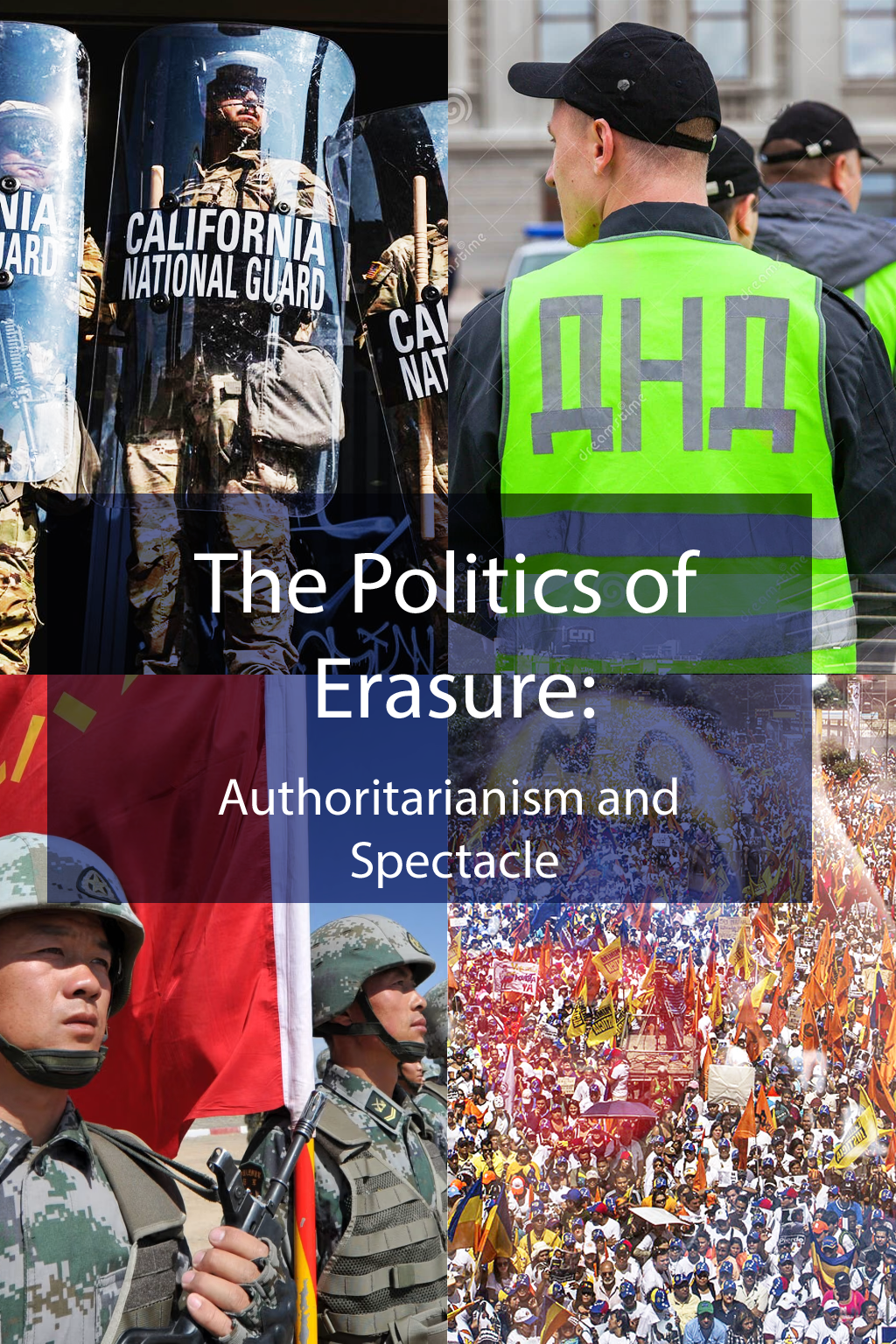
Cover design for the essay “The Politics of Erasure: Authoritarianism and Spectacle.” The composite image juxtaposes surveillance, militarization, propaganda, and mass spectacle to underscore how authoritarian regimes render lives expendable while legitimizing control through display.
By Ricardo Morín, In Transit to and from NJ, August 22, 2025
Authoritarianism in the present era does not present itself with uniform symbols. It emerges within democracies and one-party states alike, in countries with declining economies and in those boasting rapid growth. What unites these varied contexts is not the formal shape of government but the way power acts upon individuals: autonomy is curtailed, dignity denied, and dissent reclassified as threat. Control is maintained not only through coercion but also through the appropriation of universal values—peace, tolerance, harmony, security—emptied of their content and redeployed as instruments of supression. The result is a politics in which human beings are treated as expendable and spectacle serves as both distraction and justification.
In the United States, the Bill of Rights secures liberties, yet their practical force is weakened by structural inequality and concentrated control over communication. After the attacks of September 11, the USA PATRIOT Act authorized sweeping surveillance in the name of defending freedom, normalizing the monitoring of private communications (ACLU 2021). Protest movements such as the Black Lives Matter demonstrations of 2020 filled the streets, but their urgency was absorbed into the circuits of media coverage, partisan argument, and corporate monetization (New York Times 2020). What begins as protest often concludes as spectacle: filmed, replayed, and reframed until the original message is displaced by distractions. Meanwhile, the opioid epidemic, mass homelessness, and medical bankruptcy reveal how millions of lives are tolerated as expendable (CDC 2022). Their suffering is acknowledged in statistics but rarely addressed in policy, treated as collateral to an order that prizes visibility over remedy.
Venezuela offers a more direct case. The Ley contra el Odio (“Law against Hatred”), passed in 2017 by a constituent assembly lacking democratic legitimacy, was presented as a measure to protect tolerance and peace. In practice, it has been used to prosecute journalists, students, and citizens for expressions that in a democratic society would fall squarely within the realm of debate (Amnesty International 2019). More recently, the creation of the Consejo Nacional de Ciberseguridad has extended this logic to place fear and self-censorship among neighbors and colleagues (Transparencia Venezuela 2023). At the same time, deprivation functions as a tool of discipline: access to food and medicine is selectively distributed to turn scarcity into a means of control (Human Rights Watch 2021). The state’s televised rallies and plebiscites portray unity and loyalty, but the reality is a society fractured by exile, with over seven million citizens abroad and those who remain bound by necessity rather than consent (UNHCR 2023).
Russia combines repression with patriotic theater. The 2002 Law on Combating Extremist Activity and the 2012 “foreign agents” statute have systematically dismantled independent journalism and civil society (Human Rights Watch 2017), while the 2022 law against “discrediting the armed forces” criminalized even the description of war as war (BBC 2022). Citizens have been detained for carrying blank signs, which demonstrates how any act, however symbolic, can be punished if interpreted as dissent (Amnesty International 2022). The war in Ukraine has revealed the human cost of this system: conscripts drawn disproportionately from poorer regions and minority populations are sent to the frontlines, their lives consumed for national projection. At home, state television ridicules dissent as treason or foreign manipulation, while parades, commemorations, and managed elections transform coercion into duty. The official promise of security and unity is sustained not by coexistence but by the systematic silencing of plural voices, enforced equally through law, propaganda, and ritual display.
China illustrates the most technologically integrated model. The 2017 Cybersecurity Law and the 2021 Data Security Law require companies and individuals to submit to state control over digital information and extend surveillance across every layer of society (Creemers 2017; Kuo 2021). Social media platforms compel group administrators to monitor content and disperses the responsibility of conformity to citizens themselves (Freedom House 2022). At the same time, spectacle saturates the landscape: the Singles’ Day shopping festival in November generates billions in sales, broadcast as proof of prosperity and cohesion, while state media showcases technological triumphs as national achievements (Economist 2021). Entire communities, particularly in Xinjiang, are declared targets of re-education and surveillance. Mosques are closed, languages restricted, and traditions suppressed—all in the name of harmony (Amnesty International 2021). Stability is invoked, but the reality is the systematic denial of dignity: identity reduced to an administrative category, cultural life dismantled at will, and existence itself rendered conditional upon conformity to the designs of state power.
Taken together, these cases reveal a common logic. The United States commodifies dissent and normalizes abandonment as a permanent condition of public life. Venezuela uses deprivation to enforce discipline and the resulting compliance is publicly presented as loyalty to the state. Russia demands sacrifice and transforms coercion into patriotic duty. China fuses surveillance and prosperity and engineers conformity. Entire communities are suppressed in the name of harmony. The registers differ—commercial, ritualistic, militarized, digital—but the pattern is shared: dissent is stripped of legitimacy, lives are treated as expendable, and universal values are inverted to justify coercion.
References
ACLU: “Surveillance under the USA PATRIOT Act”. New York: American Civil Liberties Union, 2021. (This article documents how post-9/11 legislation expanded state surveillance in the United States and framed “security” as a justification for reducing privacy rights.)
Amnesty International: “Venezuela: Hunger for Justice. London: Amnesty International”, 2019. (Amnesty International reports on how Venezuela’s Ley contra el Odio has been used to prosecute citizens and silence dissent under the rhetoric of tolerance.)
Amnesty International: “Like We Were Enemies in a War: China’s Mass Internment, Torture and Persecution of Muslims in Xinjiang”. London: Amnesty International. 2021. (Amnesty International provides evidence of mass detention, surveillance, and cultural repression in Xinjiang carried out in the name of “harmony” and stability.)
Amnesty International: “Russia: Arrests for Anti-War Protests”. London: Amnesty International, 2022. (Amnesty International details the systematic arrest of Russian citizens, including those holding blank signs, under laws claiming to protect peace and order.)
BBC: “Russia Passes Law to Jail People Who Spread ‘Fake’ Information about Ukraine War.” March 4, 2022. (News coverage of Russia’s 2022 law criminalizing criticism of the war shows how “discrediting the armed forces” became a punishable offense.)
CDC.: “Opioid Overdose Deaths in the United States. Atlanta: Centers for Disease Control and Prevention”. 2022. (The CDC provides statistical evidence of widespread loss of life in the U.S. and underscores how entire populations are treated as expendable in public health.)
Creemers, Rogier: “Cybersecurity Law of the People’s Republic of China”: Translation with Annotations. Leiden University, 2017. (An authoritative translation and analysis of China’s 2017 Cybersecurity Law illustrate how digital oversight is institutionalized.)
UNHCR: “Refugee and Migrant Crisis in Venezuela: Regional Overview”. Geneva: United Nations High Commissioner for Refugees, 2023. (This report offers figures on the Venezuelan exodus and highlights the mass displacement caused by deprivation and repression.)
This story forms part of a narrative triptych alongside In Tenebris [2021] and In Darkness [2022], three pieces that explore the same murder trial through a different angle.
In Tenebris addresses the deliberation from within; In Darkness proposes an open-ended reimagining; Between Law and Conscience returns to the experience from a reflective distance—to examine what the justice system leaves out.
*
The trial took place seven years after the murder.
It was difficult to grasp how something so grave could have waited so long. No weapon had been recovered.The witnesses gave halting, conflicted testimony.The victim had been fourteen when he was shot. The defendant—who looked barely older than twenty at the time of trial—must have been about the same age back then. Both boys, really.What had unfolded in those missing years—before and after—was never addressed.
We were told the crime stemmed from a turf dispute between youth gangs. Not a premeditated act, but a flare of violence born in a world where survival, for some, is its own daily labor. Children—some no older than primary school age—trapped in loops of retaliation, where fear and poverty set the rhythm. None of that—none of what might explain how violence germinates where options vanish—was part of what we were allowed to consider.
There may have been earlier proceedings. Maybe the case began in juvenile court. Maybe there were appeals, delays, witnesses who refused to testify. Or maybe the file just sank, for a time, under the sheer weight of the judicial backlog. By the time we—the jury—entered, none of that background was available to us. Our task was to begin where the case file did: with the event. As if time had left no mark. As if the intervening seven years had not eroded memory or reshaped the young man who now sat before us.
The purpose, formally, was to determine guilt or innocence. But from the outset it felt like we were being asked to apply a blunt question to a situation that resisted such clean edges. This was not just about what had happened—but about what could not be said.
We were instructed to confine ourselves to the evidence. And we tried. But the questions kept tugging—quietly, steadily. How could we not see that this was a killing between teenagers? That it unfolded in a context already stacked against them? How could we not feel that something vital had been left out of the frame?
No one spoke of the defendant’s time in custody—how long he’d waited for trial, whether he’d been offered a plea, or had access to counsel early on. And that expression on his face—unreadable to some, unsettling to others—may have carried traces of confinement, of growing up inside a system that offers little room for grace. I couldn’t know. But I kept wondering.
Despite our best efforts to remain disciplined, the questions kept returning. What chances had that boy really had to escape the fate that claimed him? What might his life have looked like if different choices—his or others’—had been possible earlier? Was it fair, even legal, to weigh his guilt without considering the conditions that had shaped him?
But those thoughts were not admissible. They weren’t in the record. The judge’s instructions were clear: such context, however compelling, was irrelevant to the task before us. Justice, we were told, required a kind of tunnel vision—stripped of background, stripped of time.
So the proceedings followed their course: objections, testimony, forensic accounts, cross-examinations. The weapon was never found. Both the prosecution and the defense had their lapses—moments where arguments frayed or confidence gave way to fatigue. But what lingered wasn’t the strength or weakness of the case. It was the feeling that something essential remained unspoken, unreachable. That the full truth—if such a thing existed—had been sealed off long before we arrived.
Some jurors were ready to decide quickly. For them, the evidence presented was enough to convict. Others, myself included, were less sure—not out of sympathy, but because the case felt incomplete. I kept returning to a quiet unease: were we being asked to judge a person, or only the narrow outline the system permitted us to see?
During deliberations, the tension thickened. One juror said that the defendant’s withdrawn posture looked like guilt. Another saw in it exhaustion. I couldn’t say. But I kept asking myself—what does innocence look like after seven years in pretrial detention? What shape does presence take in someone who has lived under constant suspicion?
On one afternoon, before we adjourned for the day, the youngest among us—barely twenty—spoke up. His voice was low but certain:
“I grew up in a neighborhood too, where you were more likely to be stopped for how you looked than to be seen as someone worth protecting. I don’t know if he did it. But I do know what it feels like to be judged before you understand who you are.”
No one responded. But something in the room changed. The atmosphere softened. Our conversations grew less defensive, more reflective.
It took us nearly three weeks to reach a verdict. Not because the case was complex in a technical sense, but because we all—each of us—had to confront not only the facts but our own expectations of justice. Doubts lingered. The discussions were civil, even quiet, but weighted. It was as if the jury room had become something else—a kind of confessional, where what we revealed was not just about the case, but about ourselves.
I thought of my father, who used to say that justice must be blind, but never deaf. That one must listen for what’s withheld, not just what’s claimed. That memory stayed with me as we signed the verdict: not guilty.
There were quiet cheers from the defendant’s side. The victim’s mother wept. We, the jury, didn’t feel resolution—only the tremor of uncertainty. The judge thanked us for our service. We exited through a narrow corridor, shielded from the public, down a service elevator, then out.
I don’t know what became of him after that. Maybe he disappeared again into the margins of a city that had already marked him. Maybe he tried to begin again. I can’t know. But I do know this: that trial was not only about one act of violence. It was about the quiet violence of exclusion—of what the law, in its procedures, often refuses to see.
And it is that omission—silent, sanctioned, systematic—that places justice itself on the stand.
For him, inspiration didn’t strike—it settled. It arrived not with answers, but with permission to begin.
There was no ritual. No dramatic turning point. Only the canvas, the scent of oil, the shifting light across the floor. One day folding into the next, until the work became its own weather—sometimes clear, sometimes stormy, but always present.
He believed in attention, not mastery.
What moved him wasn’t how the painting was achieved at any given moment, but when deconstructed he had to reclaim it, not out of skill, but out of necessity—when the hand moved before thought, and something more honest than intention began to lead. And when it happened, it asked everything of him.
Any one watching—anyone but him—would have seen very little. A trace. A pause. A slight adjustment. But inside, something in him was listening—not to himself, but to the world, the material, the echo of a form not yet known.
He didn’t make work to be remembered, though he carried each piece like a child of his. He made it to stay alive. And when he encountered a finished painting years later, it stirred him physically. It wasn’t nostalgia. It was the smell of pigment, the sound of bristles, the grief of something nearly realized—lost, then found again.
Some days, the work moved with a kind of ease. Other days, it refused. He learned not to chase either.
He always began without knowing what he was after. A shade. A flicker of transparency. Astroke that unsettled the surface. Often the brush would stop midair, suspended while he waited for the next move to reveal itself. Sometimes nothing came. Those pieces sat untouched for weeks—a quiet unease in the corner of the room.
He lived alongside their silence.
The studio was never clean, but always ordered. Rags folded. Jars fogged with old turpentine. Walls bearing soft outlines of past canvases. The mess wasn’t careless. It was lived-in—not careless, just lived-in. Notes of Goethe’s pyramidal harmony hung besides mineral samples, sketches, color wheels, torn letters from art dealers. Not for revelation—but for proximity.
Not every piece held. Some failed completely. Others, losing urgency layer by layer, failed gradually, He kept those too—not as records, but as reminders. Where the hand had gone quiet. Where the work had ceased to ask. Yet they became platforms—spaces for later returns, for deeper entry.
His days had no fixed schedule, though a rhythm formed over the years—a long devotion, interrupted, resumed, endured.
Now, he arrived late morning from the City. The studio held the faint scent of wax and turpentine, laced with something older—dust, fabric, memory. He opened a window if weather allowed. Not for light but for air. For movement. For the slow turning of the fans like breath.
He made tea. Sometimes he played Bach, or a pianist, whose fingers pressed deeper into the keys than others. Other mornings: National Public Radio. A poet, a scientist, someone trying to say the impossible in ordinary words. He liked the trying more than the saying.
He painted standing—rarely seated. Some days he moved constantly between easel, sink, and mixing table. Other days he barely moved at all. Just watched.
Lunch was simple. Bread. Fruit. A little cheese. Sometimes eggs, lentils, soup across several days. He didn’t eat out much—not out principle, but because it broke the thread.
If tired, he would lie on the couch at the back wall. Twenty, thirty minutes. No more. And when he woke, the light had shifted again—slanted, softened, more forgiving. The canvas looked changed. As if it had waited for his absence.
Late afternoons were often the best. A second wind, free of pressure. There was a looseness in the air, born from knowing no one would knock or call. He spoke to the work then—not aloud, but inwardly. This tint? Too warm. This stroke? Too sure. Let it break. Let it breathe. Let it speak without saying.
Sometimes the medium resisted. A brush faltered. A gesture collapsed. He didn’t fight. He gave it space. If he stayed patient, it found its rhythm again.
Not everything reached completion. Some works remained open—not abandoned, simply finished enough. Others came suddenly, like music that plays without lifting the fingers.
By evening, he cleaned his tools. Never rushed. He wiped the palette. Rinsed the jars. Hung the rags to dry. It was a kind of thanks. Not to the painting. To the day.
Then lights out. Door closed. Nothing declared. Nothing completed. Yet something always moved forward.
Grief, too, remained. It lived in the room like dust—settled in corners, clinging to stretchers still bare, woven into old white sheets.
His sister’s illness came slowly, then all at once—while Adagio in G Minor played low across the studio. He painted through it. Not to escape, but because stopping would have undone him. In the silence between strokes, he could feel her breath weakening. Sometimes he imagined she could see the work from wherever she was. That each finished piece carried a word he hadn’t dared to say aloud. She would have understood. She always had.
Later, when his former lover died—alone, unexpectedly, in Berlin—he stopped painting altogether. The studio felt still in a way he couldn’t enter. Even the canvas turned away from him. When he returned, it was with a muted palette. Dry. Indifferent. The first brush stroke broke in two. He left it. And continued.
Desire, too, had quieted. Not vanished. Just softened. In youth it had been urgent, irrepressible. Now it hovered—an echo that came and went. He didn’t shame it or perform it. He lived beside it, the way one lives beside a field once burned, now slowly greening.
Grief didn’t interrupt the work. It deepened it. Not in theme—but in texture. Some of those paintings seemed familiar to others. But he knew what they held—the weight of holding steady while coming apart inside.
Even now, some colors recalled a bedside. A winter walk. The sound of someone no longer breathing. A flat grey. A blue once brilliant, now tempered between longing and restraint.
He wondered sometimes about that tension.
But when he painted, stillness returned.
Seventeen years ago, when chemotherapy ended, the days grew quieter.
There was no triumph. Just a slow return to rhythm—different now. The body had changed. So had the mind. He couldn’t paint for hours without fatigue. The gestures once fluid were heavier, more tentative.
He didn’t resist it.
The studio remained, but the center of gravity shifted. Where once he reached for a brush, now he reached for a pen. At first, just notes. Fragments. A way to hold the day together. Then came sentences. Paragraphs. Not about himself, not directly. About time. Memory. Presence. Writing became a solace. A way to shape what the body could no longer carry. A place to move, still, with care.
It wasn’t the end of painting. Just a pause. A migration. Writing required its own attention, its own patience. And he recognized in that a familiar devotion.
Sometimes, the canvas still called. It would rest untouched for weeks. Then one day, without announcement, he would begin again.
The two practices lived side by side. Some days the brush. Some days the page. No hierarchy. No regret. Only the quiet persistence of a life still unfolding.
There is no final piece. No last word.
He understands now: a life is not made of things finished, but of gestures continued—marks made in good faith, even when no one is watching. A sentence begun. A color mixed. A canvas turned to the wall—not in shame, but because it had said enough.
He no longer asks what comes next. That question no longer troubles him.
If anything remains, it will not be the name, or the archive, or even the objects themselves. It will be the integrity of attention—the way he returned, again and again, to meet the moment as it was.
Not to make something lasting. But to live, briefly, in truth.
*
Ricardo F Morin Tortolero
Bala Cynwyd, Pa., June 14, 2025
Editor:Billy Bussell Thompson
Author’s Note
This piece, like much of what I’ve made in recent years, exists because of those who have sustained me.
To David Lowenberger—whose love and steadfastness give my life its rhythm. Without him, continuity itself would falter.
To José Luis Montero, my first art teacher, whose presence early on became a compass I’ve never stopped following.
To my parents, whose quiet influence shaped my regard for form, devotion, and care.
And always, to my friend and editor, Billy Bussell Thompson, whose voice lives quietly in mine.
Writing, silence, and the art of understanding in stillness
*
Ricardo Morín Triangulation 4 22″ x 30″ Graphite on paper 2006
To my sister Bonnie
*
Ricardo F. Morín
June 2025
Oakland Park, Florida
Author’s Note
This reflection was originally drafted before The Ethics of Perception, Part I, yet it belongs to the same inquiry into attention, understanding, and ethical relation.
There are moments when the truest form of intimacy is silence. At other times, it’s the quiet labor of reaching for the right word—however incomplete—that brings us closer. Expression, in this light, is not just a vehicle for communication, but an act of care.
To speak, to withhold, to write, to listen—each choice carries a particular weight. Intimacy lives in these gestures: not in grand declarations, but in the ethics of how we reveal ourselves—and how we receive what another dares to offer. What follows is not a theory, but a reflection on how intimacy appears in expression—and in its absence.
I. Prelude: in the pause between words
It’s hard to pinpoint the moment when something becomes intimate. It isn’t always a touch, or a glance, or even a confession. Sometimes, it’s just a pause—a shared pause—between one word and the next, when both people sense that something true is either about to be said or has just been said, without quite naming it.
Once, sitting face to face, I watched someone I cared for stare silently out the window. I said nothing either. There was no gesture, no disclosure, no clarifying words. And yet the silence didn’t feel empty—it felt full. In that stillness, something passed between us—not a message, not even an understanding, but a kind of permission:
To exist without explanation. To be present without having to perform.
That moment stayed with me not because it was dramatic, but because it was unplanned. I hadn’t expected it, and I couldn’t have recreated it. I only knew, afterward, that I had been in the presence of something rare: an intimacy that asked nothing more than to be.
And yet, not all intimacy is born in silence or in someone else’s presence. Some comes later, through writing—in that long interval between feeling and saying. Some is only possible thanks to the quiet distance that makes reflection possible.
II. What we mean when we say “intimate”
The word intimacy often evokes physical closeness: the realm of touch, proximity, lovers, secrets shared in the dark. But what if intimacy were less about closeness than about permission? The permission to be undefended. To move slowly. To be unclear—and still be trusted.
To be intimate with someone is not merely to be known, but to be seen— seen without the pressure to explain yourself quickly or justify what you feel. It’s an opening, and it’s also a risk: the risk of being misunderstood, and the deeper risk of being understood too well.
Some forms of intimacy unfold face to face. Others require distance. Some happen through dialogue. Others need a single voice, speaking on one’s own in a quiet room.
That’s where writing begins— not as performance, but as a long conversation, uninterrupted.
III. The varieties of intimacy
Intimacy shifts with context, with time, with the shape of the self we bring to another. It is not one thing— not just closeness, or tenderness, or vulnerability— but a set of ways we allow ourselves to be known, and sometimes, to know another.
There’s the intimacy of the body— perhaps the most visible and least understood. It belongs to touch, proximity, the instinctive draw toward another’s presence. But this form can deceive: physical closeness without emotional resonance is common— and easily faked. Yet when body and emotion align, there’s a wordless attunement: a hand resting on a shoulder for just the right amount of time; a breath falling into rhythm without intention.
Then there’s emotional intimacy: the slow courage to say what one feels— not just when it’s beautiful or convenient, but when it’s awkward, incomplete, or raw. This kind of intimacy isn’t given—it’s earned. It may take years, or a single night. Trust lives here—or breaks.
There’s also intellectual intimacy: what arises in conversation when ideas flow without anyone guarding their ground. It’s rare. Most social spaces reward speed, the need to shine, or the safety of politeness. But sometimes, with someone equally curious, thought expands in the presence of the other— not in agreement, but in response. There’s nothing to prove— only the pleasure of discovery. That’s intellectual intimacy. It creates a different kind of closeness— not of feeling, but of perception.
Stranger still is narrative intimacy— the kind that forms not between two people in the same room, but between the one who writes and the one who reads, separated by silence and time. It isn’t immediate— but it isn’t less real. A voice emerges from the page and seems to speak directly to you, as if it knew the contours of your mind. You feel understood—without being seen. You may never meet the person who wrote those words, but something in you shifts. You are no longer alone.
These are not rigid categories. They overlap, interrupt, evoke one another. One may deepen another. Physical presence can create emotional safety. Intellectual closeness can open into unexpected tenderness. And still, each has its own rhythm, its own grammar— and its own risks.
In that complexity, intimacy ceases to be a condition. It becomes a practice: something we learn, lose, revise, and sometimes write when no other form is possible.
IV. Writing as intimacy with oneself (and with another)
Writing, too, is a kind of intimacy— not only with others, but with oneself. Especially when it’s honest— when what’s written is not just clever or correct, but true. That kind of writing doesn’t flatter. It doesn’t argue. It reveals.
We write to bring something forth— not just for an audience, but to hear ourselves think, to see what we didn’t yet know we felt. In writing, we become witnesses to our own consciousness— both its lucidity and its evasions.
We follow a sentence not only for its logic, but for the feeling it carries. And when that feeling falters, we know we’ve lost the thread.
So we begin again, and again— trying not just to explain, but to say something that feels just.
In that sense, writing is an ethical act. It demands attention. It requires patience. It invites us to inhabit our own experience with precision— even when that experience is fragmented or unresolved.
And if we are lucky— if we are honest— something in that effort will reach someone else. Not to impress. Not to convince. But to accompany.
V. When intimacy fails or is refused
Sometimes you reach out—carefully, sincerely—and receive silence, indifference, or a response so misaligned it makes you feel naïve for having tried. Other times, the failure is subtler: a conversation that scatters just as something real begins to take shape—or a listener who hears your words, but not your meaning.
Those moments stay with us. Not because they’re dramatic, but because they remind us how precarious intimacy can be. It can’t be forced—just as humility can’t. Both require a quiet letting go—a willingness to offer something without knowing how it will be received. We can prepare the ground, make the gesture, risk the truth—but the rest depends on the other: their timing, their capacity, their willingness to meet us there.
There’s also the experience of being misunderstood—not just in fact, but in essence. You try to say something that matters, and the other person responds to what they think you said—or to a version of you that never was. It’s a blow— that mismatch between what you tried to share and what actually landed. The desire for intimacy becomes exposure without connection—a wound instead of a bridge.
Sometimes we avoid intimacy not because we don’t want it, but because we fear what it might cost. We’ve been made to feel clumsy—for caring too much, or for being too visible. Or we’ve shared something intimate, only to have it treated lightly—or analyzed without feeling. After that, we grow cautious. We speak less—or in fragments—or not at all.
It’s in the wake of such rejections—large or small—that writing ceases to be mere expression. It becomes repair. Writing allows us to recover what was lost in the moment— to name what never reached its destination, to finish the thought no one waited for, to say it again—this time without interruption, without assumptions, without fear.
And while writing cannot undo the failure of a shared moment, it can offer something else: coherence. A record. A form of truth that endures—even if it wasn’t heard.
In this way, writing becomes a quiet act of insistence—not against the world, but on behalf of the self. It’s a way of saying: What I tried to share still matters—even if it wasn’t received.
VI. The gesture that remains
In the end, intimacy is not a state but a gesture— repeated again and again— toward understanding, toward presence, toward a shared sense that may arrive… or may not.
Sometimes that gesture is a word spoken at the right moment. Sometimes it’s a silence held just long enough for the other to speak. And sometimes it’s the act of writing—solitary, patient, unfinished— offered not to a crowd, but to a single imagined reader who, one day, might need what you are now trying to say.
Writing, at its core, is a form of listening. Not only to others, but to the self that doesn’t rush, doesn’t perform, doesn’t need to persuade.
To the self that waits— that wants to be known not by what it manages to say in quick response, but by what it keeps trying to say with care.
That’s why I return to the page: not because it guarantees connection, but because it keeps the door open. Because in a world that demands speed, certainty, and charm, writing makes room for something slower and more faithful: the long, unfinished gesture of trying to reach someone— perhaps even oneself— with something resonant.
And when intimacy happens—on the page or in life— it’s never because we found the perfect words. It’s because someone stayed. Someone listened. Someone let the moment open—without rushing to close it.
That’s what I’m doing now: writing not to end something, but to leave it open— so that something of greater consequence might enter.