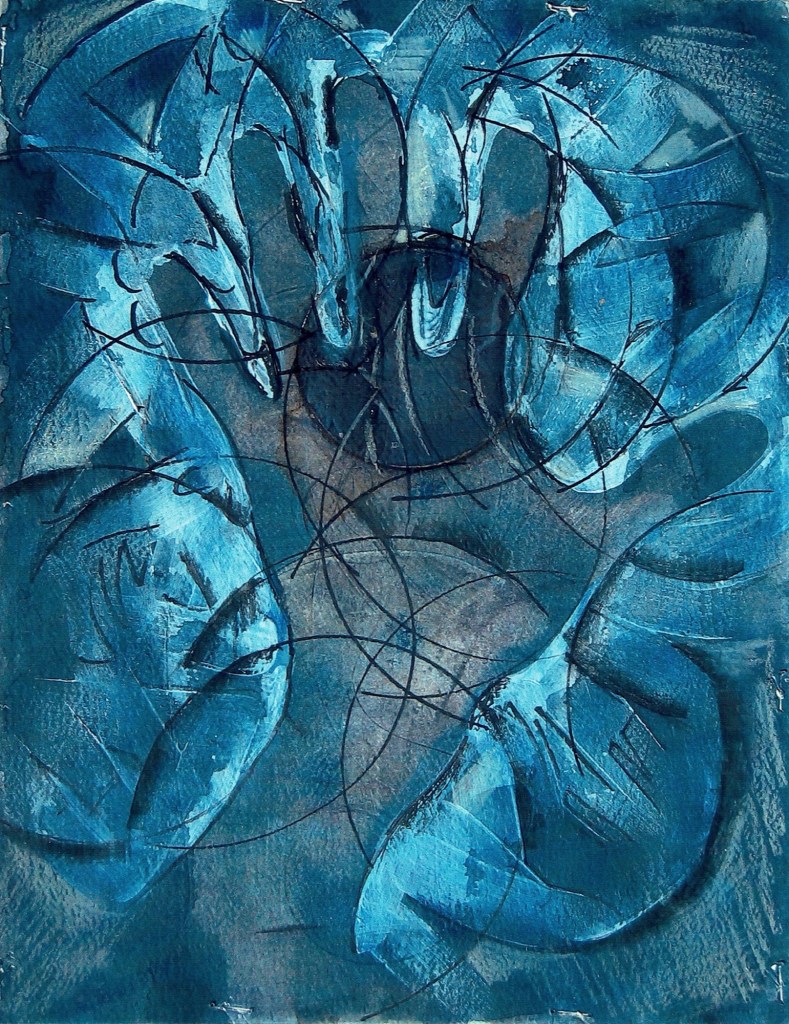
Ricardo F. Morín Ligadura (Binding) Watercolor and ink with incised lines on cardboard 8 × 10 in. (20.3 × 25.4 cm) 2005
The United States does not cease to be bound by law when it acquires the power to determine what another country may do. Its officials require authority under American law. The State remains subject to its international obligations. Neither requirement is satisfied merely because the government affected by American power agrees to the resulting arrangement.
Venezuelan constitutional authority and American legal responsibility are distinct questions. The first concerns the competence to grant rights over the Republic’s wealth. The second concerns the means by which the United States obtained those rights and the authority under which its officials acted. An American contract cannot supply a missing Venezuelan competence. Venezuelan governmental consent cannot supply a missing American power or excuse a breach of an international obligation binding the United States.
The distinction was already present before the January intervention. On December 23, 2025, the Department of Justice’s Office of Legal Counsel advised that the President could order military personnel to assist in removing Nicolás Maduro from Venezuela for prosecution in the United States. The memorandum expressly addressed domestic law. Its opening conclusion depended on the national interests served and on the anticipated force remaining below the level of war in the constitutional sense. [1]
The opinion supplied the executive branch’s interpretation of presidential authority for the proposed operation. Congressional authorization and judicial review remain separate sources of constitutional judgment. Each subsequent exercise of American power over Venezuela’s government, revenues, or petroleum requires its own legal basis.
The Constitution assigns Congress the power to declare war and makes the President Commander in Chief. The disputed boundary between those powers cannot be settled by the President’s description of his own conduct. Nor does an executive opinion addressing that boundary determine whether another State’s sovereignty may lawfully be violated. [2]
On January 4, Ambassador Mike Waltz publicly invoked self-defense under Article 51. [3] On January 5, he told the Security Council that the United States had conducted a law-enforcement operation with military assistance. He invoked the indictments against Maduro and Cilia Flores, the President’s responsibility to protect Americans, and Maduro’s lack of legitimacy. He also denied that the United States was occupying Venezuela. [4]
An indictment authorizes proceedings within a legal system. It does not, by itself, authorize the use of armed force within another State. The United Nations Charter prohibits force against territorial integrity or political independence. The pertinent grounds for departing from that prohibition include Security Council authorization and self-defense; valid territorial consent presents a separate inquiry. Article 51 identifies an armed attack as the condition for the inherent right it preserves. [5]
The Administration must explain how those justifications fit together and establish the conditions required by each. A prosecutorial purpose does not itself satisfy the international requirements for self-defense; invoking self-defense does not itself establish domestic authority for the operation. The Administration must identify the armed attack relied upon and explain the necessity and proportionality of its response. Article 51 also requires immediate reporting of self-defense measures to the Council. [5]
On January 6, the United Nations Human Rights Office rejected unilateral military intervention as a means of obtaining accountability for Venezuela’s human-rights violations and described the operation as undermining the prohibition on force. On January 13, the Inter-American Commission on Human Rights likewise insisted on respect for sovereignty, non-intervention, and the prohibitions on aggression and force, while reiterating its findings concerning the Maduro government’s repression. [6][7]
Those institutional assessments identify obligations that remain binding when the target government commits abuses. If the Administration relies instead on an invitation to intervene, it must identify valid consent given before the operation and establish that its forces acted within that consent. Recognition of a preferred authority cannot stand in for the consent itself. [8]
The War Powers Resolution subjects presidential military action to reporting and termination requirements. [9] On January 14, the Senate sustained a point of order against the privileged status of S.J.Res. 98, a measure directing the removal of American forces from unauthorized hostilities within or against Venezuela. Senators divided fifty to fifty; the Vice President voted in the affirmative. [10]
That vote blocked the measure’s progress and left the statutory question unresolved. Congress grants authority through law. A defeated effort to restrain the President records a political failure to impose restraint, rather than an affirmative grant of the disputed power.
The financial arrangements raise their own questions of American authority.
Executive Order 14373, issued on January 9, identifies specified Venezuelan natural-resource revenues as Venezuelan sovereign property and describes American possession as custodial. Yet it assigns the Secretary of State responsibility for determining the public, governmental, or diplomatic purposes for which those funds may be disbursed, and directs Treasury to follow the Secretary’s instructions. [11]
The order invokes the International Emergency Economic Powers Act. Section 1702(a)(1)(B) authorizes extensive regulation of foreign-property transactions. Section 1702(a)(1)(C) separately permits confiscation when the United States is engaged in armed hostilities or has been attacked, subject to a presidential determination connecting the foreign owner to those hostilities or attacks. The statute distinguishes transaction control from vesting ownership for American benefit. [12]
The Administration must account for its conduct under that distinction. Its January order claims custody while assigning American officials decisions over the use of Venezuelan wealth. Any later acquisition of ownership requires authority for that acquisition. Powers to control transactions cannot simply be treated as powers to take property for American benefit. [11][12]
Senators Ron Wyden, Elizabeth Warren, and Sheldon Whitehouse addressed precisely the problem of control without ownership in a letter dated September 16 and released the following day. Citing public reporting, they referred to at least $13 billion in Venezuelan oil revenues deposited in a Treasury custody account. They asked what constitutional or statutory constraints govern funds that the United States does not own but whose use its officials control. [13]
The senators requested account statements, transaction records, Venezuelan spending requests, and safeguards against improper disbursements. Their October 5 response deadline remained open on September 30. The letter places the Administration under a formal demand to account for its authority and conduct. [13] The Administration’s own order classifies those funds as Venezuelan sovereign property held in American custody. On that premise, the Administration must account for the authority by which American officials determine their use. [11]
The petroleum arrangement adds a further act requiring authority. On August 31, the White House announced that North American Blue Energy Partners had granted the Office of Strategic Capital a 35 percent equity interest in its corporate parent. It also announced preferential purchasing rights and powers over corporate governance. The fact sheet emphasized that the American interest came at no cost to the taxpayer. [14]
Acceptance, administration, and disposition of that interest each require legal authority. A zero acquisition price answers a question about cost, while leaving the agency’s power to acquire the asset to be demonstrated. Any proceeds received for the United States must also be accounted for under federal law governing public receipts and expenditures. [15]
A Congressional Research Service report updated September 8 describes the Office of Strategic Capital’s capital-assistance program in terms of loans, loan guarantees, and technical assistance. It separately identifies proposed legislation that would authorize certain equity investments. [16]
The Administration must therefore identify the particular legal basis for the NABEP interest. The operative instrument and the authority invoked would permit assessment of whether the transaction falls within an existing power and satisfies its conditions. A press announcement leaves that statutory account incomplete.
American statutory authority, even if established, would answer only the domestic question. International law determines separately whether the United States has breached an obligation owed outside its own legal order. Article 3 of the International Law Commission’s articles on State responsibility expresses the distinction: an act’s treatment as lawful under internal law does not determine its international lawfulness. [17]
The Charter of the Organization of American States addresses the acquisition of advantage with particular precision. Article 19 prohibits direct and indirect intervention. Article 20 prohibits economic or political coercion intended to force another State’s sovereign will and obtain advantages. Article 21 rejects recognition of territorial acquisitions or special advantages obtained through force or other coercive means. [18]
These provisions subject the relation between pressure and benefit to law. Coercive intervention can occur without military occupation, and a private company can serve as the vehicle through which governmental pressure secures an advantage.
The documented sequence is consequently material: American force removed the president; an American order placed decisions over Venezuelan revenues under American supervision; the Administration then announced enduring American interests in petroleum production and corporate governance. In April, President Trump had already described the economic relationship as resembling a joint venture and stated that the attack had paid for itself many times over. [4][11][14][19]
The sequence supports an inference connecting intervention to economic advantage. A finding of prohibited coercion must establish how American pressure constrained Venezuela’s sovereign choice and contributed to obtaining the particular rights. The President’s own description supplies evidence of that connection and requires the military action and economic return to be examined together.
The Administration’s reliance on governmental agreement must therefore be examined within the circumstances in which that agreement was obtained. Consent is relevant. Its existence on an instrument cannot, without examination, dispose of a claim that force or coercion procured it.
The corporate structure requires equal precision. The White House distinguishes its agreement with NABEP, governed by American law, from the company’s Venezuelan concessions, governed by Venezuelan legislation. [14] A contract with a private corporation is not automatically a treaty between States. Any associated intergovernmental commitments must be identified before rules governing treaty validity are applied.
Where the instrument is a treaty, the rule expressed in Article 52 of the Vienna Convention addresses consent procured through unlawful threats or force. The United States’ non-ratification requires attention to the applicable customary rule. The prior question about American conduct nevertheless remains direct: did the United States use prohibited force or coercion to obtain the advantages it now claims? [20][21]
American officials remain answerable for their own acts throughout that corporate structure. Their decisions to direct revenues, acquire interests, and exercise governmental powers are conduct of the United States. Attribution of additional corporate conduct requires further evidence, but the Administration’s own participation is already the subject of its announcements. [17]
Permanent sovereignty over natural resources supplies another applicable principle. Its legal standing does not depend solely on the status of a General Assembly declaration. The International Court of Justice has recognized it as a principle of customary international law, expressly reaffirming that character in its advisory opinion of July 19, 2024. [22]
Its application requires attention to the policy and conduct established by the evidence. Here the Administration has expressly announced a policy of securing American benefit from Venezuelan resources. A Venezuelan private beneficiary and an American governmental beneficiary can participate in the same transaction without either representing the sovereign people whose resources give it value.
Occupation would impose additional obligations if the facts establish it. Under the Hague Regulations, the relevant condition is effective authority over territory by hostile armed forces. Financial supervision and political predominance alone do not establish that condition. An American denial does not disprove it. The inquiry must concern the authority actually exercised over particular territory during the relevant period. [23]
If occupation is established, its law limits the occupant’s administration of public property and natural resources. The occupant does not acquire sovereignty. Its powers are temporary, and the rules governing usufruct require preservation of the capital of the resources administered. The International Court of Justice has reiterated those limits. [22][23]
The prohibitions on unlawful force and coercive intervention apply independently of that territorial classification. Responsibility for the intervention and the advantages obtained through it can therefore be examined while the evidence concerning occupation remains incomplete.
The Administration owes a specific account: the authority for its equity interest, the rules governing its directions over sovereign revenues, and the legal justification for the force and pressure through which the announced advantages were obtained. The operative instruments and transaction records are necessary to test that account. Their absence leaves the Administration’s claims of lawful authority unsubstantiated at precisely the points where its conduct requires explanation.
Congressional oversight, statutory limits, and international obligations address the conduct from different legal positions. Enforcement may remain contested and adjudication incomplete. The Administration nevertheless bears the burden of identifying the powers it exercises and answering the obligations its conduct engages.
The Administration has announced what the United States obtained. It has not thereby established what American law authorized its officials to acquire or what international law permitted the United States to exact.
The law governing that conduct is not a condition the United States may impose on Venezuela. It is an obligation the United States must meet itself.
Ricardo F. Morín
September 30, 2026
Bala Cynwyd, Pennsylvania
Notes
[1] U.S. Department of Justice, Office of Legal Counsel, “Proposed War Department Operation to Support Law Enforcement Efforts in Venezuela,” December 23, 2025, especially pp. 1–2; publicly released in redacted form.
[2] Constitution of the United States, Article I, Section 8, Clause 11, and Article II, Section 2, Clause 1. Congress.gov, Constitution Annotated, 2024 Supplement, discussion of presidential and congressional war powers.
[3] Ambassador Mike Waltz, interview on Fox News Sunday Morning Futures, January 4, 2026, invoking Article 51; broadcaster’s report and embedded interview. This public statement is distinct from a communication to the Security Council reporting measures taken in self-defense.
[5] Charter of the United Nations, Articles 2(4), 39–42, and 51. The record reviewed for this essay does not establish whether the United States submitted an Article 51 communication reporting the January operation. No finding of failure to report is made.
[6] Office of the United Nations High Commissioner for Human Rights, statement by spokesperson Ravina Shamdasani on the United States intervention in Venezuela, January 6, 2026; official UN Geneva transcript.
[7] Inter-American Commission on Human Rights, “IACHR expresses concern over armed incursion in Venezuela, calls for respect for international law, and the end of repression,” January 13, 2026.
[8] International Law Commission, Articles on Responsibility of States for Internationally Wrongful Acts, with commentaries, 2001, Article 20 and its commentary, concerning valid consent, its limits, and consent given before the act. The commentary supplies the consent framework, not a determination of which Venezuelan authority could invite intervention. A claim of invitation by a recognized authority lacking effective control requires examination of that authority’s international capacity, the timing and scope of its consent, and the conduct authorized. Recognition alone does not resolve those questions.
[9] War Powers Resolution, 50 U.S.C. §§ 1543(a)(1), 1544(b), and 1547. The sixty-day rule concerns the report submitted or required under § 1543(a)(1); the additional thirty-day period requires the presidential determination specified in § 1544(b). Applying the clock requires establishing when a report was submitted or required and whether the relevant use of forces continued. Continuing financial supervision is not itself continuing military hostilities.
[10] United States Senate, Roll Call Vote No. 9, 119th Congress, Second Session, January 14, 2026, point of order concerning the privileged status of S.J.Res. 98.
[11] Executive Order 14373, “Safeguarding Venezuelan Oil Revenue for the Good of the American and Venezuelan People,” January 9, 2026, especially Sections 4(a), 4(b), 4(c)(ii), and 5(a)(ii).
[12] International Emergency Economic Powers Act, 50 U.S.C. §§ 1701–1702, especially § 1702(a)(1)(B)–(C). The armed-hostilities condition in subsection (C) is distinct from the constitutional-war threshold discussed by OLC. Subsection (C) also requires a presidential determination that the foreign owner planned, authorized, aided, or engaged in the relevant hostilities or attack. Acquisition of a corporate interest requires identification of its own legal basis; it is not classified here as confiscation merely because the acquirer is governmental.
[13] Senators Ron Wyden, Elizabeth Warren, and Sheldon Whitehouse, letter to Treasury Secretary Scott Bessent and Secretary of State Marco Rubio, dated September 16, 2026, released September 17, 2026, pp. 1–3. The committee release and download title bear the September 17 date; the letter itself bears September 16.
[14] The White House, “Fact Sheet: President Donald J. Trump Announces Historic Oil Agreement to Secure American Energy Dominance and Drive Venezuela’s Economic Recovery,” August 31, 2026.
[15] Constitution of the United States, Article I, Section 9, Clause 7; Miscellaneous Receipts Act, 31 U.S.C. § 3302(b). Section 3302(b) generally requires deposit of money received for the Government, subject to applicable statutory exceptions. The Appropriations Clause governs withdrawals from the Treasury. Venezuelan sovereign funds held in custody are not automatically American public receipts or appropriations. Receipts accruing to an American governmental equity interest require separate classification.
[16] Congressional Research Service, “Office of Strategic Capital: Overview and Considerations,” IF13215, updated September 8, 2026, sections on the capital-assistance pilot program and issues for Congress. Public reproduction of the CRS report.
[17] International Law Commission, Articles on Responsibility of States for Internationally Wrongful Acts, 2001, especially Articles 2–5, 8, and 20; annexed to General Assembly Resolution 56/83. These articles are not a treaty; many provisions reflect customary law. Article 4 concerns State organs. Article 5 requires legal empowerment to exercise governmental authority and conduct in that capacity; ordinary corporate governance rights do not themselves establish such delegation. Article 8 concerns particular conduct under State instructions, direction, or control. State equity alone does not attribute all corporate conduct.
[20] Vienna Convention on the Law of Treaties, 1969, Articles 2(1)(a), 46, and 52. Article 46 provides a separate, narrow connection between internal competence and international validity: the violation must concern a fundamental internal rule governing treaty-making competence and be manifest. The expiry of a temporary presidential-substitution period does not by itself establish those conditions or invalidate every subsequent act. That issue remains distinct from responsibility for American force or coercion.
[21] U.S. Department of State, “Vienna Convention on the Law of Treaties,” archived treaty-law guidance on the United States’ signature, non-ratification, and recognition of customary treaty law.
[22] International Court of Justice, Legal Consequences arising from the Policies and Practices of Israel in the Occupied Palestinian Territory, including East Jerusalem, Advisory Opinion, July 19, 2024, paragraphs 124–125, 133, and 240; reproduced in UN document A/78/968. The opinion discusses Armed Activities on the Territory of the Congo (Democratic Republic of the Congo v. Uganda), Judgment, December 19, 2005, paragraph 244. In the 2005 judgment, the Court declined to apply permanent sovereignty to the looting and exploitation there considered. Paragraph 125 of the 2024 opinion distinguishes the absence of credible evidence of a governmental exploitation policy in that case from exploitation pursued as governmental policy contrary to occupation-law duties. The principle is therefore neither categorically inapplicable to occupation nor a substitute for establishing the relevant facts and obligations.
[23] International Committee of the Red Cross, “Occupation and international humanitarian law,” August 4, 2004, especially the discussion of Hague Regulations Articles 42 and 55 and the factual test for occupation.
The constitutional question now presented by Venezuela does not begin with petroleum. It begins with the identity of the sovereign.
Article 5 of the Constitution in force states that sovereignty resides in the people and cannot be transferred. It specifies that the people exercise sovereignty directly in the forms provided by the Constitution and law and indirectly, through suffrage, by the organs exercising Public Power. It then establishes the relation on which the rest depends: the organs of the State emanate from popular sovereignty and remain subject to it. [1]
That language does not identify government with the sovereign people. It distinguishes the sovereign from the organs through which sovereign authority is exercised. A president, legislature, ministry, State enterprise, or interim administration may exercise constitutional competencies. None becomes the sovereign by exercising them. Governmental power is constituted power. Sovereignty remains with the people.
Article 12 gives this distinction a material object. Mineral and hydrocarbon deposits belong to the Republic, are property in the public domain, and are inalienable and imprescriptible. The deposits do not belong to the officials administering the Republic. Temporary control of governmental institutions does not convert public-domain wealth into the property of those who control them. [2]
The relation between Articles 5 and 12 therefore precedes any petroleum agreement. The Republic possesses the deposits. State organs may act concerning them only through authority conferred by the constitutional order. The sovereign source of those organs remains the people.
That structure has acquired immediate consequence because the United States has not merely facilitated commerce in Venezuelan petroleum. The present Administration publicly describes an arrangement designed to secure American governmental and economic advantages over Venezuelan reserves on a scale and for a duration extending far beyond the present political transition.
On August 31, 2026, the White House announced what it called the biggest oil deal in world history. It said Venezuelan interim authorities had granted North American Blue Energy Partners 100-year concessions over 17 fields containing approximately 65 billion barrels of proven reserves. The same announcement described United States “majority control,” governmental governance rights, “economic ownership,” a 35 percent equity interest for the Department of War’s Office of Strategic Capital, a guaranteed right for the Department of State to purchase 20 percent of production at cost, a right of first refusal over the remaining 80 percent, veto authority over appointments to the company’s board, and a requirement that a majority of directors be United States citizens. [3]
The Administration did not present those provisions as incidental protections surrounding a Venezuelan development program. It presented them as American achievements. The White House said the arrangement would secure American “energy dominance for the next century,” expand the reserves effectively available to the United States, support American refineries and employment, and provide low-cost petroleum for the Strategic Petroleum Reserve, military requirements, and other sensitive uses. [3][4]
The United States is not an accidental beneficiary of an arrangement designed elsewhere. The benefits to the United States are stated as objectives of the policy itself.
The same fact sheet describes the arrangement as part of stabilization, reconstruction, and eventual democratic transition. It says the new hydrocarbons framework was adopted with United States support. It describes United States governance and audit provisions, banking reform, payment oversight, and financial monitorship as means by which tax and royalty payments will be supervised. It also says the United States is sponsoring reconciliation talks between the 2015 National Assembly and the interim authorities. [3]
The vocabulary of transition therefore accompanies a structure in which the foreign power that intervened militarily has acquired enduring economic interests, governance rights, purchasing privileges, and supervisory functions over the principal natural resource of the country in transition.
The present interim administration did not obtain its current mandate through a new national election following the January United States military action. As of late September, its president continued to promise elections as part of a transition to full democracy without establishing a firm election date. The United States itself continues to describe democratic transition as prospective. [3][5][6]
That circumstance does not make Article 5 disappear. It makes Article 5 unavoidable.
If sovereignty were vested in whoever happened to control the machinery of government, effective control would answer the constitutional question. Article 5 says otherwise. The organs of the State emanate from popular sovereignty and remain subject to it. The Constitution therefore refuses the identification of governmental possession with sovereign ownership. [1]
The current National Assembly’s subsequent endorsement of the petroleum arrangement is part of the constitutional record. On September 1, it backed the arrangement by a show-of-hands vote. Some opposition deputies abstained because they had not been able to examine the written terms. [7] But an act of a constituted organ is not identical with the sovereign from which Article 5 says constituted authority derives. Legislative approval must possess constitutional competence for the act approved. The existence of a vote cannot, by itself, transform the organ casting it into the sovereign people or cure an antecedent absence of authority if the power purportedly exercised was not constitutionally available to that organ.
This is the distinction between representation and sovereignty. Representatives may exercise constitutionally conferred powers on behalf of the people. They do not own the sovereignty they exercise. Article 5 keeps the representative subject to the sovereign represented.
The distinction is particularly consequential where the commitment is intended to endure for a century. One hundred years is not a transitional interval. A concession of that duration reaches beyond the officials who granted it, beyond the present American Administration, beyond the promised democratic transition, and through generations of Venezuelans who had no part in the governmental circumstances under which it was created.
The American record itself recognizes, in another context, that control and possession do not extinguish Venezuelan ownership. Executive Order 14373, issued on January 9, defines specified natural-resource revenues held in United States Treasury accounts in Section 2 and determines in Section 4(a) that those funds are property of the Government of Venezuela. It says the United States holds those funds solely in a custodial and governmental capacity, not as a market participant, and requires Treasury to designate them as sovereign property of Venezuela rather than property of the United States. [8][9]
Yet Section 4(c)(ii) of the same order provides that those funds are held pending “sovereign disposition” for public, governmental, or diplomatic purposes determined by the United States Secretary of State on behalf of the Government of Venezuela. Section 5(a)(ii) directs Treasury to follow the Secretary of State’s instructions concerning disbursements and transfers. [8]
From January onward, the Administration thus assigned an American officer authority to determine the purposes for which Venezuelan sovereign property would be used. Venezuelan ownership remained formally acknowledged while decisions concerning its exercise passed to an officer of the intervening State. The authority by which that officer could determine sovereign purposes on Venezuela’s behalf was asserted in an American order rather than supplied by the Venezuelan Constitution.
Nearly eight months later, the petroleum arrangement added proprietary advantages to that supervisory structure. The White House described United States economic ownership, majority control, veto rights, preferential acquisition, and a governmental equity interest protected against dilution. Reuters reported that the 35 percent position was structured through penny warrants intended to preserve the United States ownership level as additional capital entered the enterprise. [3][10]
The sequence is not one of ignorance about whose resources are involved. The American documents repeatedly identify the reserves, revenues, concessions, and deposits as Venezuelan. The Administration knows the object is Venezuelan wealth. Its own January order expressly recognizes Venezuelan sovereign property. Its later announcements expressly identify the advantages sought for the United States. [3][8]
The Venezuelan juridical record identifies the force that altered the governmental circumstances. On January 3, the Constitutional Chamber described the United States action as an agresión militar extranjera [foreign military aggression] undertaken for the secuestro[abduction] of Nicolás Maduro. It treated his resulting ausencia forzosa [forced absence] as a material and temporary impossibility of exercising presidential functions. Invoking its interpretation of Articles 234 and 239.8, the Chamber ordered Vice President Delcy Rodríguez to exercise the presidency through an urgent precautionary measure intended to preserve the State and defend the Nation. It left the definitive classification of the absence to the competent State organs. [11]
The ruling that named the aggression also ordered the acting presidency whose consent the United States now invokes. Dismissing the Chamber as an organ of the former government does not supply an independent constitutional basis for that consent. The government maintained through the Chamber’s response subsequently became the channel through which the United States obtained the petroleum advantages it announced in August.
The President of the beneficiary State had already connected the military action to its economic return. On April 30, President Trump described the relationship with Venezuela as “like a joint venture,” said both countries were making money, and declared that the United States had “paid for the attack many times over.” [12]
Exploitation does not mean every foreign investment, petroleum sale, loan, or commercial concession. It denotes the deliberate extraction of advantage from another nation’s resources under conditions in which the foreign beneficiary possesses extraordinary power over the governmental circumstances through which consent is purportedly obtained. The asymmetry is recorded on both sides: the Venezuelan Chamber named the aggression and ordered a defensive measure; the American President described the resulting economic relationship as a joint enterprise that had repaid the attack. The August arrangement then gave enduring economic and governmental form to that advantage.
The White House’s own language makes the contradiction sharper. Its August fact sheet accuses Russian and Chinese actors, along with Venezuelan political cronies, of having “looted Venezuela’s resources” for the benefit of American adversaries. The same document then celebrates the displacement of those actors by a system designed to ensure American dominance in the hemisphere, American governmental control, American economic ownership, American purchasing privileges, and American strategic supply. [3][4]
The nationality of the beneficiary cannot determine whether Venezuelan sovereignty has been respected. If foreign control of Venezuelan resources is objectionable because the resources belong to Venezuela, changing the foreign beneficiary does not alter the constitutional location of Venezuelan sovereignty or the juridical status of the deposits.
The constitutional issue is not whether Venezuela may receive foreign capital, sell petroleum, or enter long-term commercial relations. It is the source of the authority by which the Republic is bound. Investment describes capital. Contract describes an instrument. Recognition describes a foreign government’s diplomatic position. None of those categories, by itself, supplies Venezuelan sovereign competence.
The distinction becomes still more important when corporate form intervenes. The White House has emphasized the role of a private company and the use of private American capital. [3][4] But a private corporation cannot grant itself a Venezuelan petroleum concession. The underlying right to exploit deposits belonging to the Republic must originate in Venezuelan law. Private corporate arrangements can distribute economic interests after a right exists. They cannot create the sovereign authority necessary to create the right in the first place.
Reuters identifies North American Blue Energy Partners as controlled by the Venezuelan businessman Alejandro Betancourt. [10] The arrangement therefore joins a Venezuelan private beneficiary to the American governmental interests it expressly creates. The advantage obtained by the United States need not be exclusive to be deliberate. Nor does a Venezuelan businessman’s private interest constitute the consent of the Venezuelan people. His participation does not alter the need to establish the constitutional authority for granting rights over the Republic’s deposits.
Nor can American law answer that antecedent Venezuelan question. American statutes, executive orders, licenses, contracts, and judicial jurisdiction can determine what United States officials and American entities may do under United States law. They cannot determine what authority Venezuelan officials possess under the Constitution of Venezuela to bind the Republic.
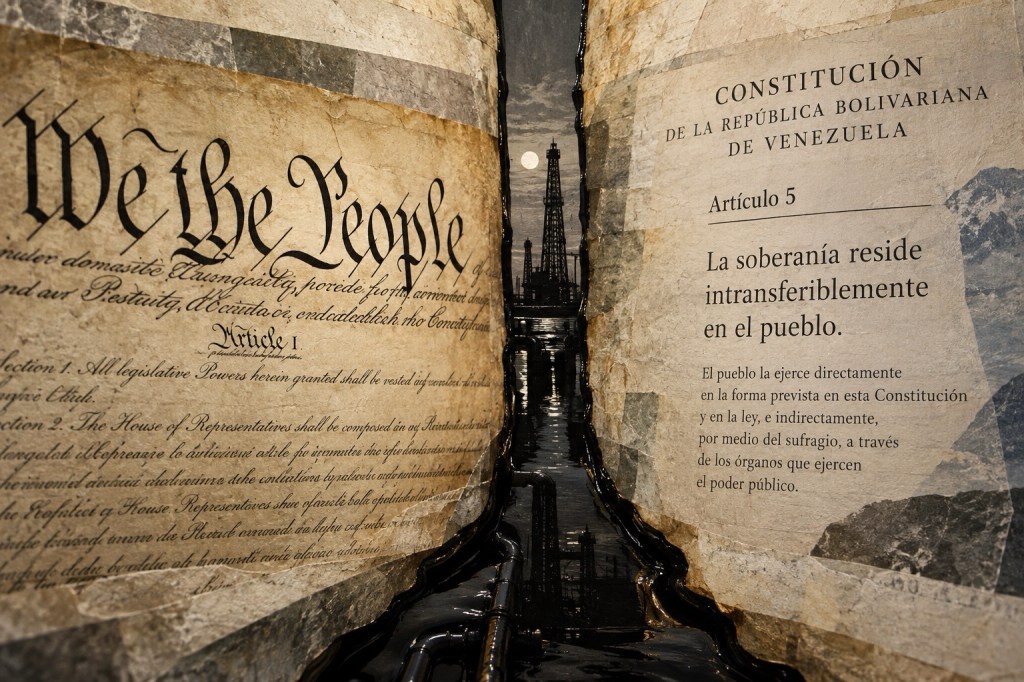
The American Preamble begins “We the People,” and American constitutional doctrine treats those words as identifying the source that ordained and established the Constitution. But the Supreme Court has not treated the Preamble as an independent source of substantive governmental power. Venezuela’s Article 5 is not prefatory language. It is an operative constitutional provision defining where sovereignty resides, how it is exercised, where State organs derive from, and to what they remain subject. [1][13][14]
Translating Article 5 into the familiar American phrase “We the People” would diminish rather than clarify it.
Article 5 is more exact. The people do not merely appear at the founding moment and then disappear into the institutions they created. Sovereignty remains theirs. Government does not receive sovereignty as property. It exercises constituted powers while remaining subordinate to the sovereign source from which those powers emanate.
The distinction between the sovereign people and their representatives determines what governmental consent can mean.
A representative act can bind the Republic only because the constitutional order gives the representative authority to perform that act. Representation is therefore derivative. Sovereignty is not. To treat the consent of representatives as self-validating is to reverse the constitutional relation Article 5 establishes.
The problem becomes more acute when the governmental order supplying the consent exists under foreign tutelage. The January order placed decisions over Venezuelan sovereign revenues in American hands. The subsequent structure extended that supervision across the transition: the foreign State sponsors political reconciliation, supports the legal framework governing the resource, claims audit and financial-monitoring functions, acquires governance rights and vetoes in the resulting enterprise, receives economic ownership and preferential purchasing rights, and openly describes the arrangement as securing its own dominance. [3][4][8]
Under those conditions, governmental consent cannot be treated as evidence independent of the foreign power obtaining the benefit. The foreign beneficiary participates in the political and institutional environment from which the purported consent emerges.
When the petroleum arrangement was announced, even the maximum temporary-substitution period under Article 234 had expired. Article 234 provides for substitution during a temporary presidential absence for up to ninety days, extendable by the National Assembly for up to ninety more. The first period ended on April 3. [1] On April 6, the Associated Press reported that the Assembly had taken no public vote to authorize an extension. [15] Even assuming authorization of the maximum second period, the outermost 180-day limit ended on July 2. [1]
On July 15, Acceso a la Justicia reported that the Assembly still had not pronounced on the presidential absence. It argued that the exhausted temporary period required the Assembly to activate Article 233 and the new presidential election prescribed within thirty consecutive days. Its reading permits Rodríguez to continue transitionally until an elected president takes office. That continuation does not dispense with the succession determination or the election; it exists pending their completion. [16]
On August 31, the White House announced the grant of rights it described as lasting a century. The Assembly’s failure to resolve the absence had been publicly documented, and the election required under the Article 233 reading had not occurred. By late September, there was still no firm election date. [3][5][6][16]
The Assembly’s endorsement supplied political support for a commitment reaching across generations while the constitutional duties governing the presidency making that commitment remained unperformed. [7][16]
The constitutional authority has not been established merely by pointing to the consent of the interim administration. That consent is precisely what is in question. A government continuing beyond the temporary-substitution period, without completion of the succession and electoral duties governing the transition, cannot be identified with the sovereign Venezuelan people merely because it continues to exercise governmental power. The foreign power that altered the circumstances of that government cannot invoke its consent as independent evidence that the Venezuelan people consented to the appropriation of the Republic’s natural wealth.
The intervening State invokes the consent of the governmental order maintained after its intervention as the juridical basis for its own acquisition. The circle never reaches the sovereign identified by Article 5.
The defense that someone had to govern establishes the need for continuity. It does not establish that continuity required granting the intervening State enduring ownership interests and preferential access to Venezuelan wealth. The Administration’s own January response to the emergency expressly distinguished custody and administration from proprietary acquisition. Its August arrangement crossed that distinction. Neither the need to preserve revenues nor the absence of an elected successor supplies authority to turn temporary administration into century-long foreign advantage.
Calling the arrangement reconstruction does not establish that authority. Calling it privatization does not establish it. Calling it stabilization does not establish it. Calling it a contract does not establish it. Each term describes a policy, mechanism, or objective. None establishes the Venezuelan constitutional source of the authority exercised.
Article 12 places the deposits in the public domain of the Republic. Article 5 places sovereignty in the people. Between those provisions stand the organs of government, possessing only the authority the constitutional order gives them. [1][2]
The constitutional chain therefore runs in one direction: from the sovereign people, through constituted authority, to the administration of the Republic and its public wealth. It does not run backward from possession of governmental offices to ownership of sovereignty.
A foreign power can acquire physical access. It can acquire contractual rights. It can acquire economic leverage. It can obtain governmental cooperation. It can exercise military superiority. It can even obtain effective control over institutions and revenues. None of those conditions changes the constitutional identity of the Venezuelan sovereign.
The Administration’s rhetoric of victory makes the distinction still more stark. On September 22, while discussing Venezuela and the oil agreement in his address to the United Nations General Assembly, President Trump said, “To the victor belong the spoils.” [17] A victor may possess the capacity to take advantage of circumstances created by victory. Capacity is not title. Superior force can explain how control was obtained. It cannot establish, by itself, the Venezuelan constitutional authority by which control becomes lawful.
That is why the issue cannot be reduced to whether the petroleum arrangement will increase production, attract investment, lower prices, rebuild infrastructure, or generate tax revenue. Those consequences may be economically important. They do not answer the antecedent question.
The question is who possessed authority to consent.
Under Article 5, that inquiry cannot end with the identification of those presently occupying governmental institutions. The organs of the State are not the source of sovereignty. They emanate from it and remain subject to it. [1]
Under Article 12, the object of the transaction is not ordinary governmental property available to rulers in their own right. The deposits belong to the Republic as public-domain property. [2]
The United States may call its role stabilization. It may call its interests economic ownership. It may call its supervision reconstruction. It may call its dominance strategic necessity. Venezuela’s Constitution supplies the prior vocabulary: people, sovereignty, Republic, Public Power, public domain, competence.
Those terms determine the Venezuelan question.
The American Administration’s own record establishes that the acquisition of advantage is deliberate. It announces the control, quantifies the ownership, fixes the purchasing privilege, protects the equity position, imposes governance conditions, celebrates the absence of cost to the American taxpayer, and states the objective of American dominance. [3][4][10]
The Administration has used the consent of the interim authorities to secure enduring American advantages over Venezuelan wealth. It has not established the Venezuelan constitutional authority by which those authorities could grant them.
Ricardo F. Morín
September 30, 2026
Bala Cynwyd, Pennsylvania
Notes
[1] Centro para la Integración y el Derecho Público (CIDEP), Constituciones de Venezuela, Constitución de 1999, Articles 5, 233, 234, and 239.8.
[3] The White House, “Fact Sheet: President Donald J. Trump Announces Historic Oil Agreement to Secure American Energy Dominance and Drive Venezuela’s Economic Recovery,” August 31, 2026.
[7] Reuters, “Venezuela’s assembly backs oil deal announced with U.S.,” September 1, 2026. Euronews, “Venezuela hands the US control over a fifth of its oil in landmark deal,” September 2, 2026, reports the show-of-hands vote and the abstention of opposition deputies who had not been able to examine the written terms.
[8] Executive Order 14373, “Safeguarding Venezuelan Oil Revenue for the Good of the American and Venezuelan People,” January 9, 2026, especially Sections 2, 4(a), 4(b), 4(c)(ii), and 5(a).
[9] The White House, “Fact Sheet: President Donald J. Trump Safeguards Venezuelan Oil Revenue for the Good of the American and Venezuelan People,” January 9, 2026.
[10] Reuters, “US structured Venezuela oil position to protect it from dilution, official says,” September 4, 2026. Also identifies NABEP as controlled by Venezuelan businessman Alejandro Betancourt.
[11] Acceso a la Justicia, “La SC ordena que Delcy Rodríguez, Vicepresidenta Ejecutiva, asuma y ejerza en condición de ‘encargada’ la presidencia de la República,” January 3, 2026. Reproduces the Constitutional Chamber’s decision, including its descriptions of foreign military aggression, abduction, and forced absence, and its precautionary order under Articles 234 and 239.8.
[12] GovInfo, “Remarks During a Document Signing Ceremony and an Exchange With Reporters,” April 30, 2026, p. 8, official presidential transcript, including the descriptions “like a joint venture” and “we’ve paid for the attack many times over.”
[15] Associated Press, “Venezuela’s Delcy Rodríguez remains acting president after her initial 90-day appointment expired,” April 6, 2026. Reports that the National Assembly had not taken a public vote to extend the initial period.
[16] Acceso a la Justicia, “¿Qué ocurre con la encargaduría presidencial?”, July 15, 2026. Reports the Assembly’s failure to pronounce on the presidential absence, argues for activation of Article 233 following exhaustion of the temporary-substitution period, and reads the Constitution as permitting transitional service until the elected president takes office.
[17] Factba.se / Roll Call, transcript of President Donald J. Trump’s address to the 81st Session of the United Nations General Assembly, September 22, 2026, including the statement “To the victor belong the spoils” following his discussion of the Venezuela oil agreement.
“Geometric Allegory” digital painting (2023) by Ricardo Morín (American visual artist, born in Venezuela, 1954)
Scope and Use
This entry forms part of the constitutional corpus presented in the Appendix, comprising the constitutions of Venezuela organized for consultation rather than sequential reading. Comparison proceeds through permanent rubric codes whose identities remain constant throughout the corpus; absent rubrics signify constitutional silence, while retired rubrics are not reassigned. Citations are anchored first on the article number and follow the CIDEP recension linked at the close of the entry. The corpus definition, editorial methodology, and citation convention are set forth in the Scope and Use note introducing the nineteenth-century constitutions in “Unmasking Disappointment: Series XI”.
Ricardo F. Morín Sept , 2026 Bala Cynwyd, Pennsylvania
●
15). The Constitution of 1922
The 1922 Constitución de los Estados Unidos de Venezuela [Constitution of the United States of Venezuela] was declared sanctioned at the Palacio Federal Legislativo [Federal Legislative Palace], Caracas, on 19 June 1922, after the unanimous ratification recorded for the Asambleas Legislativas de los Estados [State Legislative Assemblies], and promulgated at the Palacio Federal [Federal Palace], Caracas, on 24 June 1922, under the provisional presidency of Victorino Márquez Bustillos.
Historical reference
President Victorino Márquez Bustillos, who had exercised the provisional presidency while President Juan Vicente Gómez held military command, signed the execution formula printed in the CIDEP recension with the date 24 June 1922. Gómez was elected President for the constitutional period 1922–1929 and resumed the exercise of the presidency in 1922.
Sources: CIDEP, Constitution of 1922, pp. 3 and 21; Ramón J. Velásquez, “Gómez, Juan Vicente,” Diccionario de Historia de Venezuela, Fundación Empresas Polar.
The Congreso de los Estados Unidos de Venezuela [Congress of the United States of Venezuela] invoked Article 133 of the existing Pacto Federal [Federal Compact] in its enacting formula:
“The Congress of the United States of Venezuela, in the name of Almighty God, and in exercise of the faculty conferred upon it by Article 133 of the Federal Compact in force, decrees the present Constitution.”
The formula differed from that of June 1914, which identified a congress of plenipotentiary deputies and the authority conferred by the district assemblies (cf. 1914, enacting formula: “The Congress of Plenipotentiary Deputies of the States forming the Venezuelan Union, in exercise of the power conferred upon it by the Assemblies of Plenipotentiary Deputies of the Districts of the States, in the name of Almighty God, decrees the present: Constitution.”).
FND-TER—Territory:
The territory comprised the former Capitanía General de Venezuela [Captaincy General of Venezuela], subject to modifications resulting from public treaties, and consisted of the territories of the States, the Distrito Federal [Federal District], the Territorios Federales Amazonas y Delta-Amacuro [Amazonas and Delta-Amacuro Federal Territories], and the Venezuelan islands in the Caribbean Sea (Art. 1; cont. 1914, Art. 1). The Nation retained the name Estados Unidos de Venezuela [United States of Venezuela], its declared independence, and its republican, federal, democratic, elective, representative, responsible, and alternating form of government (Arts. 8–9; cont. 1914, Arts. 8–9).
State boundaries continued to refer to the Ley de 28 de abril de 1856 [Law of 28 April 1856] and the modifications of 1909. Article 2 additionally recognized the boundary modifications agreed by Aragua and Carabobo in the Maracay Protocol of 31 January 1917 and approved by their respective legislative assemblies on 27 February and 2 March 1917 (cf. 1914, Art. 2: “[…] subject to the modifications established in the Constitution sanctioned by the National Congress on 4 August 1909 and ordered executed on 5 August of the same year.”).
Boundary controversies remained subject to referral by the Cámara del Senado [Chamber of the Senate], at the request of one or more affected States, to a tribunal of árbitros arbitradores [arbitrators empowered to decide in equity] freely appointed by the Ejecutivo Federal [Federal Executive] (Art. 3; cont. 1914, Art. 3).
The Distrito Federal [Federal District] retained Caracas, its enumerated outlying parishes, and the Departamento Vargas [Vargas Department]. Caracas remained the capital and seat of the general powers, with temporary executive residence elsewhere within the Federal District permitted in unforeseen circumstances (Arts. 4 and 6; cont. 1914, Arts. 4 and 6). Amazonas and Delta-Amacuro could attain statehood upon satisfying the population and administrative-capacity requirements; the Caribbean islands remained under direct federal administration until constituted as Territories (Art. 5; cont. 1914, Art. 5). The prohibition upon alienating, leasing, or ceding national territory to a foreign power remained (Art. 7; cont. 1914, Art. 7).
POW-LEG—Congress:
Legislative power remained vested in the Congreso de los Estados Unidos de Venezuela [Congress of the United States of Venezuela], composed of the Cámara de Diputados [Chamber of Deputies] and the Cámara del Senado [Chamber of the Senate] (Art. 34; cont. 1914, Art. 34). The ratio of one Diputado [Deputy] for thirty-five thousand inhabitants, with an additional Deputy for an excess of fifteen thousand and at least one for each State, the equal number of Suplentes [Alternates], and the three-year term remained. Deputies had to be Venezuelan by birth and at least twenty-one years of age. The Federal District and qualifying Federal Territories also elected Deputies (Arts. 35–37; cont. 1914, Arts. 35–37). Article 35 retained votación directa [direct voting], as confirmed by the scanned collection hosted by CIDEP, printed page 235; direct voting was also prescribed by Article 19, base 20, and Article 37 (cont. 1914, corresponding provisions).
The Cámara de Diputados [Chamber of Deputies] retained the power to censure Ministers, whose offices thereby ceased, and to elect the Procurador General de la Nación [Procurator General of the Nation] and two Alternates every three years (Art. 38; cont. 1914, Art. 38). Each State assembly elected two principal Senators and two Alternates from outside its membership for three years; Senators had to be Venezuelan by birth and at least thirty years of age (Arts. 39–40; cont. 1914, Arts. 39–40). The Senate retained its functions concerning boundary arbitration, interment in the Panteón Nacional [National Pantheon], foreign gifts and distinctions, and military and naval promotions (Art. 41; cont. 1914, Art. 41). For foreign gifts and distinctions, Article 41(3) referred to public employees, whereas its antecedent referred to national employees.
The Chambers continued to convene on 19 April or the nearest possible date, but their sessions now closed without extension on 5 July (Art. 42; cf. 1914, Art. 42: “The sessions shall last seventy non-extendable days.”). The provisions respecting quorum, public or secret sessions, internal regulation, concurrent sittings, incompatibilities, remuneration, immunity, non-responsibility for votes and opinions, contracts, and vacancies remained (Arts. 43–53; cont. 1914, Arts. 43–53).
The distinction between Leyes [Laws] enacted by the Chambers as co-legislators and Acuerdos [Resolutions] adopted jointly or upon matters exclusive to one Chamber remained, as did the presidency of the joint assembly by the President of the Senate (Arts. 54–56; cont. 1914, Arts. 54–56). The joint assembly retained its electoral, reporting, accounting, military-appointment, and statehood functions; its competence to receive resignations now expressly included the Vice Presidents (Art. 57; cf. 1914, Art. 57(3): “To take cognizance of the resignation of the President of the United States of Venezuela.”).
The common legislative attributions continued to encompass federal organic and electoral laws, taxation, codes, currency, public offices, debt and loans, statistics, sanitation, militia, census, treaties, contracts and concessions, the budget, weights and measures, pensions, military organization, war, and port security (Art. 58; cont. 1914, Art. 58). The census remained decennial; Article 58(8) no longer specified 1 January 1916 as the initial date.
Legislative initiative, three discussions in each Chamber, the treatment of disagreements, rejection, repeal, publication, nondelegation, and nonretroactivity remained regulated in Articles 59–71. Article 65 specified that pending projects received the three discussions in the following year in the Chamber in which they had not received them (cf. 1914, Art. 65: “Projects remaining pending in either Chamber at the end of the sessions shall undergo the same three discussions in the sessions of the following year.”). The other cited procedural provisions retained their corresponding antecedents (Arts. 59–64 and 66–71; cont. 1914, Arts. 59–64 and 66–71).
ECO-TES—Treasury:
The Chambers retained the powers to decree national taxes and authorize annual collection, regulate national debt and interest, decree loans, approve the specified contracts and concessions, and sanction the Presupuesto General de Rentas y Gastos Públicos [General Budget of Public Revenues and Expenditures] (Art. 58, nums. 2, 6–7, and 10–11; cont. 1914, Art. 58, same numbers).
State revenues continued to comprise the Impuesto Territorial [Territorial Tax] collected at customs houses; proceeds from mines, terrenos baldíos [public lands], and saltworks; the statutory share of the Renta de Aguardiente [Distilled-Spirits Revenue]; taxes upon the exploitation of natural products; and papel sellado [stamped paper]. The States delegated the establishment and organization of the first three revenue categories to the federal legislature and their administration to the Nation, with net proceeds distributed according to population (Art. 19, bases 27–28; cont. 1914, Art. 19, bases 27–28). The prohibition upon alienating public lands on maritime, fluvial, and lacustrine islands also remained (Art. 19, base 28, sole paragraph; cont. 1914, same provision).
Exports remained free of duties (Art. 117; cont. 1914, Art. 117). Disbursements from the Tesoro Nacional [National Treasury] required a congressional appropriation or an executive decree authorizing a Crédito Adicional [Additional Credit] with the affirmative vote of the Consejo de Ministros [Council of Ministers]. Officials incurred civil liability for unauthorized payments; ordinary expenditures took precedence, and additional credits required submission to the succeeding meeting of the legislature (Art. 118; cont. 1914, Art. 118).
The prohibition upon issuing paper currency or prescribing compulsory circulation of banknotes or other paper-represented value remained. Silver or nickel coinage required prior legislative authorization (Art. 119; cont. 1914, Art. 119). Public-interest contracts could not be transferred to foreign governments and incorporated the prescribed Venezuelan jurisdictional clause; companies formed in their execution had to establish legal domicile in Venezuela (Art. 121; cont. 1914, Art. 121). Ministerial budget and accounting obligations remained (Art. 89; cont. 1914, Art. 89).
POW-EXE—Executive:
The Presidente de los Estados Unidos de Venezuela [President of the United States of Venezuela] continued to exercise the federal executive with the Ministros del Despacho [Ministers of the Departments]. Executive functions remained exercisable outside the Federal District only in the constitutional cases (Arts. 72–73; cont. 1914, Arts. 72–73).
The Congreso [Congress] elected the President within the first fifteen days after installation and, in the same sitting, a First and a Second Vice President. The sitting was public and permanent, with five days’ notice; election was by secret ballot and an absolute majority of the members present (Arts. 74–76; cf. 1914, Art. 74: “[…] to elect the President of the United States of Venezuela.”). A designated Minister continued to supply temporary presidential absences. Absolute vacancies were now supplied by the Vice Presidents in their order of election; failing both, the President of the Corte Federal y de Casación [Federal and Cassation Court] assumed office and convened new elections for the unexpired term (Art. 77; cf. 1914, Art. 77: “In the event of an absolute vacancy, the President of the Federal and Cassation Court shall assume power and shall immediately convene Congress to elect a new President for the remainder of the term.”).
The President and Vice Presidents had to be Venezuelan by birth, of estado seglar [secular status], more than thirty years of age, and in possession of civil and political rights. They made the legal promise before the legislature or, if that was impossible, before the Court in Sala Plena [Plenary Session] (Art. 78; cf. 1914, Art. 78: “[…] shall make the legal promise before Congress before entering upon the exercise of his functions.”).
The presidential attributions continued to include appointments, promulgation and execution of laws, regulations, federal administration, loans, diplomatic negotiations, contracts, nationality and navigation instruments, military command, emergency measures, amnesties, and pardons (Art. 79; cont. 1914, corresponding provisions of Art. 79). Public health was added to the services regulated under number 10. Number 21 also permitted the expulsion of foreigners described by the text as pernicious who possessed immovable property valued below forty thousand bolívares, proved by public instruments of ownership (cf. 1914, Art. 79(21): “[…] to expel pernicious foreigners who possess no immovable property in the country.”).
The annual presidential message, statutory remuneration, responsibility for treason and ordinary crimes, and cessation of presidential functions on 19 April of the final year remained (Arts. 80–83; cont. 1914, Arts. 80–83). The executive and judicial terms remained seven years, now counted from 19 April of the election year (Art. 128; cf. 1914, Art. 128: “[…] seven years […] from 19 April 1915.”).
The law continued to prescribe the ministerial departments; Article 84 additionally authorized the Ejecutivo Federal [Federal Executive] to create Ministries during the legislative recess (cf. 1914, Art. 84: “The President of the United States of Venezuela shall have for his dispatch the Ministers prescribed by law. The law shall determine their functions and duties and organize their Secretariats.”). Ministerial qualifications, countersignature, personal and joint responsibility, annual reports and accounts, appearances before the Chambers, and the enumerated grounds of responsibility remained (Arts. 85–91; cont. 1914, Arts. 85–91).
POW-JUD—Judicial Power:
Judicial power remained vested in the Corte Federal y de Casación [Federal and Cassation Court] and the other tribunals established by law. Judicial officers remained responsible for treason, bribery, constitutional and legal violations, and ordinary crimes (Arts. 92–93; cont. 1914, Arts. 92–93).
The Court retained seven Vocales [Members], elected for seven years and required to be Venezuelan by birth, more than thirty years of age, of secular status, and attorneys of the Republic. Seven groups of State and Federal District delegations each presented two candidates; the unelected candidates became Alternates, and the Court supplied absolute vacancies by lot until the next legislative meeting (Arts. 94–97; cont. 1914, Arts. 94–97).
Article 98(2) added criminal proceedings against the Vice Presidents to the Court’s jurisdiction. The preliminary determination whether proceedings should be instituted accordingly applied to the first three numbered categories (cf. 1914, Art. 98: “In the two preceding cases, the Court shall declare whether or not there is cause to institute proceedings […]”). The remaining attributions concerning national and State officials, diplomats, claims against the Nation, cassation, prizes, jurisdictional conflicts, constitutional review, statutory collisions, public acts, contracts, foreign judgments, and titles to mines, public lands, and ejidos [municipal common lands] continued, with the subsequent numbered attributions shifted by one (Art. 98, nums. 3–18; cont. 1914, Art. 98, nums. 2–17). The annual report, prohibition upon concurrent executive employment, and statutory remuneration remained (Arts. 99–101; cont. 1914, Arts. 99–101).
The Ministerio Público [Public Ministry] remained entrusted to the Procurador General de la Nación [Procurator General of the Nation], elected by the Chamber of Deputies for three years, with two Alternates. Eligibility remained Venezuelan nationality by birth, age above thirty, and qualification as an attorney (Arts. 38(2) and 102–104; cont. 1914, Arts. 38(2) and 102–104). His functions continued to encompass execution of laws, legal opinions, supervision of federal officers, accusations, fiscal proceedings, and representation of the Nation. The reference governing the Ministerio Fiscal [Fiscal Ministry] now included the first four numbered jurisdictions of the Court, including proceedings against Vice Presidents (Art. 105(5); cf. 1914, Art. 105(5): “[…] the proceedings referred to in attributions 1, 2, and 3 of the Federal and Cassation Court […]”).
POW-SUB—Subnational Government:
The same twenty States retained reciprocal recognition of autonomy, political equality, and sovereignty not delegated by the Constitution, subject to the Bases de la Unión [Bases of the Union]. Their obligations respecting constitutional organization, federal enactments, municipal autonomy, foreign relations, justice, inter-State controversies, military contingents, and revenues remained prescribed in Article 19 (cont. 1914, Art. 19). Base 17 added public health to the Nation’s legislative competence alongside public instruction (cf. 1914, Art. 19, base 17: “To reserve to the Nation the faculty of legislating upon Public Instruction […]”).
The Concejos Municipales [Municipal Councils] retained economic and administrative autonomy and their revenue powers subject to the specified restrictions. Wartime assumption of district administration by the State executive continued to require the vote of the State assembly or, during its recess, the State supreme court (Art. 19, base 4; cont. 1914, same provision). States could unite and recover their separate status, retaining the specified Senate and Court-election rights while united (Arts. 20–21; cont. 1914, Arts. 20–21).
Residual competence remained with the States. Their three-year constitutional terms were now counted from 20 February of the year in which the respective term commenced (Art. 106; cf. 1914, Art. 106: “[…] three years, counted from 20 February 1915.”). State tribunals remained independent, subject to the review assigned by law to the federal Court (Art. 108; cont. 1914, Art. 108).
Article 113 retained the prohibition upon resident federal officials exercising authority in the States except in the enumerated services, together with subjection to State laws and removal upon a legally grounded State request. Its enumeration included fiscal, educational, communications, sanitary, resource-administration, and military-establishment personnel. The restriction of the latter jurisdiction to their respective functions and the precincts of fortresses, barracks, naval stations, and ports of entry remained in the scanned collection hosted by CIDEP, printed page 244. The separate reference to frontier forces was not repeated (cf. 1914, Art. 113: “[…] forces assigned to the defence of the frontiers or to garrison fortresses, arsenals, naval stations, and ports of entry […]”).
CON-AMD—Amendment of the Constitution:
The amendment procedure remained in Articles 130–134. Amendments or additions requested by three-fourths of the Asambleas Legislativas de los Estados [State Legislative Assemblies] in ordinary session could be decreed by the Congreso Nacional [National Congress] only in ordinary session and upon the points on which a majority of States concurred (Art. 130; cont. 1914, Art. 130).
The ordinary legislative procedure applied; the President of the legislature submitted the agreed text to the State assemblies for definitive ratification. Legislatively initiated amendments required ratification by three-fourths of those assemblies, and their final votes returned to the national legislature for scrutiny (Arts. 131–134; cont. 1914, Arts. 131–134). The repeated phrase in the CIDEP transcription of Article 130 of 1914 is not repeated in the 1922 recension.
CIV-SUF—Suffrage:
Venezuelans more than twenty-one years of age who satisfied the constitutional qualifications remained electors and eligible for office. Freedom of suffrage remained subject to the Constitution and laws, and citizens enjoying their political rights could elect and be elected to public office (Arts. 12, 22(11), and 123; cont. 1914, same provisions).
The States retained direct voting for the Concejos Municipales [Municipal Councils], Asambleas Legislativas [Legislative Assemblies], and Cámara de Diputados [Chamber of Deputies], and indirect or delegated voting for other popularly elected officers, with secrecy and the federal censo electoral [electoral census] required in both cases (Art. 19, base 20; cont. 1914, same provision). The express direct-vote provision for the Federal District and qualifying Federal Territories remained (Art. 37; cont. 1914, Art. 37). The representation count continued to exclude the population designated by the recension as indígenas que viven en estado salvaje [Indigenous persons living in a savage state] (Art. 37, sole paragraph; cont. 1914, same provision).
The Congreso [Congress] now elected two Vice Presidents in addition to the President, by secret ballot and an absolute majority of those present (Arts. 74–76; cf. 1914, Art. 76: “The voting shall be secret, and the citizen obtaining an absolute majority of the votes of the members of Congress present at the election shall be proclaimed elected President of Venezuela.”). Members of the Fuerza Pública Nacional [National Public Force] on duty remained quartered during voting (Art. 124; cont. 1914, Art. 124).
CIV-CIT—Citizenship:
Article 10 retained nationality of origin and acquired nationality. Nationality by birth comprised persons born in Venezuela and children of Venezuelan parents, irrespective of birthplace. Acquisition extended, under the stated conditions, to adult children born abroad of a father or mother Venezuelan by naturalization; persons born in the Hispanic-American republics; foreigners obtaining a carta de naturaleza [letter of naturalization]; and a foreign woman married to a Venezuelan, including continuation after dissolution upon the prescribed declaration within the first year (cont. 1914, Art. 10).
The declaration before the Registrador Principal [Principal Registrar], its inscription, transmission to the Ejecutivo Federal [Federal Executive], and ordered and completed publication in the Gaceta Oficial [Official Gazette] remained required (Art. 11; cont. 1914, Art. 11). The duties of service and the equality of rights and duties throughout the Union remained (Arts. 13–14; cont. 1914, Arts. 13–14).
The four grounds for suspension of citizenship rights remained undertaking to serve against Venezuela, conviction or punishment carrying political or public-office disqualification, unauthorized acceptance by an official of foreign gifts or distinctions, and judicial interdiction (Art. 24; cont. 1914, Art. 24). The rules concerning foreigners’ rights and duties, political participation, indemnification, and treaties remained in Articles 15–18 (cont. 1914, Arts. 15–18).
RTS-GAR—Rights:
Article 22 retained the inviolability of life and abolition of capital punishment; property; correspondence and private papers; the home; personal liberty; expression; transit; industry; assembly and association; petition; suffrage; teaching; religion; individual security; and equality (cont. 1914, Art. 22). The property guarantee retained legislative contributions, judicial decisions, sanitary measures, and taking for public utility after adversarial proceedings and indemnification. The guarantees concerning forced recruitment and slavery also remained (Art. 22, nums. 1–3 and 5; cont. 1914, same provisions).
The home could additionally be entered to execute judicial decisions in criminal proceedings (Art. 22(4); cf. 1914, Art. 22(4): “[…] only to prevent the perpetration or consummation of a crime, or for sanitary reasons, and this shall also be executed in accordance with the laws.”). The expression guarantee retained fianza de cárcel segura [bail securing provisional liberty] when an arrest order had issued in the specified proceedings. The restrictions upon monopolies, the statutory exceptions to association, the thirty-day maximum preliminary investigation after detention, the prohibition upon incommunicado detention, the twenty-year maximum corporal penalty, and the prohibition upon a second trial for the same offence remained (Art. 22, nums. 6, 8–9, and 14; cont. 1914, same provisions).
The enumeration did not deny other rights; officials issuing or executing measures contrary to guaranteed rights remained punishable; and laws impairing those rights were to be declared unconstitutional and ineffective (Arts. 23 and 25–26, read with Art. 98(11); cont. 1914, Arts. 23 and 25–26, read with Art. 98(10)).
Reference correction: the applicable locus is Article 98(11), which expressly assigns the declaration of nullity of unconstitutional laws. Article 26 prints attribution 10 in both the modern CIDEP transcription and the scanned collection, printed page 235; attribution 10 concerns conflicts of judicial competence. The apparatus supplies the correct parallel reference without altering the recorded source reading.
REG-MIL—The Armed Force:
The States continued to supply their proportional unarmed contingent, prohibit the specified enlistments and levies, and refrain from war against one another (Art. 19, bases 22–24; cont. 1914, same provisions). The joint Congreso [Congress] could continue to appoint annually a Comandante en Jefe del Ejército Nacional [Commander in Chief of the National Army] and determine his functions (Art. 57(2); cont. 1914, Art. 57(2)). The Chambers retained their legislative functions concerning militia, military organization, recruitment, war, and peace (Art. 58, nums. 8 and 18–20; cont. 1914, same provisions).
The President retained the declaration of a legislatively decreed war, command of the Ejército [Army] and Armada [Navy], organization of the Milicia [Militia], and determination of force numbers. The military, extraordinary, pacificatory, and amnesty attributions remained subject to the legislative determination when a Commander in Chief was appointed (Art. 79, nums. 17 and 22–25, and sole paragraph; cont. 1914, same provisions).
The Fuerza Pública Nacional [National Public Force] remained naval and terrestrial, composed of citizen militias and augmentable in war. Civil and military authority could coincide only during disturbances of public order; all military materiel belonged to the Nation. The Fuerza Armada [Armed Force] remained passive, obedient, and non-deliberative, and could requisition assistance only through civil authorities according to law (Arts. 109–111, 115, and 125; cont. 1914, same articles). The electoral quartering requirement remained in Article 124.
REG-REL—Religion:
Religious liberty continued under the laws and the supreme inspection of all worship by the Ejecutivo Federal [Federal Executive] (Art. 22(13); cont. 1914, Art. 22(13)). The Nation retained the Derecho de Patronato Eclesiástico [Right of Ecclesiastical Patronage], exercisable under the Ley de 28 de julio de 1824 [Law of 28 July 1824] (Art. 112; cont. 1914, Art. 112).
ECO-INF—Infrastructure:
The territory to be ceded by the States for federal works now expressly included aerodromos [aerodromes], alongside forts, wharves, warehouses, shipyards, penitentiaries, communication routes, quarantine stations, and national buildings (Art. 19, base 7; cf. 1914, Art. 19, base 7: “[…] forts, wharves, warehouses, shipyards, penitentiaries, communication routes, quarantine stations, national buildings, and other works indispensable to the general Administration.”).
Federal legislative and executive jurisdiction retained Correos, Telégrafos y Teléfonos [Posts, Telegraphs, and Telephones], navigation, wharves, and national roads, and now expressly included aerial navigation (Art. 19, base 9; cf. 1914, Art. 19, base 9: “[…] maritime, coastal, and fluvial navigation and wharves and national roads […]”). A new sole paragraph expressly authorized federal provisions governing vehículos de tracción mecánica [mechanically propelled vehicles] on national roads. The definition of roads crossing a State, Territory, or the Federal District and extending beyond its boundaries remained.
National legislative competence and presidential regulatory competence now expressly included Sanidad [Public Health] (Arts. 19, base 17, and 79(10); cf. 1914, Art. 79(10): “To regulate the postal, telegraphic, and public or private telephone services […]”). Legislative approval of communication-route concessions and national-interest contracts, the issuance of navigation patents, and legislation upon maritime port and coastal security remained (Arts. 58(10), 58(21), and 79(12); cont. 1914, same provisions).
CON-FIN—Final Provisions:
Promulgation and entry into force depended upon the Congreso Nacional [National Congress] finding, after scrutiny, that the State legislative assemblies had ratified the amendments and additions (Art. 135; cf. 1914, Art. 135: “[…] at least two-thirds of the Assemblies have ratified the present Constitution.”). The 1914 provision concerned district plenipotentiary assemblies and scrutiny by the constituent congress; the 1922 provision concerned State legislative assemblies and the national legislature.
Seven-year executive and judicial terms were counted from 19 April of the election year; the census basis and official computation of Independence from 19 April 1810 and Federation from 20 February 1859 remained (Arts. 127–129; cont. 1914, Arts. 127 and 129; cf. 1914, Art. 128: “[…] seven years […] from 19 April 1915.”). Article 129 was a general provision, not the transitory provision.
The Disposición Transitoria [Transitory Provision] required immediate election of the First and Second Vice Presidents after promulgation (Art. 136). The Disposición Final [Final Provision] repealed the Constitution of 13 June 1914 (Art. 137; cf. 1914, Art. 141: “The Provisional Constitutional Statute of 19 April 1914 is repealed.”). The concluding attestation was dated 19 June 1922 at the Palacio Federal Legislativo [Federal Legislative Palace], Caracas; the execution order was dated 24 June at the Palacio Federal [Federal Palace], Caracas, and signed by V. Márquez Bustillos and the Ministers.
Source note: this entry follows the recension of the Centro para la Integración y el Derecho Público [Centre for Integration and Public Law] (CIDEP), collated at the specified loci with the CIDEP-hosted scan of Leyes y Decretos de Venezuela [Laws and Decrees of Venezuela], volume 45 (1922), published by the Academia de Ciencias Políticas y Sociales [Academy of Political and Social Sciences], Caracas, 1994. The scanned witness supplies the words omitted from Articles 35 and 113 of the modern transcription and confirms the readings of Articles 26 and 98(11), on printed pages 235, 243, and 244. The antecedent is the Constitution of June 1914, not the separate Provisional Constitutional Statute of April 1914. 1922 recension, 1922 scanned collection, 1914 recension.
*
16). The Constitution of 1925
The 1925 Constitución de los Estados Unidos de Venezuela [Constitution of the United States of Venezuela] was declared sanctioned at the Palacio Federal Legislativo [Federal Legislative Palace], Caracas, on 24 June 1925, following the unanimous State ratification recorded in the agreement reproduced by the Portal Iberoamericano de Derecho de la Cultura [Ibero-American Portal of Cultural Law]. The concluding attestation in CIDEP bears the same date. The execution order was dated 1 July 1925 at the Palacio Federal [Federal Palace], Caracas, under the presidency of Juan Vicente Gómez.
DOC-PRE—Preamble:
The collated enacting formula identifies the Congreso de los Estados Unidos de Venezuela [Congress of the United States of Venezuela] and invokes Article 133 of the existing Pacto Federal [Federal Compact]:
“The Congress of the United States of Venezuela, in the name of Almighty God, and in exercise of the faculty conferred upon it by Article 133 of the Federal Compact in force, decrees the present Constitution.”
The invocation and article reference corresponded to those of the antecedent (cf. 1922, enacting formula: “[…] in exercise of the faculty conferred upon it by Article 133 of the Federal Compact in force […]”).
Textual correction: the formula and prefatory date are supplied from the reproduction identified in the source note. That witness gives Article 133 and an agreement dated 24 June 1925; the modern CIDEP file prints Article 126 and 24 May 1928 in these positions. The two readings and the basis of the correction are recorded in the accompanying verification record.
FND-TER—Territory:
Article 1 combined the definition of the Nation as a political compact under the name Estados Unidos de Venezuela [United States of Venezuela] with its declared independence, and expressly mentioned foreign protection as well as domination (cf. 1922, Arts. 8–9: “[…] in a compact of political association with the name United States of Venezuela.”“[…] free and independent of every foreign power or domination […]”). The governmental form appeared separately in Article 13.
The territorial reference to the Capitanía General de Venezuela [Captaincy General of Venezuela] and treaty modifications remained. The prohibition upon territorial alienation expressly included transfer and temporary alienation (Art. 2; cf. 1922, Art. 7: “The territory of the Nation may not be alienated, leased, or ceded in any manner to a foreign power.”). Articles 3–4 distinguished the States, Distrito Federal [Federal District], Territorios Federales [Federal Territories], and Dependencias Federales [Federal Dependencies], and enumerated the same twenty States named in Article 19 of 1922.
Article 5 retained the 1856 boundary reference, the modifications of 1909, and the Aragua–Carabobo agreement of 1917, while expressly accounting for the creation of the federal territorial divisions. It also authorized adjoining States to modify their common boundary by agreements approved by their legislatures, including reciprocal territorial compensation or cession (cf. 1922, Art. 2: “[…] the modifications established in the Protocol concluded at Maracay on 31 January 1917 by the Plenipotentiaries of Aragua and Carabobo […]”).
The Distrito Federal [Federal District] was expressly composed of the Departamentos Libertador y Vargas [Libertador and Vargas Departments], with the same city and outlying parishes enumerated for Libertador. Its municipal powers remained subject to the statutory restriction concerning federal political action (Art. 6; cont. 1922, Arts. 4 and 58(1), as to the territory and that restriction). Caracas remained the capital and seat of the government, subject to the specified wartime transfers and presidential official visits (Arts. 7 and 100, nums. 24(b) and 25; cf. 1922, Art. 6: “[…] the Federal Executive may establish its temporary residence at any other point within the Federal District when an unforeseen circumstance requires it.”).
Amazonas and Delta Amacuro remained Federal Territories. Their boundaries and those of the Federal District could be modified by agreements with neighbouring State governments, approved by the national legislature and the affected State legislatures (Art. 8). The population and administrative-capacity requirements for statehood remained and extended to subsequently created Territories (Art. 9; cont. 1922, Art. 5, as to those requirements). The Dependencias Federales [Federal Dependencies] comprised the Venezuelan Caribbean islands except Margarita, identified with Nueva Esparta, and remained directly administered by the federal executive until elevated by law to territorial status (Art. 10; cf. 1922, Art. 5, sole paragraph: “[…] until they are populated and may constitute one or more Territories.”).
Inter-State boundary controversies were assigned to the Corte Federal y de Casación [Federal and Cassation Court] under the statutory procedure (Art. 11; cf. 1922, Art. 3: “[…] submitted by the Chamber of the Senate […] to a tribunal of arbitrators empowered to decide in equity, freely appointed by the Federal Executive.”).
POW-LEG—Congress:
The Congreso de los Estados Unidos de Venezuela [Congress of the United States of Venezuela] retained its two Chambers (Art. 55; cont. 1922, Art. 34). The representation ratio, minimum State representation, equal number of Suplentes [Alternates] for Deputies, three-year legislative terms, and nationality and age requirements for Deputies remained (Arts. 56–58; cont. 1922, Arts. 35–37). Article 58 designated the Indigenous population excluded from the representation count as indígenas no reducidos [unassimilated Indigenous persons] (cf. 1922, Art. 37, sole paragraph: “Indigenous persons living in a savage state shall not be included in the population basis.”). State assemblies retained the election of two Senators and two Alternates; senatorial eligibility now specified age above thirty (Arts. 60–61; cf. 1922, Art. 40: “[…] to have attained thirty years of age.”).
The Cámara de Diputados [Chamber of Deputies] retained the voto de censura [vote of censure] against Ministers, but the President was not obliged to remove a censured Minister unless the Corte Federal y de Casación [Federal and Cassation Court] declared legal cause for prosecution (Art. 59(1); cf. 1922, Art. 38(1): “To cast a vote of censure against the Ministers of the Departments, who shall thereby cease in their offices.”). Election of the Procurador general de la Nación [Procurator General of the Nation] no longer appeared among the Chamber’s functions and was assigned to the President by Article 113.
The Cámara del Senado [Chamber of the Senate] retained the functions concerning the Panteón Nacional [National Pantheon], foreign gifts and distinctions, and military and naval promotions; referral of State boundary disputes was not retained in its enumeration (Art. 62; cont. 1922, Art. 41, nums. 2–5; see 1925, Arts. 11 and 120(16)). Ordinary sessions lasted ninety non-extendable days, rather than ending on 5 July. Extraordinary sessions were confined to the convocation’s subjects and legislation connected with them (Art. 63; cf. 1922, Art. 42: “[…] shall close their sessions, without extension, on the following 5 July.”).
Quorum, public or secret sessions, internal rules, concurrent sittings, incompatibilities, remuneration, contracting restrictions, and vacancies continued in Articles 64–69 and 72–73, corresponding to Articles 43–48 and 52–53 of 1922. Article 70 specified the protections from detention, interference with functions, and compulsory participation in civil proceedings during legislative immunity. It also prohibited waiver by the Chambers (cf. 1922, Art. 49: “[…] immunity, which consists in the suspension of every civil or criminal proceeding, whatever its origin or nature.”). Article 71 retained non-responsibility for opinions, without separately repeating the antecedent’s reference to votes (cf. 1922, Art. 51: “The members of the Chambers are not responsible for the vote or the opinions they express therein.”).
Joint sittings, the distinction between Leyes [Laws] and Acuerdos [Resolutions], and the joint assembly’s presiding officers remained (Arts. 74–76; cont. 1922, Arts. 54–56). Article 77 retained constitutional elections, presidential resignation, reports and accounts, and territorial admission, and expressly included examination of additional credits. It did not reproduce the annual appointment of a Commander in Chief or the separate reference to vice-presidential resignations in Article 57 of 1922.
Common legislative powers were enumerated in Article 78. They included taxes, debt and loans, offices, currency, treaties, contracts, national immovables, the budget, census, pensions, military recruitment, war, ports, and federal legislation. Amnesties appeared among these powers (Art. 78(16); cf. 1922, Art. 79(25): “To grant amnesties and pardons.”). Mining concessions and public-land titles granted under their respective laws were excepted from congressional approval (Art. 78(6); cf. 1922, Art. 58(10)(a): “To approve or deny […] mining titles and concessions and alienations of public lands […]”).
Legislative initiative required at least three members of a Chamber or the executive acting through the competent Minister; the prior requirement of press publication for ministerial proposals was not repeated (Art. 79; cf. 1922, Art. 59: “[…] the project must previously be published in the press and presented by the Minister to one of the Chambers.”). Three discussions in each Chamber remained. Unresolved disagreements proceeded to a joint sitting for decision by majority vote (Arts. 80–82; cf. 1922, Art. 62: “[…] the project shall lapse once the initiating Chamber separately resolves to ratify its insistence.”). Pending projects required renewed presentation and the discussions applicable to new projects (Art. 84; cf. 1922, Art. 65: “[…] in the Chamber in which they did not undergo them.”).
The enacting formula, complete restatement of amending laws, repeal formalities, and nondelegation remained (Arts. 85–87 and 91; cont. 1922, Arts. 66–68 and 70). Articles 88–90 prescribed authenticated duplicates, publication, correction of printing errors, and commencement on the stated date or, absent one, upon publication. Article 92 retained the lesser-penalty exception to nonretroactivity and specified immediate application of procedural laws to pending proceedings, with the stated protection for previously produced evidence in criminal causes (cf. 1922, Art. 71: “No legislative provision shall have retroactive effect, except in matters of judicial procedure and where it imposes a lesser penalty.”).
ECO-TES—Treasury:
Article 48 expressly prohibited collection of taxes not authorized by law and retained the requirement of a budgetary appropriation or a prior Crédito Adicional [Additional Credit], with civil liability for unauthorized disbursements (cf. 1922, Art. 118: “No expenditure shall be made from the National Treasury for which Congress has not expressly appropriated an amount in the General Budget of Public Expenditures or an Additional Credit has not been agreed with the affirmative vote of the Council of Ministers […]”).
The customs receipts, Impuesto Territorial [Territorial Tax], and revenues from saltworks, pearls, mines, and public lands were assigned to the Tesoro Nacional [National Treasury]. State ownership of the specified resources within their territory remained expressly recognized, with federal administration (Art. 15, nums. 14 and 18). The States instead received a Situado Constitucional [Constitutional Allocation] of ten million bolívares annually, distributed according to population. After three years the aggregate allocation was to equal twelve per cent of revenue receipts in the preceding calendar year (Art. 17(4)(1); cf. 1922, Art. 19, base 28: “[…] to cede to the Nation the administration of this revenue, for distribution of its net proceeds among all the States proportionally to the number of their inhabitants.”).
State revenues also included papel sellado [stamped paper], consumption taxes, and other authorized contributions; municipal revenues were separately regulated. The restrictions included prohibitions upon taxing reserved federal or municipal subjects, inter-State transit, goods before consumption, and unequal treatment by origin, and upon requiring federal fiscal cooperation or payment in personal labour or its monetary equivalent (Arts. 17(4) and 18(3); cf. 1922, Art. 19, bases 10–13: “[…] only national customs houses shall exist […]”“[…] not to create taxes whose establishment requires the cooperation of the Nation’s fiscal administration.”). Exports remained untaxed (Art. 15(14); cont. 1922, Art. 117).
The Chambers continued to legislate upon taxation, loans, debt, currency, and the Presupuesto General de Rentas y Gastos Públicos [General Budget of Public Revenues and Expenditures]. They could not order particular disbursements outside the Budget Law through special laws or resolutions (Art. 78, nums. 1–4 and 9). The gold standard and prohibition upon compulsory circulation of paper-represented value remained; the separate prohibition upon issuing paper currency in Article 119 of 1922 was not repeated (cf. 1922, Art. 119: “[…] issue paper currency, or declare banknotes or any value represented on paper to be in compulsory circulation.”).
The President administered national revenues through the respective Ministers and could decree additional credits in Consejo de Ministros [Council of Ministers] for insufficient or unprovided appropriations, provided funds were available without impairing ordinary expenditure. The joint legislature examined those credits against the constitutional procedure. The responsible Minister prepared the annual proposed budget in consultation with the other Ministers (Arts. 100, nums. 19 and 30; 77(6); and 109; cf. 1922, Art. 118: “Every Additional Credit must be submitted to the approval of Congress at its next meeting.”).
Public contracts retained the prohibition upon transfer to foreign governments and the Venezuelan jurisdictional clause. Article 50 additionally prohibited contracting with, or permitting assignment to, companies not legally domiciled in Venezuela (cf. 1922, Art. 121: “Companies formed in execution of such contracts shall establish their legal domicile in Venezuela.”). Article 24 expressly prohibited State and municipal foreign loans.
POW-EXE—Executive:
The Presidente de los Estados Unidos de Venezuela [President of the United States of Venezuela] continued to exercise the federal executive with the Ministros del Despacho [Ministers of the Departments]. Article 94 expressly provided for execution through federal employees and agents, with State assistance in the constitutional cases (Arts. 93–94; cont. 1922, Art. 72, as to the President and Ministers).
There was one Vicepresidente de la República [Vice President of the Republic], with the same nationality, secular-status, age-above-thirty, and civil-and-political-rights requirements as the President (Art. 95; cf. 1922, Art. 74: “In this same sitting a First and a Second Vice President shall be elected […]”). The legislature elected both within the first fifteen days after installation, with at least five days’ notice published in the Gaceta Oficial [Official Gazette] (Arts. 96–97). These articles did not repeat the secret-ballot and absolute-majority formula of Article 76 of 1922. The oath was taken before the legislature or, if necessary, the Corte Federal y de Casación [Federal and Cassation Court] (Art. 99; cont. 1922, Art. 78, as to the alternative institutions).
The Vice President supplied both temporary and absolute presidential vacancies; failing him, the Court’s President assumed the executive and convened elections for the remainder of the term (Art. 98; cf. 1922, Art. 77: “Temporary absences of the President of the United States of Venezuela shall be supplied by the Minister of the Departments designated by him.”). The President could communicate instructions from anywhere within the Republic without leaving office merely through absence from the capital. Official visits could temporarily establish the executive seat where the President was situated, with current administrative business in Caracas regulated by decree (Arts. 98 and 100(25); cf. 1922, Art. 73: “The functions of the Federal Executive may not be exercised outside the Federal District except in the cases provided by this Constitution.”).
Article 100 retained and restated powers concerning appointments, laws and regulations, administration, loans, treaties, national contracts, revenues, nationality, navigation, military command, and extraordinary sessions. It expressly prescribed the participation of the Consejo de Ministros [Council of Ministers] for the enumerated decisions. Publication of laws was required as soon as possible, without the former fifteen-day limit (Art. 100(7); cf. 1922, Art. 79(7): “[…] within the first fifteen days after receiving them […]”). Admission of foreigners remained subject to presidential prohibition; expulsion was now referred to international law and national legislation, without the former property-value condition (Art. 100(22); cf. 1922, Art. 79(21): “If they possess such property, expulsion may be decreed only when the immovables are valued below forty thousand bolívares […]”).
The President could exercise powers delegated by State constitutions and reorganize States controlled by rebel forces or whose governments participated in rebellion. Suspension of guarantees was governed by Article 36 and Article 100(24). Pardons remained presidential; amnesties appeared among the common legislative powers (Arts. 100, nums. 24(d), 27–28; and 78(16); cf. 1922, Art. 79(25): “To grant amnesties and pardons.”). The annual message and responsibility for treason and ordinary crimes remained. Article 103 expressly terminated both presidential and vice-presidential functions on 19 April of the final year (Arts. 101–103; cont. 1922, Arts. 80, 82–83, as to the corresponding presidential provisions).
Ministerial countersignature remained, subject to the new Secretario general [Secretary General], who countersigned appointments of Ministers and the Federal District Governor and could transmit presidential instructions. His own appointment required no ministerial countersignature (Arts. 104–105; cf. 1922, Art. 86: “All acts of the President shall be countersigned by the Minister or Ministers to whose departments those acts correspond […]”). Ministers and the Secretary General had to be Venezuelan by birth, above thirty, and in possession of civil and political rights; the prior ministerial secular-status requirement was not repeated (Art. 106; cf. 1922, Art. 85: “[…] of secular status […]”).
Article 107 defined deliberation in Gabinete [Cabinet] and permitted attendance by the Vice President and Secretary General. Personal and joint ministerial responsibility, annual Memorias [Reports] and accounts, and the right and obligation to appear before the Chambers remained (Arts. 108–110; cont. 1922, Arts. 87–90). Article 109 assigned preparation of the proposed budget to the Minister responsible for national revenues, in consultation with the other Ministers.
POW-JUD—Judicial Power:
Judicial power remained vested in the Corte Federal y de Casación [Federal and Cassation Court] and the other tribunals established by law (Art. 116; cont. 1922, Art. 92). Article 117 expressly prescribed fixed terms for all federal judges and removal during those terms only in the statutory cases.
The Court retained seven Vocales [Members] with seven-year terms, Venezuelan nationality by birth, age above thirty, and qualification as attorneys; the secular-status condition was not repeated (Art. 118; cf. 1922, Art. 94, sole paragraph: “[…] more than thirty years of age, of secular status, and attorneys of the Republic.”). The national legislature elected each Member separately by absolute majority and then seven numbered Alternates, who supplied temporary and absolute vacancies in that order (Art. 119; cf. 1922, Art. 95: “[…] each Group shall present two candidates, from among whom Congress shall elect the Member […]”; Art. 97: “[…] the Court itself selecting by lot, in each case, one of the Alternates.”).
Article 120 retained jurisdictions concerning high officials, diplomats, cassation, prizes, public-authority disputes, judicial competence, unconstitutional laws, conflicts of laws, State autonomy, contracts and concessions, foreign judgments, and claims against the Nation. It expressly assigned State boundary disputes to the Court (Art. 120(16); cf. 1922, Art. 3: “[…] a tribunal of arbitrators empowered to decide in equity, freely appointed by the Federal Executive.”). The separate reference to criminal proceedings against Vice Presidents in Article 98(2) of 1922 was not repeated.
The nullity of an unconstitutional law was confined to the conflicting provisions unless their connection with the remainder warranted nullity of the whole law. Executive decrees and regulations altering the spirit, reason, or purpose of a law were expressly subject to annulment. Contract and concession controversies followed juicio contencioso [contentious proceedings], subject to the specified reservation for matters committed by the applicable law to executive decision without judicial recourse (Art. 120, nums. 9, 12–13; cf. 1922, Art. 98(11): “To declare the nullity of national or State laws when they conflict with the Constitution of the Republic.”; Art. 98(15): “To hear controversies arising from contracts or negotiations concluded by the President of the Republic.”). The preliminary procedure for accusations remained in Article 121; Article 122 required an annual report indicating the legal reforms the Court considered appropriate (cont. 1922, Art. 98, procedural paragraph, and Art. 99, as to preliminary determination and annual reporting).
The Ministerio Público Federal [Federal Public Ministry] received a separate constitutional title and was defined as the organ of the federal executive before federal and State judicial authorities. The Procurador general de la Nación [Procurator General of the Nation] was freely appointed and removed by the President (Arts. 111–113; cf. 1922, Art. 38(2): “To elect every three years […] the Procurator General of the Nation and two Alternates […]”). The former three-year term and the eligibility requirements of Article 103 of 1922 were not repeated in these provisions. The Procurator’s functions comprised supervision of lawful adjudication in the specified causes, legal opinions, accusations against officials, fiscal intervention, and judicial representation of the Nation, subject to lawful executive instructions (Arts. 114–115; cf. 1922, Art. 105(7): “[…] in either case, to comply with the instructions communicated by the Federal Executive.”).
POW-SUB—Subnational Government:
The States retained autonomy, political equality, nondelegated sovereignty, and duties concerning national independence and integrity. The republican, federal, democratic, elective, representative, responsible, and alternating governmental form applied expressly to both the Union and each State (Arts. 12–13; cont. 1922, Arts. 9 and 19, opening paragraph and bases 2, 5–6). Article 51 expressly included municipal power in the distribution of public power (cf. 1922, Art. 32: “Public Power is distributed between the Federal Power and the Power of the States […]”).
The Distritos [Districts] retained municipal autonomy in their administrative regime. Wartime assumption of their administration by the State executive was remitted to the State constitution, rather than the nationally prescribed assembly or court approval (Art. 14; cf. 1922, Art. 19, base 4: “[…] with the vote of its Legislative Assembly, and, if the latter is not assembled, with that of its Supreme Court.”).
Article 15 enumerated federal competences; Article 16 required compliance with federal enactments within those competences. The enumeration expressly included banking and credit institutions, social provision, labour, natural-resource conservation, military aviation, and the other listed matters (cf. 1922, Art. 19, base 16: “[…] one and the same substantive civil, commercial, and criminal legislation, as well as procedural legislation.”; base 17: “To reserve to the Nation the faculty of legislating upon Public Health and Public Instruction […]”).
States retained constitution-making, elections, justice, revenue organization, and their other reserved autonomous rights. They could retain or change their names and could delegate specified powers to the President through their constitutions (Art. 17; cf. 1922, Art. 106: “Everything not expressly attributed in this Constitution to the General Administration of the Nation belongs to the competence of the States.”). The uniform three-year State term prescribed in that antecedent was not repeated. Municipal functions, ejidos [municipal common lands], and revenues were separately enumerated in Article 18.
Article 20 expressly authorized the enumerated federal judges, public-ministry agents, administrative and fiscal officers, and forces within the States, limited their jurisdiction to their functions, and prohibited incompatible State duties. It did not repeat removal upon a State government’s legally grounded request (cf. 1922, Art. 113: “[…] subject to immediate removal or replacement […] upon the request of the government of the respective State for a legal cause.”).
Recognition of public and judicial acts, federal works, prohibited levies, and the prohibition upon inter-State war remained regulated (Arts. 19 and 21–23; cont. 1922, Art. 19, bases 7, 15, and 23–24, as to those obligations). States and municipalities could not negotiate foreign loans (Art. 24). States retained the right to unite and recover their separate status (Art. 25; cont. 1922, Art. 20), but the distinct guarantee concerning Senate and Court-election representation in Article 21 of 1922 was not repeated.
CON-AMD—Amendment of the Constitution:
The charter expressly provided for total or partial reform. State-initiated reform still required requests from three-fourths of the Asambleas Legislativas de los Estados [State Legislative Assemblies] in ordinary session, action by the Congreso Nacional [National Congress] in ordinary session, and concurrence upon the points supported by a majority of States (Art. 123; cf. 1922, Art. 130: “This Constitution is susceptible of amendments or additions […]”).
Legislative procedure, submission to State assemblies for definitive ratification, and return of the final State vote to the national legislature for scrutiny remained (Arts. 124–125 and 127; cont. 1922, Arts. 131–132 and 134). For amendments initiated by the national legislature, the ratification threshold was two-thirds of the State assemblies (Art. 126; cf. 1922, Art. 133: “[…] they shall not be considered sanctioned without ratification by three-fourths of the Legislative Assemblies of the States.”).
CIV-SUF—Suffrage:
Article 32(12) placed electoral capacity within the right of suffrage. Venezuelans more than twenty-one years of age who were neither under interdiction nor subject to a criminal sentence entailing political disqualification were electors and eligible for public offices, subject to constitutional restrictions and the special competence or capacity required by law for particular offices (cf. 1922, Art. 12: “Venezuelans more than twenty-one years of age who possess the qualifications required by this Constitution are electors and eligible.”; Art. 22(11): “Freedom of suffrage, with no restrictions other than those established by this Constitution and the laws.”).
Direct and secret voting, based on the federal electoral census, remained prescribed for the Consejos Municipales [Municipal Councils], Asambleas Legislativas [Legislative Assemblies], and congressional Deputies (Art. 17(1); cont. 1922, Art. 19, base 20, as to those elections). The same provision did not repeat the antecedent’s prescription of indirect or delegated voting for other popularly elected officials. Deputy elections and population qualifications remained in Articles 56 and 58 (cont. 1922, Arts. 35 and 37).
The national legislature elected the President and one Vice President (Arts. 95–97; cf. 1922, Art. 74: “[…] a First and a Second Vice President […]”). Article 47 required troops to remain quartered during electoral periods (cf. 1922, Art. 124: “During electoral periods, members of the National Public Force who are on duty shall remain quartered during voting.”).
CIV-CIT—Citizenship:
The charter used nationality by birth and nationality acquired by naturalization (Art. 27; cf. 1922, Art. 10: “Venezuelan nationality is of origin or acquired.”). Birth in the Republic and descent from Venezuelan parents remained the grounds for nationality by birth (Art. 28; cont. 1922, Art. 10(a)).
The naturalization categories retained adult children born abroad of a father or mother Venezuelan by naturalization, statutory naturalization, and a foreign woman married to a Venezuelan under the stated conditions. The republics whose nationals could acquire nationality through residence and declaration were designated Ibero-American, rather than Hispanic-American (Art. 29; cf. 1922, Art. 10(b)(2): “Persons born or to be born in the Hispanic-American Republics […]”). The declaration and publication procedure remained, with acquisition dependent upon completed publication in the Gaceta Oficial [Official Gazette]; Article 30 did not separately repeat the requirement that the executive order that publication (cont. 1922, Art. 11, as to registration and publication).
Article 31 expressly required defence of the Nation and obedience to the Constitution, laws, and lawful public acts. Persons undertaking service against Venezuela were punishable under the law as traidores a la Patria [traitors to the Fatherland] (cf. 1922, Art. 13: “All Venezuelans have the duty to serve the Nation as the laws provide.”; Art. 24(1): “For undertaking to serve against Venezuela.”). Interdiction and politically disqualifying criminal sentences appeared in the suffrage provision, while unauthorized acceptance by officials of foreign gifts and distinctions was separately punishable under Article 49 (Arts. 32(12) and 49; cf. 1922, Art. 24(3): “For accepting, while an employee, gifts, offices, honours, or rewards from foreign governments without prior corresponding authorization from the Senate.”).
Foreigners’ rights and duties remained subject to law and could not exceed those of Venezuelans. The political-participation and indemnification provisions continued, with municipalities expressly included in the latter; the treaty restriction appeared in the presidential treaty power (Arts. 37–39 and 100(20); cont. 1922, Arts. 15–18, as to the corresponding rules).
RTS-GAR—Rights:
Article 32 retained guarantees concerning life, property, correspondence, the home, personal liberty, expression, movement, industry, assembly, association, petition, suffrage, teaching, religion, individual security, and equality. It expressly added work to industrial liberty and placed the right to accuse officials within the enumeration (Art. 32, nums. 8 and 11; cont. 1922, Art. 116, as to accusation).
The property provision expressly required compliance with laws concerning public hygiene and conservation of forests and waters (Art. 32(2); cf. 1922, Art. 22(2): “[…] judicial decision, sanitary measures in accordance with law, and taking for works of public utility […]”). The secrecy of domestic and private papers was qualified by their lack of relation to the proceeding; entry into the home could implement lawful judicial decisions in proceedings generally, alongside crime prevention and sanitary visits (Art. 32, nums. 3–4; cf. 1922, Art. 22(3): “[…] always preserving secrecy concerning domestic and private matters.”; Art. 22(4): “[…] to execute judicial decisions in matters of criminal procedure […]”).
Expression remained subject to responsibility for the enumerated offences. The specific expression-related bail sentence was not repeated; bail appeared in the general security provision (Art. 32, nums. 6 and 15(f); cf. 1922, Art. 22(6): “[…] the accused may furnish bail securing provisional liberty […] until final judgment […]”). The association guarantee referred generally to statutory restrictions and prohibitions instead of the two laws dated 1837 and 1874 (Art. 32(9); cf. 1922, Art. 22(9): “[…] with the exceptions established by the laws of 23 February 1837 and 5 May 1874.”). Petitioners had a right to a timely answer; the former collective-petition signature and factual-responsibility clauses were not repeated (Art. 32(10); cf. 1922, Art. 22(10): “If the petition is submitted by several persons, the first five answer for the authenticity of the signatures, and all for the truth of the facts.”).
Individual security retained natural judges, pre-existing law, detention formalities, the thirty-day preliminary-investigation limit, protection against self-incrimination and incommunicado detention, the twenty-year corporal-penalty ceiling, and prohibition upon a second trial for the same punishable act. Article 32(15) additionally mentioned ascendants, release following a final judicial decision removing the grounds of detention, release upon sufficient bail in statutory cases, and prohibition of perpetual penalties even when non-corporal (cf. 1922, Art. 22(14)(8): “Nor be condemned to corporal punishment for more than twenty years.”). Equality expressly included equal legal protection, statutory limits upon exemptions from contributions, and an exception for diplomatic forms of address (Art. 32(16); cf. 1922, Art. 22(15)(3): “No official form of address shall be given other than Citizen and You.”).
Unenumerated rights remained recognized (Art. 33; cont. 1922, Art. 23). The prohibition upon impairment expressly extended to federal laws, State constitutions and laws, and municipal ordinances (Art. 34; cf. 1922, Art. 26: “[…] shall not be impaired or injured by laws regulating their exercise […]”). The responsibility provision included an exception for measures of national defence or preservation or restoration of peace adopted by competent officials in the cases of Article 36 (Art. 35; cf. 1922, Art. 25: “[…] are culpable and shall be punished according to law.”).
Suspension of guarantees required a declaration by the President in Consejo de Ministros [Council of Ministers] during international or civil war or imminent danger of either. It lasted only until peace was restored and preserved life and the prohibition of infamous punishment. Confiscation was prohibited except for the specified reciprocal wartime reprisals. Arrest, confinement, and expulsion ceased with the circumstances occasioning them, except that expulsion of foreigners could remain unrevoked (Art. 36; cf. 1922, Art. 79(23)(d): “[…] to suspend […] rights whose exercise is incompatible with the defence of the country, except the inviolability of life.”).
REG-MIL—The Armed Force:
Federal competence expressly included the Ejército [Army], Armada [Navy], and Aviación Militar [Military Aviation]. States and municipalities could maintain only police and prison guards, apart from forces organized by federal order. The proportional contingent extended expressly to the States, Federal District, Territories, and Dependencies; the law could organize contractual enlistment as well as citizen militias (Art. 15(8); cf. 1922, Art. 19, base 22: “To supply the unarmed contingent proportionally corresponding to them to constitute the National Public Force […]”). National ownership of military materiel remained (Art. 15(8); cont. 1922, Art. 115).
The prohibition upon concurrent civil and military authority now expressly excepted the President and lawful wartime assignment of military functions to a civil officer (Art. 45; cf. 1922, Art. 111: “[…] except in cases of disturbance of public order.”). The armed force remained passive, obedient, and non-deliberative, with requisitions through civil authorities; the electoral quartering requirement referred to troops (Art. 47; cont. 1922, Art. 125, as to non-deliberation and requisitions; see also 1922, Art. 124).
The President retained direction of war, command of the Army and Navy, organization of the Army and national militia, and determination of force numbers (Art. 100(23); cont. 1922, Art. 79(22)). The Chambers retained the declaration of war and legislation upon formation and replacement of forces (Art. 78, nums. 14–15; cont. 1922, Art. 58, nums. 20 and 19). The 1925 enumeration did not retain the annual legislative appointment of a separate Commander in Chief or the associated qualification of presidential powers (cf. 1922, Art. 57(2): “To appoint each year, if deemed appropriate […] a Commander in Chief of the National Army, and determine his functions in the same act.”; Art. 79, sole paragraph: “[…] in conformity with what Congress determines when exercising attribution 2 of Article 57 […]”).
REG-REL—Religion:
Religious liberty remained under statutory regulation and the supreme inspection of worship by the Ejecutivo Federal [Federal Executive]. The guarantee now expressly preserved the Patronato Eclesiástico [Ecclesiastical Patronage] referred to in Article 52 (Art. 32(14); cf. 1922, Art. 22(13): “Religious liberty in accordance with the laws and under the supreme inspection of every form of worship by the Federal Executive.”). Exercise of that patronage under the Ley de 28 de julio de 1824 [Law of 28 July 1824] remained (Art. 52; cont. 1922, Art. 112).
ECO-INF—Infrastructure:
Federal competence retained aerial, maritime, and fluvial navigation, wharves, national roads, and Correos, Telégrafos y Teléfonos [Posts, Telegraphs, and Telephones]. Article 15 expressly included wireless communications, landing works, cables aéreos de tracción [aerial traction cables], and railways even within one State, while reserving urban tramways and urban traction cables to the respective municipalities (Art. 15, nums. 13 and 15–16; cf. 1922, Art. 19, base 9: “[…] aerial, maritime, coastal, and fluvial navigation and wharves and national roads […]”). The rule against restricting navigation of waters requiring no special works remained.
Federal public works throughout the Nation were expressly provided for without excluding works undertaken by States and municipalities (Art. 15(19)). Article 21 authorized federal forts, wharves, warehouses, shipyards, penitentiaries, and the other enumerated establishments in State territory (cf. 1922, Art. 19, base 7: “To cede to the Government of the Federation the territory necessary to erect forts, aerodromes, wharves, warehouses, shipyards, penitentiaries, communication routes, quarantine stations, national buildings, and other works indispensable to the general Administration.”).
The Municipalidades [Municipalities] received express competence for police, supplies, cemeteries, municipal ornamentation, civil architecture, lighting, aqueducts, urban tramways, and other municipal services. Local hygiene remained subject to federal sanitary law, regulation, and inspection (Art. 18(1); cf. 1922, Art. 19, base 4: “[…] municipal autonomy of the Districts and their independence from the political power of the State in matters concerning their economic and administrative regime […]”).
Congressional approval covered the enumerated railway, traction-cable, telegraphic, wireless, immigration, and other national-interest contracts. Mining concessions and public-land titles issued according to their respective laws were excluded from that approval (Art. 78(6); cf. 1922, Art. 58(10): “To approve or deny […] mining titles and concessions and alienations of public lands […] concessions for constructing communication routes […]”). The legislative enumeration included navigation, communications, railways, roads, motor traffic, public lands, saltworks, pearl fisheries, and mines (Art. 78(18); cf. 1922, Art. 19, base 9, sole paragraph: “The Federal Power is authorized to issue legislative and executive provisions concerning mechanically propelled vehicle traffic upon those roads.”).
Presidential regulation of sanitary and communications services required the Consejo de Ministros [Council of Ministers] (Art. 100(10); cont. 1922, Art. 79(10), as to the services regulated). The competent Minister issued navigation patents and titles for public-land adjudications or leases and mining concessions (Art. 100, nums. 12 and 29; cf. 1922, Art. 79(18): “To administer public lands, mines, saltworks, and the distilled-spirits revenue in conformity with this Constitution and the laws.”).
CON-FIN—Final Provisions:
The seven-year federal period was counted from 19 April 1922, with legislative renewal within it (Art. 54; cf. 1922, Art. 128: “The constitutional terms of the Executive and Judicial branches of the Federal Power shall last seven years and shall be counted from 19 April of the election year.”). Article 128 continued the existing President, Vice President, and Court Members for the unexpired period, numbered the Court Alternates by their former electoral groups, retained Senators and Deputies for the remainder of their three-year terms, and required provision of the Procurator’s office under Article 113.
The Disposiciones Transitorias [Transitory Provisions] also authorized provisional presidential organization of the States pending their new constitutions and prescribed reciprocal renunciation of specified State and national fiscal claims through the fiscal year 1924–1925 (Arts. 129–130). These were not the transitory subject of 1922 (cf. 1922, Art. 136: “The First and Second Vice Presidents of the Republic for the present term shall be elected as soon as this Constitution is promulgated.”).
Promulgation and entry into force followed legislative scrutiny establishing State ratification (Art. 131; cont. 1922, Art. 135, as to scrutiny before commencement). The Constitution of 19 June 1922, ordered executed on 24 June 1922, was repealed (Art. 132; cf. 1922, Art. 137: “The Constitution of 13 June 1914 is repealed.”). The official computation of Independence and Federation remained in Article 26 (cont. 1922, Art. 129).
The concluding attestation was dated 24 June 1925 at the Palacio Federal Legislativo [Federal Legislative Palace], Caracas. The execution order was dated 1 July 1925 at the Palacio Federal [Federal Palace], Caracas, and signed by J. V. Gómez and the Ministers. The prefatory agreement of 24 June 1925 used in this apparatus is identified under DOC-PRE and in the source note.
Source note: this entry follows the recension of the Centro para la Integración y el Derecho Público [Centre for Integration and Public Law] (CIDEP), with the prefatory date and enacting formula corrected by collation with the reproduction in the Portal Iberoamericano de Derecho de la Cultura [Ibero-American Portal of Cultural Law], page 1. The Biblioteca Virtual Miguel de Cervantes [Miguel de Cervantes Virtual Library] catalogue independently records sanction on 24 June 1925 and execution and official publication on 1 July 1925. 1925 CIDEP recension, 1925 collation witness, 1925 catalogue record, 1922 antecedent.
“Geometric Allegory” digital painting 2023 by Ricardo Morin (American visual artist born in Venezuela–1954)
*
Scope and Use
This entry forms part of the constitutional corpus presented in the Appendix, comprising the twenty-five constitutions of Venezuela and organized for consultation rather than sequential reading. Comparison proceeds by means of permanent rubric codes whose identities remain constant across the corpus; absent rubrics signify constitutional silence, while retired rubrics are not reassigned. Citations are anchored first on the article number and follow the CIDEP recension linked at the close of the entry. The full corpus definition, methodology, and citation convention are set forth in the Scope and Use note heading the 19th-Century Constitutions, which opens in the installment of “Unmasking Disappointment: Series XI”.
Ricardo F. Morín
Sept 20, 2026
Bala Cynwyd, Pennsylvania
*
13). The Constitution of 1909
The 1909 Constitución de los Estados Unidos de Venezuela [Constitution of the United States of Venezuela] was ratified by the Asambleas Legislativas de los Estados [State Legislative Assemblies], declared sanctioned by the Congreso [Congress] in Caracas on 4 August 1909, and promulgated in the same city on 5 August, under the presidency of Juan Vicente Gómez.
DOC-PRE—Preamble:
The charter designated its introductory formula as the Prólogo [Prologue]:
“The Congress of the United States of Venezuela, in the name of Almighty God, by authority of the Peoples of the Republic, and in exercise of the faculty conferred upon it by Article 130 of the Constitution, decrees the following: Constitution.”
The 1909 formula mentions the authority of the Peoples of the Republic and the exercise of the faculty conferred by Article 130. The 1904 formula identified the Congress as Constituyente [Constituent] and did not cite an article of the preceding Constitution (cf. 1904, formula of sanction: “THE CONSTITUENT CONGRESS OF THE UNITED STATES OF VENEZUELA, IN THE NAME OF ALMIGHTY GOD AND BY AUTHORITY OF THE PEOPLES OF VENEZUELA, DECREES THE FOLLOWING: CONSTITUTION”).
FND-TER—Territory:
The Constitution declared that the Venezuelan Nation was the union of all Venezuelans under one covenant of political association for their common utility (Title I, Art. 1; new). It declared the Nation forever and irrevocably free and independent of every foreign power or “denomination,” according to the word reproduced in the CIDEP recension, and prohibited any authority, Congress, or power from altering its republican, federal, democratic, elective, representative, alternating, and responsible form (Art. 2; new).
The territory comprised everything denominated the Capitanía General de Venezuela [Captaincy General of Venezuela] before the political transformation of 1810, with the modifications resulting from public treaties, and was divided for its better administration into Estados [States], Secciones [Sections], Distritos [Districts], Municipios [Municipalities], and Territorios Federales [Federal Territories] (Art. 3; cf. 1904, Title I, Art. 1: “The Territory of the United States of Venezuela is the same as that which, in the year 1810, corresponded to the Captaincy General of Venezuela, with the modifications resulting from Public Treaties.”).
The Secciones [Sections] that had formed the Pacto de Unión de 1864 [Covenant of Union of 1864] resumed their sovereignty and united to constitute twenty States enumerated and denominated by the charter (Art. 4; cf. 1904, Title I, Arts. 2–3, which organized thirteen States from Districts). Their boundaries were governed by those assigned to the former Provinces by the Law of 28 April 1856; boundary controversies were submitted to the arbitral tribunal prescribed by Article 144 (Art. 5; cf. 1904, Title I, Art. 3, § 2, and Title VIII, Art. 126). The States could unite without relinquishing the faculty to recover their separate character and, while united, retained their rights of representation in the Consejo de Gobierno [Council of Government] and the Corte Federal y de Casación [Federal and Cassation Court] (Arts. 6–8; new in relation to the territorial organization of 1904).
The Territorios Federales Amazonas y Delta Amacuro [Amazonas and Delta Amacuro Federal Territories] could acquire the category of States if they attained the population basis required to elect one Deputy and demonstrated the capacity to attend to public services and their expenditures (Art. 9; cf. 1904, Title I, Art. 4: “The Federal Territories may attain the category of State provided that they satisfy the following conditions: 1. To have at least one hundred thousand inhabitants; and 2. To demonstrate before Congress that they possess the capacity to attend to the public service in all its branches and to meet the expenditures that it requires.”). The Distrito Federal [Federal District] comprised the city of Caracas, its outlying parishes, and the Departamento Vargas [Vargas Department]; Caracas was the seat of the General Powers, although the Executive could establish its transitory residence at another place within the District (Art. 10; cf. 1904, Title I, Art. 5).
The national territory could not be alienated, leased, or ceded in any manner to a foreign power (Art. 11; cf. 1904, Title I, Art. 6: “The territory of the Nation may not be alienated in any manner to a foreign power.”).
POW-LEG—Congress:
The Legislative Power resided in a bicameral Congreso de los Estados Unidos de Venezuela [Congress of the United States of Venezuela], composed of a Cámara del Senado [Chamber of the Senate] and a Cámara de Diputados [Chamber of Deputies] (Title V, Sec. I, Art. 35; cont. 1904, Title V, Sec. I, Art. 30: “The Legislative Power is exercised by an Assembly denominated the Congress of the United States of Venezuela, composed of two Chambers, one of Senators and the other of Deputies.”).
Each State directly elected one Diputado [Deputy] for every thirty-five thousand inhabitants and one additional Deputy for an excess of fifteen thousand, with at least one Deputy for each State; it elected an equal number of Suplentes [Alternates]. The Deputies served four years and were renewed in their entirety (Arts. 36–38; cf. 1904, Title V, Sec. II, Art. 31: “To form the Chamber of Deputies, each State shall elect by direct vote and in conformity with its Election Law one Deputy for every forty thousand inhabitants, and one additional Deputy for an excess of twenty thousand. […] The Deputies shall serve six years in their functions.”). Each Asamblea Legislativa Estatal [State Legislative Assembly] elected from outside its membership two principal Senators and two Alternates, likewise for four years (Arts. 40–41; cf. 1904, Title V, Sec. III, Art. 35: “To form this Chamber, the Legislative Assembly of each State shall elect from outside its membership two Principal Senators and two Alternates […] The Senators shall serve six years in their functions.”).
Both Chambers judged the qualifications of their members, adopted their regulations, exercised disciplinary authority, enjoyed immunity during the period fixed around their sessions, and observed the prescribed incompatibilities (Arts. 43–56; cont. 1904, Title V, Sec. IV, Arts. 38–51). When assembled as Congreso [Congress], they examined the presidential message and ministerial accounts and elected the President of the Republic, the Consejo de Gobierno [Council of Government], and the Corte Federal y de Casación [Federal and Cassation Court]. When acting separately as co-legislative bodies, they sanctioned national legislation and exercised the powers respecting taxation, currency, debt, loans, census, sanitation, treaties, national contracts, weights and measures, military organization, Federal Territories, and declarations of war (Arts. 57–58; cf. 1904, Title V, Sec. V, Arts. 52–53).
Bills received three readings in each Chamber. Once sanctioned, they were communicated to the President for execution and publication; the Minister of the respective branch could also initiate designated codes after prior publication of the bill in the press (Arts. 59–72; cf. 1904, Title V, Sec. VI, Arts. 54–67).
ECO-TES—Treasury:
The Congreso [Congress] decreed national taxes, determined all matters pertaining to the national debt and its interest, decreed loans upon the credit of the Nation, and sanctioned the Presupuesto General de Rentas y Gastos Públicos [General Budget of Public Revenues and Expenditures] (Title V, Art. 57, nums. 6, 10, 11, and 15; cont. 1904, Title V, Art. 52, nums. 5, 9, 10, and 14: “To decree national taxes”; “To determine all matters pertaining to the National Debt and its interest”; “To decree loans upon the credit of the Nation”; “To sanction the General Budget of Public Revenues and Expenditures”). The Ministros del Despacho [Ministers of the Departments] presented annually the General Budget and the general account of the preceding year (Title VI, Art. 103; cf. 1904, Title VI, Art. 86, which required biennial accounts).
No expenditure could be made from the Tesoro Nacional [National Treasury] without an express congressional appropriation in the General Budget or an additional credit approved by the Consejo de Gobierno [Council of Government]. Officials acting in contravention incurred civil liability to the Treasury; ordinary expenditures had precedence over extraordinary expenditures, and every additional credit had to be submitted to Congress for approval (Title VIII, Art. 134; cf. 1904, Title VIII, Art. 116: “No expenditure shall be made from the National Treasury for which Congress has not expressly appropriated an amount in the General Budget of Public Expenditures […] In every disbursement, ordinary expenditures shall have precedence over extraordinary expenditures.”).
Neither the Legislative Power nor any authority of the Republic could issue paper currency, declare banknotes or other paper-represented values to be legal tender, or authorize the coinage of silver or nickel currency without prior congressional authorization conferred through the ordinary legislative procedure (Art. 135; cont. 1904, Title VIII, Art. 117). Exports remained free from duties throughout Venezuela (Art. 133; cf. 1904, Title II, Art. 7, Basis 10: “Not to impose contributions upon national products destined for exportation.”).
POW-EXE—Executive:
The Administración General de la Unión [General Administration of the Union] belonged to the Ejecutivo Nacional [National Executive] in every matter not attributed to another authority. The Executive was exercised by the Presidente de los Estados Unidos de Venezuela [President of the United States of Venezuela], with the Ministros del Despacho [Ministers of the Departments] as his organs and with the Consejo de Gobierno [Council of Government] in the powers expressly conferred upon that body (Title VI, Arts. 73–74; cf. 1904, Title VI, Arts. 68–69: “[…] the Federal Executive […] is exercised by a Magistrate denominated the President of the United States of Venezuela, in union with the Ministers of the Departments, who are his organs.”).
Within the first fifteen days after their installation, the Chambers assembled as Congreso [Congress] elected the President directly, in a public and permanent session and by secret ballot; the citizen obtaining an absolute majority of the members present was elected (Arts. 75–77; cf. 1904, Title VI, Arts. 70–72: “There shall be an Electoral Body composed of fourteen members of the National Congress, elected by it […]”). The Constitution of 1909 does not contain the Cuerpo Electoral [Electoral Body] prescribed by Articles 70–72 of 1904.
The President was required to be Venezuelan by birth, of secular status, more than thirty years of age, and in possession of his civil and political rights (Art. 78; cf. 1904, Title VI, Art. 73: “The President of the United States of Venezuela shall be Venezuelan by birth and more than thirty years of age […]”). Temporary or absolute absences were supplied by the Vocal [Member] presiding over the Consejo de Gobierno [Council of Government]. If an absolute vacancy occurred during the first two years of the term, the Councillor exercising the presidency convened Congress to elect the citizen who would complete the term (Art. 79; cf. 1904, Title VI, Art. 74, which prescribed First and Second Vice Presidents).
The President’s exclusive powers included appointing and removing the Ministers; administering the Federal District and the Federal Territories; directing war and commanding the Army and Navy; executing and publishing the Constitution, laws, and decrees; issuing regulations without altering the spirit or rationale of the law; organizing the Army and the National Militia; negotiating loans decreed by Congress; supervising national revenues; regulating posts, telegraphs, and telephones; and exercising the other enumerated functions (Art. 80; cf. 1904, Title VI, Arts. 75 and 80).
With the consultative vote of the Consejo de Gobierno [Council of Government], the President convened Congress extraordinarily, declared a war decreed by Congress, directed the prescribed proceedings of the Procurador General de la Nación [Procurator General of the Nation], administered public lands, mines, saltworks, and the distilled-spirits revenue, directed diplomatic negotiations, concluded national contracts, and could exclude or expel designated foreigners (Art. 81). With the deliberative vote of the Council, he exercised the extraordinary powers applicable during foreign war, internal commotion, or armed rebellion; employed the public force to terminate armed collisions between States or suppress rebellions; and granted amnesties and pardons (Art. 82; cf. 1904, Title VI, Art. 80, nums. 8, 9, and 11).
The President presented an annual message to Congress (Art. 83; cont. 1904, Title VI, Art. 76). He could not be reelected for the immediately succeeding term, even if he had not completed the term for which he was elected. Neither could a citizen who had exercised the presidency during the last year of the preceding term, nor a relative of either citizen within the fourth degree of consanguinity or the second degree of affinity, be elected for the immediately succeeding term (Art. 84; cf. 1904, Title VI, Art. 77: “The President of the United States of Venezuela may not be reelected for the immediately succeeding term.”). His salary was fixed by law and could not be increased except for the succeeding term (Art. 85; cont. 1904, Title VI, Art. 78).
The President ceased exercising his functions on 19 April of the final year of the term; on that date, the President of the Corte Federal y de Casación [Federal and Cassation Court] assumed the Executive until the newly elected President took office (Art. 86; cf. 1904, Title VIII, Art. 133: “[…] precisely on 23 May, the President […] shall cease […] and the Minister of Interior Relations shall enter upon the exercise of the Presidency […]”). The President was responsible for treason against the Fatherland and ordinary crimes (Art. 87; cont. 1904, Title VI, Art. 79).
The charter established a Consejo de Gobierno [Council of Government] composed of ten Vocales [Members], elected by Congress every four years to represent ten regional groupings. The Council rendered the consultative and deliberative votes required for presidential powers, authorized additional credits, and could report upon legislation and administration (Arts. 88–97). The Constitution of 1904 does not contain a Consejo de Gobierno [Council of Government]. The Ministros del Despacho [Ministers of the Departments] were the President’s sole and necessary legal organs, countersigned his acts, incurred personal responsibility for them and joint responsibility for matters resolved in the Consejo de Ministros [Council of Ministers], and presented annual reports and accounts to Congress (Arts. 98–105; cf. 1904, Title VI, Arts. 81–88).
POW-JUD—Judicial Power:
The Judicial Power resided in the Corte Federal y de Casación [Federal and Cassation Court] and in the other tribunals and courts established by law. Judicial officials were responsible for treason against the Fatherland, bribery or corruption, violation of the Constitution and laws, and ordinary crimes (Title VII, Arts. 106–107; cont. 1904, Title VII, Arts. 89–90).
The Corte Federal y de Casación [Federal and Cassation Court] was the Supreme Tribunal of the Federation and the States. It was composed of seven Vocales [Members] elected by Congress every four years; the groupings of States and the Federal District presented two candidates, and those not elected became Alternates (Arts. 108–111; cf. 1904, Title VII, Arts. 91–94: “The Federal and Cassation Court […] shall be composed of seven Members […]”, whose members served six years). The Members were required to be Venezuelan by birth, more than thirty years of age, and attorneys of the Republic (Art. 108, sole paragraph; cont. 1904, Title VII, Art. 91, sole §).
The Court heard constitutional accusations against the President, Councillors of Government, Ministers, the Procurador General [Procurator General], the Governor of the Federal District, and its own members; proceedings against senior State officials; diplomatic causes; civil suits in which the Nation was defendant; cassation proceedings; prize causes; jurisdictional controversies; the constitutionality of laws; the nullity of acts contrary to the Constitution or State autonomy; controversies arising from presidential contracts; the recognition of foreign judgments; and the other matters attributed by the Constitution and laws (Art. 112; cf. 1904, Title VII, Art. 95). It presented annually to Congress an account of its work and a report upon impediments to the uniformity of civil, criminal, and commercial legislation (Art. 113; cf. 1904, Title VII, Art. 96, which required a biennial account). Its Members could not accept employment dependent upon the Executive while exercising their functions, and their remuneration was fixed by law (Arts. 114–115; cont. 1904, Title VII, Arts. 97–98).
The Ministerio Público [Public Ministry] was entrusted to the Procurador General de la Nación [Procurator General of the Nation], who was required to be Venezuelan by birth, more than thirty years of age, and an attorney, and who served two years with two Alternates (Arts. 116–118; cont. 1904, Title VII, Arts. 99–101). The Procurator promoted the execution of laws, issued legal opinions, supervised federal officials, instituted the prescribed accusations, exercised the Ministerio Fiscal [Fiscal Ministry], and defended the interests of the Nation (Art. 119; cont. 1904, Title VII, Art. 102).
Recensional note: the CIDEP reproduction of Article 109 omits the Sixth Grouping and enumerates six groupings for a Court of seven Members. The same recension proceeds from Article 130 to Article 132. This corpus records both lacunae without supplying text.
POW-SUB—Subnational Government:
The States of the Union were autonomous and equal as political entities and retained the sovereignty not delegated by the Constitution, subject to the obligations of the Bases de la Unión [Bases of the Union] (Title II, Art. 12; cont. 1904, Title II, Art. 7: “The States forming the Venezuelan Union are autonomous and equal as political entities and retain in its plenitude the sovereignty not delegated by this Constitution […]”). Every matter not expressly attributed to the General Administration of the Nation belonged to the States; their constitutional terms were to endure four years from 20 February 1910 (Title VIII, Art. 120; cf. 1904, Title VIII, Art. 103: “[…] the constitutional terms of their Public Powers shall be three years, counted from 1 January 1905.”).
The State tribunals were independent, subject to no review other than that of the Corte Federal y de Casación [Federal and Cassation Court] in the cases permitted by law (Art. 122; cont. 1904, Title VIII, Art. 105). Every act of the Legislative Chambers or the Federal Executive that violated rights guaranteed to the States or attacked their autonomy was to be declared null by the Court (Art. 123; cont. 1904, Title VIII, Art. 106).
The Federal Government could not maintain within the States resident officials vested with jurisdiction or authority other than the express exceptions for the Treasury, Public Instruction, administration of mines, public lands, saltworks, and the distilled-spirits revenue, and military services at frontiers, fortresses, parks, naval stations, and authorized ports (Art. 129; cont. 1904, Title VIII, Art. 112). Any citizen could accuse national or State officials before the tribunals or authorities designated by law (Art. 132; cont. 1904, Title VIII, Art. 115). For the civil and political acts of the States, the governing population was that determined by the latest census approved by Congress (Art. 151; cont. 1904, Title VIII, Art. 134).
CON-AMD—Amendment of the Constitution:
The Constitution admitted amendments and additions, but Congress could decree them only in ordinary sessions, upon the request of three-fourths of the State Legislative Assemblies meeting in ordinary session and upon the points on which a majority of the States concurred. They could not enter into force until after the renewal of the Public Powers that had requested or sanctioned them (Title VIII, Art. 145; cf. 1904, Title VIII, Art. 127: “This Constitution is susceptible of amendments or additions; but neither may be decreed by the National Congress except in ordinary sessions and when requested by three-fourths of the Legislative Assemblies of the States in ordinary sessions.”).
The amendments followed the ordinary legislative procedure; once approved by Congress, its President remitted them to the Legislative Assemblies for definitive ratification. Congress could also initiate amendment, but it required ratification by three-fourths of the Assemblies. Irrespective of the origin of the initiative, the definitive vote returned to Congress for canvass (Arts. 146–149; cont. 1904, Title VIII, Arts. 128–131).
CIV-SUF—Suffrage:
All Venezuelans more than twenty-one years of age who satisfied the constitutional and legal conditions were electors and eligible for public office (Title III, Art. 15; cont. 1904, Title III, Art. 10: “Venezuelans more than twenty-one years of age are electors and eligible, subject only to the conditions expressed in this Constitution and the laws.”). Freedom of suffrage appeared among the guaranteed rights (Art. 23, num. 11; cont. 1904, Title III, Art. 17, num. 11).
The Bases de la Unión [Bases of the Union] required direct vote for the Concejos Municipales [Municipal Councils], the Asambleas Legislativas [Legislative Assemblies], and the Cámara de Diputados [Chamber of Deputies], and indirect or delegated vote for the other officials of popular election; both forms were to be secret and based upon the electoral census (Title II, Art. 12, num. 19; cf. 1904, Title II, Art. 7, num. 19: “[…] the direct vote, and for their other officials of popular election, the direct or delegated vote […]”). During electoral periods, the National Public Force and the forces of the States remained quartered during popular elections (Title VIII, Art. 137; cont. 1904, Title VIII, Art. 119).
CIV-CIT—Citizenship:
The Constitution distinguished between Venezuelans by birth and by naturalization (Title III, Art. 13; cont. 1904, Title III, Art. 8: “Venezuelans are such by birth or by naturalization.”). Venezuelans by birth were those born in Venezuela and the children of Venezuelan parents, irrespective of their place of birth. Venezuelans by naturalization were the children of a Venezuelan father or mother by naturalization, born outside the Republic, who established domicile in the country and manifested their will; persons born in the Hispanic-American Republics who established residence and declared their will; foreigners who obtained letters of naturalization; and a foreign woman married to a Venezuelan under the prescribed conditions (Art. 13; cf. 1904, Title III, Art. 8).
The declaration of will was made before the Registrador Principal [Principal Registrar] of the applicant’s domicile and transmitted to the Executive for publication in the Gaceta Oficial [Official Gazette] (Art. 14; cont. 1904, Title III, Art. 9: “The declaration of the will to be Venezuelan must be made before the Principal Registrar […] who […] shall send a copy of it to the National Executive for publication in the Official Gazette.”). Venezuelans were required to serve the Nation in conformity with law and enjoyed equal rights throughout the territory of the Republic (Arts. 16–17; cont. 1904, Title III, Arts. 11–12).
The rights of citizenship were suspended for undertaking to serve against Venezuela; for a sentence carrying interdiction or disqualification; for an official’s acceptance of offices, honors, or rewards from a foreign government without authorization from the Senate; and for judicial interdiction (Art. 18; new). The rights and duties of foreigners were remitted to law, subject to the provisions respecting political participation, indemnities, and treaties (Arts. 19–22; cont. 1904, Title III, Arts. 13–16).
RTS-GAR—Rights:
The Nation guaranteed the inviolability of life and abolished capital punishment, irrespective of the law establishing it or the authority ordering it (Title III, Art. 23, num. 1; cf. 1904, Title III, Art. 17, num. 1: “The inviolability of life, capital punishment being abolished.”). It protected property, subject to legislative contributions, judicial decision, and taking for public utility after prior indemnification and adversarial proceedings (Art. 23, num. 2; cont. 1904, Title III, Art. 17, num. 2).
The charter guaranteed correspondence and private papers, the domestic home, personal liberty, expression and the press, transit, industry, assembly and association, petition, suffrage, education, religion, individual security, and equality (Art. 23, nums. 3–15). The text of 1909 provided that, in causes relating to expression, the accused could not be detained before final judgment; included the right to depart from the Republic and return with one’s property; subjected industry to public order and good morals and prohibited games of chance, raffles, and lotteries; prohibited a second trial for the same offense; and declared infamous punishments abolished (cf. 1904, Title III, Art. 17, nums. 6–8 and 14).
The enumeration did not prevent the States from recognizing other rights and did not deny other rights that might belong to citizens (Arts. 24–25; cf. 1904, Title III, Art. 18: “The preceding enumeration does not restrict the faculty of the States to accord other rights to their inhabitants.”; new in relation to the general clause of Art. 25). A person who issued, signed, executed, or ordered the execution of decrees or resolutions violating the guaranteed rights was culpable under law and was required to indemnify the injured party (Art. 26; cf. 1904, Title III, Art. 20). Regulatory laws that impaired those rights were unconstitutional and without effect (Art. 27; cont. 1904, Title III, Art. 21).
REG-MIL—The Armed Force:
The Congreso [Congress] fixed annually the number of naval and land forces, issued Army ordinances and the law for the formation and replacement of the forces, determined the manner of conferring military grades and promotions, conferred grades from Lieutenant Colonel upward, and decided upon the admission of foreigners into the service of the Republic (Title V, Art. 57, nums. 23–27). The power respecting admission of foreigners belonged to Congress under Article 57, num. 23, of 1909 and to the Executive under Article 80, num. 21, of 1904. The President directed war, commanded the Army and Navy, and organized the Army and the National Militia (Title VI, Art. 80, nums. 6 and 10; cf. 1904, Title VI, Arts. 75, num. 6, and 80, num. 4).
During foreign war, internal commotion, or armed rebellion, and after a declaration that public order was disturbed, the President exercised the enumerated extraordinary powers with the deliberative vote of the Consejo de Gobierno [Council of Government] (Art. 82; cf. 1904, Title VI, Art. 80, num. 8). The Fuerza Pública Nacional [National Public Force] was divided into naval and land forces and was composed of citizen militias; it could be increased in time of war. Military and civil authority could not be exercised simultaneously by the same person or corporation except during disturbances of public order. During elections, the National Public Force and the State forces remained quartered. The armed force could not deliberate, was passive and obedient, and could require assistance only through the civil authorities (Title VIII, Arts. 124–127, 137, and 140; cont. 1904, Title VIII, Arts. 107–110, 119, and 122).
The Constitution of 1909 does not contain the office of Comandante en Jefe del Ejército Nacional [Commander in Chief of the National Army]. Article 43 of the Estatuto Constitucional Provisorio [Provisional Constitutional Statute] of 19 April 1914 regulated that office for the provisional period. Article 57, num. 2, of the June 1914 Constitution authorized Congress to appoint that officer annually.
REG-REL—Religion:
Religious liberty could not impair the Republic’s derecho de Patronato [right of Patronage], which was to be exercised in conformity with law, and the Federal Executive retained supreme inspection over every established or future form of worship (Title III, Art. 23, num. 13; cf. 1904, Title III, Art. 17, num. 13: “Religious liberty in conformity with the laws and under the supreme inspection of the President of the Republic.”). The Nation was to exercise the Patronato Eclesiástico [Ecclesiastical Patronage] in conformity with the Law of 28 July 1824 (Title VIII, Art. 128; cont. 1904, Title VIII, Art. 111).
ECO-INF—Infrastructure:
The States ceded to the Federal Government the territory necessary for fortresses, wharves, warehouses, shipyards, penitentiaries, and other works indispensable to the administration (Title II, Art. 12, num. 7; cont. 1904, Title II, Art. 7, num. 7: “To cede to the Government of the Federation the territory necessary to erect fortresses, wharves, warehouses, shipyards, penitentiaries, and other works indispensable to the general administration.”). They reserved to the Federal Power legislative and executive jurisdiction over maritime, coastal, and river navigation, wharves, and national roads; roads passing beyond the boundaries of one State and leading to another State, the Federal District, or the Federal Territories were national roads (Art. 12, num. 9; cont. 1904, Title II, Art. 7, num. 9).
The President regulated federal posts, telegraphs, and telephones and could create or abolish stations or offices when urgently required, reporting to Congress (Title VI, Art. 80, num. 14; cont. 1904, Title VI, Art. 80, num. 17). Congress legislated respecting the Federal District and the Federal Territories, sanitation, statistics, and works encompassed within the general powers of the Federal Power (Title V, Art. 57, nums. 4, 12, 16, and 21).
CON-FIN—Final Provisions:
The Constitution was to be promulgated and enter into force when Congress, after canvassing the votes of the State Legislative Assemblies, ascertained ratification of the amendments and additions (Title VIII, Art. 153; new). It opened a provisional period until 19 April 1910 for preparation of the definitive organization of the Republic (Art. 154; new). During that period, Congress was to elect a Provisional President under the formalities established for the office, and the Provisional President could issue the measures, decrees, and regulations necessary for political and administrative organization (Transitory Provisions, Arts. 155–156; new).
The constitutional terms of the Federal Power were to endure four years from 19 April 1910 (Art. 150; cf. 1904, Title VIII, Art. 132: “The constitutional terms of the Federal Power shall endure six years, counted from 23 May 1905.”). The date of Independence was to be computed from 19 April 1810 (Art. 152; cf. 1904, Title VIII, Art. 135: “[…] the date of Independence from 5 July 1811 […]”). The Final Provision repealed the Constitution of 27 April 1904 (Art. 157; new). The charter was given at the Palacio Federal Legislativo [Federal Legislative Palace] in Caracas on 4 August 1909 and ordered executed on 5 August by J. V. Gómez and the Minister of Interior Relations.
Note: the original text of the 1909 Constitution may be consulted in the CIDEP Recopilación de Leyes y Decretos de Venezuela [Compilation of the Laws and Decrees of Venezuela]: https://cidep.online/files/constituciones/1909.pdf
*
14). The Constitution of 1914
The 1914 Constitución de los Estados Unidos de Venezuela [Constitution of the United States of Venezuela] was ratified by the Asambleas de Plenipotenciarios de los Distritos de los Estados [Assemblies of Plenipotentiaries of the Districts of the States], declared sanctioned by the Congreso de Diputados Plenipotenciarios [Congress of Plenipotentiary Deputies] in Caracas on 13 June 1914, and promulgated in the same city on 19 June, under the provisional presidency of Victorino Márquez Bustillos. It was preceded by the Estatuto Constitucional Provisorio [Provisional Constitutional Statute] of 19 April 1914.
Historical reference
President Victorino Márquez Bustillos exercised the provisional presidency from 1914 until 1922. During that period, President Juan Vicente Gómez held military command as Comandante en Jefe del Ejército Nacional [Commander-in-Chief of the National Army]. Following his election by Congress in 1915, Gómez remained President-elect without assuming the presidency, while Márquez Bustillos continued to exercise the provisional presidency.
Source: Ramón J. Velásquez, “Gómez, Juan Vicente,” Diccionario de Historia de Venezuela, Fundación Empresas Polar.
The charter opened with a formula of sanction by the Congreso de Diputados Plenipotenciarios [Congress of Plenipotentiary Deputies]:
“The Congress of Plenipotentiary Deputies of the States forming the Venezuelan Union, in exercise of the power conferred upon it by the Assemblies of Plenipotentiary Deputies of the Districts of the States, in the name of Almighty God, decrees the present: Constitution.”
The 1914 formula mentions the power conferred by the Assemblies of Plenipotentiary Deputies of the Districts of the States. The 1909 formula mentioned the authority of the Peoples of the Republic and the faculty conferred by Article 130 of that Constitution (cf. 1909, Prólogo [Prologue]: “The Congress of the United States of Venezuela, in the name of Almighty God, by authority of the Peoples of the Republic, and in exercise of the faculty conferred upon it by Article 130 of the Constitution, decrees the following: Constitution.”).
FND-TER—Territory:
The territory comprised everything denominated the Capitanía General de Venezuela [Captaincy General of Venezuela] before the political transformation of 1810, with the modifications resulting from public treaties, and consisted of the territories of the States, the Distrito Federal [Federal District], the Territorios Federales Amazonas y Delta Amacuro [Amazonas and Delta Amacuro Federal Territories], and the Venezuelan islands in the Caribbean Sea (Title I, Art. 1; cf. 1909, Title I, Art. 3: “The territory of Venezuela comprises everything denominated the Captaincy General of Venezuela before the political transformation of 1810, with the modifications resulting from Public Treaties. For its better administration, it is divided into States, Sections, Districts, Municipalities, and Federal Territories.”).
The general boundaries of each State were those then existing, determined by the Law of 28 April 1856, subject to the modifications established by the Constitution of 1909 (Art. 2; cf. 1909, Title I, Art. 5). Boundary controversies were submitted by the Cámara del Senado [Chamber of the Senate], upon the request of one or more of the respective States, to a tribunal of arbitrators exercising equitable powers and freely appointed by the Federal Executive (Art. 3; cf. 1909, Title I, Art. 5, sole paragraph, and Title VIII, Art. 144).
The Distrito Federal [Federal District] comprised the city of Caracas, its outlying parishes, and the Departamento Vargas [Vargas Department]; Caracas was the capital and seat of the General Powers, although the Executive could establish its transitory residence elsewhere within the Federal District (Arts. 4 and 6; cont. 1909, Title I, Art. 10). The Amazonas and Delta Amacuro Territories could attain the category of States upon satisfying the prescribed population and administrative-capacity conditions. The Venezuelan islands of the Caribbean Sea depended directly upon the Federal Executive until they could be constituted as one or more Territories (Art. 5; cf. 1909, Title I, Art. 9).
The national territory could not be alienated, leased, or ceded in any manner to a foreign power (Art. 7; cont. 1909, Title I, Art. 11: “The territory of the Nation may not be alienated, leased, or ceded in any manner to a foreign power.”).
POW-LEG—Congress:
The Legislative Power resided in the Congreso de los Estados Unidos de Venezuela [Congress of the United States of Venezuela], composed of a Cámara de Diputados [Chamber of Deputies] and a Cámara del Senado [Chamber of the Senate] (Title V, Art. 34; cont. 1909, Title V, Art. 35: “The Legislative Power is exercised by an Assembly denominated the Congress of the United States of Venezuela, composed of two Chambers, one of Senators and the other of Deputies.”).
Each State directly elected one Diputado [Deputy] for every thirty-five thousand inhabitants and one additional Deputy for an excess of fifteen thousand, with at least one Deputy for each State and an equal number of Alternates. The Deputies served three years and were renewed in their entirety (Arts. 35–37; cf. 1909, Title V, Art. 36: “[…] one for every thirty-five thousand inhabitants, and one additional Deputy for an excess of fifteen thousand […] The Deputies shall serve four years in their functions and shall be renewed in their entirety.”). Each Asamblea Legislativa [Legislative Assembly] elected two principal Senators and two Alternates for three years, with the Senate renewed in its entirety (Arts. 39–40; cf. 1909, Title V, Art. 40: “[…] two Principal Senators, and two Alternates […] The Senators shall serve four years in their functions.”).
The Chambers judged the qualifications of their members, adopted their regulations, maintained the order of their sessions, enjoyed immunity, and observed the constitutional incompatibilities (Arts. 42–53; cont. 1909, Title V, Arts. 43–56). When assembled as Congreso [Congress], they conducted the constitutional elections, examined the presidential message and ministerial accounts, could appoint annually a Comandante en Jefe del Ejército Nacional [Commander in Chief of the National Army], and could elevate Territories to the category of States (Arts. 54–57; cf. 1909, Title V, Art. 57). When acting separately as co-legislative bodies, they exercised legislative powers respecting taxation, currency, debt, loans, sanitation, census, treaties, contracts and concessions, the budget, militia, war, ports, and coasts (Art. 58; cf. 1909, Title V, Art. 57).
Laws and decrees could be initiated in either Chamber and also by the competent Minister after prior publication of the bill. They received three readings in each Chamber and, once sanctioned, were remitted to the President for execution and publication (Arts. 59–71; cont. 1909, Title V, Arts. 59–72).
ECO-TES—Treasury:
The Chambers, acting as co-legislative bodies, decreed national taxes and authorized their collection for each fiscal year, determined the national debt and its interest, decreed loans, and sanctioned the Presupuesto General de Rentas y Gastos Públicos [General Budget of Public Revenues and Expenditures] (Title V, Art. 58, nums. 2, 6, 7, and 11; cf. 1909, Title V, Art. 57, nums. 6, 10, 11, and 15). The President negotiated the decreed loans and administered public lands, mines, saltworks, and the distilled-spirits revenue (Title VI, Art. 79, nums. 9 and 18; cf. 1909, Title VI, Arts. 80, num. 12, and 81, num. 4). The Ministros del Despacho [Ministers of the Departments] presented annually the draft General Budget, the Cuenta General de Rentas y Gastos [General Account of Revenues and Expenditures], and the accounts of their departments (Art. 89; cf. 1909, Title VI, Art. 103).
No expenditure could be made from the Tesoro Nacional [National Treasury] without an express congressional appropriation or a Crédito Adicional [Additional Credit] approved by the Consejo de Ministros [Council of Ministers] and authorized by Executive Decree. Officials acting in contravention incurred civil liability; ordinary expenditures had precedence over extraordinary expenditures, and every credit had to be submitted to Congress at its next meeting (Title VIII, Art. 118). Article 118 of 1914 required the affirmative vote of the Council of Ministers; Article 134 of 1909 required the affirmative vote of the Consejo de Gobierno [Council of Government] (cf. 1909, Title VIII, Art. 134: “No expenditure shall be made from the National Treasury […] unless an additional credit has been accorded with the affirmative vote of the Council of Government.”).
Neither the Legislative Power, the Executive Power, nor any authority could issue paper currency, declare banknotes or other paper-represented values to be legal tender, or authorize silver or nickel currency without prior legislative authorization (Art. 119; cf. 1909, Title VIII, Art. 135). Exports remained free from duties (Art. 117; cont. 1909, Title VIII, Art. 133).
POW-EXE—Executive:
The Administración General de la Unión [General Administration of the Union] belonged to the Ejecutivo Federal [Federal Executive], exercised by the Presidente de los Estados Unidos de Venezuela [President of the United States of Venezuela] with the Ministros del Despacho [Ministers of the Departments] as his organs (Title VI, Arts. 72–73; cf. 1909, Title VI, Arts. 73–74). Within the first fifteen days after their installation, the Chambers assembled as Congreso [Congress] elected the President by secret ballot in a public and permanent session (Arts. 74–76; cont. 1909, Title VI, Arts. 75–77).
Temporary absences were supplied by the Minister designated by the President. Upon an absolute vacancy, the President of the Corte Federal y de Casación [Federal and Cassation Court] assumed the Executive and immediately convened Congress to elect the citizen who would complete the term (Art. 77; cf. 1909, Title VI, Arts. 79 and 86: “Temporary or absolute absences […] shall be supplied by the Member presiding over the Council of Government.”). The President was required to be Venezuelan by birth, of secular status, more than thirty years of age, and in possession of his civil and political rights (Art. 78; cont. 1909, Title VI, Art. 78).
The Constitution conferred upon him the execution of the Constitution and laws; appointment and removal of Ministers and officials; administration of the Federal District and the Territories; negotiation of loans, treaties, and contracts; administration of public lands, mines, saltworks, and the distilled-spirits revenue; direction and organization of the armed force; regulation of communications; and the other enumerated powers (Art. 79; cf. 1909, Title VI, Arts. 80–82). The Constitution of 1914 does not contain the Consejo de Gobierno [Council of Government] regulated by Articles 88–97 of 1909. The powers that Articles 81–82 of 1909 subjected to the consultative or deliberative vote of that Council appear among the presidential powers in Article 79 of 1914.
During foreign war, internal commotion, or armed rebellion, and after a declaration that public order was disturbed, the President exercised the extraordinary powers of Article 79 until the restoration of peace (Art. 79, num. 23; cf. 1909, Title VI, Art. 82). The military, extraordinary, pacificatory, and amnesty powers in numbers 22–25 were exercised in conformity with the determination of Congress when it appointed a Comandante en Jefe [Commander in Chief] (Art. 79, sole paragraph; no equivalent provision identified in the Constitution of 1909).
The President presented an annual message to Congress, received the salary established by law, was responsible for treason and ordinary crimes, and ceased in office on 19 April of the final year of the term, when the President of the Court assumed the Executive provisionally (Arts. 80–83; cont. 1909, Title VI, Arts. 83, 85–87). The charter of 1914 does not contain the prohibition upon immediate presidential reelection or the familial disqualifications established by Article 84 of 1909.
The Ministros del Despacho [Ministers of the Departments] were the President’s sole and necessary legal organs, countersigned his acts, incurred personal responsibility and, with respect to matters resolved in the Consejo de Ministros [Council of Ministers], joint responsibility; presented annual reports and accounts; and were responsible for treason, constitutional or legal violation, expenditures exceeding appropriations, bribery, embezzlement, and ordinary crimes (Arts. 84–91; cf. 1909, Title VI, Arts. 98–105).
POW-JUD—Judicial Power:
The Judicial Power resided in the Corte Federal y de Casación [Federal and Cassation Court] and the other tribunals established by law; judicial officials were responsible for treason, bribery, constitutional or legal violation, and ordinary crimes (Title VII, Arts. 92–93; cont. 1909, Title VII, Arts. 106–107).
The Court was the Supreme Tribunal of the Federation and the States and was composed of seven Vocales [Members] elected by Congress. The term of the Members was seven years in 1914 and four years in 1909. The Members were required to be Venezuelan by birth, of secular status, more than thirty years of age, and attorneys (Arts. 94–97; cf. 1909, Title VII, Art. 108: “The Federal and Cassation Court […] shall be composed of seven Members elected by Congress every four years […]”). The groupings of States and the Federal District presented the candidates, and those not elected became Alternates (Arts. 95–96; cf. 1909, Title VII, Arts. 109–110).
The Court heard accusations against the President, Ministers, the Procurador General [Procurator General], the Governor of the Federal District, and its own members; proceedings against State officials; diplomatic causes; claims against the Nation; cassation proceedings; prize causes; jurisdictional controversies; the constitutionality and collision of laws; the nullity of acts contrary to the Constitution or State autonomy; contractual controversies; recognition of foreign judgments; proceedings for nullity of titles to mines, public lands, and municipal lands; and controversies arising from a refusal to issue those titles (Art. 98; cf. 1909, Title VII, Art. 112). It presented an annual report to Congress; its Members could not accept employment dependent upon the Executive while exercising office, and their remuneration was fixed by law (Arts. 99–101; cont. 1909, Title VII, Arts. 113–115).
The Ministerio Público [Public Ministry] was entrusted to the Procurador General [Procurator General], who was required to be Venezuelan by birth, more than thirty years of age, and an attorney. The Procurator’s term was three years in 1914 and two years in 1909; two Alternates supplied his absences (Arts. 102–104; cf. 1909, Title VII, Arts. 116–118). His functions comprised promoting the execution of laws, issuing legal opinions, supervising federal employees, instituting accusations, exercising the Ministerio Fiscal [Fiscal Ministry], and representing the Nation judicially (Art. 105; cont. 1909, Title VII, Art. 119).
POW-SUB—Subnational Government:
The twenty States of the Union reciprocally recognized their autonomy, were equal as political entities, and retained the sovereignty not delegated to the Nation, subject to the Bases de la Unión [Bases of the Union] (Title II, Art. 19; cf. 1909, Title II, Art. 12: “The States forming the Venezuelan Union are autonomous and equal as political entities: they retain in its plenitude the sovereignty not delegated by this Constitution […]”). Two or more States could unite to form one State and subsequently recover their separate character; while united, they retained their rights of representation in the Senate and of presenting Members for the Court (Arts. 20–21; cont. 1909, Title I, Arts. 6–7).
Every matter not expressly attributed to the General Administration of the Nation belonged to the States, whose constitutional terms were to endure three years from 20 February 1915 (Title VIII, Art. 106; cf. 1909, Title VIII, Art. 120: “[…] the constitutional terms of their Public Powers shall endure four years, counted from 20 February 1910.”). The State tribunals were independent, subject only to review by the Court in the cases permitted by law (Art. 108; cont. 1909, Title VIII, Art. 122).
The Federal Government could not maintain in the States resident officials vested with jurisdiction or authority other than the exceptions respecting the Treasury, Public Instruction, posts, telegraphs, telephones, sanitation, administration of mines, public lands, saltworks, and distilled spirits, and military establishments (Art. 113; cf. 1909, Title VIII, Art. 129). Any citizen could accuse national or State officials before the authorities designated by law (Art. 116; cont. 1909, Title VIII, Art. 132).
CON-AMD—Amendment of the Constitution:
Amendments and additions could be decreed only in ordinary sessions of Congress, upon the request of three-fourths of the Legislative Assemblies meeting in ordinary session and upon the points on which a majority of the States concurred (Title VIII, Art. 130). Article 130 of 1914 does not contain the requirement to await renewal of the Public Powers; Article 145 of 1909 contained that requirement (cf. 1909, Title VIII, Art. 145: “[…] amendments or additions shall never be made except upon the points on which a majority of the States concur, nor may they be put into force until after the renewal of the Public Powers of the Nation that requested or sanctioned them.”).
Amendments followed the legislative procedure; the President of Congress submitted them to the State Assemblies for ratification; Congress could initiate them, subject to ratification by three-fourths; and the definitive vote returned to Congress for canvass (Arts. 131–134; cont. 1909, Title VIII, Arts. 146–149).
Recensional note: in the CIDEP reproduction of Article 130, the words “or of additions; but neither shall be decreed” appear twice consecutively. They appear once in this summary.
CIV-SUF—Suffrage:
Venezuelans more than twenty-one years of age who satisfied the constitutional conditions were electors and eligible (Title I, Art. 12; cf. 1909, Title III, Art. 15: “All Venezuelans more than twenty-one years of age are electors and eligible, subject only to the conditions expressed in this Constitution and the laws.”). Freedom of suffrage appeared among the guarantees, subject only to the Constitution and laws (Title III, Art. 22, num. 11; cont. 1909, Title III, Art. 23, num. 11).
All Venezuelans enjoying the rights of citizenship could elect and be elected to public offices (Title VIII, Art. 123; new). During voting, members of the Fuerza Pública Nacional [National Public Force] who were on duty remained quartered (Art. 124). Article 124 of 1914 mentions members of the National Public Force who were on duty and does not mention the State forces; Article 137 of 1909 mentioned the National Public Force and the forces of the States (cf. 1909, Title VIII, Art. 137: “During electoral periods, the National Public Force and those of the States shall remain quartered for the duration of the popular elections.”).
CIV-CIT—Citizenship:
The Constitution of 1914 employed the categories nationality of origin and acquired nationality; the Constitution of 1909 employed the categories birth and naturalization (Title I, Art. 10; cf. 1909, Title III, Art. 13: “Venezuelans are such by birth or by naturalization.”). Venezuelans by birth were those born in the territory and the children of Venezuelan parents. Nationality was acquired by adult children of a Venezuelan father or mother by naturalization, born abroad, who established domicile and manifested their will; by persons born in Hispanic-American Republics who satisfied the enumerated conditions; by persons who obtained letters of naturalization; and by a foreign woman married to a Venezuelan under the prescribed conditions (Art. 10; cf. 1909, Title III, Art. 13).
The declaration was made before the Registrador Principal [Principal Registrar] and did not produce effect until the Executive ordered and completed its publication in the Gaceta Oficial [Official Gazette] (Art. 11; cf. 1909, Title III, Art. 14: “[…] shall send a copy of it to the National Executive for publication in the Official Gazette.”). Venezuelans were required to serve the Nation and enjoyed equal rights and duties in the Union (Arts. 12–14; cf. 1909, Title III, Arts. 15–17). The four causes of suspension enumerated in Article 18 of 1909 also appear in Article 24 of 1914; the latter also mentions gifts from foreign governments among the acceptances prohibited to officials. The rights and duties of foreigners were remitted to law, could not exceed those of Venezuelans, and were subject to the constitutional provisions respecting political participation, indemnification, and treaties (Arts. 15–18; cf. 1909, Title III, Arts. 19–22).
RTS-GAR—Rights:
The charter guaranteed the inviolability of life and abolished capital punishment irrespective of its source (Title III, Art. 22, num. 1; cont. 1909, Title III, Art. 23, num. 1). It protected property, subject to legislative contributions, judicial decision, sanitary measures prescribed by law, and taking for public utility after adversarial proceedings and indemnification (Art. 22, num. 2; cf. 1909, Title III, Art. 23, num. 2: “[…] it shall be subject only to contributions decreed by the Legislative Authority, to judicial decision, and to taking for works of public utility, after prior indemnification and adversarial proceedings.”).
It also guaranteed postal and telegraphic correspondence and private papers, the home, personal liberty, expression and the press, transit, industry, assembly and association, petition, suffrage, education, religion, individual security, and equality (Art. 22, nums. 3–15; cf. 1909, Title III, Art. 23, nums. 3–15). Article 22 of 1914 authorized entry into the home for sanitary reasons; permitted bail securing release in the specified causes relating to expression; declared the grant of monopolies abolished; subjected freedom of association to the exceptions of the cited laws; fixed thirty days as the maximum duration of the preliminary investigation; and fixed twenty years as the maximum corporal punishment. Article 23 of 1909 did not contain the sanitary provisions or the maximum duration of the preliminary investigation; provided that an accused person in a cause relating to expression could not be detained before final judgment; prohibited games of chance, raffles, and lotteries; did not cite laws restricting association; and fixed fifteen years as the maximum corporal punishment.
The enumeration did not deny other rights of citizens (Art. 23; cont. 1909, Title III, Art. 25). The Constitution of 1914 does not contain a provision equivalent to Article 24 of 1909, which permitted the States to accord other rights to their inhabitants. A person who violated guaranteed rights by decree, order, or resolution was culpable and was to be punished (Art. 25). Article 25 of 1914 does not contain the sentence respecting indemnification included in Article 26 of 1909 (cf. 1909, Title III, Art. 26: “The culpable person shall indemnify the injured party for the prejudice caused.”). Laws that impaired rights in regulating their exercise were unconstitutional and without effect (Art. 26; cont. 1909, Title III, Art. 27).
REG-MIL—The Armed Force:
The Chambers assembled as Congreso [Congress] could appoint annually, if they considered it appropriate and within the first fifteen days after their installation, a Comandante en Jefe del Ejército Nacional [Commander in Chief of the National Army] and determine his functions (Title V, Art. 57, num. 2). The Constitution of 1909 does not contain that office; Article 43 of the Estatuto Constitucional Provisorio [Provisional Constitutional Statute] regulated it for the provisional period beginning on 19 April 1914. As co-legislative bodies, the Chambers legislated respecting the militia, issued Army ordinances and the law for formation and replacement of the naval and land forces, decided upon foreigners in the service of the Republic, and decreed war (Art. 58, nums. 8, 16, 18–20; cf. 1909, Title V, Art. 57, nums. 23 and 26–28).
The President declared a war decreed by Congress, directed military operations, commanded the Army and Navy, organized the Army and Militia, and fixed annually the number of the forces (Title VI, Art. 79, nums. 17 and 22; cf. 1909, Title VI, Arts. 80, nums. 6 and 10, and 81, num. 2). He exercised the extraordinary powers during war, commotion, or rebellion and could employ the public force to terminate armed collisions between States or rebellions (Art. 79, nums. 23–24; cf. 1909, Title VI, Art. 82). When Congress appointed the Commander in Chief, powers 22–25 were exercised in conformity with its determination (Art. 79, sole paragraph). Article 138 prescribed for the transitory period that the Provisional President exercise those powers in agreement with the Commander in Chief.
The Fuerza Pública Nacional [National Public Force] was divided into naval and land forces and was composed of citizen militias; the contingent could be increased in time of war. Military and civil authority could not coincide except during disturbances of public order; all elements of war belonged to the Nation; members on duty remained quartered during voting; and the armed force was passive, obedient, and non-deliberative, without authority to make requisitions or demand assistance except through the civil authority (Title VIII, Arts. 109–111, 115, and 124–125; cf. 1909, Title VIII, Arts. 124–127, 137, and 140).
REG-REL—Religion:
The Constitution guaranteed religious liberty in conformity with law and under the Federal Executive’s supreme inspection of every form of worship (Title III, Art. 22, num. 13; cf. 1909, Title III, Art. 23, num. 13: “Religious liberty, without impairment for any reason of the right of Patronage possessed by the Republic, which shall continue to be exercised in the manner prescribed by law, it being likewise understood that the Federal Executive shall exercise supreme inspection over every form of worship established or to be established in the country.”). The Nation continued to exercise the Patronato Eclesiástico [Ecclesiastical Patronage] in conformity with the Law of 28 July 1824 (Title VIII, Art. 112; cont. 1909, Title VIII, Art. 128).
ECO-INF—Infrastructure:
The States ceded to the Federal Government the territory necessary for fortresses, wharves, warehouses, shipyards, penitentiaries, lines of communication, quarantine stations, national buildings, and other works indispensable to the General Administration (Title II, Art. 19, num. 7). Article 19 of 1914 mentions lines of communication, quarantine stations, and national buildings; those elements do not appear in the enumeration in Article 12 of 1909 (cf. 1909, Title II, Art. 12, num. 7: “[…] fortresses, wharves, warehouses, shipyards, penitentiaries, and other works indispensable to the administration.”).
Article 19, num. 9, reserved to the Federal Power legislative and executive jurisdiction over posts, telegraphs, telephones, navigation, wharves, and national roads, and denominated as national roads those traversing a State, a Territory, or the Federal District and passing beyond its boundaries (cf. 1909, Title II, Art. 12, num. 9). The President regulated public or private posts, telegraphs, and telephones and could create or abolish federal stations (Title VI, Art. 79, num. 10; cf. 1909, Title VI, Art. 80, num. 14). Congress legislated respecting the security of maritime ports and coasts (Title V, Art. 58, num. 21; no equivalent provision identified in the Constitution of 1909).
CON-FIN—Final Provisions:
The Constitution was to be promulgated and enter into force when the Congreso de Diputados Plenipotenciarios [Congress of Plenipotentiary Deputies], after canvassing the district votes, ascertained ratification by at least two-thirds of the Asambleas de Plenipotenciarios [Assemblies of Plenipotentiaries]. The votes were to be inserted at the foot of the text (Title VIII, Arts. 135–136; cf. 1909, Title VIII, Art. 153: “The present Constitution shall be promulgated and shall enter into force as soon as the National Congress, having canvassed the votes of the Legislative Assemblies of the States, finds that they have ratified the amendments and additions.”).
The constitutional terms of the Executive and Judicial branches of the Federal Power were to endure seven years from 19 April 1915 (Art. 128; cf. 1909, Title VIII, Art. 150: “The constitutional terms of the Federal Power shall endure four years and shall be counted from 19 April 1910.”). The legislative and State terms were three years (Title V, Arts. 35 and 39; Title VIII, Art. 106). The governing population was that determined by the latest census approved by Congress, and official dates computed Independence from 19 April 1810 and the Federation from 20 February 1859 (Arts. 127 and 129; cont. 1909, Title VIII, Arts. 151–152).
The Disposiciones Transitorias [Transitory Provisions] retained the Provisional President, the Provisional Vice Presidents, the Members of the Court, and the Procurator until their successors took office; retained the Commander in Chief until the constitutional President took office; authorized the Provisional President to issue the measures required to institute the new organization; and required the Provisional President and the Commander to render an account to the succeeding Congress (Arts. 137–140; new). The Disposición Final [Final Provision] repealed the Estatuto Constitucional Provisorio [Provisional Constitutional Statute] of 19 April 1914 (Art. 141; new). The charter was given at the Palacio Federal Legislativo [Federal Legislative Palace] on 13 June 1914 and ordered executed on 19 June by Provisional President Victorino Márquez Bustillos and the Ministers of the Departments.
Note: the original text of the 1914 Constitution and the Estatuto Constitucional Provisorio [Provisional Constitutional Statute] of 19 April 1914 may be consulted in the CIDEP Recopilación de Leyes y Decretos de Venezuela [Compilation of the Laws and Decrees of Venezuela]: https://cidep.online/files/constituciones/1914.pdf
“Geometric Allegory” digital painting 2023 by Ricardo Morin (American visual artist born in Venezuela–1954)
*
Scope and Use
This entry forms part of the constitutional corpus presented in the Appendix, comprising the twenty-five constitutions of Venezuela and organized for consultation rather than sequential reading. Comparison proceeds by means of permanent rubric codes whose identities remain constant across the corpus; absent rubrics signify constitutional silence, while retired rubrics are not reassigned. Citations are anchored first on the article number and follow the CIDEP recension linked at the close of each entry. The full corpus definition, methodology, and citation convention are set forth in the Scope and Use note heading the 19th-Century Constitutions, which opens in the installment of “Unmasking Disappointment: Series XI.”
Ricardo F. Morín
September, 2026
Bala Cynwyd, Pennsylvania
*
11). The 1901 Constitution
The 1901 Constitución de los Estados Unidos de Venezuela [Constitution of the United States of Venezuela] was enacted by the Asamblea Nacional Constituyente [National Constituent Assembly] in Caracas on 26 March 1901. The Ejecutivo Federal [Federal Executive], presided over by Cipriano Castro, directed its observance through the Cúmplase [order of execution] issued at the Palacio Federal [Federal Palace] on 29 March. Article 153 repealed the Constitution of 21 June 1893.
DOC-PRE—Preamble:
“The National Constituent Assembly, in the name of Almighty God and by the authority of the People of Venezuela, decrees:” (Preamble; cf. 1893, Preamble: “We, the representatives of the people of Venezuela, assembled by virtue of the convocation contained in the Executive Decree of 1 January of the present year, in Constituent Assembly, invoking the favor and inspiration of the Supreme Legislator of the Universe, decree the following.”).
FND-TER—Territory:
The Constitution declared that the territory of the Estados Unidos de Venezuela [United States of Venezuela] was the same as that which had corresponded in 1810 to the Capitanía General de Venezuela [Captaincy General of Venezuela], subject to the modifications resulting from public treaties (Art. 1; cf. 1893, Art. 3: “The territory of the United States of Venezuela is the same as that which in the year 1810 corresponded to the Captaincy General of Venezuela.”). It reconstituted as States the twenty entities that the Constitution of 1864 had declared independent and united, and determined their boundaries by reference to the provincial division of 1856, as modified by the creation of the Distrito Federal [Federal District] and the Territorios Federales [Federal Territories] (Arts. 2–3; cf. 1893, Arts. 1–2: “The States Los Andes, Bermúdez, Bolívar, Carabobo, Falcón, Lara, Miranda, Zamora, and Zulia continue united in forming the Nation under the denomination United States of Venezuela.”).
The States could unite and subsequently reassume their prior condition through a petition from two-thirds of the Concejos Municipales [Municipal Councils], agreement by the respective Asambleas Legislativas [Legislative Assemblies], and a declaration by the Congreso Nacional [National Congress], with effect deferred until the succeeding period (Art. 4; cf. 1893, Art. 4: “The States […] reserve the power to unite two or more to form a single State.”). The national territory could not be alienated in any manner to a foreign power (Art. 5; cf. 1893, Art. 13, base 4: “Not to alienate to a foreign Power any part of their territory.”).
POW-LEG—Congress:
The Poder Legislativo [Legislative Power] was exercised by the Congreso de los Estados Unidos de Venezuela [Congress of the United States of Venezuela], composed of a Cámara del Senado [Senate] and a Cámara de Diputados [Chamber of Deputies] (Art. 31; cont. 1893, Art. 18: “The Congress of the United States of Venezuela shall consist of two Chambers, one of Senators and the other of Deputies.”).
Each State elected one Deputy for every forty thousand inhabitants and one additional Deputy for an excess of twenty thousand; a State whose population did not reach forty thousand elected one. Deputies served throughout the constitutional period (Art. 32; cf. 1893, Arts. 20 and 24: “Each State shall elect one for every thirty-five thousand inhabitants and another for an excess of not less than fifteen thousand”; “Deputies shall serve in their offices for four years.”). The Asamblea Legislativa [Legislative Assembly] of each State elected two principal Senators and two alternates; Senators served six years and one-half were renewed every three years (Art. 36; cf. 1893, Arts. 26 and 29: “Three principal Senators and three alternates”; “They shall serve in their offices for four years and shall be renewed in their entirety.”).
The Chambers convened annually on 20 February for eighty non-extendable days. The Constitution regulated quorum, sessions, immunity, incompatibilities, the powers of Congreso [Congress], and the formation of laws (Arts. 39–69; cf. 1893, Arts. 30–59: “The Legislative Chambers shall convene each year […] on 20 February […] The sessions shall last seventy days, extendable to ninety.”).
ECO-TES—Treasury:
The Congreso [Congress] could decree national taxes, determine all matters relating to the Deuda Nacional [National Debt] and its interest, authorize loans upon the credit of the Nation, and enact annually the Presupuesto General de Rentas y Gastos Públicos [General Budget of Public Revenues and Expenditures] (Art. 54, nos. 2, 9, 10, and 18; cont. 1893, Art. 44, nos. 2, 9, 10, and 17: “To decree national taxes”; “To determine exclusively all matters relating to the National Debt and its interest”; “To authorize loans upon the credit of the Nation”; “To prepare the general budget of public revenues and expenditures.”).
The Ejecutivo Federal [Federal Executive] was required to negotiate loans in accordance with the enactments of Congreso [Congress], supervise the collection of national revenues, and administer the public lands, mines, and salt works of the States (Art. 89, nos. 8, 9, and 19; cf. 1893, Art. 76, nos. 5, 15, and 16: “To administer the public lands, mines, and salt works of the States, in accordance with law”; “To negotiate the loans decreed by Congress”; “To supervise and oversee the collection of national revenues.”).
No expenditure could be made from the Tesoro Nacional [National Treasury] without an express appropriation by Congreso [Congress] in the budget; those who violated the rule incurred civil liability for the amounts paid, and ordinary expenditures took precedence over extraordinary expenditures (Art. 129; cont. 1893, Art. 138: “No expenditure shall be made from the National Treasury for which Congress has not expressly appropriated a sum.”). The issuance of paper money, the compulsory circulation of banknotes, and the importation of currency other than gold were prohibited; the governmental minting or importation of silver or nickel required legislative authorization and was subject to limits per inhabitant (Art. 130; cf. 1893, Art. 13, base 36, which obligated the States “not to coin money or issue paper money.”). Collection offices and payment offices were required to remain separate (Art. 131; cont. 1893, Art. 139: “The offices for the collection of national revenues and those for payment shall always remain separate.”).
POW-EXE—Executive:
The Administración General de la Nación [General Administration of the Nation] not assigned to another authority belonged to the Ejecutivo Federal [Federal Executive], exercised by a magistrate styled Presidente de los Estados Unidos de Venezuela [President of the United States of Venezuela], together with the Ministros del Despacho [Ministers of the Cabinet], who were his organs (Art. 70; cf. 1893, Art. 60: “Everything relating to the General Administration of the Nation that is not assigned to another authority […] belongs to the competence of the National Executive.”). Its functions could not be exercised outside the Distrito Federal [Federal District], except for the constitutional provision permitting the transfer of the public powers during a foreign war (Art. 71; cf. 1893, Art. 61: “The functions of the National Executive cannot be exercised outside the Federal District.”).
The President was required to be Venezuelan by birth and at least thirty years of age. He served for six years, could not be reelected for the immediately succeeding period, and neither a person who had exercised the Presidency during the final year of the preceding period nor specified relatives of either could be elected (Arts. 72–73; cf. 1893, Arts. 63 and 73: “To be elected, one must be Venezuelan by birth and have attained thirty years of age”; “He may not be elected for the succeeding period.”). Presidential vacancies were supplied by a First and a Second Vice President and, in the absence of both, by the President of the Corte Federal [Federal Court], under the electoral rules governing an absolute vacancy (Arts. 75–77; cf. 1893, Arts. 70–72: “The temporary or absolute absences of the President of the Republic shall be supplied by the citizen presiding over the Council of Government.”).
The presidential election was no longer direct. The Concejos Municipales [Municipal Councils] voted for the President and Vice Presidents; each Asamblea Legislativa [Legislative Assembly] canvassed those votes and declared the candidates of the State; the Senado [Senate] conducted the general canvass; and, if no absolute majority existed or the vote was tied, the Chambers constituted themselves as a Cuerpo Electoral [Electoral Body] to perfect the election through the votes of the state delegations (Arts. 82–88; cf. 1893, Arts. 63–69: “The election of the President of the United States of Venezuela shall be made by the citizens of all the States and of the Federal District by direct and secret vote.”).
The President possessed exclusive powers of appointment, diplomatic representation, direction of war, command of the Army, and temporary departure from the capital (Art. 79). The Ejecutivo Federal [Federal Executive] executed the laws, issued regulations, organized the Army and militia, conducted foreign relations, administered the enumerated revenues and resources, exercised the powers of war and restoration of constitutional order, and concluded contracts of national interest subject to legislative approval (Art. 89). The Ministros del Despacho [Ministers of the Cabinet] were the legal, sole, and necessary organs of the President; their countersignature was a requisite for the efficacy of presidential acts, and a written presidential order did not extinguish their personal responsibility (Arts. 90–98; cont. 1893, Arts. 90–99: “The Ministers are the legal, sole, and necessary organs of the President […] and without this requisite the acts shall have no effect”; “Their personal responsibility is not relieved by the order of the President.”).
POW-JUD—Judiciary:
The Poder Judicial [Judicial Power] resided in the Corte Federal [Federal Court], the Corte de Casación [Court of Cassation], and the other courts and tribunals established by law (Art. 99; cont. 1893, Art. 100: “The Judicial Power of the United States of Venezuela resides in the Federal High Court, the Court of Cassation, and such other courts and tribunals as the Law shall establish.”). The Constitution retained two separate high courts. The Asambleas Legislativas [Legislative Assemblies] proposed candidates, the Senado [Senate] conducted the election according to groupings of States, and the members served six years (Arts. 101–110; cf. 1893, Arts. 102–115: “The Federal High Court shall be composed of nine Justices”; “The Court of Cassation […] shall be composed of nine Justices.”).
The Corte Federal [Federal Court] possessed jurisdiction, among other matters, over constitutional accusations against the President, Ministers, the Procurador General de la Nación [Attorney General of the Nation], the Governor of the Distrito Federal [Federal District], and its own members; federal controversies; conflicts of laws; the nullity of acts contrary to the Constitution; controversies arising from contracts of the Nation; and the recognition of foreign judgments (Art. 106). The Corte de Casación [Court of Cassation] heard proceedings against high state officials, appeals in cassation, and conflicts of judicial competence (Art. 110).
The Ministerio Público [Public Ministry] was entrusted to the Procurador General de la Nación [Attorney General of the Nation], elected by the Cámara de Diputados [Chamber of Deputies] for two years. He was charged with promoting the execution of the laws, supervising the performance of federal officials, instituting accusations, exercising the prosecutorial ministry, and representing the Nation in judicial proceedings (Arts. 111–114; cf. 1893, Art. 25, no. 2: “To elect every two years […] the Attorney General of the Nation and two alternates”; the antecedent charter contained no equivalent autonomous section).
POW-SUB—Subnational Government:
The States forming the Union were autonomous and equal as political entities and assumed the obligations of the Bases de la Unión [Bases of the Union] (Art. 6; cont. 1893, Art. 13: “The States forming the Venezuelan Union are autonomous and equal as political entities.”). They were required to organize themselves according to the principles of popular, elective, federal, representative, alternating, and responsible government; recognize municipal autonomy; comply with the Constitution, laws, and legitimate acts of the national powers; abstain from political relations with foreign powers; organize state justice under uniform substantive and procedural legislation; and submit their controversies to the federal tribunals (Art. 6, bases 1–30).
Residual competence remained in the States: “Everything not expressly assigned by this Constitution to the General Administration of the Nation belongs to the competence of the States.” (Art. 115; cont. 1893, Art. 116: “Everything not expressly assigned by this Constitution to the General Administration of the Nation belongs to the competence of the States.”). The States determined in their constitutions the duration and qualifications of their high officials.
CON-AMD—Amending the Constitution:
The Constitution admitted amendments or additions, but the Congreso Nacional [National Congress] could enact them only in ordinary sessions and upon the request of three-fourths of the Asambleas Legislativas [Legislative Assemblies] of the States, themselves meeting in ordinary sessions. They could not enter into force until after the renewal of the public powers that had requested or enacted them (Art. 141; cont. 1893, Art. 151: “This Constitution may be amended or supplemented […] but neither may be put into force until after the renewal of the Public Powers of the Nation that requested or enacted them.”).
Amendments and additions followed the ordinary legislative procedure; once adopted by the national legislature, they were remitted to the Asambleas Legislativas [Legislative Assemblies] for definitive ratification. Congreso [Congress] could also initiate them, but they required ratification by three-fourths of the Assemblies and took effect only in the succeeding period. In every case the definitive vote returned to the Congreso Nacional [National Congress] for canvass and promulgation (Arts. 142–145; cont. 1893, Arts. 152–155: “Constitutional amendments or additions shall be made through the same procedure established for the enactment of laws”; “The definitive vote of the States shall always return to the National Congress.”).
CIV-SUF—Suffrage:
Venezuelans over twenty-one years of age were electors and eligible for public office, subject to the conditions established by the Constitution and laws (Art. 10; cf. 1893, Art. 6: “Venezuelan males over twenty-one years of age are eligible for office.”). Among the guaranteed rights, suffrage belonged exclusively to Venezuelan males over twenty-one, except those under interdiction declared by a final judgment (Art. 17, no. 11; cf. 1893, Art. 14, no. 11: “Freedom of suffrage, subject to no restriction other than being under twenty-one years of age.”).
The Bases de la Unión [Bases of the Union] required direct and secret voting for the Concejos Municipales [Municipal Councils], Asambleas Legislativas [Legislative Assemblies], and Cámara de Diputados [Chamber of Deputies], and permitted either direct or delegated voting for the remaining popularly elected officials (Art. 6, base 21; cf. 1893, Art. 13, base 24: “To establish direct and secret suffrage in popular elections.”). The Presidency, however, was elected through the indirect sequence of Articles 82–88.
CIV-CIT—Nationality:
Venezuelans were such either by birth or by naturalization (Art. 8; cont. 1893, Art. 5: “Venezuelans are such either by birth or by naturalization.”). The Constitution defined both categories and required that a declaration of intention be made before the Registrador Principal [Principal Registrar] of the State of domicile, entered into the protocol, and published in the Gaceta Oficial [Official Gazette] (Arts. 8–9; cf. 1893, Art. 5, which contained no autonomous registration procedure: “They are Venezuelans by naturalization […] who have established their residence within the territory of the Republic and declared their intention to be Venezuelans.”).
All Venezuelans had the duty to serve the Nation and enjoyed equal rights and bore equal duties throughout the territory (Arts. 11–12; cont. 1893, Arts. 7–8: “All Venezuelans have the duty to serve the Nation”; “They shall enjoy […] the same rights and shall bear the same duties.”). Foreigners enjoyed the civil rights of nationals but incurred the responsibilities of Venezuelans if they participated in political conflicts. Neither nationals nor foreigners could demand indemnification for damages, injuries, or expropriations not effected by legitimate authorities acting in their public capacity, and the Government could not conclude treaties that impaired those principles (Arts. 13–16; cf. 1893, Arts. 9–12: “Foreigners enjoy all the civil rights enjoyed by nationals”; “The law shall determine the rights and duties corresponding to foreigners who are not domiciled.”).
RTS-GAR—Rights:
The Nation guaranteed the inviolability of life and abolished capital punishment; protected property, correspondence, private papers, and the home; and recognized personal liberty, the proscription of slavery, freedom of thought, movement, industry, assembly, association, petition, suffrage, education, and religion, together with individual security and equality (Art. 17; cf. 1893, Art. 14: “The Nation guarantees to Venezuelans the effective enjoyment of the following rights.”).
The 1901 formulation introduced material changes. In freedom of expression it required a final judgment before detention for calumny or insult; in freedom of movement it inserted the limitation “in time of peace”; in individual security it increased the maximum corporal sentence from ten to fifteen years and reformulated the guarantees governing deprivation of liberty for political causes (Art. 17, nos. 6, 7, and 14; cf. 1893, Art. 14, nos. 6, 7, and 14: “The accused may not be detained or imprisoned […] except after the competent Tribunal has rendered the judgment condemning him”; “Nor be sentenced to corporal punishment for more than ten years.”).
The enumeration did not prevent the States from recognizing additional rights. Those who violated the guarantees outside the cases of exception incurred responsibility, and laws impairing the rights were to be declared unconstitutional and without effect (Arts. 18–20; cont. 1893, Arts. 15–17: “The preceding enumeration does not restrict the power of the States to grant other rights to their inhabitants”; “Laws that do so shall be held unconstitutional and shall have no effect.”).
REG-MIL—The Military:
The Fuerza Pública Nacional [National Public Force] was divided into naval and land forces and composed of the citizen militias organized according to law. Each State furnished a contingent proportionate to its population, which could be increased in time of war (Arts. 120–122; cf. 1893, Arts. 125–127: “The National Public Force is divided into naval and land forces and shall be composed of the citizen militias organized by the States.”). Military and civil authority could not be exercised simultaneously by the same person or corporation (Art. 123; cont. 1893, Art. 129: “Military and civil authority shall never be exercised simultaneously by the same person or corporation.”).
During electoral periods, the national public force and the forces of the States were required to remain quartered (Art. 132; cont. 1893, Art. 140: “The national public force or that of the States shall remain quartered during the period of popular elections.”). The armed force could not deliberate; it was passive and obedient and could demand assistance only from the civil authorities in the manner established by law (Art. 137; cont. 1893, Art. 145: “The armed force cannot deliberate; it is passive and obedient.”).
REG-REL—Religion:
The Constitution guaranteed libertad religiosa [freedom of religion] without further qualification (Art. 17, no. 13; cont. 1893, Art. 14, no. 13: “Freedom of religion.”). The Nation, possessing the derecho de patronato eclesiástico [right of ecclesiastical patronage], was to exercise it in accordance with the law of 28 July 1824 (Art. 124; cf. 1893, Art. 130: “It shall exercise it as determined by the law governing the matter.”).
ECO-INF—Infrastructure:
The States were required to cede to the Government of the Nation the territory necessary for forts, wharves, warehouses, shipyards, and buildings indispensable to the Administración General [General Administration] (Art. 6, base 8; cf. 1893, Art. 13, base 7: “The territory necessary to erect forts, warehouses, construction shipyards, and other buildings indispensable to the General Administration.”). They reserved to the Poder Federal [Federal Power] legislative and executive jurisdiction over maritime, coastal, and river navigation, wharves, and national roads, defined by their passage among States, the Distrito Federal [Federal District], or a Territorio Federal [Federal Territory] (Art. 6, base 10; cf. 1893, Art. 13, bases 9–10: “All legislative and executive jurisdiction concerning maritime, coastal, and river navigation and national roads.”).
The Congreso [Congress] regulated the habilitation and security of ports and coasts, the geographical chart, statistics, the census, the posts, and national telegraphs (Art. 54, nos. 3, 11, and 24; cf. 1893, Art. 44, nos. 3, 4, and 11: “To determine all matters relating to the habilitation and security of maritime and river ports and coasts”; “To create and organize the offices of national posts and telegraphs.”). The Ejecutivo Federal [Federal Executive] regulated the federal posts, telegraphs, and telephones and could urgently create or suppress stations or offices, subject to a report to the legislature at its next meeting (Art. 89, no. 13; new as to the constitutional mention of the telephone).
CON-FIN—Final Provisions:
The constitutional periods lasted six years, and the first began on 20 February 1902 (Art. 146; new). At the conclusion of each period, precisely on 20 February, the President ceased to exercise his functions and the President of the Corte Federal [Federal Court], or the person acting in his place, assumed the Presidency to effect the transfer of power (Art. 147; new).
The Constitution established the census approved by Congreso [Congress] as the population basis for the civil and political life of the States; retained the official computation of Independence from 5 July 1811 and of the Federation from 20 February 1859; ordered its promulgation following the Cúmplase [order of execution] of the Ejecutivo Federal [Federal Executive]; regulated electoral dates; and repealed the Constitution of 21 June 1893 (Arts. 149–153; cf. 1893, Arts. 157–162: “The population basis shall be that determined by the latest Census of the Republic approved by Congress”; “This Constitution shall enter into force on the day of its promulgation.”).
The 1904 Constitución de los Estados Unidos de Venezuela [Constitution of the United States of Venezuela] was enacted by the Congreso Constituyente [Constituent Congress] in Caracas on 27 April 1904. The Ejecutivo Federal [Federal Executive], presided over by Cipriano Castro, issued the Cúmplase [order of execution] on the same date. Article 137 repealed the Constitution of 29 March 1901.
DOC-PRE—Preamble:
“The Constituent Congress of the United States of Venezuela, in the name of Almighty God and by the authority of the Peoples of Venezuela, decrees the following Constitution.” (Preamble; cf. 1901, Preamble: “The National Constituent Assembly, in the name of Almighty God and by the authority of the People of Venezuela, decrees.”).
FND-TER—Territory:
The national territory continued to be defined as that which had corresponded in 1810 to the Capitanía General de Venezuela [Captaincy General of Venezuela], subject to the modifications resulting from public treaties (Art. 1; cont. 1901, Art. 1: “The territory of the United States of Venezuela is the same as that which in the year 1810 corresponded to the Captaincy General of Venezuela, subject to the modifications resulting from public Treaties.”).
The Constitution replaced the 1901 enumeration of twenty States with a division of the territory into Districts and Federal Territories, grouped the Districts into thirteen States, and enumerated the district composition of each (Arts. 2–3; cf. 1901, Arts. 2–4: “The States Apure, Aragua, Bolívar […] which the Constitution of 28 March 1864 declared independent and united, form the Nation.”). The enumerated boundary controversies and those subsequently arising among Districts were to be resolved by the arbitral tribunal prescribed in Article 126.
It recognized Amazonas, Cristóbal Colón, Colón, Delta-Amacuro, and Yuruari as Territorios Federales [Federal Territories] and permitted them to attain statehood if they possessed one hundred thousand inhabitants and demonstrated the capacity to sustain their public services (Art. 4; cf. 1901, Arts. 4 and 6, base 9: “The Federal Territories Yuruary, Colón, Amazonas, and Delta Amacuro.”). It organized the Distrito Federal [Federal District] from the Departments Libertador, Vargas, Guaicaipuro, and Sucre and the island of Margarita, and established the Department Libertador as the seat of the general powers, subject to temporary relocation within the District by the Poder Ejecutivo [Executive Power] (Art. 5; cf. 1901, Art. 6, base 7: “The city of Caracas, which shall be the Capital of the Union, and the parishes El Valle, La Vega, Antímano, Macarao, La Guaira, Maiquetía, and Macuto.”). The territory of the Nation could not be alienated in any manner to a foreign power (Art. 6; cont. 1901, Art. 5: “The national territory may not be alienated in any manner to a foreign power.”).
POW-LEG—Congress:
The Poder Legislativo [Legislative Power] remained vested in the Congreso de los Estados Unidos de Venezuela [Congress of the United States of Venezuela], composed of a Chamber of Senators and a Chamber of Deputies (Art. 30; cont. 1901, Art. 31: “The Legislative Power is exercised by an Assembly denominated the Congress of the United States of Venezuela, composed of two Chambers.”).
Each State directly elected one Deputy for every forty thousand inhabitants and one additional Deputy for an excess of twenty thousand, and Deputies served six years. The requirement that a Deputy be a native or domiciliary of the electing State was eliminated and replaced by Venezuelan nationality by birth and a minimum age of twenty-one (Arts. 31–33; cf. 1901, Arts. 32–34: “To be Venezuelan, a native of the State that elects him or domiciled therein, and to have attained twenty-five years of age.”). Each Asamblea Legislativa [Legislative Assembly] elected two principal Senators and two alternates; Senators served six years, but renewal of one-half every three years was no longer prescribed (Arts. 35–36; cf. 1901, Arts. 36–37: “The Senators shall serve in their functions for six years and shall be renewed by one-half every three years.”).
The Chambers passed from annual sessions beginning on 20 February and lasting eighty days to biennial sessions beginning on 23 May and lasting ninety non-extendable days (Art. 38; cf. 1901, Art. 39: “The Legislative Chambers shall meet each year […] on 20 February […] The sessions shall last eighty non-extendable days.”). The Constitution retained bicameral organization and the regimes governing quorum, immunity, incompatibilities, and legislative procedure, subject to the modifications contained in Articles 38–67.
The powers of Congreso [Congress] were concentrated in eighteen paragraphs. They included receiving presidential resignations, examining ministerial accounts, organizing the Distrito Federal [Federal District] and the Territorios Federales [Federal Territories], decreeing taxes, enacting codes, regulating the currency, national debt, and public credit, approving treaties and contracts of national interest, enacting the budget, electing the Cuerpo Electoral [Electoral Body], and electing the Corte Federal y de Casación [Federal Court and Court of Cassation] (Art. 52; cf. 1901, Art. 54: “The Congress of the United States of Venezuela has the following powers,” distributed among thirty-two paragraphs).
ECO-TES—Treasury:
The Congreso [Congress] retained the powers to decree national taxes, determine matters relating to the Deuda Nacional [National Debt], authorize loans, and enact the Presupuesto General de Rentas y Gastos Públicos [General Budget of Public Revenues and Expenditures] (Art. 52, nos. 5, 9, 10, and 14; cont. 1901, Art. 54, nos. 2, 9, 10, and 18: “To decree national taxes”; “To determine exclusively all matters relating to the national debt and its interest”; “To authorize loans upon the credit of the Nation”; “To debate and enact the General Budget of Public Revenues and Expenditures.”).
The Ejecutivo Federal [Federal Executive] negotiated the loans authorized by Congreso [Congress], supervised the collection of revenues, and administered public lands, mines, salt works, and the tobacco and spirits revenues (Art. 80, nos. 12–14; cf. 1901, Art. 89, nos. 8, 9, and 19: “To negotiate loans authorized by Congress”; “To supervise and oversee the collection of national revenues”; “To administer the public lands, mines, and salt works of the States.”). The Ministers presented reasoned and documented reports every two years, together with the general budget and the accounts for the preceding two years (Art. 86; cf. 1901, Art. 96: “The Ministers shall render account to the Chambers each year.”).
No expenditure could be made from the Tesoro Nacional [National Treasury] without an express appropriation by Congreso [Congress]; violators incurred civil liability, and ordinary expenditures took precedence over extraordinary expenditures (Art. 116; cont. 1901, Art. 129: “No expenditure shall be made from the National Treasury for which Congress has not expressly appropriated a sum.”). The prohibition of paper money and compulsory circulation of banknotes, the requirement of congressional authorization for acceptance of silver or nickel currency, and the separation of collection from payment offices persisted (Arts. 117–118; cf. 1901, Arts. 130–131: “It may not issue […] paper money or declare any class of Bank Notes to be of compulsory circulation”; “The offices for collection […] and those for payment shall always remain separate.”).
POW-EXE—Executive:
The Administración General de la Nación [General Administration of the Nation] not assigned to another authority belonged to the Ejecutivo Federal [Federal Executive], exercised by the Presidente de los Estados Unidos de Venezuela [President of the United States of Venezuela] in union with the Ministros del Despacho [Ministers of the Cabinet] (Arts. 68–69; cont. 1901, Arts. 70–71: “Everything relating to the General Administration of the Nation […] belongs to the competence of the Federal Executive”; “The functions of the National Executive cannot be exercised outside the Federal District.”).
The Constitution abandoned the electoral sequence initiated in the Concejos Municipales [Municipal Councils]. During the first fifteen days of its session, Congreso [Congress] elected a Cuerpo Electoral [Electoral Body] of fourteen members of Congress, one from each political entity and an additional Deputy for the Distrito Federal [Federal District]. That body elected the President and two Vice Presidents by an absolute majority of its entire membership (Arts. 70–72; cf. 1901, Arts. 82–88: “The Municipal Councils of each State shall assemble and vote for President, First Vice President, and Second Vice President”; “The general canvass shall be conducted by the Senate of the Republic.”).
The President was required to be Venezuelan by birth and over thirty years of age, took the legal oath before Congreso [Congress], and could not be reelected for the immediately succeeding period (Arts. 73 and 77; cont. 1901, Arts. 72–74: “To be President of the Republic, one must be Venezuelan by birth and have attained thirty years of age”; “He may not be reelected for the immediately succeeding constitutional period.”). Presidential vacancies were supplied by the First and Second Vice Presidents; if the Second Vice President assumed office upon the absolute absence of the first two officeholders, he was required to convene the Senado [Senate] to elect a substitute (Art. 74; cf. 1901, Arts. 75–77: “The temporary or absolute absences of the President […] shall be supplied by a First Vice President and those of the latter by a Second Vice President”; in the absence of both, “by the President of the Federal Court.”).
The President appointed and removed Ministers, received foreign public ministers, administered the Distrito Federal [Federal District] and Territorios Federales [Federal Territories], directed war and the Army, and could absent himself temporarily from the capital or from the exercise of office (Art. 75). He was required to present Congreso [Congress] with a concise message concerning his acts, the condition of the Republic, and advisable legislative reforms (Art. 76; cf. 1901, Art. 79, no. 7, and Art. 96: “To address to the Congress of the Union […] a concise message concerning the political and administrative course of the country.”).
The Ejecutivo Federal [Federal Executive] executed the Constitution and laws, issued regulations, convened Congreso [Congress], organized the Army and militia, exercised powers of war and internal disturbance, directed the Procurador General de la Nación [Attorney General of the Nation] to seek nullity and responsibility, granted amnesties and pardons, negotiated loans, administered revenues and resources, conducted diplomacy, concluded treaties and contracts, regulated communications, and exercised the remaining enumerated functions (Art. 80; cf. 1901, Art. 89: “The following are powers of the Federal Executive.”).
The redistribution encompassed powers of particular consequence. In 1901 it belonged to Congreso [Congress] “to decree war and require the Federal Executive to negotiate peace,” and the Executive could declare war only after Congress had decreed it (1901, Arts. 54, no. 15, and 89, no. 18). In 1904 the enumeration of congressional powers omitted that competence, and Article 80, no. 6, conferred upon the Ejecutivo Federal [Federal Executive] the power “to declare war.” Likewise, amnesty, which in 1901 belonged to Congreso [Congress] (Art. 54, no. 21), passed to the Executive together with the pardon (1904, Art. 80, no. 11: “To grant amnesties and pardons.”). The admission of foreigners into the service of the Republic also passed from congressional to executive competence (1901, Art. 54, no. 22; 1904, Art. 80, no. 21).
The Ministros del Despacho [Ministers of the Cabinet] remained the legal, sole, and necessary organs of the President. Their countersignatures conditioned the efficacy of presidential acts; a presidential order did not relieve their responsibility; and they answered for treason, constitutional or legal violation, expenditures beyond the budget, bribery, misappropriation, and common crimes (Arts. 81–88; cont. 1901, Arts. 90–98: “The Ministers are the legal, sole, and necessary organs of the President”; “Their personal responsibility is not relieved by order of the President.”).
POW-JUD—Judiciary:
The Poder Judicial [Judicial Power] resided in the Corte Federal y de Casación [Federal Court and Court of Cassation] and the other tribunals and courts established by law (Art. 89; cf. 1901, Art. 99: “The Judicial Power of the Republic resides in the Federal Court, the Court of Cassation, and the other Courts and Tribunals.”). The reform united the two high courts of 1901 into a single Tribunal Supremo de la Federación y de los Estados [Supreme Tribunal of the Federation and the States], composed of seven Justices elected by Congreso [Congress] for six years and eligible for reelection (Arts. 91–94; cf. 1901, Arts. 101–110).
The Corte Federal y de Casación [Federal Court and Court of Cassation] accumulated the constitutional, federal, and cassation jurisdictions formerly distributed between two courts. It heard accusations against high federal and state officials; diplomatic proceedings, civil actions against the Nation, and prize cases; appeals in cassation; political controversies and judicial conflicts; the nullity of laws and acts contrary to the Constitution; controversies arising from presidential contracts; and the recognition of foreign judgments (Art. 95; cf. 1901, Arts. 106 and 110: “The following are powers of the Federal Court”; “The Court of Cassation has the following powers.”).
The Court was required to report every two years to Congreso [Congress] concerning its work and obstacles to uniformity in civil, criminal, and commercial legislation. Its Justices could not accept offices dependent upon the Ejecutivo Federal [Federal Executive] while exercising their functions, and their salaries were fixed by law (Arts. 96–98).
The Ministerio Público [Public Ministry] remained entrusted to the Procurador General de la Nación [Attorney General of the Nation], elected for two years and eligible for reelection. He was required to be Venezuelan by birth, over thirty years of age, and an attorney of the Republic; he promoted the execution of laws, rendered legal opinions, supervised federal officials, instituted accusations upon presidential direction, exercised the prosecutorial ministry, and represented the Nation (Arts. 99–102; cont. 1901, Arts. 111–114: “The Public Ministry is entrusted to the Attorney General of the Nation.”).
POW-SUB—Subnational Government:
The States were declared autonomous and equal as political entities and, for the first time in this immediate constitutional chain, the Constitution stated that they “retain in their entirety the sovereignty not delegated by this Constitution.” (Art. 7; cf. 1901, Art. 6: “The States forming the Venezuelan Union are autonomous and equal as political entities.”). The clause coexisted with a federal reorganization that grouped the Districts into thirteen States and subjected numerous functions to federal jurisdiction.
The Bases de la Unión [Bases of the Union] obligated the States to adopt constitutions conforming to the Pacto Fundamental [Fundamental Compact]; recognize district autonomy; obey legitimate acts of national power; abstain from foreign relations; cede territory for federal works; leave the Territories under national administration; reserve specified jurisdictions to the Poder Federal [Federal Power]; maintain uniform civil, commercial, criminal, and procedural legislation; participate in forming the Corte Federal y de Casación [Federal Court and Court of Cassation]; adopt common electoral rules; provide education and military contingents; submit interstate controversies to the Court; and accept the constitutional revenue regime (Art. 7, bases 1–29; cf. 1901, Art. 6, bases 1–30: “The States forming the Venezuelan Union are autonomous and equal as political entities, and bind themselves.”).
Competence not expressly assigned to the Administración General de la Nación [General Administration of the Nation] remained in the States. Their constitutions were required to establish three-year periods for their public powers beginning on 1 January 1905 (Art. 103; cf. 1901, Art. 115: “Everything not expressly assigned to the General Administration of the Nation […] belongs to the competence of the States.”).
State tribunals remained independent (Art. 105; cont. 1901, Art. 117: “The Tribunals of Justice in the States are independent.”). The Corte Federal y de Casación [Federal Court and Court of Cassation] was required to nullify acts of the Chambers or the Ejecutivo Federal [Federal Executive] that violated the rights or autonomy of the States (Art. 106; cont. 1901, Art. 119: “Every act of the Legislative Chambers or the Federal Executive that violates the rights guaranteed to the States or attacks their autonomy shall be declared null.”). The National Government could maintain within the States only those resident officials exercising jurisdiction who were expressly excepted by Article 112 (cf. 1901, Art. 125: “The National Government shall have no resident officials within the States exercising jurisdiction or authority other than officials of the States themselves.”). District boundary controversies were entrusted to arbitrators arbitradores [authorized to decide in equity] freely appointed by the Ejecutivo Federal [Federal Executive] (Art. 126; new).
CON-AMD—Amending the Constitution:
The Constitution could be amended or supplemented, but the Congreso Nacional [National Congress] could enact neither except in ordinary sessions and upon the request of three-fourths of the state Asambleas Legislativas [Legislative Assemblies] meeting in ordinary sessions (Art. 127; cf. 1901, Art. 141: “Neither may be put into force until after the renewal of the Public Powers of the Nation that requested or enacted them.”). The 1904 reform removed from this article the mandatory postponement until renewal of the requesting or enacting powers.
Amendments followed the procedure for the formation of laws. Once adopted by Congreso [Congress], they were remitted to the Asambleas Legislativas [Legislative Assemblies] for definitive ratification. Congress could also initiate them, always subject to ratification by three-fourths of the Assemblies, and the definitive vote was required to return to Congress for canvass and promulgation (Arts. 128–131; cont. 1901, Arts. 142–145: “Constitutional amendments or additions shall be made through the same procedure established for the enactment of laws”; “The definitive vote of the States shall always return to the National Congress,” except for the disappearance of the rule deferring effectiveness until the succeeding period).
CIV-SUF—Suffrage:
Venezuelans over twenty-one years of age were electors and eligible for office, subject to the conditions established by the Constitution and laws (Art. 10; cont. 1901, Art. 10: “Venezuelans over twenty-one years of age are electors and eligible for public office.”). The Constitution guaranteed freedom of suffrage under those general restrictions (Art. 17, no. 11; cf. 1901, Art. 17, no. 11, which expressly reserved it to “Venezuelan males over twenty-one years of age” and excepted those under judicial interdiction).
The Bases de la Unión [Bases of the Union] retained direct voting for the Concejos Municipales [Municipal Councils], Asambleas Legislativas [Legislative Assemblies], and Cámara de Diputados [Chamber of Deputies], and direct or delegated voting for other popular officials, always secret and founded on the electoral census (Art. 7, base 19; cont. 1901, Art. 6, base 21: “To adopt […] direct voting, and for their remaining popularly elected officials direct or delegated voting; in both cases it shall be secret.”). Deputies were directly elected (Arts. 31 and 33). The President and Vice Presidents, however, were elected by the Cuerpo Electoral [Electoral Body] designated by Congreso [Congress] (Arts. 70–72; cf. 1901, Arts. 82–88: “The general canvass shall be conducted by the Senate of the Republic.”).
The national public force and the forces of the States were required to remain quartered during popular elections (Art. 119; cont. 1901, Art. 132: “The national public force, or that of the States, shall remain quartered during the period of popular elections.”).
CIV-CIT—Nationality:
Venezuelans were such by birth or naturalization. Venezuelans by birth comprised all persons born in the territory and children of Venezuelan parents regardless of place of birth. Naturalized Venezuelans comprised persons born in the Spanish American republics who acquired domicile and declared their intention; persons who obtained letters of naturalization; persons acquiring nationality under special laws; and foreign women married to Venezuelans while the bond subsisted, subject to the prescribed condition thereafter (Art. 8; cf. 1901, Art. 8: “Venezuelans are such either by birth or by naturalization,” followed by a narrower enumeration and distinctions relating to parentage and diplomatic missions).
The declaration of intention was made before the Registrador Principal [Principal Registrar], entered in the protocol, and remitted to the Ejecutivo Nacional [National Executive] for publication in the Gaceta Oficial [Official Gazette] (Art. 9; cont. 1901, Art. 9: “The declaration of intention to be Venezuelan shall be made before the Principal Registrar.”). The duty of service, territorial equality of rights and duties, responsibility of foreigners who participated in political conflicts, exclusion of indemnification for acts not performed by legitimate authorities, and prohibition of treaties contrary to those principles persisted (Arts. 11–16; cf. 1901, Arts. 11–16: “All Venezuelans have the duty to serve the Nation”; “Foreigners, if they participate in political conflicts, shall be subject to the same responsibilities as Venezuelans.”).
RTS-GAR—Rights:
The Constitution guaranteed life and abolished capital punishment; protected property, correspondence, and the home; recognized personal liberty and freedom of thought, movement, industry, assembly, association, petition, suffrage, education, and religion; and established guarantees of individual security and equality (Art. 17; cf. 1901, Art. 17: “The Nation guarantees to Venezuelans the effective enjoyment of the following rights.”).
The reformulation was not merely verbal. In expression it removed the prohibition against detaining the accused before a final judgment. In movement it omitted the express freedom to depart from the Republic, return, and transport property. In individual security it eliminated, among other express guarantees, the prohibition against quartering soldiers in a home, the three-day limit on police detention, the particular regime governing detention for political causes and separation from persons accused or convicted of common crimes, the prohibition against a second trial for the same act, and the prohibition of torture (Art. 17, nos. 6, 7, and 14; cf. 1901, Art. 17, nos. 6, 7, and 14: “Arrests by the police [may not] exceed three days”; “Nor be tried a second time for the same act, nor subjected to any form of torture.”).
The enumeration did not restrict the States from recognizing additional rights (Art. 18; cont. 1901, Art. 18: “The preceding enumeration does not restrict the power of the States to grant other rights to their inhabitants.”). The rights could be suspended only in the cases and under the formalities governing the exceptional powers of the Ejecutivo Federal [Federal Executive] (Art. 19; cf. 1901, Arts. 19 and 89: “Those who, outside the case of Article 89, issue […] decrees […] that violate any of the rights […] are guilty.”). Officials who violated guarantees outside those cases incurred responsibility, and laws impairing the rights were to be declared unconstitutional (Arts. 20–21; cont. 1901, Arts. 19–20: “The rights […] shall not be impaired or injured by laws regulating their exercise.”).
REG-MIL—The Military:
The Fuerza Pública Nacional [National Public Force] was divided into naval and land forces and composed of the citizen militias. Each State furnished a contingent proportionate to its population, which could be increased in time of war (Arts. 107–109; cont. 1901, Arts. 120–122: “The National Public Force is divided into naval and land forces and shall be composed of the citizen militias”; “In time of war, the contingent may be increased.”).
Military and civil authority could not be exercised simultaneously by the same person or corporation, but the 1904 Constitution introduced the exception “in cases of disturbance of the public order.” (Art. 110; cf. 1901, Art. 123: “Military and civil authority shall never be exercised simultaneously by the same person or corporation.”).
All instruments of war belonged to the Nation (Art. 114; cf. 1901, Art. 126: “All instruments of war existing within the territory of the Republic upon the promulgation of this Constitution belong to the National Government.”). During elections, the national and state forces remained quartered (Art. 119; cont. 1901, Art. 132: “The national public force, or that of the States, shall remain quartered during the period of popular elections.”). The armed force could not deliberate; it was passive and obedient and could demand assistance only from the civil authorities according to law (Art. 122; cont. 1901, Art. 137: “The armed force cannot deliberate; it is passive and obedient.”).
REG-REL—Religion:
Libertad religiosa [freedom of religion] became subject to the laws and the “supreme supervision of the President of the Republic.” (Art. 17, no. 13; cf. 1901, Art. 17, no. 13: “Freedom of religion.”). The Ejecutivo Federal [Federal Executive] could prohibit and prevent the entry of foreigners specially devoted to the service of any cult or religion, regardless of their order or rank (Art. 80, no. 23; new).
The Nation retained the derecho de Patronato Eclesiástico [right of Ecclesiastical Patronage] and was to exercise it under the law of 28 July 1824 (Art. 111; cont. 1901, Art. 124: “The Nation, being in possession of the right of ecclesiastical patronage, shall exercise it as determined by the law of 28 July 1824.”).
ECO-INF—Infrastructure:
The States were required to cede to the Government of the Federation the territory necessary for forts, wharves, warehouses, shipyards, penitentiaries, and other works indispensable to the general administration (Art. 7, base 7; cf. 1901, Art. 6, base 8: “The territory necessary to erect forts, wharves, warehouses, construction shipyards, and other buildings indispensable to the General Administration,” without reference to penitentiaries). They reserved to the Poder Federal [Federal Power] legislative and executive jurisdiction over maritime, coastal, and river navigation, wharves, and national roads, and permitted restrictions only where navigation had required special works (Art. 7, base 9; cf. 1901, Art. 6, base 10: “All legislative and executive jurisdiction concerning maritime, coastal, and river navigation, wharves, and national roads.”).
The Ejecutivo Federal [Federal Executive] regulated the federal posts, telegraphs, and telephones; it could urgently create or suppress stations or offices and report to Congreso [Congress] at its next meeting (Art. 80, no. 17; cont. 1901, Art. 89, no. 13: “To regulate the Federal Posts, Telegraphs, and Telephones.”). It issued navigation patents to national vessels (Art. 80, no. 19; cont. 1901, Art. 89, no. 2: “To issue navigation patents to national vessels.”). The States could not establish customs houses, for only national customs houses could exist (Art. 7, base 13; cont. 1901, Art. 6, base 14: “Not to establish Customs Houses for the collection of import duties, for there shall be only national ones.”).
CON-FIN—Final Provisions:
The Constitution retained the residual competence of the States but fixed three-year constitutional periods for their public powers beginning on 1 January 1905 (Art. 103; cf. 1901, Art. 115: “Everything not expressly assigned to the General Administration of the Nation […] belongs to the competence of the States.”). It prohibited every magistrate, authority, or corporation from exercising functions not expressly assigned by the Constitution and laws (Art. 104; cont. 1901, Art. 116: “Every Magistrate, authority, or corporation is prohibited from exercising any function not expressly assigned to it.”).
The general provisions regulated state judicial independence; nullity of acts injuring state autonomy; the public force; ecclesiastical patronage; federal officials resident within the States; instruments of war; official responsibility; budgetary appropriation; currency; separation of collection and payment; electoral quartering; international arbitration; incompatibilities; military discipline; oaths; public-interest contracts; the Derecho de Gentes [Law of Nations]; and arbitration of district boundaries (Arts. 105–126; cf. 1901, Arts. 117–140: “The Tribunals of Justice in the States are independent”; “No contract of public interest […] may be transferred, in whole or in part, to a foreign government”; “The Law of Nations supplements the national legislation.”).
Contracts of public interest could not be transferred, in whole or in part, to a foreign government. They were deemed to incorporate a clause submitting their controversies to Venezuelan tribunals and excluding foreign claims; corporations formed to perform them were required to be Venezuelan and legally domiciled in the country (Art. 124; cf. 1901, Art. 139: “They shall be decided by the competent Tribunals of Venezuela in conformity with its laws, and under no circumstance […] may they give rise to foreign claims.”).
The Derecho de Gentes [Law of Nations] formed part of national legislation but could not be invoked against the Constitution and laws (Art. 125; cf. 1901, Art. 140: “The Law of Nations supplements the national legislation; but it may never be invoked against the provisions of this Constitution and the individual rights it guarantees.”). The 1904 text omitted the express 1901 provisions concerning civil war, humanitarian practices, and legislative instructions for the Army.
The constitutional periods of the Poder Federal [Federal Power] lasted six years beginning on 23 May 1905. Upon the conclusion of each period on that date, the President ceased to exercise his functions and the Ministro de Relaciones Interiores [Minister of Interior Relations] assumed the Presidency for the transmission of power (Arts. 132–133; cf. 1901, Arts. 146–147: “The constitutional periods shall last six years, and the first shall begin to run on 20 February 1902”; “The President of the Federal Court […] shall enter upon the exercise of the Presidency of the Republic.”).
The Constitution retained the latest approved census as the population basis for the civil and political life of the States and the official dates of Independence and the Federation; ordered immediate promulgation following the Cúmplase [order of execution] of the Ejecutivo Federal [Federal Executive]; and repealed the Constitution of 29 March 1901 (Arts. 134–137; cf. 1901, Arts. 149–153: “The population basis shall be that determined by the latest Census of the Republic approved by Congress”; “The Constitution of 21 June 1893 is repealed.”).
Constitutional Authority and Venezuela Ricardo F. Morín 2026
The constitutions of Venezuela and the United States frame petroleum as the material interest between two distinct constitutional orders.
Ricardo F. Morín September 6, 2026
I have written to the President of the United States and to my representatives in Congress about recent United States actions involving Venezuela, its petroleum resources, sovereign revenues, reconstruction, and political transition.
I am publishing that correspondence because the questions raised by these actions belong in the public record.
My purpose is neither partisan nor dependent upon support for any Venezuelan political faction. The same standard should apply to every American administration and to every government exercising authority in Venezuela.
The question at the center of this inquiry can be stated plainly: who has the legal authority to make these decisions?
Under Article 5 of the Venezuelan Constitution, sovereignty resides in the Venezuelan people. The institutions of the State exercise powers that come from that sovereignty; the institutions themselves are not sovereign. Venezuela’s Constitution also places its hydrocarbon and mineral deposits within the public domain of the Republic and declares them inalienable and imprescriptible. This raises a further question: what constitutional power does any Venezuelan administration have to make long-term commitments involving those resources?
There is a separate American question. What authority does the United States government have under the Constitution and federal law to acquire rights involving another nation’s sovereign resources and revenues? What has Congress authorized? What has Congress funded? Which commitments belong to private investors, and which powers are being exercised by the United States government?
Private investment does not answer these questions. A corporation can invest money and enter into contracts. Corporate participation, however, cannot give either government constitutional powers that it does not otherwise possess.
THE DOCUMENTARY RECORD
The official record has become unusually specific.
In a Fact Sheet dated August 31, 2026, the White House states that an agreement involving North American Blue Energy Partners, or NABEP, gives the United States government “powerful governance rights, economic ownership, and guaranteed low-cost off-take,” meaning rights to purchase Venezuelan oil at favorable terms.
The same Fact Sheet explains what some of those rights are. It states that the Department of War’s Office of Strategic Capital received a 35 percent ownership stake in NABEP’s corporate parent. It states that the Department of State received the right to purchase 20 percent of the oil produced at production cost and the first opportunity to purchase the remaining 80 percent.
The governmental rights extend beyond ownership and oil purchases. According to the Fact Sheet, the United States government can veto the appointment of any member of NABEP’s board of directors, and a majority of the board must be United States citizens. The Fact Sheet also states that the United States government’s agreement with NABEP is governed by United States law and is subject to the jurisdiction of United States courts.
The White House further states that what it calls Venezuela’s “interim authorities” granted NABEP 100-year concessions covering 17 oil fields containing approximately 65 billion barrels of proven reserves. I use “interim authorities” here only because that is the White House’s description. Its use should not be read as my own determination of the constitutional status or authority of the Venezuelan officials involved.
The White House describes two related but distinct relationships. Its August 31 Fact Sheet states that Venezuela’s “interim authorities” granted NABEP the 100-year concessions. The September 2 release, meanwhile, states that the United States government’s agreement is with the private company, not with Venezuela’s interim government, and that no political process formed part of those negotiations. The later statement identifies the counterparty to the United States agreement; it does not, on its face, withdraw the earlier statement about who granted NABEP the Venezuelan concessions.
The August 31 Fact Sheet describes NABEP’s proposed investment of as much as $100 billion in Venezuelan oil infrastructure as private investment and says that the agreement will cost American taxpayers nothing.
That distinction matters. Private investment is not the same thing as public spending. Money invested by a private company is not a congressional appropriation. But private financing does not turn governmental powers into private acts. A United States government ownership stake, government purchasing rights, authority over board appointments, control or monitoring of revenues, and other rights exercised by federal agencies remain governmental actions. Their legal authority must be established separately.
A White House release dated September 2 again describes the agreement as giving the United States government “powerful governance rights, economic ownership, and guaranteed low-cost off-take.” The same release places the agreement within the Administration’s broader program of “stabilization, reconstruction and democratic transition.”
Another official document raises a related question.
Executive Order 14373, issued January 9, 2026, states that specified Venezuelan oil revenues held by the United States remain property of the Government of Venezuela rather than property of the United States. Section 4(b) is expressly titled “Custodial Nature of United States Possession” and states that the United States will hold these funds “solely in a custodial and governmental capacity.”
Section 4(c)(ii) further provides that the funds are to be held pending sovereign disposition for public, governmental, or diplomatic purposes determined by the Secretary of State on behalf of the Government of Venezuela.
In ordinary terms, the United States holds the revenues but does not own them, while a United States cabinet officer is given responsibility for determining their sovereign disposition on behalf of Venezuela. Section 5 further directs the Treasury to identify the funds as sovereign property of the Government of Venezuela “held in custody by the United States.” The Treasury is also directed to comply with instructions from the Secretary of State concerning transfers or disbursements of those funds.
The Order states the legal authority upon which it relies. It invokes the Constitution, the International Emergency Economic Powers Act, the National Emergencies Act, and section 301 of title 3 of the United States Code.
The Order also expressly contemplates a continuing role for Congress. Section 6(b) authorizes recurring and final reports to Congress concerning the national emergency under the reporting provisions of the National Emergencies Act and the International Emergency Economic Powers Act. Section 7(b) states that implementation of the Order must be consistent with applicable law and is “subject to the availability of appropriations.”
Those provisions are part of the record and should not be overlooked. They identify legal authorities asserted by the Executive Branch and recognize statutory reporting and appropriations constraints. They do not, by themselves, answer the broader question of how far those authorities extend or establish the legal basis for every governmental action associated with Venezuela’s resources, reconstruction, or political transition.
This creates a question that deserves a clear answer: what authority do the laws invoked by the Executive Order actually confer upon American officials to determine the disposition of sovereign Venezuelan property that the United States itself acknowledges it does not own?
The official documents establish what the Executive Branch says it has undertaken and identify some of the authority it relies upon. They do not, by themselves, establish that every action described in them is constitutionally or statutorily authorized.
That distinction is the reason for this inquiry.
One set of questions must be answered under American law: what powers do the Constitution and federal statutes give the Executive Branch, what has Congress authorized or funded, and where are the limits of those powers?
Another set must be answered under Venezuelan law: did the Venezuelan officials entering these arrangements have the constitutional power to make them?
Neither question can answer the other. American recognition cannot give Venezuelan officials powers that Venezuela’s own Constitution does not give them. Venezuelan consent cannot give the United States government powers that the American constitutional system does not give it.
These are the questions addressed in the correspondence reproduced below.
PRIMARY DOCUMENTS
White House Fact Sheet, August 31, 2026 President Donald J. Trump Announces Historic Oil Agreement to Secure American Energy Dominance and Drive Venezuela’s Economic Recovery
The Fact Sheet and September 2 release tell us how the Executive Branch describes the agreement. They are not substitutes for the complete agreement itself. Unless and until that agreement is made public, we can establish what the Executive Branch says the agreement contains, but we cannot independently examine all of its terms.
LETTERS TO CONGRESS
September 6, 2026
The following is reproduced as sent.
Ref. Constitutional Authority and United States Actions Concerning Venezuela
Dear Member of Congress:
I write as an American citizen concerned about a constitutional question that should transcend political affiliation: the authority under which the Executive Branch is assuming governmental, financial, and proprietary powers concerning Venezuela, its sovereign assets, and its natural resources.
My concern is not whether the present policy toward Venezuela is politically desirable. Nor is it a defense of Nicolás Maduro or of any Venezuelan political faction. It concerns the limits of governmental authority under the constitutions of both nations and the corresponding responsibility of Congress.
Recent official statements describe a United States role in the stabilization, reconstruction, and democratic transition of Venezuela. The White House has also announced arrangements giving agencies of the United States government substantial economic and governance rights associated with Venezuelan petroleum resources, including rights connected with concessions reportedly granted by Venezuela’s interim authorities.
These actions raise a question that cannot be answered exclusively under American law.
Article 5 of the Constitution of Venezuela places sovereignty in the Venezuelan people. The organs exercising public power emanate from that sovereignty and are subject to it. The government administering the State is therefore not itself the sovereign.
That distinction becomes especially consequential where national resources are concerned. Venezuela’s Constitution places hydrocarbon and mineral deposits within the public domain of the Republic and declares them inalienable and imprescriptible. Whatever authority a Venezuelan government possesses over those resources must consequently derive from the Venezuelan constitutional order. Effective control of governmental institutions cannot by itself establish unlimited constitutional competence to dispose of them.
Recognition by the United States cannot answer that question. Neither can participation by private enterprise. A private corporation may possess contractual rights, but it cannot confer sovereign authority upon a Venezuelan administration or upon the government of the United States. Nor can foreign recognition substitute for constitutional authority originating in the Venezuelan people.
There is a separate American constitutional question. Congress possesses powers concerning appropriations, war, foreign commerce, and oversight that cannot simply be presumed to have passed to the Executive because an asserted foreign-policy objective is considered urgent or advantageous. The involvement of private capital likewise does not eliminate the need to determine the legal authority for governmental rights, commitments, military involvement, administration of foreign sovereign property, or governmental direction accompanying that investment.
I therefore respectfully ask Congress to establish, through its constitutional powers of inquiry and oversight, the legal foundation for what has already occurred.
In particular, Congress should require public identification of the constitutional and statutory authority asserted for every significant United States governmental interest acquired in connection with Venezuelan resources; determine whether Congress authorized or appropriated funds for governmental activities associated with Venezuela’s stabilization, reconstruction, or political transition; obtain and examine the operative agreements rather than relying upon descriptions of them; determine the legal basis upon which United States officials purport to exercise governance, financial, custodial, or proprietary rights involving Venezuelan sovereign assets; and examine whether the Venezuelan parties purporting to authorize these arrangements possessed the constitutional competence to do so.
This inquiry should also address the antecedent question of Venezuelan popular sovereignty. If any undertaking purports to exercise a power that the Venezuelan Constitution reserves to the people, the validity of that authority cannot logically be established merely by pointing to the signature of those presently exercising governmental control.
The principle at stake should apply irrespective of political party. No Democratic or Republican President should acquire powers over another nation’s sovereign resources merely because the United States possesses sufficient economic or military power to make an arrangement effective in practice.
Effective power and lawful authority are different things.
I therefore ask Congress not simply whether current policy toward Venezuela is beneficial, but whether each exercise of American governmental power has been lawfully authorized, whether the Venezuelan constitutional authority upon which it depends actually exists, and whether Congress has permitted executive action to move beyond powers the Constitution assigns to it.
The answer should be established publicly and documentarily, before arrangements of extraordinary duration become accepted as accomplished facts.
Respectfully,
Ricardo F. Morín
LETTER TO THE PRESIDENT
September 6, 2026
The following is reproduced as sent.
President Donald J. Trump The White House 1600 Pennsylvania Avenue NW Washington, DC 20500
Ref. Constitutional Authority and United States Actions Concerning Venezuela
Dear Mr. President:
I write concerning the constitutional foundations of the United States government’s present actions involving Venezuela, particularly those affecting its petroleum resources, sovereign revenues, reconstruction, and political transition.
This is not a partisan objection, nor is it an argument for the restoration of Nicolás Maduro. It concerns a principle that should bind every American administration regardless of party: the power of the United States does not itself create the legal authority to exercise sovereign powers belonging to another nation.
Your Administration has publicly described a program of stabilization, reconstruction, and democratic transition for Venezuela. It has also announced substantial United States governmental economic and governance rights associated with Venezuelan petroleum resources.
The fundamental constitutional question begins in Venezuela rather than in Washington.
Under Article 5 of the Venezuelan Constitution, sovereignty resides in the Venezuelan people. Governmental institutions exercise authority emanating from popular sovereignty; governmental institutions do not possess that sovereignty.
The distinction is essential. Effective possession of governmental institutions does not make an administration synonymous with the Nation, nor does recognition by the United States transfer Venezuelan sovereignty to the administration presently exercising governmental control.
Venezuela’s constitutional treatment of natural resources makes the question still more consequential. Hydrocarbon and mineral deposits are constitutionally characterized as public-domain property of the Republic and as inalienable and imprescriptible. The authority of any administration to make commitments concerning those resources must therefore be established from the Venezuelan constitutional order itself.
Private enterprise cannot supply missing sovereign authority. A corporation may invest capital or undertake contractual obligations, but corporate participation cannot confer upon either government a constitutional power that the Venezuelan constitutional order has not granted.
Nor does describing an arrangement as privately financed resolve the separate question of American governmental authority. Where agencies of the United States acquire governance rights, economic interests, control over revenues, rights concerning petroleum production, or responsibilities associated with another nation’s reconstruction and political transition, the source and limits of those United States governmental powers remain matters of constitutional importance.
Executive Order 14373 recognizes that Venezuelan oil revenues held by the United States remain sovereign Venezuelan property rather than property of the United States. That recognition makes the underlying question unavoidable: by what authority may American officials determine the disposition, governance, or economic use of property whose sovereign character the United States itself acknowledges?
I respectfully ask your Administration to make public the complete legal basis for these United States governmental actions, including the constitutional and statutory authority asserted by the United States; the operative agreements creating governmental rights or obligations; the legal basis for the authority claimed by the Venezuelan parties entering those agreements; and the basis for concluding that the agreements are compatible with Venezuelan constitutional sovereignty and applicable international law.
The question is not whether the United States believes that these arrangements will benefit Venezuela. Constitutional government does not derive its legitimacy from a foreign government’s assessment that the arrangements will be beneficial.
Nor should military, economic, or diplomatic predominance be permitted to settle a constitutional question that precedes the exercise of military, economic, or diplomatic power.
The Venezuelan people are the source of Venezuelan sovereignty. Neither an American President nor a Venezuelan administration can substitute itself for the Venezuelan people. Recognition by the United States cannot create Venezuelan constitutional competence, and private investment cannot convert effective control into sovereign authority.
This principle should not depend upon who occupies the White House. The same limitation should bind this Administration and every succeeding administration.
I therefore respectfully ask that the constitutional authority for United States actions already undertaken be disclosed and examined before additional commitments concerning Venezuela’s resources, reconstruction, or governmental transition are made irreversible in practice.
The distinction is fundamental: the capacity to accomplish an act does not establish the lawful authority to perform that act.
Respectfully,
Ricardo F. Morín
LETTER TO THE SECRETARY OF STATE
September 6, 2026
The following is reproduced as sent.
The Honorable Marco Rubio Secretary of State U.S. Department of State Washington, DC 20520
Ref. Constitutional Authority and United States Actions Concerning Venezuela
Dear Mr. Secretary:
I write concerning the constitutional and statutory authority underlying actions you have taken with respect to Venezuela in two distinct capacities: as a signatory to the recently announced petroleum agreement, and as the official whom Executive Order 14373 designates to determine the purposes for which Venezuelan sovereign revenues held by the United States may be disposed.
This is not a partisan objection, nor an argument for restoring Nicolás Maduro. It concerns a principle that should bind every administration regardless of party: the power of the United States does not itself create the legal authority to exercise sovereign powers belonging to another nation.
Executive Order 14373 presents the contradiction directly. The Order identifies the specified funds as property of the Government of Venezuela and states that the United States holds them “solely in a custodial and governmental capacity,” and not as a market participant. Yet it provides that those funds are to be held pending sovereign disposition for public, governmental, or diplomatic purposes determined by the Secretary of State on behalf of the Government of Venezuela, and directs the Secretary of the Treasury to comply with your instructions concerning their disbursement or transfer.
Custody does not confer sovereignty. An Executive Order may assign functions within the Executive Branch, but it cannot, by its own terms, create an authority greater than the constitutional and statutory authority from which it derives. Executive Order 14373 identifies IEEPA, the National Emergencies Act, and 3 U.S.C. §301 among its sources of authority, but the Order does not establish how those authorities confer upon a United States cabinet officer Venezuelan sovereign competence to determine governmental purposes for the disposition of property that the Order itself recognizes as belonging to Venezuela. The assertion of that power therefore does not resolve the antecedent question of lawful authority to exercise it.
A related defect arises from the petroleum agreement announced by the White House. The White House describes that agreement as giving the United States government governance rights, economic ownership, and guaranteed rights to purchase Venezuelan oil in connection with concessions covering approximately 65 billion barrels of proven reserves. Article 12 of the Venezuelan Constitution provides that hydrocarbon deposits within the territory and specified maritime areas belong to the Republic, constitute property in the public domain, and are therefore inalienable and imprescriptible. Article 5 provides that sovereignty resides intransferably in the Venezuelan people and that the organs of the State emanate from popular sovereignty and are subject to it.
These provisions do not mean that every commercial interest in petroleum once lawfully produced is itself constitutionally inalienable. They establish the antecedent constitutional question: the authority to create concessions and governmental rights concerning resources belonging to the Republic must itself derive from the Venezuelan constitutional order.
The participation of a private company does not cure that defect. A private contractual act cannot substitute for sovereign competence, nor can a private entity confer upon the United States governmental rights that depend upon authority the Venezuelan constitutional order has not lawfully supplied. The relevant question is not whether private investment may participate in Venezuelan petroleum development, but whether the concessions and governmental rights upon which this arrangement depends were created through constitutionally competent Venezuelan authority.
Effective control of governmental institutions does not itself establish constitutional competence. United States recognition cannot create that competence, and the participation or consent of a private party cannot replace it. Under Article 5, the source of Venezuelan sovereignty remains the Venezuelan people.
Accordingly, the publicly disclosed instruments do not establish the lawful authority necessary for the United States to exercise the sovereign functions described above. Executive assertion cannot supply Venezuelan constitutional competence, and private agreement cannot convert effective control into sovereign authority. If the United States maintains that enacted law and the Venezuelan constitutional order nevertheless authorize these actions, the operative agreements and the specific provisions upon which that position rests should be made public and subjected to examination against the constitutional limitations described here.
The Venezuelan people are the source of Venezuelan sovereignty. Neither a United States official nor a private enterprise can substitute itself for them.
The distinction is fundamental: the capacity to accomplish an act does not establish the lawful authority to perform it.
Respectfully,
Ricardo F. Morín
LETTER TO THE U.S. DEPARTMENT OF WAR
September 6, 2026
The following is reproduced as sent.
The Honorable Pete Hegseth Secretary of War U.S. Department of War Washington, DC 20301
Ref. Constitutional Authority and United States Actions Concerning Venezuela
Dear Mr. Secretary:
I write concerning the constitutional and statutory authority underlying your Department’s participation in the recently announced petroleum arrangement involving Venezuela, including the 35 percent equity interest that the White House states has been granted to the Office of Strategic Capital.
This is not a partisan objection, nor an argument for restoring Nicolás Maduro. It concerns a principle that should bind every administration regardless of party: the possession of governmental power does not itself establish that its exercise has been lawfully authorized.
The White House states that North American Blue Energy Partners granted your Department’s Office of Strategic Capital a 35 percent equity stake in its corporate parent, representing what the White House describes as potentially hundreds of billions of dollars in value and dividends for the United States. The fact that a private company purports to grant such an interest does not itself confer statutory authority upon a federal office to accept, hold, administer, or benefit from it.
The statutory framework governing the Office of Strategic Capital makes the defect particularly significant. Section 149 of title 10 defines “capital assistance” as a loan, loan guarantee, or technical assistance and defines an eligible investment by reference to such capital assistance. Its capital-assistance program provides for loans and loan guarantees, together with technical assistance, subject to the conditions Congress prescribed.
Congress subsequently considered the very authority implicated here. The House included in its version of the National Defense Authorization Act for Fiscal Year 2026 a provision that would have provided equity-investment authority for the Office of Strategic Capital. The final congressional agreement did not include that provision. Congress enacted additional authorities for the Office while leaving the proposed equity-investment authority unenacted.
The publicly identified statutory framework therefore does not authorize the 35 percent equity holding described by the White House. An executive office cannot treat its general investment-related responsibilities as equivalent to a specific power to acquire and hold equity where the governing statute defines the forms of capital assistance Congress authorized and Congress considered, but did not enact, an express equity-investment authority. The White House’s assertion that the interest was obtained at no cost to the American taxpayer does not cure that statutory defect. Absence of a purchase price is not an authorization to accept and hold property.
The White House further states that the United States government possesses veto power over appointments to the company’s board of directors and that a majority of the board must consist of United States citizens. It characterizes the interests obtained by the United States as governance rights. These governmental rights cannot derive their legal authority merely from the willingness of a private company to confer them. A private agreement cannot enlarge the statutory powers of a federal agency.
A further and independent defect arises under the constitutional order of Venezuela. Article 12 of the Venezuelan Constitution provides that the country’s hydrocarbon deposits belong to the Republic, constitute property in the public domain, and are therefore inalienable and imprescriptible. Article 5 provides that sovereignty resides intransferably in the Venezuelan people and that the organs of the State emanate from popular sovereignty and are subject to it.
These provisions do not make every commercial interest in lawfully produced petroleum constitutionally inalienable. They establish that the authority underlying concessions and governmental rights concerning the Republic’s hydrocarbon resources must itself arise within the Venezuelan constitutional order.
The participation of North American Blue Energy Partners does not answer that antecedent question. A private entity may possess contractual rights, investment interests, and commercial capacity; it does not thereby possess sovereign competence to create governmental authority that Venezuelan law has not supplied, nor can its contractual grant enlarge the statutory authority Congress has conferred upon an office of the United States.
Neither effective control of Venezuelan governmental institutions nor recognition by the United States can itself create Venezuelan constitutional competence. Likewise, neither private capital nor a purported private grant can cure the absence of governmental authority on the United States side.
Accordingly, the public legal record does not establish lawful authority for the Office of Strategic Capital to accept and hold the equity interest described by the White House. If the Department maintains that a separate enacted authority defeats that conclusion, the specific statutory provision and the operative agreements upon which that position rests should be made public. The same applies to the Venezuelan authority underlying the concessions and governmental rights upon which the arrangement depends.
The distinction is fundamental: the capacity to accomplish an act does not establish the lawful authority to perform it.
Respectfully,
Ricardo F. Morín
LETTER TO THE U.S. DEPARTMENT OF ENERGY
September 7, 2026
The Honorable Chris Wright Secretary of Energy U.S. Department of Energy 1000 Independence Avenue SW Washington, DC 20585
Ref. Constitutional Authority and United States Actions Concerning Venezuela
Dear Mr. Secretary:
I write concerning the constitutional and statutory authority underlying your Department’s participation in United States governmental activities involving Venezuela’s petroleum resources, electrical infrastructure, economic stabilization, and reconstruction.
This is not a partisan objection, nor an argument for restoring Nicolás Maduro. It concerns a principle that should bind every administration regardless of party: governmental power and private economic capacity do not themselves create lawful authority to exercise sovereign powers belonging to another nation.
On September 2, 2026, the Department of Energy announced that you traveled to Venezuela to oversee agreements involving Chevron, Eni, and GE Vernova. Your Department describes these agreements as expanding petroleum production, unlocking billions of dollars in private-sector investment, modernizing Venezuela’s electrical grid, and advancing the Administration’s effort to rebuild the country’s critical energy infrastructure.
The Department further states that these agreements build upon an earlier arrangement establishing what it describes as “U.S. majority control” over an estimated 65 billion barrels of Venezuela’s proven petroleum reserves.
That description raises an antecedent question of governmental authority that private investment cannot answer.
Private companies may invest capital, enter contracts, assume commercial risks, and undertake infrastructure projects. Their expenditures do not become congressional appropriations merely because United States officials encourage or facilitate them. The distinction is fundamental. Billions of dollars committed by private companies must not be represented as billions appropriated by Congress for Venezuelan reconstruction.
The converse is equally important. Private financing does not transform governmental action into private action. When a Cabinet Secretary travels to another nation to oversee agreements that his Department describes as implementing United States control over petroleum resources and rebuilding that nation’s critical infrastructure, the governmental role requires an independent source of lawful authority. Private capital cannot confer powers upon the Department of Energy that Congress has not granted it.
The Venezuelan constitutional question is separate and equally fundamental.
Article 12 of the Constitution of Venezuela provides that hydrocarbon deposits within the national territory and corresponding maritime areas belong to the Republic, constitute property in the public domain, and are therefore inalienable and imprescriptible. Article 5 provides that sovereignty resides intransferably in the Venezuelan people and that the organs of the State emanate from popular sovereignty and are subject to it.
These provisions do not mean that every commercial interest in petroleum once lawfully produced is itself constitutionally inalienable. They establish the antecedent question: the governmental authority to create concessions, confer control, and undertake long-term commitments concerning resources belonging to the Republic must itself derive from the Venezuelan constitutional order.
Nor does the participation of Venezuelan officials, PDVSA, CORPOELEC, Chevron, Eni, GE Vernova, or any other private or state enterprise resolve that question. Contractual capacity and sovereign competence are not interchangeable. A corporation may possess authority to contract without possessing authority to confer sovereign powers, and effective control of governmental institutions does not itself establish unlimited constitutional competence to bind the Venezuelan nation or dispose of rights concerning its public domain.
I therefore do not presume that a national referendum is required for every energy contract or infrastructure undertaking. The more fundamental question precedes that issue: what constitutionally competent Venezuelan authority authorized the concessions, governmental rights, and long-term commitments that the Department of Energy now describes as producing “U.S. majority control” over Venezuelan petroleum resources?
The United States constitutional question must be answered independently. Venezuelan consent cannot enlarge powers that Congress has not conferred upon the Department of Energy, just as United States recognition or participation cannot create constitutional competence that Venezuelan officials do not possess.
Congress has previously enacted legislation addressing assistance, democratic institutions, elections, and other United States activities concerning Venezuela. Those enactments demonstrate that Congress knows how to authorize particular governmental activities concerning Venezuela and to appropriate funds for them. They do not establish a general Executive authority to administer Venezuela’s economy, direct its reconstruction, or assume governmental control over its natural resources.
The distinction between private investment and governmental commitment is therefore indispensable. If Chevron, Eni, GE Vernova, or other private entities invest their own capital, that fact should be stated as such. If the United States Government is committing federal funds, assuming financial obligations, directing reconstruction, administering infrastructure, acquiring control over Venezuelan resources, or otherwise exercising governmental authority, the enacted statutory and appropriations authority for each such undertaking should likewise be identified.
Accordingly, the public record presently establishes substantial United States governmental participation in arrangements concerning Venezuela’s energy resources and reconstruction, but it does not, merely by announcing those arrangements, establish the constitutional and statutory authority necessary to exercise every governmental power the Department describes.
If the Department maintains that enacted law authorizes its participation in these activities, I respectfully ask that it identify the specific statutory provisions upon which it relies; disclose any governmental agreements defining the Department’s authority, obligations, financial commitments, or supervisory role; distinguish federal expenditures and obligations from private-sector investments; and identify the Venezuelan constitutional authority upon which the United States relies for the concessions, control, and governmental rights involved.
The question is not whether increased petroleum production, electrical reliability, foreign investment, or economic reconstruction may benefit Venezuela or the United States. Expected economic benefit cannot itself confer constitutional authority upon either government.
The Venezuelan people remain the source of Venezuelan sovereignty. Neither foreign governmental power, effective domestic control, nor private economic investment can substitute for constitutionally competent authority.
The distinction is fundamental: the capacity to accomplish an act does not establish the lawful authority to perform it.
Respectfully,
Ricardo F. Morín
OFFICIAL PUBLIC CONTACT CHANNELS
The letters above record what I have written. The source documents allow readers to examine the underlying government statements for themselves.
Readers may reach their own conclusions. Anyone who independently decides to communicate with the federal government may write in their own words, adapt my correspondence, reproduce it, disagree with it, or take a different position.
For readers throughout the United States, the appropriate members of Congress are their own Representative and Senators.
Find Your Representative, United States House of Representatives
The House lookup identifies the Representative currently serving a reader’s congressional district and provides access to that Representative’s website and contact page. The Senate directs public-policy correspondence to the Senators representing the writer’s own state and provides access to their contact information. The White House provides an electronic contact form.
These links are offered as public information, not as enrollment in a campaign. What a reader does with the information is entirely that reader’s decision.
PUBLIC POSITION
The constitutional question does not depend upon whether someone believes the present policy is good or bad for the United States or Venezuela. It should not depend upon which political party controls the government.
The question is more basic: does the government have the legal authority to do what it is doing?
The White House has made consequential claims in public documents. It describes United States government rights involving an ownership stake, oil purchases, appointments to a corporate board, Venezuelan revenues, and a broader program of stabilization, reconstruction, and democratic transition.
Those actions should be measured against the powers that the United States Constitution and federal law actually give the government.
A second question must be answered under Venezuela’s Constitution. The United States cannot give Venezuelan officials powers that Venezuela’s own Constitution does not give them. Nor can a private corporation do so.
Under Venezuela’s Constitution, the Venezuelan people are the source of Venezuelan sovereignty. A foreign government cannot supply that sovereignty, and neither can a private company.
None of this determines in advance what the answers must be. It establishes the questions that should be answered.
Government action should not become lawful merely because the government has enough power to carry it out. Nor should an unresolved question of authority disappear simply because an arrangement has already been put into effect.
That is why I am placing the correspondence and the documents on which it is based before the public.
ADDITIONAL LETTERS
On September 9, 2026, the following correspondence was submitted by United States mail to Congressional Oversight Committees, United Nations Officials, and Selected Press, Requesting Independent Journalistic Examination.
Letters to Congressional Oversight Committees:
September 8, 2026
The Honorable James E. Risch Chairman Committee on Foreign Relations United States Senate
The Honorable Jeanne Shaheen Ranking Member Committee on Foreign Relations United States Senate
423 Dirksen Senate Office Building Washington, DC 20510
Ref. Congressional Oversight of Constitutional Authority and United States Actions Concerning Venezuela
Dear Chairman Risch and Ranking Member Shaheen:
I write to place before the Committee a constitutional and statutory question arising from the expanding role of the United States Government in Venezuela and to request congressional examination of the authority underlying that role.
This is not a partisan objection, nor an argument for restoring Nicolás Maduro. It concerns the allocation of governmental authority under the laws of the United States and the constitutional sovereignty of Venezuela. The distinction is fundamental: the capacity to accomplish an act does not establish the lawful authority to perform it.
The Committee has already examined United States policy toward Venezuela and the conditions necessary for a democratic transition. Members of both parties have affirmed that Venezuela’s political future must ultimately be determined through free and fair elections and by the Venezuelan people themselves. That principle acquires additional constitutional importance as the Executive Branch enters long-term arrangements concerning Venezuelan petroleum resources, governmental revenues, economic reconstruction, and institutional control before that democratic transition has occurred.
Executive Order 14373 identifies specified Venezuelan natural-resource revenues as property of the Government of Venezuela and states that the United States holds those funds “solely in a custodial and governmental capacity.” Yet the Order provides that the funds are to be held pending sovereign disposition for public, governmental, or diplomatic purposes determined by the Secretary of State on behalf of the Government of Venezuela, and directs the Secretary of the Treasury to comply with instructions concerning their disbursement or transfer.
Custody and sovereign authority are not equivalent. An Executive Order may allocate functions within the Executive Branch, but it cannot by its own terms create authority greater than that conferred by the Constitution and laws from which it derives.
A further question arises from the petroleum agreement announced by the White House on August 31, 2026. The White House states that the agreement gives the United States Government governance rights, economic ownership, guaranteed rights to acquire Venezuelan petroleum, and veto power concerning appointments to the board of the private company involved. It further states that Venezuelan interim authorities granted North American Blue Energy Partners 100-year concessions covering 17 fields containing approximately 65 billion barrels of proven petroleum reserves.
The same announcement describes these arrangements as part of a three-stage program of stabilization, reconstruction, and democratic transition. It identifies up to $100 billion in proposed Venezuelan petroleum infrastructure expenditures as private-sector investment. That distinction must be preserved. Private investment is not a congressional appropriation, and private capital cannot itself confer governmental authority upon an Executive department or agency.
The Venezuelan constitutional question is separate.
Article 12 of the Venezuelan Constitution provides that hydrocarbon deposits belong to the Republic, constitute property in the public domain, and are therefore inalienable and imprescriptible. Article 5 provides that sovereignty resides intransferably in the Venezuelan people and that the organs of the State emanate from popular sovereignty and are subject to it.
These provisions do not make every commercial interest in petroleum once lawfully produced constitutionally inalienable. They establish an antecedent question: the authority to create concessions and governmental rights concerning resources belonging to the Republic must itself derive from the Venezuelan constitutional order.
Neither United States recognition nor effective control of Venezuelan governmental institutions answers that question. Nor does the participation of a private enterprise. Contractual capacity cannot substitute for sovereign competence.
The duration of the arrangements makes the issue particularly consequential. A 100-year concession purports to bind Venezuela far beyond the tenure of the officials presently exercising governmental power and beyond the democratic transition that the United States itself says remains to be completed. A future election cannot retrospectively be presumed to supply constitutional authority for governmental commitments undertaken before that election. The relevant inquiry is whether constitutionally competent authority exists at the time the Republic is purportedly bound.
There is also an unresolved congressional question concerning the extent of the United States governmental commitment. Public reporting has described proposals for a substantial United States stabilization or reconstruction presence in Venezuela, including a proposal involving approximately 3,000 personnel and expenditures of approximately $3 billion. I have not identified an enacted congressional authorization or appropriation establishing such a mission. Nor should privately financed petroleum or infrastructure projects be treated as evidence that Congress has appropriated funds for a governmental reconstruction program.
I therefore respectfully ask the Committee to exercise its oversight authority to determine:
1. what enacted statutory authority supports the governmental rights, economic interests, petroleum acquisition rights, financial administration, and other sovereign functions the Executive Branch has undertaken or proposes to undertake concerning Venezuela;
2. what operative agreements, legal opinions, memoranda, or other instruments define those governmental rights and obligations;
3. what constitutional authority the United States relies upon for the Venezuelan officials presently exercising power to grant 100-year petroleum concessions and other long-term governmental rights affecting resources belonging to the Republic;
4. what federal funds have been appropriated, obligated, transferred, or expended for Venezuelan stabilization, reconstruction, administration, infrastructure, or related governmental activities, separately identifying expenditures of the United States Government from investments made by private enterprises;
5. whether any proposed deployment or assignment of approximately 3,000 United States personnel, or any approximately $3 billion stabilization or reconstruction program, has received statutory authorization, appropriations, or other congressional approval; and
6. what mechanisms exist for congressional audit and continuing oversight of Venezuelan sovereign revenues held or administered by the United States Government.
These questions do not depend upon whether the policies at issue are expected to produce economic benefits for Venezuela or strategic benefits for the United States. Economic advantage cannot supply constitutional authority where that authority is otherwise absent.
Nor does the prospect of future democratic elections answer the present question. If the Venezuelan people remain the source of Venezuelan sovereignty, the authority by which their Republic is bound today must be identifiable today.
I respectfully ask the Committee to obtain and examine the operative instruments and legal authorities upon which these arrangements depend and, to the extent consistent with legitimate requirements of confidentiality, to make that record available to Congress and the public.
The distinction is fundamental: the capacity to accomplish an act does not establish the lawful authority to perform it.
Respectfully,
Ricardo F. Morín
September 8, 2026
The Honorable Brian J. Mast Chairman Committee on Foreign Affairs U.S. House of Representatives
The Honorable Gregory W. Meeks Ranking Member Committee on Foreign Affairs U.S. House of Representatives
2170 Rayburn House Office Building Washington, DC 20515
Ref. Congressional Oversight of Constitutional Authority and United States Actions Concerning Venezuela
Dear Chairman Mast and Ranking Member Meeks:
I write to place before the Committee a constitutional and statutory question arising from the expanding role of the United States Government in Venezuela and to request congressional examination of the authority underlying that role.
This is not a partisan objection, nor an argument for restoring Nicolás Maduro. It concerns a principle antecedent to disagreements over policy: governmental power does not itself establish lawful governmental authority, and neither recognition nor private economic participation can supply constitutional competence that does not otherwise exist.
The Committee has already addressed Venezuela’s democratic transition. Members representing differing political positions have nevertheless recognized that the Venezuelan people must ultimately determine their political future through a credible democratic process. That proposition becomes particularly important as the Executive Branch undertakes long-term arrangements concerning Venezuelan petroleum resources, sovereign revenues, reconstruction, and governmental control before that democratic transition has occurred.
Executive Order 14373 identifies specified Venezuelan natural-resource revenues as property of the Government of Venezuela and states that the United States holds them “solely in a custodial and governmental capacity.” Yet the Order provides that those funds are to be held pending sovereign disposition for public, governmental, or diplomatic purposes determined by the Secretary of State on behalf of the Government of Venezuela, and directs the Secretary of the Treasury to comply with instructions concerning their disbursement or transfer.
The Order therefore raises an antecedent question that its own assertion of Executive authority does not resolve: what enacted authority permits an officer of the United States to determine governmental purposes for the disposition of sovereign property that the Order itself recognizes as belonging to Venezuela?
The petroleum agreement announced by the White House on August 31 raises a related question. The White House states that the agreement gives the United States Government governance rights, economic ownership, guaranteed petroleum acquisition rights, and veto power concerning appointments to the board of the private enterprise involved. It further states that Venezuelan interim authorities granted North American Blue Energy Partners 100-year concessions covering 17 fields containing approximately 65 billion barrels of proven petroleum reserves.
The White House identifies these arrangements as a central component of an Administration program of stabilization, reconstruction, and democratic transition.
That sequence deserves congressional examination. The democratic transition is described as prospective, while governmental and economic arrangements capable of extending for generations are being created in the present.
Article 5 of the Venezuelan Constitution provides that sovereignty resides intransferably in the Venezuelan people and that the organs of the State emanate from popular sovereignty and are subject to it. Article 12 provides that hydrocarbon deposits belong to the Republic, constitute property in the public domain, and are therefore inalienable and imprescriptible.
These provisions do not establish that every commercial interest in petroleum once lawfully produced is constitutionally inalienable. They establish the antecedent constitutional question: by what authority are concessions and governmental rights concerning resources belonging to the Republic being created?
Effective governmental control is not synonymous with constitutional competence. United States recognition cannot itself create Venezuelan constitutional authority. A private enterprise may possess contractual capacity, but it cannot confer sovereign competence upon Venezuelan officials or enlarge the statutory powers of an agency of the United States.
The 100-year duration attributed to the petroleum concessions makes that distinction especially important. Such concessions purport to create rights extending far beyond the tenure of the present Venezuelan authorities and beyond the democratic transition the United States says it seeks. A future election cannot simply be presumed to supply retrospectively the constitutional authority required for commitments undertaken before that election.
The United States side presents an independent question.
The White House describes up to $100 billion in proposed petroleum infrastructure expenditures as private investment. Other Administration announcements likewise describe billions of dollars in prospective private-sector energy and infrastructure investment. These amounts must be distinguished from appropriated federal funds. Private investment is not a congressional appropriation.
The converse is equally important. Private financing does not transform governmental conduct into private conduct. When officers and agencies of the United States acquire governance rights, administer foreign sovereign revenues, exercise economic interests, supervise reconstruction, or assume governmental obligations, those acts require statutory authority regardless of whether private capital finances the underlying commercial projects.
Public reporting has also described a proposed United States stabilization or reconstruction mission involving approximately 3,000 personnel and approximately $3 billion. I have not identified an enacted congressional authorization or appropriation establishing such a mission. If no such authority exists, the distinction should be made explicit. If authority has been enacted or funds have been obligated, the relevant legal instrument and appropriation should be identified.
I therefore respectfully ask the Committee, including through its appropriate subcommittees, to determine:
1. what enacted statutory authority supports the governance rights, economic interests, petroleum acquisition rights, administration of Venezuelan sovereign revenues, and other governmental functions undertaken by the Executive Branch;
2. what operative agreements, legal opinions, memoranda, or other instruments define those rights and obligations;
3. what Venezuelan constitutional authority the United States relies upon for the grant of 100-year petroleum concessions and other long-term governmental commitments by the authorities presently exercising power in Venezuela;
4. what federal funds have been appropriated, obligated, transferred, or expended for Venezuelan stabilization, reconstruction, administration, infrastructure, or related governmental activities, with federal expenditures distinguished from private-sector investment;
5. whether any proposed deployment or assignment of approximately 3,000 United States personnel, or an approximately $3 billion stabilization or reconstruction program, has received congressional authorization or appropriations;
6. what authority governs the acquisition or exercise by United States departments or agencies of equity interests, governance rights, veto powers, petroleum acquisition rights, or comparable economic interests arising from these arrangements; and
7. what mechanisms Congress has established, or should establish, for auditing Venezuelan sovereign revenues held or administered by the United States and for reviewing the governmental agreements now being implemented.
These questions do not require Congress first to determine whether the Administration’s economic policy will succeed or fail. They precede that judgment. A policy may be economically advantageous and still require constitutional and statutory authority for the governmental acts through which it is implemented.
The same principle applies in Venezuela. Expected reconstruction, increased petroleum production, or future democratic elections cannot substitute for the authority required when long-term obligations are created.
If the Venezuelan people are to chart their own destiny, the governmental authority by which their Republic is being bound in the present must itself be capable of constitutional identification.
I respectfully ask the Committee to obtain and examine the operative agreements and legal authorities underlying these arrangements and, to the extent consistent with legitimate requirements of confidentiality, to make that record available to Congress and the public.
The distinction is fundamental: the capacity to accomplish an act does not establish the lawful authority to perform it.
Respectfully,
Ricardo F. Morín
September 8, 2026
The Honorable Mike Rogers Chairman Committee on Armed Services U.S. House of Representatives
The Honorable Adam Smith Ranking Member Committee on Armed Services U.S. House of Representatives
2216 Rayburn House Office Building Washington, DC 20515
Ref. Congressional Oversight of the Office of Strategic Capital’s 35 Percent Equity Interest in the Venezuela Petroleum Arrangement
Dear Chairman Rogers and Ranking Member Smith:
I write to request congressional examination of the statutory authority under which the Department of War’s Office of Strategic Capital has accepted or holds the 35 percent equity interest described by the White House in connection with the recently announced petroleum arrangement involving Venezuela.
The question falls directly within the Committee’s legislative and oversight responsibilities because Congress has not merely legislated generally concerning the Office of Strategic Capital. During consideration of the National Defense Authorization Act for Fiscal Year 2026, the House addressed the precise subject of equity-investment authority for that Office.
On August 31, 2026, the White House announced that North American Blue Energy Partners had granted the Office of Strategic Capital a 35 percent equity interest in its corporate parent. The White House characterized that interest as having been obtained at no cost to the American taxpayer and as representing up to hundreds of billions of dollars in potential value and dividends for the United States.
Whether the interest was acquired without a purchase price does not answer the antecedent statutory question. Authority to accept, hold, administer, exercise rights arising from, or receive distributions upon an equity interest must derive from law. A private entity cannot enlarge the statutory powers of a federal office by offering property to it.
Section 149 of title 10 establishes the Office of Strategic Capital and gives it substantial investment-related responsibilities. Its capital-assistance program, however, defines “capital assistance” as a loan, loan guarantee, or technical assistance and defines an eligible investment by reference to that capital assistance.
The legislative history of the Fiscal Year 2026 authorization is therefore particularly consequential. The House included section 905, which the joint explanatory statement states “would provide equity investment authority for the Office of Strategic Capital.” The Senate contained no similar provision. The final congressional agreement did not include the House provision.
I do not treat the omission of section 905 as though it were, by itself, a judicial determination that every possible equity transaction by the Office is unlawful. It establishes something narrower and directly relevant to congressional oversight: Congress considered express equity-investment authority for the Office, and that proposed authority was not included in the final agreement.
Against that legislative record, the subsequent acquisition or acceptance of a 35 percent equity interest requires identification of the enacted authority upon which the Department relies.
The White House announcement raises additional questions concerning the nature of the interest. The United States Government is said to possess veto power over appointments to the company’s board, while a majority of the board must consist of United States citizens. The White House expressly characterizes the arrangement as conferring governance rights and economic ownership upon the United States Government.
These are not merely descriptive references to private investment. They concern governmental property interests and governmental rights purportedly held by an office within the Department of War.
The distinction between private and governmental action is therefore indispensable. North American Blue Energy Partners may possess whatever contractual capacity applicable private law affords it. That capacity does not determine what property or powers a federal office is authorized by Congress to accept or exercise.
I respectfully ask the Committee to determine:
1. the specific enacted statutory authority under which the Office of Strategic Capital accepted, acquired, or holds the 35 percent equity interest described by the White House;
2. whether the interest is held directly by the United States, by the Department of War, by the Office of Strategic Capital, through an intermediary, or under some other legal arrangement;
3. the legal instrument by which the interest was conveyed and the terms governing dividends, voting rights, disposition, valuation, liability, and governmental control;
4. the statutory authority for the United States Government’s veto power over appointments to the company’s board and any other governance rights associated with the interest;
5. whether the Department relies upon 10 U.S.C. §149 or upon some separate enacted authority, and, if upon separate authority, what provision Congress enacted;
6. how the Department reconciles the transaction with the FY2026 legislative history in which express equity-investment authority for the Office was proposed in the House but not included in the final congressional agreement;
7. whether any appropriated federal funds, guarantees, contingent liabilities, administrative expenditures, or other governmental financial commitments accompany the interest, separately from the private capital that the White House states will finance petroleum development in Venezuela; and
8. what reporting, audit, valuation, conflict-of-interest, disposition, and continuing congressional oversight requirements govern an equity interest that the White House values potentially in the hundreds of billions of dollars.
These questions do not depend upon whether the underlying petroleum investment proves commercially successful or advantageous to the United States. Expected economic benefit cannot substitute for statutory authority.
Nor does the absence of a purchase price resolve the matter. Governmental ownership of valuable property can create rights, obligations, liabilities, administrative responsibilities, and future revenues irrespective of whether money was initially paid to acquire it.
Congress possesses both the authority and the institutional record necessary to determine whether the Executive Branch is exercising a power Congress enacted or one that was proposed but left unenacted.
I respectfully ask the Committee to obtain the operative agreement and the Department’s legal analysis and to determine the statutory basis upon which the Office of Strategic Capital has accepted and now exercises the equity and governance rights described by the White House.
The distinction is fundamental: the capacity to accomplish an act does not establish the lawful authority to perform it.
Respectfully,
Ricardo F. Morín
September 8, 2026
The Honorable Roger F. Wicker Chairman Committee on Armed Services United States Senate
The Honorable Jack Reed Ranking Member Committee on Armed Services United States Senate
228 Russell Senate Office Building Washington, DC 20510
Ref. Congressional Oversight of the Office of Strategic Capital’s 35 Percent Equity Interest in the Venezuela Petroleum Arrangement
Dear Chairman Wicker and Ranking Member Reed:
I write to request congressional examination of the statutory authority under which the Department of War’s Office of Strategic Capital has accepted or holds the 35 percent equity interest described by the White House in connection with the recently announced petroleum arrangement involving Venezuela.
This question warrants particular examination by the Senate Armed Services Committee because the legislative history of the National Defense Authorization Act for Fiscal Year 2026 records Congress’s consideration of the precise authority now implicated.
On August 31, 2026, the White House announced that North American Blue Energy Partners had granted the Office of Strategic Capital a 35 percent equity interest in its corporate parent. The White House states that the interest was obtained at no cost to the American taxpayer and represents up to hundreds of billions of dollars in potential value and dividends for the United States.
The absence of a purchase price does not answer the statutory question. Authority to accept, hold, administer, exercise rights arising from, or receive distributions upon an equity interest must derive from law. A private company cannot confer statutory authority upon an office of the United States merely by purporting to grant property to it.
Section 149 of title 10 establishes the Office of Strategic Capital and assigns it substantial responsibilities concerning capital investment. Its capital-assistance program, however, defines “capital assistance” as a loan, loan guarantee, or technical assistance and defines an eligible investment by reference to such capital assistance.
Congress considered going further.
The House version of the Fiscal Year 2026 National Defense Authorization Act contained section 905. The joint explanatory statement states expressly that this provision “would provide equity investment authority for the Office of Strategic Capital.” The Senate bill contained no similar provision, and the final congressional agreement did not include the House provision.
That legislative history should not be overstated. Failure to include a proposed provision does not, standing alone, establish a judicial holding that every conceivable equity transaction is unlawful. It does establish that express authority for the Office to make equity investments was presented to Congress and was not enacted as part of the final agreement.
The subsequent announcement that the Office possesses a 35 percent equity interest therefore presents a concrete question for the committees that negotiated that legislation: what enacted authority permits the Office to possess the interest now attributed to it?
The White House further states that the United States Government possesses veto power over appointments to the company’s board and that a majority of the board must consist of United States citizens. It characterizes the arrangement as conferring governance rights and economic ownership upon the United States Government.
These features make the statutory question more, not less, consequential. They concern governmental ownership and governmental control, not merely the facilitation of private investment.
I respectfully ask the Committee to determine:
1. the specific enacted statutory authority under which the Office of Strategic Capital accepted, acquired, or holds the 35 percent equity interest;
2. the legal form in which that interest is held and the governmental entity that legally owns it;
3. the operative instrument establishing the interest and the terms governing voting, dividends, valuation, transfer, disposition, liabilities, and governmental control;
4. the statutory authority for the United States Government’s veto power over appointments to the company’s board and any related governance rights;
5. whether the Department relies upon 10 U.S.C. §149 or another enacted provision as authority for the equity interest and, if another provision is relied upon, what provision that is;
6. how the Department reconciles its present position with the FY2026 legislative history in which the House proposed express equity-investment authority for the Office, the Senate contained no corresponding provision, and the final agreement did not include the House proposal;
7. whether federal appropriations, guarantees, administrative expenditures, contingent liabilities, or other governmental commitments accompany the interest, separately identifying them from the private-sector capital the Administration states will finance petroleum development in Venezuela; and
8. what congressional reporting, audit, valuation, ethics, disposition, and oversight requirements govern the interest and any revenues derived from it.
The distinction between private contractual capacity and governmental statutory authority is fundamental. A private company may have legal capacity to offer an equity interest. That does not establish that a federal office possesses legal authority to accept and hold it.
Likewise, the potential economic value of the transaction cannot resolve the question. If anything, an interest that the White House describes as potentially representing hundreds of billions of dollars in value and dividends warrants correspondingly clear congressional authority and oversight.
I respectfully ask the Committee to obtain the operative agreement and the Department’s legal analysis and to determine whether the equity and governance rights announced by the White House fall within authority Congress enacted.
The distinction is fundamental: the capacity to accomplish an act does not establish the lawful authority to perform it.
Respectfully,
Ricardo F. Morín
September 8, 2026
The Honorable Mike Lee Chairman Committee on Energy and Natural Resources United States Senate
The Honorable Martin Heinrich Ranking Member Committee on Energy and Natural Resources United States Senate
304 Dirksen Senate Office Building Washington, DC 20510
Ref. Congressional Oversight of Department of Energy Authority Concerning Venezuela
Dear Chairman Lee and Ranking Member Heinrich:
I write to request congressional examination of the statutory authority underlying the Department of Energy’s expanding governmental role concerning Venezuela’s petroleum resources, electrical infrastructure, and economic reconstruction.
On September 2, 2026, the Department announced that Secretary Chris Wright traveled to Venezuela to oversee the signing of agreements involving Chevron, Eni, and GE Vernova. DOE states that these arrangements will expand petroleum production, unlock billions of dollars in private-sector investment, modernize Venezuela’s electrical grid, and advance the Administration’s effort to rebuild critical energy infrastructure.
DOE further states that these agreements build upon President Trump’s August 28 announcement of what DOE calls a “historic binational agreement with Venezuela,” which DOE describes as establishing “U.S. majority control” of an estimated 65 billion barrels of proven Venezuelan petroleum reserves.
Congress has authorized the Secretary of Energy to conduct certain international energy activities. In particular, 42 U.S.C. §16341 directs the Secretary to carry out a program promoting Western Hemisphere energy cooperation, including activities intended to increase energy supplies, improve energy efficiency, and assist the development and transfer of energy-supply and efficiency technologies.
That authority is relevant and should be acknowledged. It does not, on its face, answer the separate question presented by DOE’s own description of the present arrangements: what enacted authority supports a governmental role involving “U.S. majority control” over another nation’s petroleum resources, supervision of long-term commercial agreements, or direction of that nation’s energy reconstruction?
The distinction between cooperation and governmental control is legally consequential.
The same is true of the distinction between private investment and public expenditure. DOE describes Chevron’s announced investment of more than $7 billion and other anticipated expenditures as private-sector investment. Those investments are not congressional appropriations. Conversely, the fact that private companies finance commercial projects does not transform governmental action by the Secretary or Department into private conduct.
If DOE is committing federal funds, assuming obligations, administering agreements, directing reconstruction, exercising governmental control, or otherwise undertaking functions beyond facilitating lawful private energy cooperation, each such governmental act requires an identifiable source of statutory authority and, where federal funds are involved, an applicable appropriation.
The Venezuelan side presents a separate question. DOE states that Eni and PDVSA entered a 25-year arrangement concerning the Junín 5 field and that Secretary Wright joined the Venezuelan interim President in witnessing an agreement between GE Vernova and CORPOELEC concerning Venezuela’s electrical system. DOE simultaneously describes an earlier arrangement as establishing United States majority control over approximately 65 billion barrels of Venezuelan reserves.
Article 12 of the Venezuelan Constitution provides that hydrocarbon deposits belong to the Republic, constitute property in the public domain, and are inalienable and imprescriptible. Article 5 provides that sovereignty resides intransferably in the Venezuelan people and that the organs of the State emanate from popular sovereignty and are subject to it.
Those provisions do not make every commercial interest in lawfully produced petroleum inalienable, nor do I presume that every energy agreement requires a national referendum. They do require identification of the constitutionally competent Venezuelan authority by which long-term concessions and governmental rights affecting resources belonging to the Republic are created.
I therefore respectfully ask the Committee to determine:
1. the specific statutory authorities upon which DOE relies for Secretary Wright’s participation in and supervision of the Venezuela agreements announced on September 2;
2. whether DOE relies upon 42 U.S.C. §16341, the Department of Energy Organization Act, another enacted statute, presidential delegation, or some combination of authorities, and the scope DOE attributes to each;
3. the identity and legal character of the “historic binational agreement with Venezuela” that DOE states President Trump announced on August 28, including the parties, operative provisions, duration, and governmental obligations created by it;
4. how that instrument relates to the separately described agreement between the United States Government and North American Blue Energy Partners and to the petroleum concessions granted by Venezuelan interim authorities;
5. what DOE means legally by “U.S. majority control” over approximately 65 billion barrels of Venezuelan proven petroleum reserves and what governmental rights DOE itself possesses under that arrangement;
6. whether DOE has obligated or expended federal funds, assumed contingent liabilities, provided guarantees, committed personnel or resources, or undertaken other governmental financial obligations in connection with Venezuelan stabilization, reconstruction, petroleum development, or electrical infrastructure;
7. which announced expenditures constitute private-sector investment and which, if any, constitute obligations or expenditures of the United States Government;
8. what Venezuelan constitutional authority the United States relies upon for the long-term concessions and governmental rights involved; and
9. what reporting, audit, records-preservation, and continuing congressional oversight mechanisms apply to DOE’s participation.
The question is not whether greater petroleum production, reliable electricity, or private investment may benefit Venezuela or the United States. Those are policy and economic judgments. They cannot themselves determine the scope of authority Congress conferred upon an Executive department.
I respectfully ask the Committee to obtain the operative agreements and DOE’s legal analysis so that Congress can distinguish authorized international energy cooperation from any governmental authority over Venezuela’s resources or reconstruction that requires a separate statutory foundation.
The distinction is fundamental: the capacity to accomplish an act does not establish the lawful authority to perform it.
Respectfully,
Ricardo F. Morín
September 8, 2026
The Honorable Brett Guthrie Chairman Committee on Energy and Commerce U.S. House of Representatives
The Honorable Frank Pallone, Jr. Ranking Member Committee on Energy and Commerce U.S. House of Representatives
2125 Rayburn House Office Building Washington, DC 20515
Ref. Congressional Oversight of Department of Energy Authority Concerning Venezuela
Dear Chairman Guthrie and Ranking Member Pallone:
I write to request congressional examination of the statutory authority underlying the Department of Energy’s expanding governmental role concerning Venezuela’s petroleum resources, electrical infrastructure, and economic reconstruction.
On September 2, 2026, DOE announced that Secretary Chris Wright traveled to Venezuela to oversee agreements involving Chevron, Eni, and GE Vernova. The Department states that the agreements will expand petroleum production, unlock billions in private-sector investment, modernize Venezuela’s electrical grid, and advance the Administration’s effort to rebuild critical energy infrastructure.
DOE further states that these agreements build upon President Trump’s August 28 announcement of what DOE describes as a “historic binational agreement with Venezuela,” which DOE says establishes “U.S. majority control” of approximately 65 billion barrels of proven Venezuelan petroleum reserves.
Congress has granted the Secretary authority to undertake specified international energy activities. Under 42 U.S.C. §16341, the Secretary is directed to promote Western Hemisphere energy cooperation through activities including increased energy production, improved efficiency, and assistance in the development and transfer of energy technologies.
The existence of that authority makes it important to identify its boundary rather than to assume either that DOE possesses no international role or that international energy cooperation confers unlimited governmental authority.
DOE’s September 2 announcement goes beyond describing technical cooperation. It places the Secretary personally in the supervision of agreements involving Venezuelan petroleum production and electrical infrastructure and connects those agreements to what DOE itself calls United States majority control over a substantial portion of Venezuela’s proven petroleum reserves.
I respectfully ask the Committee, exercising its jurisdiction over the Department of Energy, to determine the statutory basis and limits of that governmental role.
The financial record also requires clarification. DOE describes billions of dollars committed by Chevron and other companies as private-sector investment. Those expenditures should remain analytically distinct from federal appropriations, obligations, guarantees, administrative expenditures, or other commitments of the United States Government.
Private financing cannot supply governmental authority that Congress has not enacted. Conversely, governmental encouragement or facilitation does not convert private corporate capital into public expenditure. Both sides of that distinction are necessary if Congress and the public are to understand the actual financial commitments being made in Venezuela.
I therefore respectfully ask the Committee to determine:
1. the specific statutory authority for Secretary Wright’s participation in and supervision of the Venezuela agreements;
2. the extent to which DOE relies upon 42 U.S.C. §16341, the Department of Energy Organization Act, presidential delegation, or other enacted authority;
3. the identity, parties, terms, and legal status of the “historic binational agreement with Venezuela” that DOE states President Trump announced on August 28;
4. the legal meaning of DOE’s statement that this arrangement establishes “U.S. majority control” over approximately 65 billion barrels of proven Venezuelan petroleum reserves;
5. the governmental rights, obligations, supervisory functions, or financial commitments DOE itself possesses or exercises under the arrangement;
6. the relationship between the agreement described by DOE as announced on August 28 and the separately announced United States Government agreement with North American Blue Energy Partners;
7. all federal funds, personnel, guarantees, administrative resources, contingent liabilities, or other governmental commitments used or contemplated in connection with Venezuelan energy reconstruction;
8. the amounts that instead represent investments undertaken solely by Chevron, Eni, GE Vernova, North American Blue Energy Partners, or other private entities;
9. the Venezuelan constitutional authority upon which the United States relies for the long-term concessions and governmental rights involved; and
10. the mechanisms by which Congress can review the operative agreements, expenditures, legal opinions, and implementation of DOE’s activities.
The public interest is not served by collapsing governmental commitments and private investment into a single figure or by treating the economic desirability of an arrangement as evidence of legal authority.
Congress has established DOE’s powers by statute. If those statutes authorize the governmental functions now being exercised in Venezuela, the provisions should be identifiable. If additional authority is required, that determination belongs to Congress rather than arising from the accomplished fact of Executive action.
I respectfully ask the Committee to obtain the operative instruments and the Department’s legal analysis and to examine whether DOE’s activities remain within the authority Congress enacted.
The distinction is fundamental: the capacity to accomplish an act does not establish the lawful authority to perform it.
Respectfully,
Ricardo F. Morín
Letters to United Nations Officials
September 8, 2026
His Excellency António Guterres Secretary-General of the United Nations United Nations New York, NY 10017
Ref. Venezuela, Sovereign Authority, and Subsequent United States Governmental Arrangements
Dear Mr. Secretary-General:
I write concerning developments in Venezuela subsequent to the United States military action of January 3, 2026, and the principles of sovereignty, political independence, territorial integrity, and the sovereign will of the Venezuelan people that you placed before the Security Council on January 5.
In the remarks delivered on your behalf to the Council, you expressed concern that rules of international law had not been respected in connection with the January 3 military action. You recalled the Charter prohibition against the threat or use of force against the territorial integrity or political independence of a State and called for an inclusive democratic process in which Venezuelans could determine their own future, with full respect for the sovereign will of the Venezuelan people.
Developments since then raise a related but distinct question. The issue is no longer confined to the military action itself. The United States Government has announced long-term governmental and economic arrangements concerning Venezuela while the democratic transition that the United States itself says should ultimately establish representative government remains incomplete.
On August 31, 2026, the White House announced a petroleum arrangement that it describes as giving the United States Government powerful governance rights, economic ownership, and guaranteed rights to acquire Venezuelan petroleum. According to the White House, Venezuelan interim authorities granted a private company, North American Blue Energy Partners, 100-year concessions covering 17 petroleum fields containing approximately 65 billion barrels of proven reserves.
The White House further states that the United States Government possesses veto power over appointments to the company’s board and that a majority of its directors must be United States citizens. The arrangement is described as a central component of a program of stabilization, reconstruction, and eventual democratic transition.
Separate governmental action concerns Venezuelan sovereign revenues. Executive Order 14373 identifies specified Venezuelan natural-resource revenues as property of the Government of Venezuela and states that the United States holds them solely in a custodial and governmental capacity. Yet the Order provides for their sovereign disposition for public, governmental, or diplomatic purposes determined by the United States Secretary of State on behalf of the Government of Venezuela.
These arrangements present questions that extend beyond the domestic law of either country.
I do not ask the United Nations to adjudicate the meaning of the Constitution of Venezuela or the statutory powers of an agency of the United States. Those questions belong to the competent institutions of the respective legal orders. Their international consequences, however, cannot be separated entirely from the principles you articulated on January 5.
Article 5 of the Venezuelan Constitution provides that sovereignty resides intransferably in the Venezuelan people and that the organs of the State emanate from popular sovereignty and are subject to it. Article 12 provides that hydrocarbon deposits belong to the Republic, constitute property in the public domain, and are therefore inalienable and imprescriptible.
These provisions do not mean that every commercial interest in petroleum once lawfully produced is constitutionally inalienable. Nor do I presume that every energy agreement requires a national referendum. They do raise an antecedent question concerning the constitutional competence by which long-term concessions and governmental rights affecting resources belonging to the Republic are created.
That question acquires an international dimension when another State accepts governmental rights, economic ownership, control arrangements, or authority over sovereign revenues on the basis of those acts.
The distinction between effective governmental control and constitutional authority is therefore important. Recognition by another State cannot, by itself, resolve the internal constitutional competence of those who purport to bind a nation for generations. Nor can anticipated economic benefit answer a question concerning the source of sovereign authority.
The duration of the petroleum concessions makes the issue particularly consequential. A 100-year concession would extend far beyond the tenure of the authorities presently exercising power and beyond the democratic transition that the United States says remains to be completed.
A future democratic government may make its own decisions concerning Venezuela’s resources and international economic relations. The prospect of such a government, however, cannot simply be presumed to confer retrospectively the authority required for commitments undertaken before it exists.
I therefore respectfully ask that the subsequent governmental arrangements concerning Venezuela be considered in light of the principles expressed in your January 5 statement: respect for the Charter, the sovereignty and political independence of States, the rule of law, and the sovereign will of the Venezuelan people.
The question is not whether Venezuela should receive foreign investment, reconstruct its infrastructure, increase petroleum production, or maintain economic relations with the United States. It is whether governmental arrangements of exceptional duration and consequence preserve the principle that Venezuelans themselves remain the source of authority by which their Republic is bound.
The transition from intervention to stabilization and reconstruction does not make that principle less important. It makes the identification of lawful sovereign authority more important.
The distinction is fundamental: the capacity to accomplish an act does not establish the lawful authority to perform it.
Respectfully,
Ricardo F. Morín
September 8, 2026
The Honorable Mike Waltz Representative of the United States of America to the United Nations United States Mission to the United Nations 799 United Nations Plaza New York, NY 10017
Ref. United States Representations at the United Nations and Governmental Arrangements Concerning Venezuela
Dear Mr. Ambassador:
I write concerning the relationship between the position of the United States at the United Nations regarding Venezuela and the governmental arrangements subsequently announced by the United States concerning Venezuelan petroleum resources, sovereign revenues, stabilization, and reconstruction.
The question is distinct from whether the United States regards the former Maduro government as legitimate or whether its policies toward Venezuela are expected to produce economic or strategic benefits. It concerns the international legal principle that the governmental power of one State does not itself establish authority to exercise sovereign functions belonging to another.
The situation in Venezuela came before the Security Council following the United States military action of January 3, 2026. In that forum, questions of sovereignty, political independence, territorial integrity, self-determination, and the Charter obligations of Member States were placed directly before the United States and the Council.
Subsequent actions have expanded the question beyond the January military operation.
On August 31, the White House announced an arrangement that it describes as giving the United States Government powerful governance rights, economic ownership, and guaranteed low-cost rights to acquire Venezuelan petroleum. The White House states that Venezuelan interim authorities granted North American Blue Energy Partners 100-year concessions covering 17 fields containing approximately 65 billion barrels of proven reserves.
The White House further states that the United States Government possesses veto power over appointments to the company’s board and that a majority of the board must consist of United States citizens.
Executive Order 14373 presents another dimension of the same problem. It recognizes specified Venezuelan natural-resource revenues as property of the Government of Venezuela and states that the United States holds them solely in a custodial and governmental capacity. Yet it provides for sovereign disposition of those funds for public, governmental, or diplomatic purposes determined by the United States Secretary of State on behalf of the Government of Venezuela.
The Administration describes the broader policy as proceeding through stabilization and reconstruction toward democratic transition.
That sequence raises a question the United States should be able to answer before the international institution in which it represents its adherence to the Charter.
What is the international legal basis upon which the United States distinguishes assistance to Venezuela from the acquisition or exercise of governmental and economic rights belonging to Venezuela?
The domestic constitutional questions are important but separate. Article 5 of the Venezuelan Constitution provides that sovereignty resides intransferably in the Venezuelan people. Article 12 provides that hydrocarbon deposits belong to the Republic, constitute property in the public domain, and are inalienable and imprescriptible.
Those provisions do not make every commercial interest in petroleum once lawfully produced inalienable, and they do not establish that every energy agreement requires a referendum. They do establish the antecedent question of what constitutionally competent Venezuelan authority can create the concessions and governmental rights upon which the United States arrangements depend.
Recognition by the United States cannot itself answer that question. Effective control of governmental institutions is a fact; constitutional competence to bind a Republic is a question of authority.
The 100-year duration attributed to the petroleum concessions makes the distinction particularly consequential. Those concessions would survive the authorities that granted them, the present United States Administration, and the democratic transition that the United States itself says remains to occur.
A future Venezuelan election cannot simply be presumed to ratify retrospectively every governmental commitment made before that election. If the United States maintains that the present Venezuelan authorities possess constitutional competence to create these long-term rights, the basis for that conclusion should be capable of articulation independently of United States recognition.
I therefore respectfully ask the United States Mission to identify how the Government reconciles the arrangements announced since January with the Charter principles of sovereign equality and political independence and with the principle that the political future of Venezuela is to be determined by the Venezuelan people.
I further ask whether the United States regards the governance rights, economic ownership, administration of sovereign revenues, and other governmental functions it has announced as temporary incidents of a transition; contractual rights intended to survive that transition; or sovereign governmental powers exercised on behalf of Venezuela. The legal distinction among those possibilities is substantial.
Private-sector investment does not resolve it. Private capital may finance petroleum development or reconstruction, but it cannot itself supply sovereign authority to either government. Nor should private investment be confused with expenditures or obligations of the United States Government.
The United States has an interest in demonstrating at the United Nations that the principles it invokes concerning sovereignty and self-determination are principles of law rather than rules whose application depends upon the identity or power of the State concerned.
The Venezuelan people remain the source of Venezuela’s political future. The governmental arrangements made before they are again able to express that future through a credible democratic process should therefore be capable of justification under the same principles of sovereignty and political independence that the United States expects other States to observe.
The distinction is fundamental: the capacity to accomplish an act does not establish the lawful authority to perform it.
Respectfully,
Ricardo F. Morín
September 8, 2026
His Excellency Jérôme Bonnafont President of the United Nations Security Council Permanent Representative of France to the United Nations One Dag Hammarskjöld Plaza 245 East 47th Street, 44th Floor New York, NY 10017
Ref. Venezuela: Subsequent Developments Concerning a Matter Formally Placed Before the Security Council
Dear Mr. President:
I write concerning subsequent developments bearing upon a matter that the Bolivarian Republic of Venezuela formally placed before the United Nations following the United States military action of January 3, 2026.
On that date, the Permanent Representative of Venezuela transmitted identical letters to the Secretary-General and the President of the Security Council, subsequently circulated as documents A/80/586–S/2026/5. Venezuela characterized the United States military action as an armed aggression with implications for regional and international peace and security and invoked, among other principles, Article 2, paragraph 4, of the Charter of the United Nations.
On January 8, Venezuela transmitted further material, circulated as A/80/592–S/2026/19, containing statements by several groups of States concerning the January 3 action.
I recognize that the allegations contained in those communications are the position of Venezuela and that their circulation as United Nations documents does not constitute an adjudication of their legal merits. Their significance for the present submission is procedural and documentary: the situation between Venezuela and the United States was formally placed before the Security Council, and the Council convened on January 5 under the agenda item “Threats to international peace and security.”
At that meeting, the Secretary-General expressed concern that rules of international law had not been respected in connection with the January 3 military action. He recalled the Charter principles of sovereignty, political independence, territorial integrity, and the prohibition of the threat or use of force. He further called for an inclusive democratic process respecting the sovereign will of the Venezuelan people.
France took a position of particular relevance to the developments that have followed.
Speaking before the Council, the representative of France stated that the military operation resulting in the capture of Nicolás Maduro contravened the principles of peaceful settlement of disputes and non-use of force. France reaffirmed its commitment to the Charter and declared that Venezuela’s transition must be peaceful, democratic, respectful of the choices of the sovereign Venezuelan people, and “led by and for the Venezuelans.”
France now holds the presidency of the Security Council for September 2026. I therefore respectfully submit that subsequent governmental arrangements concerning Venezuela warrant consideration against the principles already placed before the Council and expressly affirmed by France.
The circumstances have materially developed since January.
On August 31, 2026, the White House announced a petroleum arrangement that it describes as granting the United States Government governance rights, economic ownership, guaranteed petroleum acquisition rights, and veto power concerning appointments to the board of the private enterprise involved. According to the White House, Venezuelan interim authorities granted North American Blue Energy Partners 100-year concessions covering 17 petroleum fields containing approximately 65 billion barrels of proven reserves.
The United States Government has separately established arrangements governing Venezuelan natural-resource revenues. Executive Order 14373 recognizes specified funds as property of the Government of Venezuela and states that the United States holds them solely in a custodial and governmental capacity. At the same time, the Order provides for their sovereign disposition for public, governmental, or diplomatic purposes determined by the United States Secretary of State on behalf of the Government of Venezuela.
The United States Department of Energy has since described an arrangement concerning those petroleum resources as establishing “U.S. majority control” over approximately 65 billion barrels of Venezuelan proven reserves and has announced the participation of the United States Secretary of Energy in agreements concerning petroleum production and the reconstruction of Venezuela’s electrical infrastructure.
The United States presents these measures as components of stabilization, economic reconstruction, and an eventual democratic transition.
Those subsequent developments raise a question that was not before the Council in its present form on January 5.
The issue is no longer limited to the legality of the military action that precipitated the Council’s meeting. It now concerns the governmental and economic arrangements being established in its aftermath, their intended duration, and their relationship to the sovereign authority of the Venezuelan people during a transition that the United States itself acknowledges remains incomplete.
Article 5 of the Venezuelan Constitution provides that sovereignty resides intransferably in the Venezuelan people and that the organs of the State emanate from popular sovereignty and are subject to it. Article 12 provides that hydrocarbon deposits belong to the Republic, constitute property in the public domain, and are inalienable and imprescriptible.
I do not ask the Security Council to adjudicate the meaning of those provisions. Nor do I contend that every commercial transaction involving lawfully produced petroleum requires direct popular approval. The constitutional provisions identify an antecedent question whose international consequences are relevant here: by what sovereign authority are governmental rights and concessions of exceptional duration being created and accepted during a transition that has not yet restored the democratic expression of the Venezuelan people?
A 100-year petroleum concession is not intrinsically transitional. It purports to create rights capable of surviving the officials who granted them, the present United States Administration, and generations of future Venezuelan governments.
The same distinction applies to governmental control. Assistance to a State during a transition is one thing. Acquisition by another State of governance rights, economic ownership, control over natural-resource arrangements, or authority concerning sovereign revenues presents a different question.
That distinction becomes especially significant in light of France’s January position that the Venezuelan transition must be “led by and for the Venezuelans.”
If that principle is to retain substantive meaning, the transition cannot be defined solely by the identity of the officials presently exercising governmental functions. It must also encompass the source and limits of their authority to bind the Venezuelan people through commitments extending far beyond the transitional period itself.
I do not submit that the January communications from Venezuela predetermined the Council’s legal conclusion. They did not. I submit instead that they established a formal documentary record before the Council concerning the consequences of United States action for Venezuelan sovereignty and international peace and security. The governmental arrangements announced since then constitute subsequent developments directly relevant to that record.
Nor does opposition to the former Maduro government resolve the question. France itself demonstrated on January 5 that these propositions are not contradictory: it rejected Nicolás Maduro’s democratic legitimacy while simultaneously insisting upon the Charter, the prohibition on the use of force, Venezuelan sovereignty, and a transition determined by Venezuelans themselves.
That distinction is important. International law does not require a State to approve the government of another State before respecting the sovereignty of its people.
I therefore respectfully request, during France’s presidency of the Security Council, that these subsequent developments be brought to the attention of the members of the Council in connection with the matter already considered on January 5 and the documentary record established by S/2026/5 and subsequent communications.
In particular, I respectfully submit for the Council’s consideration whether governmental and economic arrangements of exceptional duration, undertaken before the completion of the democratic transition invoked to justify them, are consistent with the principles of sovereign equality, political independence, self-determination, and respect for the sovereign will of the Venezuelan people that were placed before the Council in January.
The question does not require endorsement of Nicolás Maduro, opposition to foreign investment, or rejection of Venezuela’s economic reconstruction. It requires only that the means employed to accomplish those objectives remain subject to the principles of law governing relations among States.
France stated before the Council that those principles must be applied “at all times and in all places.” The developments since January provide an occasion to apply that proposition to the transition now occurring in Venezuela.
The distinction is fundamental: the capacity to accomplish an act does not establish the lawful authority to perform it.
Respectfully,
Ricardo F. Morín
Letters to Selected Press, Requesting Independent Journalistic Examination
September 8, 2026
Editors The Washington Post 1301 K Street NW Washington, DC 20071
Ref. Venezuela: The Unresolved Question of Authority Behind the United States Petroleum Arrangement
Dear Editors:
Your September 8 report, “Rubio enjoyed major support among Venezuelans. Then came Trump’s oil deal,” by Adam Taylor, Samantha Schmidt, and Helena Carpio, places in the public record a temporal and constitutional question that deserves further investigation. The United States is entering long-term governmental and economic arrangements concerning Venezuela while the democratic government that American officials say should ultimately govern the country remains prospective.
I write as a Venezuelan-born naturalized American citizen who has been examining the public constitutional and statutory record surrounding these actions. I do not write in defense of Nicolás Maduro, nor to oppose economic reconstruction, petroleum development, or American investment in Venezuela. My concern is narrower: the distinction between the capacity of governments and private parties to accomplish an act and the lawful authority by which they may do so.
Your report makes that distinction especially concrete. Secretary of State Marco Rubio told Sergio Novelli that “There is much more to be done, including the issues of democracy and elections.” Asked before departing on his Latin American trip about the Venezuela oil arrangement, he further said that the petroleum fields would generate royalties and revenues for the Venezuelan people “eventually, through a democratically elected government, hopefully sooner rather than later.”
Those statements need not be characterized as a contradiction. They establish two different temporal facts. Long-term petroleum and governmental arrangements exist in the present; the democratically elected Venezuelan government through which Secretary Rubio says the revenues will eventually benefit the Venezuelan people remains a future objective. The unresolved question lies between those facts: if the democratically elected government remains prospective, what is the source of authority by which commitments intended to endure for a century are being made in the present?
The documentary record permits that question to be examined without speculation.
On August 31, the White House announced that Venezuelan interim authorities had granted North American Blue Energy Partners 100-year concessions covering 17 petroleum fields with approximately 65 billion barrels of proven reserves. The White House simultaneously described the United States Government as receiving “powerful governance rights,” “economic ownership,” guaranteed low-cost petroleum off-take, and veto authority concerning appointments to the company’s board.
The arrangement contains another feature deserving scrutiny. The White House states that NABEP granted the Department of War’s Office of Strategic Capital a 35 percent equity interest in its corporate parent, potentially representing hundreds of billions of dollars in value and dividends.
Congress’s own record makes that transaction particularly significant.
The current text of 10 U.S.C. §149 gives the Office of Strategic Capital investment-related responsibilities but defines “capital assistance” as a loan, loan guarantee, or technical assistance. During consideration of the Fiscal Year 2026 National Defense Authorization Act, the House included section 905, which, according to the Joint Explanatory Statement, “would provide equity investment authority for the Office of Strategic Capital.” The Senate contained no similar provision. The final congressional agreement did not include the House provision.
That legislative history does not by itself constitute a judicial determination that every conceivable federal equity transaction is unlawful. It does, however, produce a concrete question for independent reporting: what enacted authority does the Administration contend permits the Office of Strategic Capital to accept, hold, administer, and derive value from the 35 percent equity interest announced by the White House?
There is an equally important Venezuelan question.
Article 5 of Venezuela’s Constitution provides that sovereignty resides intransferably in the people and that the organs of the State emanate from popular sovereignty and are subject to it. Article 12 places hydrocarbon deposits within the Republic’s public domain and declares them inalienable and imprescriptible.
Article 12 should not be overstated. It does not necessarily make every commercial interest in petroleum after lawful extraction inalienable. Nor do I suggest that every Venezuelan energy contract requires a referendum. The antecedent question is instead one of constitutional competence: what authority permits officials exercising power during a transition to grant 100-year concessions and governmental rights concerning resources belonging to the Republic?
The duration matters. One hundred years is not a transitional interval. The concessions would survive the officials who granted them, the present American Administration, the contemplated Venezuelan democratic transition, and generations of future governments.
There is also a separate question concerning Venezuelan revenues. Executive Order 14373 states that specified Venezuelan natural-resource revenues remain property of the Government of Venezuela and that the United States holds them solely in a custodial and governmental capacity. Yet it provides for their sovereign disposition for public, governmental, or diplomatic purposes determined by the Secretary of State on behalf of the Government of Venezuela.
Each element may have an explanation grounded in enacted law and operative agreements. If so, those authorities should be identifiable.
I respectfully ask The Washington Post to examine the documentary chain independently and seek answers to several questions: What is the complete operative petroleum agreement? What enacted statute authorizes the Office of Strategic Capital equity interest? What governmental rights does “economic ownership” actually convey? What is the legal character of the United States board veto? What Venezuelan constitutional authority supports concessions extending for a century? Which expenditures are genuinely private investment and which create federal obligations or governmental liabilities? And how are commitments intended to survive a transition reconciled with Secretary Rubio’s acknowledgment, reported by the Post, that democratically elected government remains prospective?
These questions need not be partisan. They do not depend upon approval of Maduro, President Trump, the Venezuelan interim authorities, or the petroleum companies involved. Nor should the existence of questions be treated as an accusation of wrongdoing against private participants.
They concern something more durable than the individuals presently holding office: whether governmental power is being exercised pursuant to authority that can be identified in law.
The documents are public. The consequences may endure for a century. Independent examination by the press is therefore warranted.
The distinction is fundamental: the capacity to accomplish an act does not establish the lawful authority to perform it.
Respectfully,
Ricardo F. Morín
September 8, 2026
Editors The New York Times 620 Eighth Avenue New York, NY 10018
Ref. Venezuela: A Documentary Question Concerning Sovereign Authority, Petroleum, and the United States Government
Dear Editors:
I respectfully submit for independent examination a developing matter concerning United States actions in Venezuela whose importance extends beyond the policy merits of the Administration’s approach to that country.
The question is one of authority.
Since the United States military action of January 3, 2026, the Administration has moved from intervention into stabilization, petroleum development, economic reconstruction, and what it describes as an eventual democratic transition. The public record now documents governmental arrangements of extraordinary duration and consequence undertaken during that interval.
On August 31, the White House announced an agreement concerning Venezuelan petroleum under which Venezuelan interim authorities granted North American Blue Energy Partners 100-year concessions covering 17 fields containing approximately 65 billion barrels of proven reserves.
The White House describes the United States Government as receiving “powerful governance rights,” “economic ownership,” guaranteed low-cost petroleum off-take, and veto authority concerning appointments to the company’s board. It further states that NABEP granted the Department of War’s Office of Strategic Capital a 35 percent equity interest in the company’s corporate parent.
These descriptions raise questions in two separate legal systems.
Under United States law, 10 U.S.C. §149 establishes the Office of Strategic Capital and gives it substantial investment-related responsibilities. The statute nevertheless defines “capital assistance” as a loan, loan guarantee, or technical assistance, and defines an eligible investment by reference to that capital assistance.
The legislative history adds an unusual fact. During consideration of the Fiscal Year 2026 National Defense Authorization Act, the House adopted a provision that the Joint Explanatory Statement says “would provide equity investment authority for the Office of Strategic Capital.” The Senate contained no similar provision. The final agreement did not include the House provision.
The omission does not establish, without more, that every conceivable equity transaction by the federal government is unlawful. It does establish something narrower and independently verifiable: Congress considered express equity-investment authority for this particular office and did not enact that provision in the final agreement.
What statutory authority, then, does the Administration contend permits the Office to accept and hold the 35 percent equity interest announced by the White House? If another enacted statute supplies that authority, identifying it should resolve the question.
Venezuelan law presents a different inquiry.
Article 5 of Venezuela’s Constitution provides that sovereignty resides intransferably in the Venezuelan people. Article 12 provides that hydrocarbon deposits belong to the Republic, constitute property in the public domain, and are inalienable and imprescriptible.
Those provisions should be read carefully. Article 12 does not necessarily make every commercial interest in petroleum following lawful extraction inalienable, and I do not suggest that every petroleum contract requires direct popular approval.
The more fundamental issue precedes either proposition: what constitutionally competent Venezuelan authority may create concessions and governmental rights of exceptional duration concerning the Republic’s petroleum resources?
The 100-year term makes that question difficult to dismiss as an incident of temporary administration. The concessions are designed to survive the present interim authorities and bind Venezuelan governments that do not yet exist.
At the same time, the United States continues to describe democratic transition and elections as future objectives.
There is a further governmental arrangement worthy of examination. Executive Order 14373 identifies specified Venezuelan natural-resource revenues as property of the Government of Venezuela and states that the United States possesses them solely in a custodial and governmental capacity. The same Order provides that they are held pending sovereign disposition for public, governmental, or diplomatic purposes determined by the United States Secretary of State on behalf of the Government of Venezuela.
The juxtaposition deserves careful reporting rather than premature conclusion. Custody is not ownership. Private investment is not congressional appropriation. Recognition of an interim government is not necessarily constitutional competence to bind a nation indefinitely. Effective control is not synonymous with lawful authority.
The international record supplies another dimension. Venezuela formally placed the January 3 United States military action before the United Nations in documents A/80/586–S/2026/5. On January 5, the Secretary-General told the Security Council that he remained deeply concerned that rules of international law had not been respected and invoked sovereignty, political independence, territorial integrity, and the prohibition against the threat or use of force.
None of that adjudicates the legality of the subsequent petroleum arrangement. It establishes that the international consequences of United States action concerning Venezuelan sovereignty were already formally before the United Nations before the century-long petroleum arrangements were announced.
I therefore respectfully ask The New York Times to investigate the complete legal and documentary chain rather than accept either the Administration’s characterization or its opponents’ conclusions.
The operative agreements should be obtained. The statutory authority for the federal equity interest should be identified. The legal meaning of “governance rights,” “economic ownership,” and “U.S. majority control” should be established. Federal financial commitments should be distinguished from private investment. The Venezuelan authority supporting century-long concessions should be examined. And the relationship between commitments made now and democratic authority expected later should be confronted directly.
The inquiry requires neither hostility toward the United States nor defense of the government it displaced. Constitutional government depends upon a more elementary proposition: desirable objectives do not create governmental authority merely because those possessing power are capable of achieving them.
The distinction is fundamental: the capacity to accomplish an act does not establish the lawful authority to perform it.
Respectfully,
Ricardo F. Morín
September 8, 2026
Opinion Editor The Reader’s Forum Miami Herald 11410 NW 20th Street Suite 222 Miami, FL 33172
Ref. Venezuela’s Oil Agreement and the Democratic Authority That Has Yet to Exist
Dear Editor:
For Venezuelans in South Florida, the debate over the United States petroleum arrangement with Venezuela presents a choice that should not be reduced to support for Nicolás Maduro on one side and support for American intervention on the other.
There is a third and more fundamental position: Venezuela’s future should belong to Venezuelans, and the authority to bind that future should be established before commitments lasting generations are treated as accomplished facts.
I am a Venezuelan-born naturalized American citizen. I oppose any attempt to restore the former Maduro government. I also recognize the importance of investment, increased petroleum production, restoration of Venezuela’s electrical infrastructure, and economic recovery after decades of institutional and economic deterioration.
But economic desirability and constitutional authority are different questions.
On August 31, the White House announced what it calls the largest oil agreement in history. According to its own account, Venezuelan interim authorities granted North American Blue Energy Partners 100-year concessions for 17 petroleum fields containing approximately 65 billion barrels of proven reserves.
The White House says the arrangement gives the United States Government powerful governance rights, economic ownership, guaranteed low-cost petroleum off-take, and veto authority concerning appointments to the company’s board. It also says NABEP granted the Department of War’s Office of Strategic Capital a 35 percent equity interest in its corporate parent.
Two days later, the Department of Energy described the arrangement as establishing “U.S. majority control” of approximately 65 billion barrels while announcing Secretary Chris Wright’s participation in agreements involving Chevron, Eni, and GE Vernova to increase petroleum production and reconstruct Venezuela’s electrical infrastructure.
The private investment may be beneficial. That does not answer the question of governmental authority.
Article 5 of Venezuela’s Constitution states that sovereignty resides intransferably in the people and that the organs of the State emanate from popular sovereignty and are subject to it. Article 12 places hydrocarbon deposits within the Republic’s public domain and declares them inalienable and imprescriptible.
Article 12 should not be converted into a claim that every barrel of petroleum lawfully extracted can never become the subject of commerce. Nor does every energy contract require a referendum. The prior question is simpler: what constitutionally competent authority can grant concessions over Venezuela’s petroleum resources for a century?
One hundred years is not a transition.
The concessions could remain in force through governments elected by Venezuelans who had no opportunity to approve the political circumstances in which those commitments originated. Yet American officials continue to describe democratic elections and a fully democratic Venezuelan government as objectives still to be achieved.
That sequence deserves examination.
There is an American statutory question as well. The White House says the Office of Strategic Capital received a 35 percent equity interest. Current federal law gives that Office investment-related responsibilities but defines its capital-assistance mechanism in terms of loans, loan guarantees, and technical assistance.
More strikingly, the House of Representatives included in its Fiscal Year 2026 defense authorization bill a provision expressly providing equity-investment authority for the Office of Strategic Capital. The Senate contained no similar provision, and the final congressional agreement did not include the House proposal.
That fact does not by itself prove that the announced equity interest is unlawful. It makes the question unavoidable: what enacted authority does permit it?
Another question concerns Venezuelan petroleum revenues now held by the United States. Executive Order 14373 acknowledges that specified funds remain property of the Government of Venezuela and says the United States holds them solely in a custodial and governmental capacity. Yet their public, governmental, or diplomatic purposes are determined by the United States Secretary of State on behalf of Venezuela.
These are questions capable of documentary answers.
The complete petroleum agreements can be disclosed. The statutory authority for the federal equity interest can be identified. The meaning of “U.S. majority control” can be explained. Private investment can be separated from federal expenditure and liability. And the Venezuelan constitutional authority for commitments extending a century can be stated and examined.
Venezuelans should not have to choose between the authoritarian government from which they sought liberation and unquestioning acceptance of whatever arrangements follow its displacement.
Democracy means more than replacing one set of officials with another. It means preserving for Venezuelans the sovereign capacity to determine the institutions, resources, and obligations through which their country will be governed.
Economic recovery matters. Investment matters. Stable relations with the United States matter. But none requires abandoning the question of authority.
Indeed, if these arrangements are lawful, transparent examination should strengthen them rather than threaten them.
The distinction is fundamental: the capacity to accomplish an act does not establish the lawful authority to perform it.
Respectfully,
Ricardo F. Morín
September 8, 2026
Editors The Philadelphia Inquirer 100 S. Independence Mall West Suite 600 Philadelphia, PA 19106
Ref. Venezuela: A Request for Independent Examination of United States Governmental Authority
Dear Editors:
I write as a Venezuelan-born naturalized American citizen with a residence in the Philadelphia area concerning a matter that I have also placed before my elected representatives in Congress and appropriate federal officials.
My purpose is not to defend Nicolás Maduro, oppose Venezuela’s economic reconstruction, or contest the desirability of foreign investment. It is to ask whether governmental actions of exceptional duration and consequence now being undertaken by the United States concerning Venezuela rest upon authority that can be identified in law.
The public documentary record presents questions that warrant independent journalistic examination.
On August 31, 2026, the White House announced a petroleum arrangement under which Venezuelan interim authorities granted North American Blue Energy Partners 100-year concessions covering 17 petroleum fields containing approximately 65 billion barrels of proven reserves.
The White House describes the United States Government as receiving powerful governance rights, economic ownership, guaranteed low-cost petroleum off-take, and veto authority concerning appointments to the company’s board. It further states that NABEP granted the Department of War’s Office of Strategic Capital a 35 percent equity interest in its corporate parent, potentially representing hundreds of billions of dollars in value and dividends.
That equity interest raises a specific congressional question.
Under 10 U.S.C. §149, the Office of Strategic Capital possesses substantial investment-related responsibilities, but its statutory capital-assistance mechanism is defined in terms of loans, loan guarantees, and technical assistance.
During consideration of the National Defense Authorization Act for Fiscal Year 2026, the House included a provision that, according to the congressional Joint Explanatory Statement, “would provide equity investment authority for the Office of Strategic Capital.” The Senate contained no similar provision. The final congressional agreement did not include the House provision.
That legislative history does not, by itself, establish that every conceivable federal equity transaction is unlawful. It establishes a narrower and verifiable fact: Congress considered express equity-investment authority for this Office and did not enact that provision in the final agreement.
The resulting question should have a documentary answer: what enacted authority permits the Office of Strategic Capital to accept, hold, administer, and receive value from the 35 percent equity interest announced by the White House?
A separate question arises under Venezuelan law.
Article 5 of Venezuela’s Constitution provides that sovereignty resides intransferably in the Venezuelan people and that the organs of the State emanate from popular sovereignty and are subject to it. Article 12 provides that hydrocarbon deposits belong to the Republic, constitute property in the public domain, and are inalienable and imprescriptible.
Those provisions should not be overstated. Article 12 does not necessarily make every commercial interest in petroleum following lawful extraction inalienable. Nor do I contend that every Venezuelan energy contract requires a national referendum.
The antecedent question is one of constitutional competence: what authority permits officials exercising power during a transition to grant petroleum concessions lasting 100 years and to create governmental rights intended to survive that transition?
One hundred years is not a transitional interval.
The concessions would extend beyond the tenure of the Venezuelan officials who granted them, beyond the present American Administration, beyond the democratic transition that the United States says remains to be completed, and through generations of future Venezuelan governments.
There is an additional question concerning Venezuelan sovereign revenues. Executive Order 14373 identifies specified Venezuelan natural-resource revenues as property of the Government of Venezuela and states that the United States holds them solely in a custodial and governmental capacity. Yet the Order provides for their sovereign disposition for public, governmental, or diplomatic purposes determined by the United States Secretary of State on behalf of the Government of Venezuela.
The Department of Energy has since described the broader petroleum arrangement as establishing “U.S. majority control” over approximately 65 billion barrels of Venezuelan proven reserves. Secretary of Energy Chris Wright has participated in agreements concerning petroleum development and reconstruction of Venezuela’s electrical infrastructure.
Here another distinction is essential. The investments publicly announced by Chevron, Eni, GE Vernova, and other private actors should not be characterized as congressional appropriations merely because United States officials facilitated or participated in the arrangements. Conversely, private financing cannot convert the exercise of governmental authority into private conduct or confer powers upon a federal agency that Congress has not granted.
The international record now adds another dimension. Venezuela formally placed the January 3 United States military action before the United Nations Security Council. On January 5, the Secretary-General invoked the principles of sovereignty, political independence, territorial integrity, and the sovereign will of the Venezuelan people. France, now holding the September presidency of the Security Council, stated at that meeting that Venezuela’s transition should be peaceful, democratic, respectful of the choices of its sovereign people, and led by Venezuelans themselves.
None of these facts independently establishes a judicial conclusion that the subsequent petroleum arrangements are unlawful. Together, however, they establish questions sufficiently concrete to be investigated.
The operative agreements can be obtained and examined. The statutory authority for the Office of Strategic Capital equity interest can be identified. The legal meaning of “governance rights,” “economic ownership,” and “U.S. majority control” can be established. Private investment can be distinguished from federal expenditure, guarantees, administrative costs, and governmental liabilities. The constitutional authority asserted by the Venezuelan officials granting century-long concessions can be examined. And the relationship between commitments undertaken during the present transition and the authority of a future democratically elected Venezuelan government can be investigated.
I have raised these questions with federal officials and members of Congress because they concern governmental accountability. I raise them separately with The Philadelphia Inquirer because an independent press serves a different function. Government should not be the sole institution responsible for examining the legal authority underlying its own conduct.
This inquiry need not begin with a conclusion. It requires neither support for Maduro nor opposition to President Trump. It requires only a willingness to follow the documentary record and ask whether the governmental authority claimed is the governmental authority that law actually provides.
If the necessary authority exists, its identification would strengthen the public record. If it does not, the magnitude and duration of the arrangements make that absence a matter of public consequence.
The distinction is fundamental: the capacity to accomplish an act does not establish the lawful authority to perform it.
Respectfully,
Ricardo F. Morín
SUBSEQUENT CORRESPONDENCE TO CONGRESS
On September 15, 2026, the following letter was addressed to Representative Raja Krishnamoorthi in response to his September 4 congressional inquiry concerning the governmental agencies, funds, financing mechanisms, guarantees, insurance, and other taxpayer-supported resources associated with the United States petroleum arrangement concerning Venezuela. The letter places before him the documentary record published here and identifies related questions of constitutional and statutory authority that extend beyond the source of private investment.
LETTER TO REPRESENTATIVE RAJA KRISHNAMOORTHI
September 15, 2026
The Honorable Raja Krishnamoorthi United States House of Representatives 2367 Rayburn House Office Building Washington, DC 20515
Re: Constitutional and Statutory Authority Concerning United States Actions in Venezuela
Dear Representative Krishnamoorthi:
I write in connection with your September 4, 2026 inquiry requesting disclosure of the United States government agencies, funds, financing mechanisms, guarantees, insurance, or other taxpayer-supported resources that may be used in connection with the recently announced Venezuela petroleum arrangement.
Between September 6 and September 9, I submitted related correspondence to the President, the Secretaries of State, War, and Energy, and the chairs and ranking members of congressional committees possessing jurisdiction over foreign affairs, the Armed Forces, energy, and federal expenditures. I am submitting this additional letter because your inquiry independently reaches several of the questions raised in that correspondence.
My concern is not whether private investment in Venezuela should occur. The White House has characterized the contemplated investment of as much as $100 billion in Venezuelan petroleum infrastructure as private capital and has stated that it will entail no cost to American taxpayers. Private investment, however, is analytically distinct from governmental expenditure, federal financial exposure, and the exercise of governmental authority.
The same announced arrangement attributes to the United States Government an economic interest, rights concerning petroleum purchases, and authority affecting corporate governance. Those governmental rights raise questions different from the source of the private investment itself. They require identification of the constitutional and statutory authority under which an agency or instrumentality of the United States may acquire, accept, administer, or exercise them.
Executive Order 14373 presents a related but separate question. The Order describes designated Venezuelan oil revenues as sovereign property of Venezuela held by the United States in a custodial and governmental capacity. If any such Venezuelan sovereign revenues are to finance stabilization, reconstruction, petroleum infrastructure, governmental administration, or other activities, the public record should distinguish those funds from congressional appropriations, private capital, and any financial obligation undertaken by the United States Government.
A further question arises from Venezuela’s own constitutional order. Article 5 of the Venezuelan Constitution places sovereignty in the Venezuelan people, while Article 12 places hydrocarbon deposits within the public domain and declares them inalienable and imprescriptible. Recognition by the United States of Venezuelan governmental authorities does not itself determine the constitutional competence those authorities possess under Venezuelan law to undertake commitments affecting the Republic’s sovereign resources.
I therefore respectfully ask that your continuing inquiry consider, in addition to the questions contained in your September 4 letter:
What enacted statutory authority permits any federal department, agency, office, or instrumentality to acquire or exercise the governmental economic and corporate-governance rights announced in connection with the petroleum arrangement?
What federal funds, guarantees, insurance, credit support, contracts, personnel, or other governmental resources have been committed or may be committed, separately from private-sector investment?
Are Venezuelan sovereign revenues held pursuant to Executive Order 14373 being used, pledged, committed, or contemplated for stabilization, reconstruction, petroleum development, or governmental administration, and under what legal authority?
What operative agreements establish the respective rights and obligations of the United States Government, Venezuelan authorities, and the private parties participating in these arrangements?
What legal determination has been made concerning the constitutional competence of the Venezuelan authorities entering commitments affecting petroleum resources and sovereign revenues of the Republic?
These questions do not presume their answers. They seek to distinguish private investment from public expenditure, Executive policy from enacted statutory authority, presidential recognition from Venezuelan constitutional competence, and governmental capacity from lawful governmental authority.
I am attaching my published documentary record, Constitutional Authority and Venezuela: A Public Record of Correspondence, which contains the correspondence and official documents upon which these questions are based. The publication is available at:
Your September 4 inquiry now places several of these questions independently within congressional oversight. I respectfully submit the record for consideration in connection with that continuing inquiry.
The distinction remains fundamental: the capacity to accomplish an act does not establish the lawful authority to perform that act.
Respectfully,
Ricardo F. Morín
THE CONSTITUTIONAL ORDER IN FOREIGN AFFAIRS
The constitutional powers of the United States do not operate in foreign affairs with equal scope, independence, or immediacy. The President conducts diplomacy, recognizes foreign governments, serves as Commander in Chief, and exercises constitutional and statutory authorities that do not in every instance depend upon prior congressional authorization. Congress possesses different and substantial powers: it legislates, controls appropriations, regulates foreign commerce, exercises oversight, and holds enumerated powers concerning war and the Armed Forces. The federal judiciary may determine the legality of governmental action when a controversy capable of judicial resolution properly comes before it.
These powers coexist, but they do not become effective through the same institutional process or at the same moment. The President may exercise certain foreign-affairs powers through Executive action. Congress, when legislation is required to authorize, condition, prohibit, or defund governmental action, must act collectively through the legislative process. A federal court cannot intervene merely because a constitutional question exists; a controversy within its jurisdiction must first come before it.
The resulting constitutional arrangement is therefore not symmetrical. Executive action may establish consequential facts before Congress has enacted a restraint and before a federal court has occasion to determine the limits of the authority asserted. Congress may possess the constitutional power to legislate, appropriate, investigate, authorize, prohibit, or withhold funds, but possession of those powers does not make their restraint contemporaneous with Executive action. Judicial review may remain available in principle without producing an adjudication while the governmental action proceeds.
The distinction is particularly consequential in foreign relations because “foreign affairs” does not constitute a single governmental power. Recognition of a foreign government, diplomatic negotiation, administration or disposition of foreign sovereign revenues, acquisition of governmental economic or governance rights, acceptance of a federal equity interest, expenditure of United States funds, deployment of American personnel, and participation in the stabilization, reconstruction, or administration of another State present different questions of constitutional and statutory authority. Authority sufficient for one does not necessarily supply authority for another.
The actions concerning Venezuela give this distinction a concrete referent. Recognition of Venezuelan authorities may fall within presidential authority that does not depend upon congressional concurrence. That proposition does not determine the statutory authority for a federal office to acquire an equity interest, the authority to expend federal funds, the legal basis for administering Venezuelan sovereign revenues, or the constitutional and statutory authority required for other governmental commitments. Nor does presidential recognition of Venezuelan officials determine the competence that Venezuela’s own constitutional order gives those officials to bind the Republic.
The absence of a specific congressional authorization therefore cannot by itself establish that every Executive action concerning Venezuela is unauthorized. Conversely, the existence of independent presidential authority in foreign affairs cannot establish that every governmental action undertaken in the name of foreign policy belongs to that authority. The inquiry must remain particular: which actions arise from powers the Constitution assigns independently to the President; which arise from authority Congress has enacted; which depend upon the interaction of presidential and congressional powers; and which require authority that has not been identified?
The institutional record introduces a further difficulty. Members of Congress have raised objections and proposed restrictions concerning United States action in Venezuela, but proposals that have not been enacted impose no binding statutory restraint. No judicial decision identified in this record has determined the limits of the governmental authority exercised or asserted in the arrangements examined here. Meanwhile, governmental actions and long-term arrangements concerning Venezuelan petroleum, sovereign revenues, reconstruction, and political transition have proceeded.
The absence of a binding congressional restraint does not establish Executive authority. The absence of a judicial decision does not establish illegality. An Executive assertion of authority does not establish its own constitutional limits. Each proposition describes an institutional fact; none can substitute for the legal authority whose identification this record seeks.
The problem disclosed by those facts reaches beyond institutional inaction. It concerns the relation between the immediacy with which governmental power can act and the time required for constitutional restraint to acquire legal effect.
A constitutional order may divide governmental power in law while permitting one institution to establish consequential facts before the institutions possessing powers of restraint make those restraints effective. The existence of checks and balances then presents a question different from their formal allocation: whether those checks remain capable of governing the power they were constituted to check.
The contradiction therefore has two boundaries. Within the United States, Executive power may act while congressional restraint and judicial review have yet to acquire operative effect. Beyond the United States, that Executive power encounters a sovereignty that neither presidential recognition nor American military command can create, enlarge, or transfer. The constitutional autonomy of the American Executive may determine how the United States acts; it cannot, by itself, determine what belongs to Venezuela.
There the distinction with which this record began becomes unavoidable. Power may establish possession, control, compliance, or accomplished fact. None is synonymous with sovereign authority. If the constitutional authority of Venezuela ends where a transfer of sovereignty is forbidden, the superior capacity of another State to compel the act cannot supply the authority that the Venezuelan constitutional order has withheld. It demonstrates power precisely where authority remains in question.
“Geometric Allegory” digital painting 2023 by Ricardo Morin (American visual artist born in Venezuela–1954)
*
Scope and Use
This entry forms part of the constitutional corpus presented in the Appendix, which gathers the twenty-five constitutions of Venezuela and is arranged for consultation rather than continuous reading. Collation proceeds by means of permanent rubric codes whose identity remains constant throughout the corpus; absent rubrics signify constitutional silence, while withdrawn rubrics are not reassigned. Citations are anchored first in the article number and follow the CIDEP recension linked at the close of the entry. The complete definition of the corpus, its methodology, and its citation convention appear in the Scope and Use note that heads the Constitutions of the Nineteenth Century, opening in the instalment “Unmasking Disillusion: Series XI”: https://observacionessobrelanaturalezade.com/2026/06/15/desenmascarar-la-desilusion-serie-xi/
Translation Convention
Institutional and technical names are given first in italicized Latinate Castilian and followed by their contemporary Latinate English equivalents in brackets. All constitutional quotations appear in italic type between quotation marks and are rendered in contemporary Latinate English, faithfully preserving the substance and distinctions of the original charters. Comparative references are restricted to 1874 against 1864 and 1881 against 1874. The apparatus retains the classifications cont., cf., and new.
Ricardo F. Morín
August 31, 2026
Bala Cynwyd, Pennsylvania
* *
7). The Constitución de 1874
The Constitución de 1874 [Constitution of 1874], formally the Constitución de los Estados Unidos de Venezuela [Constitution of the United States of Venezuela], was decreed by the Congreso de los Estados Unidos de Venezuela [Congress of the United States of Venezuela] at Caracas on 23 May 1874 and ordered executed by Presidente [President] Antonio Guzmán Blanco on 27 May 1874.
DOC-PRE—Preámbulo[Preamble]
“The Congress of the United States of Venezuela, under the invocation of the Supreme Author and Legislator of the Universe, and by authority of the people of Venezuela, manifested in the petitions addressed to it by the Legislatures of the twenty States composing the Venezuelan Union, requesting the reform of the Constitution of 1864 decreed by the Constituent Assembly of the States, and in conformity with its Article 122; decrees:”
FND-TER—Territorio[Territory]
The Constitución de 1874 [Constitution of 1874] declared that the Estados [States] which the Constitution of March 1864 had declared independent and united to form the Federación Venezolana [Venezuelan Federation], and which were then denominated Apure, Bolívar, Barquisimeto, Barcelona, Carabobo, Cumaná, Cojedes, Falcón, Guzmán Blanco, Guárico, Guayana, Guzmán, Maturín, Nueva Esparta, Portuguesa, Táchira, Trujillo, Yaracuy, Zamora, and Zulia, undertook to continue forming an independent and sovereign Nación [Nation] under the denomination Estados Unidos de Venezuela [United States of Venezuela] (Tít. I, Sec. I, Art. 1; cf. 1864, Tít. I, Sec. I, Art. 1: “The Provinces of Apure, Aragua, Barcelona, Barinas, Barquisimeto, Carabobo, Caracas, Cojedes, Coro, Cumaná, Guárico, Guayana, Maracaibo, Maturín, Mérida, Margarita, Portuguesa, Táchira, Trujillo, and Yaracuy declare themselves independent States and unite to form a free and sovereign Nation under the name ‘UNITED STATES OF VENEZUELA’.”).
The limits of each Estado [State] were those which the Law of 28 April 1856 had assigned to the Provincias [Provinces], that law having fixed the last territorial division (Art. 2; cont. 1864, Tít. I, Sec. I, Art. 2).
The limits of the Estados Unidos [United States] composing the Federación Venezolana [Venezuelan Federation] were those that in 1810 corresponded to the former Capitanía General de Venezuela [Captaincy General of Venezuela] (Art. 3; cont. 1864, Tít. I, Sec. I, Art. 3).
The political entities expressed in Article 1 reserved the faculty of two or more uniting to form a single Estado [State], while always retaining the liberty to recover their character as an Estado [State]; in either case notice was given to the Ejecutivo Nacional [National Executive], the Congreso [Congress], and the other Estados de la Unión [States of the Union] (Art. 4; cont. 1864, Tít. I, Sec. I, Art. 4).
The Estados [States] that had exercised the faculty conferred by the preceding article retained their votes for the Presidencia de los Estados Unidos [Presidency of the United States], the appointment of Senadores [Senators], and the presentation of Vocales [Justices] for the Alta Corte Federal [High Federal Court] (Art. 5; cont. 1864, Tít. I, Sec. I, Art. 5).
POW-LEG—Congreso[Congress]
The Constitución de 1874 [Constitution of 1874] provided that the Legislatura Nacional [National Legislature] comprise two Cámaras [Chambers], one of Senadores [Senators] and the other of Diputados [Deputies] (Tít. IV, Sec. I, Art. 18; cont. 1864, Tít. IV, Sec. I, Art. 18).
The Estados [States] determined the manner of appointing Senadores [Senators] and Diputados [Deputies] (Art. 19; cont. 1864, Art. 19).
Each Estado [State] appointed Diputados [Deputies] by popular election in conformity with Article 13, no. 23, at the ratio of one for every twenty-five thousand inhabitants and one additional Deputy for every excess exceeding twelve thousand, with an equal number of substitutes elected in the same manner (Tít. IV, Sec. II, Art. 20; cf. 1864, Art. 20).
The Diputados [Deputies] served for two years and were renewed in their entirety (Art. 21; cont. 1864, Art. 21).
The Cámara de Diputados [Chamber of Deputies] examined the annual account presented by the Presidente de los Estados Unidos de Venezuela [President of the United States of Venezuela], passed votes of censure upon the Ministros del Despacho [Ministers of State], and heard accusations against the person charged with the Ejecutivo Nacional [National Executive], the Ministers and other national employees, and the high public functionaries of the Estados [States], in the cases stated by Article 22 (Art. 22; cf. 1864, Art. 22: “To hear accusations against the person charged with the National Executive for treason against the Fatherland or for common offences, and against the Ministers and other national employees for infringement of the laws and for malperformance of their functions, in conformity with Article 82 of this Constitution.”).
When a Diputado [Deputy], corporation, or individual proposed an accusation, the Cámara [Chamber] appointed, by secret ballot, a commission of three Deputies; the commission delivered its opinion within the third day; and the Chamber decided by an absolute majority of the members present, the accusing Deputy abstaining from the vote (Art. 23; cont. 1864, Art. 23).
The declaration that there was ground to proceed suspended the accused by operation of law and disqualified him from exercising any public office during the trial (Art. 24; cont. 1864, Art. 24).
Each Estado [State] elected two principal Senadores [Senators] and two substitutes to fill vacancies (Tít. IV, Sec. III, Art. 25; cont. 1864, Art. 25).
To be a Senador [Senator], a person was required to be Venezuelan by birth and thirty years of age (Art. 26; cont. 1864, Art. 26).
The Senadores [Senators] served for two years (Art. 27; cf. 1864, Art. 27: “The Senators shall remain in their offices for four years and one half shall be renewed. When for any reason they are appointed in their entirety, one shall be elected for two years.”).
The Senado [Senate] conducted and resolved the trials initiated in the Cámara de Diputados [Chamber of Deputies] (Art. 28; cont. 1864, Art. 28).
If a trial had not concluded during the sessions, the Senado [Senate] remained assembled for that purpose alone until the cause was terminated; in such a case the Senadores [Senators] received no allowances (Art. 29; cont. 1864, Art. 29).
The Legislatura [Legislature] assembled annually in the capital of the Estados Unidos [United States] on 20 February, or on the earliest possible day thereafter, without awaiting convocation; its sessions lasted seventy days and could be prolonged to ninety (Tít. IV, Sec. IV, Art. 30; cont. 1864, Art. 30).
The Cámaras [Chambers] opened their sessions with at least two thirds of their members; in the absence of that number, those present met as a preparatory commission and adopted measures to secure the attendance of the absentees (Art. 31; cont. 1864, Art. 31).
Once the sessions had opened, the Cámaras [Chambers] could continue with two thirds of those who had installed them, provided that the number did not fall below one half of the total membership appointed (Art. 32; cont. 1864, Art. 32).
The Cámaras [Chambers] functioned separately, but assembled as Congreso [Congress] when the Constitución [Constitution] or the law so determined, or when one Chamber judged it necessary; if the invited Chamber concurred, it fixed the day and hour of the meeting (Art. 33; cont. 1864, Art. 33).
The sessions were public, and secret whenever the Cámara [Chamber] so resolved (Art. 34; cont. 1864, Art. 34).
The Cámaras [Chambers] possessed the rights enumerated in Article 35 concerning their rules, discipline, internal police, correction of spectators, removal of obstacles to the exercise of their functions, execution of their exclusive resolutions, qualification of their members, and hearing of resignations (Art. 35; cont. 1864, Art. 35).
Neither Cámara [Chamber] could suspend its sessions or change its seat without the consent of the other; in case of disagreement, the Chambers assembled and the determination of the majority was executed (Art. 36; cont. 1864, Art. 36).
The exercise of any public function was incompatible, during the sessions, with the office of Senador [Senator] or Diputado [Deputy]; the law fixed their indemnities, which could not be increased during the constitutional period in which they were established (Art. 37; cont. 1864, Art. 37).
The Senadores [Senators] and Diputados [Deputies] enjoyed immunity from 20 January of each year until thirty days after the sessions had ended; immunity consisted in the suspension of every proceeding, whatever its origin or nature. When a member committed an act deserving corporal punishment, the investigation continued through the conclusion of the preliminary inquiry and remained in that state for the duration of the immunity (Art. 38; cont. 1864, Art. 38).
The Congreso [Congress] was presided over by the Presidente del Senado [President of the Senate], while the Presidente de la Cámara de Diputados [President of the Chamber of Deputies] served as Vice-President (Art. 39; cont. 1864, Art. 39).
Members of the Cámaras [Chambers] were not responsible for the opinions or speeches they delivered therein (Art. 40; cont. 1864, Art. 40).
The Senadores [Senators] and Diputados [Deputies] could not accept offices or commissions from the Ejecutivo Nacional [National Executive] until one year after the conclusion of the period for which they had been appointed; the offices of Ministros del Despacho [Ministers of State], diplomatic employment, and military commands in time of war were excepted, acceptance of any such office vacating the seat occupied in the Chamber (Art. 41; cont. 1864, Art. 41).
The Senadores [Senators] and Diputados [Deputies] could not enter into contracts with the Gobierno General [General Government] or prosecute the claims of others before it (Art. 42; cont. 1864, Art. 42).
The Legislatura Nacional [National Legislature] possessed the attributions enumerated in Article 43, including the resolution of controversies among the Estados [States]; erection and organization of the Distrito Federal [Federal District]; organization of the Aduanas [Customs Houses], ports, posts, national codes, currency, national symbols, national employments, public debt, loans, census and statistics, Armed Force, war, treaties, public-works contracts, budgets, public prosperity, weights and measures, amnesties, territories, procedures and penalties for trials before the Senado [Senate], population basis for the Diputados [Deputies], admission of foreigners to public service, presidential elections, military retirements and pensions, responsibility of national and State employees, and military ranks or promotions (Art. 43; cf. 1864, Art. 43, no. 14: “To prescribe the rules for the formation and replacement of the forces expressed in the preceding number”; Art. 43, no. 28: “To enact the law governing the responsibility of all national employees.”).
In addition to the preceding enumeration, the Legislatura Nacional [National Legislature] could enact such laws of general character as were necessary (Art. 44; cont. 1864, Art. 44).
Laws and decrees of the Legislatura Nacional [National Legislature] could be initiated by members of either Cámara [Chamber], in the manner prescribed by their rules (Tít. IV, Sec. VI, Art. 45; cont. 1864, Art. 45).
Upon presentation, a bill was considered for admission; once admitted, it received three debates, with an interval of at least one day between each, under the rules established for debate (Art. 46; cont. 1864, Art. 46).
Bills approved in the Cámara [Chamber] in which they had originated passed to the other Chamber for the purposes of Article 46; if not rejected, they were returned to the Chamber of origin with the alterations they had undergone (Art. 47; cont. 1864, Art. 47).
If the Cámara [Chamber] of origin did not accept the alterations, it could insist and transmit its written reasons to the other Chamber; the Chambers could also assemble as Congreso [Congress] and constitute themselves as a general commission to seek agreement, and if none was attained, the bill became void when the Chamber of origin so decided separately (Art. 48; cont. 1864, Art. 48).
When bills passed from one Cámara [Chamber] to the other, the days upon which they had been debated were stated (Art. 49; cont. 1864, Art. 49).
A law reforming another was drafted in its entirety, and the anterior law was repealed in all its parts (Art. 50; cont. 1864, Art. 50).
Laws employed the formula “The Congress of the United States of Venezuela decrees.” (Art. 51; cf. 1864, Art. 51: the formula was “The Congress of the United States of Venezuela. Decree.”).
Bills rejected in one Legislatura [Legislature] could not be presented anew except in another (Art. 52; cont. 1864, Art. 52).
Bills pending in a Cámara [Chamber] at the close of the sessions underwent the same three debates in succeeding Legislatures (Art. 53; cont. 1864, Art. 53).
Laws were repealed with the same formalities by which they were enacted (Art. 54; cont. 1864, Art. 54).
When the Ministros del Despacho [Ministers of State] had maintained before a Cámara [Chamber] that a bill was unconstitutional and it nevertheless became law, the Ejecutivo de la Unión [Executive of the Union] could submit it to the Nación [Nation], represented in the Legislaturas de los Estados [State Legislatures] (Art. 55; cont. 1864, Art. 55).
In such a case, each Estado [State] represented one vote, expressed by the majority of the members attending its Legislatura [Legislature], and transmitted the result to the Corte Federal [Federal Court] with the formula “I Confirm” or “I Object” (Art. 56; cont. 1864, Art. 56).
If a majority of the Estados [States] concurred with the Ejecutivo [Executive], the Corte [Court] ordered the law suspended and reported to the Congreso [Congress], transmitting the entire record (Art. 57; cont. 1864, Art. 57).
Laws entered into observance only after publication with the prescribed solemnity (Art. 58; cont. 1864, Art. 58).
The faculty conferred for the sanctioning of a law was not delegable (Art. 59; cont. 1864, Art. 59).
No legislative provision had retroactive effect, except in judicial procedure and when imposing a lesser penalty (Art. 60; cont. 1864, Art. 60).
ECO-HAC—Hacienda[Public Finance]
The Constitución de 1874 [Constitution of 1874] conferred upon the Legislatura Nacional [National Legislature] the faculty of organizing all matters relating to the Aduanas [Customs Houses], whose revenues formed the Tesoro de la Unión [Treasury of the Union] until replaced by others (Tít. IV, Sec. V, Art. 43, no. 3; cont. 1864, Tít. IV, Sec. V, Art. 43, no. 3).
The Estados [States] having no mines in operation received from national revenues the sum of sixteen thousand venezolanos, which was fixed in the annual budget of public expenditures and delivered in anticipated quarters (Tít. II, Art. 13, no. 17; cf. 1864, Tít. II, Art. 13, no. 17: “To reserve from national revenues, for the benefit of the States having no mines in operation, the sum of twenty thousand pesos…”).
The Legislatura Nacional [National Legislature] determined all matters relating to the national debt and contracted loans upon the credit of the Nación [Nation] (Art. 43, nos. 10–11; cont. 1864, Art. 43, nos. 10–11).
The Legislatura Nacional [National Legislature] annually formed the budgets of public expenditures (Art. 43, no. 18; cont. 1864, Art. 43, no. 18).
The Presidente de la Unión [President of the Union] supervised the collection of national revenues (Tít. V, Sec. II, Art. 72, no. 3; cont. 1864, Tít. V, Sec. II, Art. 72, no. 3).
The Presidente [President] appointed empleados de hacienda [Treasury employees] whose appointment was not attributed to other functionaries, Venezuelan birth being required for those offices (Art. 72, no. 10; cont. 1864, Art. 72, no. 10).
In foreign war, the Presidente [President] could demand contributions in advance or negotiate decreed loans whenever ordinary revenues were insufficient (Art. 72, no. 15.2; cont. 1864, Art. 72, no. 15.2).
Within the first five sessions of each year, the Ministros del Despacho [Ministers of State] presented to the Legislatura Nacional [National Legislature] the budget of public expenditures and the general account of the preceding year (Tít. V, Sec. III, Art. 80; cont. 1864, Tít. V, Sec. III, Art. 80).
The Congreso [Congress] could not increase the taxes burdening exports or constitute further mortgages upon them; once the existing obligations were satisfied by payment, compensation, or substitution, the exportation of national products was forever free (Tít. VII, Art. 103; cont. 1864, Tít. VII, Art. 103).
No expenditure could be made from the Tesoro Nacional [National Treasury] unless the Congreso [Congress] had expressly appropriated a sum in the annual budget; those contravening this provision were civilly responsible to the National Treasury for the sums paid. In every expenditure from the public treasury, ordinary expenditures were preferred to extraordinary ones (Art. 108; cont. 1864, Art. 108).
Offices collecting national contributions and offices making payments remained separate; the former could make no payments other than the salaries of their own employees (Art. 109; cont. 1864, Art. 109).
When for any reason the budget corresponding to a fiscal period was not enacted, the budget of the immediately preceding period continued in force (Art. 110; cont. 1864, Art. 110).
POW-EXE—Ejecutivo[Executive]
The Constitución de 1874 [Constitution of 1874] entrusted the general administration of the Nación [Nation] to a magistrate bearing the title Presidente de los Estados Unidos de Venezuela [President of the United States of Venezuela] (Tít. V, Sec. I, Art. 61; cont. 1864, Tít. V, Sec. I, Art. 61).
To be Presidente [President], a person was required to be Venezuelan by birth and thirty years of age (Art. 62; cont. 1864, Art. 62).
The Presidente [President] was elected by the citizens of all Estados [States] through direct and public ballot, each State possessing one vote constituted by the relative majority of its electors (Arts. 63–66; cf. 1864, Arts. 63–65: “The election of the President shall be made by the citizens of all the States through direct and secret ballot, in such a manner that each State possesses one vote, which shall be that of the relative majority of its electors.”).
Temporary absences of the Presidente [President] were supplied by one of the Ministros del Despacho [Ministers of State], selected by a majority vote of his colleagues. Absolute vacancies arising from death, resignation, removal, or cessation in command upon termination of the period were supplied by the Presidente de la Alta Corte Federal [President of the High Federal Court], who was required to convoke new elections unless the vacancy occurred within the final six months of the constitutional period. Whoever supplied the President was required to possess the constitutional qualifications for the office (Arts. 67–68; cf. 1864, Arts. 67 and 69).
The Presidente [President] served for two years, counted from 20 February. The outgoing President, or the person replacing him in an absolute vacancy, could not be elected for either the period immediately succeeding the one then ending or the period following it; the same prohibition applied to the relatives of either within the fourth civil degree of consanguinity or affinity (Arts. 69–70; cf. 1864, Arts. 68 and 70: the presidential period was four years, and the prohibition extended only to the immediately succeeding period and did not encompass relatives).
The Constitución [Constitution] enumerated the attributions of the Presidente [President], including preservation of the Nación [Nation] from external attack; execution of the laws and decrees of the Legislatura Nacional [National Legislature]; supervision of national revenues; administration of terrenos baldíos [public lands] according to law; convocation of the Legislature; appointment of diplomatic representatives and Treasury employees; direction of diplomatic negotiations and treaties; conclusion of national contracts subject to legislative approval; appointment and removal of the Ministros [Ministers]; granting of cartas de nacionalidad [letters of nationality]; issuance of patentes de navegación [navigation patents]; declaration of war following a decree of the Congreso [Congress]; exercise of the extraordinary faculties prescribed for foreign war and armed insurrection; direction of military operations; granting of pardons; defence of the Distrito Federal [Federal District]; and performance of the other functions attributed by national law (Tít. V, Sec. II, Arts. 72–73; cont. 1864, Tít. V, Sec. II, Arts. 72–73).
POW-JUD—Poder Judicial[Judicial Power]
The Constitución de 1874 [Constitution of 1874] vested national judicial authority in the Alta Corte Federal [High Federal Court], whose organization, composition, and jurisdiction were regulated in Title VI (Tít. VI, Arts. 85–89; cf. 1864, Tít. VI, Arts. 85–89).
The Alta Corte Federal [High Federal Court] comprised five Vocales [Justices], who were required to be Venezuelan by birth or to have ten years of naturalization, and to be thirty years of age (Art. 85; cont. 1864, Art. 85).
The Legislatura [Legislature] of each Estado [State] presented candidates for the Corte [Court], and the Congreso [Congress] declared elected the candidate receiving the greatest number of votes in each of the five electoral groups established by the Constitution; ties were resolved by Congress, which also filled vacancies when the States had not transmitted their presentations (Art. 86; cf. 1864, Art. 86, which did not provide for Congress to fill such vacancies).
The law determined the respective functions of the Vocales [Justices] of the Corte [Court] and its other employees (Art. 87; cont. 1864, Art. 87).
The Vocales [Justices] and their respective substitutes served for two years; neither the principals nor the substitutes in exercise could accept offices appointed by the Ejecutivo [Executive] during that period, even after resigning their judicial office (Art. 88; cf. 1864, Art. 88: “The Justices and their respective substitutes […] shall remain in their offices for four years…”).
The competence of the Alta Corte Federal [High Federal Court] comprised civil and criminal causes involving diplomatic employees in the cases permitted by the law of nations; causes against the Ministros del Despacho [Ministers of State] and diplomatic agents; causes against high functionaries of the Estados [States] in conformity with Article 13, no. 24; civil causes in which the Nación [Nation] was defendant when so determined by law; controversies of jurisdiction among employees of different States; matters voluntarily submitted by the States; declaration of the law in force when national laws collided with one another or with State laws; controversies arising from contracts or negotiations concluded by the Presidente de la Unión [President of the Union]; prize causes; and the other attributions prescribed by law (Art. 89; cf. 1864, Art. 89, no. 5, which conditioned causes against high State functionaries upon the laws of the respective States).
The Constitución de 1874 [Constitution of 1874] reserved to the Estados [States] everything not expressly attributed by the Constitution to the Administración General de la Nación [General Administration of the Nation] (Tít. VII, Art. 90; cont. 1864, Tít. VII, Art. 90).
The courts of justice of the Estados [States] were declared independent; causes initiated under their own procedure and concerning matters within their exclusive competence terminated within the respective States without submission to examination by any external authority (Art. 91; cont. 1864, Art. 91).
Every act of the Congreso Nacional [National Congress] or the Ejecutivo Nacional [National Executive] that violated the rights guaranteed to the Estados [States] by the Constitution, or attacked their independence, was to be declared void by the Alta Corte Federal [High Federal Court] whenever requested by a majority of the State Legislatures (Art. 92; cont. 1864, Art. 92).
The Gobierno Nacional [National Government] could maintain within the Estados [States] no other resident employees exercising jurisdiction or authority than those of the States themselves, except Treasury employees and personnel assigned to national fortresses, parks established by law, naval stations, and enabled ports, whose jurisdiction was confined to their respective offices and installations (Art. 99; cont. 1864, Art. 99).
The Gobierno Nacional [National Government] could not station forces or military commanders exercising command within an Estado [State] without the permission of that State’s government (Art. 100; cont. 1864, Art. 100).
Neither the Ejecutivo Nacional [National Executive] nor the Ejecutivos de los Estados [State Executives] could intervene by Armed Force in the domestic conflicts of a State; they were permitted only to offer their good offices toward a peaceful resolution (Art. 101; cont. 1864, Art. 101).
CON-AMD—Reforma de la Constitución[Constitutional Amendment]
The Constitución de 1874 [Constitution of 1874] authorized the Legislatura Nacional [National Legislature] to reform the Constitution in whole or in part whenever requested by a majority of the Legislaturas de los Estados [State Legislatures]; no reform could extend beyond the points comprised in the State petitions (Tít. VII, Art. 122; cont. 1864, Tít. VII, Art. 122).
CIV-SUF—Sufragio[Suffrage]
The Constitución de 1874 [Constitution of 1874] provided that Senadores [Senators] and Diputados [Deputies] be elected in the manner determined by the Estados [States] (Tít. IV, Arts. 19, 25; cont. 1864, Tít. IV, Arts. 19, 25).
The Diputados [Deputies] were elected by popular vote at the ratio of one for every twenty-five thousand inhabitants and one additional Deputy for every excess exceeding twelve thousand, with an equal number of substitutes elected in the same manner (Art. 20; cf. 1864, Art. 20).
The Constitución [Constitution] required the Estados [States] to establish in their constitutions direct, public, written, and signed suffrage for popular elections, with a registration period of thirty days and a voting period of eight days, including the final two Sundays (Tít. II, Art. 13, no. 23; cf. 1864, Tít. II, Art. 13, no. 23: “To establish direct and secret suffrage in popular elections.”).
The Presidente de los Estados Unidos de Venezuela [President of the United States of Venezuela] was elected by the citizens of all Estados [States] through direct and public ballot, each State possessing one vote constituted by the relative majority of its electors (Tít. V, Arts. 63–66; cf. 1864, Tít. V, Art. 63: “The election of the President shall be made by the citizens of all the States through direct and secret ballot.”).
The Constitución [Constitution] guaranteed liberty of suffrage in popular elections, without restriction other than minority below eighteen years of age (Tít. III, Art. 14, no. 11; cont. 1864, Tít. III, Art. 14, no. 11).
CIV-CIT—Ciudadanía[Citizenship]
The Constitución de 1874 [Constitution of 1874] defined as Venezuelans all persons born in the territory of Venezuela, whatever the nationality of their parents; children of a Venezuelan father or mother born in another territory who established domicile in the country and manifested the will to be Venezuelan; foreigners who had obtained a carta de nacionalidad [letter of nationality]; and persons born in any of the Spanish American Republics or the Spanish Antilles who established residence in the territory of the Unión [Union] and desired to be Venezuelan (Tít. I, Sec. II, Art. 6; cont. 1864, Tít. I, Sec. II, Art. 6).
Venezuelans who established domicile and acquired nationality in a foreign country did not lose their character as Venezuelans (Art. 7; cont. 1864, Art. 7).
Venezuelan men above twenty-one years of age were eligible for public offices, subject to the exceptions established by the Constitución [Constitution] (Art. 8; cont. 1864, Art. 8).
All Venezuelans were bound to serve the Nación [Nation] in the manner prescribed by law, with the sacrifice of their property and life if necessary for its defence (Art. 9; cont. 1864, Art. 9).
Venezuelans present in the territory of any Estado [State] possessed therein the same rights and duties as those domiciled in that State (Art. 10; cont. 1864, Art. 10).
The law determined the rights corresponding to the condition of foreigner (Art. 11; cont. 1864, Art. 11).
RTS-GAR—Derechos[Rights]
The Constitución de 1874 [Constitution of 1874] guaranteed Venezuelans the inviolability of life and abolished capital punishment, whatever law might establish it (Tít. III, Art. 14, no. 1; cont. 1864, Tít. III, Art. 14, no. 1).
It guaranteed property with all its rights, subject only to contributions established by the legislative authority, judicial decision, and taking for public works following indemnification and an adversarial proceeding (Art. 14, no. 2; cont. 1864, Art. 14, no. 2).
It guaranteed the inviolability and secrecy of correspondence and other papers; the inviolability of the domestic home, except to prevent the perpetration of an offence in conformity with law; liberty of thought expressed by word or through the press, without restriction; liberty of transit, domicile, departure from the Republic, and return thereto; liberty of industry; liberty of unarmed meeting and association; liberty of petition and the right to obtain a resolution; liberty of instruction; religious liberty, with public worship outside temples reserved to the Roman Catholic and Apostolic Religion; personal security; and equality before the law (Art. 14, nos. 3–15; cont. 1864, Art. 14, nos. 3–15).
Under the guarantee of personal liberty, the Constitución [Constitution] abolished forced recruitment, proscribed slavery forever, declared free the slaves who entered Venezuelan territory, and recognized the right of each person to do whatever did not prejudice another (Art. 14, no. 5; cont. 1864, Art. 14, no. 5).
The Constitución [Constitution] provided that the enumeration of guarantees did not restrict the faculty of the Estados [States] to accord other guarantees to their inhabitants (Art. 15; cont. 1864, Art. 15).
The laws of the Estados [States] prescribed penalties for infringers of those guarantees and established the procedures for making them effective (Art. 16; cont. 1864, Art. 16).
Persons who issued, signed, executed, or ordered the execution of decrees, orders, or resolutions violating any guarantee accorded to Venezuelans were declared culpable and punished according to law, and any citizen was competent to accuse them (Art. 17; cont. 1864, Art. 17).
REG-MIL—La fuerza armada[The Armed Force]
The Constitución de 1874 [Constitution of 1874] provided that the fuerza pública nacional [National Public Force] was divided into naval and land forces and composed of the Milicia Ciudadana [Citizen Militia] organized by the Estados [States] under their laws (Tít. VII, Art. 93; cont. 1864, Tít. VII, Art. 93).
The force under charge of the Unión [Union] was formed from volunteers and a proportional contingent supplied by each Estado [State], which called to service the citizens obliged to render it under its laws (Art. 94; cont. 1864, Art. 94).
In time of war, the contingent could be augmented by bodies of the Milicia Ciudadana [Citizen Militia] to the number of men required by the Gobierno Nacional [National Government] (Art. 95; cont. 1864, Art. 95).
The Gobierno Nacional [National Government] could change the commanders of the fuerza pública [Public Force] furnished by the Estados [States] in the cases and with the formalities prescribed by national military law, the States then providing replacements (Art. 96; cont. 1864, Art. 96).
Military and civil authority could never be exercised by the same person or corporation (Art. 97; cont. 1864, Art. 97).
During national and State electoral periods, the fuerza pública [Public Force] was to be disarmed in the manner prescribed by law (Art. 111; cont. 1864, Art. 111).
The fuerza armada [Armed Force] could not deliberate; it was declared passive and obedient. No armed body could make requisitions or demand assistance of any kind except through the civil authorities and in the manner prescribed by law (Art. 116; cont. 1864, Art. 116).
REG-REL—Religión[Religion]
The Constitución de 1874 [Constitution of 1874] invoked the Supreme Author and Legislator of the Universe in its Preámbulo [Preamble], decreed by the Congreso de los Estados Unidos de Venezuela [Congress of the United States of Venezuela] under the authority of the people of Venezuela (Preamble; cont. 1864, Preamble).
The Constitución [Constitution] guaranteed religious liberty, but provided that only the Roman Catholic and Apostolic Religion could exercise public worship outside temples (Tít. III, Art. 14, no. 13; cont. 1864, Tít. III, Art. 14, no. 13).
The Nación [Nation], being in possession of the right of ecclesiastical patronage, was to exercise it in the manner prescribed by law (Tít. VII, Art. 98; cont. 1864, Tít. VII, Art. 98).
REG-SLA—Esclavitud[Slavery]
The Constitución de 1874 [Constitution of 1874] proscribed slavery forever and declared free the slaves who entered the territory of Venezuela (Tít. III, Art. 14, no. 5.2–3; cont. 1864, Tít. III, Art. 14, no. 5.2–3).
ECO-INF—Infraestructura[Infrastructure]
The Constitución de 1874 [Constitution of 1874] empowered the Legislatura Nacional [National Legislature] to resolve all matters relating to the enabling and security of ports and maritime coasts; create and organize the national posts and establish charges upon the carriage of correspondence; promote measures conducive to the prosperity of the country and the advancement of the sciences and arts; fix and unify national weights and measures; and approve or reject, before execution, contracts concerning national public works concluded by the Presidente de la Unión [President of the Union] (Tít. IV, Sec. V, Art. 43, nos. 4–5, 17, 19–20; cont. 1864, Tít. IV, Sec. V, Art. 43, nos. 4–5, 17, 19–20).
The Constitución [Constitution] authorized the Legislatura Nacional [National Legislature] to establish temporarily, under the denomination territorios [territories], regions that were unpopulated or inhabited by uncivilized Indigenous peoples, which depended directly upon the Ejecutivo Nacional [National Executive] (Art. 43, no. 22; cont. 1864, Art. 43, no. 22).
The Nación [Nation] and the Estados [States] were to promote immigration and the colonization of foreigners in conformity with their respective laws (Tít. VII, Art. 117; cont. 1864, Tít. VII, Art. 117).
CON-FIN—Disposiciones finales[Final Provisions]
The Constitución de 1874 [Constitution of 1874] provided that the laws and dispositions of the governments of the Estados [States] remained in force until the new State Legislatures brought them into harmony with the Constitution, which was to occur within four months (Tít. VII, Art. 121; cont. 1864, Tít. VII, Art. 121).
The Constitución [Constitution] could be reformed in whole or in part by the Legislatura Nacional [National Legislature] at the request of a majority of the Legislaturas de los Estados [State Legislatures], without any reform extending beyond the points comprised in those petitions (Art. 122; cont. 1864, Art. 122).
The Constitución [Constitution] entered into force upon its official publication in each Estado [State]. Public acts and official documents were to date the Federación [Federation] from 20 February 1859 and the Law from 28 March 1864 (Art. 123; cf. 1864, Art. 123).
The sole transitory provision established that the new constitutional period for the offices of the Administración General de la República [General Administration of the Republic] would begin on 20 February 1877, upon expiration of the current period, while the periods of State employees would begin when the periods then in force terminated under the respective State constitutions (Tít. VIII, Art. 124; new; cf. 1864: constitutional silence).
The Constitución [Constitution] was given and signed in the Palacio de Sesiones del Cuerpo Legislativo Federal [Palace of Sessions of the Federal Legislative Body] at Caracas on 23 May 1874 by the officers and members of the Congreso [Congress], and was ordered executed and observed in the Palacio Federal [Federal Palace] at Caracas on 27 May 1874 by Presidente [President] Antonio Guzmán Blanco and his Ministros [Ministers].
Note
The original text of the Constitución de 1874 [Constitution of 1874] may be consulted in the CIDEP (Recopilación de Leyes y Decretos de Venezuela [Compilation of the Laws and Decrees of Venezuela]): https://cidep.online/files/constituciones/1874.pdf
* *
8). TheConstitution of 1881
The Constitución de 1881 [Constitution of 1881], formally the Constitución de los Estados Unidos de Venezuela [Constitution of the United States of Venezuela], was sanctioned by the Congreso de los Estados Unidos de Venezuela [Congress of the United States of Venezuela] at Caracas on 4 April 1881 and ordered executed by Presidente [President] Antonio Guzmán Blanco on 27 April 1881. It declared as the Constitution of the United States of Venezuela the text requested by the Legislatures of the twenty States of the Federación Venezolana [Venezuelan Federation] and organized those States into nine great political entities.
DOC-PRE—Preámbulo[Preamble]
“The Congress of the United States of Venezuela, having considered and scrutinized the petitions addressed by means of their Legislatures by the twenty States composing the Venezuelan Federation, requesting the reform of the Constitution of 1874, in complete conformity with the Project submitted by Congress for their consideration, and with each and every modification proposed by the Illustrious American, President of the Republic, in the Message he addressed to the State Legislatures on 15 October 1880, without essential difference upon the general points of the reform; and having present, moreover, the will expressed by the Sections concerning their own grouping, decrees:”
“Sole Article. The Constitution of the United States of Venezuela requested by the Legislatures of the twenty States of the Venezuelan Federation is hereby declared, in the following terms:”
“CONSTITUTION OF THE UNITED STATES OF VENEZUELA.”
FND-TER—Territorio[Territory]
The Constitución de 1881 [Constitution of 1881] constituted as nine great political entities the twenty Estados [States] that had remained independent and united since the Constitution of 28 March 1864, preserving their union as a single free, sovereign, and independent Nación [Nation] under the denomination Estados Unidos de Venezuela [United States of Venezuela] (Art. 1; cf. 1874, Art. 1). The territorial organization comprised the Estados [States] of Oriente, Guzmán Blanco, Carabobo, Sur de Occidente, Norte de Occidente, Los Andes, Bolívar, Zulia, and Falcón, formed by grouping the former twenty States (Art. 1; new; cf. 1874: no corresponding grouping).
The limits of the great Estados [States] continued to be determined by the territorial division established by the Law of 28 April 1856 until reformed (Art. 2; cont. 1874, Art. 2). The exterior limits of the República [Republic] remained those that in 1810 corresponded to the former Capitanía General de Venezuela [Captaincy General of Venezuela] (Art. 3; cont. 1874, Art. 3).
The grouped Estados [States] were denominated Secciones [Sections] and declared equal among themselves. Their constitutions were to accord with the federative principles established by the national Constitution, while sovereignty not expressly delegated continued to reside in the constituent States, subject only to the limitations arising from the compact of association (Art. 4; cf. 1874, Art. 12: “The States forming the Venezuelan Union reciprocally recognize their autonomies, declare themselves equal as political entities, and retain in all its plenitude their sovereignty not expressly delegated by this Constitution.”).
POW-LEG—Congreso[Congress]
The Constitución de 1881 [Constitution of 1881] retained a bicameral Legislatura Nacional [National Legislature], composed of a Cámara de Senadores [Chamber of Senators] and a Cámara de Diputados [Chamber of Deputies] (Art. 18; cont. 1874, Art. 18). The Estados [States] determined the manner of electing the Deputies, while the Senators were elected by the respective State Legislatures (Arts. 19, 25; cf. 1874, Arts. 19, 25). Each State elected three principal Senators and an equal number of substitutes, and the senatorial period was extended from two to four years (Arts. 25–27; cf. 1874, Arts. 25–27).
Representation in the Cámara de Diputados [Chamber of Deputies] was modified to one Diputado [Deputy] for every thirty-five thousand inhabitants, with one additional Deputy for every remainder not below fifteen thousand, and an equal number of substitutes (Art. 20; cf. 1874, Art. 20: “…one for every twenty-five thousand inhabitants, and another for every excess exceeding twelve thousand.”). The Deputies continued to be elected by direct popular vote, but their period was increased from two to four years (Arts. 20–21; cf. 1874, Arts. 20–21).
The Cámara de Diputados [Chamber of Deputies] retained the faculty of examining the annual account of the Presidente [President], censuring the Ministros del Despacho [Ministers of State], and hearing accusations against the Ejecutivo [Executive], the Ministers, national employees, and high functionaries of the Estados [States] for the causes determined in Article 22 (Art. 22; cont. 1874, Art. 22). The accusation procedures, declaration that there was ground to proceed, suspension of the accused, and disqualification during trial remained substantially unchanged (Arts. 23–24; cont. 1874, Arts. 23–24).
The Senado [Senate] continued to conduct and resolve trials initiated in the Cámara de Diputados [Chamber of Deputies] (Art. 28; cont. 1874, Art. 28). If a trial had not concluded during the sessions, the Senate remained assembled for that purpose alone until the cause was terminated; the 1874 provision denying allowances to the Senators in such a case no longer appeared (Art. 29; cf. 1874, Art. 29).
The Legislatura Nacional [National Legislature] assembled annually in the capital on 20 February, or on the earliest possible day thereafter, without prior convocation. The sessions were reduced from seventy to sixty days and remained prolongable to ninety, in the judgment of the majority (Art. 30; cf. 1874, Art. 30).
The quorum requirements, separate functioning of the Cámaras [Chambers], public or secret sessions, internal faculties, presidency of the Congreso [Congress], and nonresponsibility for opinions and speeches remained substantially unchanged (Arts. 31–36, 39–40; cont. 1874, Arts. 31–36, 39–40).
The Constitución [Constitution] provided that any increase in legislative indemnities would not enter into force until the succeeding period, after complete renewal of the Chambers that had sanctioned it (Art. 37; cf. 1874, Art. 37; deferred-operation rule, new).
The Senadores [Senators] and Diputados [Deputies] enjoyed immunity from 20 January of each year until thirty days after the sessions ended; immunity consisted in the suspension of every civil or criminal proceeding, whatever its origin or nature (Art. 38; cf. 1874, Art. 38).
The Senadores [Senators] and Diputados [Deputies] who accepted from the Ejecutivo Nacional [National Executive] any office or commission thereby vacated their seat in the corresponding Cámara [Chamber] by operation of law (Art. 41; cf. 1874, Art. 41).
The Senadores [Senators] and Diputados [Deputies] could not contract with the Gobierno General [General Government] or prosecute the claims of others before it (Art. 42; cont. 1874, Art. 42).
The Legislatura Nacional [National Legislature] retained the attributions relating to controversies among the Estados [States], the Distrito Federal [Federal District], the Customs Houses, ports, posts, national codes, currency, national symbols, national offices, public debt, loans, the Armed Force, war, treaties, public works, budgets, public prosperity, weights and measures, amnesties, territories, trials before the Senado [Senate], representation in the Cámara de Diputados [Chamber of Deputies], military retirements and pensions, responsibility of public employees, and military ranks or promotions (Art. 43; cf. 1874, Art. 43).
Article 43 reduced from ten to three square miles the maximum extent of the Distrito Federal [Federal District]; replaced the formation of the census with the perfection of the census then in force; restored the reference to replacement of the Armed Force; provided that contracts concerning national public works be concluded by the Presidente [President] with the approval of the Consejo Federal [Federal Council]; suppressed the attribution to enact the law of presidential elections; and attributed to the Congreso [Congress] the election of the Federal Council and convocation of the substitutes of the Senators and Deputies elected to compose it (Art. 43, nos. 2, 12–14, 17, and 29; cf. 1874, Art. 43; Art. 43, no. 29, new; cf. 1874: constitutional silence).
The Congreso [Congress] retained the faculty of enacting necessary laws of general character, provided that they did not conflict with the Constitución [Constitution] (Art. 44; cf. 1874, Art. 44: “In addition to the preceding enumeration, the National Legislature may enact such laws of general character as are necessary.”).
The initiative of laws and decrees remained with the members of either Cámara [Chamber], but the respective bills were required to conform to the provisions established for the Parlamento de Venezuela [Parliament of Venezuela] (Art. 45; cf. 1874, Art. 45).
Upon presentation, a bill was to be read and considered for admission; once admitted, it received three debates separated by at least one day (Art. 46; cf. 1874, Art. 46, which did not expressly require the initial reading). If the originating Chamber did not accept alterations made by the other and no agreement was reached, the bill became void once the originating Chamber separately ratified its insistence (Art. 48; cf. 1874, Art. 48, which referred to a separate decision without expressly requiring ratification of the insistence).
The remaining rules concerning bicameral consideration, statement of the days of debate, integral redrafting of a reformed law, the legislative formula, rejected and pending bills, repeal, publication, nondelegability of the faculty to sanction laws, and the prohibition of retroactive legislation except in judicial procedure or when a lesser penalty was imposed remained substantially unchanged (Arts. 47, 49–54, 58–60; cont. 1874, Arts. 47, 49–54, 58–60).
When the Ministros del Despacho [Ministers of State] had maintained that a bill was unconstitutional and it had nevertheless been sanctioned as law, the Ejecutivo [Executive], with the affirmative vote of the Consejo Federal [Federal Council], suspended its execution and requested the vote of the State Legislatures. If a majority of the Legislatures concurred with the Executive, the Alta Corte Federal [High Federal Court] confirmed the suspension and the Executive reported to the succeeding Congreso [Congress] (Arts. 55–57; cf. 1874, Arts. 55–57).
ECO-HAC—Hacienda[Public Finance]
The Constitución de 1881 [Constitution of 1881] retained the provision under which the revenues of the Aduanas [Customs Houses] formed the Tesoro de la Unión [Treasury of the Union] until replaced by others, and established a system for distributing certain revenues between the Federación [Federation] and the Estados [States] (Arts. 13, nos. 32–33; 43, no. 3; cf. 1874, Arts. 13, nos. 16–17; 43, no. 3).
The Estados [States] ceded to the Gobierno Federal [Federal Government] the administration of mines, terrenos baldíos [public lands], and saltworks. Two thirds of the revenues arising from transit duties, mines, public lands, and saltworks belonged to the States and were distributed in proportion to their population; the remaining third was reserved to the Poder Federal [Federal Power] for the advancement of the country (Art. 13, nos. 15 and 32–33; cf. 1874, Art. 13, nos. 16–17).
The Congreso [Congress] continued to exercise authority over the national debt, loans, annual appropriations, administration of the Customs Houses, and organization of the Tesoro Nacional [National Treasury] (Art. 43, nos. 3, 10–11, and 18; cont. 1874, Art. 43, nos. 3, 10–11, and 18).
No expenditure could be made from the Tesoro Nacional [National Treasury] unless the Congreso [Congress] had expressly appropriated a sum in the annual budget, and those contravening the provision were civilly responsible to the National Treasury for the sums paid. Ordinary expenditures continued to be preferred to extraordinary ones (Art. 105; cont. 1874, Art. 108).
Offices collecting national contributions and offices making payments remained separate, and the former could make no payments other than the salaries of their own employees (Art. 106; cont. 1874, Art. 109). If the budget corresponding to a fiscal period was not enacted, the budget of the immediately preceding period continued in force (Art. 107; cont. 1874, Art. 110).
Exportation was declared free in Venezuela, and the imposition of duties burdening it was prohibited (Art. 101; cf. 1874, Art. 103).
POW-EXE—Ejecutivo[Executive]
The Constitución de 1881 [Constitution of 1881] established a Consejo Federal [Federal Council] composed of one Senador [Senator] and one Diputado [Deputy] from each Estado [State], together with one Deputy for the Distrito Federal [Federal District], elected by the Congreso [Congress] for two-year periods (Art. 61; new). From among its members, the Federal Council elected the Presidente de los Estados Unidos de Venezuela [President of the United States of Venezuela] and the member who was to supply his temporary or absolute absences; a presidential election falling upon a person who did not belong to the Federal Council was void (Arts. 62–64; new).
The Presidente de los Estados Unidos de Venezuela [President of the United States of Venezuela] and the members of the Consejo Federal [Federal Council] served for two years. Neither the President nor the members of the Council could be reelected for the immediately succeeding period, although the Councillors resumed their legislative seats upon completion of their functions in the Council (Art. 63; cf. 1874, Arts. 69–70, which barred the outgoing President and the person replacing him in an absolute vacancy from election for either of the two succeeding periods).
The Presidente [President] appointed and removed the Ministros del Despacho [Ministers of State]; presided over the Gabinete [Cabinet]; received diplomatic representatives; signed official communications addressed to foreign sovereigns or presidents; ordered execution of the laws and decrees of the Legislatura Nacional [National Legislature]; promulgated resolutions and decrees approved by the Consejo Federal [Federal Council]; organized the Distrito Federal [Federal District]; issued patentes de navegación [navigation patents]; reported annually to the Congreso [Congress] on the exercise of the faculties conferred by Article 66; and performed the other functions attributed by national law (Art. 65; cf. 1874, Art. 72).
With the deliberative vote of the Consejo Federal [Federal Council], the Presidente [President] preserved the Nación [Nation] from external attack; administered public lands, mines, and saltworks; convoked the Congreso [Congress]; appointed diplomatic and consular employees; directed treaty negotiations; concluded contracts of national interest; appointed and removed Treasury employees; declared war following authorization by Congress; exercised the extraordinary faculties prescribed for foreign war; restored constitutional order after an armed rebellion; intervened to terminate an armed collision between Estados [States]; directed war and organized the national force; granted pardons; and defended the Distrito Federal [Federal District] (Art. 66; cf. 1874, Art. 72).
The Presidente [President] continued to be assisted by the Ministros del Despacho [Ministers of State], whose number, functions, duties, and Secretarías [Departments] were determined by law (Art. 67; cont. 1874, Art. 74). To be a Minister, a person was required to be twenty-five years of age and Venezuelan by birth or to possess five years of nationality (Art. 68; cont. 1874, Art. 75).
The Ministros [Ministers] were the natural and necessary organs of the Presidente [President]. All presidential acts were to be subscribed by them in order to be fulfilled or executed by authorities, employees, or private persons (Art. 69; cont. 1874, Art. 76). The personal responsibility of the Ministers was not saved by an order of the President, even when received in writing (Art. 70; cont. 1874, Art. 77).
Decisions foreign to the internal administration of the Secretarías [Departments] were resolved in Consejo de Ministros [Council of Ministers], and ministerial responsibility was collective and solidary (Art. 71; cf. 1874, Art. 78: “The decision of all matters other than the internal administration of the Departments shall be resolved in Council of Ministers; and responsibility is collective.”).
The Ministros [Ministers] were to report annually to the Cámaras [Chambers] concerning what had been accomplished or projected in their respective branches and to furnish the written or verbal information required of them. They could reserve only that which it was not expedient to publish concerning diplomatic negotiations; the 1874 reservation relating to war no longer appeared (Art. 72; cf. 1874, Art. 79).
The Ministros [Ministers] were to present the budget of public expenditures and the general account of the preceding year, possessed the right to speak in the Cámaras [Chambers], and were obliged to appear when summoned (Arts. 73–74; cont. 1874, Arts. 80–81).
The Ministros [Ministers] answered for treason against the Fatherland, infringement of the Constitution or laws, misappropriation of public funds, expenditures exceeding appropriations, bribery or corrupt payment, and failure to execute decisions of the Consejo Federal [Federal Council] (Art. 75; cf. 1874, Art. 82; Art. 75, no. 6, new).
The first paragraph of Article 86 provided that the Ejecutivo Nacional [National Executive] was exercised by the Consejo Federal [Federal Council], the Presidente de los Estados Unidos de Venezuela [President of the United States of Venezuela] or the person acting in his stead, in union with the Ministros del Despacho [Ministers of State], who were its organs (Art. 86, para. 1; cf. 1874, Art. 83). Its second paragraph required the President to be Venezuelan by birth (Art. 86, para. 2; cf. 1874, Art. 62, which additionally required thirty years of age).
When the Presidente [President], with approval of the Consejo Federal [Federal Council], assumed command of the Ejército [Army] or left the Distrito Federal [Federal District] upon matters of public interest, he was replaced by the Federal Council in conformity with Article 62 (Art. 87; cf. 1874, Art. 84).
POW-JUD—Poder Judicial[Judicial Power]
The Constitución de 1881 [Constitution of 1881] retained the Alta Corte Federal [High Federal Court], modified its composition, and established a Corte de Casación [Court of Cassation] as tribunal of the Estados [States] (Arts. 76–85; cf. 1874, Arts. 85–89; Arts. 81–85, new).
The Alta Corte Federal [High Federal Court] comprised one Vocal [Justice] for each Estado de la Federación [State of the Federation], and each Justice was required to be Venezuelan by birth and thirty years of age (Art. 76; cf. 1874, Art. 85: “The High Federal Court shall be composed of five Justices…”).
The Vocales [Justices] were elected by the Congreso [Congress] from lists formed by the assembled representation of each Estado [State] (Art. 77; cf. 1874, Art. 86). The law determined the functions of the Justices and the other employees of the High Federal Court (Art. 78; cont. 1874, Art. 87).
The Vocales [Justices] and their substitutes served for four years. Neither the principals nor the substitutes in exercise could accept appointments from the Ejecutivo [Executive] without first resigning their judicial office, and infringement of this prohibition was punished by four years of disqualification from public office (Art. 79; cf. 1874, Art. 88).
The competence of the Alta Corte Federal [High Federal Court] comprised civil and criminal causes involving diplomatic employees in the cases permitted by the law of nations; causes against the Ministros del Despacho [Ministers of State] and diplomatic agents; civil causes in which the Nación [Nation] was defendant when so determined by law; controversies of jurisdiction or competence among authorities of different Estados [States]; matters voluntarily submitted by the States; determination of the law in force when national laws collided with one another or with State laws; controversies arising from contracts or negotiations concluded by the Presidente [President]; prize causes; and the other attributions determined by law (Art. 80; cf. 1874, Art. 89).
The Corte de Casación [Court of Cassation] was a tribunal of the Estados [States] and comprised one Vocal [Justice] for each State, with four-year periods (Art. 81; new). To be a Justice, a person was required to be a practising lawyer with at least six years of practice, to be Venezuelan, and to be thirty years of age (Art. 82; new).
The Legislaturas de los Estados [State Legislatures] presented lists of candidates from which the Consejo Federal [Federal Council] elected the Justice corresponding to each Estado [State]. Absolute vacancies were filled by lot from the general list of unelected candidates and temporary vacancies in conformity with law (Arts. 83–84; new).
The Corte de Casación [Court of Cassation] heard criminal causes or causes of responsibility against high functionaries of the Estados [States]; the recourse of cassation in the manner prescribed by law; reported annually to the Congreso [Congress] concerning obstacles opposed to the unity of civil and criminal legislation; and resolved conflicts of jurisdiction among judicial authorities of different States and, when applicable, among those of the same State (Art. 85; new).
The Constitución de 1881 [Constitution of 1881] grouped the twenty Estados [States] existing under the Constitution of 1874 into nine great States formed by territorial Secciones [Sections], and declared the constituent States equal among themselves (Arts. 1, 4; cf. 1874, Arts. 1, 12).
The constitutions of the Secciones [Sections] were to accord with the federative principles established by the national Constitution. Sovereignty not expressly delegated continued to reside in the constituent Estados [States], subject only to the limitations arising from the federal compact (Art. 4; cf. 1874, Art. 12).
Everything not expressly attributed by the Constitución [Constitution] to the Administración General de la Nación [General Administration of the Nation] belonged to the Estados [States] (Art. 88; cont. 1874, Art. 90).
The Estados [States] were to organize themselves according to the principles of popular, elective, federal, representative, alternative, and responsible government, and to establish their internal constitutional order in harmony with the national Constitution (Art. 13, nos. 1–2; cf. 1874, Art. 13, no. 1).
The Estados [States] bound themselves to preserve the independence and integrity of the Federación [Federation]; not to alienate territory or implore foreign protection; not to maintain political or diplomatic relations with foreign nations; not to establish Customs Houses or impose differential internal contributions; not to obstruct interstate commerce; and not to declare or make war among themselves (Art. 13, nos. 3–13 and 27–30; cf. 1874, Art. 13).
The Estados [States] were to cede the lands necessary for the Distrito Federal [Federal District] and other federal establishments; recognize federal jurisdiction over navigation, national roads, mines, public lands, saltworks, and insular territories; maintain uniform substantive civil and criminal legislation and uniform procedural laws; provide primary education and instruction in arts and trades; recognize the jurisdiction of the Corte de Casación [Court of Cassation]; establish criminal extradition as a constitutional principle; contribute contingents to the national Armed Force; preserve neutrality in controversies among States; and submit interstate controversies to the Congreso [Congress] or the Alta Corte Federal [High Federal Court] (Art. 13, nos. 6–34; cf. 1874, Art. 13).
The Estados [States] ceded to the Gobierno Federal [Federal Government] the administration of mines, public lands, and saltworks. Two thirds of the revenues arising from transit duties, mines, public lands, and saltworks were distributed among the States in proportion to their population, while the remaining third was reserved to the Poder Federal [Federal Power] for the advancement of the country (Art. 13, nos. 15 and 32–33; cf. 1874, Art. 13, nos. 16–17).
The courts of justice of the Estados [States] were declared independent, without prejudice to the recourse of cassation in the cases established by law (Art. 89; cf. 1874, Art. 91). Acts of the Congreso [Congress] or the Ejecutivo Nacional [National Executive] violating the constitutional rights or independence of the States were to be declared void by the Alta Corte Federal [High Federal Court] at the request of a majority of the State Legislatures (Art. 90; cont. 1874, Art. 92).
The Gobierno de la Federación [Government of the Federation] could maintain in the Estados [States] no other resident employees exercising jurisdiction or authority than those of the States themselves, except Treasury employees and personnel of the forces assigned to national fortresses, parks established by law, naval stations, and enabled ports. Article 97 further recognized that the existing instruments of war belonged to the Gobierno Nacional [National Government] and that the States could acquire those necessary for their internal defence (Art. 97; cf. 1874, Art. 99).
CON-AMD—Reforma de la Constitución[Constitutional Amendment]
The Constitución de 1881 [Constitution of 1881] provided that when a majority of the Legislaturas de los Estados [State Legislatures] requested constitutional reform, the Legislatura Nacional [National Legislature] was required to sanction it. The reform could not comprise points other than those upon which the State petitions concurred (Art. 118; cf. 1874, Art. 122).
CIV-SUF—Sufragio[Suffrage]
The Constitución de 1881 [Constitution of 1881] established direct and public suffrage for popular elections, grounded upon an electoral census and made obligatory. The vote was to be cast in public session of the respective electoral board, entered in the register established by law, and signed by the voter or, if he could not sign, by another citizen at his request; without this formality no vote could be deemed validly cast (Art. 13, no. 22; cf. 1874, Art. 13, no. 23).
The Constitución [Constitution] continued to guarantee liberty of suffrage in popular elections, without restriction other than minority below eighteen years of age (Art. 14, no. 11; cont. 1874, Art. 14, no. 11).
Eligibility for public offices remained confined to Venezuelan men above twenty-one years of age, subject to the exceptions established by the Constitución [Constitution] (Art. 7; cont. 1874, Art. 8).
The Presidente de los Estados Unidos de Venezuela [President of the United States of Venezuela] ceased to be elected directly by the citizens and was instead elected by the Consejo Federal [Federal Council] from among its members (Art. 62; cf. 1874, Arts. 63–66). The Senadores [Senators] were elected by the State Legislatures, while the Diputados [Deputies] continued to be elected by direct popular vote (Arts. 19–25; cf. 1874, Arts. 19–25).
CIV-CIT—Ciudadanía[Citizenship]
The Constitución de 1881 [Constitution of 1881] retained the constitutional definition of Venezuelan nationality. Venezuelans were all persons born in the territory of Venezuela, whatever the nationality of their parents; children of a Venezuelan mother or father born in another territory who established domicile in the República [Republic] and manifested the will to be Venezuelan; foreigners who had obtained a carta de nacionalidad [letter of nationality]; and persons born in any of the Spanish American Republics or the Spanish Antilles who established residence in the Republic and manifested the will to be its citizens (Art. 5; cont. 1874, Art. 6).
Venezuelans who established domicile abroad and acquired a foreign nationality did not lose their character as Venezuelans (Art. 6; cont. 1874, Art. 7).
Eligibility for public offices remained confined to Venezuelan men above twenty-one years of age, subject to the exceptions established by the Constitución [Constitution] (Art. 7; cont. 1874, Art. 8).
Every Venezuelan was bound to serve the Nación [Nation], including the sacrifice of property and life when necessary for its defence (Art. 8; cont. 1874, Art. 9).
Venezuelans throughout the Federación [Federation] enjoyed the rights and immunities inherent in their condition as citizens and were subject to the same duties as persons native to and domiciled in the Estado [State] in which they resided (Art. 9; cf. 1874, Art. 10).
Foreigners enjoyed the same civil rights as Venezuelans and equal security in their persons and property. They could employ the diplomatic channel according to public treaties and in cases permitted by law (Art. 10; new). The law determined the rights corresponding to the condition of foreigner and distinguished between foreigners domiciled in the República [Republic] and transient foreigners (Art. 11; cf. 1874, Art. 11).
RTS-GAR—Derechos[Rights]
The Constitución de 1881 [Constitution of 1881] retained the catalogue of constitutional guarantees established in 1874 and modified certain formulations (Arts. 14–17; cf. 1874, Arts. 14–17).
The Nación [Nation] guaranteed the inviolability of life through abolition of capital punishment; property; inviolability and secrecy of correspondence; inviolability of the domestic home; personal liberty; liberty of expression; liberty of transit; liberty of industry; liberty of meeting and association; the right of petition; liberty of suffrage; liberty of instruction; religious liberty; personal security; and equality before the law (Art. 14; cf. 1874, Art. 14).
Property was guaranteed with all its attributes, immunities, and privileges, subject only to contributions decreed by the legislative authority, judicial decision, and taking for public works following indemnification and an adversarial proceeding (Art. 14, no. 2; cf. 1874, Art. 14, no. 2: “Property with all its rights…”).
Personal liberty comprised abolition of forced recruitment, proscription of slavery, freedom of the slaves who entered Venezuelan territory, and the rule that no person was obliged to do what the law did not command or prevented from doing what it did not prohibit (Art. 14, no. 5; cf. 1874, Art. 14, no. 5).
Liberty to express thought by word or through the press was not subject to prior censorship; actions for calumny, insult, or prejudice to a third person nevertheless remained available under the common laws (Art. 14, no. 6; cf. 1874, Art. 14, no. 6).
The authorities could exercise no act of inspection or coercion over unarmed meetings or associations (Art. 14, no. 9; cf. 1874, Art. 14, no. 9).
Religious liberty was retained without the 1874 provision reserving to the Roman Catholic and Apostolic Religion the exercise of public worship outside temples (Art. 14, no. 13; cf. 1874, Art. 14, no. 13).
Personal security comprised protection against imprisonment for debt except in cases of fraud or offence; forced quartering of troops; special tribunals; arbitrary arrest; incommunication; compulsory self-incrimination; imprisonment without legal cause; criminal punishment without prior citation and lawful hearing; corporal punishment exceeding ten years; and imprisonment for political reasons once constitutional order had been restored (Art. 14, no. 14; cf. 1874, Art. 14, no. 14).
The enumeration of guarantees did not restrict the faculty of the Estados [States] to grant other guarantees to their inhabitants (Art. 15; cont. 1874, Art. 15). The laws of the States prescribed penalties for infringers and established procedures for making the guarantees effective (Art. 16; cont. 1874, Art. 16). Persons who issued, signed, executed, or ordered the execution of measures violating the constitutional guarantees were responsible according to law, and every citizen was competent to accuse them (Art. 17; cont. 1874, Art. 17).
REG-MIL—La fuerza armada[The Armed Force]
The Constitución de 1881 [Constitution of 1881] retained the organization of the fuerza pública nacional [National Public Force] into naval and land forces, composed of the Milicia Ciudadana [Citizen Militia] organized by the Estados [States] in conformity with their laws (Art. 91; cont. 1874, Art. 93).
The force under charge of the Federación [Federation] was formed by contingents contributed by the Estados [States] in proportion to their population; the 1874 reference to volunteers no longer appeared (Art. 92; cf. 1874, Art. 94). In time of war, the contingents could be augmented by bodies of the Citizen Militia to the number required by the Gobierno Nacional [National Government] (Art. 93; cont. 1874, Art. 95).
The Gobierno Nacional [National Government] could change the commanders of State contingents in the cases and under the procedures prescribed by national military law, the Estados [States] then providing the necessary replacements (Art. 94; cont. 1874, Art. 96). Civil and military authority could not be exercised simultaneously by the same person or corporation (Art. 95; cont. 1874, Art. 97).
The Gobierno Nacional [National Government] could not station forces or military commanders exercising command within an Estado [State] without the consent of that State’s government (Art. 98; cont. 1874, Art. 100). Neither the Ejecutivo Nacional [National Executive] nor the Ejecutivos de los Estados [State Executives] could intervene by Armed Force in the domestic conflicts of a State; they could only offer their good offices toward a peaceful resolution (Art. 99; cont. 1874, Art. 101).
During electoral periods, the national fuerza pública [Public Force] and that of the Estados [States] were to remain rigorously quartered while popular elections were conducted (Art. 108; cf. 1874, Art. 111: “During the electoral periods of the Nation and the States, the Public Force shall be disarmed; and the respective laws shall determine the manner of effecting it.”).
The fuerza armada [Armed Force] could not deliberate; it was passive and obedient. No armed body could make requisitions or demand assistance except through the civil authorities and in the manner prescribed by law (Art. 113; cont. 1874, Art. 116).
REG-REL—Religión[Religion]
The introductory text of the Constitución de 1881 [Constitution of 1881] did not reproduce the invocation of the Supreme Author and Legislator of the Universe contained in the Preámbulo [Preamble] of 1874 (cf. 1874, Preamble).
The Constitución [Constitution] retained religious liberty and eliminated the 1874 provision reserving to the Roman Catholic and Apostolic Religion the exercise of public worship outside temples (Art. 14, no. 13; cf. 1874, Art. 14, no. 13).
The Nación [Nation] continued to exercise the right of ecclesiastical patronage in the manner prescribed by law (Art. 96; cont. 1874, Art. 98).
REG-SLA—Esclavitud[Slavery]
The Constitución de 1881 [Constitution of 1881] proscribed slavery forever and declared free the slaves who entered the territory of Venezuela (Art. 14, no. 5.2–3; cont. 1874, Art. 14, no. 5.2–3).
ECO-INF—Infraestructura[Infrastructure]
The Constitución de 1881 [Constitution of 1881] reserved to the powers of the Federación [Federation] specified competences over national infrastructure and communications (Arts. 13, 43; cf. 1874, Art. 43).
The Estados [States] reserved to the powers of the Federación [Federation] legislative and executive jurisdiction over maritime, coastal, and river navigation and over caminos nacionales [national roads], understood as those exceeding the limits of one State and leading to the frontiers of another and to the Distrito Federal [Federal District] (Art. 13, no. 9; new).
The Estados [States] ceded to the Federación [Federation] the land necessary for the Distrito Federal [Federal District] and for the erection of fortifications, storehouses, shipyards, penitentiaries, and the other buildings indispensable to the Administración General [General Administration] (Art. 13, nos. 6–7; cf. 1874, Art. 13, no. 3).
The Congreso [Congress] retained the faculty of enabling and securing the ports and maritime coasts of the República [Republic], organizing the national posts, establishing postal charges, and approving contracts concerning national public works (Art. 43, nos. 3–5 and 17; cf. 1874, Art. 43, nos. 3–5 and 17).
The Congreso [Congress] could enact measures conducive to the prosperity of the country and the advancement of the sciences and arts (Art. 43, no. 19; cont. 1874, Art. 43, no. 19). The Nación [Nation] and the Estados [States] were to promote immigration and the colonization of foreigners in conformity with their respective laws (Art. 114; cont. 1874, Art. 117).
CON-FIN—Disposiciones finales[Final Provisions]
The Constitución de 1881 [Constitution of 1881] entered into force upon its official promulgation in each Estado [State]. Public acts and official documents were to continue dating the Federación [Federation] from 20 February 1859 and the Law from 28 March 1864 (Art. 119; cont. 1874, Art. 123).
The newly constituted great Estados [States] were to elect Diputados Seccionales [Sectional Deputies] to compose Asambleas Constituyentes [Constituent Assemblies] charged with sanctioning local constitutions in accord with the principles of the federal Constitution and the laws applicable throughout the territory of each grouping (Art. 120; new; cf. 1874: constitutional silence).
Once the great Estados [States] had been constituted, each was to elect its Presidente [President] and the Diputados [Deputies] and Senadores [Senators] of the Legislatura Nacional [National Legislature], so that the Legislature might be installed on 20 February 1882, elect the Consejo Federal [Federal Council] from its own body, and the Council elect the Presidente de los Estados Unidos de Venezuela [President of the United States of Venezuela] (Art. 121; new; cf. 1874: constitutional silence).
The new constitutional period for the offices of the Administración General de la República [General Administration of the Republic] would begin on 20 February 1882, when the current period terminated (Art. 122; cf. 1874, Tít. VIII, Art. 124).
For all acts of the civil and political life of the Estados de la Federación [States of the Federation], the population basis continued to be that determined by the census approved on 6 June 1874 until reformed (Art. 123; new; cf. 1874: constitutional silence).
The Constitución [Constitution] expressly repealed the federal Constitution sanctioned in 1874 (Art. 124; new; cf. 1874: constitutional silence).
The Constitución [Constitution] was given and signed in the Palacio de las Sesiones del Cuerpo Legislativo Federal [Palace of Sessions of the Federal Legislative Body] at Caracas on 4 April 1881 by the members of the Congreso [Congress], and was ordered executed and observed on 27 April 1881 by Presidente [President] Antonio Guzmán Blanco and his Ministros [Ministers].
Note
The original text of the Constitución de 1881 [Constitution of 1881] may be consulted in the CIDEP (Recopilación de Leyes y Decretos de Venezuela [Compilation of the Laws and Decrees of Venezuela]): https://cidep.online/files/constituciones/1881.pdf
Ricardo F. Morín Temple of Zeus Underwater CGI 2003
The siblings had spent many years trying to conclude matters that had survived both of their parents. Their father had died nearly three decades earlier. Their mother died years after him, and even then the responsibilities did not end. Properties remained unsold. Before those matters were completed, another loss entered the family. The middle sister died the year before. Her own property and affairs now had to be incorporated into responsibilities that had already extended across many years.
Old registries and chains of title extending into the nineteenth century carried certifications, seals, and annotations from different decades and governments.
The country itself had changed during the last three decades. Currency and property lost value before transactions could be completed. Offices closed and reopened under different regulations, sometimes even under different names.
To release properties, formalize transfers, and liquidate assets, it became necessary to gather records, certifications, and documentary chains that different offices and fiscal authorities required for review. Procedures stalled among administrative demands, fiscal obligations, and intermediaries capable of accelerating processes that otherwise could remain paralyzed for months. Files accumulated beside seals, signatures, and annotations originating from different decades.
The matters had already extended across months and years. Meanwhile the siblings aged separately on opposite sides of the Atlantic. The oldest, still practicing law in Venezuela, continued moving between courts, registries, and offices in pursuit of unresolved claims and transfers.
At the same time, land previously belonging to the family remained tied to a legal dispute after having been illegally expropriated by the State years earlier. Defending the claim required certifications, archival records, legal filings, authorizations, appeals, and countersuits. Municipal fees, taxes, and procedural costs continued accumulating while the responsibilities themselves remained unfinished.
From outside the country, it was possible to perceive only partially how procedures there changed from month to month and sometimes from day to day. Some introduced further demands. Others became unavailable altogether. Another day had already been spent moving between offices, registries, and courts.
Messages moved constantly between them through calls, forwarded emails, receipts, scanned documents, explanations, and reminders. One sibling asked whether a payment could still be completed before another increase in tax fees made the transfer even more burdensome. The reply listed offices already visited that week and certifications still missing. Before the question returned again, the exchange had shifted toward an earlier disagreement others believed had already been resolved.
The second oldest, who had left Venezuela many years earlier, explained to one sibling that reminders concerning powers of attorney were meant to prevent delays. To another, he explained that unanswered messages were beginning to be understood differently. One sibling wrote late into the night to avoid misunderstanding. Another answered briefly the next morning before returning to the offices.
A signature believed to be sufficient was later rejected for lacking an additional authentication no one had mentioned before. One office requested papers already sent weeks earlier. Another confirmed receipt but could not say when the matter would be reviewed. A delayed response no longer remained only a delay.
Some questions received partial replies. Others were acknowledged and left unanswered. A message asking whether the funds could still be sent before the end of the month received only this reply: “We are doing what we can from here.” Another asking whether the property sale documents had already been submitted received a response about summer travel plans and whether the necessary signature would still be available in time.
He remembered a childhood game in which a sentence passed from one person to another until it returned altered, sometimes accidentally and sometimes not. At the time, the changes were part of the amusement.
When he attempted to describe some of this, one sibling told him that he was philosophizing again. The remark was mild enough to avoid argument, yet the explanation did not continue after that.
A requirement completed one week returned the next with another condition attached to it.
A message revised several times before being sent remained unanswered for days. Another received only a brief acknowledgment that did not refer to what had actually been written. By the time the next reply arrived, what had gone unanswered in the earlier message had already begun shaping the exchange that followed.
Later, a message arrived saying that one of the unresolved matters had finally been completed. No one referred to what had preceded the resolution. The exchanges resumed in a calmer tone, and attention moved toward whatever remained pending.
Any examination of the policies adopted by the United States toward Venezuela must begin with the constitutional consequence of the presidential election of 28 July 2024.⠀⠀The publicly available, disaggregated polling-station results indicated the election of Edmundo González Urrutia to the presidential term extending until 2031, while the Venezuelan electoral authorities did not publish corresponding disaggregated results capable of substantiating their contrary proclamation.⠀⠀The failure to confront that antecedent constitutional fact allowed subsequent policy to proceed without determining whether the mandate produced by the election remained constitutionally operative.
That omission constitutes the first defect.⠀⠀A constitutional mandate does not arise from diplomatic recognition, foreign approval, or political convenience.⠀⠀A mandate arises from the exercise of constitutional authority by the community from which the constitutional order derives.⠀⠀The election of a president is not identical with constitutional agency, but is a particular expression of it:⠀⠀the constitutional community acts through its institutions and produces a mandate whose authority cannot be displaced merely because an external power chooses not to give the mandate practical effect.
Constitutional agency consists in the capacity of a constitutional community to determine and exercise its own constitutional order through its own institutions.⠀⠀That capacity precedes any judgment concerning the legitimacy of a government.⠀⠀Once the authority to determine legitimacy has been transferred outside the constitutional community itself, constitutional legitimacy cannot be restored.
Even if one were to assume, solely for the sake of argument, that Venezuela’s constitutional order had become impaired, the policies adopted in response could not constitutionally remedy that impairment by relocating essential decisions to the discretionary authority of the Executive Branch of the United States.⠀⠀A remedy directed toward the restoration of constitutional government must preserve the agency of the constitutional community whose government is to be restored.⠀⠀Otherwise, the remedy abolishes the condition upon which constitutional restoration depends.
The distinction between representation and agency becomes decisive at this point.⠀⠀Diplomatic recognition determines whom a foreign government chooses to treat as the representative of another state.⠀⠀Constitutional agency determines how the people and institutions of that state establish and exercise constitutional authority.⠀⠀Recognition may acknowledge constitutional agency, but recognition cannot create, replace, or suspend it.⠀⠀To recognize an external representative while disregarding the constitutional mandate produced by the Venezuelan electorate is therefore not equivalent to preserving Venezuela’s capacity to act constitutionally.
The policies adopted with respect to Venezuela have nevertheless placed decisions concerning national assets, diplomatic representation, the exercise of public authority and the conditions of political succession outside the constitutional community to which they belong.⠀⠀The consequence does not consist merely in foreign influence.⠀⠀It consists in the practical subordination of Venezuela’s constitutional action to decisions adopted by a foreign executive power.⠀⠀Therein lies the fundamental constitutional contradiction.
The constitutional concern does not arise from the existence of foreign assistance itself, but from the relationship between the resources retained under foreign control and those returned as assistance.⠀⠀If revenues derived from Venezuelan national assets substantially exceed the humanitarian assistance subsequently provided, the resulting asymmetry invites a constitutional question.⠀⠀Assistance may then cease to appear as the restoration of Venezuela’s own constitutional capacity and instead become the conditional administration of resources that constitutionally belong to the Nation.
The justification of democratic transition does not resolve that contradiction.⠀⠀A democratic transition can possess constitutional legitimacy only when it restores the authority of the constitutional community rather than replacing that authority with an externally designed succession.⠀⠀A transition that disregards an existing electoral mandate, conditions the disposition of national assets, or determines in advance which political actors may exercise authority does not restore constitutional agency.⠀⠀It substitutes a political design for the constitutional judgment of the nation concerned.
The existence of an electoral mandate, however, does not by itself restore constitutional government.⠀⠀The election determines who is entitled to exercise the Presidency.⠀⠀It does not by itself restore the remaining institutions through which constitutional government ordinarily functions.⠀⠀The Constitution identifies the Presidency, but it does not expressly provide how the interrupted constitutional order is to be restored once its ordinary operation has ceased.
That unanswered question cannot simply be ignored.⠀⠀A constitutional government cannot consist of the Presidency alone.⠀⠀The legislative, judicial, electoral, and other institutions through which public authority is exercised must also be restored.⠀⠀Where the Constitution provides no express procedure for accomplishing that task, the need for a provisional governing body naturally arises.
The constitutional question therefore is not whether such a provisional body may become necessary.⠀⠀Under the present circumstances it may well be.⠀⠀The question is whether its authority proceeds from the constitutional Presidency established by the election or independently of it.⠀⠀If its purpose is to restore constitutional government, it cannot begin by setting aside the constitutional consequence of the presidential election.⠀⠀Otherwise, the process intended to restore the constitutional order would begin by replacing the very constitutional foundation upon which that restoration depends.
The same principle applies to the invocation of national security and to the historical assumptions associated with the Monroe Doctrine.⠀⠀Neither national security nor hemispheric policy may operate as self-validating premises exempt from the constraints imposed by constitutional and international law.⠀⠀Whenever either is invoked to justify the continuing control of another nation’s assets, political representation, or governmental succession, the language of protection assumes the character of tutelage.
The policies adopted toward Venezuela therefore contain two related, though conceptually distinct, defects.⠀⠀The first consists in disregarding the antecedent constitutional mandate produced by the presidential election of 28 July 2024.⠀⠀The second, which remains even if the first were conceded, consists in transferring the exercise of constitutional judgment from Venezuela’s constitutional community to the discretionary authority of a foreign sovereign.
The fundamental constitutional error lies in confusing the power to recognize a representative with the authority to displace a nation’s constitutional agency.⠀⠀Representation may express the constitutional will of a people, but it cannot substitute for that people’s capacity to determine it.⠀⠀A policy that seeks to remedy a defect of constitutional legitimacy by depriving the constitutional community of its capacity to act does not restore constitutional order.⠀⠀It produces a defect more fundamental than the one it purports to correct.
An officially announced political process is scheduled to begin on August 1, 2026, while authorities in Washington are reportedly considering a broader mechanism through which the United States might assist Venezuela’s material reconstruction. The former has been publicly confirmed by the parties and by the United States Department of State. The latter remains under consideration as a longer-term technical and financial framework and has not yet become official United States policy, notwithstanding the humanitarian assistance already authorized by the United States in response to the recent earthquakes affecting portions of Venezuela.
The announced political process follows the removal of Nicolás Maduro from the exercise of executive authority on January 3, 2026.⠀⠀The governmental structure that had previously exercised public authority nevertheless remains in place as part of the transitional arrangements announced by the Trump administration.⠀⠀Those arrangements do not explain the constitutional consequence of the presidential election of July 28, 2024, despite the available voting records indicating that Edmundo González Urrutia had received the majority of the votes, while the electoral authorities withheld the complete results and declared Nicolás Maduro the winner.⠀⠀Nor do they identify whose constitutional authority is to be exercised after August 1.⠀⠀The possible establishment of a junta, or of some other governing authority composed of representatives drawn from opposing political factions, would leave that antecedent constitutional question unresolved.⠀⠀Any subsequent electoral process conducted under an authority whose constitutional basis has not first been established would necessarily inherit that unresolved condition.
Against that background, the contacts between Jorge Rodríguez, who presides over the legislative body presently exercising parliamentary functions in Caracas, and Dinorah Figuera, who presides from exile over the body composed of the deputies elected in 2015, gave rise to the agenda subsequently announced.⠀⠀That agenda encompasses institutional reconstruction, the strengthening of the electoral system, the establishment of guarantees for political participation, and the restoration of civil liberties.⠀⠀The United States has formally adopted that agenda as a Venezuelan initiative directed toward a democratic transition.
The participation of the deputies elected in 2015 must nevertheless be understood within its constitutional limits. Their presence identifies them as political interlocutors possessing an objectively ascertainable representative antecedent. Claims have been advanced that their constitutional standing continued beyond the expiration of their elected term. Those claims, however, do not themselves demonstrate the continuing representative mandate required by the Constitution. Their participation therefore cannot, by itself, resolve the constitutional status of the body in whose name they act.
The negotiations simultaneously expose a second constitutional question. If the displacement of the National Assembly elected in 2015 occurred without constitutional foundation, the title of the legislative body that replaced it necessarily becomes subject to the same inquiry. A successor institution cannot derive constitutional validity from the unconstitutional displacement of its predecessor. Its title must therefore be demonstrated independently rather than presumed from its continued exercise of legislative authority.
The consequence is that the negotiations bring together two legislative bodies whose constitutional situations remain unresolved for different reasons. One asserts the continuation of a representative status requiring demonstration. The other continues to exercise legislative authority under a title that likewise requires demonstration. Neither circumstance is resolved by the passage of time, by the effective exercise of institutional power or by participation in a political agreement. The burden of demonstration therefore applies equally to both.
The presidential election of July 28, 2024 occupies a different constitutional position. It constitutes the most recent direct act through which the Venezuelan Nation attributed the Presidency of the Republic. The voting records examined by independent observers demonstrate that Edmundo González Urrutia obtained the majority of the votes, while the National Electoral Council did not publish the disaggregated results necessary to substantiate its contrary announcement. The constitutional period corresponding to that election remains in effect.
The announced negotiations may therefore contribute to constitutional restoration by facilitating the recovery of electoral guarantees, civic freedoms and the institutional conditions indispensable to the functioning of the Republic. They cannot themselves constitute a new source of public authority or cure, by agreement alone, unresolved defects in title. Their proper constitutional function, should they attain their declared objectives, would be to facilitate the effectiveness of the Nation’s most recent electoral act rather than substitute another title in its place.
Separately, reports indicate that authorities in Washington have examined a possible technical and financial framework through which the United States might contribute to Venezuela’s long-term reconstruction. The proposal contemplates technical personnel, engineers and financial resources dedicated to rebuilding infrastructure and essential public services beyond the humanitarian relief already authorized following the recent earthquakes. No public announcement, executive order, enacted appropriation or bilateral agreement has yet established that broader reconstruction framework as official policy.
Foreign technical assistance would be compatible with Venezuelan sovereignty only insofar as it remained subordinate to constitutionally attributable Venezuelan authority. It could assist in rebuilding infrastructure, administering resources allocated for that purpose and restoring the operational capacity of public administration. It could not independently determine the source of Venezuelan public authority or replace the attribution already expressed by the Nation through the presidential election of 2024.
The developments presently unfolding increasingly intersect with one another. Political negotiations, diplomatic recognition, institutional accommodations, sanctions policy and proposals for material reconstruction no longer operate independently. Each may appear justifiable when considered in isolation, particularly in light of Venezuela’s prolonged institutional deterioration and the humanitarian consequences recently aggravated by natural disaster. Considered together, however, they may progressively shape a political settlement before the source of public authority has itself been determined. In that event, the unresolved defect would risk becoming incorporated into the very institutions intended to restore the Republic.
The constitutional question therefore remains antecedent to every political arrangement that may emerge from these concurrent developments. Neither political agreement, institutional continuity, the effective exercise of power, foreign assistance nor diplomatic recognition can supply the title that only the Nation itself is competent to attribute. Urgency cannot eliminate uncertainty, nor can constitutional method guarantee the course of events. It does, however, furnish the only criterion capable of distinguishing constitutional restoration from the consolidation of a new distribution of public authority. The seriousness demanded by that inquiry cannot be presumed from negotiations principally designed to achieve political accommodation, immediate stability or material reconstruction. It requires the prior and public demonstration of constitutional title. Any arrangement proceeding without resolving that antecedent question would not overcome Venezuela’s constitutional crisis but instead transmit it into the future under a different institutional form.