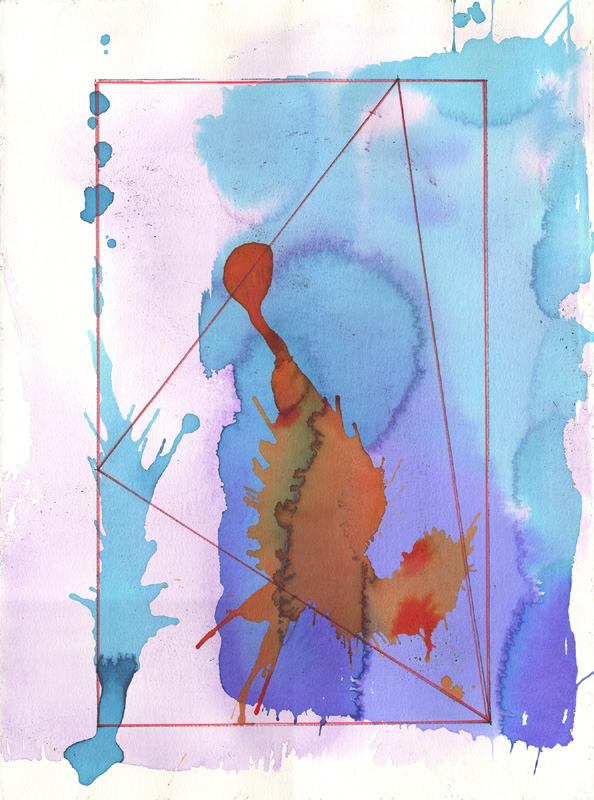
Triangulation 10
22″ x 30″
Watercolor and wax pencil on paper
2007
Preface
This essay proceeds from an observation: the forces that now shape collective life and the institutions that hold responsibility for it no longer operate at the same scale. Climate volatility, digital acceleration, migratory displacement, and economic interdependence move through air, water, data, and supply chains without regard for territorial boundaries. The world remains organized as a collection of discrete sovereignties, each answerable for exposures that form elsewhere and propagate everywhere.
What follows is an examination of that condition. It predicts nothing and recommends nothing. A disproportion of scale can be described, and the description makes visible what the inherited arrangement obscures: where responsibility fragments, where exposure accumulates, where the vocabulary of governance ceases to correspond to the movement of events.
The examination moves as perception moves. It begins inside the condition, where the disproportion between forces and institutions can be observed in its anatomy. Held in view long enough, the condition begins to disclose what the inherited arrangement obscures, and the examination follows the disclosure. From what becomes visible, certain forms become conceivable, and the examination considers them as perception finds them, without electing among them. And because every condition includes whatever resists its own alteration, the examination ends among the resistances, which belong to the condition as fully as the forces do and persist on their own measures of time.
The essay names a condition. Whatever follows from the naming occurs in the one who perceives it.
I. Geometry:
i.
Heat does not present itself for inspection. It moves through the atmosphere as a single circulation, raising the temperature of a harvest, a reservoir, a city’s August, without recording where one administration ends and another begins. Carbon released over one industrial basin enters the same air that returns it, years later, as drought on a continent that released little. The atmosphere keeps no ledger of origin; it distributes consequence by physics, on a schedule of its own.
Water behaves in the same manner at a different speed. Rivers gather in one jurisdiction and flood in another; aquifers lie beneath several at once; currents redistribute warmth along coastlines that share nothing but the water itself. A drought is regional by nature and national only on the map laid over it.
A pathogen moves through breath and proximity. Sequenced in one country, it circulates in forty before the sequence is published. Its itinerary is composed of airports, markets, and households; nothing in its manner of travel corresponds to the perimeter of a ministry of health.
Data moves fastest of all. A transaction, a rumor, and a model cross the planet in less time than any procedure for examining them requires. The infrastructure that carries them is physically located in territories and functionally located in none.
Supply chains move objects more slowly but bind their endpoints completely. A vehicle assembled in one country contains the labor and minerals of a dozen others; an interruption at a single port reprices goods on every continent. The dependency is real at every point of the chain and visible from none of them in its entirety.
And people move, displaced by the other movements: by the dried harvest, the emptied aquifer, the repriced economy. Displacement is the one traffic the boundary registers, and what it registers is the person; the conditions that moved the person crossed earlier, unexamined.
ii.
The institutions that hold responsibility for these movements are organized by perimeter. A state’s authority is defined by the territory in which it operates: its law binds within the line, its budget is spent within the line, its officials answer to those who reside within the line. This is its manner of holding. Responsibility becomes governable by being bounded; the instrument functions because its field of action is finite and known.
Within the perimeter, the institutional senses are acute. A government measures its own air, counts its own cases, audits its own ports, registers its own arrivals. What lies beyond reaches it through other channels and under other names: foreign affairs, imports, externality. The grammar of the institution renders the outside as context rather than as object.
Accountability follows the same geometry. An electorate, where one exists, holds its government answerable for conditions within the territory; no constituency exists anywhere for the consequence delivered abroad. The institution is rewarded and punished by those inside the line, and its attention is shaped accordingly.
iii.
The disproportion appears wherever the two manners meet. The atmosphere lies above every territory and within none; the instruments that act on it are funded, legislated, and judged perimeter by perimeter. The pathogen’s itinerary and the ministry’s reach intersect at the airport for a matter of hours; the remainder of the itinerary proceeds elsewhere. The supply chain’s interruption occurs everywhere at once and is administered nowhere in particular. The data crossing a border is examined, where it is examined at all, at endpoints the movement itself does not require.
In each location the structure is the same: the instrument acts on the portion of the force that lies within its field, and the force is not partitioned by the instrument. The remainder of the force continues, carrying the portion with it. This is the condition as it presently stands, a geometry of reach that does not coincide, observable point by point.
II. Exposure:
i.
What appears first is exposure. The instrument acts on its portion, the remainder continues, and those who live inside each perimeter live in the path of what no instrument reaches. Exposure of this kind is shared without being held in common: every territory stands in it; no territory administers it.
It can be watched traveling. A harvest dries in one region. Within a season, grain is repriced in markets that have never seen the field; within a year, a household on another continent spends more of its income on bread; the household’s city grows tense in proportions no office measures. The sequence is continuous from field to street, and at no point along it does any single institution see more than the segment inside its line. Deprivation forms in one place and arrives in others as instability, having traveled the whole way without once being seen entire.
Nor is the exposure evenly laid. It gathers where the means of absorbing it are thinnest, in the household with nothing left to reduce, in the region whose aquifer was already low. The geometry of reach distributes consequence without reference to the capacity to receive it.
ii.
The border, watched against this movement, becomes visible twice. In one register it is complete: the person presents a document, the container is opened, the tariff is assessed; nothing built into the border has failed, and everything it was made to register, it registers. In the other register it does not appear at all: the heat and the signal pass at altitudes and speeds for which the border has no instrument, having never been built for them. The same line is whole and absent at once, depending on the register in which it is observed. Its persistence is administrative fact; its coverage, a portion. The doubleness is the disclosure: what had been perceived as the edge of responsibility shows itself as the edge of one kind of traffic.
iii.
The words come forward next, in the places where everyone meets them. The evening news gives a flood abroad thirty seconds and a flood at home a week; the first is foreign affairs, the second a national emergency, though the water behaves identically in both. A ministry calls the smoke drifting in from a neighboring country’s fires an externality, and the word performs a quiet operation: it files the smoke as something outside, even as it settles into the lungs of those inside. The drought that empties a distant aquifer is a foreign matter until the people it displaced stand at the crossing, at which moment the same drought becomes domestic, though nothing in the drought has changed; the word moved, the event did not.
Watched in this way, the vocabulary shows what it is doing. Domestic and foreign, internal and external sort events by the side of the line on which they stand, and the sorting holds only in the register where the line appears. The words are learned so early and used so constantly that they pass for the events themselves; held against the actual movement of events, they show themselves as belonging to the line, terms of its manner of rendering the world.
iv.
The sequence that began in the dried field ends at a person. The consequence has an origin: the carbon has its basins, the repricing has its port, the displacement has its drought. It has a route, traceable segment by segment. What it does not have is an address at which it is received whole: each institution along the route faced its portion, and the consequence, assembled from all the portions, faces no institution anywhere. The person who stands in it, whose bread costs more, whose well draws sand, whose street has grown tense, stands in something produced in full view of many offices and held as the object of none. The person can be counted, and is; assisted, at times; named, rarely. What the condition makes visible, held to the end, is this: a consequence entire, a person inside it, and between origin and arrival no point at which anyone was facing the whole.
III. Images:
i.
What has been seen begins, on its own, to produce something. Anyone who has lived in a town knows the experience in small: a water main bursts, the street floods, and whatever else is uncertain, one thing is not, that somewhere there is an office whose business this is. The repair may come late and the office may be poor, but the flooding has an address, and the mind rests on that address without being asked to.
The consequence traced in the second movement has none. It traveled from the dried field through the port and the market to the street that has grown tense, and at no point did it land on a desk as the matter of that desk. Whoever has seen this whole forms the image of an address without intending to: a desk at the scale of the route, something facing the entire consequence the way the town office faces the burst main. The image arrives unbidden; that is what it means for a form to become thinkable. Nothing in the image says it is near, or simple, or good. It says only that the mind, shown a lack entire, completes the shape of what is lacking.
ii.
A second image follows from the unevenness. Within any town, certain things are already held in common because everyone stands under them equally. No household builds its own levee; the levee answers to the river, which does not visit house by house. The arrangement is so familiar it goes unnoticed: where what arrives, arrives at all, what absorbs it is held by all.
The exposure shown earlier stands over every territory the way the river stands over the low town, and it gathers, as the second movement found, on the household with nothing left to reduce. Held in view, the familiar arrangement extends itself in the mind to the scale of the actual water: the means of absorbing what arrives, held as commonly as the arrival. The image is of the levee matched to the river it actually has, no more. It prescribes nothing about how such a thing is built, or by whom, or whether those now living would consent to build it. It is the shape the mind gives to a protection matched to an exposure already shared.
iii.
The third image is of the line, and it is an image of continuance. Nothing in the foregoing showed the line failing at its own work. The document is still presented, the container still opened; the language of the street, the court where neighbors take their disputes, the school, the holidays, the manner in which a town buries its dead, all of this lives inside the line and was never once crossed by the heat or the signal. What the doubleness disclosed was the size of the line’s register, never a failure inside it.
So the image that forms is double, like the disclosure that produces it: the line continuing entire in its own register, holding everything it has always held, while the registers it never covered, the heat, the signal, the route of the pathogen, meet instruments for the first time. The two parts arrive together and do not yet rest together. Whatever faced the whole of a consequence would draw means and allegiance, and means and allegiance now live inside the lines; the image carries this strain within itself, two registers distinct to perception and contending wherever both would have to be sustained. Whether such a layering could hold outside the mind, the image does not say; seen honestly, it shows the doubleness and the strain at once.
IV. Calendars:
i.
Allegiance has a scale, and it is small. A person belongs first to a street, a table, a language spoken at that table, the graves that are visited on the appointed days. Whatever larger belonging is learned afterward, the flag, the anthem, is taught into a heart already occupied by the near, and takes hold to the degree that it borrows the near’s warmth. No one is from the planet. The word names the place where everyone lives and the place where no one has ever lived.
Part of the trust given to the town office is that it can be walked to. The clerk has a face; the office has a door; the complaint can be carried there in person, and if nothing comes of it, the failure too has an address. The desk at the scale of the route has no door anyone can reach. The image asks the mind to extend trust across a distance at which trust has never yet formed, past the last face, past the last door. The mind that formed the image is the same mind that hesitates before it, and the hesitation is itself a perception, the love of the near reporting accurately what the near provides.
ii.
The second resistance keeps records. In most of the world, the enterprises that have operated across many lines at once are remembered by the people whose lines they crossed: the company that came for the metal, the administration that renamed the streets, the school that punished the language of the table. The image of an instrument facing the whole arrives, in these places, into the memory of the last instrument that claimed to face the whole, and the memory answers before any argument can begin: such things are built somewhere, and the somewhere has never been here.
The memory is a record, kept in archives and in households, read at the scale where it was lived. Consulting it before extending the hand is among the most ordinary acts of perception there is. The image of the desk does not erase the record; it is received into it, and what it becomes there is decided by the record, not by the image.
iii.
Means live inside the lines, and what holds means defends them. The ministry’s reach is its budget; the industry stands where the chain now runs, and the chain, running, pays for the standing. And smaller, in the kitchen: the dockworker’s wage lives in the tariff’s shadow, the town’s school is funded by the refinery, the pension rests on the placement of things as they are placed. Anything that faced the whole of a consequence would draw means and allegiance, as the strain already showed, and means and allegiance do not transfer themselves; they are held, and holding has hands at every scale. The motion of those hands is the same in the palace and in the kitchen, the hand closing over what feeds it, and the examination assigns it to no one as a fault. It records it as what position does, wherever position is held.
iv.
The three resistances keep their own calendars. Attachment is renewed with every childhood, and a generation is the unit of its time. Memory outlives its witnesses; the household and the archive carry it past the century. Position reproduces itself by inheritance and appointment, at a pace slower than a life. Against these calendars, the forces move at the speed of air and signal: the heat by the season, the price by the day, the pathogen by the hour. Inside the condition a second disproportion comes visible, of tempo rather than reach: what moves fastest crosses every line, and what would have to move for anything to meet it moves at the pace of childhood, memory, and inheritance. The condition holds both disproportions at once, and they can be observed together, calendar by calendar.
Epilogue
An examination closes without verdict. Nothing in the preceding movements has proposed a remedy, because no remedy is given in the condition itself. What is given has been described.
What has been described here is visible from within the condition and from nowhere else. The forms that appear thinkable appear so to a perception situated in this interval, under these pressures; a different interval will carry a different horizon. The essay claims nothing beyond that boundary. It remains within the horizon of what the present condition permits to be perceived.
Ricardo F. Morin
June 9, 2026
Bala Cynwyd, Pennsylvania
Tags: borders, calendars, climate, examination, exposure, geometry of reach, horizon, images, Institutions, interdependence, migration, Perception, planetary condition, sovereignty, supply chains


PLease leave a Reply