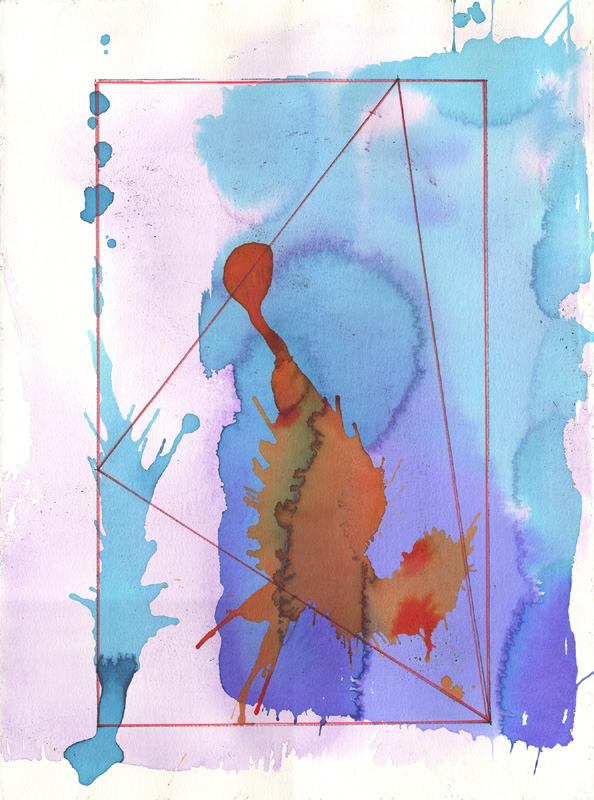
Ricardo F. Morín Triangulation 10 22″ x 30″ Watercolor and wax pencil on paper 2007
Preface
This essay proceeds from an observation: the forces that now shape collective life and the institutions that hold responsibility for it no longer operate at the same scale. Climate volatility, digital acceleration, migratory displacement, and economic interdependence move through air, water, data, and supply chains without regard for territorial boundaries. The world remains organized as a collection of discrete sovereignties, each answerable for exposures that form elsewhere and propagate everywhere.
What follows is an examination of that condition. It predicts nothing and recommends nothing. A disproportion of scale can be described, and the description makes visible what the inherited arrangement obscures: where responsibility fragments, where exposure accumulates, where the vocabulary of governance ceases to correspond to the movement of events.
The examination moves as perception moves. It begins inside the condition, where the disproportion between forces and institutions can be observed in its anatomy. Held in view long enough, the condition begins to disclose what the inherited arrangement obscures, and the examination follows the disclosure. From what becomes visible, certain forms become conceivable, and the examination considers them as perception finds them, without electing among them. And because every condition includes whatever resists its own alteration, the examination ends among the resistances, which belong to the condition as fully as the forces do and persist on their own measures of time.
The essay names a condition. Whatever follows from the naming occurs in the one who perceives it.
I. Geometry:
i.
Heat does not present itself for inspection. It moves through the atmosphere as a single circulation, raising the temperature of a harvest, a reservoir, a city’s August, without recording where one administration ends and another begins. Carbon released over one industrial basin enters the same air that returns it, years later, as drought on a continent that released little. The atmosphere keeps no ledger of origin; it distributes consequence by physics, on a schedule of its own.
Water behaves in the same manner at a different speed. Rivers gather in one jurisdiction and flood in another; aquifers lie beneath several at once; currents redistribute warmth along coastlines that share nothing but the water itself. A drought is regional by nature and national only on the map laid over it.
A pathogen moves through breath and proximity. Sequenced in one country, it circulates in forty before the sequence is published. Its itinerary is composed of airports, markets, and households; nothing in its manner of travel corresponds to the perimeter of a ministry of health.
Data moves fastest of all. A transaction, a rumor, and a model cross the planet in less time than any procedure for examining them requires. The infrastructure that carries them is physically located in territories and functionally located in none.
Supply chains move objects more slowly but bind their endpoints completely. A vehicle assembled in one country contains the labor and minerals of a dozen others; an interruption at a single port reprices goods on every continent. The dependency is real at every point of the chain and visible from none of them in its entirety.
And people move, displaced by the other movements: by the dried harvest, the emptied aquifer, the repriced economy. Displacement is the one traffic the boundary registers, and what it registers is the person; the conditions that moved the person crossed earlier, unexamined.
ii.
The institutions that hold responsibility for these movements are organized by perimeter. A state’s authority is defined by the territory in which it operates: its law binds within the line, its budget is spent within the line, its officials answer to those who reside within the line. This is its manner of holding. Responsibility becomes governable by being bounded; the instrument functions because its field of action is finite and known.
Within the perimeter, the institutional senses are acute. A government measures its own air, counts its own cases, audits its own ports, registers its own arrivals. What lies beyond reaches it through other channels and under other names: foreign affairs, imports, externality. The grammar of the institution renders the outside as context rather than as object.
Accountability follows the same geometry. An electorate, where one exists, holds its government answerable for conditions within the territory; no constituency exists anywhere for the consequence delivered abroad. The institution is rewarded and punished by those inside the line, and its attention is shaped accordingly.
iii.
The disproportion appears wherever the two manners meet. The atmosphere lies above every territory and within none; the instruments that act on it are funded, legislated, and judged perimeter by perimeter. The pathogen’s itinerary and the ministry’s reach intersect at the airport for a matter of hours; the remainder of the itinerary proceeds elsewhere. The supply chain’s interruption occurs everywhere at once and is administered nowhere in particular. The data crossing a border is examined, where it is examined at all, at endpoints the movement itself does not require.
In each location the structure is the same: the instrument acts on the portion of the force that lies within its field, and the force is not partitioned by the instrument. The remainder of the force continues, carrying the portion with it. This is the condition as it presently stands, a geometry of reach that does not coincide, observable point by point.
II. Exposure:
i.
What appears first is exposure. The instrument acts on its portion, the remainder continues, and those who live inside each perimeter live in the path of what no instrument reaches. Exposure of this kind is shared without being held in common: every territory stands in it; no territory administers it.
It can be watched traveling. A harvest dries in one region. Within a season, grain is repriced in markets that have never seen the field; within a year, a household on another continent spends more of its income on bread; the household’s city grows tense in proportions no office measures. The sequence is continuous from field to street, and at no point along it does any single institution see more than the segment inside its line. Deprivation forms in one place and arrives in others as instability, having traveled the whole way without once being seen entire.
Nor is the exposure evenly laid. It gathers where the means of absorbing it are thinnest, in the household with nothing left to reduce, in the region whose aquifer was already low. The geometry of reach distributes consequence without reference to the capacity to receive it.
ii.
The border, watched against this movement, becomes visible twice. In one register it is complete: the person presents a document, the container is opened, the tariff is assessed; nothing built into the border has failed, and everything it was made to register, it registers. In the other register it does not appear at all: the heat and the signal pass at altitudes and speeds for which the border has no instrument, having never been built for them. The same line is whole and absent at once, depending on the register in which it is observed. Its persistence is administrative fact; its coverage, a portion. The doubleness is the disclosure: what had been perceived as the edge of responsibility shows itself as the edge of one kind of traffic.
iii.
The words come forward next, in the places where everyone meets them. The evening news gives a flood abroad thirty seconds and a flood at home a week; the first is foreign affairs, the second a national emergency, though the water behaves identically in both. A ministry calls the smoke drifting in from a neighboring country’s fires an externality, and the word performs a quiet operation: it files the smoke as something outside, even as it settles into the lungs of those inside. The drought that empties a distant aquifer is a foreign matter until the people it displaced stand at the crossing, at which moment the same drought becomes domestic, though nothing in the drought has changed; the word moved, the event did not.
Watched in this way, the vocabulary shows what it is doing. Domestic and foreign, internal and external sort events by the side of the line on which they stand, and the sorting holds only in the register where the line appears. The words are learned so early and used so constantly that they pass for the events themselves; held against the actual movement of events, they show themselves as belonging to the line, terms of its manner of rendering the world.
iv.
The sequence that began in the dried field ends at a person. The consequence has an origin: the carbon has its basins, the repricing has its port, the displacement has its drought. It has a route, traceable segment by segment. What it does not have is an address at which it is received whole: each institution along the route faced its portion, and the consequence, assembled from all the portions, faces no institution anywhere. The person who stands in it, whose bread costs more, whose well draws sand, whose street has grown tense, stands in something produced in full view of many offices and held as the object of none. The person can be counted, and is; assisted, at times; named, rarely. What the condition makes visible, held to the end, is this: a consequence entire, a person inside it, and between origin and arrival no point at which anyone was facing the whole.
III. Images:
i.
What has been seen begins, on its own, to produce something. Anyone who has lived in a town knows the experience in small: a water main bursts, the street floods, and whatever else is uncertain, one thing is not, that somewhere there is an office whose business this is. The repair may come late and the office may be poor, but the flooding has an address, and the mind rests on that address without being asked to.
The consequence traced in the second movement has none. It traveled from the dried field through the port and the market to the street that has grown tense, and at no point did it land on a desk as the matter of that desk. Whoever has seen this whole forms the image of an address without intending to: a desk at the scale of the route, something facing the entire consequence the way the town office faces the burst main. The image arrives unbidden; that is what it means for a form to become thinkable. Nothing in the image says it is near, or simple, or good. It says only that the mind, shown a lack entire, completes the shape of what is lacking.
ii.
A second image follows from the unevenness. Within any town, certain things are already held in common because everyone stands under them equally. No household builds its own levee; the levee answers to the river, which does not visit house by house. The arrangement is so familiar it goes unnoticed: where what arrives, arrives at all, what absorbs it is held by all.
The exposure shown earlier stands over every territory the way the river stands over the low town, and it gathers, as the second movement found, on the household with nothing left to reduce. Held in view, the familiar arrangement extends itself in the mind to the scale of the actual water: the means of absorbing what arrives, held as commonly as the arrival. The image is of the levee matched to the river it actually has, no more. It prescribes nothing about how such a thing is built, or by whom, or whether those now living would consent to build it. It is the shape the mind gives to a protection matched to an exposure already shared.
iii.
The third image is of the line, and it is an image of continuance. Nothing in the foregoing showed the line failing at its own work. The document is still presented, the container still opened; the language of the street, the court where neighbors take their disputes, the school, the holidays, the manner in which a town buries its dead, all of this lives inside the line and was never once crossed by the heat or the signal. What the doubleness disclosed was the size of the line’s register, never a failure inside it.
So the image that forms is double, like the disclosure that produces it: the line continuing entire in its own register, holding everything it has always held, while the registers it never covered, the heat, the signal, the route of the pathogen, meet instruments for the first time. The two parts arrive together and do not yet rest together. Whatever faced the whole of a consequence would draw means and allegiance, and means and allegiance now live inside the lines; the image carries this strain within itself, two registers distinct to perception and contending wherever both would have to be sustained. Whether such a layering could hold outside the mind, the image does not say; seen honestly, it shows the doubleness and the strain at once.
IV. Calendars:
i.
Allegiance has a scale, and it is small. A person belongs first to a street, a table, a language spoken at that table, the graves that are visited on the appointed days. Whatever larger belonging is learned afterward, the flag, the anthem, is taught into a heart already occupied by the near, and takes hold to the degree that it borrows the near’s warmth. No one is from the planet. The word names the place where everyone lives and the place where no one has ever lived.
Part of the trust given to the town office is that it can be walked to. The clerk has a face; the office has a door; the complaint can be carried there in person, and if nothing comes of it, the failure too has an address. The desk at the scale of the route has no door anyone can reach. The image asks the mind to extend trust across a distance at which trust has never yet formed, past the last face, past the last door. The mind that formed the image is the same mind that hesitates before it, and the hesitation is itself a perception, the love of the near reporting accurately what the near provides.
ii.
The second resistance keeps records. In most of the world, the enterprises that have operated across many lines at once are remembered by the people whose lines they crossed: the company that came for the metal, the administration that renamed the streets, the school that punished the language of the table. The image of an instrument facing the whole arrives, in these places, into the memory of the last instrument that claimed to face the whole, and the memory answers before any argument can begin: such things are built somewhere, and the somewhere has never been here.
The memory is a record, kept in archives and in households, read at the scale where it was lived. Consulting it before extending the hand is among the most ordinary acts of perception there is. The image of the desk does not erase the record; it is received into it, and what it becomes there is decided by the record, not by the image.
iii.
Means live inside the lines, and what holds means defends them. The ministry’s reach is its budget; the industry stands where the chain now runs, and the chain, running, pays for the standing. And smaller, in the kitchen: the dockworker’s wage lives in the tariff’s shadow, the town’s school is funded by the refinery, the pension rests on the placement of things as they are placed. Anything that faced the whole of a consequence would draw means and allegiance, as the strain already showed, and means and allegiance do not transfer themselves; they are held, and holding has hands at every scale. The motion of those hands is the same in the palace and in the kitchen, the hand closing over what feeds it, and the examination assigns it to no one as a fault. It records it as what position does, wherever position is held.
iv.
The three resistances keep their own calendars. Attachment is renewed with every childhood, and a generation is the unit of its time. Memory outlives its witnesses; the household and the archive carry it past the century. Position reproduces itself by inheritance and appointment, at a pace slower than a life. Against these calendars, the forces move at the speed of air and signal: the heat by the season, the price by the day, the pathogen by the hour. Inside the condition a second disproportion comes visible, of tempo rather than reach: what moves fastest crosses every line, and what would have to move for anything to meet it moves at the pace of childhood, memory, and inheritance. The condition holds both disproportions at once, and they can be observed together, calendar by calendar.
Epilogue
An examination closes without verdict. Nothing in the preceding movements has proposed a remedy, because no remedy is given in the condition itself. What is given has been described.
What has been described here is visible from within the condition and from nowhere else. The forms that appear thinkable appear so to a perception situated in this interval, under these pressures; a different interval will carry a different horizon. The essay claims nothing beyond that boundary. It remains within the horizon of what the present condition permits to be perceived.
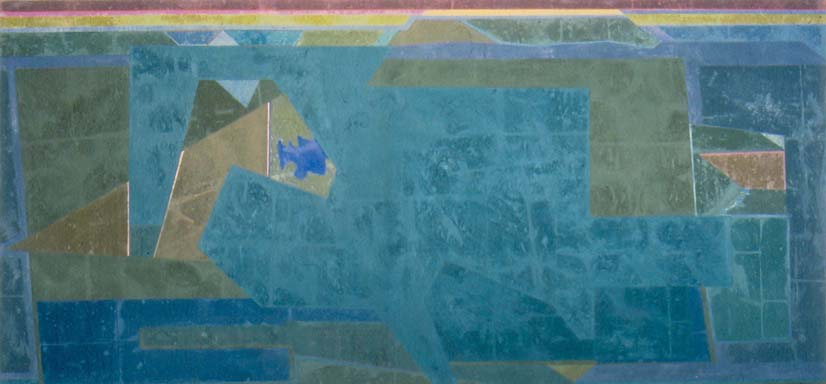
Ricardo F. Morin Buffalo Series, Nº 6 36″ x 78″ Oil on canvas 1979
Preface
People often discover that events far beyond their immediate surroundings affect their lives in ways they neither anticipated nor controlled. A shortage appears in a local store because production has been interrupted elsewhere. A disease emerges in one region and reaches another. A decision taken in a distant capital alters conditions for people who had no part in making it. Weather patterns shift, prices change, technologies spread, and consequences arrive from places most people will never see.
Such experiences belong to a world in which many of the processes shaping daily life extend beyond local communities. Families, neighborhoods, towns, and nations remain affected by forces that originate beyond them.
The circumstances in which human societies live have repeatedly encountered conditions that exceeded the reach of existing practices and expectations. Trade connected distant regions. Political territories expanded beyond local communities. Industrialization linked livelihoods to economic processes operating far from where those livelihoods were sustained. In each case, people confronted realities larger than those for which many inherited arrangements had originally been developed.
Historical responses varied. Some commercial and governmental institutions adapted gradually. Others resisted change until circumstances imposed it. Some expanded their reach while preserving older assumptions. Others generated new practices and new forms of organization. No single pattern governed these transitions. What remained constant was the encounter between inherited arrangements and conditions that had outgrown them.
Whether contemporary conditions belong to this historical pattern, or whether they represent something different, remains uncertain. At issue is not a preferred outcome, but the extent to which the reach of circumstance continues to exceed the assumptions, expectations, and arrangements through which societies understand and respond to it.
The puzzling question matters because familiar ways of organizing collective life often persist after the circumstances that gave rise to them have changed. Practices that once addressed the conditions people faced may continue long after those conditions have been altered by new technologies, new forms of exchange, new patterns of movement, and new forms of interdependence. Whether inherited arrangements can still comprehend circumstances whose reach has changed is not merely an abstract question. It bears on how societies understand the challenges before them and the range of responses available to them.
Ricardo F. Morin
June 3rd, 2026
Bala Cynwyd, Pennsylvania
I. Routes: Circumstances in Motion
Circumstances do not remain where they originate. The conditions shaping a community’s life rarely arise entirely within that community. They arrive through paths established for other purposes, across distances no single traveler encompasses, and over periods no single generation witnesses in full. Movement extends the reach of circumstance beyond the boundaries of any local setting and carries with it more than those who first set it in motion anticipated or intended. Goods travel, but so do the conditions that produce them, the diseases that accompany them, and the beliefs that give them meaning. People move, but so do the arrangements they carry within them and the circumstances they encounter along the way. Ideas cross boundaries that armies cannot always cross, and diseases pass through barriers that neither commerce nor diplomacy can fully seal. The significance of routes lies not in motion alone but in what motion makes possible: the entry of one circumstance into a setting where it had not previously been present. The reach of circumstance begins with motion.
Long before large states, industrial systems, or modern means of communication existed, overland routes connected communities separated by vast distances. The network of paths crossing Central Asia, known in later centuries as the Silk Road, consisted not of a single road but of multiple corridors traversing deserts, mountain passes, and steppe grasslands across Eurasia. Caravans moved between regions whose languages, religions, political arrangements, and ecological conditions differed profoundly from one another. No merchant occupied the entire network, and no political authority administered it in its entirety. Yet circumstances originating in one region entered the lives of populations living far beyond it. Silk moved westward. Horses moved eastward. Spices, glassware, and precious metals followed routes whose combined length exceeded the administrative reach of any empire that sought to govern them. Alongside merchandise traveled religious traditions, technical knowledge, artistic forms, and linguistic practices. The overland routes of Eurasia revealed that the reach of circumstance could extend across vast distances through the cumulative movement of many participants, none of whom controlled the whole.
Maritime routes extended that reach across different terrain. The Indian Ocean connected societies ranging from East Africa and the Arabian Peninsula to the western coast of India, the ports of Southeast Asia, and the southern coast of China. What made this network distinctive was not merely its geographic extent but the regularity of its operation. Seasonal monsoon winds established recurring patterns of movement, carrying vessels outward during one part of the year and returning them during another. Merchants, sailors, pilgrims, migrants, and travelers moved through the same maritime network across centuries, sustaining relationships among distant societies whose encounters gradually became part of the ordinary conditions of life in each of them. Goods traveled in large quantities, but so did languages, religious traditions, technologies, and commercial practices. Circumstances originating in one region entered others not through isolated contact but through recurring circulation that accumulated across generations. The maritime routes of the Indian Ocean revealed that the reach of circumstance could be sustained through continuity as much as through distance.
Oceanic routes carried the reach of circumstance further still. The Atlantic world that developed after the fifteenth century connected populations that had previously evolved in separation from one another across an ocean neither had previously crossed. Plants, animals, pathogens, technologies, and people crossed in both directions, but the consequences were distributed unequally across the societies involved. Environments were altered. Diets changed. Demographic patterns shifted on a scale that no previous exchange had produced. Labor systems were reorganized to serve production systems operating across oceanic distances. The oceanic routes of the Atlantic laid bare that the reach of circumstance could alter not only what communities possessed but the fundamental conditions under which they sustained themselves: their populations, their ecologies, and their arrangements for organizing work and distributing its products.
Certain routes acquire significance not merely because they connect distant regions but because multiple circumstances depend upon them simultaneously. Western Asia has functioned across many centuries as a crossroads through which routes linking Africa, Europe, Central Asia, and South Asia have repeatedly passed. Trade, migration, imperial expansion, religious transmission, and resource flows have converged upon the same corridors across successive periods. The Strait of Hormuz illustrates the enduring significance of such passages: a narrow body of water connecting the Persian Gulf to the Arabian Sea, has served for centuries as a point where the movement of goods, the projection of political authority, and the conduct of trade have repeatedly intersected. Circumstances affecting a single passage may alter conditions extending far beyond it. The importance of a strategic corridor lies not only in its location but in the range of relationships that depend upon its continued accessibility. The reach of circumstance becomes concentrated at such points in ways that render its dependence upon particular geographic conditions intelligible.
Information has always traveled through routes as surely as goods and people. Postal systems carried correspondence across empires and commercial networks centuries before modern communications existed. Telegraph networks in the nineteenth century altered the speed at which commercial, political, and military circumstances could be transmitted across distances that had previously required weeks or months to traverse.Broadcasting systems extended the reach of information further still, into settings that earlier communications had not penetrated. Digital networks have extended the movement of circumstance through informational pathways whose speed and scale differ from all previous systems.Circumstances travel through informational routes as they travel through physical ones: they enter settings where they had not previously been present and carry with them more than those who first transmitted them intended or anticipated. The speed of transmission changes. The reach of circumstance through routes of communication remains a constant of historical experience.
II. Entanglements: Circumstances in Relation
Circumstances rarely arrive alone. A disease follows commercial exchange. Migration follows conflict. Religious traditions accompany merchants, pilgrims, settlers, and conquerors. Crops alter diets, populations, labor systems, and patterns of settlement. Resources attract political authority, commercial investment, military protection, and competition. Movement, as the preceding inquiry has established, extends the reach of circumstance beyond its point of origin. But movement alone does not explain what happens when circumstances that originated separately enter the same field of experience. Once they intersect, they often become difficult to separate from one another. What began as distinct conditions becomes part of a single, if not always coherent, field. The reach of circumstance extends not only through movement but through relation. Circumstances become part of one another.
Disease seldom remains a medical circumstance alone. The Black Death, which followed commercial routes across Eurasia during the fourteenth century, did not arrive as a purely biological event. It traveled through a network of exchange already shaped by commercial, political, and demographic circumstances that determined where it spread, how quickly it moved, and what populations it encountered. Its effects accumulated through those relations. Labor arrangements changed because populations declined. Theological interpretations shifted because existing explanations proved inadequate to the scale of mortality. Political arrangements were destabilized in regions where administrative capacity depended upon populations that no longer existed in their previous numbers. Later epidemics revealed the same condition. Cholera moved through nineteenth-century commercial and imperial networks. Influenza followed the movement of populations during and after the First World War. HIV spread through patterns of migration and commerce across continents. Ebola exposed relations among ecological disruption, institutional capacity, and international response. COVID-19 revealed the entanglement of global supply chains, public health systems, political authority, and information circulation. Pathogens travel through circumstances already shaped by other circumstances. Their effects emerge through those relations as much as through the biology of the disease itself. The reach of a disease is inseparable from the reach of the circumstances through which it moves.
Migration alters populations, labor systems, languages, religious practices, cultural forms, and political arrangements in ways that no single cause produces and no single authority fully controls. Conditions at places of origin remain connected to conditions at destinations long after the movement itself has occurred. Remittances flow back along paths that migrants have traveled forward. Languages spoken in communities of arrival carry traces of the regions from which their speakers came. Religious practices transplanted into new settings encounter existing traditions and produce forms that neither setting would have generated alone.
The circumstances that produce migration are rarely singular. Environmental deterioration, economic displacement, political violence, demographic pressure, and military conflict often operate simultaneously, making the isolation of any one cause an analytical convenience rather than a historical reality. The circumstances that migration produces at its destinations are similarly varied. Labor market changes, institutional adaptations, cultural encounters, and political responses frequently emerge together and resist reduction to a single origin.
Migration makes it possible to recognize relationships that span multiple places and generations that outlast the original movement. The reach of circumstance through migration is measured not only in distance but in the duration of its effects upon the communities through which it passes.
Religious traditions do not travel alone. The spread of Islam across the Indian Ocean world, Central Asia, sub-Saharan Africa, and Southeast Asia was not a movement of belief in isolation from other circumstances. Languages accompanied it. Legal traditions developed alongside it. Educational institutions followed it. Commercial networks bore the tradition and were extended by its spread. Artistic forms, architectural practices, and systems of social organization traveled through the same pathways.
The spread of Christianity through the Atlantic world similarly carried languages, institutional forms, educational practices, legal concepts, and political arrangements into settings where those circumstances had not previously been present. Neither Islam nor Christianity arrived as a pure system of belief separable from the material and institutional circumstances with which each had become entangled in the course of its transmission. The circumstances accompanying religious traditions often outlasted the intensity of the original transmission and persisted in institutional forms, legal practices, and social arrangements long after the initial encounter had receded from immediate experience.
The reach of circumstance through religious transmission makes it possible to recognize that belief and institution, faith and organization, cannot always be separated from the wider field of relations through which they travel.
Food systems reveal the reach of circumstance through the most immediate conditions of daily life. Agriculture depends simultaneously upon climate, water, labor, transportation, trade, finance, and technology. No harvest is produced by a single circumstance. The voyages of Christopher Columbus altered diets, populations, environments, and economic arrangements across continents through the movement of plants, animals, and agricultural practices between hemispheres that had previously developed in separation. Maize, potatoes, tomatoes, and other American crops entered European, African, and Asian agricultural systems and altered not only what people ate but how populations grew, how labor was organized, and how land was used. Sugar production in the Americas reorganized labor systems across the Atlantic world, connecting the agriculture of one region to the commerce and consumption of others through relations that no participant in any single part of the system fully surveyed.
Food insecurity and famine frequently lay bare relations among environmental conditions, commercial arrangements, political decisions, and demographic pressures that resist attribution to a single cause. The Irish famine of the nineteenth century, the famines accompanying disruptions of colonial administration in South Asia, and the food crises of the twentieth century each demonstrated that the conditions shaping whether populations could sustain themselves were entangled with circumstances extending far beyond the fields in which crops were grown or failed.
The reach of circumstance through food systems makes clear how closely the necessities of daily life depend upon relations extending beyond the settings in which food is produced, exchanged, and consumed.
Energy systems reveal the reach of entanglement into the infrastructures upon which modern life depends. Coal altered the conditions of manufacturing, transportation, and urban life during the nineteenth century, concentrating populations, reorganizing labor, and producing consequences for health, the environment, and political organization that no single decision had anticipated. Oil extended those relations further, connecting the conditions of daily life in industrial societies to regions whose populations had no necessary relation to the consumption occurring elsewhere.
The dependence of transportation, manufacturing, agriculture, commerce, communication, and household life upon energy systems whose sources lie far from their points of use has made the entanglement of energy with other circumstances a persistent feature of modern historical experience. Disruptions in production, shifts in price, and conflicts over access to energy resources have repeatedly altered conditions well beyond the settings in which those disruptions originated. Production disruptions, price fluctuations, and conflicts over access to energy resources have repeatedly altered conditions far beyond the locations where those disturbances originated. The concentration of transport along a limited number of corridors renders distant economies dependent on geographical and political conditions beyond their control.
The reach of circumstance through energy systems makes clear how deeply the conditions of ordinary life depend upon relations extending across great distances.
Information systems alter the circulation of knowledge, belief, commerce, and political authority in ways that become entangled with the broader circumstances through which societies organize collective life. The introduction of printing in fifteenth-century Europe altered the conditions under which religious authority, commercial communication, legal practice, and political organization operated, not by replacing those circumstances but by entering into relation with them and altering the field in which they functioned. Telegraphy in the nineteenth century changed the speed at which commercial and political circumstances could interact across distances, producing relations between markets that had previously been separated by the time required for information to travel between them. Broadcasting extended the reach of information into domestic settings, entangling the circulation of belief, political authority, and commercial persuasion with the conditions of private life.
Digital networks and algorithmic platforms have extended those relations further, connecting identity, governance, markets, and social interaction through systems whose operations frequently exceed the awareness of those participating in them. Circumstances increasingly interact through systems of communication as well as through physical movement, producing relations whose origins and effects cannot always be confined to a single domain.
The reach of circumstance through information systems reveals that communication does more than transmit conditions. It becomes one of the conditions through which other circumstances interact.
Commercial exchange links production, transportation, labor, finance, consumption, and governance through relations extending beyond the awareness of individual participants. A garment produced in one region, from materials extracted in another, transported through systems organized in a third, sold in a fourth, and financed through arrangements originating in a fifth, concentrates within a single object the reach of circumstances distributed across multiple settings and multiple scales.
The supply chains through which contemporary commercial systems operate render visible relations extending far beyond the visibility of those who participate in any single part of them. Commercial circumstances intersect with migration, energy, disease, environmental change, and political authority in ways that make the effects of a disruption in one part of the system felt in settings with no immediately apparent connection to it. The financial arrangements through which commercial exchange is organized similarly distribute the effects of instability across populations that had no direct part in producing the conditions from which that instability emerged.
Exchange becomes part of a wider field of interconnected circumstances whose reach extends beyond the intentions of those who participate in it and beyond the arrangements any single authority has established to govern it. What the preceding sections allow us to recognize retrospectively through the lens of historical distance, artificial intelligence allows us to observe from a different vantage point in time.
III. Duration: Circumstance through Permutation
Some circumstances disappear. The conditions that produced them dissolve, the routes through which they traveled close, and the settings in which they operated transform beyond recognition. What remains may be little more than a trace in language, an architectural form, or a practice whose original context has become unrecoverable.
Others endure. They persist across centuries, surviving the political orders that first gave them institutional form, the commercial systems through which they first spread, the populations that first carried them, and the technologies through which they first operated. Those that endure rarely remain unchanged. A circumstance that persists across several centuries does not persist by remaining identical to what it was at its origin. It survives through successive transformations, assuming forms that its originators would not always recognize, operating through arrangements that differ substantially from those through which it first appeared, and producing effects in settings its first carriers never encountered.
Duration is not permanence. It is the capacity of a circumstance to remain identifiable across transformations that would, taken individually, appear to have altered it beyond continuity. The reach of circumstance extends not only through motion and relation but through time: through the ability of a condition to outlast the particular arrangements through which it first became visible.
Christianity emerged within the eastern Mediterranean world of the Roman Empire, among populations whose languages, political circumstances, and cultural forms were shaped by that specific historical setting. Its earliest institutions developed in relation to those conditions: the administrative structures of the empire, the philosophical traditions of the Hellenistic world, the legal practices of Roman governance, and the religious landscape of a region in which multiple traditions coexisted and competed.
Those conditions changed. The empire through whose administrative framework the tradition first spread eventually divided, contracted, and in its western portions dissolved into successor arrangements that differed substantially from what had preceded them. Christianity survived that dissolution and continued through the political arrangements that replaced it, adapting its institutional forms, its languages of worship and administration, and its relations to political authority as the conditions surrounding it changed.
Schisms altered its internal organization. Reformations challenged existing institutional arrangements and produced new expressions that contested the authority of older ones. Missionary expansion carried the tradition into settings whose populations, languages, and cultural forms differed profoundly from those in which it had first developed. Colonization entangled it with political and commercial circumstances unlike those accompanying its earlier expansion. Secularization altered the institutional position it occupied within societies where it had long been established.
Across these transformations, the circumstance remained recognizable, not because it was unchanged, but because continuity persisted through permutation rather than stasis. The reach of circumstance through duration reveals itself in the capacity to remain identifiable across conditions that would have made its original form unsustainable.
Islam emerged within the Arabian Peninsula during the seventh century and expanded across regions whose existing circumstances differed profoundly from those of its origin. Persian administrative traditions, African political arrangements, Central Asian steppe cultures, South Asian philosophical and religious systems, Southeast Asian commercial networks, and European intellectual and political formations each encountered the expanding tradition under different conditions and produced outcomes that varied accordingly.
Legal traditions diversified into schools of interpretation whose differences reflected the circumstances of the societies in which they developed. Political arrangements through which the tradition related to governance changed across regions and centuries, producing forms that differed substantially from one another while remaining recognizable as expressions of the same circumstance. Cultural expressions in architecture, literature, music, and visual art assumed forms specific to the settings in which they appeared, carrying the tradition into domains shaped by local conditions.
Islam persisted not through uniformity but through adaptation and differentiation. The circumstance remained identifiable across settings whose conditions differed as substantially from one another as the societies of West Africa, Central Asia, and Southeast Asia differed from the Arabian Peninsula in which it originated. Duration occurred through permutation rather than through the preservation of a fixed original form.
Commercial exchange long predates the institutional arrangements through which it has been organized in any particular period. The circumstance of organized exchange, the movement of goods between producers and consumers through systems that establish value, facilitate transaction, and distribute proceeds, has persisted across the full range of historical settings in which human societies have organized collective life, while the forms through which it has operated have changed repeatedly and substantially.
Markets, merchant houses, trading companies, joint-stock corporations, multinational enterprises, and the financial systems accompanying them differ in their organization, legal foundations, geographic reach, and relations to political authority. The methods through which exchange has been conducted have likewise changed. Barter gave way to coinage. Credit expanded the reach of transaction. Paper instruments, electronic transfer, and digital transactions altered the speed and scale at which exchange could occur. Accounting practices, ownership arrangements, investment structures, and the legal frameworks governing commercial claims underwent transformations that, taken individually, represented substantial departures from what preceded them.
Yet the circumstance of organized exchange endured through those transformations. It remained identifiable across settings that differ as substantially from one another as medieval merchant networks differ from contemporary commercial systems. Duration occurred through institutional transformation rather than through the preservation of any particular form.
Political authority has assumed forms across historical time that differ substantially in scale, organization, justification, and relation to the populations over which they exercised governance. City-states organized political life around concentrated urban communities. Kingdoms extended authority across territories defined by dynastic claims and military capacity. Empires incorporated diverse populations, languages, legal traditions, and administrative arrangements within structures whose geographic extent exceeded anything earlier forms had achieved. Federations distributed authority among constituent units through arrangements intended to balance local autonomy with the requirements of collective action. Colonial administrations extended political authority across oceanic distances, governing populations through arrangements designed to serve distant metropolitan centers. Nation-states organized authority around claims of shared cultural, linguistic, or historical identity whose relation to the diversity of the populations they governed was often more assumed than demonstrated.
Across these successive forms, administrative practices frequently survived the political orders that first developed them. Bureaucratic procedures, legal frameworks, taxation systems, and methods of record-keeping persisted through transitions between political forms, carrying arrangements developed under one order into the operations of its successor.
States endure less through permanence than through continual reconfiguration. The reach of circumstance through political authority reveals itself in the persistence of administrative practice across the transformations of political form.
Financial systems have evolved across centuries through transformations that repeatedly altered the mechanisms through which credit, debt, investment, and exchange are organized, while the circumstance of financial interdependence continued to expand. Coinage established systems of exchange whose operation depended upon the political authority that issued and guaranteed it. Banking institutions developed methods of credit and transfer that extended commercial activity beyond what the physical movement of coin could sustain. Securities markets created arrangements through which investment could be organized across distances and among participants with no direct relation to the enterprises their capital supported.
Central banking introduced mechanisms through which political authority sought to regulate the conditions of credit and monetary circulation across national economies. Electronic finance altered the speed and scale at which transactions could occur, connecting markets across continents through systems operating faster than any participant could fully observe. Digital assets and algorithmic trading introduced mechanisms whose operation exceeds the immediate comprehension of many of the institutional participants responsible for overseeing them.
The mechanisms through which financial interdependence operates have changed repeatedly and substantially. The circumstance itself has continued to expand, drawing an increasing range of economic activity into relations of mutual dependence extending across settings that earlier financial systems did not connect. Duration occurred through technological and organizational transformation while the underlying circumstance continued to extend its reach.
Digital infrastructures emerged from specific scientific, military, and administrative contexts during the mid-twentieth century. They developed through research programs whose participants did not anticipate the eventual scale of what they were creating and expanded from specialized systems serving limited institutional purposes into global infrastructures upon which communication, commerce, governance, research, and social interaction have become extensively dependent.
The circumstance did not remain stable across that expansion. Advances in processing capacity, network architecture, software design, the miniaturization of devices, and the integration of computational systems into everyday objects altered the conditions under which digital infrastructures operated while extending their reach into domains earlier stages of development had not penetrated. Communication became dependent upon digital infrastructures before commerce did. Commerce became dependent before governance did. Governance became dependent before social interaction at the scale of ordinary daily life did.
The circumstance continued to change even as dependence upon it deepened, producing a condition in which transformation and dependence proceeded simultaneously, each altering the conditions of the other. Duration occurred through successive technological permutations whose cumulative effect was to make digital infrastructures increasingly difficult to separate from the conditions of modern social life.
Artificial intelligence emerged from earlier developments in computation, mathematics, statistics, and information theory, carrying within it traces of the circumstances through which those antecedent fields developed. Its forms have already changed repeatedly within a comparatively short period. Early symbolic systems designed to replicate specific forms of reasoning gave way to statistical approaches that altered how patterns could be identified in large collections of data. More recently, neural network architectures have produced capabilities that their designers did not always anticipate and that existing frameworks of understanding have not always adequately characterized.
Research systems developed for specialized scientific purposes have been adapted into commercial applications serving populations that had no part in the original research programs. Governmental uses have developed alongside commercial ones, extending the reach of the circumstance into domains of administration, surveillance, and political authority. Public interaction with systems of artificial intelligence has become part of ordinary experience across multiple societies, integrating the circumstance into daily life in ways earlier stages of its development did not foresee.
The circumstance remains unstable. Its methods, capabilities, and social reach continue to change even as it becomes increasingly integrated into other circumstances whose own operations are thereby altered. What the preceding sections allow us to recognize retrospectively through the lens of historical distance, artificial intelligence reveals from a different vantage point in time. Transformations are already underway. Complex structures are already accumulating. And yet, the arc of this situation cannot yet be grasped as a completed sequence.
Duration observed from within rather than from a distance appears as precisely this condition: a circumstance already altering the settings through which it passes without having assumed the stable form that would make its persistence fully legible in retrospect. The reach of circumstance continues through permutation rather than completion, and a circumstance need not have assumed a stable form to have already altered the conditions of the settings through which it passes.
IV. Scale: Circumstances in Coexistence
Circumstances do not operate at a single scale. The conditions shaping a household differ in their immediate character from those shaping a city, a region, a nation, or a system of relations extending across continents. Yet those conditions are not sealed from one another. A circumstance operating at the scale of a continental system enters the conditions of a household through the price of food, the availability of labor, the presence or absence of disease, and the stability or disruption of the arrangements through which ordinary life is sustained. A circumstance originating within a single household may extend its effects through commercial, familial, political, or institutional connections into settings far beyond the one in which it arose.
Circumstances of different origins, different durations, and different geographic reach coexist within the same historical moment without dissolving into one another. The local does not disappear into the global. The global does not exhaust itself in any particular local expression. No single circumstance occupies the entire field in which it operates, and no single field is occupied by only one circumstance.
Coexistence renders legible the scope of the circumstance of the emergent and the inherited. New circumstances enter settings already shaped by older ones, and both remain present even when neither governs the field entirely.
Some of these coexistences become legible only in retrospect. Others are encountered while they are still forming, before their duration, effects, or final relation to older circumstances can be known.
Industrial communities of the nineteenth and twentieth centuries illustrate the coexistence of scales with particular clarity. A mill town in Lancashire, a mining community in the Ruhr Valley, or a factory district in New England organized its working life, institutions, and patterns of settlement around a specific productive activity whose conditions were determined by circumstances extending far beyond the community itself. The price of cotton, the demand for coal, the decisions of distant investors and commercial houses, the fluctuations of international commodity markets, and the policies of national governments each shaped the conditions of communities whose daily experience was immediate and local while the determinants of that experience were not.
Workers whose lives were organized around the rhythms of the mill or the mine encountered, through wages, employment, and the availability of goods, the circumstances of commercial and financial systems whose operations they did not govern and whose extent they did not survey. The community remained a particular place, with its own social arrangements, institutions, and culture of labor and association, while the conditions of its existence were shaped by scales of organization that differed substantially from those at which its members lived and worked.
Different scales coexisted without dissolving into one another. The conditions of life in any particular industrial community were shaped by their simultaneous presence rather than by any single scale operating independently.
Communities respond to the circumstances immediately before them while remaining subject to decisions made elsewhere. The conditions under which a provincial city in the Roman Empire organized its public life were shaped in part by administrative decisions made in Rome, by military commitments whose theaters of operation lay beyond the horizon of local experience, and by commercial circumstances whose origins lay in regions many of its inhabitants would never see.
The conditions under which a colonial settlement in the Atlantic World organized its economic life were shaped by commercial regulations, tariff systems, and political decisions made in distant metropolitan capitals. The distance separating those who made such decisions from those who lived within their consequences was measured not only in miles but also in differences of circumstance.
Communities in the contemporary world continue to experience the effects of decisions made beyond the settings in which those effects are felt. Financial decisions made in distant centers, commercial arrangements governed at larger scales, and political decisions affecting populations that had no part in making them all become part of local experience.
Different scales of circumstance occupy the same field without being reducible to one another. The conditions of local life are shaped by their coexistence rather than by any single scale operating independently.
Wars remain geographically situated. The territory across which armed conflict is conducted has boundaries, however contested and shifting those boundaries may become during the conflict itself. Yet the effects of armed conflict extend through circumstances that are not geographically bounded in the same way.
Migration follows armed conflict, carrying populations across distances that the conflict itself does not traverse. Commerce is disrupted across supply chains whose extent exceeds the geographic scope of the fighting. Energy systems are altered when conflicts involve regions through which vital resources pass. Diplomatic arrangements are reorganized through the broader network of relationships maintained by the parties to the conflict. Communication systems carry the circumstances of war into settings far beyond its location, making its conditions part of the experience of populations who encounter it through information rather than direct proximity.
Circumstances originating within a particular region coexist with circumstances operating at scales far beyond that region, and the reach of conflict extends through those coexisting circumstances into settings its geographic boundaries would not suggest. The reach of a circumstance is not limited to its location. What occurs within one scale is rarely confined to it.
Droughts, floods, storms, and other ecological disruptions occur within particular places. The conditions that produce them operate across scales that do not correspond to the boundaries of human political or commercial organization. A drought affecting an agricultural region alters food production in ways that extend through commercial systems far beyond the affected area, reaching consumers in distant markets through changes in price and availability. A flood disrupting transportation infrastructure in one region alters conditions across commercial networks that depend upon that infrastructure without being located within the affected area. A storm damaging energy infrastructure produces effects that extend through the systems dependent upon it into settings the storm itself does not reach.
The consequences of ecological disruptions travel through food systems, transportation networks, commercial arrangements, and migration patterns, reaching scales of impact that their immediate geographic scope would not suggest. Environmental and social circumstances coexist at different scales, and the effects of disruption in one scale pass through connections into settings operating at different geographic and institutional levels. The difference between where a disturbance occurs and where its consequences are experienced makes it possible to gauge the scope of the situation.
Strategic corridors render the coexistence of circumstances across scales with particular clarity. The Strait of Hormuz is a geographic feature of limited physical extent, a body of water measuring roughly thirty miles at its narrowest point. Yet the circumstances that depend upon its accessibility extend across scales of commercial, political, and domestic life that differ as substantially from one another as the operations of an international energy market differ from the heating of a household in a distant country.
Maritime passages, transportation networks, and energy systems similarly concentrate within specific geographic features the dependencies of circumstances operating at vastly different scales. A disruption at a strategic corridor does not remain at the scale of the corridor. It travels through the systems that depend upon it into the conditions of household economies, industrial operations, commercial arrangements, and political relations whose geographic location bears no immediate relation to the passage whose disruption altered their conditions.
Circumstances separated by scale remain connected through coexistence. The significance of a strategic corridor lies in its capacity to reveal those connections by making visible what the uninterrupted operation of wider systems ordinarily conceals.
New circumstances enter fields already occupied by established arrangements, and their coexistence produces conditions that neither would generate in isolation. The arrival of a new disease in a population with no prior exposure encounters not an empty field but one already shaped by institutions, patterns of settlement, commercial and transportation networks, and political arrangements developed under earlier conditions. The effects of the new circumstance are shaped by those coexisting conditions as much as by its own characteristics.
New technologies enter similarly structured fields. The introduction of printing encountered a world already organized by manuscript culture, ecclesiastical authority, and existing commercial networks for the distribution of written materials. Digital networks entered settings already organized by communications infrastructure, commercial arrangements, and political frameworks governing communication. Artificial intelligence is entering fields already shaped by systems of governance, commerce, education, and social organization, and its effects will be shaped in part by those preexisting conditions.
Circumstances of different duration coexist within the same historical moment. New circumstances do not arrive in empty settings. They encounter arrangements formed by earlier circumstances whose presence continues to shape the field into which the new circumstance enters.
The reach of circumstance becomes intelligible through the coexistence of the emerging and the inherited, neither of which fully determines the conditions produced by their encounter.
Armed conflict, migration, disease, food insecurity, financial instability, energy dependence, and technological transformation have repeatedly coexisted within the same historical moments without sharing a common origin, duration, or geographic reach. The fourteenth century in Eurasia witnessed the simultaneous presence of plague, commercial disruption, political instability, and agricultural crisis across a field of circumstances differing in origin, duration, and reach.
The period of Atlantic expansion witnessed the simultaneous presence of ecological transformation, demographic collapse, labor reorganization, commercial development, and religious transmission across a field of circumstances operating at different scales and through different mechanisms. The nineteenth century witnessed the simultaneous presence of industrialization, imperial expansion, mass migration, epidemic disease, and financial integration across a field of circumstances whose geographic reach and temporal duration varied substantially from one another.
No single circumstance exhausted the field in which it operated. No single field was occupied by only one circumstance. Historical experience repeatedly unfolded through the coexistence of circumstances differing in origin, duration, reach, and scale.
The reach of circumstance becomes intelligible through this simultaneous presence. Different circumstances occupy the same moment without becoming the same circumstance, and the settings through which they pass are shaped by all of them at once.
V. Passage: Circumstances in Concrete Settings
Circumstances do not operate in abstraction. The reach established through motion, extended through relation, sustained through permutation, and encountered in coexistence does not become actual until it enters a particular setting: a place with its own prior conditions, its own inherited arrangements, and its own population already engaged in the work of sustaining daily life within the circumstances present to it. A circumstance whose reach extends across continents must still pass through a port, a market, a household, an institution, or a border before its reach becomes a condition that particular people inhabit.
The setting does not contain the circumstance. It is not large enough, permanent enough, or sufficiently in control of its own conditions to contain what passes through it. Yet the circumstance does not abolish the setting. The port remains a port. The household remains a household. The institution continues to operate through inherited arrangements even as the circumstances passing through it alter what those arrangements must address.
The reach of circumstance becomes visible not in the abstract field through which it extends but in the particular places where it takes effect. There the wide and the local meet without dissolving into one another. Inherited arrangements encounter conditions that have arrived from beyond them, and the ordinary work of life continues within circumstances that no one in that setting fully originated and no one there fully controls.
Ports have long served as settings through which circumstances originating elsewhere enter the conditions of particular places with unusual concentration and visibility. A port is, by definition, a point of entry: a place organized around the movement of what arrives from beyond it and what departs toward destinations it does not control. Commerce arrives through a port, but so do diseases traveling alongside commerce, migrants following established routes of movement, religious traditions accompanying populations in transit, and political authorities seeking to regulate, tax, and administer what passes through.
Alexandria in the ancient Mediterranean world concentrated within a single urban setting the commercial, intellectual, religious, and political circumstances of a region extending from the western Mediterranean to the Indian Ocean. Calicut on the Malabar Coast received the circumstances of Arab, Chinese, African, and eventually European commercial networks within a setting that remained distinctively its own while participating in systems of exchange whose reach extended far beyond it. Lisbon in the fifteenth and sixteenth centuries became a point through which the circumstances of Atlantic expansion passed into and out of a European setting already shaped by its own prior conditions. Goods, populations, diseases, commercial arrangements, and political ambitions moved through the city without originating there.
In each case, the port remained a particular place with its own geography, population, and institutional arrangements. Yet the circumstances passing through it connected it to fields whose reach far exceeded its own. The reach of circumstance becomes visible through such locations because they concentrate within a concrete setting conditions that would otherwise remain distributed across a wider and less legible field.
Cities gather within a single setting the full range of circumstances that routes carry, entanglements multiply, duration preserves, and scale distributes across different levels of organization. The density of urban life, its concentration of populations, institutions, markets, infrastructures, and systems of communication, makes cities the settings through which wider circumstances often assume their most visible and consequential form.
Constantinople occupied for centuries a geographic position through which the circumstances of Europe, Asia, and the Mediterranean world passed. Within a single urban setting it concentrated commercial, religious, political, and military circumstances originating across a vast geographic field. The city, its walls, institutions, accumulated wealth, and position astride major routes of movement, shaped and was shaped by the circumstances passing through it. Successive political orders transformed its governance while leaving traces of earlier arrangements embedded within its institutions and urban fabric.
London in the nineteenth century concentrated within its streets, financial institutions, port facilities, administrative apparatus, and population the circumstances of an imperial system extending across multiple continents. Commercial exchange, migration, industrial production, political administration, and financial activity converged within a setting whose immediate geography was limited but whose connections extended across much of the world.
The city becomes a setting through which wider circumstances take concrete form not because it contains them but because it provides the density of arrangement through which their effects become operative and their relations become visible. The reach of circumstance becomes legible in cities because circumstances that remain dispersed elsewhere are encountered there within the same field of daily life.
Borders serve as settings through which the reach of circumstance encounters arrangements established to regulate movement. They seek to determine what may pass, at what rate, under what conditions, and with what consequences for those whose movement is governed by them. A border is not merely a line. It is a setting organized around the encounter between the reach of circumstance and the claims of political authority. Migration meets regulation there. Commerce meets inspection and taxation. The movement of people encounters the categories through which political systems classify and respond to that movement.
The borders of the Roman Empire were not fixed lines but zones through which populations, goods, military forces, and political authority moved under conditions that changed as the circumstances of the empire and of neighboring populations changed. The borders established through the colonial reorganization of territories in Africa, Asia, and the Americas created settings through which imperial authority encountered populations whose own arrangements for organizing territorial relations differed substantially from those being imposed upon them.
The effects of those encounters often persisted beyond the circumstances that first produced them. Institutional arrangements, territorial disputes, and political relationships continued to shape successor states long after direct colonial administration had ended. The circumstances that had passed through the border remained present in the settings shaped by that passage.
Borders make manifest the relation between wider circumstances and particular jurisdictions not by resolving the tensions between them but by making those tensions visible through the conditions they produce where the encounter occurs. The reach of circumstance becomes intelligible at borders because movement and regulation meet there without fully containing one another.
Markets translate the reach of distant circumstances into the local conditions that participants encounter through prices, the availability of goods, opportunities for labor, and the financial conditions under which exchange occurs. The market is a setting through which circumstances originating in harvests, military conflicts, transportation disruptions, financial decisions, and technological changes become part of daily experience, often without those participating possessing direct knowledge of their origins.
The grain markets of ancient Rome translated the agricultural circumstances of Egypt, Sicily, and North Africa into the food conditions of an urban population whose size depended upon the continued operation of supply systems extending far beyond the city. A disruption in the harvest of a distant province became a condition of urban life through exchange, connecting the agricultural circumstances of one region to the subsistence conditions of another through arrangements neither region fully controlled.
The commodity markets of the nineteenth century translated the agricultural, extractive, and manufacturing circumstances of multiple continents into the prices encountered by participants whose geographic location bore no immediate relation to the origins of what they were exchanging. Contemporary financial markets similarly translate the circumstances of commercial production, political decision, environmental disruption, and technological change into conditions of investment, credit, and exchange that affect populations across settings the originating circumstances do not directly touch.
The market becomes a setting through which wider circumstances become operative in particular lives because its mechanisms of price and exchange make distant conditions present within immediate experience.The reach of circumstance becomes visible in markets through the conversion of remote conditions into local realities.
The institutions through which societies organize their capacity to respond to the circumstances confronting them include schools, hospitals, religious organizations, governments, courts, laboratories, and commercial establishments. They are also the sites through which the scope of broader circumstances enters the organized arrangements of collective life. An institution embodies within its procedures, personnel, physical infrastructure, and accumulated practices the responses that earlier circumstances produced. The arrangements through which it operates were developed to address conditions that existed when the institution was formed or reformed, conditions that may differ substantially from those it later encounters.
The hospitals of medieval European cities were developed within particular circumstances of medical understanding, religious organization, and urban life. When epidemic disease arrived through the commercial routes connecting those cities to wider systems of exchange, it encountered institutions organized around assumptions that had been formed under different conditions. The circumstances of plague passed through institutions whose understandings of disease, care, and social obligation had not been developed in response to the conditions they were now required to confront. The encounter was shaped by both the arriving circumstance and the inherited arrangements through which it was received.
Governmental institutions developed under colonial administration provide another illustration. Many were created to govern circumstances associated with imperial rule and were later required, often with limited modification, to address the circumstances of independent statehood. The inherited arrangements remained present even as the conditions confronting them changed.
Institutions are not passive recipients of circumstance. Their accumulated practices influence how arriving conditions are interpreted, organized, and addressed. Yet neither do they fully determine the outcomes of the circumstances passing through them. The reach of circumstance becomes visible in institutions through the encounter between inherited arrangements and conditions for which those arrangements were not originally developed. What emerges from that encounter belongs fully to neither.
Families encounter the reach of circumstance through the most immediate conditions of daily existence: food, labor, health, education, transportation, communication, and the economic arrangements through which households sustain themselves across time. The circumstances that determine whether a family can support itself, educate its children, maintain the health of its members, and participate in the wider society are not produced within the household. They arrive through the systems connecting the household to broader fields of circumstance: through prices established by commercial exchange, labor conditions shaped by economic arrangements, health conditions influenced by disease and public health systems, political decisions made elsewhere, and information distributed through networks of communication.
A household engaged in agricultural production encounters distant circumstances through the prices it receives for what it produces and the prices it pays for what it must purchase. A household dependent upon wage labor encounters the circumstances of commercial production, financial organization, and political regulation through the conditions of employment available to it. A household navigating migration encounters the circumstances of political authority, economic organization, and social arrangement through the conditions of reception established by the society into which it enters.
The household does not stand outside the wider reach of circumstance. It is one of the settings through which that reach becomes visible in its most immediate and consequential form. Conditions produced by systems extending across great distances become the circumstances within which particular people make the decisions of daily life.
Families respond to the conditions immediately before them while remaining connected to circumstances extending far beyond them. The reach of circumstance becomes visible in households because it is there that distant conditions become immediate realities, and where circumstances of great reach are encountered through particular lives.
Epilogue
Circumstances do not remain where they begin.
A river rising beyond a mountain range may determine the harvest of distant settlements. A disease emerging in one locality may appear months later in another. A discovery made in a workshop, laboratory, or observatory may alter habits far beyond the place in which it originated. Commercial exchange, migration, transportation, communication, and conflict have repeatedly carried the effects of one circumstance into the lives of people who neither initiated nor anticipated it.
This condition is neither unique to the present nor confined to any particular society. The pattern recurs across historical time even though its particular forms are never fully identical and may not be fully legible while they are still unfolding. Circumstances intersect. They accumulate. They alter one another. What appears at first to belong to a single household, community, region, or nation often becomes part of a wider field of relations extending beyond it.
Yet people continue to encounter the world through particular places and particular lives.They work, travel, exchange goods, conduct commerce, establish institutions, raise families, cultivate land, and respond to the conditions immediately before them. The wider reach of circumstance does not abolish these settings. It passes through them.
The history of human societies may be read, in part, as a history of encounters between circumstances originating in different places, operating at different scales, and unfolding across different spans of time. Some were accommodated. Some were resisted. Some transformed the settings into which they entered. None remained entirely isolated from the conditions surrounding it.
The reach of circumstance lies not only in its origin or in its effects, but also in the connections through which one circumstance becomes part of another.
“Geometric Allegory,” digital painting 2023 by Ricardo Morin (American visual artist born in Venezuela–1954)
*
To my parents
*
Acknowledgements
~
I wish to acknowledge Billy Bussell Thompson for his meticulous editorial guidance. His feedback sharpened the structure, precision, and internal discipline of this work.
Preface
“Unmasking Disappointment” follows a line of inquiry present throughout my work: the examination of identity, memory, and the relations that emerge when life unfolds across cultural boundaries. Although I have lived outside Venezuela for more than five decades and became a naturalized citizen of the United States twenty-four years ago, my relationship to the country of my birth remains a persistent point of reference. The distance between these conditions—belonging and removal—forms the backdrop against which this narrative takes shape.
This work belongs to a broader autobiographical project that gathers experiences, observations, and questions accumulated over time. While personal in origin, it does not proceed as confession or memoir. Its method is sequential rather than expressive: individual exposure is situated within historical forces and political structures that have shaped Venezuelan life across generations. The intention is not to reconcile these tensions, but to render them visible through recurrence, record, and consequence.
“Series I” introduces the first thematic clusters of this inquiry. The episodes assembled here do not advance a single thesis, nor do they aim at resolution. They trace points of friction where private experience intersects with public power, and where political narratives exert pressure on ordinary life. Across these encounters, patterns emerge—not as abstractions, but as conditions that alter how authority is exercised, how responsibility is displaced, and how agency is constrained.
The chapters that follow examine the pressures produced by systemic inequality and trace contemporary Venezuelan conditions back to their historical formation. Autocratic rule and popular consent appear not as opposing forces, but as elements that increasingly entangle and weaken one another. Within this entanglement, truth does not disappear; it becomes less evenly accessible and more readily displaced by narrative.
When public discourse is shaped by propaganda and misinformation, authoritarian structures gain resilience. Recovering truth under such conditions does not resolve political conflict, but it clarifies the limits within which political life operates. Agency emerges not as an ideal, but as a condition sustained—or undermined—through practice and consequence.
This work does not propose deterministic explanations or simple remedies. It proceeds by accumulation, drawing attention to patterns that persist despite changing circumstances. What it asks of the reader is not agreement, but attention: to evidence, to sequence, and to the conditions under which political freedom may be meaningfully exercised.
Writing from Bala Cynwyd, Pennsylvania, and Fort Lauderdale, Florida, I remain aware of the distance between the environments in which this work is composed and the conditions it examines. That distance does not confer authority; it imposes responsibility.
Ricardo Federico Morín Bala Cynwyd, Pennsylvania, January 21, 2025
*
Table of Contents
*
Chapter I —A Written Language.
Chapter II —Our Recklessness.
Chapter III —Point of View.
Chapter IV —A Dialogue.
Chapter V —Abstract.
Chapter VI —Chronicles of Hugo Chávez (§§ I-XVII).
Chapter VII —The Allegorical Mode.
Chapter VIII —The Ideal Government and the Power of Virtue.
Chapter IX — First Sign: On Political and Social Resentment.
Chapter X — Second Sign: The Solid Pillar of Power; The Military Forces.
Chapter XI — Third Sign: The Asymmetry of Political Parties.
Chapter XII — Fourth Sign: Autocracy (§§ 1-9);Venezuela (§§ 10-23); The Asymmetry of Sanctions (§§ 24-32).
Chapter XIII – Fifth Sign: The Pawned Republic.
Chapter XIV — First Issue: Partisanship, Non-partisanship, and Antipartisanship.
Chapter XV — Second Issue: On Partial Truths and Repressive Anarchy.
Chapter XVI — Third Issue: The Clarion of Democracy.
Chapter XVII — Fourth Issue: On Human Rights.
Chapter XVIII — Fifth Issue: On the Nature of Violence.
Chapter XIX — Sixth Issue: On the Persistence of Injustice.
Chapter XX — The Ultimate Issue: Constitutional Form and Its Hollowing.
Appendix: Author’s Note, Prefatory Note. A). Venezuelan Constitutions [1811-1999], Branches, and Departments of Government. B) Evolution of Political Parties: 1840-2024. C) Laws Enacted by the Asamblea Nacional. D) Clarificatory Note on Domestic Coercion, Foreign Presence, and Intervention.
Bibliography.
~
*
Chapter I
*
A Written Language
~
Stability is often sought where it cannot be secured. Experience has shown this repeatedly. Even careful intentions tend to draw one into uncertain terrain, where understanding lags behind consequence. At the desk, as late-afternoon light reaches the page, writing assumes a practical function: it becomes a means of ordering what would otherwise remain unsettled. The act does not resolve vulnerability, but it records it. Whether time alters such conditions remains uncertain; what can be done is to give them form.
What follows moves from the conditions of writing to the conditions it must confront.
*
Chapter II
*
Our Recklessness
~
“Our painful struggle to deal with the politics of climate change is surely also a product of the strange standoff between science and political thinking.” — Hannah Arendt: The Human Condition: Being and Time [1958], Kindle Book, 159.
*
1
The COVID pandemic and the 2023 Canadian wildfires, among other recent events, have made visible conditions that were already in place. These events did not introduce new vulnerabilities as much as they revealed the extent to which existing systems depend on economic incentives and political habits that privilege extraction over preservation. During the period when smoke from the fires reached the northeastern United States, daylight in parts of Pennsylvania was visibly altered and registered the reach of events unfolding at a considerable distance. Such occurrences do not stand apart from prevailing economic arrangements; they coincide with a model that treats natural conditions as commodities and absorbs their degradation as an external cost.
2
The fires in California in 2025, like those that spread across Canada in 2023, do not present themselves as isolated occurrences. They form part of a sequence shaped by environmental neglect, political inertia, and sustained industrial expansion. Conditions such as desertification, resource scarcity, and population displacement no longer appear solely as projected outcomes; they are increasingly registered as present circumstances. Scientific assessments indicate that these patterns are likely to intensify in the absence of structural change. [1][2][3] What is brought into view, over time, is not a singular failure but a system that continues to operate according to priorities that favor immediate yield over long-term continuity.
3
The question of balance does not arise solely as a technical problem. It emerges within a moral and political field shaped by prevailing economic assumptions. The treatment of nature—and more recently of artificial intelligence—as a commodity reflects a trajectory in which matters of shared survival are increasingly translated into market terms. Under such conditions, considerations that once belonged to collective responsibility are recast as variables within systems of calculation.
4
Such patterns place increasing strain on conditions necessary for collective survival. Responses to these conditions vary and range from indifference to urgency, though urgency does not invariably produce clarity. What becomes apparent, across repeated instances, is a tendency for crisis to recur without sustained adjustment. This recurrence parallels the political histories examined in the chapters that follow, where warning and consequence frequently fail to align.
Conversations with my editor, Billy Bussell Thompson, have accompanied the development of this work over time. His attention to research method and to the structure of argument has contributed to the clarification of its scope and direction. These exchanges, often conducted at a distance and without ceremony, formed part of the process through which the present narrative took shape. After an extended period of uncertainty regarding how to approach the subject of Hugo Chávez, the contours of Unmasking Disappointment gradually emerged.
2
Hugo Chávez entered national political life as a leader whose authority was exercised in opposition to political liberalism.[1] While his public discourse emphasized alignment with the poor, the material benefits of power accumulated within a narrow circle. [2] Over the course of his tenure, democratic institutions in Venezuela experienced progressive weakening, and governance assumed increasingly authoritarian forms. These developments become more legible when situated within the historical record and examined through documented practice rather than rhetorical claim.
3
The events that followed Chávez’s rule are marked by disorder and unresolved consequence. Their persistence draws attention to questions of historical accountability and collective responsibility that remain unsettled. Examining the record of autocratic leadership—its ambitions as well as its failures—provides a means of approaching the problem of justice in Venezuela without presuming resolution. Through this examination, enduring tensions come into view as conditions to be understood rather than conclusions to be reached.
~
Endnotes—Chapter III
[1]The term caudillo originates in Spanish and has historically been used to describe a leader who exercises concentrated political and military authority. In the Venezuelan context, the term carries particular resonance and refers to figures associated with the post-independence period of the nineteenth century. Such leaders tended to consolidate power through a combination of personal authority, allegiance from armed factions, and the promise—whether substantive or rhetorical—of maintaining order under conditions of instability. While some were regarded as defenders of local or national causes, others became associated with practices that facilitated authoritarian governance and weakened institutional structures. The concept of the caudillo continues to function within Venezuelan political culture as a descriptive category applied to leadership forms that combine popular support with concentrated power.
A series of conversations between BBT and the author accompanied the examination of Venezuelan politics and history developed in this section. These exchanges formed a transitional space in which reflection gave way to historical inquiry, allowing questions of interpretation, responsibility, and record to be addressed through dialogue rather than exposition.
1
—RFM: “My writing has been concerned with the evolution of Venezuela’s political landscape, with particular attention to the emergence of authoritarian forms of rule. The focus has been less on abstract doctrine than on how specific policies translated into everyday conditions for ordinary Venezuelans.”
2
—BBT: “Examining how authoritarian leadership shapes political conditions is necessary, though the term itself is often contested and applied unevenly. In Chávez’s case, the use of propaganda was not exceptional in form, but it was consistently employed as an instrument of governance. How did official narratives during his tenure circulate, and what effects did they have on public perception over time?”
3
—RFM: “Propaganda is not unique to Chávez; it functions as a recurring instrument across political systems. In Venezuela, official media regularly attributed economic hardship to external interference rather than to domestic policy decisions. At the same time, material conditions deteriorated, with shortages emerging from economic mismanagement and later compounded by external restrictions. Opposition groups also circulated counter-narratives, which in turn elicited responses from the State. These exchanges unfolded within a historical context shaped by civil conflict and Cold War alignments, and produced a fragmented informational environment. Within that environment, responsibility for economic decline was frequently displaced, while public perception was managed through repetition rather than resolution. The social and economic reforms invoked in justification did not, over time, yield the reductions in poverty and inequality that had been promised.”
4
—BBT: “To render Venezuela’s political conditions with some accuracy, attention must be given to how ordinary citizens encountered these dynamics in daily life. How were such conditions navigated in practice, particularly where political discourse intersected with immediate economic necessity?”
5
—RFM: “The economic collapse that followed the decline of the oil-based model intensified poverty and placed sustained pressure on public services. Examined in sequence, this period shows how colonial legacies and authoritarian practices converged in the formation of Chavismo. Episodes such as the 1989 riots known as El Caracazo registered widespread disaffection with established parties and democratic institutions. Under such conditions, the demands of securing basic necessities frequently outweighed engagement with abstract political principles.”
6
—BBT: “Clarity in narrative depends in part on recognizing the assumptions that guide interpretation. When these assumptions are made explicit and examined, the account becomes less directive and more accessible, allowing readers to follow the record without being steered toward a predetermined position.”
7
—RFM: “No narrative proceeds without interpretation, including this one. Writing provides a means of approaching Venezuela’s history—its colonial formation, episodes of authoritarian rule, and periods of political disruption—without foreclosing alternative readings. A coherent account need not be exhaustive; it remains open insofar as it attends to implication and consequence rather than resolution.”
8
—BBT: “The exchange itself underscores the importance of careful narration when approaching Venezuela’s political and social record. Attending to multiple viewpoints does not resolve complexity, but it allows a more coherent account to emerge without reducing that history to a single explanatory frame.”
The exchange marked a transition from reflective inquiry to historical record.
~
*
Chapter V
*
Abstract
*
1
This section examines the sequence through which the political project articulated under Hugo Chávez assumed autocratic form. Rather than attributing this outcome to a single cause, the inquiry proceeds by tracing how leadership decisions unfolded within a convergence of historical conditions, institutional arrangements, economic pressures, and geopolitical alignments. The account does not begin from conclusion, but from record.
2 Attention remains on how authority was exercised and how its effects registered within Venezuelan society. Historical circumstance, institutional design, and external influence are examined not to simplify the record, but to make visible the interdependencies through which power consolidated over time. What emerges is not an explanatory thesis, but a configuration whose coherence can be assessed only through sustained attention to sequence and consequence.
Ricardo Morín Teratological Topographies Series One: CIVIC AGENCY Oil On Linen Quadtych: Each panel: 14 by 18 by 3/4 inches 2009
Ricardo F. Morín
November, 2025
Oakland Park, Florida
Billy Bussell Thompson, Editor, NY, NY
*
AUTHOR’S NOTE
This essay examines conditions frequently distorted by ideology, moral inheritance, or historical narrative. Questions of sovereignty, occupation, revolution, exile, and national identity are often debated through claims that appeal to absolutes—religious entitlement, historical grievance, or revolutionary legitimacy. These claims differ in language but share the same structure: they place a single idea over civic realities of people whose lives are structured by such narratives.
To address what is obscured by these narratives, the essay turns to a structural factor that cuts across these differences: civic agency, understood as the capacity of people to shape the conditions of civic life through their participation, representation, and lawful processes. When civic agency is removed—whether through external control, internal authoritarianism, or deterrence directed at displaced populations; the form of the constraint may change, but the civic effect remains constant.
This essay does not compare political histories. It examines how State power, in its various configurations, regulates civic life. It considers how ideology obscures this regulation and how populations experience the consequences of decisions in which they have little or no role. The goal is not to reduce political conflict but to call attention to the structures that determine whether freedom is possible or remains beyond reach.
ABSTRACT
This essay will argue that the most reliable way to understand situations that appear politically incompatible—such as Palestinian statelessness and Cuban authoritarian sovereignty—is to examine the structural absence of the civic agency that defines both. Although the forms of constraint differ, the civic condition comes together: the State, whether external or internal, restricts the capacity of the population to shape its own civic life. By analyzing how State regulation limits participation, suppresses representation, or fragments jurisdiction, this essay will show how civic agency becomes the central measure of freedom. It will further examine how ideological narratives, policies of deterrence, and migratory pressures hide this structural reality. The aim is not to adjudicate political claims but to bring to light the conditions under which civic life can be formed, protected, or denied.
1
Every attempt to understand political life must begin with the recognition that populations do not experience freedom as an abstraction; they experience it through the structures regulating their civic existence. These structures determine how decisions are made, how authority is exercised, and whether or not people can participate in shaping the conditions for their own lives. Civic agency is therefore not an ideal but a condition that either exists or not. When it is absent, freedom appears as a formal claim rather than a lived condition.
2
Civic agency consists of three components: participation, representation, and lawful process. Participation allows individuals and communities to influence public decisions. Representation provides continuity between the governed and the governing body. Lawful processes ensure that authority is exercised within defined limits. When any of these components is removed, the people lose their capacity to shape the civic environment they inhabit. This loss may occur by external regulation, internal authoritarianism, or policies reducing civic life to a set of restrictions that diminishes a shared domain.
3
The absence of civic agency can take different forms. A population may be governed by institutions that do not recognize the communities’ sovereignty and thus leave civic agency subject to regulations that the people have no significant role in its shaping. Alternatively, a people may inhabit a sovereign State that suppresses political pluralism, restricts lawful dissent, and monopolizes institutional authority. In both cases, the civic condition is suppressed: the people are without the ability to influence the rules that govern them.
4
The Palestinian case illustrates the first form. Multiple authorities regulate movement, territory, and public life without providing unified jurisdiction or sovereign protection. Decisions made by external States define daily existence and leave the population without consistent civic rights or a stable institutional framework. The absence of sovereignty is not only territorial but civic; this absence takes away the mechanisms by which participation and representation are possible.
5
The situation with Cuba represents the second form. Although the State possesses sovereignty, it concentrates political authority within a single institutional apparatus and restricts lawful avenues for dissent, competition, or structural reform. Citizens live under a system that maintains political continuity by restricting avenues for participation. Sovereignty prevails; civic agency is limited.
6
Palestine and Cuba differ, of course, in history, structure, and origin; yet they align in one respect: the State, whether external or internal, restricts participation in ways that make civic agency unattainable. The absence of agency is the common element that marks the civic condition beneath political narratives. This absence also provides a framework through which populations that experience different forms of constraint are to be understood without conflation.
7
Ideological narratives frequently align with existing distributions of power. Religious entitlement asserts that land is secured by divine mandate rather than civic protection. Revolutionary rhetoric proclaims that political authority is justified by historical struggle rather than accountability. Both forms of narrative elevate an absolute over the civic realities of the population. They replace agency with allegiance, and they interpret restriction as necessity, and not as a failure of representation.
8
Migration provides a third lens through which the limits of civic agency become visible. People leave their countries when the structures regulating their lives collapse or become uninhabitable. They seek stability, protection, and the ability to rebuild civic participation in new surroundings. Yet policies of deterrence in host States often mirror the pressures that displaced them. The new States restrict the migrants’ movements, their access to social institutions, and narrow the possibilities of belonging to a civic order. These policies do not reproduce the original dilemma, but host States reintroduce the experience of living under rules that they cannot influence.
9
For many asylum seekers, these restrictive measures narrow the distance between the pressures that forced their departure and the pressures they encounter upon their arrival, a shift that makes stability hard to distinguish from exclusion. European examples such as Denmark and the United Kingdom reveal how deterrence is used to discourage asylum without acknowledging the civic vacancy it creates. The United States employs similar policies at its borders and presents deterrence as an instrument of order, which leaves migrants suspended between exclusion and unresolved civic status.
10
The structural argument is not that these situations are equivalent, but that the absence of civic agency creates a civic condition transcending political differences. Populations ruled without participation, governed without representation, or confined within systems that restrict lawful processes experience freedom as external to their civic environment. This condition cannot be explained by ideology because ideology addresses identity, justification, or legitimacy—not agency.
11
Understanding civic agency clarifies the difference between political claims and civic realities. Sovereignty does not guarantee freedom; revolution does not guarantee participation; religious entitlement does not guarantee protection. Civic agency exists only when people can shape the conditions that guide them. When this becomes impossible, the people do not inhabit a civic order but a regulated space.
12
When civic agency becomes the measure through which political life is understood, ideological narratives lose their authority, and the structure of constraint becomes visible. This visibility does not resolve conflict but reveals the conditions under which freedom can either emerge or remain unapproachable. Civic agency is where the possibility of civic life begins and where its absence becomes structurally apparent.
Ricardo Morín Still Thirty-seven: Geographies of Survival Oil on linen & board 15″ x 12″ x 1/2″ 2012
Ricardo F. Morín
November 2025
Oakland Park, Florida
Author’s Note
This essay examines how human groups respond to instability when the conditions that once sustained them begin to fail. Its focus is not on specific crises, events, or regions, but on the structural pressures that compel populations either to relocate or to defend their ground. I approach the subject without moral interpretation and without attributing virtue or fault to the choices communities make under duress. The aim is simply to describe the grammars of behavior that arise when survival becomes uncertain and to trace how identity, claims to legitimacy, and patterns of continuity reorganize themselves under those pressures. The essay does not propose solutions or anticipate outcomes; it observes the patterns that emerge when stability dissolves and the land itself ceases to offer guarantees.
Abstract
Geographies of Survival explores two fundamental responses to instability: migration and entrenchment. When climate disruption, scarcity, or civic breakdown exceed a community’s capacity to endure, populations seek stability either through movement or through defending their position. Migration reorganizes identity through adaptation to new conditions; entrenchment intensifies identity to preserve continuity in place. These responses arise from the same pressures and function as parallel strategies for survival rather than opposing moral positions. The essay examines how claims to legitimacy, patterns of identification, and the search for continuity are reshaped by these pressures, and how the friction between movement and resistance reflects structural forces rather than cultural incompatibility. Its purpose is to illuminate the conditions under which these survival grammars emerge and the ways they transform the meaning of land, stability, and collective life.
1
Migration is often described as the movement of people from one place to another, but this description obscures the deeper forces at work. Migration is not merely geography in motion; it is also the expression of a survival grammar that becomes visible whenever a community faces conditions it can no longer absorb. Climate shifts, failing economies, collapsing states, and persisting insecurities create pressures that exceed the capacity of existing structures. Under these pressures, a population confronts a choice so fundamental that it precedes ideology: to move or to entrench.
2
These are not parallel options. They are opposing responses built from the same materials—fear, instability, and the search for continuity. Migration seeks stability by relocating; entrenchment seeks stability by confronting the agents of instability directly. Neither response is superior. Neither is voluntary. Both emerge from conditions that compress judgment, narrow possibility, and force communities to defend themselves against forces too large to negotiate.
3
Migration begins when a group concludes that the geography that sustained it can no longer guarantee survival. The land fails, or institutions collapse, or the future narrows. Movement becomes the only remaining form of protection. Yet movement does not dissolve identity—it reorganizes it. A migrating population must redefine its internal coherence in relation to unfamiliar surroundings. Identity becomes adaptive not by preference but by necessity. Adaptation is not reinvention; it is survival.
4
Entrenchment moves in the opposite direction. When a group chooses to remain in place, it must defend what movement would surrender: territory, memory, continuity, and the stability that comes from rootedness. Entrenchment therefore intensifies identification rather than loosening it. Boundaries become rigid. Narratives harden. Conflict becomes a strategy rather than an interruption. A community that fights to remain where it is must believe that displacement would erase it. Confrontation becomes a method of preservation.
5
Cultural confrontation arises most sharply when a migrating population settles on land that another group interprets as an extension of its own continuity. To the migrant community, the land represents safety, possibility, or relief from pressures that made departure unavoidable. To the entrenched community, the same land represents memory, inheritance, and the boundary that protects its historical coherence. Each group sees the other as the agent of potential erasure: migrants perceive exclusion and hostility; entrenched populations perceive encroachment and loss. Conflict escalates not because either group seeks domination, but because each interprets survival through a different grammar—adaptation for one, preservation for the other.
6
Policies adopted in countries such as Denmark and the United Kingdom illustrate how entrenched societies respond when migration is perceived as a threat. For many asylum seekers, these deterrent measures narrow the distance between the pressures that forced them to leave and the pressures they encounter upon arrival, a condition that makes stability difficult to distinguish from exclusion.Governments frequently defend entrenched policies by arguing that the resources needed to support asylum seekers are limited, and that extending those resources further would risk weakening existing systems of welfare, housing, and public order.
7
These responses of movement and entrenchment seem incompatible, yet they describe a single reality: populations under pressure behave according to the survival strategies available to them, not according to idealized accounts of culture or volition. When migrants and entrenched populations come into contact, each sees the other through the lens of its own pressures. Migrants see protection; the entrenched see threat. Migrants carry adaptation; the entrenched carry defense. Each posture misreads the other because each is responding to different forms of danger.
8
Climate change intensifies these divergent responses, not by determining them but by tightening the conditions under which communities must choose. Climate does not produce conflict by itself; it alters the margins within which stability is possible. Regions once predictable become irregular; resources once continuous become intermittent. As these margins narrow, some populations interpret movement as the only viable safeguard, while others interpret remaining in place as the only defensible continuity. The same pressure exposes different vulnerabilities, and each community responds according to its own history, capacity, and thresholds of endurance—rather than to climate alone.
9
The friction between these grammars—movement and entrenchment—should not be mistaken for a clash of civilizations. It is a collision between two interpretations of threat. One group treats survival as relocation; the other treats survival as resistance. Both postures emerge from instability; both use identity as a tool shaped by circumstance rather than as a fixed inheritance. Identity becomes an instrument of continuity, shaped by conditions that leave little room for negotiation or reflection.
10
The world often interprets these collisions through moral, ideological, or geopolitical frames, but such interpretations obscure the deeper movement: instability reorganizes identity faster than identity reorganizes the world. When geography shifts, populations adapt. When populations adapt, meanings shift. Collective life becomes contested not because cultures are inherently antagonistic, but because survival pressures force groups into patterns they would not otherwise choose.
11
If there is a universal character to the present century, it is this: the pressures that produce migration are the same pressures that produce conflict among those who refuse to migrate. To understand one without the other is to misunderstand both. Movement and entrenchment are not opposites but consequences—expressions of the structural instability that now shapes every region, every culture, every claim to continuity.
12
The question that follows is neither predictive nor ideological. It is simply the next step in the logic of this analysis:What forms of stability become possible when migration and entrenchment are understood not as opposing moral positions but as parallel responses to the same changing world?The answer is not yet visible, but the conditions that will shape it already are.
Ricardo Morín Triangulación 9: The Rhetoric of Threat 56 x 76 cm Watercolor and wax crayon on paper 2007
Ricardo Morín
November 2025
Oakland Park, Florida
Authoritarian language does not arise as excess or accident; it emerges as a deliberate strategy designed to reorganize public perception until difference appears suspect and complexity becomes intolerable. Within this framework, the phrase attributed to the Argentine president Javier Milei—“if an immigrant does not adapt to your culture, then it is not immigration but an invasion” (or https://youtube.com/shorts/EJ9RRC3pyTQ?si=xehJCUD8fIIpaqsw )—functions as a mechanism of extreme reduction. It replaces the historical reality of migration with a binary schema meant to provoke alarm. The leader is not describing a fact; he is manufacturing an enemy.
This formulation shifts the migratory experience into a warlike imaginary in which any form of difference is construed as aggression. Culture—treated as a static and homogeneous block—is framed as a besieged territory requiring defense, and plurality as a threat that can only be resolved through submission. Under this logic, the migrant ceases to be a person and becomes an abstraction crafted to justify coercive impulse.
The paradox is unmistakable: what is proclaimed as the defense of identity is, in truth, an effort to standardize it; what is presented as caution operates as an instrument of fear. Rather than analyze, the language disciplines. And in doing so, it exposes its deeper function: it shapes an emotional climate ready to accept measures that, under any other light, would be incompatible with democratic life.
This is the dimension that most clearly reveals the nature of the statement: it is not a commentary on immigration but a mechanism of affective control. By turning coexistence into compulsory assimilation, it introduces a dehumanized conception of the social world, one in which diversity ceases to be constitutive and becomes an obstacle to be neutralized. Ultimately, this discourse seeks not to understand reality but to govern it.
To my brother Alberto, whose persistence sustained this reflection and made these pages possible.
*
By Ricardo Morin
July 29, 2025
Abstract
This essay examines the fragmentation of Venezuelan national identity amid a prolonged crisis of State failure. It argues that the collapse of institutional sovereignty, the entrenchment of foreign authoritarian influence, and the marginalization of native citizens from civic and economic life have not only hollowed out the republic but have also fractured the symbolic cohesion necessary for shared civic identity. Through a reasoned analysis of foreign entanglement, cultural displacement, and the moral cost of dispossession, the essay contends that Venezuelan identity has become a contested act of memory and resistance. The argument proceeds not from political activism but from a civic and ethical perspective on national dissolution.
Section I: Losing the Nation: Identity in a Failed State
National identity is not an abstraction. It is a lived sense of coherence that binds individuals to a shared history, a common language, and a civic project. In functional States, this identity is sustained by stable institutions of governance, the continuity of law, and the everyday experience of participation in a protected civic order. When a State collapses—through authoritarian control, institutional decay, and the disfigurement of sovereignty—its people do not merely lose services or rights. They begin to lose their place in the world.
As Michel Agier observes, “when institutions that once guaranteed rights, protection, and civic recognition collapse—such as courts, elections, or access to public services—citizens can become internally exiled: physically present, but stripped of belonging”—of any sense of inclusion.
This disintegration is not caused solely by economic collapse or political repression. It has been compounded by the regime’s calculated alignment with foreign authoritarian powers, which have embedded external interests deep within the nation’s economy and territorial administration. Through negotiated dependencies—whether in extractive industries, infrastructure, surveillance, or military cooperation—the Venezuelan State has relinquished control over strategic industries and assets. In doing so, it has not only compromised national sovereignty; it has reordered the social and cultural hierarchy of belonging.
As Louisa Loveluck has documented, these foreign enclaves operate as “parallel structures of control and privilege,” where loyalty to external powers displaces the traditional role of State industries such as in oil and mining resources (Loveluck, “Foreign Control and Local Collapse in Venezuela’s Border Zones,” The Washington Post, 2019).
According to David Smilde, this delegation of sovereign functions to authoritarian allies has transformed the State apparatus into an instrument of regime survival rather than a vehicle of national representation (Smilde, “The Military and Authoritarian Resilience in Venezuela,” Latin American Politics and Society, 2020).
The result is a deep psychological rupture. Arjun Appadurai describes this condition as a form of “identity disanchoring,” in which cultural detachment renders citizens unable to recognize themselves in their historical present (Modernity at Large, 1996).
When a nation’s institutions no longer reflect its people, and when its future is shaped by foreign imperatives, Venezuelanness becomes less a civic reality and more a memory under siege. What is lost is not only territorial—it is existential. Hannah Arendt warned of this condition with stark clarity: the loss of the right to have rights begins when one no longer belongs to a political community capable of guaranteeing them security (The Origins of Totalitarianism, 1951).
Section II: Authoritarian Alliances and Economic Infiltration
Venezuela’s transformation into a failed State has not occurred in isolation. Its authoritarian trajectory has been reinforced by a calculated strategy of international alignment with other regimes operating outside the norms of democratic accountability. These alliances—chiefly with Cuba, Russia, China, Iran, and Turkey—have provided the Maduro regime not only with political legitimacy and technical support, but have also enabled the gradual outsourcing of national functions and resources to foreign control (cf. Ellis 2018, 49–56).
These alliances are transactional: the Venezuelan State forfeits sovereignty in exchange for survival. Chinese loans secured by oil reserves, Russian stakes in energy infrastructure, Cuban intelligence operations embedded in the military and civil apparatus, and Iranian ventures in mining and logistics have together displaced native Venezuelans from critical sectors of the economy (cf. Trinkunas 2015, 3–6; Levitsky and Ziblatt 2018, 197–198).
In parallel, private and informal business networks—often tied to these foreign interests—have taken root in local markets, at times displacing or outperforming historical domestic producers. This economic infiltration has a dual effect. It distorts the allocation of national resources, diverting wealth and opportunity away from the general population toward a narrow class of regime beneficiaries and their foreign patrons (cf. Corrales 2020, 212–215). And it reconfigures the geography of power: entire regions, especially those rich in oil, minerals, or strategic positions, have come under the functional control of external actors or militias under foreign protection (cf. Romero 2021, 88–91).
In such contexts, Venezuelans do not merely feel excluded from their economy; they experience it as something alien—managed, exploited, and secured by those whose loyalties lie elsewhere. The result is a corrosive alienation. A population that once saw itself as a beneficiary of a national project now confronts the reality of an extractive system in which their labor, land, and culture are no longer valued on their own terms. The economy ceases to be a platform for collective progress and becomes a zone of foreign extraction, protected by repression and organized through impunity (cf. Loveluck and Dehghan 2020; López Maya 2022).
In this environment, the question of identity becomes inseparable from the loss of agency. To be Venezuelan under such conditions is to be subordinated within one’s own country.
Section III: Cultural and Social Displacement
The dissolution of identity in a failed State extends beyond political and economic structures; it reaches into the cultural and social fabric of everyday life. In Venezuela, the displacement of native citizens is not always physical—though mass emigration has marked the national experience. The institutions, customs, and even public spaces that once embodied a shared civic identity are being emptied out, repurposed, or replaced by structures that no longer reflect Venezuelan values or priorities [cf. Salas 2019, 45–47].
Public education, for instance—once a source of national pride and social mobility—has been systematically dismantled. In its place, ideological indoctrination and partisan loyalty have become criteria for access and advancement [cf. Human Rights Watch 2021]. The result is not only the degradation of knowledge and opportunity but even the politicization of childhood itself. Similarly, cultural production—formerly diverse, expressive, and regionally vibrant—has withered under censorship, economic collapse, and the withdrawal of public support for the arts [cf. Ávila 2020, 119–124].
What remains is either trivialized as propaganda or silenced altogether. The result is a cultural silence, where shared narratives are undermined and the cultural life of the nation is reduced to slogans and spectacle. Meanwhile, the influx of foreign interests and their social infrastructure—contract workers, commercial complexes, private security, parallel institutions—has introduced new cultural norms and loyalties into local environments, particularly in border areas and resource-rich zones [cf. Rodríguez and Ortega 2023].
These changes are often subtle: signage in unfamiliar languages, imported goods replacing local ones, new patterns of exclusion in access to services or employment. But over time, they alter the character of a place, displacing not only people but the meanings those places once held. This form of displacement is disorienting because it operates within everyday life. It renders Venezuelans strangers in their own markets, their own schools, their own land. It unravels the mutual recognition that makes coexistence possible.
When communities no longer share a common point of reference—whether legal, linguistic, or moral—they lose the cohesion needed to sustain identity as something lived and affirmed. The rupture is not dramatic; it is slow, cumulative, and deeply damaging [cf. Arendt 1951, 302–306]. In such a context, cultural resilience becomes increasingly difficult to sustain. Identity, once reinforced by public participation and pride in collective achievement, begins to retreat into nostalgia or fracture along lines of class, exile, or ideological survival. It becomes reactive rather than generative—something to defend rather than to build.
Section IV: Dignity and the Struggle to Belong
“Venezuela: Freedom in the World 2024” by Freedom House offers updated empirical data and analytical context regarding the decline of political rights and civil liberties in Venezuela, with particular attention to authoritarian consolidation and State control.
At the heart of national identity lies the human need for dignity: the certainty that one’s life is acknowledged, one’s labor valued, and one’s voice able to contribute to a shared future. In today’s Venezuela, that dignity has been systematically undermined. The collapse of institutions, the degradation of public life, and the influence of foreign entanglements distorting the national economy have created a climate in which the average citizen no longer feels seen or protected by their country. This is not merely a political failure, but a fracture in the ethical foundation of the nation. As Emmanuel Levinas warned, “dignity is not a legal category but the response of the face of the other, who calls and obliges us” (Levinas 1982).
When a government no longer rules on behalf of its people, but rather to ensure its own permanence and serve external patrons, civic inclusion becomes conditional. Loyalty is demanded, not earned. Dissent is criminalized, not heard. Citizenship, far from offering protection, becomes a liability. In such a system, dignity is not merely denied—it is redefined through fear, dependency, and silence. Here, Hannah Arendt’s warning comes to pass: “the loss of human rights begins when the right to have rights is lost” (Arendt 1951).
This leaves Venezuelans—both within and beyond the country—suspended between dispossession and resistance. Many continue to fight for what remains: organizing locally, teaching despite educational collapse, feeding neighbors in the absence of public services, safeguarding memory in the face of propaganda. These acts are heroic, but they also respond to abandonment. They attest to the resilience of the people, but also to the void where the State should be.
For those in exile, the loss is often twofold: the loss of a physical home and the loss of a living context. Cultural reference points no longer match daily experience. One’s accent becomes a marker of displacement. The passport becomes a barrier more than a right. And yet, exile can also sharpen awareness of what has been lost—and what must be preserved. Thus, identity persists not through affirmation of a functioning nation, but through refusal to forget one. In the words of Edward Said, “exile is not simply a condition of loss, but a critical way of being in the world” (Said 2000).
Even so, dignity requires more than memory. It requires restoration: of institutions, of justice, of a civic space where Venezuelans may once again participate as equals. Until such restoration is possible, the struggle to belong will continue to define Venezuelan identity—not as a static inheritance, but as a sustained refusal to surrender what remains of the nation’s moral core.
Section V: A Word for the Dispossessed
To speak of dispossession is to name not only what has been taken but also what continues to be denied: the right to shape one’s future within a framework of justice, belonging, and shared meaning. In Venezuela, dispossession has unfolded through a deliberate dismantling of sovereignty—first by internal corruption, then by foreign entanglement. What remains is a scattered people, a fragmented territory, and an identity under immense pressure. As Achille Mbembe has noted, “dispossession acts not only upon bodies but also upon the collective imaginaries that sustain life in common” (Mbembe 2016).
And yet, dispossession is not the end of identity. The absence of a functional State does not erase a nation’s moral memory. The language, traditions, civic values, and aspirations that once shaped Venezuelan life have not vanished: they have been driven underground, carried into exile, or preserved in the hearts of those who remember. “Language is the house of being,” said Heidegger, and where it is kept alive, a form of belonging endures (Heidegger 1959).
The task now is not only to resist, but to rebuild: to articulate a vision of Venezuelanness that rejects both cynicism and forgetfulness.
This cannot be done through nostalgia alone. Nor can it be deferred to future generations without commitment. It begins with the refusal to normalize what is not normal: the foreign occupation of national resources, the criminalization of dissent, the denial of opportunity, the devaluation of citizenship. It continues in the quiet labor of preserving language, history, and dignity wherever that remains possible—whether in classrooms, in exile, or through the written word. And it gains strength through solidarity: among those who stayed, those who left, and those who bear both destinies.
Under these conditions, Venezuelan identity is not a fixed inheritance but an act of resistance. It is the assertion that dignity is not negotiable, and that a people cannot be permanently replaced by alliances of convenience and control. The recovery of the nation will take time and may require forms not yet imagined. But it will depend, above all, on the preservation of civic spirit—one that knows what has been lost and refuses to let it be forgotten.
Epilogue *
As Venezuela’s history unfolds in waves, the struggle between unity and fragmentation, idealism and authority, repeats itself—not only in the corridors of power but also in the private lives of those who live with its consequences. Power, in its many forms, tests the very fabric of the nation, yet the quest for balance remains elusive. Venezuela remains gripped by a profound humanitarian crisis, with millions deprived of basic healthcare and nutrition, according to the “World Report 2024” by Human Rights Watch. [1] The country now has the highest rate of undernourishment in South America, with 66% of its population in need of humanitarian aid and 65% having irreversibly lost their means of livelihood. Despite repeated promises of reform and amnesty, entrenched power structures have prevented meaningful change and perpetuated what is widely regarded as an authoritarian and corrupt regime. External interventions, primarily diplomatic and economic sanctions, have been frequent, yet they have failed to compel any substantive transformation.
Political theory once held that the spread of democracy would secure peace among nations. [2] The ordeal for Venezuelans suggests the converse: peace recedes where democracy is hollowed into the temporality of chaos. Although such theories do not directly address the persistence of autocracies, the Venezuelan case highlights how regimes strengthened by internal control and by strategic autocratic alliances with external powers can withstand both internal unrest and external pressure.
In Venezuela, theoretical insights find concrete expression in how democratic institutions—elections, legislatures, and courts—are repurposed to entrench authoritarian control. Through staged electoral processes, constrained legislatures, and politicized judiciaries, these regimes suppress dissent, manage perception, and deflect external accountability. Legitimacy transforms from a mandate of the people into a mechanism for the endurance of autocratic power.
While the path forward remains uncertain, the crisis is no longer merely political—it is systemic, embedded in the very fabric of Venezuela’s history. The resolution of this crisis requires more than political turnover or external intervention; it requires an acknowledgment of the historical inheritance that has shaped the nation’s mistrust and dysfunction. The foundations of governance have long been built on conflicting forces, and any potential for change begins with an awareness of this legacy. A coordinated strategy that integrates economic support, diplomatic engagement, and grassroots democratic movements may provide short-term relief, but it cannot resolve what is ingrained. True transformation requires a cultural reckoning—an internal shift in consciousness that confronts the very forces that have enabled autocratic rule. Yet without a profound internal unity—a cultural awakening capable of overcoming centuries of inherent contradictions—the possibility of such transformation may remain distant, though not extinguished.
[2] Azar Gat, “The Democratic Peace Theory Reframed,” World Politics (Baltimore: The Johns Hopkins University Press, Vol. 58, No. 1, October 2005, 73-100.https://www.jstor.org/stable/40060125
Améry, Jean: At the Mind’s Limits: Contemplations by a Survivor on Auschwitz and Its Realities. Bloomington: Indiana University Press, 1980. (A philosophical and existential reflection on suffering, exile, and the loss of belonging. The essay draws on his idea that there is no greater violence than being stripped of a place in the world to return to, which becomes a moral axis in the Venezuela of the exodus.)
Appadurai, Arjun: Modernity at Large: Cultural Dimensions of Globalization. Minneapolis: University of Minnesota Press, 1996. (Appadurai introduces the concept of “identity disanchoring” to describe the cultural unmooring brought about by globalization, which disrupts symbolic continuity between past and present. He is cited to explain the subjective rupture in contexts of cultural loss and displacement.)
Arendt, Hannah: The Origins of Totalitarianism. New York: Harcourt Brace, 1951. (Foundational study on rootlessness, denationalization, and the right to have rights. Her conceptualization of stateless refugees directly informs the argument about the loss of belonging as a form of ontological expulsion.)
Ávila, Rafael: La cultura sitiada: Arte, política y silencio en Venezuela. Caracas: Editorial Alfa, 2020. (Ávila examines how censorship, economic precariousness, and institutional control have drastically reduced independent artistic production in Venezuela. He is cited to support the claim that cultural diversity has been replaced by an expression conditioned by power and subsistence.)
Corrales, Javier: Autocracy Rising: How Venezuela’s Authoritarian Leaders Consolidated Power. Washington, DC: Brookings Institution Press, 2020. (Corrales explains how regime elites have concentrated economic control through informal networks, enabling foreign-backed oligarchies to displace domestic economic actors. Used to support the claim that foreign patrons and loyalists now dominate Venezuelan resource flows.)
Ellis, R. Evan: Transnational Organized Crime in Latin America and the Caribbean. Lanham, MD: Lexington Books, 2018. (Ellisprovides a comprehensive mapping of how foreign actors—especially from Cuba, Russia, and China—embed themselves in the Venezuelan state. Cited to explain the strategic outsourcing of sovereignty to non-democratic allies.)
Gessen, Masha: Surviving Autocracy. New York: Riverhead Books, 2020. (Though centered on the United States, this book articulates general patterns of autocratic behavior—such as the distortion of language, the hollowing of institutions, and the disorientation of those governed—which also apply to the Venezuelan case.)
Heidegger, Martin: Unterwegs zur Sprache. Pfullingen: Neske, 1959. (Includes the well-known phrase “Language is the house of being,” which is cited to emphasize the relationship between linguistic continuity and existential belonging.)
Human Rights Watch: “Venezuela’s Humanitarian Emergency: Large-Scale UN Response Needed to Address Health and Food Crisis.” New York: Human Rights Watch, 2019. (H.R.W. detailed report linking the collapse of public services with violations of basic rights and national dignity, highlighting how the humanitarian crisis contributes to the dissolution of identity.)
Levinas, Emmanuel: Totalité et infini: Essai sur l’extériorité. The Hague: Martinus Nijhoff, 1961. (Levinas’s ethics of alterity, centered on responsibility toward the irreducible other, underlies the essay’s argument for a politics founded on dignity, not on state identity or calculated reciprocity.)
Levitsky, Steven, and Ziblatt, Daniel: How Democracies Die. Nueva York: Crown Publishing Group, 2018. (Levitsky and Ziblatt offer a framework for understanding democratic degradation via institutional capture and foreign alignment. It is referenced to underline the transactional nature of Venezuela’s external alliances.)
López Maya, Margarita: “Economía extractiva y soberanía en disputa: el Arco Minero del Orinoco.” Revista Venezolana de Ciencia Política 45 (2022): 34–49. (López Maya analyzes how mining zones have become semi-autonomous territories controlled by militias and foreign interests, supporting the essay’s argument on geographic alienation and economic fragmentation.)
Loveluck, Louisa: “The Collapse of a Nation: Venezuela’s Descent into Authoritarianism.” The Washington Post, July 2020. (Journalistic synthesis of Venezuela’s structural collapse, including firsthand accounts of economic alienation and the psychological cost of state abandonment.)
Loveluck, Louisa, and Dehghan, Saeed Kamali: “Venezuela Hands Over Control of Key Assets to Foreign Backers.” The Washington Post, 2020. (Loveluck’s and Dehghan’s investigative report documents the privatization and foreign management of strategic Venezuelan sectors. Their report is cited to demonstrate how national industries have been subordinated to external control.)
Mbembe, Achille. Politiques de l’inimitié. Paris: La Découverte, 2016. (Mbembe explores the politics of enmity and the mechanisms of dispossession in late modernity. Quoted to highlight how structural violence targets both material life and the collective imagination.)
Rodríguez, Luis, y Ortega, Daniela: Colonización contemporánea: transformaciones culturales en las zonas extractivas de Venezuela. Mérida: Editorial de la Universidad de los Andes, 2023. (An ethnographic study on the sociocultural effects of foreign investment in mining and border regions, including the introduction of new hierarchies, codes of coexistence, and parallel organizational forms. It is cited to support the argument about the transformation of cultural norms and community loyalties.)
Romero, Carlos A.: “Geopolítica, militarización y relaciones internacionales del chavismo.” Nueva Sociedad 293 (2021): 82–94. (Romero traces how foreign alliances have militarized border zones and reinforced internal authoritarianism. Used to support the claim that power has shifted toward actors whose loyalties lie beyond Venezuela.)
Roth, Kenneth: The Fight for Rights: Human Dignity and the Struggle Against Authoritarianism. New York: W. W. Norton, 2022. (Roth examines the moral and civic foundations of dignity, providing context for the argument that Venezuelan identity must now be preserved through resistance rather than state recognition.)
Said, Edward W.: Reflections on Exile and Other Essays. Cambridge, MA: Harvard University Press, 2000. (Said explores the experience of exile as an existential and critical condition, beyond mere uprootedness. Cited to support the idea that Venezuelan identity in the diaspora endures not through the affirmation of a functioning nation, but through the refusal to forget.)
Salas, Miguel: Arquitectura y desposesión: Espacios públicos y crisis urbana en Venezuela. Caracas: Editorial Punto Cero, 2019. (Salas examines the transformation of public architecture and space in the context of political and social collapse in Venezuela. Cited to support the idea that shared civic structures are being stripped of their symbolic and communal function.)
Schmitt, Carl: The Concept of the Political. Chicago: University of Chicago Press, 1996. (Theoretical reference on sovereignty, useful for understanding how the Venezuelan regime defines enemies and allies not through legality but through loyalty, thereby reshaping the very meaning of citizenship.)
Shklar, Judith: American Citizenship: The Quest for Inclusion. Cambridge, MA: Harvard University Press, 1991. (Shklar examines how political and social exclusion has shaped the meaning of citizenship in the United States. The essay takes up her premise that to be a citizen implies not only legal rights, but effective belonging and recognized dignity.)
Smilde, David: “Participation, Politics, and Culture in Twenty-First Century Venezuela.” Latin American Research Review 52, no. 1 (2017): 157–65. (Analyzes the cultural impact of political polarization and exclusion in Venezuela, and how identity is formed in contested civic spaces.)
Trinkunas, Harold A.: “Venezuela’s Defense Sector and Civil-Military Relations.” Washington: Brookings Institution Working Paper, 2015. (Trinkunas examines the entrenchment of Cuban and Russian influence in the Venezuelan military. Cited to explain the redefinition of sovereignty under foreign advisory presence.)