Ricardo F. Morín Breaking Away Computer-generated image (CGI) 2026
Laws are written in the language of peace, but peace does not follow from them alone. A statute specifies the conduct it requires: it forbids violence, protects the vulnerable, and assigns duties to those who govern. Sanctions can restrain conduct where ethical conviction is absent, and the law can give the injured a means of redress. Yet the application of the law depends on people who obey, evade, or manipulate it. Where its administration serves the interests it was meant to restrain, the distance between what is written and what is done widens.
The same distance appears among nations. The Convention on the Prevention and Punishment of the Crime of Genocide was adopted in 1948, and genocide has been committed since. Slavery and forced labor are prohibited under international law, yet both persist throughout the world. In the United Nations Security Council, the five permanent members hold veto power, which has been used to block draft resolutions concerning mass atrocities. The institution’s procedures follow their regular course: sessions are held, reports are submitted, and resolutions are numbered. What those procedures were established to prevent continues alongside them. Where economic or strategic interests prevail, the obligation to act yields, and that capitulation is recorded in the same orderly form as everything else.
Political doctrines can conceal this distance and justify arrangements that cause harm. A democracy proclaims the equality of its citizens and tolerates their exclusion. Capitalism invokes the promise of reward for effort as its justification, while ownership confers advantages that effort alone cannot secure. Communism promises the abolition of classes and installs a class that administers the rest of society. Fascism promises national unity and greatness; submission to its rulers is demanded as proof of loyalty to the nation. The doctrines differ, as does the worth of what they profess. A promise may be betrayed, or it may make subordination acceptable. Left, center, and right accuse one another and seldom examine the loyalties that govern their own judgment. When accusation replaces examination, political debate is caught in a vortex of accusation and counteraccusation: the exchange continues, but the loyalties governing judgment remain fixed.
Silence in the face of injustice has different sources. A person worn down by the demands of survival may recognize injustice yet lack the strength or means to oppose it. A person with the means to act may be so absorbed in entertainment that unease at injustice is dulled before it gives rise to judgment. Exhaustion and indifference can produce the same public silence, though they entail different responsibilities. Those who benefit from that silence have no need to distinguish its causes.
Meanwhile, common goods pass into private hands, and some cell lines developed from human tissue are patented and sold. A patent does not establish that the person whose tissue made the research possible understood or consented to the commercial use of that material. Where consent is bypassed, appropriation extends to the substance of the body itself. Here, the law both limits conduct and assigns control. Compliance with a rule does not establish the ethical legitimacy of what it authorizes.
Each person acquires attachments before the capacity to judge them has developed: a nation, a region, a sect, a sacred text, a party, the loyalties an institution cultivates through its propaganda. These attachments give a person a place to stand and others to stand with. When loyalty overrides judgment, belonging to the group serves as a measure of another person’s worth. The outsider then appears as a rival, an inferior, or someone whose fate is of no concern. The sense of superiority that follows does not feel like an affront to another person’s humanity. It feels like belonging. Reformers and leaders may remain bound by the same loyalties as those they lead, and exploitation persists when fidelity to an institution excuses its conduct.
The division within the person and the division among nations are connected through the institutions people sustain. The fear a person carries into a negotiation, the greed that weighs a contract against a life, the envy that measures one nation by another’s wealth: these enter public life through decisions, contracts, and policies. An institution can restrain these dispositions or give them enduring force. Its rules can preserve an advantage beyond the lifetimes of those who secured it. The power to sustain or alter those rules is unevenly distributed, and responsibility varies accordingly. The impasse sustained by this vortex of political accusation recurs in the person whose judgment remains bound by loyalty.
To recognize this correspondence is to lose the assurance that the disorder belongs entirely elsewhere. Recognition offers no guarantee of repair. It locates the division in both the institution and the person and reveals how each sustains that division in the other. The deadlock in the Council is present in you, and yours is present there.
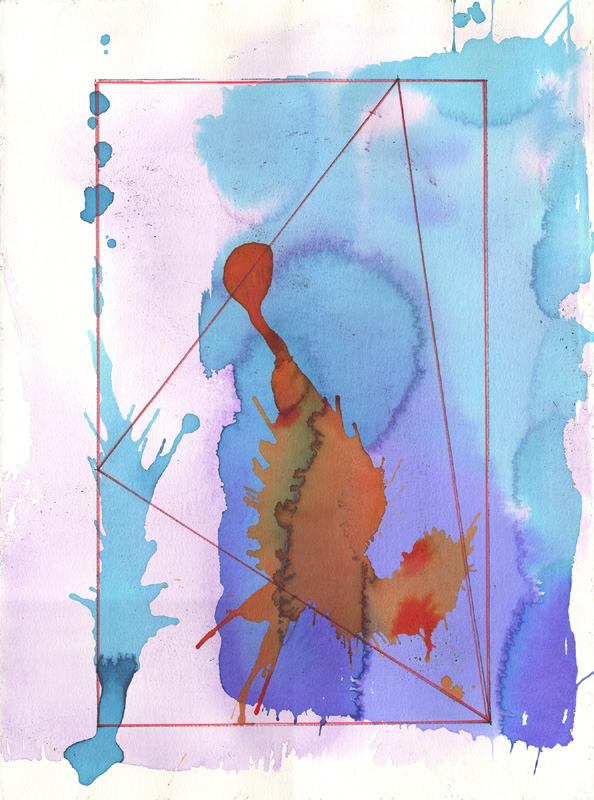
Ricardo F. Morín Triangulation 10 22″ x 30″ Watercolor and wax pencil on paper 2007
Preface
This essay proceeds from an observation: the forces that now shape collective life and the institutions that hold responsibility for it no longer operate at the same scale. Climate volatility, digital acceleration, migratory displacement, and economic interdependence move through air, water, data, and supply chains without regard for territorial boundaries. The world remains organized as a collection of discrete sovereignties, each answerable for exposures that form elsewhere and propagate everywhere.
What follows is an examination of that condition. It predicts nothing and recommends nothing. A disproportion of scale can be described, and the description makes visible what the inherited arrangement obscures: where responsibility fragments, where exposure accumulates, where the vocabulary of governance ceases to correspond to the movement of events.
The examination moves as perception moves. It begins inside the condition, where the disproportion between forces and institutions can be observed in its anatomy. Held in view long enough, the condition begins to disclose what the inherited arrangement obscures, and the examination follows the disclosure. From what becomes visible, certain forms become conceivable, and the examination considers them as perception finds them, without electing among them. And because every condition includes whatever resists its own alteration, the examination ends among the resistances, which belong to the condition as fully as the forces do and persist on their own measures of time.
The essay names a condition. Whatever follows from the naming occurs in the one who perceives it.
I. Geometry:
i.
Heat does not present itself for inspection. It moves through the atmosphere as a single circulation, raising the temperature of a harvest, a reservoir, a city’s August, without recording where one administration ends and another begins. Carbon released over one industrial basin enters the same air that returns it, years later, as drought on a continent that released little. The atmosphere keeps no ledger of origin; it distributes consequence by physics, on a schedule of its own.
Water behaves in the same manner at a different speed. Rivers gather in one jurisdiction and flood in another; aquifers lie beneath several at once; currents redistribute warmth along coastlines that share nothing but the water itself. A drought is regional by nature and national only on the map laid over it.
A pathogen moves through breath and proximity. Sequenced in one country, it circulates in forty before the sequence is published. Its itinerary is composed of airports, markets, and households; nothing in its manner of travel corresponds to the perimeter of a ministry of health.
Data moves fastest of all. A transaction, a rumor, and a model cross the planet in less time than any procedure for examining them requires. The infrastructure that carries them is physically located in territories and functionally located in none.
Supply chains move objects more slowly but bind their endpoints completely. A vehicle assembled in one country contains the labor and minerals of a dozen others; an interruption at a single port reprices goods on every continent. The dependency is real at every point of the chain and visible from none of them in its entirety.
And people move, displaced by the other movements: by the dried harvest, the emptied aquifer, the repriced economy. Displacement is the one traffic the boundary registers, and what it registers is the person; the conditions that moved the person crossed earlier, unexamined.
ii.
The institutions that hold responsibility for these movements are organized by perimeter. A state’s authority is defined by the territory in which it operates: its law binds within the line, its budget is spent within the line, its officials answer to those who reside within the line. This is its manner of holding. Responsibility becomes governable by being bounded; the instrument functions because its field of action is finite and known.
Within the perimeter, the institutional senses are acute. A government measures its own air, counts its own cases, audits its own ports, registers its own arrivals. What lies beyond reaches it through other channels and under other names: foreign affairs, imports, externality. The grammar of the institution renders the outside as context rather than as object.
Accountability follows the same geometry. An electorate, where one exists, holds its government answerable for conditions within the territory; no constituency exists anywhere for the consequence delivered abroad. The institution is rewarded and punished by those inside the line, and its attention is shaped accordingly.
iii.
The disproportion appears wherever the two manners meet. The atmosphere lies above every territory and within none; the instruments that act on it are funded, legislated, and judged perimeter by perimeter. The pathogen’s itinerary and the ministry’s reach intersect at the airport for a matter of hours; the remainder of the itinerary proceeds elsewhere. The supply chain’s interruption occurs everywhere at once and is administered nowhere in particular. The data crossing a border is examined, where it is examined at all, at endpoints the movement itself does not require.
In each location the structure is the same: the instrument acts on the portion of the force that lies within its field, and the force is not partitioned by the instrument. The remainder of the force continues, carrying the portion with it. This is the condition as it presently stands, a geometry of reach that does not coincide, observable point by point.
II. Exposure:
i.
What appears first is exposure. The instrument acts on its portion, the remainder continues, and those who live inside each perimeter live in the path of what no instrument reaches. Exposure of this kind is shared without being held in common: every territory stands in it; no territory administers it.
It can be watched traveling. A harvest dries in one region. Within a season, grain is repriced in markets that have never seen the field; within a year, a household on another continent spends more of its income on bread; the household’s city grows tense in proportions no office measures. The sequence is continuous from field to street, and at no point along it does any single institution see more than the segment inside its line. Deprivation forms in one place and arrives in others as instability, having traveled the whole way without once being seen entire.
Nor is the exposure evenly laid. It gathers where the means of absorbing it are thinnest, in the household with nothing left to reduce, in the region whose aquifer was already low. The geometry of reach distributes consequence without reference to the capacity to receive it.
ii.
The border, watched against this movement, becomes visible twice. In one register it is complete: the person presents a document, the container is opened, the tariff is assessed; nothing built into the border has failed, and everything it was made to register, it registers. In the other register it does not appear at all: the heat and the signal pass at altitudes and speeds for which the border has no instrument, having never been built for them. The same line is whole and absent at once, depending on the register in which it is observed. Its persistence is administrative fact; its coverage, a portion. The doubleness is the disclosure: what had been perceived as the edge of responsibility shows itself as the edge of one kind of traffic.
iii.
The words come forward next, in the places where everyone meets them. The evening news gives a flood abroad thirty seconds and a flood at home a week; the first is foreign affairs, the second a national emergency, though the water behaves identically in both. A ministry calls the smoke drifting in from a neighboring country’s fires an externality, and the word performs a quiet operation: it files the smoke as something outside, even as it settles into the lungs of those inside. The drought that empties a distant aquifer is a foreign matter until the people it displaced stand at the crossing, at which moment the same drought becomes domestic, though nothing in the drought has changed; the word moved, the event did not.
Watched in this way, the vocabulary shows what it is doing. Domestic and foreign, internal and external sort events by the side of the line on which they stand, and the sorting holds only in the register where the line appears. The words are learned so early and used so constantly that they pass for the events themselves; held against the actual movement of events, they show themselves as belonging to the line, terms of its manner of rendering the world.
iv.
The sequence that began in the dried field ends at a person. The consequence has an origin: the carbon has its basins, the repricing has its port, the displacement has its drought. It has a route, traceable segment by segment. What it does not have is an address at which it is received whole: each institution along the route faced its portion, and the consequence, assembled from all the portions, faces no institution anywhere. The person who stands in it, whose bread costs more, whose well draws sand, whose street has grown tense, stands in something produced in full view of many offices and held as the object of none. The person can be counted, and is; assisted, at times; named, rarely. What the condition makes visible, held to the end, is this: a consequence entire, a person inside it, and between origin and arrival no point at which anyone was facing the whole.
III. Images:
i.
What has been seen begins, on its own, to produce something. Anyone who has lived in a town knows the experience in small: a water main bursts, the street floods, and whatever else is uncertain, one thing is not, that somewhere there is an office whose business this is. The repair may come late and the office may be poor, but the flooding has an address, and the mind rests on that address without being asked to.
The consequence traced in the second movement has none. It traveled from the dried field through the port and the market to the street that has grown tense, and at no point did it land on a desk as the matter of that desk. Whoever has seen this whole forms the image of an address without intending to: a desk at the scale of the route, something facing the entire consequence the way the town office faces the burst main. The image arrives unbidden; that is what it means for a form to become thinkable. Nothing in the image says it is near, or simple, or good. It says only that the mind, shown a lack entire, completes the shape of what is lacking.
ii.
A second image follows from the unevenness. Within any town, certain things are already held in common because everyone stands under them equally. No household builds its own levee; the levee answers to the river, which does not visit house by house. The arrangement is so familiar it goes unnoticed: where what arrives, arrives at all, what absorbs it is held by all.
The exposure shown earlier stands over every territory the way the river stands over the low town, and it gathers, as the second movement found, on the household with nothing left to reduce. Held in view, the familiar arrangement extends itself in the mind to the scale of the actual water: the means of absorbing what arrives, held as commonly as the arrival. The image is of the levee matched to the river it actually has, no more. It prescribes nothing about how such a thing is built, or by whom, or whether those now living would consent to build it. It is the shape the mind gives to a protection matched to an exposure already shared.
iii.
The third image is of the line, and it is an image of continuance. Nothing in the foregoing showed the line failing at its own work. The document is still presented, the container still opened; the language of the street, the court where neighbors take their disputes, the school, the holidays, the manner in which a town buries its dead, all of this lives inside the line and was never once crossed by the heat or the signal. What the doubleness disclosed was the size of the line’s register, never a failure inside it.
So the image that forms is double, like the disclosure that produces it: the line continuing entire in its own register, holding everything it has always held, while the registers it never covered, the heat, the signal, the route of the pathogen, meet instruments for the first time. The two parts arrive together and do not yet rest together. Whatever faced the whole of a consequence would draw means and allegiance, and means and allegiance now live inside the lines; the image carries this strain within itself, two registers distinct to perception and contending wherever both would have to be sustained. Whether such a layering could hold outside the mind, the image does not say; seen honestly, it shows the doubleness and the strain at once.
IV. Calendars:
i.
Allegiance has a scale, and it is small. A person belongs first to a street, a table, a language spoken at that table, the graves that are visited on the appointed days. Whatever larger belonging is learned afterward, the flag, the anthem, is taught into a heart already occupied by the near, and takes hold to the degree that it borrows the near’s warmth. No one is from the planet. The word names the place where everyone lives and the place where no one has ever lived.
Part of the trust given to the town office is that it can be walked to. The clerk has a face; the office has a door; the complaint can be carried there in person, and if nothing comes of it, the failure too has an address. The desk at the scale of the route has no door anyone can reach. The image asks the mind to extend trust across a distance at which trust has never yet formed, past the last face, past the last door. The mind that formed the image is the same mind that hesitates before it, and the hesitation is itself a perception, the love of the near reporting accurately what the near provides.
ii.
The second resistance keeps records. In most of the world, the enterprises that have operated across many lines at once are remembered by the people whose lines they crossed: the company that came for the metal, the administration that renamed the streets, the school that punished the language of the table. The image of an instrument facing the whole arrives, in these places, into the memory of the last instrument that claimed to face the whole, and the memory answers before any argument can begin: such things are built somewhere, and the somewhere has never been here.
The memory is a record, kept in archives and in households, read at the scale where it was lived. Consulting it before extending the hand is among the most ordinary acts of perception there is. The image of the desk does not erase the record; it is received into it, and what it becomes there is decided by the record, not by the image.
iii.
Means live inside the lines, and what holds means defends them. The ministry’s reach is its budget; the industry stands where the chain now runs, and the chain, running, pays for the standing. And smaller, in the kitchen: the dockworker’s wage lives in the tariff’s shadow, the town’s school is funded by the refinery, the pension rests on the placement of things as they are placed. Anything that faced the whole of a consequence would draw means and allegiance, as the strain already showed, and means and allegiance do not transfer themselves; they are held, and holding has hands at every scale. The motion of those hands is the same in the palace and in the kitchen, the hand closing over what feeds it, and the examination assigns it to no one as a fault. It records it as what position does, wherever position is held.
iv.
The three resistances keep their own calendars. Attachment is renewed with every childhood, and a generation is the unit of its time. Memory outlives its witnesses; the household and the archive carry it past the century. Position reproduces itself by inheritance and appointment, at a pace slower than a life. Against these calendars, the forces move at the speed of air and signal: the heat by the season, the price by the day, the pathogen by the hour. Inside the condition a second disproportion comes visible, of tempo rather than reach: what moves fastest crosses every line, and what would have to move for anything to meet it moves at the pace of childhood, memory, and inheritance. The condition holds both disproportions at once, and they can be observed together, calendar by calendar.
Epilogue
An examination closes without verdict. Nothing in the preceding movements has proposed a remedy, because no remedy is given in the condition itself. What is given has been described.
What has been described here is visible from within the condition and from nowhere else. The forms that appear thinkable appear so to a perception situated in this interval, under these pressures; a different interval will carry a different horizon. The essay claims nothing beyond that boundary. It remains within the horizon of what the present condition permits to be perceived.
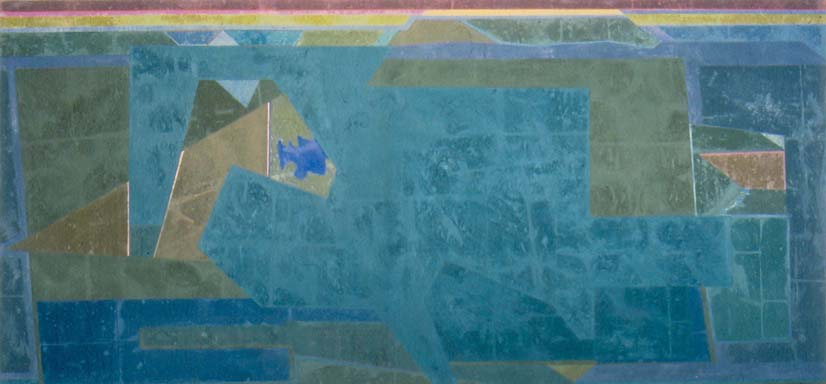
Ricardo F. Morín Temple of Zeus Underwater CGI 2003
The siblings had spent many years trying to conclude matters that had survived both of their parents. Their father had died nearly three decades earlier. Their mother died years after him, and even then the responsibilities did not end. Properties remained unsold. Before those matters were completed, another loss entered the family. The middle sister died the year before. Her own property and affairs now had to be incorporated into responsibilities that had already extended across many years.
Old registries and chains of title extending into the nineteenth century carried certifications, seals, and annotations from different decades and governments.
The country itself had changed during the last three decades. Currency and property lost value before transactions could be completed. Offices closed and reopened under different regulations, sometimes even under different names.
To release properties, formalize transfers, and liquidate assets, it became necessary to gather records, certifications, and documentary chains that different offices and fiscal authorities required for review. Procedures stalled among administrative demands, fiscal obligations, and intermediaries capable of accelerating processes that otherwise could remain paralyzed for months. Files accumulated beside seals, signatures, and annotations originating from different decades.
The matters had already extended across months and years. Meanwhile the siblings aged separately on opposite sides of the Atlantic. The oldest, still practicing law in Venezuela, continued moving between courts, registries, and offices in pursuit of unresolved claims and transfers.
At the same time, land previously belonging to the family remained tied to a legal dispute after having been illegally expropriated by the State years earlier. Defending the claim required certifications, archival records, legal filings, authorizations, appeals, and countersuits. Municipal fees, taxes, and procedural costs continued accumulating while the responsibilities themselves remained unfinished.
From outside the country, it was possible to perceive only partially how procedures there changed from month to month and sometimes from day to day. Some introduced further demands. Others became unavailable altogether. Another day had already been spent moving between offices, registries, and courts.
Messages moved constantly between them through calls, forwarded emails, receipts, scanned documents, explanations, and reminders. One sibling asked whether a payment could still be completed before another increase in tax fees made the transfer even more burdensome. The reply listed offices already visited that week and certifications still missing. Before the question returned again, the exchange had shifted toward an earlier disagreement others believed had already been resolved.
The second oldest, who had left Venezuela many years earlier, explained to one sibling that reminders concerning powers of attorney were meant to prevent delays. To another, he explained that unanswered messages were beginning to be understood differently. One sibling wrote late into the night to avoid misunderstanding. Another answered briefly the next morning before returning to the offices.
A signature believed to be sufficient was later rejected for lacking an additional authentication no one had mentioned before. One office requested papers already sent weeks earlier. Another confirmed receipt but could not say when the matter would be reviewed. A delayed response no longer remained only a delay.
Some questions received partial replies. Others were acknowledged and left unanswered. A message asking whether the funds could still be sent before the end of the month received only this reply: “We are doing what we can from here.” Another asking whether the property sale documents had already been submitted received a response about summer travel plans and whether the necessary signature would still be available in time.
He remembered a childhood game in which a sentence passed from one person to another until it returned altered, sometimes accidentally and sometimes not. At the time, the changes were part of the amusement.
When he attempted to describe some of this, one sibling told him that he was philosophizing again. The remark was mild enough to avoid argument, yet the explanation did not continue after that.
A requirement completed one week returned the next with another condition attached to it.
A message revised several times before being sent remained unanswered for days. Another received only a brief acknowledgment that did not refer to what had actually been written. By the time the next reply arrived, what had gone unanswered in the earlier message had already begun shaping the exchange that followed.
Later, a message arrived saying that one of the unresolved matters had finally been completed. No one referred to what had preceded the resolution. The exchanges resumed in a calmer tone, and attention moved toward whatever remained pending.
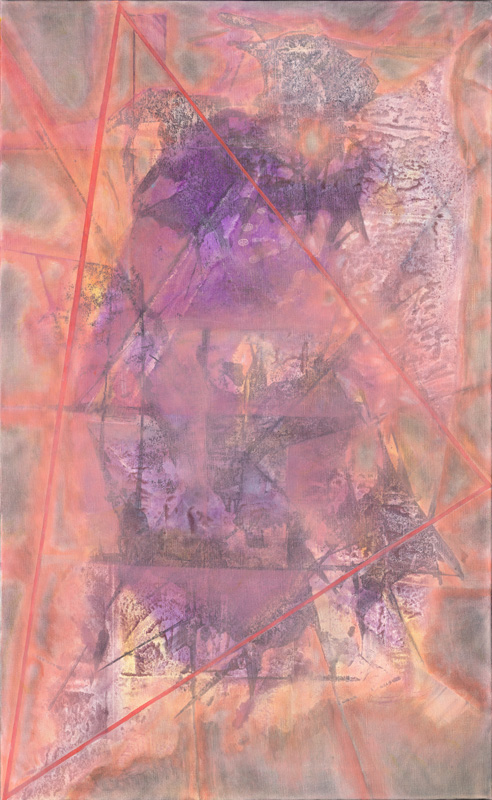
Ricardo Morín Triangulation Series Nº 10: Method 37″ x 60″ x 2″ Oil on linen 2006
*
PREFACE
i
Clarity begins where boundaries appear. A boundary is not a restraint but a distance, an interval in which perception can separate itself from emotion long enough for understanding to take shape. When that distance collapses, experience is reorganized by impulse; the world becomes an extension of what one feels rather than what one sees.
ii
Boundaries are the only defense against this collapse. They prevent meaning from dissolving into reaction and keep perception from being redirected by purpose. Purpose, when allowed to speak first, narrows the field of vision and turns inquiry into confirmation. A boundary interrupts this tendency; it holds intention in suspension so that attention can return to what is actually present.
iii
Inquiry depends on this interruption. Without boundaries, the movement of thought cannot be distinguished from the movement of desire, and doctrine quietly replaces observation. Boundaries do not resolve uncertainty, but they make uncertainty legible. They create the conditions in which questions can be asked without predetermining their answers.
iv
Humility is inseparable from this act. It is not a posture but a condition that allows perception to proceed without the weight of intention. Clarity requires more than sincerity or restraint; it requires a mind that is not driven by the need to accumulate, whether knowledge, virtue, certainty, or self-justification. Accumulation reorganizes perception around a desired result. Discipline, in this sense, is not the pursuit of an ideal but the maintenance of boundaries that protect perception from being redirected by purpose. It is a discipline of subtraction rather than achievement: an effort that becomes effortless when it no longer seeks reward.
This preface introduces the method that follows. Method is not a technique, nor is it a path toward improvement. It is the sustained practice of observing without coercion, distinguishing structure from projection, and permitting meaning to emerge without forcing it into preexisting shapes. Boundaries make that discipline possible. They are the ground on which clarity stands.
Ricardo F. Morín
November, 2025
Oakland Park, Florida
1
Every attempt to understand the world begins with a simple but often overlooked fact: we see in fragments. Human perception operates like a lamp in a large room; perception illuminates what is near, dimming what is distant, and leaves most of the room in shadow. We navigate life with the assumption that our partial view is complete, even though experience repeatedly proves otherwise. Knowledge helps us organize what we see, but it also defines the edges of our understanding; it clarifies one portion of the room while it obscures another. No one escapes this condition. No historian, philosopher, commentator, or citizen sees the world in its entirety, and acknowledging this is not an act of modesty but the foundation of honest inquiry.
2
Two different intellectual traditions help illuminate the tension between seeing and understanding. One comes from the kind of clarity found in Krishnamurti’s observations: the discipline of perceiving without the distortion of fear, motive, or the narratives we inherit without noticing. He insisted that much of what we call “knowledge” is actually memory, habit, or reaction, and that these patterns cloud perception rather than sharpen it. The second tradition, rooted in Western civic philosophy and historical analysis, insists that societies cannot be understood without structure: without categories that describe institutions, without distinctions between authority and power, or between law and the decisions made in its name. This tradition demands reasoning, evidence, and articulation.
3
Neither tradition is sufficient on its own. Pure perception can become impressionistic; it dissolves the world into sensations without offering any explanation of how things work. Pure structure can become rigid; it treats human experience as an abstraction, flattening its subtleties into neat but inaccurate theories. A method emerges when these approaches intersect. Its first movement is subtraction. It asks the observer to remove the noise that interferes with perception: the assumptions that rush ahead of reality, the narratives that interpret the world before we have actually seen it, the emotional recoil that transforms a fact into a grievance, or a possibility into a threat. Subtraction does not eliminate complexity; it makes room for it. It allows us to look at familiar situations, conflict, political argument, civic breakdown, inequality, without immediately reaching for slogans or for the explanations we already prefer.
4
The second movement is structure: identifying the patterns that persist once distortion has been removed. Structure appears in the way institutions operate, in the incentives that shape public behavior, in the stories societies tell to justify their actions, and in the consequences that repeat themselves across time. A society punishes in one way rather than another for reasons that can be traced. A population interprets progress according to a set of assumptions that can be examined. A system favors certain outcomes because its design makes other outcomes unlikely. Structure is not the enemy of perception; it is what perception reveals when it is clean.
5
Meaning arises from the interplay between these two movements. It does not remain stable; it shifts when the conditions that hold it together change. Words like “justice,” “freedom,” “security,” or “progress” acquire new meanings not because thinkers redefine them, but because societies reorganize themselves around different fears, expectations, or pressures. To assume that these meanings are fixed is to mistake living processes for static definitions. The task is not to declare what these concepts should mean, but to examine how they function in the real world; how they guide action; how they justify authority; and how they shape the limits of what people consider possible.
6
This approach allows writing to become neither abstract nor ideological. It is not a performance of expertise nor a confession of personal experience. It is an effort to look at the world as it is lived: how people respond to harm; how institutions drift from their original purpose; how fear transforms into policy; how progress becomes a story that conceals as much as it reveals; how public judgment forms under conditions of uncertainty. These are not theoretical questions but everyday realities, observable to anyone who pays sustained attention.
7
The method does not claim special insight. It does not elevate the observer above the events being described. It argues something simpler and more democratic: that clarity is available to anyone willing to examine both perception and structure without surrendering to either. The observer remains part of the world being studied, affected by its pressures, limited by its uncertainties, and shaped by its histories. The goal is not to escape this condition, but to see it clearly enough that understanding becomes possible.
8
In this sense, method is not a technique but a form of discipline. It is the discipline of perceiving without leaning on the crutch of inherited narratives; the discipline of thinking without allowing ideology to rush ahead of evidence; the discipline of naming structures without pretending they are inevitable; and the discipline of allowing meaning to remain flexible enough to reflect the movement of time. Its purpose is not to simplify the world but to make it legible, without illusion, without theatricality, and without the desire to be right.
9
Such a method offers no certainty. What it offers is honesty: an acknowledgment that truth is not a possession, that the world exceeds every attempt to capture it, and that clarity emerges not from authority but from attention.
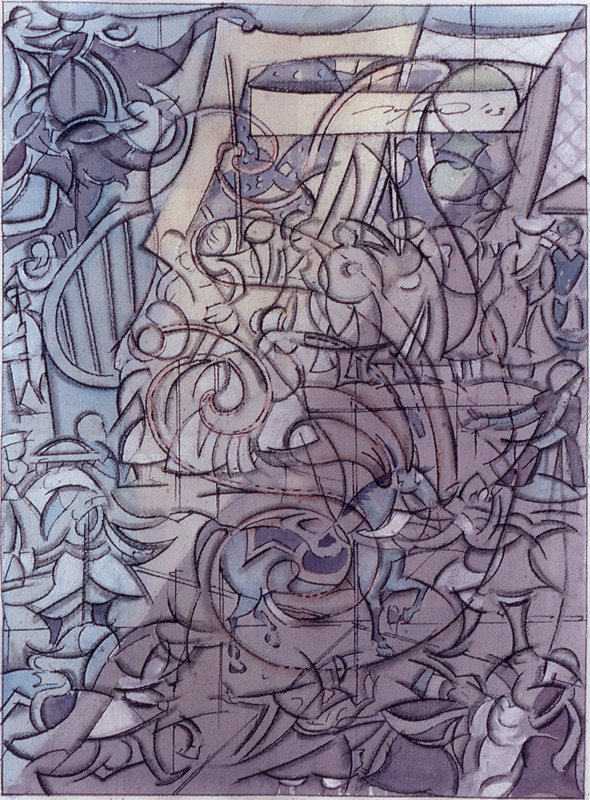
Ricardo F. Morin Buffalo Series, Nº 6 36″ x 78″ Oil on canvas 1979
Preface
People often discover that events far beyond their immediate surroundings affect their lives in ways they neither anticipated nor controlled. A shortage appears in a local store because production has been interrupted elsewhere. A disease emerges in one region and reaches another. A decision taken in a distant capital alters conditions for people who had no part in making it. Weather patterns shift, prices change, technologies spread, and consequences arrive from places most people will never see.
Such experiences belong to a world in which many of the processes shaping daily life extend beyond local communities. Families, neighborhoods, towns, and nations remain affected by forces that originate beyond them.
The circumstances in which human societies live have repeatedly encountered conditions that exceeded the reach of existing practices and expectations. Trade connected distant regions. Political territories expanded beyond local communities. Industrialization linked livelihoods to economic processes operating far from where those livelihoods were sustained. In each case, people confronted realities larger than those for which many inherited arrangements had originally been developed.
Historical responses varied. Some commercial and governmental institutions adapted gradually. Others resisted change until circumstances imposed it. Some expanded their reach while preserving older assumptions. Others generated new practices and new forms of organization. No single pattern governed these transitions. What remained constant was the encounter between inherited arrangements and conditions that had outgrown them.
Whether contemporary conditions belong to this historical pattern, or whether they represent something different, remains uncertain. At issue is not a preferred outcome, but the extent to which the reach of circumstance continues to exceed the assumptions, expectations, and arrangements through which societies understand and respond to it.
The puzzling question matters because familiar ways of organizing collective life often persist after the circumstances that gave rise to them have changed. Practices that once addressed the conditions people faced may continue long after those conditions have been altered by new technologies, new forms of exchange, new patterns of movement, and new forms of interdependence. Whether inherited arrangements can still comprehend circumstances whose reach has changed is not merely an abstract question. It bears on how societies understand the challenges before them and the range of responses available to them.
Ricardo F. Morin
June 3rd, 2026
Bala Cynwyd, Pennsylvania
I. Routes: Circumstances in Motion
Circumstances do not remain where they originate. The conditions shaping a community’s life rarely arise entirely within that community. They arrive through paths established for other purposes, across distances no single traveler encompasses, and over periods no single generation witnesses in full. Movement extends the reach of circumstance beyond the boundaries of any local setting and carries with it more than those who first set it in motion anticipated or intended. Goods travel, but so do the conditions that produce them, the diseases that accompany them, and the beliefs that give them meaning. People move, but so do the arrangements they carry within them and the circumstances they encounter along the way. Ideas cross boundaries that armies cannot always cross, and diseases pass through barriers that neither commerce nor diplomacy can fully seal. The significance of routes lies not in motion alone but in what motion makes possible: the entry of one circumstance into a setting where it had not previously been present. The reach of circumstance begins with motion.
Long before large states, industrial systems, or modern means of communication existed, overland routes connected communities separated by vast distances. The network of paths crossing Central Asia, known in later centuries as the Silk Road, consisted not of a single road but of multiple corridors traversing deserts, mountain passes, and steppe grasslands across Eurasia. Caravans moved between regions whose languages, religions, political arrangements, and ecological conditions differed profoundly from one another. No merchant occupied the entire network, and no political authority administered it in its entirety. Yet circumstances originating in one region entered the lives of populations living far beyond it. Silk moved westward. Horses moved eastward. Spices, glassware, and precious metals followed routes whose combined length exceeded the administrative reach of any empire that sought to govern them. Alongside merchandise traveled religious traditions, technical knowledge, artistic forms, and linguistic practices. The overland routes of Eurasia revealed that the reach of circumstance could extend across vast distances through the cumulative movement of many participants, none of whom controlled the whole.
Maritime routes extended that reach across different terrain. The Indian Ocean connected societies ranging from East Africa and the Arabian Peninsula to the western coast of India, the ports of Southeast Asia, and the southern coast of China. What made this network distinctive was not merely its geographic extent but the regularity of its operation. Seasonal monsoon winds established recurring patterns of movement, carrying vessels outward during one part of the year and returning them during another. Merchants, sailors, pilgrims, migrants, and travelers moved through the same maritime network across centuries, sustaining relationships among distant societies whose encounters gradually became part of the ordinary conditions of life in each of them. Goods traveled in large quantities, but so did languages, religious traditions, technologies, and commercial practices. Circumstances originating in one region entered others not through isolated contact but through recurring circulation that accumulated across generations. The maritime routes of the Indian Ocean revealed that the reach of circumstance could be sustained through continuity as much as through distance.
Oceanic routes carried the reach of circumstance further still. The Atlantic world that developed after the fifteenth century connected populations that had previously evolved in separation from one another across an ocean neither had previously crossed. Plants, animals, pathogens, technologies, and people crossed in both directions, but the consequences were distributed unequally across the societies involved. Environments were altered. Diets changed. Demographic patterns shifted on a scale that no previous exchange had produced. Labor systems were reorganized to serve production systems operating across oceanic distances. The oceanic routes of the Atlantic laid bare that the reach of circumstance could alter not only what communities possessed but the fundamental conditions under which they sustained themselves: their populations, their ecologies, and their arrangements for organizing work and distributing its products.
Certain routes acquire significance not merely because they connect distant regions but because multiple circumstances depend upon them simultaneously. Western Asia has functioned across many centuries as a crossroads through which routes linking Africa, Europe, Central Asia, and South Asia have repeatedly passed. Trade, migration, imperial expansion, religious transmission, and resource flows have converged upon the same corridors across successive periods. The Strait of Hormuz illustrates the enduring significance of such passages: a narrow body of water connecting the Persian Gulf to the Arabian Sea, has served for centuries as a point where the movement of goods, the projection of political authority, and the conduct of trade have repeatedly intersected. Circumstances affecting a single passage may alter conditions extending far beyond it. The importance of a strategic corridor lies not only in its location but in the range of relationships that depend upon its continued accessibility. The reach of circumstance becomes concentrated at such points in ways that render its dependence upon particular geographic conditions intelligible.
Information has always traveled through routes as surely as goods and people. Postal systems carried correspondence across empires and commercial networks centuries before modern communications existed. Telegraph networks in the nineteenth century altered the speed at which commercial, political, and military circumstances could be transmitted across distances that had previously required weeks or months to traverse.Broadcasting systems extended the reach of information further still, into settings that earlier communications had not penetrated. Digital networks have extended the movement of circumstance through informational pathways whose speed and scale differ from all previous systems.Circumstances travel through informational routes as they travel through physical ones: they enter settings where they had not previously been present and carry with them more than those who first transmitted them intended or anticipated. The speed of transmission changes. The reach of circumstance through routes of communication remains a constant of historical experience.
II. Entanglements: Circumstances in Relation
Circumstances rarely arrive alone. A disease follows commercial exchange. Migration follows conflict. Religious traditions accompany merchants, pilgrims, settlers, and conquerors. Crops alter diets, populations, labor systems, and patterns of settlement. Resources attract political authority, commercial investment, military protection, and competition. Movement, as the preceding inquiry has established, extends the reach of circumstance beyond its point of origin. But movement alone does not explain what happens when circumstances that originated separately enter the same field of experience. Once they intersect, they often become difficult to separate from one another. What began as distinct conditions becomes part of a single, if not always coherent, field. The reach of circumstance extends not only through movement but through relation. Circumstances become part of one another.
Disease seldom remains a medical circumstance alone. The Black Death, which followed commercial routes across Eurasia during the fourteenth century, did not arrive as a purely biological event. It traveled through a network of exchange already shaped by commercial, political, and demographic circumstances that determined where it spread, how quickly it moved, and what populations it encountered. Its effects accumulated through those relations. Labor arrangements changed because populations declined. Theological interpretations shifted because existing explanations proved inadequate to the scale of mortality. Political arrangements were destabilized in regions where administrative capacity depended upon populations that no longer existed in their previous numbers. Later epidemics revealed the same condition. Cholera moved through nineteenth-century commercial and imperial networks. Influenza followed the movement of populations during and after the First World War. HIV spread through patterns of migration and commerce across continents. Ebola exposed relations among ecological disruption, institutional capacity, and international response. COVID-19 revealed the entanglement of global supply chains, public health systems, political authority, and information circulation. Pathogens travel through circumstances already shaped by other circumstances. Their effects emerge through those relations as much as through the biology of the disease itself. The reach of a disease is inseparable from the reach of the circumstances through which it moves.
Migration alters populations, labor systems, languages, religious practices, cultural forms, and political arrangements in ways that no single cause produces and no single authority fully controls. Conditions at places of origin remain connected to conditions at destinations long after the movement itself has occurred. Remittances flow back along paths that migrants have traveled forward. Languages spoken in communities of arrival carry traces of the regions from which their speakers came. Religious practices transplanted into new settings encounter existing traditions and produce forms that neither setting would have generated alone.
The circumstances that produce migration are rarely singular. Environmental deterioration, economic displacement, political violence, demographic pressure, and military conflict often operate simultaneously, making the isolation of any one cause an analytical convenience rather than a historical reality. The circumstances that migration produces at its destinations are similarly varied. Labor market changes, institutional adaptations, cultural encounters, and political responses frequently emerge together and resist reduction to a single origin.
Migration makes it possible to recognize relationships that span multiple places and generations that outlast the original movement. The reach of circumstance through migration is measured not only in distance but in the duration of its effects upon the communities through which it passes.
Religious traditions do not travel alone. The spread of Islam across the Indian Ocean world, Central Asia, sub-Saharan Africa, and Southeast Asia was not a movement of belief in isolation from other circumstances. Languages accompanied it. Legal traditions developed alongside it. Educational institutions followed it. Commercial networks bore the tradition and were extended by its spread. Artistic forms, architectural practices, and systems of social organization traveled through the same pathways.
The spread of Christianity through the Atlantic world similarly carried languages, institutional forms, educational practices, legal concepts, and political arrangements into settings where those circumstances had not previously been present. Neither Islam nor Christianity arrived as a pure system of belief separable from the material and institutional circumstances with which each had become entangled in the course of its transmission. The circumstances accompanying religious traditions often outlasted the intensity of the original transmission and persisted in institutional forms, legal practices, and social arrangements long after the initial encounter had receded from immediate experience.
The reach of circumstance through religious transmission makes it possible to recognize that belief and institution, faith and organization, cannot always be separated from the wider field of relations through which they travel.
Food systems reveal the reach of circumstance through the most immediate conditions of daily life. Agriculture depends simultaneously upon climate, water, labor, transportation, trade, finance, and technology. No harvest is produced by a single circumstance. The voyages of Christopher Columbus altered diets, populations, environments, and economic arrangements across continents through the movement of plants, animals, and agricultural practices between hemispheres that had previously developed in separation. Maize, potatoes, tomatoes, and other American crops entered European, African, and Asian agricultural systems and altered not only what people ate but how populations grew, how labor was organized, and how land was used. Sugar production in the Americas reorganized labor systems across the Atlantic world, connecting the agriculture of one region to the commerce and consumption of others through relations that no participant in any single part of the system fully surveyed.
Food insecurity and famine frequently lay bare relations among environmental conditions, commercial arrangements, political decisions, and demographic pressures that resist attribution to a single cause. The Irish famine of the nineteenth century, the famines accompanying disruptions of colonial administration in South Asia, and the food crises of the twentieth century each demonstrated that the conditions shaping whether populations could sustain themselves were entangled with circumstances extending far beyond the fields in which crops were grown or failed.
The reach of circumstance through food systems makes clear how closely the necessities of daily life depend upon relations extending beyond the settings in which food is produced, exchanged, and consumed.
Energy systems reveal the reach of entanglement into the infrastructures upon which modern life depends. Coal altered the conditions of manufacturing, transportation, and urban life during the nineteenth century, concentrating populations, reorganizing labor, and producing consequences for health, the environment, and political organization that no single decision had anticipated. Oil extended those relations further, connecting the conditions of daily life in industrial societies to regions whose populations had no necessary relation to the consumption occurring elsewhere.
The dependence of transportation, manufacturing, agriculture, commerce, communication, and household life upon energy systems whose sources lie far from their points of use has made the entanglement of energy with other circumstances a persistent feature of modern historical experience. Disruptions in production, shifts in price, and conflicts over access to energy resources have repeatedly altered conditions well beyond the settings in which those disruptions originated. Production disruptions, price fluctuations, and conflicts over access to energy resources have repeatedly altered conditions far beyond the locations where those disturbances originated. The concentration of transport along a limited number of corridors renders distant economies dependent on geographical and political conditions beyond their control.
The reach of circumstance through energy systems makes clear how deeply the conditions of ordinary life depend upon relations extending across great distances.
Information systems alter the circulation of knowledge, belief, commerce, and political authority in ways that become entangled with the broader circumstances through which societies organize collective life. The introduction of printing in fifteenth-century Europe altered the conditions under which religious authority, commercial communication, legal practice, and political organization operated, not by replacing those circumstances but by entering into relation with them and altering the field in which they functioned. Telegraphy in the nineteenth century changed the speed at which commercial and political circumstances could interact across distances, producing relations between markets that had previously been separated by the time required for information to travel between them. Broadcasting extended the reach of information into domestic settings, entangling the circulation of belief, political authority, and commercial persuasion with the conditions of private life.
Digital networks and algorithmic platforms have extended those relations further, connecting identity, governance, markets, and social interaction through systems whose operations frequently exceed the awareness of those participating in them. Circumstances increasingly interact through systems of communication as well as through physical movement, producing relations whose origins and effects cannot always be confined to a single domain.
The reach of circumstance through information systems reveals that communication does more than transmit conditions. It becomes one of the conditions through which other circumstances interact.
Commercial exchange links production, transportation, labor, finance, consumption, and governance through relations extending beyond the awareness of individual participants. A garment produced in one region, from materials extracted in another, transported through systems organized in a third, sold in a fourth, and financed through arrangements originating in a fifth, concentrates within a single object the reach of circumstances distributed across multiple settings and multiple scales.
The supply chains through which contemporary commercial systems operate render visible relations extending far beyond the visibility of those who participate in any single part of them. Commercial circumstances intersect with migration, energy, disease, environmental change, and political authority in ways that make the effects of a disruption in one part of the system felt in settings with no immediately apparent connection to it. The financial arrangements through which commercial exchange is organized similarly distribute the effects of instability across populations that had no direct part in producing the conditions from which that instability emerged.
Exchange becomes part of a wider field of interconnected circumstances whose reach extends beyond the intentions of those who participate in it and beyond the arrangements any single authority has established to govern it. What the preceding sections allow us to recognize retrospectively through the lens of historical distance, artificial intelligence allows us to observe from a different vantage point in time.
III. Duration: Circumstance through Permutation
Some circumstances disappear. The conditions that produced them dissolve, the routes through which they traveled close, and the settings in which they operated transform beyond recognition. What remains may be little more than a trace in language, an architectural form, or a practice whose original context has become unrecoverable.
Others endure. They persist across centuries, surviving the political orders that first gave them institutional form, the commercial systems through which they first spread, the populations that first carried them, and the technologies through which they first operated. Those that endure rarely remain unchanged. A circumstance that persists across several centuries does not persist by remaining identical to what it was at its origin. It survives through successive transformations, assuming forms that its originators would not always recognize, operating through arrangements that differ substantially from those through which it first appeared, and producing effects in settings its first carriers never encountered.
Duration is not permanence. It is the capacity of a circumstance to remain identifiable across transformations that would, taken individually, appear to have altered it beyond continuity. The reach of circumstance extends not only through motion and relation but through time: through the ability of a condition to outlast the particular arrangements through which it first became visible.
Christianity emerged within the eastern Mediterranean world of the Roman Empire, among populations whose languages, political circumstances, and cultural forms were shaped by that specific historical setting. Its earliest institutions developed in relation to those conditions: the administrative structures of the empire, the philosophical traditions of the Hellenistic world, the legal practices of Roman governance, and the religious landscape of a region in which multiple traditions coexisted and competed.
Those conditions changed. The empire through whose administrative framework the tradition first spread eventually divided, contracted, and in its western portions dissolved into successor arrangements that differed substantially from what had preceded them. Christianity survived that dissolution and continued through the political arrangements that replaced it, adapting its institutional forms, its languages of worship and administration, and its relations to political authority as the conditions surrounding it changed.
Schisms altered its internal organization. Reformations challenged existing institutional arrangements and produced new expressions that contested the authority of older ones. Missionary expansion carried the tradition into settings whose populations, languages, and cultural forms differed profoundly from those in which it had first developed. Colonization entangled it with political and commercial circumstances unlike those accompanying its earlier expansion. Secularization altered the institutional position it occupied within societies where it had long been established.
Across these transformations, the circumstance remained recognizable, not because it was unchanged, but because continuity persisted through permutation rather than stasis. The reach of circumstance through duration reveals itself in the capacity to remain identifiable across conditions that would have made its original form unsustainable.
Islam emerged within the Arabian Peninsula during the seventh century and expanded across regions whose existing circumstances differed profoundly from those of its origin. Persian administrative traditions, African political arrangements, Central Asian steppe cultures, South Asian philosophical and religious systems, Southeast Asian commercial networks, and European intellectual and political formations each encountered the expanding tradition under different conditions and produced outcomes that varied accordingly.
Legal traditions diversified into schools of interpretation whose differences reflected the circumstances of the societies in which they developed. Political arrangements through which the tradition related to governance changed across regions and centuries, producing forms that differed substantially from one another while remaining recognizable as expressions of the same circumstance. Cultural expressions in architecture, literature, music, and visual art assumed forms specific to the settings in which they appeared, carrying the tradition into domains shaped by local conditions.
Islam persisted not through uniformity but through adaptation and differentiation. The circumstance remained identifiable across settings whose conditions differed as substantially from one another as the societies of West Africa, Central Asia, and Southeast Asia differed from the Arabian Peninsula in which it originated. Duration occurred through permutation rather than through the preservation of a fixed original form.
Commercial exchange long predates the institutional arrangements through which it has been organized in any particular period. The circumstance of organized exchange, the movement of goods between producers and consumers through systems that establish value, facilitate transaction, and distribute proceeds, has persisted across the full range of historical settings in which human societies have organized collective life, while the forms through which it has operated have changed repeatedly and substantially.
Markets, merchant houses, trading companies, joint-stock corporations, multinational enterprises, and the financial systems accompanying them differ in their organization, legal foundations, geographic reach, and relations to political authority. The methods through which exchange has been conducted have likewise changed. Barter gave way to coinage. Credit expanded the reach of transaction. Paper instruments, electronic transfer, and digital transactions altered the speed and scale at which exchange could occur. Accounting practices, ownership arrangements, investment structures, and the legal frameworks governing commercial claims underwent transformations that, taken individually, represented substantial departures from what preceded them.
Yet the circumstance of organized exchange endured through those transformations. It remained identifiable across settings that differ as substantially from one another as medieval merchant networks differ from contemporary commercial systems. Duration occurred through institutional transformation rather than through the preservation of any particular form.
Political authority has assumed forms across historical time that differ substantially in scale, organization, justification, and relation to the populations over which they exercised governance. City-states organized political life around concentrated urban communities. Kingdoms extended authority across territories defined by dynastic claims and military capacity. Empires incorporated diverse populations, languages, legal traditions, and administrative arrangements within structures whose geographic extent exceeded anything earlier forms had achieved. Federations distributed authority among constituent units through arrangements intended to balance local autonomy with the requirements of collective action. Colonial administrations extended political authority across oceanic distances, governing populations through arrangements designed to serve distant metropolitan centers. Nation-states organized authority around claims of shared cultural, linguistic, or historical identity whose relation to the diversity of the populations they governed was often more assumed than demonstrated.
Across these successive forms, administrative practices frequently survived the political orders that first developed them. Bureaucratic procedures, legal frameworks, taxation systems, and methods of record-keeping persisted through transitions between political forms, carrying arrangements developed under one order into the operations of its successor.
States endure less through permanence than through continual reconfiguration. The reach of circumstance through political authority reveals itself in the persistence of administrative practice across the transformations of political form.
Financial systems have evolved across centuries through transformations that repeatedly altered the mechanisms through which credit, debt, investment, and exchange are organized, while the circumstance of financial interdependence continued to expand. Coinage established systems of exchange whose operation depended upon the political authority that issued and guaranteed it. Banking institutions developed methods of credit and transfer that extended commercial activity beyond what the physical movement of coin could sustain. Securities markets created arrangements through which investment could be organized across distances and among participants with no direct relation to the enterprises their capital supported.
Central banking introduced mechanisms through which political authority sought to regulate the conditions of credit and monetary circulation across national economies. Electronic finance altered the speed and scale at which transactions could occur, connecting markets across continents through systems operating faster than any participant could fully observe. Digital assets and algorithmic trading introduced mechanisms whose operation exceeds the immediate comprehension of many of the institutional participants responsible for overseeing them.
The mechanisms through which financial interdependence operates have changed repeatedly and substantially. The circumstance itself has continued to expand, drawing an increasing range of economic activity into relations of mutual dependence extending across settings that earlier financial systems did not connect. Duration occurred through technological and organizational transformation while the underlying circumstance continued to extend its reach.
Digital infrastructures emerged from specific scientific, military, and administrative contexts during the mid-twentieth century. They developed through research programs whose participants did not anticipate the eventual scale of what they were creating and expanded from specialized systems serving limited institutional purposes into global infrastructures upon which communication, commerce, governance, research, and social interaction have become extensively dependent.
The circumstance did not remain stable across that expansion. Advances in processing capacity, network architecture, software design, the miniaturization of devices, and the integration of computational systems into everyday objects altered the conditions under which digital infrastructures operated while extending their reach into domains earlier stages of development had not penetrated. Communication became dependent upon digital infrastructures before commerce did. Commerce became dependent before governance did. Governance became dependent before social interaction at the scale of ordinary daily life did.
The circumstance continued to change even as dependence upon it deepened, producing a condition in which transformation and dependence proceeded simultaneously, each altering the conditions of the other. Duration occurred through successive technological permutations whose cumulative effect was to make digital infrastructures increasingly difficult to separate from the conditions of modern social life.
Artificial intelligence emerged from earlier developments in computation, mathematics, statistics, and information theory, carrying within it traces of the circumstances through which those antecedent fields developed. Its forms have already changed repeatedly within a comparatively short period. Early symbolic systems designed to replicate specific forms of reasoning gave way to statistical approaches that altered how patterns could be identified in large collections of data. More recently, neural network architectures have produced capabilities that their designers did not always anticipate and that existing frameworks of understanding have not always adequately characterized.
Research systems developed for specialized scientific purposes have been adapted into commercial applications serving populations that had no part in the original research programs. Governmental uses have developed alongside commercial ones, extending the reach of the circumstance into domains of administration, surveillance, and political authority. Public interaction with systems of artificial intelligence has become part of ordinary experience across multiple societies, integrating the circumstance into daily life in ways earlier stages of its development did not foresee.
The circumstance remains unstable. Its methods, capabilities, and social reach continue to change even as it becomes increasingly integrated into other circumstances whose own operations are thereby altered. What the preceding sections allow us to recognize retrospectively through the lens of historical distance, artificial intelligence reveals from a different vantage point in time. Transformations are already underway. Complex structures are already accumulating. And yet, the arc of this situation cannot yet be grasped as a completed sequence.
Duration observed from within rather than from a distance appears as precisely this condition: a circumstance already altering the settings through which it passes without having assumed the stable form that would make its persistence fully legible in retrospect. The reach of circumstance continues through permutation rather than completion, and a circumstance need not have assumed a stable form to have already altered the conditions of the settings through which it passes.
IV. Scale: Circumstances in Coexistence
Circumstances do not operate at a single scale. The conditions shaping a household differ in their immediate character from those shaping a city, a region, a nation, or a system of relations extending across continents. Yet those conditions are not sealed from one another. A circumstance operating at the scale of a continental system enters the conditions of a household through the price of food, the availability of labor, the presence or absence of disease, and the stability or disruption of the arrangements through which ordinary life is sustained. A circumstance originating within a single household may extend its effects through commercial, familial, political, or institutional connections into settings far beyond the one in which it arose.
Circumstances of different origins, different durations, and different geographic reach coexist within the same historical moment without dissolving into one another. The local does not disappear into the global. The global does not exhaust itself in any particular local expression. No single circumstance occupies the entire field in which it operates, and no single field is occupied by only one circumstance.
Coexistence renders legible the scope of the circumstance of the emergent and the inherited. New circumstances enter settings already shaped by older ones, and both remain present even when neither governs the field entirely.
Some of these coexistences become legible only in retrospect. Others are encountered while they are still forming, before their duration, effects, or final relation to older circumstances can be known.
Industrial communities of the nineteenth and twentieth centuries illustrate the coexistence of scales with particular clarity. A mill town in Lancashire, a mining community in the Ruhr Valley, or a factory district in New England organized its working life, institutions, and patterns of settlement around a specific productive activity whose conditions were determined by circumstances extending far beyond the community itself. The price of cotton, the demand for coal, the decisions of distant investors and commercial houses, the fluctuations of international commodity markets, and the policies of national governments each shaped the conditions of communities whose daily experience was immediate and local while the determinants of that experience were not.
Workers whose lives were organized around the rhythms of the mill or the mine encountered, through wages, employment, and the availability of goods, the circumstances of commercial and financial systems whose operations they did not govern and whose extent they did not survey. The community remained a particular place, with its own social arrangements, institutions, and culture of labor and association, while the conditions of its existence were shaped by scales of organization that differed substantially from those at which its members lived and worked.
Different scales coexisted without dissolving into one another. The conditions of life in any particular industrial community were shaped by their simultaneous presence rather than by any single scale operating independently.
Communities respond to the circumstances immediately before them while remaining subject to decisions made elsewhere. The conditions under which a provincial city in the Roman Empire organized its public life were shaped in part by administrative decisions made in Rome, by military commitments whose theaters of operation lay beyond the horizon of local experience, and by commercial circumstances whose origins lay in regions many of its inhabitants would never see.
The conditions under which a colonial settlement in the Atlantic World organized its economic life were shaped by commercial regulations, tariff systems, and political decisions made in distant metropolitan capitals. The distance separating those who made such decisions from those who lived within their consequences was measured not only in miles but also in differences of circumstance.
Communities in the contemporary world continue to experience the effects of decisions made beyond the settings in which those effects are felt. Financial decisions made in distant centers, commercial arrangements governed at larger scales, and political decisions affecting populations that had no part in making them all become part of local experience.
Different scales of circumstance occupy the same field without being reducible to one another. The conditions of local life are shaped by their coexistence rather than by any single scale operating independently.
Wars remain geographically situated. The territory across which armed conflict is conducted has boundaries, however contested and shifting those boundaries may become during the conflict itself. Yet the effects of armed conflict extend through circumstances that are not geographically bounded in the same way.
Migration follows armed conflict, carrying populations across distances that the conflict itself does not traverse. Commerce is disrupted across supply chains whose extent exceeds the geographic scope of the fighting. Energy systems are altered when conflicts involve regions through which vital resources pass. Diplomatic arrangements are reorganized through the broader network of relationships maintained by the parties to the conflict. Communication systems carry the circumstances of war into settings far beyond its location, making its conditions part of the experience of populations who encounter it through information rather than direct proximity.
Circumstances originating within a particular region coexist with circumstances operating at scales far beyond that region, and the reach of conflict extends through those coexisting circumstances into settings its geographic boundaries would not suggest. The reach of a circumstance is not limited to its location. What occurs within one scale is rarely confined to it.
Droughts, floods, storms, and other ecological disruptions occur within particular places. The conditions that produce them operate across scales that do not correspond to the boundaries of human political or commercial organization. A drought affecting an agricultural region alters food production in ways that extend through commercial systems far beyond the affected area, reaching consumers in distant markets through changes in price and availability. A flood disrupting transportation infrastructure in one region alters conditions across commercial networks that depend upon that infrastructure without being located within the affected area. A storm damaging energy infrastructure produces effects that extend through the systems dependent upon it into settings the storm itself does not reach.
The consequences of ecological disruptions travel through food systems, transportation networks, commercial arrangements, and migration patterns, reaching scales of impact that their immediate geographic scope would not suggest. Environmental and social circumstances coexist at different scales, and the effects of disruption in one scale pass through connections into settings operating at different geographic and institutional levels. The difference between where a disturbance occurs and where its consequences are experienced makes it possible to gauge the scope of the situation.
Strategic corridors render the coexistence of circumstances across scales with particular clarity. The Strait of Hormuz is a geographic feature of limited physical extent, a body of water measuring roughly thirty miles at its narrowest point. Yet the circumstances that depend upon its accessibility extend across scales of commercial, political, and domestic life that differ as substantially from one another as the operations of an international energy market differ from the heating of a household in a distant country.
Maritime passages, transportation networks, and energy systems similarly concentrate within specific geographic features the dependencies of circumstances operating at vastly different scales. A disruption at a strategic corridor does not remain at the scale of the corridor. It travels through the systems that depend upon it into the conditions of household economies, industrial operations, commercial arrangements, and political relations whose geographic location bears no immediate relation to the passage whose disruption altered their conditions.
Circumstances separated by scale remain connected through coexistence. The significance of a strategic corridor lies in its capacity to reveal those connections by making visible what the uninterrupted operation of wider systems ordinarily conceals.
New circumstances enter fields already occupied by established arrangements, and their coexistence produces conditions that neither would generate in isolation. The arrival of a new disease in a population with no prior exposure encounters not an empty field but one already shaped by institutions, patterns of settlement, commercial and transportation networks, and political arrangements developed under earlier conditions. The effects of the new circumstance are shaped by those coexisting conditions as much as by its own characteristics.
New technologies enter similarly structured fields. The introduction of printing encountered a world already organized by manuscript culture, ecclesiastical authority, and existing commercial networks for the distribution of written materials. Digital networks entered settings already organized by communications infrastructure, commercial arrangements, and political frameworks governing communication. Artificial intelligence is entering fields already shaped by systems of governance, commerce, education, and social organization, and its effects will be shaped in part by those preexisting conditions.
Circumstances of different duration coexist within the same historical moment. New circumstances do not arrive in empty settings. They encounter arrangements formed by earlier circumstances whose presence continues to shape the field into which the new circumstance enters.
The reach of circumstance becomes intelligible through the coexistence of the emerging and the inherited, neither of which fully determines the conditions produced by their encounter.
Armed conflict, migration, disease, food insecurity, financial instability, energy dependence, and technological transformation have repeatedly coexisted within the same historical moments without sharing a common origin, duration, or geographic reach. The fourteenth century in Eurasia witnessed the simultaneous presence of plague, commercial disruption, political instability, and agricultural crisis across a field of circumstances differing in origin, duration, and reach.
The period of Atlantic expansion witnessed the simultaneous presence of ecological transformation, demographic collapse, labor reorganization, commercial development, and religious transmission across a field of circumstances operating at different scales and through different mechanisms. The nineteenth century witnessed the simultaneous presence of industrialization, imperial expansion, mass migration, epidemic disease, and financial integration across a field of circumstances whose geographic reach and temporal duration varied substantially from one another.
No single circumstance exhausted the field in which it operated. No single field was occupied by only one circumstance. Historical experience repeatedly unfolded through the coexistence of circumstances differing in origin, duration, reach, and scale.
The reach of circumstance becomes intelligible through this simultaneous presence. Different circumstances occupy the same moment without becoming the same circumstance, and the settings through which they pass are shaped by all of them at once.
V. Passage: Circumstances in Concrete Settings
Circumstances do not operate in abstraction. The reach established through motion, extended through relation, sustained through permutation, and encountered in coexistence does not become actual until it enters a particular setting: a place with its own prior conditions, its own inherited arrangements, and its own population already engaged in the work of sustaining daily life within the circumstances present to it. A circumstance whose reach extends across continents must still pass through a port, a market, a household, an institution, or a border before its reach becomes a condition that particular people inhabit.
The setting does not contain the circumstance. It is not large enough, permanent enough, or sufficiently in control of its own conditions to contain what passes through it. Yet the circumstance does not abolish the setting. The port remains a port. The household remains a household. The institution continues to operate through inherited arrangements even as the circumstances passing through it alter what those arrangements must address.
The reach of circumstance becomes visible not in the abstract field through which it extends but in the particular places where it takes effect. There the wide and the local meet without dissolving into one another. Inherited arrangements encounter conditions that have arrived from beyond them, and the ordinary work of life continues within circumstances that no one in that setting fully originated and no one there fully controls.
Ports have long served as settings through which circumstances originating elsewhere enter the conditions of particular places with unusual concentration and visibility. A port is, by definition, a point of entry: a place organized around the movement of what arrives from beyond it and what departs toward destinations it does not control. Commerce arrives through a port, but so do diseases traveling alongside commerce, migrants following established routes of movement, religious traditions accompanying populations in transit, and political authorities seeking to regulate, tax, and administer what passes through.
Alexandria in the ancient Mediterranean world concentrated within a single urban setting the commercial, intellectual, religious, and political circumstances of a region extending from the western Mediterranean to the Indian Ocean. Calicut on the Malabar Coast received the circumstances of Arab, Chinese, African, and eventually European commercial networks within a setting that remained distinctively its own while participating in systems of exchange whose reach extended far beyond it. Lisbon in the fifteenth and sixteenth centuries became a point through which the circumstances of Atlantic expansion passed into and out of a European setting already shaped by its own prior conditions. Goods, populations, diseases, commercial arrangements, and political ambitions moved through the city without originating there.
In each case, the port remained a particular place with its own geography, population, and institutional arrangements. Yet the circumstances passing through it connected it to fields whose reach far exceeded its own. The reach of circumstance becomes visible through such locations because they concentrate within a concrete setting conditions that would otherwise remain distributed across a wider and less legible field.
Cities gather within a single setting the full range of circumstances that routes carry, entanglements multiply, duration preserves, and scale distributes across different levels of organization. The density of urban life, its concentration of populations, institutions, markets, infrastructures, and systems of communication, makes cities the settings through which wider circumstances often assume their most visible and consequential form.
Constantinople occupied for centuries a geographic position through which the circumstances of Europe, Asia, and the Mediterranean world passed. Within a single urban setting it concentrated commercial, religious, political, and military circumstances originating across a vast geographic field. The city, its walls, institutions, accumulated wealth, and position astride major routes of movement, shaped and was shaped by the circumstances passing through it. Successive political orders transformed its governance while leaving traces of earlier arrangements embedded within its institutions and urban fabric.
London in the nineteenth century concentrated within its streets, financial institutions, port facilities, administrative apparatus, and population the circumstances of an imperial system extending across multiple continents. Commercial exchange, migration, industrial production, political administration, and financial activity converged within a setting whose immediate geography was limited but whose connections extended across much of the world.
The city becomes a setting through which wider circumstances take concrete form not because it contains them but because it provides the density of arrangement through which their effects become operative and their relations become visible. The reach of circumstance becomes legible in cities because circumstances that remain dispersed elsewhere are encountered there within the same field of daily life.
Borders serve as settings through which the reach of circumstance encounters arrangements established to regulate movement. They seek to determine what may pass, at what rate, under what conditions, and with what consequences for those whose movement is governed by them. A border is not merely a line. It is a setting organized around the encounter between the reach of circumstance and the claims of political authority. Migration meets regulation there. Commerce meets inspection and taxation. The movement of people encounters the categories through which political systems classify and respond to that movement.
The borders of the Roman Empire were not fixed lines but zones through which populations, goods, military forces, and political authority moved under conditions that changed as the circumstances of the empire and of neighboring populations changed. The borders established through the colonial reorganization of territories in Africa, Asia, and the Americas created settings through which imperial authority encountered populations whose own arrangements for organizing territorial relations differed substantially from those being imposed upon them.
The effects of those encounters often persisted beyond the circumstances that first produced them. Institutional arrangements, territorial disputes, and political relationships continued to shape successor states long after direct colonial administration had ended. The circumstances that had passed through the border remained present in the settings shaped by that passage.
Borders make manifest the relation between wider circumstances and particular jurisdictions not by resolving the tensions between them but by making those tensions visible through the conditions they produce where the encounter occurs. The reach of circumstance becomes intelligible at borders because movement and regulation meet there without fully containing one another.
Markets translate the reach of distant circumstances into the local conditions that participants encounter through prices, the availability of goods, opportunities for labor, and the financial conditions under which exchange occurs. The market is a setting through which circumstances originating in harvests, military conflicts, transportation disruptions, financial decisions, and technological changes become part of daily experience, often without those participating possessing direct knowledge of their origins.
The grain markets of ancient Rome translated the agricultural circumstances of Egypt, Sicily, and North Africa into the food conditions of an urban population whose size depended upon the continued operation of supply systems extending far beyond the city. A disruption in the harvest of a distant province became a condition of urban life through exchange, connecting the agricultural circumstances of one region to the subsistence conditions of another through arrangements neither region fully controlled.
The commodity markets of the nineteenth century translated the agricultural, extractive, and manufacturing circumstances of multiple continents into the prices encountered by participants whose geographic location bore no immediate relation to the origins of what they were exchanging. Contemporary financial markets similarly translate the circumstances of commercial production, political decision, environmental disruption, and technological change into conditions of investment, credit, and exchange that affect populations across settings the originating circumstances do not directly touch.
The market becomes a setting through which wider circumstances become operative in particular lives because its mechanisms of price and exchange make distant conditions present within immediate experience.The reach of circumstance becomes visible in markets through the conversion of remote conditions into local realities.
The institutions through which societies organize their capacity to respond to the circumstances confronting them include schools, hospitals, religious organizations, governments, courts, laboratories, and commercial establishments. They are also the sites through which the scope of broader circumstances enters the organized arrangements of collective life. An institution embodies within its procedures, personnel, physical infrastructure, and accumulated practices the responses that earlier circumstances produced. The arrangements through which it operates were developed to address conditions that existed when the institution was formed or reformed, conditions that may differ substantially from those it later encounters.
The hospitals of medieval European cities were developed within particular circumstances of medical understanding, religious organization, and urban life. When epidemic disease arrived through the commercial routes connecting those cities to wider systems of exchange, it encountered institutions organized around assumptions that had been formed under different conditions. The circumstances of plague passed through institutions whose understandings of disease, care, and social obligation had not been developed in response to the conditions they were now required to confront. The encounter was shaped by both the arriving circumstance and the inherited arrangements through which it was received.
Governmental institutions developed under colonial administration provide another illustration. Many were created to govern circumstances associated with imperial rule and were later required, often with limited modification, to address the circumstances of independent statehood. The inherited arrangements remained present even as the conditions confronting them changed.
Institutions are not passive recipients of circumstance. Their accumulated practices influence how arriving conditions are interpreted, organized, and addressed. Yet neither do they fully determine the outcomes of the circumstances passing through them. The reach of circumstance becomes visible in institutions through the encounter between inherited arrangements and conditions for which those arrangements were not originally developed. What emerges from that encounter belongs fully to neither.
Families encounter the reach of circumstance through the most immediate conditions of daily existence: food, labor, health, education, transportation, communication, and the economic arrangements through which households sustain themselves across time. The circumstances that determine whether a family can support itself, educate its children, maintain the health of its members, and participate in the wider society are not produced within the household. They arrive through the systems connecting the household to broader fields of circumstance: through prices established by commercial exchange, labor conditions shaped by economic arrangements, health conditions influenced by disease and public health systems, political decisions made elsewhere, and information distributed through networks of communication.
A household engaged in agricultural production encounters distant circumstances through the prices it receives for what it produces and the prices it pays for what it must purchase. A household dependent upon wage labor encounters the circumstances of commercial production, financial organization, and political regulation through the conditions of employment available to it. A household navigating migration encounters the circumstances of political authority, economic organization, and social arrangement through the conditions of reception established by the society into which it enters.
The household does not stand outside the wider reach of circumstance. It is one of the settings through which that reach becomes visible in its most immediate and consequential form. Conditions produced by systems extending across great distances become the circumstances within which particular people make the decisions of daily life.
Families respond to the conditions immediately before them while remaining connected to circumstances extending far beyond them. The reach of circumstance becomes visible in households because it is there that distant conditions become immediate realities, and where circumstances of great reach are encountered through particular lives.
Epilogue
Circumstances do not remain where they begin.
A river rising beyond a mountain range may determine the harvest of distant settlements. A disease emerging in one locality may appear months later in another. A discovery made in a workshop, laboratory, or observatory may alter habits far beyond the place in which it originated. Commercial exchange, migration, transportation, communication, and conflict have repeatedly carried the effects of one circumstance into the lives of people who neither initiated nor anticipated it.
This condition is neither unique to the present nor confined to any particular society. The pattern recurs across historical time even though its particular forms are never fully identical and may not be fully legible while they are still unfolding. Circumstances intersect. They accumulate. They alter one another. What appears at first to belong to a single household, community, region, or nation often becomes part of a wider field of relations extending beyond it.
Yet people continue to encounter the world through particular places and particular lives.They work, travel, exchange goods, conduct commerce, establish institutions, raise families, cultivate land, and respond to the conditions immediately before them. The wider reach of circumstance does not abolish these settings. It passes through them.
The history of human societies may be read, in part, as a history of encounters between circumstances originating in different places, operating at different scales, and unfolding across different spans of time. Some were accommodated. Some were resisted. Some transformed the settings into which they entered. None remained entirely isolated from the conditions surrounding it.
The reach of circumstance lies not only in its origin or in its effects, but also in the connections through which one circumstance becomes part of another.
Life does not begin with power. It begins with dependence. Before a human being becomes capable of judgment, choice, consent, or resistance, existence already unfolds within relationships upon which survival depends. No one enters the world invested with autonomy. Every human life begins by being sustained through the action of another.
Dependence, however, is not sufficient to explain authority. Whoever possesses greater strength may preserve another’s life, abandon it, or destroy it. Physical superiority alone cannot explain the character of the relationship through which human life ordinarily comes to develop. If force alone governed the bond between the one who requires protection and the one capable of providing it, care would cease to be distinguishable from domination.
Care begins to reveal itself as something different from domination through an experience so ordinary that it seldom becomes an object of reflection. The child gradually discovers a world in which the guidance received is not experienced solely as a limitation imposed from without, but as guidance properly exercised by the person who provides it. Before authority becomes an object of understanding, it constitutes a lived experience. Its first appearance assumes not the form of command, but that of care.
Care makes possible a form of dependence that force could never produce: a dependence that does not extinguish future freedom, but prepares the conditions for its emergence. The guidance received becomes intelligible because it is exercised for the benefit of a life still in formation, rather than for the immediate satisfaction of the person possessing greater power.
Power and authority operate jointly in the development of civilized life. Power designates the capacity to act. Authority designates the acknowledged right to guide, direct, judge, or decide. Both may be present in the same person, but neither necessarily implies the existence of the other. Power may exist without authority, just as authority may endure even after power has considerably diminished.
Obedience does not resolve the problem either. Human beings obey for many different reasons. They obey because they fear punishment. They obey because custom has rendered the alternatives invisible. They obey because deception has concealed the true nature of what is being required of them. They obey because every form of resistance appears futile. None of these circumstances constitutes authority. They explain only submission.
Authority begins only where recognition becomes possible. The guidance offered by one who leads must possess a title that renders its recognition justifiable independently of force. A person who accepts the guidance of another does not merely yield before a more powerful will. The person recognizes that such guidance possesses a title extending beyond the mere fact that it can be imposed.
That recognition constitutes legitimacy. Legitimacy is not identical with effectiveness, popularity, success, antiquity, or duration. Nor does it arise from the mere assertion of the person claiming obedience. It designates the condition under which authority may be recognized as due, rather than merely acknowledged as existing.
Because legitimacy depends upon recognition rather than upon the possession of power, it is more fragile than power itself. Force may remain intact after legitimacy has already begun to disappear. Armies may continue to obey. Institutions may continue to function. Laws may continue to be enforced. Yet the basis of recognition has already changed: what was once acknowledged as due begins to be experienced only as imposed.
From that moment onward, human relationships begin to change without commotion. Guidance approaches coercion. Trust yields to calculation. Responsibility begins to be confused with control. Instruction approaches indoctrination. Judgment begins to be perceived as domination. Authority remains visible while the intelligibility that once made it recognizable gradually recedes. A son may continue to obey his father from habit long after he has ceased to trust his judgment. From the outside, the relationship between father and son may appear scarcely altered. The same words continue to be spoken. The same decisions continue to be obeyed. Yet what inwardly sustained the father’s authority has already begun to disappear.
The disappearance of legitimacy does not bring about the immediate collapse of social life. Human relationships begin to reorganize themselves through means that no longer rest upon recognition. Where recognition ceases to sustain authority, substitutes arise to take its place. Force attempts to compensate for what recognition no longer grants. Fear seeks to secure the obedience that trust has withdrawn. Custom prolongs practices that scarcely continue to rest upon recognition. Manipulation manufactures the appearance of consent after genuine recognition has ceased to exist.
None of those means, however, constitutes authority. Force obtains conduct, but not recognition. Fear silences resistance, but does not produce assent. Custom prolongs forms whose intelligibility has weakened. Manipulation imitates legitimacy because it can no longer produce it. All such means depend upon the absence of the recognition they seek to replace.
What makes it possible for one human being to recognize the authority of another without reducing that recognition to force, fear, custom, or manipulation? Every subsequent form of authority will receive its intelligibility from the answer given to that question.
The first manifestation of authority remains inseparable from care because life still depends upon the constant presence of another. As the child grows, however, dependence begins to change. Survival ceases to occupy the center of the relationship. Understanding gradually begins to take its place.
No experience reveals more clearly than language how survival ceases to occupy the center of dependence and understanding begins to assume its place. No child invents the language through which the world begins to become intelligible. Words are received before they are used. Meanings are recognized before they are examined. Grammar is obeyed long before it can be explained. Every act of speech therefore presupposes an inheritance that no individual has produced independently.
The transmission of that inheritance cannot be obtained by force. A child may be compelled to repeat a word, but repetition does not yet amount to understanding. Language becomes one’s own because correction eventually comes to be recognized as something distinct from imposition. The child does not merely reproduce sounds. The child learns that certain words name the world more faithfully than others. Correction therefore always refers to a reality that transcends the person who corrects.
The acquisition of language also changes the nature of authority. The dependence characteristic of early childhood ceases to constitute its principal foundation. Authority now begins to arise from shared participation in an order that precedes both teacher and pupil. The language existed before either of them. Neither may claim it as an exclusive possession. Both remain subject to the same structure that makes communication possible.
For that reason, the teaching of language can never be reduced to the exercise of command. Whoever corrects an expression ultimately answers to the language itself, and not merely to personal will. The legitimacy of correction does not arise from the speaker’s desire, but from the fidelity with which the transmitted word corresponds to the language held in common. Authority then ceases to rest principally upon the person who teaches and begins to rest upon the reality to which that person remains subordinate.
Authority may be recognized even after the personal dependence characteristic of the earliest years of life has disappeared. The child begins to discover that someone deserves to be heard, not because that person is stronger or continues to provide care, but because that person permits faithful access to a reality existing independently of them both. Recognition thus ceases to be directed exclusively toward the person and begins to be directed toward what that person makes accessible.
The redirection of recognition toward the reality transmitted, rather than exclusively toward the person transmitting it, profoundly alters human experience. Authority may now be examined without thereby being abolished. Correction itself may be corrected. The teacher may be mistaken. Neither the examination of authority, nor the correction of what has been taught, nor the teacher’s error destroys the legitimacy of teaching, because legitimacy no longer resides exclusively in the person who teaches, but in the fidelity with which that person transmits what transcends both teacher and pupil.
Civilization begins to be constructed upon this displacement of authority from the person who transmits toward the integrity of what is transmitted. Once authority becomes attributable to the integrity of what is transmitted rather than simply to the person transmitting it, every higher form of learning becomes possible. Education, scientific inquiry, moral life, judgment, and constitutional government will each reproduce, within its own sphere, the subordination of authority to an antecedent reality that governs its exercise and makes its recognition possible.
Language, however, does not yet constitute education. It provides only the possibility of communicating the understanding upon which education may act. Through language, understanding may be communicated. Education pursues a different purpose: the deliberate formation of the understanding.
A teacher corrects a mistaken line of reasoning. The pupil first recognizes the error in the answer before fully understanding the truth of the explanation received. Correction does not require obedience alone. It requires sufficient trust to accept that another person may guide the understanding toward a reality it cannot yet perceive. With education, authority undergoes a further transformation. The child no longer depends upon the adult solely in order to inhabit a shared language, but in order to gain access to bodies of knowledge that cannot be acquired through individual experience alone. Every generation receives a world whose complexity vastly exceeds the duration of any single human life. Education exists because no human being can always begin again from the beginning.
The authority of the educator cannot therefore derive from age, office, or membership in an institution. None of those circumstances confers, by itself, the right to guide another person’s intelligence. The teacher acquires legitimacy only by making accessible a form of knowledge whose validity does not proceed from the teacher. Where teaching turns the teacher into the true object of learning, education has already ceased to exist.
Intellectual formation therefore requires a discipline common to teacher and pupil. The teacher answers to the truth of what is taught. The pupil answers to the effort required to understand it. Neither governs the educational relationship unilaterally, because both appear before a body of knowledge that neither has created.
Education therefore differs radically from indoctrination. Indoctrination seeks adherence to the teacher or the preservation of a doctrine irrespective of whether that doctrine retains its intelligibility. Education pursues the opposite end. It seeks to enable the pupil to recognize the truth even when that recognition ultimately surpasses the understanding of the teacher. The success of teaching consists in rendering the authority of the teacher progressively less necessary.
Education thereby reveals one of the least noticed characteristics of legitimate authority. The more faithfully knowledge is transmitted, the less the pupil depends upon the person who served as mediator. Education does not perpetuate dependence. It prepares autonomy without destroying the legitimacy of the relationship through which that autonomy became possible.
Legitimate authority and domination reveal here with greater clarity the contrary directions toward which they move. Domination needs to perpetuate itself because it depends upon the continuing subordination of the person subjected to it. Legitimate authority, by contrast, works so that recognition may ultimately sustain itself. It does not fear the intellectual maturity of the pupil, because it never sought possession of the pupil, but formation.
When teaching attempts to prevent examination, discourages correction, or seeks indefinitely to prolong the pupil’s dependence, it begins to depart from the subordination to knowledge that justified its authority. Corruption begins when the teacher ceases to understand the self as subordinate to the knowledge transmitted and demands recognition solely by virtue of the continued possession of authority.
A new question arises from the displacement of educational legitimacy away from the person of the teacher and toward fidelity to knowledge. If the legitimacy of education depends upon fidelity to knowledge rather than exclusively upon the educator, what makes it possible for knowledge to possess authority without becoming another form of institutional power? That question leads naturally from education toward scientific inquiry.
A researcher devotes years to developing a hypothesis. The results of new experiments eventually contradict it. The researcher may ignore them in order to preserve personal prestige or publicly acknowledge that reality has disproved the conclusions. That decision reveals whether the researcher remains subordinate to the evidence obtained or instead employs the institutional authority of science to preserve personal standing. Scientific inquiry arises from the obligation to submit the researcher’s conclusions to evidence capable of disproving them. No proposition becomes true because it was formulated by a prestigious scholar, approved by a renowned institution, or accepted by the majority of specialists. The authority of science does not proceed from those who practice it. It proceeds from the discipline through which every assertion remains exposed to examination, replication, correction, or rejection by others. The scientist therefore appears under the same requirements imposed upon every conclusion.
For that reason, scientific authority possesses a singular character. The possibility of error does not weaken it; it constitutes one of the conditions that make its legitimacy possible. An inquiry remains scientifically legitimate because it permits the public correction of its own results. Error belongs to the ordinary life of science. What delegitimizes inquiry is not the fact of being mistaken, but the withdrawal of conclusions from the procedure through which they might be shown to be mistaken.
An erroneous conclusion does not destroy the authority of science so long as it remains exposed to demonstration and correction through the same procedures that justify the inquiry. Error assumes another character when examination is no longer possible, when institutional prestige replaces demonstration, or when assent is demanded independently of any further verification. At that moment the researcher ceases to mediate knowledge of reality and begins instead to mediate recognition of the self.
Scientific authority, consequently, never resides in the scientist. It resides in the continuing fidelity of inquiry to the reality it seeks to understand. The researcher retains authority only while remaining subject to that reality. From the moment the researcher seeks exemption from that subordination, legitimacy begins to withdraw, even though the institutional power of science may appear to remain intact.
The temptation disclosed within scientific inquiry does not belong exclusively to science. Every enduring institution eventually confronts the danger of confusing the preservation of its own authority with the preservation of the reality that originally justified its existence. Institutions seldom lose legitimacy merely by exercising authority. They begin to lose it when their principal concern ceases to be what was entrusted to them and becomes their own permanence. Fidelity then yields to self-preservation. Mediation becomes self-reference. Authority, which formerly allowed the reality justifying it to be seen with transparency, gradually begins to obscure it.
Scientific inquiry thus leads toward the problem of moral authority. If science receives legitimacy from its fidelity to truth, does a similar structure govern those forms of authority that cannot be demonstrated experimentally and yet remain indispensable to common life? That question introduces the problem of moral authority.
A person who exhorts others to tell the truth is discovered in a lie. The principle remains. The authority of the person who invoked it disappears. That ordinary experience introduces a question distinct from all the preceding ones. What permits one person legitimately to guide the conscience of another? Moral authority presents greater difficulties than scientific authority because the goods to which it refers cannot be reproduced experimentally or reduced to measurement.
The answer cannot be found in the intensity of conviction. Every society knows individuals who proclaim virtue while contradicting through their conduct the very principles they affirm. Neither eloquence, reputation, prestige, nor office confers moral authority by itself. Before a judgment concerning the good merits recognition, there must exist a correspondence between the life of the speaker and the principles invoked.
Integrity makes that correspondence visible. It does not guarantee that every judgment will be true. Nor does it transform anyone into a perfect example. It permits moral authority to become intelligible because the person who exhorts others remains equally subject to the norms whose observance is proposed. What human beings recognize is not perfection, but coherence.
Hypocrisy therefore possesses an incomparable power of dissolution. It does not destroy the moral principle invoked. It destroys the authority of the person claiming to speak in its name. A moral requirement may retain its full truth while a particular person loses the right to formulate it. The contradiction resides not in the principle, but in the rupture between the principle and the conduct of the person invoking it.
Here too, error must be carefully distinguished from corruption. A morally serious person may err, correct a judgment, or retrospectively discover the insufficiency of earlier conclusions. So long as that person remains subject to the principles acknowledged, legitimacy remains intact. Hypocrisy is not a moral error susceptible to correction, but the deliberate claim to an exemption from the norms imposed upon others. From that moment onward, the principle ceases to govern the person’s conduct, and the person begins to govern the principle.
The experience accumulated thus far reveals a constant. The father remains subordinate to the good of the child. The teacher remains subordinate to knowledge. The researcher remains subordinate to truth. Whoever speaks in the name of the good remains subordinate to the principles proposed. In none of these cases does authority arise from personal superiority. It arises from sustained fidelity to a reality antecedent and superior to the person exercising it.
When that subordination is reversed, corruption begins to manifest itself without any visible rupture. The good ceases to govern conduct. Truth ceases to govern inquiry. Knowledge ceases to govern teaching. Principles cease to govern conscience. What originally justified authority begins to be used to preserve authority itself. The person becomes the source of an authority previously received from the reality to which that person remained subordinate.
Two persons appear with incompatible claims. Both believe themselves to be right. Both appeal to justice. Neither can independently decide which of the two claims should prevail. There the need for judgment first appears. Moral life thus leads toward another and still more complex requirement. Where several persons advance mutually incompatible claims, the guidance of an individual conscience is no longer sufficient. It becomes necessary to discern between competing rights. The need to discern between competing rights gives rise to judgment.
Judgment introduces a mode of authority distinct from all those previously considered. The father guides the child. The teacher leads the pupil. The researcher investigates the truth. The person who lives according to principles seeks to order personal conduct and guide the conduct of others. The judge, by contrast, appears where two or more incompatible claims simultaneously demand recognition. Authority then ceases to stand before one person alone and takes its place between persons whose claims must be weighed according to justice.
The complexity of that function does not alter the structure of legitimacy. No judge acquires authority by occupying a bench, wearing a robe, or possessing the power necessary to enforce decisions. Such circumstances make the institutional exercise of judgment possible, but they do not explain why that judgment deserves to be recognized as due. Judicial authority becomes intelligible only when those appearing before it may recognize that the decision remains subject to justice rather than to the interests, preferences, or convenience of the person judging.
Impartiality, consequently, does not constitute a virtue added to the exercise of jurisdiction. It constitutes a requirement inherent in the act of judgment itself. The parties seek not merely a decision. They seek a decision whose authority proceeds from its conformity with a justice that neither judge nor litigants have created. Justice thereby occupies the place toward which judicial authority points without ever becoming the possession of the person exercising it.
For that reason, even the appearance of partiality may profoundly erode the legitimacy of judgment. When those who come before the courts begin to perceive that decisions respond principally to the interests of the judge, the institution, or an external power, authority begins to separate itself from justice. Judgments continue to be issued. Obedience may continue. The judicial machinery remains in operation. Yet recognition gradually ceases to be directed toward the justice of the decision and begins to be directed toward the force ensuring its enforcement.
Within judgment as well, error must be distinguished from the loss of legitimacy. Judges remain human beings whose understanding is necessarily limited. An erroneous judgment does not by itself destroy judicial authority so long as the legal order preserves public procedures capable of correcting it. Appeal, review, and reasoned dissent do not weaken justice. They manifest the continued subordination of the judicial function to it.
The corruption of judgment begins in an entirely different place. It begins when the person judging ceases to understand the self as a servant of justice and begins to understand justice as whatever confirms personal authority. The exercise of jurisdiction then ceases to disclose the law and begins instead to disclose the power of the judge. Fidelity once more yields to self-reference. Office occupies the place formerly belonging to justice.
The same reversal has already recurred under successive forms. Care degenerates when it transforms another life into an object of possession. Education degenerates when it replaces formation with indoctrination. Scientific inquiry degenerates when prestige replaces demonstration. Moral authority degenerates when principles are used to exempt from them the person invoking them. Judgment degenerates when justice ceases to constitute the end to which judicial authority remains subordinate.
The recurrence of the displacement through which authority occupies the place of what ought to govern it reveals that the inquiry has reached another threshold. The question is no longer the examination of particular instances of authority. What now appears is the common subordination of all legitimate authority to what precedes it and governs its exercise. The inquiry ceases to ask what makes a particular authority legitimate and begins to ask what makes the legitimacy of all authority possible.
Care, language, education, scientific inquiry, moral conscience, and judgment belong to widely different domains of human experience. Care belongs to the beginning of life. Language makes a common world possible. Education transmits knowledge. Scientific inquiry disciplines the search for truth. Moral conscience orders conduct. Judgment restores justice between conflicting claims. Despite their diversity, all these experiences remain united by a common structure.
In none of them does authority find its origin in the person who exercises it. The father does not constitute the good of the child. The speaker does not constitute the language. The teacher does not constitute knowledge. The researcher does not constitute truth. Conscience does not constitute moral principles. The judge does not constitute justice. Each receives legitimacy only while remaining faithful to what precedes the exercise of authority and continues to govern it.
Power and legitimacy thus reveal that they proceed from entirely different conditions. Power exists wherever someone possesses sufficient capacity to impose conduct. Legitimacy exists only where authority remains intelligible as the faithful mediation of a reality that does not belong to it. Power may assert itself through possession. Legitimacy can be sustained only through fidelity.
Legitimacy is therefore at once more fragile and more enduring than power. It is more fragile because recognition may disappear while institutions continue effectively to perform their functions. It is more enduring because the realities from which authority receives legitimacy remain beyond those who exercise it temporarily. Persons disappear. Institutions change. Truth, justice, knowledge, the good, and care continue to judge all those who claim to represent them.
The inquiry undertaken thus far has shown the conditions under which legitimacy arises. The examination must now turn toward the inverse movement. It becomes necessary to ask how authority begins to lose the very quality that originally rendered it worthy of recognition.
The corruption of authority does not begin with the abuse of power. Abuse merely makes visible a corruption already under way. The true deterioration appears at the moment when authority ceases to refer to the reality that legitimized it and begins to demand recognition for itself. What formerly remained transparent to truth, care, justice, or knowledge slowly begins to obscure them. The institution, office, person, or tradition occupies the place belonging to the care, knowledge, truth, justice, or common good that originally justified its authority.
The abandonment of the reality that legitimized authority, followed by the demand that authority itself be recognized, is seldom announced by spectacular ruptures. It almost always proceeds through imperceptible substitutions. Fidelity yields to preservation. Mediation becomes representation. Representation eventually identifies itself with what it claimed to represent. Little by little, the distance disappears between authority and the reality from which it received legitimacy. Authority begins to present itself as though it were the source of what it was merely called upon to preserve.
When authority begins to claim itself as the source of its own legitimacy, legitimacy begins gradually to dissolve even while external stability appears intact. Recognition ceases to be directed toward the good protected, the truth investigated, the justice administered, or the knowledge transmitted. It begins instead to be directed toward the prestige of office, the permanence of the institution, the continuity of a tradition, or the influence of particular persons. Trust is demanded because authority exists, rather than because authority remains faithful to what justified its existence.
The consequences reach every form of civilized life. Where authority loses the capacity to refer beyond itself, the substitutes encountered at the beginning of this inquiry inevitably reappear. Force attempts to replace lost recognition. Fear seeks to preserve obedience. Custom prolongs practices whose foundation has weakened. Manipulation manufactures the appearance of a legitimacy it can no longer produce.
Civilization does not therefore consist in the mere accumulation of institutions. It consists in a complex network of authorities whose legitimacy depends upon continuing fidelity to the realities that gave rise to them. The health of a civilization is not measured by the magnitude of the power it concentrates, but by the degree of transparency with which its authorities continue to refer to care, knowledge, truth, justice, and the common good.
Only at this point does political authority acquire its full meaning. Constitutional government does not constitute a problem separate from all that precedes it. Within the sphere of public life, it gathers together all the forms of legitimacy examined thus far. The question is no longer whether political power possesses a legitimacy peculiar to itself. It is whether the constitutional order remains subject to the same requirement of fidelity to a reality that precedes and transcends it.
Civilization preserves these forms of authority through institutions. No generation could transmit language, knowledge, justice, or political order by itself. Institutions extend the transmission of language, knowledge, justice, and political order through time.
An institution, however, never possesses legitimacy in itself. A school exists to educate. A university exists to cultivate knowledge. A court exists to administer justice. A research center exists to conduct inquiry. Constitutional government exists to order the political life of a community through law. None of these institutions constitutes the principle from which its authority derives. All remain subordinate to the reality entrusted to their care.
Institutions therefore combine a strength and a vulnerability that do not appear with equal intensity in personal relationships. Their permanence permits the preservation of achievements extending beyond the duration of any individual life. Yet that same permanence introduces a constant temptation. What endures eventually develops interests of its own. The preservation of what the institution was meant to protect gradually gives way to the preservation of the institution itself.
The subordination of an institutional mission to the preservation of the institution seldom begins through a deliberate act of corruption. Institutions initially seek to secure the conditions necessary for the continued fulfillment of their mission. That concern remains legitimate so long as it remains subordinate to the purpose that justified the institution’s existence. The problem appears when preservation ceases to serve the mission and the mission begins to serve preservation. Means occupy the place of ends. The continuity of the institution gradually occupies the place of fidelity to the purpose that justified its existence.
When institutional preservation begins to prevail over mission, the institution ceases to ask whether it continues to make present the reality entrusted to its care. Its principal concern becomes its own survival. A university may continue to inaugurate buildings, expand its programs, increase enrollment, and improve its position in the rankings while the formation of the understanding gradually ceases to occupy the center of academic life. Nothing appears to indicate an institutional crisis. Yet the purpose that justified the institution’s existence has begun to yield to the preservation of the institution itself. Truth, justice, knowledge, or the common good ceases to constitute the supreme criterion of institutional examination. The center of gravity shifts toward the preservation of the organization.
The loss of legitimacy rarely manifests itself immediately because institutional power ordinarily survives the weakening of legitimacy for a considerable period. Buildings remain open. Procedures continue to be applied. Offices remain occupied. Decisions continue to be produced. External forms remain recognizable while the foundation that rendered them intelligible begins to withdraw from public experience.
Institutional deterioration is therefore frequently attributed to secondary causes. Political hostility, economic difficulties, cultural change, or external pressure is blamed. All these factors may accelerate decline. None constitutes its origin. Decline begins when the institution ceases to measure itself by fidelity to the reality it was meant to preserve and begins instead to measure itself by the effectiveness with which it secures its own continuity.
To understand that decline begins when an institution privileges its continuity over the reality entrusted to its care is to clarify one of the most persistent confusions of public life. Criticism directed toward an institution is often mistaken for hostility toward it. Yet genuine institutional fidelity may require precisely such criticism when it seeks to restore the institution to the purpose that justified its origin.
Conversely, the most impassioned defense of an institution may contribute to its delegitimation when it seeks to preserve the institution independently of the good it was called upon to serve.
Recognition, consequently, does not necessarily follow permanence, nor does it inevitably accompany change. It follows fidelity. Institutions remain legitimate only so long as they continue to make present what originally conferred authority upon them.
Among all institutions, one bears a responsibility greater than the rest. Unlike the school, the court, or the laboratory, the constitutional order does not administer one particular sphere of human experience. It establishes the juridical framework within which all other authorities may legitimately exercise their respective functions. Constitutional legitimacy therefore constitutes the broadest expression of the same structure that has unfolded from the earliest relationships of care.
Constitutional authority does not constitute an exception to the preceding forms of legitimacy. On the contrary, it presupposes and gathers them within the organization of public life. What care accomplishes within the family, teaching within the formation of the understanding, inquiry within the knowledge of truth, moral conscience within conduct, and judgment within the administration of justice, the constitutional order must accomplish in relation to the political community as a whole.
Government therefore never acquires legitimacy merely by governing. To govern demonstrates the existence of power. Constitutional legitimacy raises a different question. The existence of a government does not answer that question. It merely makes the question impossible to evade.
The answer cannot depart from the structure already disclosed within every preceding form of authority. Just as the teacher does not constitute knowledge, the researcher does not constitute truth, and the judge does not constitute justice, government does not constitute the origin of the public authority it exercises. Political authority necessarily remains subordinate to a reality that precedes and transcends it.
That reality is not the government itself, the organs composing it, administrative continuity, the effectiveness of public policy, institutional permanence, international recognition, partisan support, or the practical necessity of maintaining order. All these circumstances may accompany the exercise of power. None is sufficient to confer legitimacy upon it.
Public authority remains legitimate only so long as it continues to be attributable to the political community from which it proceeds. A government may retain control over ministries, public administration, the armed forces, and international relations. None of those circumstances yet answers the decisive question. All describe who exercises power. None yet demonstrates to whom public authority is constitutionally attributable. Government is not the owner of public power. It exercises that power in the capacity of a derivative authority. The source of that authority always remains outside government itself.
That same subordination protects the constitutional order from one of the oldest temptations of politics. Every government tends spontaneously to identify the continuity of its own existence with the continuity of the political community it administers. Yet the two can never be identical. The political community remains. Governments pass away. Public power does not belong to those who temporarily exercise it.
When government begins to identify the continuity of its own existence with the continuity of the political community, the corruption through which authority occupies the place of the reality that ought to govern it reappears. Government gradually ceases to refer to the political community from which it receives legitimacy. It begins to claim recognition because it governs, because it administers, because it preserves order, because it has survived, or because no immediate alternative appears to exist. The source of legitimacy begins to yield its place to the exercise of power itself.
At that moment, constitutional attribution begins to be replaced by mere political effectiveness. Public recognition ceases to be directed toward the constitutional conditions from which authority arises and begins instead to be directed toward the continued possession of power. Administration replaces attribution. Continuity replaces legitimacy. Possession replaces title. Elections may continue to be held. Courts may continue to issue judgments. The budget may continue to be executed. Yet public discussion may already have ceased to inquire into the constitutional title of power and begun to concern itself solely with the administration of those exercising it. There the substitution begins to become visible.
The replacement of constitutional attribution by political effectiveness does not require the immediate collapse of the constitutional order. Constitutions may continue to be invoked. Institutions may continue to function. Elections may continue to be held. Governments may continue to administer the state. The visible forms of constitutionalism remain standing while the legitimacy that gave them meaning gradually withdraws from public consciousness.
The consequence extends beyond the political sphere. When public authority begins to claim recognition by virtue of its mere permanence, subordinate institutions eventually reproduce the same reversal. The subordination of authority to the good, knowledge, truth, justice, and the political community weakens throughout civilized life. The substitution of control for care, first perceived within relationships of dependence, ultimately reaches its broadest political expression when the permanent exercise of power occupies the place of constitutional attribution. Civilization then begins to reorganize its understanding of authority around power rather than legitimacy. The displacement seldom manifests itself simultaneously within every sphere. It may begin in the family, continue within the school, become visible in institutions, and eventually reach the political order. Wherever authority begins to justify itself through the permanence of the person exercising it rather than through the reality to which it remains subordinate, permanence occupies the place of legitimacy.
No civilization can sustain itself exclusively upon power. Power organizes conduct, secures obedience, protects borders, administers resources, and represses disorder. None of this explains, however, why authority continues to be recognized as due after fear disappears, circumstances change, or a greater force arises. Power governs conduct. Legitimacy governs recognition. Where recognition disappears, power must rely with increasing intensity upon the substitutes that legitimacy had rendered unnecessary.
The most profound danger confronting a civilization therefore seldom appears initially in the form of violence. It begins when attention ceases to be directed toward the realities that justified authority. Care is replaced by control. Knowledge by prestige. Truth by consensus. Justice by decision. Constitutional attribution by the administration of power. Little by little, attention ceases to be directed toward what conferred legitimacy and becomes fixed exclusively upon the person exercising authority.
None of this need assume a revolutionary appearance. Parents continue to raise their children. Teachers continue to teach. Researchers continue their work. Judges continue to issue decisions. Governments continue to govern. Outwardly, civilization appears to preserve the same physiognomy. Yet beneath those familiar forms, another source of recognition has been established, founded upon utility, influence, identity, necessity, or mere permanence, which begins to occupy the place formerly belonging to legitimacy.
When the substitution of legitimating reality by the authority that claimed to represent it becomes habitual, the nature of disagreement itself changes. Discussion ceases to ask whether authority remains faithful to the reality that legitimized it. It begins to ask only whether authority is effective, convenient, representative, or sufficiently powerful to impose itself. Inquiry into legitimacy slowly disappears from the public horizon. Power begins to explain itself.
From that moment onward, every authority bears an increasing burden. No institution can indefinitely replace through force what legitimacy alone can sustain. Fear is eventually exhausted. Custom loses force with the passing of generations. Manipulation ultimately reveals the will directing it. Even force encounters limits beyond which obedience ceases to produce recognition. Authority that has ceased to refer to a superior reality ultimately depends upon itself alone.
The decisive question has never consisted in determining whether civilization requires authority. No form of common life can exist without it. The true question is whether authority will continue to recognize the realities from which it derives legitimacy or whether it will ultimately replace them with itself. No generation is exempt from answering that question anew.
The abolition of legitimacy destroys more than governments or institutions. It destroys the very possibility that one human being might recognize the authority of another without being reduced to force, fear, custom, or manipulation. The loss does not belong exclusively to the political order. It reaches every relationship through which a common world may come into existence.
Legitimacy therefore does not constitute an incidental attribute of civilization or a quality reserved for constitutionalism. It constitutes the silent condition permitting human beings to inhabit a common world without having to explain every form of authority through domination. So long as that condition remains alive, authority will continue to be transparent to the reality that legitimizes it. When it disappears, civilization will not perish immediately. It will simply begin to forget why authority existed.
A diagnostic study of how public life continues to function when judgment is limited and conditions remain unsettled
*
Mantra: Domains of Action 21” x 28.5” Watercolor, graphite, wax crayons, ink and gesso on paper 2003
Note:
Nothing I say belongs to the painting.
The painting does not need words.
It already speaks in its own medium, to which language has no equivalent.
Preface
This work was not written to advance a position or to resolve a debate. It emerged from sustained attention to conditions that could not be ignored without distortion. Writing, in this sense, is not an expression of purpose, but a consequence of awareness.
The pages that follow do not claim authority through expertise or urgency. They proceed from the recognition that judgment must often act under incomplete conditions, and that clarity, when it appears, does so gradually and without assurance. What is offered here is not a conclusion, but a continuation: an effort to remain faithful to what can be observed when attention is sustained.
This study does not proceed from constitutional expertise, institutional authority, or professional proximity to governance. It proceeds from observation. Its claims arise from sustained attention to how public life continues to function under conditions in which judgment is constrained, information remains incomplete, and decisions must nonetheless be made.
In fields where credentialed knowledge often determines legitimacy, writing from outside formal authority can invite dismissal before engagement. That risk is real. Yet the conditions examined here are not confined to technical domains. They are encountered daily by citizens, officials, institutions, and systems alike. Judgment under uncertainty is not a specialized activity; it is a shared condition.
The absence of formal expertise does not exempt this work from rigor. It requires a different discipline: restraint in assertion, precision in description, and fidelity to what can be observed without presuming mastery. The analysis does not claim to resolve constitutional questions or prescribe institutional remedies. It examines how governance persists when clarity is partial, when authority operates through multiple domains, and when continuity depends less on certainty than on adjustment.
If this work holds value, it will not be because it speaks from authority, but because it attends carefully to how authority functions when no position—expert or otherwise—can claim full command of the conditions it confronts.
*
Author’s Note
This work clarifies a confusion that appears across many political cultures: the tendency to treat “republic” and “democracy” as interchangeable ideals rather than as distinct components of governance. The chapters observe how political arrangements continue to operate when inherited categories no longer clarify what is taking place.
The method is observational. Political life is described as it is experienced: decisions made without full knowledge, terms used out of habit, and institutions that adjust internally while keeping the same outward form. The analysis begins from the limits of judgment as a daily condition: people must act before they fully understand the circumstances in which they act.
What follows does not argue for a model or defend a tradition. It traces how language, institutions, and expectations diverge across different domains of action, and how public life continues to operate under conditions that do not permit full clarity.
*
Ricardo F. Morín,December 18, 2025, Oakland Park, Florida.
Chapter I
The Limits of Judgment in Public Life
*
1
Public life depends on forms of judgment that are uneven and often shaped by the pressures people face. Individuals arrive at political questions with different experiences, different levels of knowledge, and different conditions under which they weigh what is put before them. These differences do not prevent collective decisions, but they shape how clearly political terms and arrangements are perceived. Everything that follows—how authority is organized, how participation is structured, and how each is described—develops within this clarity, which is limited and variable.
2
Political terms remain stable even when they are understood to different degrees. Words such as republic and democracy have distinct meanings—one referring to an arrangement of authority, the other to a method of participation—yet are often used interchangeably. The terms carry familiarity, even when the clarity required to keep them separate varies by circumstance. As a result, public discussion may rely on established language without consistently matching it to the arrangements actually in effect.
3
A republic identifies an arrangement in which authority is held by public offices and exercised through institutions rather than personal rule. A democracy identifies the method through which people participate in public decisions, whether directly or through representation. A republic describes how authority is contained; a democracy describes how participation is organized. Because these terms refer to different dimensions of political life—one structural, the other procedural—a single system may combine both. The United States exemplifies this combination: authority is institutional and public, while participation is organized through elections and collective choice.
4
Public discussion often relies on familiar terms to describe political arrangements without tracing how authority and participation are actually organized. Broad references substitute for institutional operation, allowing language to remain continuous even as circumstances shift. The terms persist not because they precisely describe current arrangements, but because they provide a stable vocabulary through which public life can continue to be discussed as it adapts.
5
Patterns of this kind appear across many societies. When circumstances are unstable, authority tends to concentrate; when conditions are steadier, participation often widens. The direction is not uniform across countries or periods, but the pattern is recognizable: authority gathers or disperses in response to conditions rather than to the language used to describe political life. What varies is how clearly a society distinguishes between the structure that contains authority and the method through which participation occurs.
6
This movement between concentrated and dispersed authority appears differently across national contexts. In Venezuela, references to the republic have often accompanied periods of strong executive direction, while appeals to democracy have not consistently been supported by durable procedures of participation.
In the United States, the emphasis sometimes reverses. Democratic language is used to affirm broad popular involvement at the point of election, while republican structure is invoked to justify subsequent limits on participation through institutional filtering—nominee selection, confirmation timing, strategic vacancies, and procedural sequencing. Presidential nominations move from popular mandate into Senate committee review, confirmation votes, and ultimately lifetime tenure, where decision-making authority is consolidated beyond direct public reach.
The terms differ, but the underlying pattern converges: participation expands symbolically at the moment of selection and contracts structurally in the domains where authority is exercised over time.
7
Public life is easier to follow when the distinction between structure and participation remains visible. A republic identifies how authority is arranged through offices and institutions; a democracy identifies how participation is organized through collective procedures. When these terms are used without that distinction, attention shifts from institutional operation to nomenclature. Debate turns toward language rather than process, and the movement of authority becomes harder to trace.
8
No single combination of structure and participation satisfies all the demands placed on public life. Concentrated authority allows for speed but limits inclusion; broad participation expands inclusion but slows coordination. Most governments combine these elements in varying proportions, and those proportions change as conditions change. The relation between authority and participation becomes clearer in some periods and more opaque in others.
9
When this relation is unclear, people orient themselves by what is most visible. Some look to executive action; others to representative bodies; many respond primarily to immediate outcomes. These points of reference shape how the system is experienced even when its formal structure remains unchanged.
10
Public life continues not because its conditions are settled, but because decisions cannot wait for full certainty. Authority acts while circumstances remain incomplete, and participation proceeds without full anticipation of its effects. The system endures through this necessity: decisions are made under partial visibility, terms persist beyond their precision, and institutions adjust internally without losing their outward form. What holds public life together is not clarity, but the need to proceed in its absence.
Chapter II
Executive Action Under Uncertainty
1
Executive action is the domain in which decisions are least postponable. Unlike deliberative bodies, the executive is structured to act before conditions stabilize. Time pressure, incomplete information, and competing signals define its operating environment. This does not make executive judgment exceptional; it renders its limits more visible.
2
Because executive decisions are publicly observable, they often become the primary reference point through which political life is interpreted. Orders, statements, appointments, and enforcement actions are easier to see than the processes that precede or follow them. Visibility creates the impression of control even when outcomes remain uncertain.
3
The authority of the executive is often described as personal, yet it is exercised through institutional mechanisms. Decisions attributed to an individual are carried out through agencies, procedures, and delegated discretion. This layered execution allows action to proceed while responsibility is distributed across structures that remain largely out of view.
4
Periods of uncertainty tend to compress authority toward the executive. When coordination slows elsewhere, executive action fills the gap. This concentration does not require a change in constitutional structure; it occurs within existing forms as responsibilities narrow and timelines shorten.
5
Public judgment frequently focuses on decisiveness rather than conditions. Speed is mistaken for clarity; repetition for resolve. The question of whether a decision could have been otherwise is displaced by whether it was made visibly and without hesitation.
6
This focus alters how accountability is perceived. Because executive action is immediate, it absorbs praise and blame even when outcomes depend on factors beyond executive control. The executive domain becomes symbolically overloaded, functioning as a proxy for the system as a whole.
7
Over time, this dynamic reshapes expectations. Executives are asked to resolve conditions that no single office can manage. When results fall short, dissatisfaction is personalized rather than structural. Judgment narrows toward figures instead of processes.
8
The persistence of executive action under uncertainty does not indicate failure elsewhere. It reflects the necessity of action where delay carries its own costs. The executive does not eliminate uncertainty; it operates within it.
9
As established in Chapter I—The Limits of Judgment in Public Life—the distinction between structure and method remains intact. Executive authority is one structural component of the republic. Its prominence under uncertainty does not convert the system into personal rule, nor does it dissolve other forms of participation. It alters their relative visibility.
10
Executive action continues because decisions cannot wait for conditions to stabilize. What the public observes is not mastery, but motion. The domain appears decisive not because it resolves uncertainty, but because it must act while relevant information remains in flux.
Chapter III
Administrative Displacement and Procedural Substitution
1
Administrative action operates at a distance from public attention, not because it is concealed, but because it unfolds through structures designed for continuity rather than visibility. Rules are applied, procedures adjusted, and priorities reordered within agencies whose work sustains governance without occupying the foreground of political life. These actions rarely present themselves as discrete decisions, yet they shape outcomes as directly as legislative acts or executive orders.
2
Although the executive branch bears the most visible weight of action, it does not act alone. Authority moves through a dense internal structure—departments, offices, and administrative hierarchies—that translates executive direction into practice. Within this structure, different temporal orientations coexist. Some units respond to the immediacy of political mandates; others operate within constitutional and statutory frameworks intended to secure duration, stability, and institutional memory.
3
What appears publicly as a unitary executive act is, in practice, the visible edge of a distributed process. Administrative authorities do not replace the legislative function, nor do they interpret law in the judicial sense. They apply existing statutes, regulations, and precedents to concrete circumstances, exercising discretion only within bounds already defined. Governance continues through this application not because interpretation expands, but because execution must proceed even when direct legislative action is absent or delayed.
4
Procedural substitution occurs when formal decision-making cannot advance at the same pace as events. When legislation stalls, or when executive authority reaches its constitutional limits, administrative processes absorb responsibility by adjusting how existing rules are applied. Guidance is refined, enforcement priorities are reordered, and procedural pathways are recalibrated so that action can continue without altering the legal framework itself.
5
The effect of this adjustment is cumulative rather than declarative. Procedures acquire force through sustained use across cases, offices, and time. What matters is not the announcement of a decision, but the establishment of a practice that becomes operative through repetition. Authority is exercised through continuity of application, not through proclamation or display.
6
Because responsibility is distributed across agencies and routines, public judgment often struggles to locate where change occurs. Outcomes appear without a single moment of decision to which they can be traced. This dispersal does not eliminate accountability, but it complicates it. Effects are experienced before their procedural origins are understood, if they are understood at all.
7
Over time, this mode of governance reshapes public expectations. Citizens may sense that conditions have shifted while remaining uncertain about who acted or how. Dissatisfaction attaches to the system as a whole rather than to identifiable actors, not because authority is absent, but because it operates through channels that do not align with public narratives of decision and responsibility.
8
Administrative displacement does not signal institutional breakdown. It reflects the necessity of maintaining governance under constraint. When formal decisions cannot be taken at the speed required, procedures adapt so that authority continues to function without exceeding its legal bounds. The system does not suspend itself; it adjusts its pathways.
9
This domain illustrates the separation between form and operation established in the opening chapter. The constitutional structure of authority remains intact, while its execution shifts in emphasis and sequence. What changes is not who holds power, but how that power is carried forward under conditions that do not permit explicit resolution.
10
Governance persists through these substitutions because action cannot stop. Authority moves not by abandoning its limits, but by working within them. The continuity of public life depends less on visible decisions than on the capacity of institutions to apply existing frameworks to changing circumstances—imperfectly, and without claiming finality.
Chapter IV
Electoral Ritual and the Persistence of Form
1
Elections are the most recognizable feature of democratic participation. They provide a recurring structure through which public involvement is organized and displayed. Their regularity creates a sense of continuity even as surrounding conditions change.
2
As ritual, elections affirm participation through repetition. Procedures remain familiar—campaigns, voting, certification, transition—and establish a shared sequence that signals order and legitimacy. These outward forms sustain confidence in the process, even when outcomes remain uncertain.
3
Elections endure not because they resolve conflict, but because they organize trust at the point of selection. They do not settle disagreement; they make continued coordination possible by establishing a recognized moment of authorization.
4
Once trust is organized at the point of selection, public attention shifts from the mechanics of participation to the visibility of results. Winning and losing replace examination of how participation translates into policy, administration, or enforcement. The ritual satisfies the expectation of involvement, while attention moves away from the pathways through which authority is exercised after selection.
5
This emphasis on outcome reinforces symbolic stability. As long as elections occur on schedule and results are recognized, the system appears intact. Questions about how decisions are made afterward—how authority is carried forward, distributed, and constrained—receive less sustained attention.
6
Discrepancies between electoral choice and lived experience are often attributed to individuals rather than to institutional pathways. Dissatisfaction becomes personalized, while the structural distance between participation and governance remains largely unexamined.
7
Electoral rituals persist because they serve a stabilizing function. They mark transitions, renew legitimacy, and provide a shared reference point for public life. Their endurance does not depend on their capacity to resolve underlying pressures, but on their ability to preserve coordination in the presence of disagreement.
8
As conditions change, participation may become more expressive than effective. Voting signals presence and alignment, even when it does not materially alter administrative or executive trajectories. Expression remains visible; influence becomes less certain.
9
Democracy, understood as method, remains visible and active. What fluctuates is the degree to which participation reaches into the domains where decisions are continuously adjusted, and where authority continues to operate after the moment of voting.
10
Public life continues through this arrangement because action cannot pause at the point of selection. Decisions proceed while conditions evolve, information accumulates unevenly, and responsibility shifts across domains. What endures is not resolution, but continuity: governance advances through adjustment rather than completion, sustained by institutions that act without claiming finality.
First, I would like to share with my readers my utmost gratitude to Billy Bussell Thompson (b. November 23, 1942), Ph.D., Professor Emeritus of Linguistics at Hofstra University, for his generosity in being a mentor and editor. His scholarly trajectory goes from 1963 to 1993. Among his most salient publications in English, we have: Relic and Literature . . .; Bilingualism in Moorish Spain; The Myth of the Magdalen . . .; etc. . . .
II
Since 1989, our friendship has extended over more than three decades. We have worked in close proximity on at least a dozen articles and short stories (published in WordPress). I have been fortunate to count on his frankness and support. He has never minced words. He has been blunt, when any of my drafts seemed without merit. When that was the case, the articles went into a shredder, and I was satisfied by the integrity of his prose, as well as by my understanding of my own limitations as a writer. Prof. Bussell Thompson (B.B.T.) usually compares the skill of prose writing with that of a narrowing cone of vision. This selective cone of vision is akin to the aesthetic integrity of a visual work of art. With the present endeavor, Prof. B.B.T. believed, from the very beginning, in the possibility of bringing forth this story as a team. Even though we live in different regions – geographically far apart – of the USA, we have had no trouble communicating via phone and email.
III
This narrative seeks to explain the confusion found in society and politics, and even their seeming lack of purpose. For this reason, I dedicate my narrative to the readers.
IV
Initially, I knew not where this would lead. I submitted a five-paragraph draft to professor B.B.T. As he began to read, he paused and asked if I was alluding to Plato’s allegory of the cave. Surprised, I asked him to stop. I replied that his reference to Plato placed me in a different perspective. Gratefully, I added that his question was most welcome; at that point, I wanted to read more before continuing.
V
He encouraged me to reread Plato’s dialogues. To this he added that I take into account any ambiguity associated with Plato’s conception of the ideal authority of the State (politeia) or Nation. He referred to the Platonic ideas controversial in current discussions. He also recommended reading José Ortega y Gasset (1883-1955). He included The Revolt of the Masses[1929]and The Dehumanization of Art[1925]. He suggested that I be aware of Ortega’s meritocratic liberal perspective (though we believed that Ortega had not been known for openly endorsing any political ideology) and to heed the relevance Ortega gives to the man who is aware of his limitations – opposed to the man who is unaware: both the bourgeoisie and the mass man (who exemplify, for him la razón sinrazón [the reason for unreason]) – as explained in The Revolt of the Masses. And finally, I focus on the distinction between “content” and “form,” to explain the break by the avant-garde from the bourgeoisie.
VI
Professor B.B.T. and I also had an exchange of ideas over the parallels between the Platonic and Orteguian thought. He advised me then to read anew Meditations on Quixote[1914] both in Spanish and in English. There, B.B.T. thought that I could find a significant or productive landscape of ideas on which to reflect and, thus, be able to develop my own interpretations about the nature of knowledge, its limits, and how to find the meaning of the ideal of truth.
VII
In writing my last short story, entitled In Darkness, Professor B.B.T. had already urged me to note the meaning for circunstancia1 (“circumstance”) as defined by Ortega in Meditations on Quixote. It was clear to us that both Ortega’s phenomenological approach to “circumstance” and Plato’s thesis on the transformation of the individual (through knowledge) shared commonalities, which nurtured my own narrative.
VIII
But, the narrative journey proved to be just as challenging as Professor B.B.T. had pointed out. His criticism, even then, never ceased being constructive and energetic. His compassion was present as long as I was mindful of the necessity for clarity and precision. Often, he would cite Ernest Hemingway’s authenticity and precision.
IX
Time and time again, I experienced enormous pain in trying to comprehend what I wished to express. Freeing my prose from superficiality was like taking a deep breath to exhale the vagueness of my anxieties. Sometimes I was unable to get away from the obvious. Other times, either I hid behind the complex, or I would cling to abstract and cryptic thinking: the reductive jargon of the social sciences. Professor B.B.T. repeatedly suggested succinctness: I needed to respect the simplicity of language and find a way to its accessibility. Bringing Plato and Ortega to the reader was my responsibility. I was not to imitate them nor to think like them, but to represent them authentically. My first obligation was to the reader. For this I had to avoid euphemisms, randomness, and diversion. The affirmation of effective communication is an objective worth the effort. I would only understand myself, if I were to understand the reader.
X
B.B.T.’s exhortations and criticisms, I welcomed enthusiastically. His challenge became mine. He has been exorcising my limitations for two decades: Every time we have worked together, I have discovered something new in myself. I have become more attuned to both English and Spanish. I have had to be my own translator. In these instances, I have grown more respectful of the two languages. I have had to capture their essence by comparing them: the one informs the other.
*
Prologue
In Plato’s dialogue Theaetetus[circa 369 B.C.E.], Socrates proposes that the extraordinary extraction of ideas is like bringing forth a new life and purging what is unnecessary. Likewise, the aim here is to produce and discuss what enlightenment is, and the obstacles to its achievement. Socrates has helped me in my definition of knowledge: Is morality universal, or is objective morality even possible? For these ideas I am indebted both to Plato and to Ortega y Gasset.
Ricardo F Morin, December 19, 2022
Editor Billy Bussell Thompson
*
Plato, Roman marble bust copied from Greek original, 4th century B.C.E., Capitoline Museums, Rome.
*
Socrates, Roman marble bust copied from Greek original, 2nd half of the 4th century B.C.E., Capitoline Museums, Rome.
*
José Ortega y Gasset (1883-1955), detail of photograph of his impersonation of Honoré de Balzac, circa 1900.
*
One way to objectivity is to recognize one’s own subjectivity. Metaphors for understanding reality are rare. One sees the world primarily through one’s own experience. It is difficult (though not impossible) to understand what one has not experienced. Truth never rests: It is not singular, but always plural.
Anonymous
*
1
Index
1. Awareness of the Transformation of One’s Self:
The highest principle of inquiry is consciousness of one’s self. In inquiry lie the beginnings of change.
2
Index
2. The Absence of Trust:
In our age of disbelief, the stories we tell each other about the past and the present seem to be in a state of collapse. There is a lack of continuity in the social order, increasingly suffocated by misinformation and distrust. We challenge each other over what is real and what is not.
3
Index
3. The Unassailable Truth:
For most of us an ultimate truth remains unattainable and the stories we share from the past and the present no longer seem useful. Along with the disappearance of our past stories, both the person who seeks truth and the act of giving a person his due are in crisis. Our society finds itself defined by a decline in trust both in government and its institutions. Despairingly, the challenge is that the creation of new stories has become an act of preservation. Likewise, autocracy is on the ascendance. A lack of faith has sown aimlessness. What can change this course of despair? What will bring enlightenment to us?
4
Index
4. Consciousness:
Knowledge is constantly changing and the result of this destabilization carries us into greater disorder. For this reason clarity is more necessary than ever to understand ourselves. Even if clarity is not always possible, to know oneself is imperative. Thus arises the tension between continuity and change. Here lies the quest for survival.
5
Index
5. Not Knowing:
Not knowing is the essential condition of existence, despite one’s apparent desire for knowledge or for authority. To know is to inquire. Reality, though fleeting, inspires reflection. Change begins with the recognition that one is not in isolation. Not even the one (who seeks self-sacrifice for his spiritual advancement) by absolute cloister could get rid of his entanglement with the world. It is by relating to other people and his environment that this person comes to know who he is. Not even he (who despises the symbols of fear) is capable of freeing himself from his anguish. The fear of not knowing hangs over all of us. It is possible that striving without measure (in the aspiration for rationality) only leads us to end up being irrational: Here lies the origin of complexity given the absence of innocence.
6
Index
6. The Energy of Life:
In his theory of cultural attributes (Meditaciones del Quijote, Meditaciónpreliminar; Índice8, Lapantera o del sensualismo, pág. 21), José Ortega y Gasset gives us his concept of razón vital2, which means reason is expressed through life itself. Ortega parses the European mind into two archetypes: the Germanic and the Mediterranean. The former is meditative and the latter sensuous. Of the sensuous he says: The predominance of the senses usually implies a deficiency in inner powers. What is meditating as compared with seeing? As soon as the retina is hit by the arrow from without, our inner personal energy hastens and stops the intrusion. The impression is registered, subjected to civilized order; it is thought, and in this way it is integrated in the building up of our personality, and cooperates within it – Evelyn Rugg and Diego Martín’s translation – Notes and Introduction by Julián Marías – pp. 85-86. The Orteguian admonition here is to find the balance between extremes: between the excesses and deficiencies of these two archetypes.
7
Index
7. Human Agency and Its History:
A second source for my understanding of the mind and the senses is found in Plato’s Republic (politeia) – Socrates’s dialogue of the allegory of the cave at the beginning of Book Seven. There have been many interpretations. Mine differs. My purpose is to rid suffering from the mind of the freed slave. Once freed from shackles, the mind of the freed slave (who ascends to the mouth of the cave) discovers its own vision of the world. Despite the sun’s glare, the uneducated mind is transformed by the newly found ideal of truth. But the awareness by the prisoner (who has remained behind) is inseparable from the condition of the freed man: The slave (remaining in shadows of suffering) is not entirely separable from the memory of the freed man. Because of suffering, the freed man’s mind is aware of its inability to know. At the same time, the freed mind learns how its own transformation may be dependent on the new course of its history. This mind’s actions allow participation in change, and change is possible through self examination. The mind examines itself through meditating. Meditation is not an obligation, but a necessity. Meditation is the result of the mind’s freedom and it is the means to understanding its own choices in its approach to truth: But this effort is only an approximation to the infinity of truth. The freed mind (facing the visible world) is lacking here. Thus, the freed mind recognizes that neither its actions nor the course of its history is predictable. They (i.e. the mind’s actions and the course of its history) come from multiple possibilities about belief.
The freed mind realizes that time is an illusion: Time is fleeting, false, and deceitful. The mind, habitually trapped in its past, remains mired in pain. Anger (which comes from the past in search for justice) has for its sole purpose the manifestation of resentment. But anger only manages to put its existence on hold, awaiting compensation. Just as time is an illusion for the mind, the quest for emotional reparation is also an illusion. For the mind, there is no vindication by being trapped in the labyrinth of illusion. Only the rationality of active love can compensate for anger. If the mind of the lover of truth can project itself lovingly in the direction that it resents, then a liberating sense of bravery arises towards itself. Anger and sentimentality are one and the same. As the force of love sheds sentimentality, one’s desires dissipate and with them anger as well. Thereby, violence ceases to exist. Socrates’s allegory of the mind (freed from suffering) carries all these implications and comparisons towards a goal of Ideal Truth.
8
Index
8. Alertness:
In an effort to understand Ortega’s concept of circumstancia (“circumstance”), his Meditación preliminar, Indice 6,Culturamediterránea, explains to us that when he goes through the landscape of ideas he has to meditate with alertnesson the influence of his experiences. Needless to say, this includes all his past and present relations, the geographies he has occupied, and everything he has done in life. Ortega forewarns us of the risks in this act of meditation: We are accompanied by a keen suspicion that, at the slightest hesitation on our part, the whole world could collapse, and we with it. When we meditate, our mind has to be kept at full tension; it is a painful and integral effort – Index 6, Mediterranean Culture, translated by Evelyn Rugg and Diego Marín (Introduction and notes by Julián Marías [a favorite student of Ortega y Gasset]), p. 34. In Plato’s dialogues, the same “effort” is found: Through the act of meditation, Socrates’s freed man draws transformation and redemption from the narrow crevices among ideas. Meditation helps the lover of truth get closer to his existential condition; it offers him the possibility of reacting differently, and sustains him with the very energy that life provides.
9
Index
9. Faith:
For the one who fears meditation, having faith in one’s own actions and changes are not sufficient for inquiry. History is not alive for him: It is at a point of no return; it is dead. This person is in a world of despair and surrounded by the proverbial dancing of shadows. This person is bound in his own chains, is overwhelmed by a lack of confidence, and is, without trust, unable to make a leap of faith. Neither the notion of individuality nor the concept of free will seems satisfactory any longer. This person relinquishes personal power and is unaware of the forces influencing his mind and his senses. His refusal to face reality becomes a conscious decision for the suppression of truth. This refusal is antithetical to life itself. For him, life becomes enslavement and stands in opposition to the freed man, who fearlessly ponders the reality of the visible world, and passionately delves into the exploration of the unknown. The mind of the freed man represents Ortega’s concept of razón vital, desirous to be absorbed by it.
10
Index
10.Deliverance:
Distractions can be multiple. In Ortega’s playful analysis, he implies that if meditation is extraneous to the fears of the mind, it can succumb to obsession, and even fall despairingly into manias. Ortega values the relevance of every influence. He understands that a human being and his landscape are not separate. The unity of the two means his salvation by circunstancia (“circumstance”): Thus his appreciation of circunstancia: Yo soy yo y mi circunstancia, si no la salvo a ella no me salvo yo – Al Lector, Índice, pág. 41 (which I translate as “I am myself [in a world of perceptions] and also the material world that surrounds me; if I don’t save them, I don’t save myself”). Incidentally, here Ortega preempts his conclusion with what he has read in the Bible: Benefac loco illi quo notus es3 (loosely translated into English as “do good in the place where you are known”). With these remarks, Ortega reinforces the idea that he is unable to disassociate himself from his surroundings. If he is to flourish and to find salvation, it will be necessary for him to understand and protect what he shares with his environment.
Parallel to Ortega’s analysis is Plato’s Socratic allegory, which teaches us the effect that the visible world has on our mind. From these two perspectives, the mind tends to be discouraged by what it does not understand. Awareness of the visible world’s influence is for both thinkers an instinct for survival. To be aware, therefore, means to be silent, away from the deafening sound of fear. As long as there is fear, promoted by the progress of civilization, there will be no movement or separation from distractions. Confronting fear means dispersing it, making it disappear. Dispersal of fear is fundamental to the understanding of self. Releasing oneself from fear is confronting one’s not-knowing. Enslavement (at the depth of the cave) is equivalent to accepting the impositions of fear. Both, for Ortega and Plato, the opposition to indifference is found through meditation; thereby one is able to be alert and know oneself.
11
Index
11. Perception and Storytelling:
True confidence is living in uncertainty. An overriding fact is that human beings organize themselves around the making of stories. Every story we create is an act of piety that consoles the mind. Yet new stories and old ones are provisional tools that fill the gap of our faith, filling in the void of our ignorance. Whether the story be true or not, storytelling rescues us from ourselves. Storytelling is our razón vital. It seeks to expose us to the best possible meaning of ourselves: Meaning in storytelling is found by investing oneself with the willpower to exceed adversity. Meaning is found by creating something new within oneself. Meaning is found in one’s vulnerability and in the constant pain to overcome it. The process of finding meaning reveals that one cannot control Truth. Happiness depends on how one accepts the absence of control, and how we can stop disliking our limitations.
Storytelling persuades us to think that one’s actions will spread deeply into one’s consciousness. One may not always be able to defeat the element of preconception, for bias is always with us. As long as suffering, uncertainty, and the effort to overcome them exist, bias will persist. Bias lurks behind our thoughts, quiet and insidious, yet it is there for a reason in spite of its harmful effects. The irony is that if one banished preconceptions, there would be no further progress. In any story, if the hero overcomes the villainy of bias, it is because he is able to change: If one does not overcome bias, one does not grow and there is no transformation. Success is not as important as the struggle to overcome bias. Every time adversity comes to us, it is an opportunity for the recognition of those preconceptions that still reside in ourselves. Success does not provide happiness. Happiness is only possible through self discovery. As such, one becomes symbolically the whole of humanity. This is its highest expression: The creation of something new as we face adversity, and the worse the adversity, the greater the opportunity.
12
Index
12. Reasoning (sentience vs sapience):
Awareness of fiction is the appreciation of the paradox between what is and what is not. Knowledge expresses not only the awareness of one’s own intuitions and senses, but also the reasoning about those intuitions, senses, and impressions. That is, every time we examine the perception of our memory, we are editing our understanding. Thus, the way we organize and observe ourselves comes from our desires and senses at that moment, and this comes from our memories. For instance, it is difficult for us to agree on a common origin or a common thread uniting us as a species, even if that may be true. Whether we wish it or not, we define ourselves by the histories we create either in groups or in countries. In doing so, we are actually imagining separate and fragmented believes that we belong to separate locales, cultures, and races. Yet, there is an unavoidable thread that connects us as a species. Such composition is found in our common and preponderant origin, though our perception may resist being part of it. We endow ourselves with differences dictated by the conditioning of our perceptions. InThe Revolt of the Masses, Ortega refers to this condition as la razón de sinrazón (“reason without reason”), which explains our deeply rooted irrationality and fragmentation. Knowledge implies greater content than what is gained through the form of our perceptions. Our minds tend to abbreviate history, even believing that it does not exist. Yet the more expansive the “circumstance” or condition of apprehending truth, the greater the maturity our existence demands from us.
13
Index
13. Maturing Emotional Intelligence:
If a human being is the measure of all things, then also one comes to appreciate that knowledge is always inconclusive. Thus, meditation strengthens our mind, our memory, our learning, our attention, and our self awareness. Meditation on the past, the present, or the future depends on emotional intelligence. Emotional intelligence is based on capturing the import of influences from all areas of a man’s life, from one’s behavior to one’s relationship with others and one’s environment. Ultimate reality depends on the level of maturity of a person, and it is through meditation that one matures. Hence, how a person chooses to act depends on meditation and his level of emotional intelligence. For the fanatic (obsessed with fear) meditation seems impossible. For the fanatic, doubt is not the issue. The fanatic seeks to reiterate cycles. The fanatic fails to understand that fear of change is irrational because it is inevitable that the world is constantly evolving. The fanatic seeks to change what is beyond his control. From the Orteguian point of view, this person,within a closed valuation system, does not find consolation because his mind fears what it does not understand.
14
Index
14. Our Connection to the Universe:
From Ortega’s perspective of Cervantes’s Don Quixote[1605-15], we learn that the courage granted by Love – not hate – impels us towards understanding …the useless remains of a shipwreck that life, in its perpetual surge, throws at our feet. – To The Reader, p. 31. Loveis a divine architect who, according to Plato came down to the world – ὥστε τὀ πᾶν αὐτῶ ξυνδέδέσθα – so that every thing in the universe might be linked together: Separation means extinction. Hatred, which separates, isolates, and pulls apart, dismembers the world, and destroys individuality – To the Reader, p. 33.
Hence, Ortega explains that the imperative for the individual is to reflect on one’s circunstancia (in medias res), … to arouse the desire of understanding the universal in its particulars. – To the Reader, p. 31: To ignore the fact that each thing has a character of its own, and not that we wish to demand of it, is, in my opinion, the true capital sin, which I call a sin of the heart because it derives its nature from lack of love. There is nothing so illicit as to dwarf the world by means of our manias and blindness, to minimize reality, to suppress mentally fragments of what exists. This happens when one demands that what is deep should appear in the same way as what is superficial. No, there are things that present only that part of themselves which is strictly necessary to enable us to realize that they lie concealed behind it. – p. 62.
15
Index
15. A Heroic Perspective:
Knowledge comes before fanaticism. Fanaticism is, for Ortega, the rejection of the perspectives of others. Ortega points to reasoning as an act of charity, which uncovers differences, and suggests that understanding is akin to the circling of an eagle in flight. To be oneself, for Ortega, is the same as it is for Cervantes. The act of being a hero takes place through a sensitive exploration of the nature of reality. In Ortega’s view, as well as for Cervantes’s, the will of the hero belongs only to the persona of Don Quixote: Because to be a hero means to be one out of many, to be oneself if we refuse to have our actions determined by heredity or environment, it is because we seek to base the origin of our actions on ourselves and only on ourselves. The hero’s will is not that of his ancestors, nor of his society, but his own. This will to be oneself is heroism. – First Meditation, 15, The Hero, p. 149. … I do not think that there is a more profound originality than this practical, active originality of the hero. His life is a perpetual resistance to the habitual and customary. Each movement that he has to make has first had to overcome custom and invent a new kind of gesture. Such a life is a perpetual suffering, a constant tearing oneself away from the part of oneself, which is given over to habit and is a prisoner of matter. – First Meditation, 15, The Hero – p. 149.
16
Index
16. The Fear of fate:
A Socratic life is heroic, but if unexamined, of no value. In the pain of living, one has to embrace the fact that the examination of fear is part of life. Alongside this examination, fate is never artificial. Fate does not deceive, even in our misfortunes. Fate is not illusive, though our perception of time may be. Instead, fate challenges us to change. In change, fate protects us from stagnation. What appears to be random is, in fact, an opportunity for learning. Consequently, fate exists not for attacking, but for stimulating our transformation. Fate does not move against us, but challenges us to change by confronting obstacles. Fate attacks fear, because one’s fear takes away one’s ability to make choices. Narratives of fear turn out to be self-fulfilling prophesies. Fear deceives and defines us. It hampers survival. Fear prevents our evolving, it paralices us: We resist giving up habits because of fear. Thus one languishes and fails to overcome disbelief.
17
Index
17. Boundlessness and Humility:
The shadow of shame represents one’s flaws. The shadow is what one wishes not to be, though its shadow be part of oneself. Only, when the shadow is accepted with humility, do its flaws dissolve in the act of loving oneself with compassion. Ultimately, the fanatic will recognize his incompleteness and become aware of his own insignificance: The incapacity for completeness looms over all of us. Only through risk does one learn the extent of one’s bounds and how much further one may go. We advance through humility and humility appreciates neither truth nor falsehood. Humility is the acknowledgment of one’s inexorable estrangement from an infinite truth. Only the humble voice recognizes the struggle for understanding and change. Both depend on a flight from despair. For Ortega and for Plato, the mark of the highest values is found in our vulnerability. If we surrender absolutely, then we find redemption.
18
Index
18. Epilogue:
My perspective treats Plato and Ortega outside of any theistic justification. I leave aside any application of Plato to theological thought. Likewise, I ignore any attempt to ascribe religious respects to Ortega’s theory of values. For me their notions, when applied to theology, are not credible. I understand Plato and Ortega in their search for the limits of human perception and rationality. Efforts to apply their philosophies as religious foundations are outside of my purpose.
The depth of Plato and Ortega’s thought is not to be found in a method for objective morality. Nor is it ethical relativism, nor even is it found in a claim of universality. Ideologies on morality are derived from norms dictated by theologians, seemingly unwilling to relinquish authority. The role of the lovers of truth is not to dictate virtue nor to define the godhead. Their teachings are centered on rationalism. Their humanism is based on a concept of justice that is antithetical to fixed norms. The paradigm of true knowledge – according to Plato and Ortega – is derived from love based on the originality of heroism. This love does not reside outside of the individual. This love is not found in the promise of a transcendental world. This love finds man’s salvation in the present. This love calls for self examination. And above all, this love is a liberation from the numbness of the mind.
*
Endnotes:
1 For Ortega circunstancia, is a representation of the sum total of influences in the consciousness of a man, thus expressing the reason for his existence.
2Razón vital stands as Ortega y Gasset’s philosophy which views that reason is, in of itself, an expression of life.
Ortega y Gasset, José, Meditaciones del Quijote: Meditación Preliminar y Meditación Primera, (Madrid: PUBLICACIONES DE LA RESIDENCIA DE ESTUDIANTES, SERIE II.—VOL. I, Universidad Central de Madrid, 1914)
Cervantes Saavedra, Miguel de. The Ingenious Gentleman Don Quixote of La Mancha[1605–1615] (Cambridge: Harvard Publishing Company, 1893. Translated by John Ormsby. 4 vols. in 8 books. Limited Edition No. 71/320. 1st edition.
Platón. Teeteto. Introducción, traducción y notas de Marcelo Boeri. Buenos Aires: Editorial Losada, 2006.
Ortega y Gasset, José, La rebelión de las masas (Madrid: Editorial Revista de Occidente, 1928). Fue publicado inicialmente en 1927 como una serie de artículos en el diario El Sol, antes de ser recopilado en formato de libro en 1928 por Editorial Revista de Occidente en Madrid.