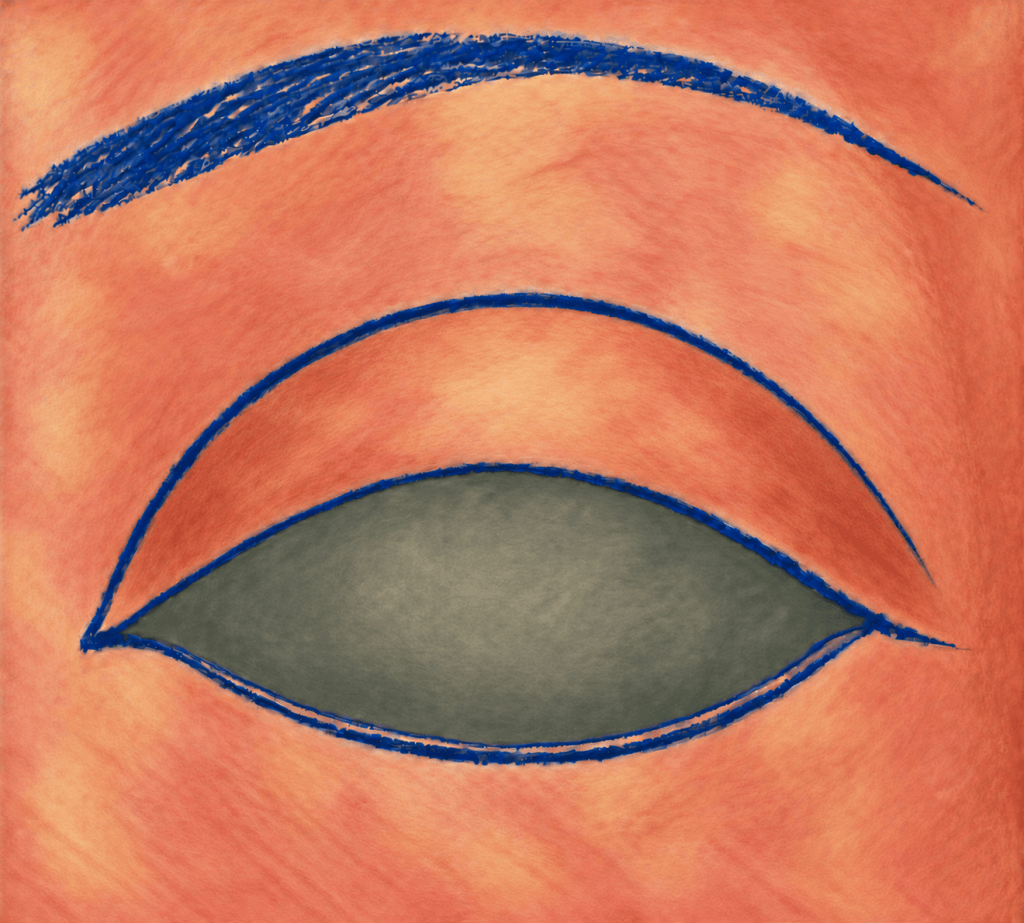
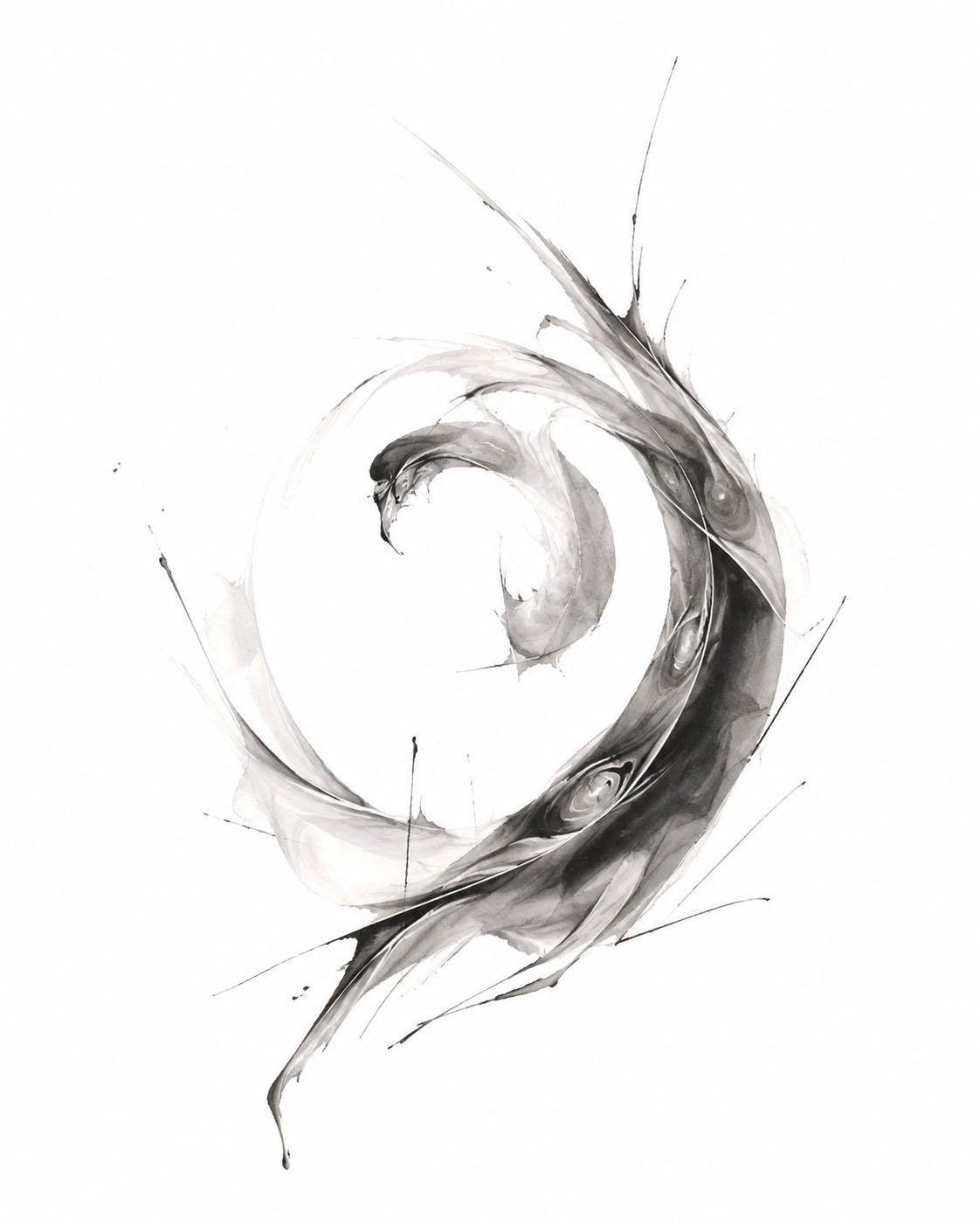
Ricardo F. Morín What Is Good Sense? Computer-generated image (CGI) 2026
Common sense consists of conclusions reached well before the occasion that calls for them: held in reserve, transmitted without examination, and applied whenever a new occasion resembles one already known. Its convenience is not imaginary, since it spares the effort of looking. And so it is that men and women of every condition carry it nonchalantly, and with it views of a purely stereotypical nature, accepted as norms of conduct because no one recalls having examined them. Under its influence, people meet one another already sorted: each is received as an instance of a collective phenomenon, a mirrored image of others presumed alike, and each answers from within a place assigned in advance. What takes place between them is less an encounter than an exchange between categories, in which the category arrives before the person and occupies the place where the person would have appeared.
The comparison of civilizations offers its most familiar form. Between any Latin and any Anglo-Saxon culture, common sense draws a border and declares two isolated worlds: Italians are like that, the English otherwise. The human condition is thereby redistributed into collective classifications dependent upon physical aspect or historical attainment. Words such as Hellenized, Latinized, Anglicized, Africanized, or Indigenized describe the passage of language and custom across centuries. Applied to an individual, they may say something true of speech or formation, yet they claim nothing about who that individual is: the claim begins when a description of many is carried over to a single person and settles in advance what that person will be found to be. What results is a sectarianism, banal and insular, which mistakes the boundary for what it encloses.
What the category erases is the particular: this face, this voice, this circumstance, which resemble others in part and never in whole. It is there that good sense begins, as a form of perception before it is a form of judgment. A painter knows the difference between drawing what is seen and drawing what is known: the eye registers the actual geometry of a face, its asymmetries and its accidents, while the hand reaches for the generic face it has drawn a hundred times. Yet the eye that registers those accidents has itself been formed by the hundred faces before it: what it retains sharpens its seeing, provided that each new face is allowed to correct what was retained. The generic face belongs to common sense, whereas the actual face is available only to attention.
What is retained from one encounter may serve the next or may stand in its place. The difference lies in whether the earlier conclusion remains open to correction by the person now present, or is applied as though that person had already been seen. Whereas common sense is held as a possession, good sense is exercised as an act, performed on each occasion or not performed at all: no one has it as one has a temperament or an education, and its absence leaves no trace, since common sense supplies an answer in the place where looking would have been.
Consequently, the line between the two does not run between groups of people: it separates neither the learned from the unlettered nor the critic from the crowd, but crosses each person from one moment to the next. A woman at a market stall who lets the stranger’s fatigue, rather than his accent, govern how she answers him has looked. The same woman, describing his country to her neighbors an hour later, may draw on the reserve. Nor are those who denounce classification exempt, since the crowd they denounce is itself a category, drawn from the same reserve as the stereotypes they oppose.
Good sense does not exempt its own conclusions. A clear perception, once kept beyond the reach of examination, hardens into a rule, and the rule passes into the reserve from which the next stereotypes are drawn: what was seen yesterday is applied tomorrow to someone who was never seen at all.
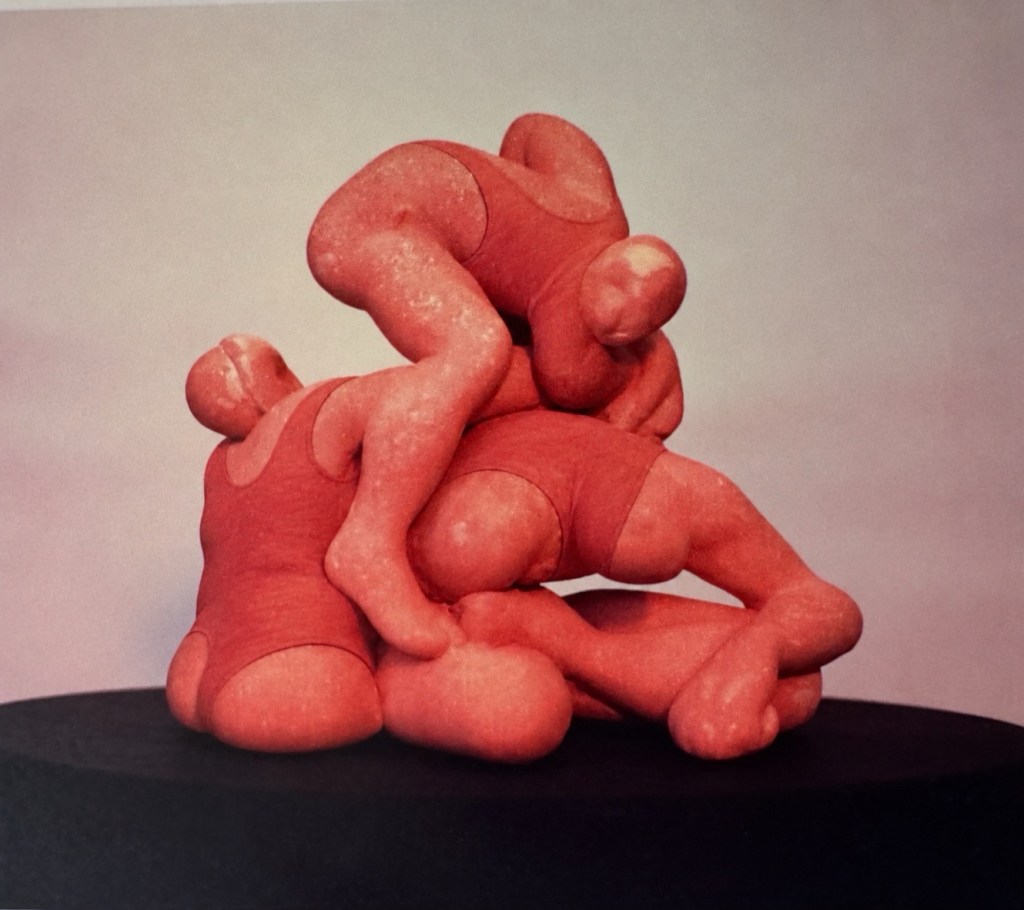
Ricardo Morín, Wrestlers, 2026. CGI after the artist’s original clay sculpture of 1975. 12 × 9 in., excluding the oval pedestal.
The Cybertruck makes its material character unusually conspicuous. Along its side, a rising windshield meets a pronounced roof crest before the upper outline descends toward the rear. Broad stainless-steel planes extend beneath this angular profile, interrupted by dark wheel surrounds and panel boundaries. Reflections change abruptly at the folds; across the larger surfaces, they spread with comparatively little modulation from curvature. The circular wheels provide a contrasting geometry, but the dominant impression of the body remains the repetition of flatness and sharp transition. Its conspicuousness concentrates attention on a small number of insistently reiterated features.
Tesla’s Q4 and FY 2024 Update, released on 29 January 2025, describes the steel’s contribution to structural stiffness and the bending process developed to manufacture its exterior. These are engineering achievements with ascertainable purposes. [1] Their technical significance leaves the perceptual relationship among the surfaces unresolved. The eye encounters extensive planes and emphatic boundaries; an account of material strength does not introduce further differentiation into those surfaces. Knowledge of their construction can inform attention without determining the quality of the encounter. The reasons for producing a form cannot substitute for the experience of encountering it.
Departure from convention acquires aesthetic significance through what the departure makes perceptible. In her account of Cubism for the Metropolitan Museum of Art, Sabine Rewald describes the fragmentation of familiar objects, the compression of pictorial depth, and the combination of contrasting viewpoints within a composition. [2] These operations altered the visible relations through which a subject could be apprehended. Recognition persisted while the means of recognition became unstable. The encounter demanded renewed attention to how objects were represented and perceived. Angularity participated in that transformation; angularity alone did not constitute it.
Arte Povera likewise gave unconventional materials a specific artistic function. The Museum of Modern Art’s account identifies the use of soil, rags, and other ordinary substances with an effort to develop a sculptural language that challenged the commercialization of art. [3] Their material poverty concerned their standing within artistic hierarchies, rather than demonstrating an absence of artistic sensibility. The economic relation changes when an exposed industrial surface becomes a distinction through which a manufactured commodity acquires desirability. Resemblance between materials does not preserve the purposes for which they are employed. The appearance of artistic departure can become a recognizable attribute detached from the perceptual discovery that gave the departure significance.
Drabness can consequently coexist with conspicuousness. An object may distinguish itself sharply from its surroundings while offering relatively little variation within its dominant gesture. Scale, brightness, and strangeness can secure immediate attention without sustaining a comparably differentiated encounter. Elaborate references can produce a similar limitation when their recognition exhausts what they offer. The initial impression promises an experience that continued attention finds little opportunity to develop.
Mystified drabness arises when the promise acquires greater authority than the encounter. Exposed material becomes evidence of authenticity; conspicuous difference becomes evidence of innovation; historical quotation becomes evidence of cultural depth. Each attribute may contribute to an accomplished work. The substitution occurs when recognition of the attribute is accepted as sufficient evidence of that accomplishment. Taste approaches its own antithesis as the identification of approved signs displaces the exercise of discrimination.
The language through which these attributes acquire authority can reproduce the same condition. A preliminary formulation of this argument attributed the Cybertruck’s appearance to the use of the wrong mathematics. That formulation gave an aesthetic judgment the apparent precision of a technical finding. Yet it identified neither an erroneous calculation nor a geometric relationship whose correction would establish the perceptual quality of the form. Its certainty supplied what its terms left unexamined. Recognition of mathematical authority can secure assent before the reader asks what has actually been demonstrated.
The substitution becomes consequential when such a judgment circulates independently of its grounds. The charge of employing the wrong mathematics can be detached and repeated while retaining the appearance of an explanation. An account of proportion, surface, scale, and transition requires the relationships under consideration to remain available for examination. Where attention acquires commercial value, the brevity and apparent completeness of the declaration can become advantages: the claim offers a conclusion that can be recognized and transmitted with little accompanying context. The same compression that facilitates circulation can conceal the work the judgment has omitted.
Firmness remains compatible with discrimination when its reach is supported by what the reader can examine. Demonstration gives emphasis its substance. The substitution occurs when the force of the sentence is accepted in place of that work. Whether conveyed through language or embodied in an object, the sign of accomplishment can become easier to circulate than the relationships through which accomplishment would be established.
Architecture gives this substitution an encompassing physical setting. A Disneyland aesthetic emerges where historical and cultural symbols are simplified into immediately recognizable effects. Picturesque façades, ornamental quotations, and theatrical sequences solicit the imagination through associations already selected and arranged for consumption. History supplies atmosphere; cultural difference supplies decorative variety. The circumstances that gave the borrowed forms their significance recede behind the impressions they can be made to deliver.
The invitation to imagine is itself commodified. Participation is directed toward identifying the allusion, receiving its promised mood, and moving to the next impression. The tensions, ambiguities, and accumulated experience through which a symbol acquires depth become obstacles to immediate legibility. Their removal makes the encounter easier to package and repeat. Different façades promise different worlds while reproducing the same abbreviated relation to their subjects. Symbolic abundance conceals the poverty of that relation, and the succession of effects distracts from how little remains to be encountered beyond them.
Mathematical complexity can sustain the same condition through another visual vocabulary. Elaborate geometry offers an immediately legible sign of technical distinction, just as a picturesque façade offers a sign of historical continuity. Neither establishes how entrances, thresholds, daylight, acoustics, and gathering places support the life conducted within a building. When the image supplies the principal measure of achievement, the continuing experience of occupation becomes subordinate to the impression prepared for recognition. Theatrical historicism and geometric spectacle can thus converge in their treatment of the inhabitant as the recipient of an effect.
In Vienna during the late nineteenth and early twentieth centuries, the search for an architecture responsive to contemporary life prompted a reconsideration of historical styles, the role of ornament, and the organization of inhabited spaces. The different responses to these questions show how sensibility could operate through both ornament and restraint. The Vienna Secession’s architectural history records how Joseph Maria Olbrich coordinated geometric volumes, symbolic ornament, and exhibition space in its building. The institution’s continuing use of those spaces also demonstrates their capacity to accommodate changing artistic activity. [4] Adolf Loos pursued another relationship between restraint and experience. In her study for the National Gallery of Victoria, curator Amanda Dunsmore describes his attention to timber, marble, and brass, together with his preference for interiors that inhabitants could adapt to their own tastes. His opposition to prescribed decoration coexisted with concern for comfort and individual use. [5] Ornament and its suppression therefore provide insufficient grounds for distinguishing sensibility from impoverishment. The distinction emerges through the relationships a work sustains among its materials, its spaces, and those who encounter it.
The resources through which such relationships acquire physical presence are consequential. The Secession’s building history records that the City of Vienna provided the site and that patrons, including the industrialist Karl Wittgenstein, contributed to construction funding. Proceeds from the association’s inaugural exhibition supplied the remaining funds. [4] Its institutional departure depended on arrangements that enabled an alternative to acquire a physical presence. The imagination that conceives a different environment must negotiate access to the means of realizing it.
Those means remain profoundly unequal. The World Inequality Report 2026 estimates that the wealthiest tenth of the global population owns three-quarters of its wealth, while the poorest half owns two per cent. [6] These figures do not establish an aesthetic consequence by themselves. Their relevance lies in the unequal resources available to commission buildings, secure premises, maintain workshops, and sustain work whose value may take time to become recognized. The capacity to imagine another environment and the capacity to bring it into existence are distributed differently.
Greater access to expression has not removed this disparity. In its published overview of the 2026 report Re|Shaping Policies for Creativity, UNESCO describes expanded access to creative tools, markets, and audiences alongside persistent insecurity in creators’ livelihoods. [7] Individual distinction can become highly visible while the means of sustaining independent practice remain fragile. The circulation of an image, a declaration, or an unconventional appearance establishes its visibility; the resources required to develop and sustain the practice behind it remain a separate concern.
Dress, possessions, and private surroundings offer immediate fields of choice. These choices can preserve and develop sensibility, but their availability does not confer comparable influence over the spaces beyond them. Where individuality finds its most accessible expression through purchasable distinctions, the market can accommodate dissatisfaction without surrendering control over the conditions that occasion it. The capacity to select among available signs of difference can expand while the capacity to determine shared conditions remains restricted.
Countercultural activity persists within this interval. Its existence demonstrates that sensibility has not disappeared. Its visibility cannot establish that the resources, institutions, and collective continuity required for a broader transformation have assembled. Dissatisfaction, creative invention, and the power to alter shared conditions remain distinct. The distance between them gives the present uncertainty its substance. [8]
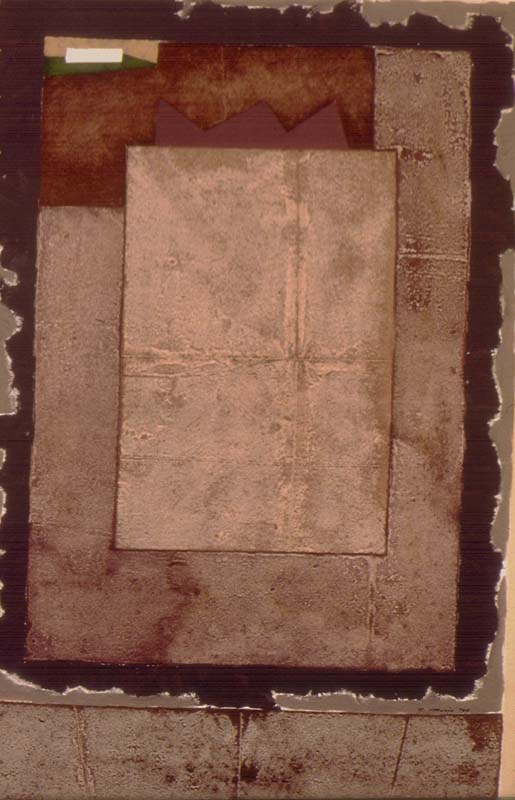
Ricardo F. Morin New York Series, Untitled 24″ x 36″ Oil on canvas 1992
1. A person withdrawn from interruption, judgment, dependency, and noise may begin to believe that solitude clarifies the self. Removed from the continual presence of others, one becomes more aware of habits, memories, reactions, and inward movement ordinarily dispersed through daily relation. Silence appears to gather experience into greater clarity. Yet prolonged isolation reveals something less expected: inward life does not remain still simply because it happens alone.
2. Thought begins circling within its own continuity without resistance. Reflection loses proportion when nothing interrupts it from beyond itself. A memory repeated often enough begins to feel increasingly complete when it is not. A fear unanswered by another perspective deepens within its own enclosure. Even silence changes character. No response arrives. No interruption. Nothing enters from outside oneself.
3. This may be why solitude eventually begins searching for relation again, even where no person is present. The hermit speaks to God, to memory, to nature, or to silence itself. The mind reaches beyond its own enclosure not necessarily from weakness, but because inward life alone cannot fully restore proportion to itself.
4. We do not discover ourselves in abstraction alone. Much of what we call individuality becomes perceptible through relation. Patience, resentment, tenderness, vanity, courage, forgiveness, and responsibility do not fully disclose themselves in separation from others. They emerge through contact, disappointment, affection, misunderstanding, dependence, and care. Another person does not diminish individuality. Something in us becomes more visible in relation than in withdrawal.
5. Communication does not eliminate distance between human beings. It reveals it. No person entirely crosses the interior distance separating one consciousness from another. Suffering, mortality, memory, and perception remain singular experiences. Yet it is often through the effort to communicate that this separateness becomes recognizable at all. We discover how far we remain from one another precisely in the attempt to reach across that distance.
6. Another person is neither an extension of oneself nor a symbolic abstraction. The other remains distinct, vulnerable, and finite. Love therefore cannot consist merely in attachment, possession, or dependence. Its deeper force lies in the capacity to recognize another existence without attempting to dissolve it into one’s own needs, fears, or projections. Compassion arises quietly from this condition.
7. Isolation becomes impossible not because solitude lacks value, but because human life continually reaches beyond private continuity. Even withdrawal retains traces of relation: language, memory, longing, recognition, prayer, imagination. The mind does not merely enclose itself. It responds. Seeks. Recalls. Addresses what remains beyond it.
8. Perhaps this is why the deepest forms of love do not abolish aloneness. They allow it to stand without hardening into enclosure. Compassion does not overcome distance by eliminating difference. Each person remains singular and ultimately unreachable in totality, yet still worthy of care. In that recognition, isolation no longer appears possible as a final condition of human life.
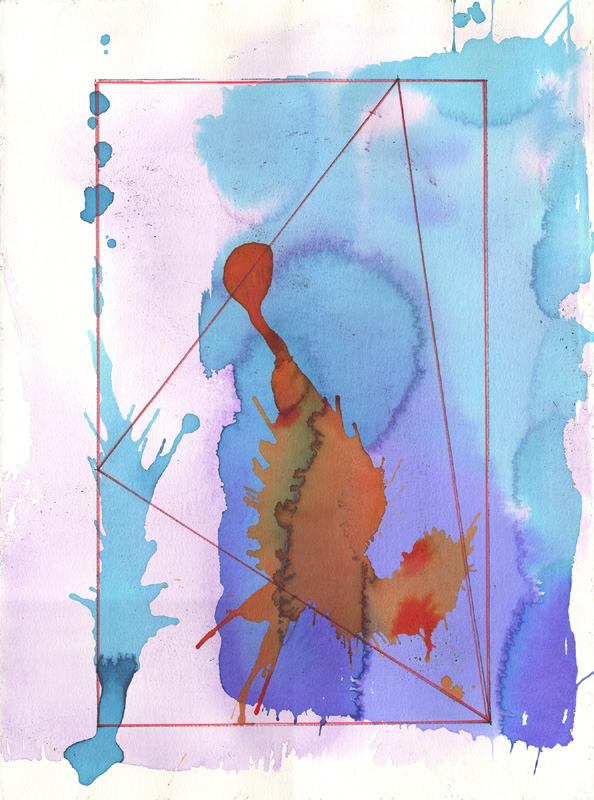
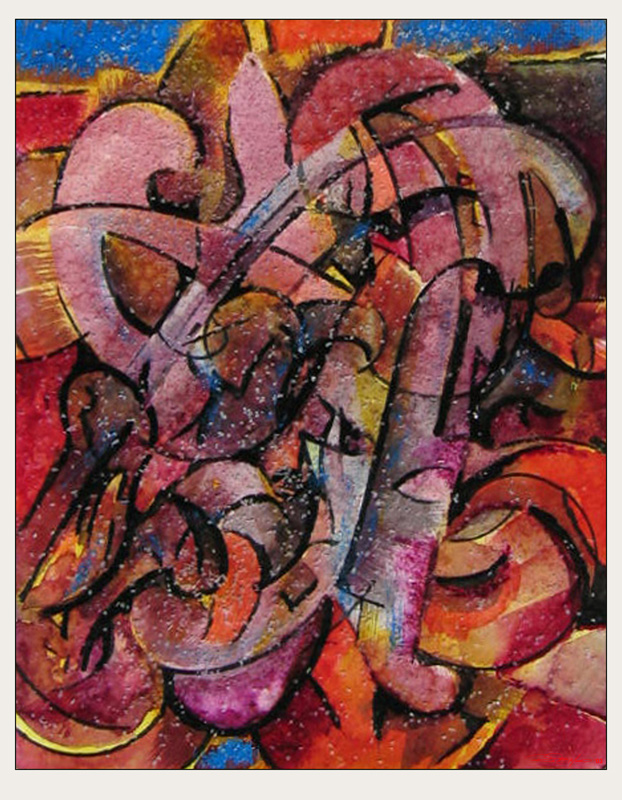
Ricardo F. Morín Triangulation 10 22″ x 30″ Watercolor and wax pencil on paper 2007
Preface
This essay proceeds from an observation: the forces that now shape collective life and the institutions that hold responsibility for it no longer operate at the same scale. Climate volatility, digital acceleration, migratory displacement, and economic interdependence move through air, water, data, and supply chains without regard for territorial boundaries. The world remains organized as a collection of discrete sovereignties, each answerable for exposures that form elsewhere and propagate everywhere.
What follows is an examination of that condition. It predicts nothing and recommends nothing. A disproportion of scale can be described, and the description makes visible what the inherited arrangement obscures: where responsibility fragments, where exposure accumulates, where the vocabulary of governance ceases to correspond to the movement of events.
The examination moves as perception moves. It begins inside the condition, where the disproportion between forces and institutions can be observed in its anatomy. Held in view long enough, the condition begins to disclose what the inherited arrangement obscures, and the examination follows the disclosure. From what becomes visible, certain forms become conceivable, and the examination considers them as perception finds them, without electing among them. And because every condition includes whatever resists its own alteration, the examination ends among the resistances, which belong to the condition as fully as the forces do and persist on their own measures of time.
The essay names a condition. Whatever follows from the naming occurs in the one who perceives it.
I. Geometry:
i.
Heat does not present itself for inspection. It moves through the atmosphere as a single circulation, raising the temperature of a harvest, a reservoir, a city’s August, without recording where one administration ends and another begins. Carbon released over one industrial basin enters the same air that returns it, years later, as drought on a continent that released little. The atmosphere keeps no ledger of origin; it distributes consequence by physics, on a schedule of its own.
Water behaves in the same manner at a different speed. Rivers gather in one jurisdiction and flood in another; aquifers lie beneath several at once; currents redistribute warmth along coastlines that share nothing but the water itself. A drought is regional by nature and national only on the map laid over it.
A pathogen moves through breath and proximity. Sequenced in one country, it circulates in forty before the sequence is published. Its itinerary is composed of airports, markets, and households; nothing in its manner of travel corresponds to the perimeter of a ministry of health.
Data moves fastest of all. A transaction, a rumor, and a model cross the planet in less time than any procedure for examining them requires. The infrastructure that carries them is physically located in territories and functionally located in none.
Supply chains move objects more slowly but bind their endpoints completely. A vehicle assembled in one country contains the labor and minerals of a dozen others; an interruption at a single port reprices goods on every continent. The dependency is real at every point of the chain and visible from none of them in its entirety.
And people move, displaced by the other movements: by the dried harvest, the emptied aquifer, the repriced economy. Displacement is the one traffic the boundary registers, and what it registers is the person; the conditions that moved the person crossed earlier, unexamined.
ii.
The institutions that hold responsibility for these movements are organized by perimeter. A state’s authority is defined by the territory in which it operates: its law binds within the line, its budget is spent within the line, its officials answer to those who reside within the line. This is its manner of holding. Responsibility becomes governable by being bounded; the instrument functions because its field of action is finite and known.
Within the perimeter, the institutional senses are acute. A government measures its own air, counts its own cases, audits its own ports, registers its own arrivals. What lies beyond reaches it through other channels and under other names: foreign affairs, imports, externality. The grammar of the institution renders the outside as context rather than as object.
Accountability follows the same geometry. An electorate, where one exists, holds its government answerable for conditions within the territory; no constituency exists anywhere for the consequence delivered abroad. The institution is rewarded and punished by those inside the line, and its attention is shaped accordingly.
iii.
The disproportion appears wherever the two manners meet. The atmosphere lies above every territory and within none; the instruments that act on it are funded, legislated, and judged perimeter by perimeter. The pathogen’s itinerary and the ministry’s reach intersect at the airport for a matter of hours; the remainder of the itinerary proceeds elsewhere. The supply chain’s interruption occurs everywhere at once and is administered nowhere in particular. The data crossing a border is examined, where it is examined at all, at endpoints the movement itself does not require.
In each location the structure is the same: the instrument acts on the portion of the force that lies within its field, and the force is not partitioned by the instrument. The remainder of the force continues, carrying the portion with it. This is the condition as it presently stands, a geometry of reach that does not coincide, observable point by point.
II. Exposure:
i.
What appears first is exposure. The instrument acts on its portion, the remainder continues, and those who live inside each perimeter live in the path of what no instrument reaches. Exposure of this kind is shared without being held in common: every territory stands in it; no territory administers it.
It can be watched traveling. A harvest dries in one region. Within a season, grain is repriced in markets that have never seen the field; within a year, a household on another continent spends more of its income on bread; the household’s city grows tense in proportions no office measures. The sequence is continuous from field to street, and at no point along it does any single institution see more than the segment inside its line. Deprivation forms in one place and arrives in others as instability, having traveled the whole way without once being seen entire.
Nor is the exposure evenly laid. It gathers where the means of absorbing it are thinnest, in the household with nothing left to reduce, in the region whose aquifer was already low. The geometry of reach distributes consequence without reference to the capacity to receive it.
ii.
The border, watched against this movement, becomes visible twice. In one register it is complete: the person presents a document, the container is opened, the tariff is assessed; nothing built into the border has failed, and everything it was made to register, it registers. In the other register it does not appear at all: the heat and the signal pass at altitudes and speeds for which the border has no instrument, having never been built for them. The same line is whole and absent at once, depending on the register in which it is observed. Its persistence is administrative fact; its coverage, a portion. The doubleness is the disclosure: what had been perceived as the edge of responsibility shows itself as the edge of one kind of traffic.
iii.
The words come forward next, in the places where everyone meets them. The evening news gives a flood abroad thirty seconds and a flood at home a week; the first is foreign affairs, the second a national emergency, though the water behaves identically in both. A ministry calls the smoke drifting in from a neighboring country’s fires an externality, and the word performs a quiet operation: it files the smoke as something outside, even as it settles into the lungs of those inside. The drought that empties a distant aquifer is a foreign matter until the people it displaced stand at the crossing, at which moment the same drought becomes domestic, though nothing in the drought has changed; the word moved, the event did not.
Watched in this way, the vocabulary shows what it is doing. Domestic and foreign, internal and external sort events by the side of the line on which they stand, and the sorting holds only in the register where the line appears. The words are learned so early and used so constantly that they pass for the events themselves; held against the actual movement of events, they show themselves as belonging to the line, terms of its manner of rendering the world.
iv.
The sequence that began in the dried field ends at a person. The consequence has an origin: the carbon has its basins, the repricing has its port, the displacement has its drought. It has a route, traceable segment by segment. What it does not have is an address at which it is received whole: each institution along the route faced its portion, and the consequence, assembled from all the portions, faces no institution anywhere. The person who stands in it, whose bread costs more, whose well draws sand, whose street has grown tense, stands in something produced in full view of many offices and held as the object of none. The person can be counted, and is; assisted, at times; named, rarely. What the condition makes visible, held to the end, is this: a consequence entire, a person inside it, and between origin and arrival no point at which anyone was facing the whole.
III. Images:
i.
What has been seen begins, on its own, to produce something. Anyone who has lived in a town knows the experience in small: a water main bursts, the street floods, and whatever else is uncertain, one thing is not, that somewhere there is an office whose business this is. The repair may come late and the office may be poor, but the flooding has an address, and the mind rests on that address without being asked to.
The consequence traced in the second movement has none. It traveled from the dried field through the port and the market to the street that has grown tense, and at no point did it land on a desk as the matter of that desk. Whoever has seen this whole forms the image of an address without intending to: a desk at the scale of the route, something facing the entire consequence the way the town office faces the burst main. The image arrives unbidden; that is what it means for a form to become thinkable. Nothing in the image says it is near, or simple, or good. It says only that the mind, shown a lack entire, completes the shape of what is lacking.
ii.
A second image follows from the unevenness. Within any town, certain things are already held in common because everyone stands under them equally. No household builds its own levee; the levee answers to the river, which does not visit house by house. The arrangement is so familiar it goes unnoticed: where what arrives, arrives at all, what absorbs it is held by all.
The exposure shown earlier stands over every territory the way the river stands over the low town, and it gathers, as the second movement found, on the household with nothing left to reduce. Held in view, the familiar arrangement extends itself in the mind to the scale of the actual water: the means of absorbing what arrives, held as commonly as the arrival. The image is of the levee matched to the river it actually has, no more. It prescribes nothing about how such a thing is built, or by whom, or whether those now living would consent to build it. It is the shape the mind gives to a protection matched to an exposure already shared.
iii.
The third image is of the line, and it is an image of continuance. Nothing in the foregoing showed the line failing at its own work. The document is still presented, the container still opened; the language of the street, the court where neighbors take their disputes, the school, the holidays, the manner in which a town buries its dead, all of this lives inside the line and was never once crossed by the heat or the signal. What the doubleness disclosed was the size of the line’s register, never a failure inside it.
So the image that forms is double, like the disclosure that produces it: the line continuing entire in its own register, holding everything it has always held, while the registers it never covered, the heat, the signal, the route of the pathogen, meet instruments for the first time. The two parts arrive together and do not yet rest together. Whatever faced the whole of a consequence would draw means and allegiance, and means and allegiance now live inside the lines; the image carries this strain within itself, two registers distinct to perception and contending wherever both would have to be sustained. Whether such a layering could hold outside the mind, the image does not say; seen honestly, it shows the doubleness and the strain at once.
IV. Calendars:
i.
Allegiance has a scale, and it is small. A person belongs first to a street, a table, a language spoken at that table, the graves that are visited on the appointed days. Whatever larger belonging is learned afterward, the flag, the anthem, is taught into a heart already occupied by the near, and takes hold to the degree that it borrows the near’s warmth. No one is from the planet. The word names the place where everyone lives and the place where no one has ever lived.
Part of the trust given to the town office is that it can be walked to. The clerk has a face; the office has a door; the complaint can be carried there in person, and if nothing comes of it, the failure too has an address. The desk at the scale of the route has no door anyone can reach. The image asks the mind to extend trust across a distance at which trust has never yet formed, past the last face, past the last door. The mind that formed the image is the same mind that hesitates before it, and the hesitation is itself a perception, the love of the near reporting accurately what the near provides.
ii.
The second resistance keeps records. In most of the world, the enterprises that have operated across many lines at once are remembered by the people whose lines they crossed: the company that came for the metal, the administration that renamed the streets, the school that punished the language of the table. The image of an instrument facing the whole arrives, in these places, into the memory of the last instrument that claimed to face the whole, and the memory answers before any argument can begin: such things are built somewhere, and the somewhere has never been here.
The memory is a record, kept in archives and in households, read at the scale where it was lived. Consulting it before extending the hand is among the most ordinary acts of perception there is. The image of the desk does not erase the record; it is received into it, and what it becomes there is decided by the record, not by the image.
iii.
Means live inside the lines, and what holds means defends them. The ministry’s reach is its budget; the industry stands where the chain now runs, and the chain, running, pays for the standing. And smaller, in the kitchen: the dockworker’s wage lives in the tariff’s shadow, the town’s school is funded by the refinery, the pension rests on the placement of things as they are placed. Anything that faced the whole of a consequence would draw means and allegiance, as the strain already showed, and means and allegiance do not transfer themselves; they are held, and holding has hands at every scale. The motion of those hands is the same in the palace and in the kitchen, the hand closing over what feeds it, and the examination assigns it to no one as a fault. It records it as what position does, wherever position is held.
iv.
The three resistances keep their own calendars. Attachment is renewed with every childhood, and a generation is the unit of its time. Memory outlives its witnesses; the household and the archive carry it past the century. Position reproduces itself by inheritance and appointment, at a pace slower than a life. Against these calendars, the forces move at the speed of air and signal: the heat by the season, the price by the day, the pathogen by the hour. Inside the condition a second disproportion comes visible, of tempo rather than reach: what moves fastest crosses every line, and what would have to move for anything to meet it moves at the pace of childhood, memory, and inheritance. The condition holds both disproportions at once, and they can be observed together, calendar by calendar.
Epilogue
An examination closes without verdict. Nothing in the preceding movements has proposed a remedy, because no remedy is given in the condition itself. What is given has been described.
What has been described here is visible from within the condition and from nowhere else. The forms that appear thinkable appear so to a perception situated in this interval, under these pressures; a different interval will carry a different horizon. The essay claims nothing beyond that boundary. It remains within the horizon of what the present condition permits to be perceived.
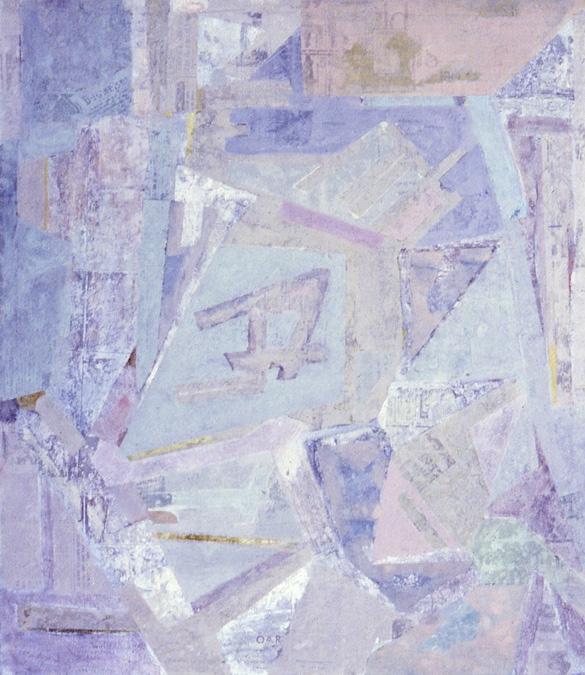
Ricardo F. Morín Templates III 8” x 10” Watercolor and ink on paper 2003
People rarely experience events alone. What someone sees, hears, or notices is soon spoken about, compared, or questioned by others. An experience becomes an account when it is told, and once it is told, it enters a space where other accounts already exist. From that moment on, perception is no longer singular. It becomes intelligible only in relation to what others perceived, remembered, or expected under different conditions.
When a person gives an account of what they witnessed, that account does not preserve the experience intact. It places the experience alongside other perceptions that do not fully coincide with it. Differences of position, attention, memory, language, and expectation shape what each person noticed and how it was understood. Even when people attend to the same event, emphasis and significance do not align completely. Testimony therefore moves within a plural field where meaning arises through comparison rather than through preservation.
Within this field, agreement is provisional rather than assured. Accounts may overlap at certain points while diverging at others. No single account can absorb the rest without remainder. Testimony does not naturally settle into a single meaning because perception itself is distributed across distinct vantage points that cannot be merged without loss.
In such conditions, misunderstanding does not signal bad faith. It persists even when everyone involved intends to be accurate. Divergence arises not from deception or carelessness, but from the fact that each account reflects a different relation to the same event. Attempts to clarify one account by reference to another often increase awareness of difference rather than resolving it, as explanation introduces distinctions that were not previously visible.
As plural accounts accumulate, pressure grows to secure agreement. Shared meaning begins to be treated as a requirement rather than as a result. Consensus is taken as a stand‑in for accuracy, and what many affirm is assumed to be what most closely reflects what occurred. Yet numerical agreement does not eliminate perceptual difference. It stabilizes one interpretation long enough for coordination to proceed.
Under this pressure, testimony is often reshaped to favor legibility over fidelity. Accounts are simplified, aligned, or muted so they can fit within an accepted framework of understanding. What resists integration is set aside as confusion or irrelevance. The field of testimony narrows not because differences have been resolved, but because they have been excluded.
What testimony provides, then, is not direct access to events, but a negotiated surface across which perceptions are compared and provisionally aligned. The stability produced by this process is practical rather than final. It allows people to act together, even as unresolved differences remain. Testimony stays open to revision not because sincerity is lacking, but because perception cannot escape the plurality through which it becomes shared.
When shared meaning is demanded from plural perception, agreement can be reached, but convergence cannot be guaranteed. Testimony coordinates perspectives without dissolving the differences that make coordination necessary.
On the Practice of Visual Art, Attention, and the Conditions of Perception
My distance from the commercial circuits of art arose not from unfamiliarity, but from decades of sustained participation. For nearly four decades after completing my formal studies in painting, I engaged directly with galleries, museums, art advisers, collectors, and private buyers. Those encounters formed part of my education, acquainting me with the language of placement, negotiation, institutional framing, and representation. They also enabled me to perceive how readily the life of an image may be subordinated to expectation, promotional identity, or calculation.
None of those experiences was singular or dramatic. What emerged, rather, was a gradual dissonance. Discussions occasioned by the work frequently departed from the conditions that had governed its genesis. What had required sustained attention in the studio could be rendered into categories extrinsic to the experience of vision, whether as market appraisal, curatorial interpretation, or institutional inscription. The imbalance was seldom articulated, but it persisted.
In time, a more pronounced distance became necessary. It arose not from rejection, but from clarification. The difficulty resided neither in commerce nor in institutions as such, but in the almost imperceptible redirection of attention they could induce. When attention gravitated toward reception or positioning, the image risked losing the quiet domain in which it had first disclosed itself. That recognition altered the conditions under which I continued to work.
The decision to permit the work to circulate without presuming to govern its destination, or simply to give it away, followed naturally. It represented less a renunciation of the work than a preservation of my relation to it. The practice had already conferred what mattered: a form of joy independent of valuation, constancy during periods of vulnerability, and companionship with images whose significance unfolded gradually and imposed no demand.
The material fate of a substantial portion of my work would eventually confer an unforeseen gravity upon those convictions. In 2009, my younger brother placed 149 of my paintings in storage at Almacenadora El Recreo, a warehousing and logistics company situated in the industrial district of Valencia, Venezuela. The ensemble encompassed twenty-five years of my artistic practice, from 1971 through 1996, and included a considerable number of canvases exceeding six feet. When the company ceased operations, my brother lost his shareholding without compensation, and I lost all knowledge of the paintings’ whereabouts. For years, I did not know whether they remained there in storage, had been moved elsewhere, or even continued to exist.
Only after the company’s bankruptcy had received judicial confirmation did the proprietor of the premises contact my brother in July 2026. The paintings were still there, but termites and mold had compromised them. Their removal required an expert technical assessment to determine which works, if any, remained salvageable, followed by conservation measures, transportation, a formal arrangement for new storage, and a security deposit equivalent to six months of storage fees. I was unable to supervise the process from abroad. My brother was likewise in no position to manage it. Under such circumstances, even donation was not a practicable alternative.
I therefore authorized the proprietor to dispose of the ensemble in whatever manner he considered necessary. He advised me that anything affected by termites would have to be burned. I consented without ever seeing the paintings again.
Their physical disappearance did not, however, remove that period entirely from view. Digitized photographic records of almost eighty percent of the paintings documented between 1977 and 1991 survive and remain accessible in the digital archive on my website. The archive preserves neither their scale, surface, material density, nor the encounter demanded by their physical presence. It nevertheless permits a substantial portion of the images to remain visible. It constitutes neither a surrogate collection nor an answer to the loss, but a record that preserves visual access while confirming the distance between those images and the material works from which they derive.
That act was not equivalent to giving the work away, nor did it transform its destruction into an aesthetic gesture. The decision was conditioned by distance, material deterioration, institutional collapse, and the impossibility of responsible intervention. Yet the necessity of making that decision revealed, with a severity I had not previously known, an intuition already implicit in my relation to the work: authorship confers neither perpetual custody nor dominion over the fate of what has been created.
The destruction of the paintings brought their existence as material objects to an end. The survival of a substantial portion of the body of work as photographic images does not annul the loss. Yet the loss did not efface the attention from which the paintings arose, the years through which they had accompanied me, or the life of which they had already become a part. Distance is not indifference, and relinquishing possession does not extinguish grief. Such relinquishment merely recognizes that the existence of a work is not exhausted by its possession.
From this perspective, authorship assumes a provisional character. The work neither originates in the market nor belongs wholly to its maker. It comes into being through a convergence of forces not fully governed by the will and thereafter remains exposed to contingencies the will cannot avert. The image inhabits a distance that neither ownership nor exchange can abolish, and that even the disappearance of its material support cannot entirely extinguish.
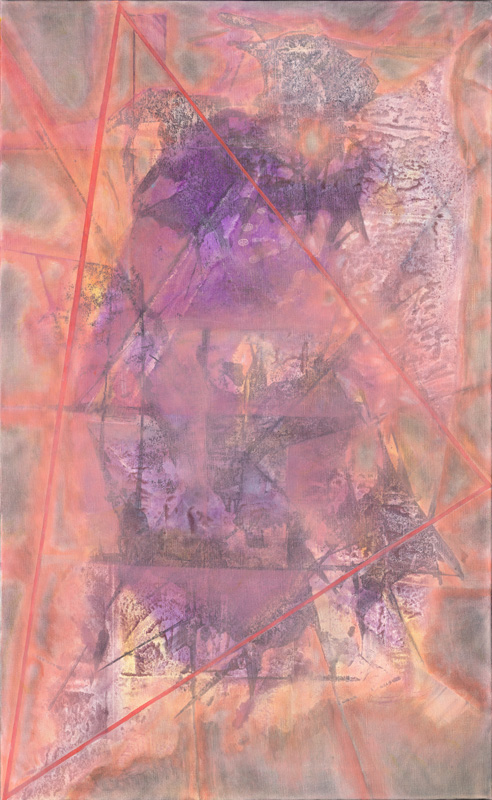
Ricardo Morín Triangulation Series Nº 10: Method 37″ x 60″ x 2″ Oil on linen 2006
*
PREFACE
i
Clarity begins where boundaries appear. A boundary is not a restraint but a distance, an interval in which perception can separate itself from emotion long enough for understanding to take shape. When that distance collapses, experience is reorganized by impulse; the world becomes an extension of what one feels rather than what one sees.
ii
Boundaries are the only defense against this collapse. They prevent meaning from dissolving into reaction and keep perception from being redirected by purpose. Purpose, when allowed to speak first, narrows the field of vision and turns inquiry into confirmation. A boundary interrupts this tendency; it holds intention in suspension so that attention can return to what is actually present.
iii
Inquiry depends on this interruption. Without boundaries, the movement of thought cannot be distinguished from the movement of desire, and doctrine quietly replaces observation. Boundaries do not resolve uncertainty, but they make uncertainty legible. They create the conditions in which questions can be asked without predetermining their answers.
iv
Humility is inseparable from this act. It is not a posture but a condition that allows perception to proceed without the weight of intention. Clarity requires more than sincerity or restraint; it requires a mind that is not driven by the need to accumulate, whether knowledge, virtue, certainty, or self-justification. Accumulation reorganizes perception around a desired result. Discipline, in this sense, is not the pursuit of an ideal but the maintenance of boundaries that protect perception from being redirected by purpose. It is a discipline of subtraction rather than achievement: an effort that becomes effortless when it no longer seeks reward.
This preface introduces the method that follows. Method is not a technique, nor is it a path toward improvement. It is the sustained practice of observing without coercion, distinguishing structure from projection, and permitting meaning to emerge without forcing it into preexisting shapes. Boundaries make that discipline possible. They are the ground on which clarity stands.
Ricardo F. Morín
November, 2025
Oakland Park, Florida
1
Every attempt to understand the world begins with a simple but often overlooked fact: we see in fragments. Human perception operates like a lamp in a large room; perception illuminates what is near, dimming what is distant, and leaves most of the room in shadow. We navigate life with the assumption that our partial view is complete, even though experience repeatedly proves otherwise. Knowledge helps us organize what we see, but it also defines the edges of our understanding; it clarifies one portion of the room while it obscures another. No one escapes this condition. No historian, philosopher, commentator, or citizen sees the world in its entirety, and acknowledging this is not an act of modesty but the foundation of honest inquiry.
2
Two different intellectual traditions help illuminate the tension between seeing and understanding. One comes from the kind of clarity found in Krishnamurti’s observations: the discipline of perceiving without the distortion of fear, motive, or the narratives we inherit without noticing. He insisted that much of what we call “knowledge” is actually memory, habit, or reaction, and that these patterns cloud perception rather than sharpen it. The second tradition, rooted in Western civic philosophy and historical analysis, insists that societies cannot be understood without structure: without categories that describe institutions, without distinctions between authority and power, or between law and the decisions made in its name. This tradition demands reasoning, evidence, and articulation.
3
Neither tradition is sufficient on its own. Pure perception can become impressionistic; it dissolves the world into sensations without offering any explanation of how things work. Pure structure can become rigid; it treats human experience as an abstraction, flattening its subtleties into neat but inaccurate theories. A method emerges when these approaches intersect. Its first movement is subtraction. It asks the observer to remove the noise that interferes with perception: the assumptions that rush ahead of reality, the narratives that interpret the world before we have actually seen it, the emotional recoil that transforms a fact into a grievance, or a possibility into a threat. Subtraction does not eliminate complexity; it makes room for it. It allows us to look at familiar situations, conflict, political argument, civic breakdown, inequality, without immediately reaching for slogans or for the explanations we already prefer.
4
The second movement is structure: identifying the patterns that persist once distortion has been removed. Structure appears in the way institutions operate, in the incentives that shape public behavior, in the stories societies tell to justify their actions, and in the consequences that repeat themselves across time. A society punishes in one way rather than another for reasons that can be traced. A population interprets progress according to a set of assumptions that can be examined. A system favors certain outcomes because its design makes other outcomes unlikely. Structure is not the enemy of perception; it is what perception reveals when it is clean.
5
Meaning arises from the interplay between these two movements. It does not remain stable; it shifts when the conditions that hold it together change. Words like “justice,” “freedom,” “security,” or “progress” acquire new meanings not because thinkers redefine them, but because societies reorganize themselves around different fears, expectations, or pressures. To assume that these meanings are fixed is to mistake living processes for static definitions. The task is not to declare what these concepts should mean, but to examine how they function in the real world; how they guide action; how they justify authority; and how they shape the limits of what people consider possible.
6
This approach allows writing to become neither abstract nor ideological. It is not a performance of expertise nor a confession of personal experience. It is an effort to look at the world as it is lived: how people respond to harm; how institutions drift from their original purpose; how fear transforms into policy; how progress becomes a story that conceals as much as it reveals; how public judgment forms under conditions of uncertainty. These are not theoretical questions but everyday realities, observable to anyone who pays sustained attention.
7
The method does not claim special insight. It does not elevate the observer above the events being described. It argues something simpler and more democratic: that clarity is available to anyone willing to examine both perception and structure without surrendering to either. The observer remains part of the world being studied, affected by its pressures, limited by its uncertainties, and shaped by its histories. The goal is not to escape this condition, but to see it clearly enough that understanding becomes possible.
8
In this sense, method is not a technique but a form of discipline. It is the discipline of perceiving without leaning on the crutch of inherited narratives; the discipline of thinking without allowing ideology to rush ahead of evidence; the discipline of naming structures without pretending they are inevitable; and the discipline of allowing meaning to remain flexible enough to reflect the movement of time. Its purpose is not to simplify the world but to make it legible, without illusion, without theatricality, and without the desire to be right.
9
Such a method offers no certainty. What it offers is honesty: an acknowledgment that truth is not a possession, that the world exceeds every attempt to capture it, and that clarity emerges not from authority but from attention.
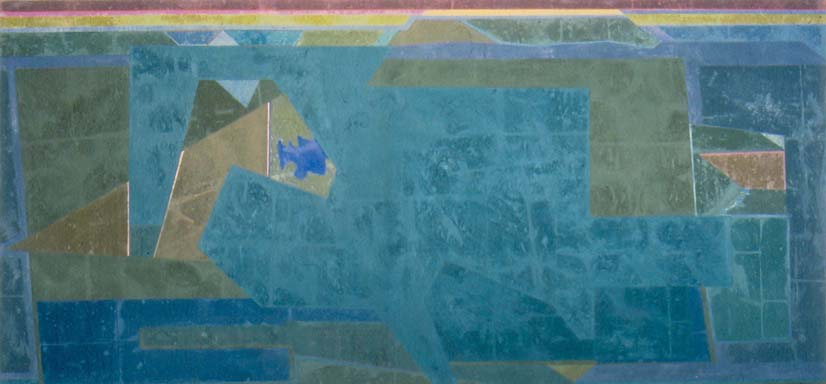
Ricardo F. Morin Buffalo Series, Nº 6 36″ x 78″ Oil on canvas 1979
Preface
People often discover that events far beyond their immediate surroundings affect their lives in ways they neither anticipated nor controlled. A shortage appears in a local store because production has been interrupted elsewhere. A disease emerges in one region and reaches another. A decision taken in a distant capital alters conditions for people who had no part in making it. Weather patterns shift, prices change, technologies spread, and consequences arrive from places most people will never see.
Such experiences belong to a world in which many of the processes shaping daily life extend beyond local communities. Families, neighborhoods, towns, and nations remain affected by forces that originate beyond them.
The circumstances in which human societies live have repeatedly encountered conditions that exceeded the reach of existing practices and expectations. Trade connected distant regions. Political territories expanded beyond local communities. Industrialization linked livelihoods to economic processes operating far from where those livelihoods were sustained. In each case, people confronted realities larger than those for which many inherited arrangements had originally been developed.
Historical responses varied. Some commercial and governmental institutions adapted gradually. Others resisted change until circumstances imposed it. Some expanded their reach while preserving older assumptions. Others generated new practices and new forms of organization. No single pattern governed these transitions. What remained constant was the encounter between inherited arrangements and conditions that had outgrown them.
Whether contemporary conditions belong to this historical pattern, or whether they represent something different, remains uncertain. At issue is not a preferred outcome, but the extent to which the reach of circumstance continues to exceed the assumptions, expectations, and arrangements through which societies understand and respond to it.
The puzzling question matters because familiar ways of organizing collective life often persist after the circumstances that gave rise to them have changed. Practices that once addressed the conditions people faced may continue long after those conditions have been altered by new technologies, new forms of exchange, new patterns of movement, and new forms of interdependence. Whether inherited arrangements can still comprehend circumstances whose reach has changed is not merely an abstract question. It bears on how societies understand the challenges before them and the range of responses available to them.
Ricardo F. Morin
June 3rd, 2026
Bala Cynwyd, Pennsylvania
I. Routes: Circumstances in Motion
Circumstances do not remain where they originate. The conditions shaping a community’s life rarely arise entirely within that community. They arrive through paths established for other purposes, across distances no single traveler encompasses, and over periods no single generation witnesses in full. Movement extends the reach of circumstance beyond the boundaries of any local setting and carries with it more than those who first set it in motion anticipated or intended. Goods travel, but so do the conditions that produce them, the diseases that accompany them, and the beliefs that give them meaning. People move, but so do the arrangements they carry within them and the circumstances they encounter along the way. Ideas cross boundaries that armies cannot always cross, and diseases pass through barriers that neither commerce nor diplomacy can fully seal. The significance of routes lies not in motion alone but in what motion makes possible: the entry of one circumstance into a setting where it had not previously been present. The reach of circumstance begins with motion.
Long before large states, industrial systems, or modern means of communication existed, overland routes connected communities separated by vast distances. The network of paths crossing Central Asia, known in later centuries as the Silk Road, consisted not of a single road but of multiple corridors traversing deserts, mountain passes, and steppe grasslands across Eurasia. Caravans moved between regions whose languages, religions, political arrangements, and ecological conditions differed profoundly from one another. No merchant occupied the entire network, and no political authority administered it in its entirety. Yet circumstances originating in one region entered the lives of populations living far beyond it. Silk moved westward. Horses moved eastward. Spices, glassware, and precious metals followed routes whose combined length exceeded the administrative reach of any empire that sought to govern them. Alongside merchandise traveled religious traditions, technical knowledge, artistic forms, and linguistic practices. The overland routes of Eurasia revealed that the reach of circumstance could extend across vast distances through the cumulative movement of many participants, none of whom controlled the whole.
Maritime routes extended that reach across different terrain. The Indian Ocean connected societies ranging from East Africa and the Arabian Peninsula to the western coast of India, the ports of Southeast Asia, and the southern coast of China. What made this network distinctive was not merely its geographic extent but the regularity of its operation. Seasonal monsoon winds established recurring patterns of movement, carrying vessels outward during one part of the year and returning them during another. Merchants, sailors, pilgrims, migrants, and travelers moved through the same maritime network across centuries, sustaining relationships among distant societies whose encounters gradually became part of the ordinary conditions of life in each of them. Goods traveled in large quantities, but so did languages, religious traditions, technologies, and commercial practices. Circumstances originating in one region entered others not through isolated contact but through recurring circulation that accumulated across generations. The maritime routes of the Indian Ocean revealed that the reach of circumstance could be sustained through continuity as much as through distance.
Oceanic routes carried the reach of circumstance further still. The Atlantic world that developed after the fifteenth century connected populations that had previously evolved in separation from one another across an ocean neither had previously crossed. Plants, animals, pathogens, technologies, and people crossed in both directions, but the consequences were distributed unequally across the societies involved. Environments were altered. Diets changed. Demographic patterns shifted on a scale that no previous exchange had produced. Labor systems were reorganized to serve production systems operating across oceanic distances. The oceanic routes of the Atlantic laid bare that the reach of circumstance could alter not only what communities possessed but the fundamental conditions under which they sustained themselves: their populations, their ecologies, and their arrangements for organizing work and distributing its products.
Certain routes acquire significance not merely because they connect distant regions but because multiple circumstances depend upon them simultaneously. Western Asia has functioned across many centuries as a crossroads through which routes linking Africa, Europe, Central Asia, and South Asia have repeatedly passed. Trade, migration, imperial expansion, religious transmission, and resource flows have converged upon the same corridors across successive periods. The Strait of Hormuz illustrates the enduring significance of such passages: a narrow body of water connecting the Persian Gulf to the Arabian Sea, has served for centuries as a point where the movement of goods, the projection of political authority, and the conduct of trade have repeatedly intersected. Circumstances affecting a single passage may alter conditions extending far beyond it. The importance of a strategic corridor lies not only in its location but in the range of relationships that depend upon its continued accessibility. The reach of circumstance becomes concentrated at such points in ways that render its dependence upon particular geographic conditions intelligible.
Information has always traveled through routes as surely as goods and people. Postal systems carried correspondence across empires and commercial networks centuries before modern communications existed. Telegraph networks in the nineteenth century altered the speed at which commercial, political, and military circumstances could be transmitted across distances that had previously required weeks or months to traverse.Broadcasting systems extended the reach of information further still, into settings that earlier communications had not penetrated. Digital networks have extended the movement of circumstance through informational pathways whose speed and scale differ from all previous systems.Circumstances travel through informational routes as they travel through physical ones: they enter settings where they had not previously been present and carry with them more than those who first transmitted them intended or anticipated. The speed of transmission changes. The reach of circumstance through routes of communication remains a constant of historical experience.
II. Entanglements: Circumstances in Relation
Circumstances rarely arrive alone. A disease follows commercial exchange. Migration follows conflict. Religious traditions accompany merchants, pilgrims, settlers, and conquerors. Crops alter diets, populations, labor systems, and patterns of settlement. Resources attract political authority, commercial investment, military protection, and competition. Movement, as the preceding inquiry has established, extends the reach of circumstance beyond its point of origin. But movement alone does not explain what happens when circumstances that originated separately enter the same field of experience. Once they intersect, they often become difficult to separate from one another. What began as distinct conditions becomes part of a single, if not always coherent, field. The reach of circumstance extends not only through movement but through relation. Circumstances become part of one another.
Disease seldom remains a medical circumstance alone. The Black Death, which followed commercial routes across Eurasia during the fourteenth century, did not arrive as a purely biological event. It traveled through a network of exchange already shaped by commercial, political, and demographic circumstances that determined where it spread, how quickly it moved, and what populations it encountered. Its effects accumulated through those relations. Labor arrangements changed because populations declined. Theological interpretations shifted because existing explanations proved inadequate to the scale of mortality. Political arrangements were destabilized in regions where administrative capacity depended upon populations that no longer existed in their previous numbers. Later epidemics revealed the same condition. Cholera moved through nineteenth-century commercial and imperial networks. Influenza followed the movement of populations during and after the First World War. HIV spread through patterns of migration and commerce across continents. Ebola exposed relations among ecological disruption, institutional capacity, and international response. COVID-19 revealed the entanglement of global supply chains, public health systems, political authority, and information circulation. Pathogens travel through circumstances already shaped by other circumstances. Their effects emerge through those relations as much as through the biology of the disease itself. The reach of a disease is inseparable from the reach of the circumstances through which it moves.
Migration alters populations, labor systems, languages, religious practices, cultural forms, and political arrangements in ways that no single cause produces and no single authority fully controls. Conditions at places of origin remain connected to conditions at destinations long after the movement itself has occurred. Remittances flow back along paths that migrants have traveled forward. Languages spoken in communities of arrival carry traces of the regions from which their speakers came. Religious practices transplanted into new settings encounter existing traditions and produce forms that neither setting would have generated alone.
The circumstances that produce migration are rarely singular. Environmental deterioration, economic displacement, political violence, demographic pressure, and military conflict often operate simultaneously, making the isolation of any one cause an analytical convenience rather than a historical reality. The circumstances that migration produces at its destinations are similarly varied. Labor market changes, institutional adaptations, cultural encounters, and political responses frequently emerge together and resist reduction to a single origin.
Migration makes it possible to recognize relationships that span multiple places and generations that outlast the original movement. The reach of circumstance through migration is measured not only in distance but in the duration of its effects upon the communities through which it passes.
Religious traditions do not travel alone. The spread of Islam across the Indian Ocean world, Central Asia, sub-Saharan Africa, and Southeast Asia was not a movement of belief in isolation from other circumstances. Languages accompanied it. Legal traditions developed alongside it. Educational institutions followed it. Commercial networks bore the tradition and were extended by its spread. Artistic forms, architectural practices, and systems of social organization traveled through the same pathways.
The spread of Christianity through the Atlantic world similarly carried languages, institutional forms, educational practices, legal concepts, and political arrangements into settings where those circumstances had not previously been present. Neither Islam nor Christianity arrived as a pure system of belief separable from the material and institutional circumstances with which each had become entangled in the course of its transmission. The circumstances accompanying religious traditions often outlasted the intensity of the original transmission and persisted in institutional forms, legal practices, and social arrangements long after the initial encounter had receded from immediate experience.
The reach of circumstance through religious transmission makes it possible to recognize that belief and institution, faith and organization, cannot always be separated from the wider field of relations through which they travel.
Food systems reveal the reach of circumstance through the most immediate conditions of daily life. Agriculture depends simultaneously upon climate, water, labor, transportation, trade, finance, and technology. No harvest is produced by a single circumstance. The voyages of Christopher Columbus altered diets, populations, environments, and economic arrangements across continents through the movement of plants, animals, and agricultural practices between hemispheres that had previously developed in separation. Maize, potatoes, tomatoes, and other American crops entered European, African, and Asian agricultural systems and altered not only what people ate but how populations grew, how labor was organized, and how land was used. Sugar production in the Americas reorganized labor systems across the Atlantic world, connecting the agriculture of one region to the commerce and consumption of others through relations that no participant in any single part of the system fully surveyed.
Food insecurity and famine frequently lay bare relations among environmental conditions, commercial arrangements, political decisions, and demographic pressures that resist attribution to a single cause. The Irish famine of the nineteenth century, the famines accompanying disruptions of colonial administration in South Asia, and the food crises of the twentieth century each demonstrated that the conditions shaping whether populations could sustain themselves were entangled with circumstances extending far beyond the fields in which crops were grown or failed.
The reach of circumstance through food systems makes clear how closely the necessities of daily life depend upon relations extending beyond the settings in which food is produced, exchanged, and consumed.
Energy systems reveal the reach of entanglement into the infrastructures upon which modern life depends. Coal altered the conditions of manufacturing, transportation, and urban life during the nineteenth century, concentrating populations, reorganizing labor, and producing consequences for health, the environment, and political organization that no single decision had anticipated. Oil extended those relations further, connecting the conditions of daily life in industrial societies to regions whose populations had no necessary relation to the consumption occurring elsewhere.
The dependence of transportation, manufacturing, agriculture, commerce, communication, and household life upon energy systems whose sources lie far from their points of use has made the entanglement of energy with other circumstances a persistent feature of modern historical experience. Disruptions in production, shifts in price, and conflicts over access to energy resources have repeatedly altered conditions well beyond the settings in which those disruptions originated. Production disruptions, price fluctuations, and conflicts over access to energy resources have repeatedly altered conditions far beyond the locations where those disturbances originated. The concentration of transport along a limited number of corridors renders distant economies dependent on geographical and political conditions beyond their control.
The reach of circumstance through energy systems makes clear how deeply the conditions of ordinary life depend upon relations extending across great distances.
Information systems alter the circulation of knowledge, belief, commerce, and political authority in ways that become entangled with the broader circumstances through which societies organize collective life. The introduction of printing in fifteenth-century Europe altered the conditions under which religious authority, commercial communication, legal practice, and political organization operated, not by replacing those circumstances but by entering into relation with them and altering the field in which they functioned. Telegraphy in the nineteenth century changed the speed at which commercial and political circumstances could interact across distances, producing relations between markets that had previously been separated by the time required for information to travel between them. Broadcasting extended the reach of information into domestic settings, entangling the circulation of belief, political authority, and commercial persuasion with the conditions of private life.
Digital networks and algorithmic platforms have extended those relations further, connecting identity, governance, markets, and social interaction through systems whose operations frequently exceed the awareness of those participating in them. Circumstances increasingly interact through systems of communication as well as through physical movement, producing relations whose origins and effects cannot always be confined to a single domain.
The reach of circumstance through information systems reveals that communication does more than transmit conditions. It becomes one of the conditions through which other circumstances interact.
Commercial exchange links production, transportation, labor, finance, consumption, and governance through relations extending beyond the awareness of individual participants. A garment produced in one region, from materials extracted in another, transported through systems organized in a third, sold in a fourth, and financed through arrangements originating in a fifth, concentrates within a single object the reach of circumstances distributed across multiple settings and multiple scales.
The supply chains through which contemporary commercial systems operate render visible relations extending far beyond the visibility of those who participate in any single part of them. Commercial circumstances intersect with migration, energy, disease, environmental change, and political authority in ways that make the effects of a disruption in one part of the system felt in settings with no immediately apparent connection to it. The financial arrangements through which commercial exchange is organized similarly distribute the effects of instability across populations that had no direct part in producing the conditions from which that instability emerged.
Exchange becomes part of a wider field of interconnected circumstances whose reach extends beyond the intentions of those who participate in it and beyond the arrangements any single authority has established to govern it. What the preceding sections allow us to recognize retrospectively through the lens of historical distance, artificial intelligence allows us to observe from a different vantage point in time.
III. Duration: Circumstance through Permutation
Some circumstances disappear. The conditions that produced them dissolve, the routes through which they traveled close, and the settings in which they operated transform beyond recognition. What remains may be little more than a trace in language, an architectural form, or a practice whose original context has become unrecoverable.
Others endure. They persist across centuries, surviving the political orders that first gave them institutional form, the commercial systems through which they first spread, the populations that first carried them, and the technologies through which they first operated. Those that endure rarely remain unchanged. A circumstance that persists across several centuries does not persist by remaining identical to what it was at its origin. It survives through successive transformations, assuming forms that its originators would not always recognize, operating through arrangements that differ substantially from those through which it first appeared, and producing effects in settings its first carriers never encountered.
Duration is not permanence. It is the capacity of a circumstance to remain identifiable across transformations that would, taken individually, appear to have altered it beyond continuity. The reach of circumstance extends not only through motion and relation but through time: through the ability of a condition to outlast the particular arrangements through which it first became visible.
Christianity emerged within the eastern Mediterranean world of the Roman Empire, among populations whose languages, political circumstances, and cultural forms were shaped by that specific historical setting. Its earliest institutions developed in relation to those conditions: the administrative structures of the empire, the philosophical traditions of the Hellenistic world, the legal practices of Roman governance, and the religious landscape of a region in which multiple traditions coexisted and competed.
Those conditions changed. The empire through whose administrative framework the tradition first spread eventually divided, contracted, and in its western portions dissolved into successor arrangements that differed substantially from what had preceded them. Christianity survived that dissolution and continued through the political arrangements that replaced it, adapting its institutional forms, its languages of worship and administration, and its relations to political authority as the conditions surrounding it changed.
Schisms altered its internal organization. Reformations challenged existing institutional arrangements and produced new expressions that contested the authority of older ones. Missionary expansion carried the tradition into settings whose populations, languages, and cultural forms differed profoundly from those in which it had first developed. Colonization entangled it with political and commercial circumstances unlike those accompanying its earlier expansion. Secularization altered the institutional position it occupied within societies where it had long been established.
Across these transformations, the circumstance remained recognizable, not because it was unchanged, but because continuity persisted through permutation rather than stasis. The reach of circumstance through duration reveals itself in the capacity to remain identifiable across conditions that would have made its original form unsustainable.
Islam emerged within the Arabian Peninsula during the seventh century and expanded across regions whose existing circumstances differed profoundly from those of its origin. Persian administrative traditions, African political arrangements, Central Asian steppe cultures, South Asian philosophical and religious systems, Southeast Asian commercial networks, and European intellectual and political formations each encountered the expanding tradition under different conditions and produced outcomes that varied accordingly.
Legal traditions diversified into schools of interpretation whose differences reflected the circumstances of the societies in which they developed. Political arrangements through which the tradition related to governance changed across regions and centuries, producing forms that differed substantially from one another while remaining recognizable as expressions of the same circumstance. Cultural expressions in architecture, literature, music, and visual art assumed forms specific to the settings in which they appeared, carrying the tradition into domains shaped by local conditions.
Islam persisted not through uniformity but through adaptation and differentiation. The circumstance remained identifiable across settings whose conditions differed as substantially from one another as the societies of West Africa, Central Asia, and Southeast Asia differed from the Arabian Peninsula in which it originated. Duration occurred through permutation rather than through the preservation of a fixed original form.
Commercial exchange long predates the institutional arrangements through which it has been organized in any particular period. The circumstance of organized exchange, the movement of goods between producers and consumers through systems that establish value, facilitate transaction, and distribute proceeds, has persisted across the full range of historical settings in which human societies have organized collective life, while the forms through which it has operated have changed repeatedly and substantially.
Markets, merchant houses, trading companies, joint-stock corporations, multinational enterprises, and the financial systems accompanying them differ in their organization, legal foundations, geographic reach, and relations to political authority. The methods through which exchange has been conducted have likewise changed. Barter gave way to coinage. Credit expanded the reach of transaction. Paper instruments, electronic transfer, and digital transactions altered the speed and scale at which exchange could occur. Accounting practices, ownership arrangements, investment structures, and the legal frameworks governing commercial claims underwent transformations that, taken individually, represented substantial departures from what preceded them.
Yet the circumstance of organized exchange endured through those transformations. It remained identifiable across settings that differ as substantially from one another as medieval merchant networks differ from contemporary commercial systems. Duration occurred through institutional transformation rather than through the preservation of any particular form.
Political authority has assumed forms across historical time that differ substantially in scale, organization, justification, and relation to the populations over which they exercised governance. City-states organized political life around concentrated urban communities. Kingdoms extended authority across territories defined by dynastic claims and military capacity. Empires incorporated diverse populations, languages, legal traditions, and administrative arrangements within structures whose geographic extent exceeded anything earlier forms had achieved. Federations distributed authority among constituent units through arrangements intended to balance local autonomy with the requirements of collective action. Colonial administrations extended political authority across oceanic distances, governing populations through arrangements designed to serve distant metropolitan centers. Nation-states organized authority around claims of shared cultural, linguistic, or historical identity whose relation to the diversity of the populations they governed was often more assumed than demonstrated.
Across these successive forms, administrative practices frequently survived the political orders that first developed them. Bureaucratic procedures, legal frameworks, taxation systems, and methods of record-keeping persisted through transitions between political forms, carrying arrangements developed under one order into the operations of its successor.
States endure less through permanence than through continual reconfiguration. The reach of circumstance through political authority reveals itself in the persistence of administrative practice across the transformations of political form.
Financial systems have evolved across centuries through transformations that repeatedly altered the mechanisms through which credit, debt, investment, and exchange are organized, while the circumstance of financial interdependence continued to expand. Coinage established systems of exchange whose operation depended upon the political authority that issued and guaranteed it. Banking institutions developed methods of credit and transfer that extended commercial activity beyond what the physical movement of coin could sustain. Securities markets created arrangements through which investment could be organized across distances and among participants with no direct relation to the enterprises their capital supported.
Central banking introduced mechanisms through which political authority sought to regulate the conditions of credit and monetary circulation across national economies. Electronic finance altered the speed and scale at which transactions could occur, connecting markets across continents through systems operating faster than any participant could fully observe. Digital assets and algorithmic trading introduced mechanisms whose operation exceeds the immediate comprehension of many of the institutional participants responsible for overseeing them.
The mechanisms through which financial interdependence operates have changed repeatedly and substantially. The circumstance itself has continued to expand, drawing an increasing range of economic activity into relations of mutual dependence extending across settings that earlier financial systems did not connect. Duration occurred through technological and organizational transformation while the underlying circumstance continued to extend its reach.
Digital infrastructures emerged from specific scientific, military, and administrative contexts during the mid-twentieth century. They developed through research programs whose participants did not anticipate the eventual scale of what they were creating and expanded from specialized systems serving limited institutional purposes into global infrastructures upon which communication, commerce, governance, research, and social interaction have become extensively dependent.
The circumstance did not remain stable across that expansion. Advances in processing capacity, network architecture, software design, the miniaturization of devices, and the integration of computational systems into everyday objects altered the conditions under which digital infrastructures operated while extending their reach into domains earlier stages of development had not penetrated. Communication became dependent upon digital infrastructures before commerce did. Commerce became dependent before governance did. Governance became dependent before social interaction at the scale of ordinary daily life did.
The circumstance continued to change even as dependence upon it deepened, producing a condition in which transformation and dependence proceeded simultaneously, each altering the conditions of the other. Duration occurred through successive technological permutations whose cumulative effect was to make digital infrastructures increasingly difficult to separate from the conditions of modern social life.
Artificial intelligence emerged from earlier developments in computation, mathematics, statistics, and information theory, carrying within it traces of the circumstances through which those antecedent fields developed. Its forms have already changed repeatedly within a comparatively short period. Early symbolic systems designed to replicate specific forms of reasoning gave way to statistical approaches that altered how patterns could be identified in large collections of data. More recently, neural network architectures have produced capabilities that their designers did not always anticipate and that existing frameworks of understanding have not always adequately characterized.
Research systems developed for specialized scientific purposes have been adapted into commercial applications serving populations that had no part in the original research programs. Governmental uses have developed alongside commercial ones, extending the reach of the circumstance into domains of administration, surveillance, and political authority. Public interaction with systems of artificial intelligence has become part of ordinary experience across multiple societies, integrating the circumstance into daily life in ways earlier stages of its development did not foresee.
The circumstance remains unstable. Its methods, capabilities, and social reach continue to change even as it becomes increasingly integrated into other circumstances whose own operations are thereby altered. What the preceding sections allow us to recognize retrospectively through the lens of historical distance, artificial intelligence reveals from a different vantage point in time. Transformations are already underway. Complex structures are already accumulating. And yet, the arc of this situation cannot yet be grasped as a completed sequence.
Duration observed from within rather than from a distance appears as precisely this condition: a circumstance already altering the settings through which it passes without having assumed the stable form that would make its persistence fully legible in retrospect. The reach of circumstance continues through permutation rather than completion, and a circumstance need not have assumed a stable form to have already altered the conditions of the settings through which it passes.
IV. Scale: Circumstances in Coexistence
Circumstances do not operate at a single scale. The conditions shaping a household differ in their immediate character from those shaping a city, a region, a nation, or a system of relations extending across continents. Yet those conditions are not sealed from one another. A circumstance operating at the scale of a continental system enters the conditions of a household through the price of food, the availability of labor, the presence or absence of disease, and the stability or disruption of the arrangements through which ordinary life is sustained. A circumstance originating within a single household may extend its effects through commercial, familial, political, or institutional connections into settings far beyond the one in which it arose.
Circumstances of different origins, different durations, and different geographic reach coexist within the same historical moment without dissolving into one another. The local does not disappear into the global. The global does not exhaust itself in any particular local expression. No single circumstance occupies the entire field in which it operates, and no single field is occupied by only one circumstance.
Coexistence renders legible the scope of the circumstance of the emergent and the inherited. New circumstances enter settings already shaped by older ones, and both remain present even when neither governs the field entirely.
Some of these coexistences become legible only in retrospect. Others are encountered while they are still forming, before their duration, effects, or final relation to older circumstances can be known.
Industrial communities of the nineteenth and twentieth centuries illustrate the coexistence of scales with particular clarity. A mill town in Lancashire, a mining community in the Ruhr Valley, or a factory district in New England organized its working life, institutions, and patterns of settlement around a specific productive activity whose conditions were determined by circumstances extending far beyond the community itself. The price of cotton, the demand for coal, the decisions of distant investors and commercial houses, the fluctuations of international commodity markets, and the policies of national governments each shaped the conditions of communities whose daily experience was immediate and local while the determinants of that experience were not.
Workers whose lives were organized around the rhythms of the mill or the mine encountered, through wages, employment, and the availability of goods, the circumstances of commercial and financial systems whose operations they did not govern and whose extent they did not survey. The community remained a particular place, with its own social arrangements, institutions, and culture of labor and association, while the conditions of its existence were shaped by scales of organization that differed substantially from those at which its members lived and worked.
Different scales coexisted without dissolving into one another. The conditions of life in any particular industrial community were shaped by their simultaneous presence rather than by any single scale operating independently.
Communities respond to the circumstances immediately before them while remaining subject to decisions made elsewhere. The conditions under which a provincial city in the Roman Empire organized its public life were shaped in part by administrative decisions made in Rome, by military commitments whose theaters of operation lay beyond the horizon of local experience, and by commercial circumstances whose origins lay in regions many of its inhabitants would never see.
The conditions under which a colonial settlement in the Atlantic World organized its economic life were shaped by commercial regulations, tariff systems, and political decisions made in distant metropolitan capitals. The distance separating those who made such decisions from those who lived within their consequences was measured not only in miles but also in differences of circumstance.
Communities in the contemporary world continue to experience the effects of decisions made beyond the settings in which those effects are felt. Financial decisions made in distant centers, commercial arrangements governed at larger scales, and political decisions affecting populations that had no part in making them all become part of local experience.
Different scales of circumstance occupy the same field without being reducible to one another. The conditions of local life are shaped by their coexistence rather than by any single scale operating independently.
Wars remain geographically situated. The territory across which armed conflict is conducted has boundaries, however contested and shifting those boundaries may become during the conflict itself. Yet the effects of armed conflict extend through circumstances that are not geographically bounded in the same way.
Migration follows armed conflict, carrying populations across distances that the conflict itself does not traverse. Commerce is disrupted across supply chains whose extent exceeds the geographic scope of the fighting. Energy systems are altered when conflicts involve regions through which vital resources pass. Diplomatic arrangements are reorganized through the broader network of relationships maintained by the parties to the conflict. Communication systems carry the circumstances of war into settings far beyond its location, making its conditions part of the experience of populations who encounter it through information rather than direct proximity.
Circumstances originating within a particular region coexist with circumstances operating at scales far beyond that region, and the reach of conflict extends through those coexisting circumstances into settings its geographic boundaries would not suggest. The reach of a circumstance is not limited to its location. What occurs within one scale is rarely confined to it.
Droughts, floods, storms, and other ecological disruptions occur within particular places. The conditions that produce them operate across scales that do not correspond to the boundaries of human political or commercial organization. A drought affecting an agricultural region alters food production in ways that extend through commercial systems far beyond the affected area, reaching consumers in distant markets through changes in price and availability. A flood disrupting transportation infrastructure in one region alters conditions across commercial networks that depend upon that infrastructure without being located within the affected area. A storm damaging energy infrastructure produces effects that extend through the systems dependent upon it into settings the storm itself does not reach.
The consequences of ecological disruptions travel through food systems, transportation networks, commercial arrangements, and migration patterns, reaching scales of impact that their immediate geographic scope would not suggest. Environmental and social circumstances coexist at different scales, and the effects of disruption in one scale pass through connections into settings operating at different geographic and institutional levels. The difference between where a disturbance occurs and where its consequences are experienced makes it possible to gauge the scope of the situation.
Strategic corridors render the coexistence of circumstances across scales with particular clarity. The Strait of Hormuz is a geographic feature of limited physical extent, a body of water measuring roughly thirty miles at its narrowest point. Yet the circumstances that depend upon its accessibility extend across scales of commercial, political, and domestic life that differ as substantially from one another as the operations of an international energy market differ from the heating of a household in a distant country.
Maritime passages, transportation networks, and energy systems similarly concentrate within specific geographic features the dependencies of circumstances operating at vastly different scales. A disruption at a strategic corridor does not remain at the scale of the corridor. It travels through the systems that depend upon it into the conditions of household economies, industrial operations, commercial arrangements, and political relations whose geographic location bears no immediate relation to the passage whose disruption altered their conditions.
Circumstances separated by scale remain connected through coexistence. The significance of a strategic corridor lies in its capacity to reveal those connections by making visible what the uninterrupted operation of wider systems ordinarily conceals.
New circumstances enter fields already occupied by established arrangements, and their coexistence produces conditions that neither would generate in isolation. The arrival of a new disease in a population with no prior exposure encounters not an empty field but one already shaped by institutions, patterns of settlement, commercial and transportation networks, and political arrangements developed under earlier conditions. The effects of the new circumstance are shaped by those coexisting conditions as much as by its own characteristics.
New technologies enter similarly structured fields. The introduction of printing encountered a world already organized by manuscript culture, ecclesiastical authority, and existing commercial networks for the distribution of written materials. Digital networks entered settings already organized by communications infrastructure, commercial arrangements, and political frameworks governing communication. Artificial intelligence is entering fields already shaped by systems of governance, commerce, education, and social organization, and its effects will be shaped in part by those preexisting conditions.
Circumstances of different duration coexist within the same historical moment. New circumstances do not arrive in empty settings. They encounter arrangements formed by earlier circumstances whose presence continues to shape the field into which the new circumstance enters.
The reach of circumstance becomes intelligible through the coexistence of the emerging and the inherited, neither of which fully determines the conditions produced by their encounter.
Armed conflict, migration, disease, food insecurity, financial instability, energy dependence, and technological transformation have repeatedly coexisted within the same historical moments without sharing a common origin, duration, or geographic reach. The fourteenth century in Eurasia witnessed the simultaneous presence of plague, commercial disruption, political instability, and agricultural crisis across a field of circumstances differing in origin, duration, and reach.
The period of Atlantic expansion witnessed the simultaneous presence of ecological transformation, demographic collapse, labor reorganization, commercial development, and religious transmission across a field of circumstances operating at different scales and through different mechanisms. The nineteenth century witnessed the simultaneous presence of industrialization, imperial expansion, mass migration, epidemic disease, and financial integration across a field of circumstances whose geographic reach and temporal duration varied substantially from one another.
No single circumstance exhausted the field in which it operated. No single field was occupied by only one circumstance. Historical experience repeatedly unfolded through the coexistence of circumstances differing in origin, duration, reach, and scale.
The reach of circumstance becomes intelligible through this simultaneous presence. Different circumstances occupy the same moment without becoming the same circumstance, and the settings through which they pass are shaped by all of them at once.
V. Passage: Circumstances in Concrete Settings
Circumstances do not operate in abstraction. The reach established through motion, extended through relation, sustained through permutation, and encountered in coexistence does not become actual until it enters a particular setting: a place with its own prior conditions, its own inherited arrangements, and its own population already engaged in the work of sustaining daily life within the circumstances present to it. A circumstance whose reach extends across continents must still pass through a port, a market, a household, an institution, or a border before its reach becomes a condition that particular people inhabit.
The setting does not contain the circumstance. It is not large enough, permanent enough, or sufficiently in control of its own conditions to contain what passes through it. Yet the circumstance does not abolish the setting. The port remains a port. The household remains a household. The institution continues to operate through inherited arrangements even as the circumstances passing through it alter what those arrangements must address.
The reach of circumstance becomes visible not in the abstract field through which it extends but in the particular places where it takes effect. There the wide and the local meet without dissolving into one another. Inherited arrangements encounter conditions that have arrived from beyond them, and the ordinary work of life continues within circumstances that no one in that setting fully originated and no one there fully controls.
Ports have long served as settings through which circumstances originating elsewhere enter the conditions of particular places with unusual concentration and visibility. A port is, by definition, a point of entry: a place organized around the movement of what arrives from beyond it and what departs toward destinations it does not control. Commerce arrives through a port, but so do diseases traveling alongside commerce, migrants following established routes of movement, religious traditions accompanying populations in transit, and political authorities seeking to regulate, tax, and administer what passes through.
Alexandria in the ancient Mediterranean world concentrated within a single urban setting the commercial, intellectual, religious, and political circumstances of a region extending from the western Mediterranean to the Indian Ocean. Calicut on the Malabar Coast received the circumstances of Arab, Chinese, African, and eventually European commercial networks within a setting that remained distinctively its own while participating in systems of exchange whose reach extended far beyond it. Lisbon in the fifteenth and sixteenth centuries became a point through which the circumstances of Atlantic expansion passed into and out of a European setting already shaped by its own prior conditions. Goods, populations, diseases, commercial arrangements, and political ambitions moved through the city without originating there.
In each case, the port remained a particular place with its own geography, population, and institutional arrangements. Yet the circumstances passing through it connected it to fields whose reach far exceeded its own. The reach of circumstance becomes visible through such locations because they concentrate within a concrete setting conditions that would otherwise remain distributed across a wider and less legible field.
Cities gather within a single setting the full range of circumstances that routes carry, entanglements multiply, duration preserves, and scale distributes across different levels of organization. The density of urban life, its concentration of populations, institutions, markets, infrastructures, and systems of communication, makes cities the settings through which wider circumstances often assume their most visible and consequential form.
Constantinople occupied for centuries a geographic position through which the circumstances of Europe, Asia, and the Mediterranean world passed. Within a single urban setting it concentrated commercial, religious, political, and military circumstances originating across a vast geographic field. The city, its walls, institutions, accumulated wealth, and position astride major routes of movement, shaped and was shaped by the circumstances passing through it. Successive political orders transformed its governance while leaving traces of earlier arrangements embedded within its institutions and urban fabric.
London in the nineteenth century concentrated within its streets, financial institutions, port facilities, administrative apparatus, and population the circumstances of an imperial system extending across multiple continents. Commercial exchange, migration, industrial production, political administration, and financial activity converged within a setting whose immediate geography was limited but whose connections extended across much of the world.
The city becomes a setting through which wider circumstances take concrete form not because it contains them but because it provides the density of arrangement through which their effects become operative and their relations become visible. The reach of circumstance becomes legible in cities because circumstances that remain dispersed elsewhere are encountered there within the same field of daily life.
Borders serve as settings through which the reach of circumstance encounters arrangements established to regulate movement. They seek to determine what may pass, at what rate, under what conditions, and with what consequences for those whose movement is governed by them. A border is not merely a line. It is a setting organized around the encounter between the reach of circumstance and the claims of political authority. Migration meets regulation there. Commerce meets inspection and taxation. The movement of people encounters the categories through which political systems classify and respond to that movement.
The borders of the Roman Empire were not fixed lines but zones through which populations, goods, military forces, and political authority moved under conditions that changed as the circumstances of the empire and of neighboring populations changed. The borders established through the colonial reorganization of territories in Africa, Asia, and the Americas created settings through which imperial authority encountered populations whose own arrangements for organizing territorial relations differed substantially from those being imposed upon them.
The effects of those encounters often persisted beyond the circumstances that first produced them. Institutional arrangements, territorial disputes, and political relationships continued to shape successor states long after direct colonial administration had ended. The circumstances that had passed through the border remained present in the settings shaped by that passage.
Borders make manifest the relation between wider circumstances and particular jurisdictions not by resolving the tensions between them but by making those tensions visible through the conditions they produce where the encounter occurs. The reach of circumstance becomes intelligible at borders because movement and regulation meet there without fully containing one another.
Markets translate the reach of distant circumstances into the local conditions that participants encounter through prices, the availability of goods, opportunities for labor, and the financial conditions under which exchange occurs. The market is a setting through which circumstances originating in harvests, military conflicts, transportation disruptions, financial decisions, and technological changes become part of daily experience, often without those participating possessing direct knowledge of their origins.
The grain markets of ancient Rome translated the agricultural circumstances of Egypt, Sicily, and North Africa into the food conditions of an urban population whose size depended upon the continued operation of supply systems extending far beyond the city. A disruption in the harvest of a distant province became a condition of urban life through exchange, connecting the agricultural circumstances of one region to the subsistence conditions of another through arrangements neither region fully controlled.
The commodity markets of the nineteenth century translated the agricultural, extractive, and manufacturing circumstances of multiple continents into the prices encountered by participants whose geographic location bore no immediate relation to the origins of what they were exchanging. Contemporary financial markets similarly translate the circumstances of commercial production, political decision, environmental disruption, and technological change into conditions of investment, credit, and exchange that affect populations across settings the originating circumstances do not directly touch.
The market becomes a setting through which wider circumstances become operative in particular lives because its mechanisms of price and exchange make distant conditions present within immediate experience.The reach of circumstance becomes visible in markets through the conversion of remote conditions into local realities.
The institutions through which societies organize their capacity to respond to the circumstances confronting them include schools, hospitals, religious organizations, governments, courts, laboratories, and commercial establishments. They are also the sites through which the scope of broader circumstances enters the organized arrangements of collective life. An institution embodies within its procedures, personnel, physical infrastructure, and accumulated practices the responses that earlier circumstances produced. The arrangements through which it operates were developed to address conditions that existed when the institution was formed or reformed, conditions that may differ substantially from those it later encounters.
The hospitals of medieval European cities were developed within particular circumstances of medical understanding, religious organization, and urban life. When epidemic disease arrived through the commercial routes connecting those cities to wider systems of exchange, it encountered institutions organized around assumptions that had been formed under different conditions. The circumstances of plague passed through institutions whose understandings of disease, care, and social obligation had not been developed in response to the conditions they were now required to confront. The encounter was shaped by both the arriving circumstance and the inherited arrangements through which it was received.
Governmental institutions developed under colonial administration provide another illustration. Many were created to govern circumstances associated with imperial rule and were later required, often with limited modification, to address the circumstances of independent statehood. The inherited arrangements remained present even as the conditions confronting them changed.
Institutions are not passive recipients of circumstance. Their accumulated practices influence how arriving conditions are interpreted, organized, and addressed. Yet neither do they fully determine the outcomes of the circumstances passing through them. The reach of circumstance becomes visible in institutions through the encounter between inherited arrangements and conditions for which those arrangements were not originally developed. What emerges from that encounter belongs fully to neither.
Families encounter the reach of circumstance through the most immediate conditions of daily existence: food, labor, health, education, transportation, communication, and the economic arrangements through which households sustain themselves across time. The circumstances that determine whether a family can support itself, educate its children, maintain the health of its members, and participate in the wider society are not produced within the household. They arrive through the systems connecting the household to broader fields of circumstance: through prices established by commercial exchange, labor conditions shaped by economic arrangements, health conditions influenced by disease and public health systems, political decisions made elsewhere, and information distributed through networks of communication.
A household engaged in agricultural production encounters distant circumstances through the prices it receives for what it produces and the prices it pays for what it must purchase. A household dependent upon wage labor encounters the circumstances of commercial production, financial organization, and political regulation through the conditions of employment available to it. A household navigating migration encounters the circumstances of political authority, economic organization, and social arrangement through the conditions of reception established by the society into which it enters.
The household does not stand outside the wider reach of circumstance. It is one of the settings through which that reach becomes visible in its most immediate and consequential form. Conditions produced by systems extending across great distances become the circumstances within which particular people make the decisions of daily life.
Families respond to the conditions immediately before them while remaining connected to circumstances extending far beyond them. The reach of circumstance becomes visible in households because it is there that distant conditions become immediate realities, and where circumstances of great reach are encountered through particular lives.
Epilogue
Circumstances do not remain where they begin.
A river rising beyond a mountain range may determine the harvest of distant settlements. A disease emerging in one locality may appear months later in another. A discovery made in a workshop, laboratory, or observatory may alter habits far beyond the place in which it originated. Commercial exchange, migration, transportation, communication, and conflict have repeatedly carried the effects of one circumstance into the lives of people who neither initiated nor anticipated it.
This condition is neither unique to the present nor confined to any particular society. The pattern recurs across historical time even though its particular forms are never fully identical and may not be fully legible while they are still unfolding. Circumstances intersect. They accumulate. They alter one another. What appears at first to belong to a single household, community, region, or nation often becomes part of a wider field of relations extending beyond it.
Yet people continue to encounter the world through particular places and particular lives.They work, travel, exchange goods, conduct commerce, establish institutions, raise families, cultivate land, and respond to the conditions immediately before them. The wider reach of circumstance does not abolish these settings. It passes through them.
The history of human societies may be read, in part, as a history of encounters between circumstances originating in different places, operating at different scales, and unfolding across different spans of time. Some were accommodated. Some were resisted. Some transformed the settings into which they entered. None remained entirely isolated from the conditions surrounding it.
The reach of circumstance lies not only in its origin or in its effects, but also in the connections through which one circumstance becomes part of another.
We seldom think about gravity until something falls. A glass slips from a hand, rain descends through the air, our knees remind us that climbing stairs is not the same as coming down. Most of the time we simply accept weight as one of the conditions of being here. We stand because there is ground beneath us. We walk because our bodies remain attached to the surface of the Earth. We grow tired because carrying ourselves requires effort. Gravity seems so familiar that we hardly consider what it means.
We may know how to live within a condition without understanding what that condition reveals about us.
For centuries it was possible to imagine gravity as an attraction between bodies. A stone falls toward the Earth because the Earth pulls it downward. The image works well enough for ordinary purposes, and Newton gave that intuition mathematical power of extraordinary precision. Einstein did not simply improve the calculation.He altered the picture. In general relativity, gravity is expressed in the geometry of spacetime itself.Matter and energy affect that geometry, and a body in free fall follows the path determined by it.
When we stand motionless on the floor, we say that gravity is pressing us downward. But the pressure we actually feel comes from the floor pressing upward against us. If the floor disappeared and we began to fall freely, the sensation of weight would disappear as well, even though gravity had not gone away. What we call weight is the sensation produced when the floor prevents our body from following the path it would take in free fall.
We ask what time it is as though the question had a single answer.A call between London and Sydney gives the question different answers at the same moment.Morning in one place is already evening in another.We accept the discrepancy without difficulty because each clock names the hour from a different position on a rotating Earth.The clocks do not announce different realities.They reveal that even our most familiar account of time depends upon where we are.
Relativity carries that dependence further than ordinary experience suggests. The time accumulated by clocks depends not only upon the conventions by which we name the hour, but upon motion and gravity. Two perfectly accurate clocks separated by height do not accumulate exactly the same amount of time. A clock farther from the surface of the Earth runs imperceptibly faster than one below it. The difference within the height of a human body is extraordinarily small, yet it is real.
We do not feel it. Nothing in our nervous system announces that time accumulates at a slightly different rate near our head than near our feet. Our senses give us a practical world, not an exhaustive one.
The clock does more than organize appointments. Where we are enters into what we measure, first through the conventions of daily life and, at a deeper level, through the physical conditions in which the clock itself exists.
What suffices for living is not always enough for understanding.
We wake each morning within the apparent boundary of a body. We remember what happened yesterday. We anticipate what may happen tomorrow. We identify a continuous person who has survived changes of place, age, opinion, health, desire and circumstance. That continuity is indispensable. Without it we could scarcely conduct a life. But continuity does not mean immobility.
The body whose persistence we call ourselves is continually exchanging matter with its surroundings. We breathe, eat, excrete, shed cells, repair tissue, alter proteins, replace molecules and reorganize connections. The apparent solidity of the organism depends upon activity. What persists is not an untouched collection of material preserved from birth, but an organization maintained through change.
We distinguish the tree from the soil, rain, atmosphere and sunlight because the distinction is useful and because the tree possesses an organization unmistakably its own. Yet remove those exchanges and there is no tree. Its individuality does not require isolation. The boundary is real, but what it encloses remains dependent upon what crosses it.
We are no exception.
The elements in our bones, blood and nervous tissue did not begin with us. The carbon, calcium, oxygen, phosphorus and iron assembled into our bodies preceded every memory we possess. They entered a temporary organization capable of metabolism, sensation and thought. Eventually that organization will cease to maintain itself, and the materials that composed it will continue under other arrangements.
Nothing mystical needs to be added to this fact. Its difficulty comes from how directly it contradicts the scale at which we normally conduct our lives.
We naturally experience ourselves as centers. Vision opens from here. Pain occurs here. Memory gathers around this history. Desire points outward from this body. Every conscious life therefore begins from a perspective it cannot abandon. We cannot see without seeing from somewhere.
The mistake begins only when perspective becomes rank.
Because experience is centered upon us, we can begin to imagine that reality is centered upon us as well. What begins as an unavoidable condition of perception becomes an assumption about significance. Our plans acquire urgency because they are ours. Our losses appear uniquely intolerable because we undergo them. Our victories expand in importance because we remember the effort required to obtain them. The world gradually takes the form of a field across which we measure advantage, recognition, possession and control.
Much of human life must operate at this scale. We need homes, work, protection, institutions, agreements and some capacity to shape circumstances rather than merely submit to them. There is nothing inherently misguided in agency. The confusion occurs when the capacity to act becomes evidence of independence, or when the ability to control a portion of our circumstances is mistaken for mastery over the conditions that make control possible.
We may command a room, own a building, govern a company, direct an institution or exercise authority over millions of people, yet none of these distinctions alters the geometry in which our bodies exist. The most powerful person and the least visible pedestrian remain equally unable to suspend the passage of their own time. No title arrests metabolism. No possession negotiates with gravity. No reputation follows matter as an intrinsic property when the organization that sustained a person comes to an end.
This does not make human distinctions unreal. It places them.
A contract matters within human relations. An injustice matters to the person subjected to it. A work of art may alter perceptions long after the artist dies. A decision taken in an office can change a river, destroy a forest, preserve a neighborhood or determine whether strangers live under security or fear. Scale does not abolish consequence.
But consequence and cosmic importance are not the same thing.
We often seem caught between two unsatisfactory possibilities. Either we exaggerate ourselves until human desire becomes the measure of reality, or we look at the immensity of the universe and conclude that nothing we do can matter. Both responses preserve the same assumption. Both imagine that significance must be proportional to size or duration.
It need not be.
A brief event can alter everything that follows from it. A mutation occurs within a microscopic structure. A seed germinates in a crack. A sentence changes a judgment. A decision made in minutes affects people who were never present when it was made. Duration does not determine consequence any more than physical size determines complexity.
Our lives can therefore be transient without being negligible.
Much of human culture has been built around resistance to transience. We preserve names on buildings. We accumulate objects beyond use. We construct genealogies, monuments, archives and institutions. We seek recognition from people we do not know and sometimes from generations that will never meet us. Even power often carries beneath its practical advantages an obscure promise that importance might somehow protect us against disappearance.
Yet permanence is not what continuity means.
A wave continues through water without preserving the same water. A forest persists while individual trees germinate, mature, fall and decompose. A language survives because speakers who did not invent it alter it while using it. Continuity can depend upon transformation rather than resist it.
We usually speak of beginnings and endings as though they marked opposite conditions of reality. Something begins when a form appears and ends when that form can no longer sustain itself. The distinction remains real at the scale of the form, yet becomes less absolute when we ask what, precisely, has begun or ended. The wave subsides while the water continues in motion. The tree dies while its matter enters other exchanges. A body ceases to maintain the organization by which we recognized a person, while its materials continue under conditions the person no longer inhabits.
The same uncertainty widens with the scale. Roger Penrose has proposed, through conformal cyclic cosmology, that the remote future of one cosmic era may be conformally continuous with what appears as the beginning of another. Whether that proposal survives observation remains unresolved. Its relevance here lies less in asking us to accept a cyclic universe than in exposing how readily we treat beginning and ending as absolute properties of reality when they may also describe transitions between forms whose continuity exceeds the scale from which we observe them.
Every beginning we encounter already depends upon conditions that preceded it, and every ending alters the conditions that follow. A beginning can therefore be genuine without being an emergence from nothing, just as an ending can be final for a particular organization without becoming the disappearance of the reality from which that organization arose.
Continuity does not abolish beginning or ending. It places both within transformation.
We participate in such continuities everywhere, although our attention gravitates toward the individual form.
Birth gathers matter into an organization capable of sustaining a particular history. Death ends that organization. Between them something genuinely singular occurs. There is perception. There is memory. There is the astonishing capacity not merely to undergo events but to recognize relations among them.
Consciousness occurs within that same continuity.
We still do not possess an agreed physical account of how subjective experience arises. Penrose has also suggested that the problem may expose limits in our present understanding of quantum mechanics and perhaps connect consciousness with processes deeper than ordinary computation. Those proposals remain disputed.The more elementary point does not depend upon them:whatever consciousness ultimately proves to be, it does not occur outside nature.
Our thoughts are not spectators admitted into the universe from another realm.
They happen here.
The brain that distinguishes a star against surrounding darkness was assembled from the same physical world it observes. The eye that receives the light belongs to an organism formed on a planet orbiting one star among hundreds of billions in a galaxy that is itself one among an immense number of galaxies. The mathematical symbols with which we describe curvature, time and matter arise within nervous systems subject to the very conditions those symbols attempt to understand.
We are therefore in a peculiar position. We cannot step outside the universe to inspect it, yet within the universe a form has arisen capable of asking what the universe is.
This need not mean that the cosmos is conscious. The claim would exceed what we know. A more modest claim is already extraordinary enough: portions of matter can become organized in such a way that the resulting organism acquires sensation, memory, inference and the ability to examine its own conditions of existence.
For a while, matter can ask what matter is.
For a while, a temporal organism can investigate time.
For a while, beings held to the Earth by a geometry they cannot perceive directly can discover that geometry and revise an intuition that had seemed obvious.
Consciousness also allows consequences to be imagined before they occur.
A stone changes what it strikes. A river reshapes its banks. A storm destroys without intending destruction. We also alter what surrounds us, but sometimes we can foresee the alteration.
That difference is small in cosmic scale and enormous in human consequence.
The ability to anticipate does not guarantee wisdom. It also permits calculation, exploitation and forms of domination unavailable to creatures incapable of abstraction. We can organize resources on scales no individual could command alone. We can convert forests into numbers, populations into categories and distant consequences into tolerable abstractions. The same intelligence that discovers our dependence upon intricate systems can devise increasingly efficient ways of extracting from them.
Our problem may therefore be less a shortage of intelligence than a disorder in the scale at which intelligence is applied.
We become extraordinarily attentive to what enlarges immediate agency and strangely inattentive to the conditions that make agency possible. We learn how to increase production before asking what its continuation requires. We perfect means of influence without examining what influence is for. We celebrate the enlargement of personal power while rarely asking whether the self being enlarged has been understood.
We are temporary organizations of matter attempting to secure permanence by accumulating temporary arrangements of matter. We seek independence through systems of dependence. We pursue control while inhabiting bodies whose most elementary processes remain beyond voluntary command. We measure ourselves against one another while all of us participate in conditions none of us established.
Perhaps this is why cosmic perspective can become sentimental so easily. We look at photographs of galaxies, pronounce ourselves small and then return unchanged to the same hierarchies of importance. Smallness alone teaches very little.
The more consequential recognition is not that we are small. It is that we are situated.
We exist here, under conditions.
The word here contains more than location. It includes a particular planet, atmosphere, gravitational field, evolutionary history, network of organisms, inherited language and moment in time. None was chosen by us. Yet through them we acquired the capacity to choose other things.
We often speak of freedom as though it required independence from conditions, although nothing we observe possesses that kind of independence. What we call freedom therefore takes place within circumstances we did not choose and cannot entirely command.
Use is not identical with entitlement, nor ambition with domination. Individuality does not require separation from what sustains it, just as singularity does not by itself confer supremacy.
None of this diminishes human achievement. The ability to understand even a fragment of the cosmos is itself one of those achievements. What changes is the meaning of achievement when it no longer serves as evidence that we stand above the reality from which it arose.
Gravity remains an ordinary condition of the body.
We may speculate about consciousness, argue about the origin of the universe and construct theories extending billions of years into the past and future, but while doing so we remain seated in chairs, standing on floors, carrying the weight of bodies whose organization must continuously be maintained. The cosmic does not begin somewhere beyond ordinary life. It is already present in the conditions that make ordinary life possible.
The distance between our feet and the ground is enough.
The interval between one heartbeat and the next is enough.
The fact that we are changing while calling ourselves the same is enough.
The universe becomes less an enormous object surrounding us than the continuity within which our distinctions arise. We do not disappear into that continuity. We become more precisely located within it.
And perhaps location is a better beginning for human significance than grandeur.
We do not need to imagine ourselves as the purpose of the universe. We do not need the universe to certify our importance. We need only recognize that, during the brief organization we call a life, we can become aware of relations that extend beyond our immediate interests and sometimes choose our actions in light of them.
Gravity gives us weight without telling us what deserves weight.
Consciousness cannot release us from the conditions of existence, but it allows us to examine the measures by which we assign importance within them.
Between those two facts, a human life takes place.
We tend to think we know where a tree comes from. We place a seed in the ground, water it, wait, and eventually a green shoot breaks through the surface. The explanation seems almost too simple to deserve a question. The tree comes from the earth.
Yet a mature tree can weigh thousands of pounds, and almost none of the increase in its dry mass comes from the soil. The minerals absorbed by its roots are indispensable, but they account for only a small fraction of the matter that eventually becomes trunk, bark, branches, and roots. Much of the carbon incorporated into the body of the tree entered through its leaves as carbon dioxide, an invisible gas dispersed throughout the atmosphere. With water and the energy of sunlight, the tree incorporates that carbon into sugars, cellulose, lignin, and the extraordinary architecture we call wood.
That much of a tree’s dry mass originates in the atmosphere is elementary biology. Its implications are anything but elementary.
A tree appears solid, independent, and bounded. We can touch its bark and walk around its trunk. We can distinguish precisely where the tree ends and the air begins. Yet the history of the matter that constitutes the tree contradicts the apparent simplicity of that boundary. The matter that now forms a trunk was once dispersed through the atmosphere. Water entered the tree from the soil and will leave it again. Minerals passed from rock into soil and from soil into roots. Energy arriving from a star made possible the chemical transformations that sustain living structure.
The tree, then, is better understood as an organized continuity than as an isolated object.
And so are we.
The contrast between our ordinary perception and this material exchange can be unsettling because perception encourages us to picture the body as a closed unit. We experience ourselves as contained within the outlines of our bodies and conceive of the world as a reality beginning beyond the skin. We speak naturally of what occurs within the body and what lies beyond its limits. These distinctions are useful and biologically necessary, but their usefulness does not make them absolute.
Every breath contradicts the idea of an entirely closed bodily boundary.
Matter that a moment ago was outside our bodies subsequently participates in the body’s internal chemistry. Oxygen enters the bloodstream. Carbon dioxide leaves it. Water passes through us. Food supplies matter for tissue and chemical energy for vital processes, while tissues are continually broken down and rebuilt. The substances that compose us have histories immensely older than our own appearance and will continue to enter other processes once our present organization has ceased.
We are not, therefore, substances that permanently possess a fixed collection of matter. We are organized processes that maintain a recognizable form through continuous exchange.
Individuality does not become unreal merely because our bodies depend upon continuous exchange. A tree remains a tree, and we remain ourselves. The continuous exchange of matter and energy, together with the relationships that sustain life, does not erase the difference between the tree and us. It is more fruitful to understand individuality precisely as differentiation within continuity.
We do not have to choose between absolute separation and indistinction.
The tree is not the same as us, yet the tree and we do not belong to entirely separate orders of existence. We arise within the same material world, depend upon intersecting cycles, and participate in exchanges that precede each of our individual forms. Our difference is real, but our separation is never complete.
We habitually imagine the subject as an inner realm set apart from an external object. We look at the tree. But our experience never arises from an isolated consciousness contemplating a reality wholly external to itself. We see because we possess bodies capable of sight, because light travels between the world and our eyes, because the nervous system transforms physical events into perception, and because our bodies already belong to the same world that appears before us.
We do not exist first and enter into relation with the world afterward. Our relation to the world is part of the very condition of our existence.
The separation between the perceiving subject and the perceived world therefore ceases to constitute an absolute opposition. The perceiving subject and the perceived world belong to the same sensible field. We may say that our individuality is a conscious differentiation occurring within a continuity that has never ceased to contain us.
The idea of differentiation within continuity acquires a different gravity when we lose someone.
When someone we love dies, absence imposes itself with a gravity that seems absolute. A voice no longer answers. A body is no longer available to touch. The consciousness with which we once shared words, gestures, and attention no longer responds to our own. We confront a rupture that no philosophical subtlety should attempt to erase.
Yet death may compel us to reconsider what it has actually interrupted and what it has not.
We often speak as though the person had been removed entirely from existence, as though an individual life were an isolated portion of the world that death could simply annul. Material processes do not conform to such absolute cancellation. Matter does not fall into nothingness. Energy does not simply disappear. Structures dissolve, bonds break, and substances enter new cycles.
Matter continues to undergo transformation, but that continuity is not enough to preserve the person. The continued circulation of atoms does not mean that the singular consciousness we knew and loved continues with them. With death, the living form that made that singular consciousness possible comes to an end.
We never existed as isolated substances confronting an external reality. Our bodily, perceptual, and relational experience has always arisen within the same sensible reality to which we still belong.
A life also remains inscribed in other lives. It leaves memories, alters decisions, awakens affections, and produces consequences within a shared world. Death may bring the consciousness of that person to an end, but it cannot remove from reality the events that life made possible or the transformations it produced in those who remain.
We cannot infer from the conservation of matter or energy that personal consciousness survives death. Science provides no basis for such a conclusion. Nor does the continuity of physical processes constitute evidence that an individual mind persists after death.
But neither are we required to imagine death as an expulsion from existence.
The person who has died no longer persists as the conscious organism through which we knew and loved that person. Yet nothing requires us to imagine that the life itself has somehow fallen outside the world from which it arose. The individual organization has ceased. Material continuity, belonging to the sensible world, and the consequences of that life have not been annulled.
Once we recognize that physical continuity does not demonstrate personal survival, it becomes understandable that the ancient idea of reincarnation might enter our thoughts. Nothing we have recognized, however, implies the migration of an individual consciousness from one body to another.
Perhaps we can reformulate the intuition that the word reincarnation attempts to name.
The continuity of existence need not mean the repetition of the individual. The matter and energy that made a life possible enter new configurations, while the relationships and consequences produced by that life remain inscribed in the lives of those it affected. The person does not reappear in those new configurations or in the lives transformed by that person’s own, but the end of a singular form does not therefore amount to an absolute fall into nothingness.
The carbon in our bodies belonged before us to other organisms and material processes and will later become part of others. The elements that compose our bodies have histories reaching back to earlier generations of stars. The living world continually incorporates, transforms, releases, and reincorporates matter.
Our life begins within that ceaseless exchange and retains a form for an interval.
Transience does not make our lives insignificant. On the contrary, perhaps it is precisely the transient character of form that gives a life significance. A melody does not become unreal because its notes do not continue sounding forever. The identity of a melody resides in an organization that unfolds through time. We do not require music to become permanent matter before granting it reality.
Why should we require permanence of ourselves?
Perhaps we resemble a melody more than a monument.
Our existence does not consist in the permanence of a substance exclusively our own, but in an organized continuity of matter and energy within processes that exceed every individual. For a time, that continuity takes the form of a particular body, a particular perception, and a particular voice. That individual acquires a history and a name. Loves particular people. Remembers particular rooms. Looks at a tree and recognizes a presence distinct from itself.
When we look again at the tree, we discover unexpectedly that the separation between our bodies and the world was never as absolute as we had imagined.
We discover that matter which appears solid may once have been dispersed through the air. Matter that appears motionless participates in constant exchange. An organism that appears self-sufficient depends upon innumerable relationships. Forms we perceive as separate can retain genuine differences without ever having been absolutely severed from one another.
We need not deny that death has occurred. We need not invent certainties about what happens to consciousness when the body can no longer sustain it. We can acknowledge the full gravity of absence while also examining the assumption that absence amounts to absolute separation.
Death brings a singular form of presence to an end, but it cannot turn into absolute separation a life that was never absolutely separate from the world or from other lives. Those we have loved do not remain as consciousnesses demonstrably accessible to us, but neither can their lives be excluded from the shared reality in which they occurred and of which our own lives remain a part.
The singular form of each person cannot be replaced. That person’s consciousness cannot simply be reconstructed from the matter of the organism that once sustained it. Yet that life created relationships, left memories, and generated consequences that now belong to the actual history of the world and to the lives of those transformed by its presence.
We continue within the same reality that once held us together, not because death has preserved an intact personal identity, but because separation was never the original condition of our existence.
The tree thus becomes a way of understanding that extends beyond the example of photosynthesis. The existence of the tree invites us to reconsider the categories by which we divide reality. Air and wood, self and world, presence and absence, permanence and transformation may not stand on opposite sides of the absolute boundaries we habitually draw.
Perhaps existence does not consist primarily of separate things that occasionally enter into relation with one another.
Perhaps relationships are constitutive, and individual forms arise within them.
We can therefore say, without giving the phrase a literal biological meaning, that the tree is also us. Not because our differences disappear, but because every difference occurs within a continuity that no individual form originates and no individual ending can abolish.
We do not stand outside existence looking in from the exterior.
We are among the transient forms capable of recognizing the continuity of the existence to which we belong.