Ricardo F. Morín
Before One’s Turn
Computer-generated image (CGI)
2026
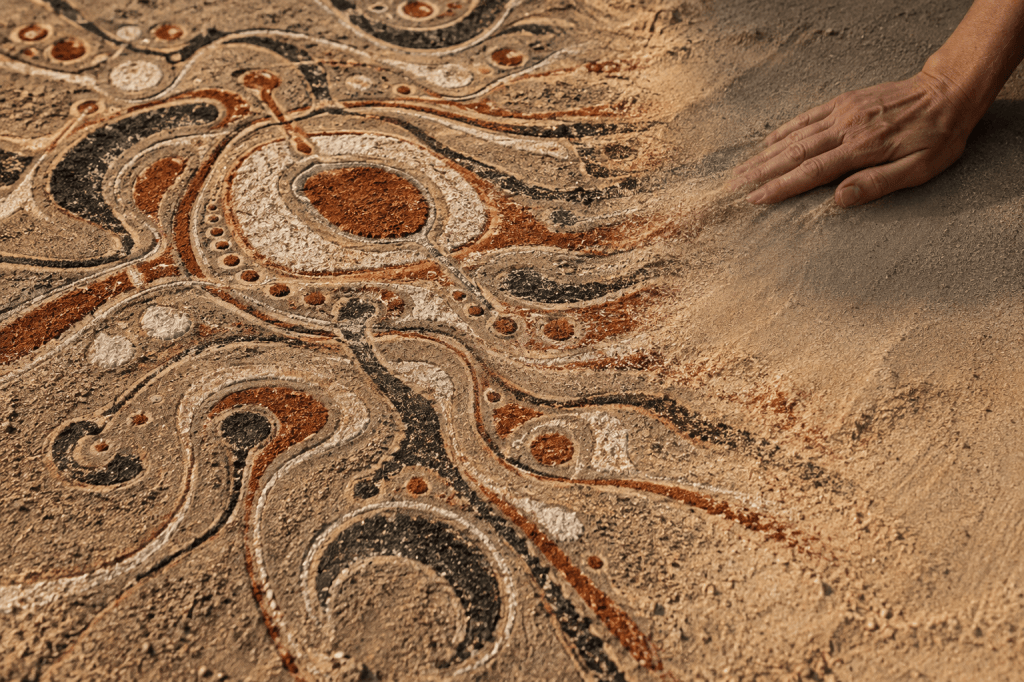
An imagined ceremonial sand drawing in the process of erasure.
Some images are made to end. A figure is drawn in sand while it is spoken of and smoothed away when the speaking is done; a design is painted on the body for the length of a ceremony and washed off before the next day’s work. The image belongs to its occasion: it exists for those who are present, at the moment they are permitted to be present, and its disappearance is part of its form rather than a loss. Nothing needs to guard it afterward, because there is no afterward in which it could be seen.
Where knowledge is given this way, seeing is itself a sequence. What a person may look at depends on what that person has already been shown, and on whether the community judges them ready for what comes next. An image’s meaning cannot be separated from its place in that order: the same design seen too early is not the same knowledge received sooner, but a different thing, and the order that would have given it sense has been skipped. A community holds its knowledge in the timing of its disclosures as much as in what they contain.
A durable surface changes the terms on which such an image exists. Moved to board, canvas or metal, the design no longer ends with its occasion; it stays available to anyone at any hour, including people who stand in no relation to the sequence that once governed it. Permanence does not have to be sold to have this effect. Once the image outlasts the ceremony, its restriction depends on keeping the object out of view, and an object kept out of view is already a different arrangement from an image that left nothing behind. Exchange, exhibition and reproduction extend the reach of what permanence has opened; they do not originate it.
The eye that receives such an object comes from outside the order. It may look with admiration, with scholarly attention or with the interest of ownership, and these differ in conscience while sharing a position: none of them was admitted to the image through the stages that gave it its sense. What reaches that eye is the surface of a knowledge without its sequence, complete in form and empty of the permission that was once its content. The looking cannot be returned like a stolen thing. Once something has been seen out of order, no later prohibition restores the condition of its not having been seen.
Those who make the images know this. Designs are dotted over, simplified, partly withheld, so that what circulates shows where a knowledge is while keeping its substance back. Concealment then happens inside the visible object itself: the painting carries the secret only as evidence that it is being withheld. This answers the exposure without undoing it. The community keeps what it declines to show, yet the order of seeing now includes an object anyone may look at, and every initiate grows up in a world where that object exists.
What erodes is not the knowledge as content, which can be kept, but the sequence’s authority to be the only way it reaches anyone. A generation can still be taught in stages, but it is taught alongside images that answer to no stage. The difference between what has been given and what has only been glimpsed must now be maintained by the community against a surface that does not honour it. That labour falls entirely on those who hold the knowledge, and it has no point at which it is finished.
Ricardo F. Morín
October 13, 2026
In transit
Tags: community, concealment, image, initiation, Knowledge, Perception, permanence, sequence


PLease leave a Reply