
Posts Tagged ‘concealment’

“Before One’s Turn”

October 18, 2026


Ricardo F. Morín
Before One’s Turn
Computer-generated image (CGI)
2026
An imagined ceremonial sand drawing in the process of erasure.

Some images are made to end.  A figure is drawn in sand while it is spoken of and smoothed away when the speaking is done; a design is painted on the body for the length of a ceremony and washed off before the next day’s work.  The image belongs to its occasion:  it exists for those who are present, at the moment they are permitted to be present, and its disappearance is part of its form rather than a loss.  Nothing needs to guard it afterward, because there is no afterward in which it could be seen.

Where knowledge is given this way, seeing is itself a sequence.  What a person may look at depends on what that person has already been shown, and on whether the community judges them ready for what comes next.  An image’s meaning cannot be separated from its place in that order:  the same design seen too early is not the same knowledge received sooner, but a different thing, and the order that would have given it sense has been skipped.  A community holds its knowledge in the timing of its disclosures as much as in what they contain.

A durable surface changes the terms on which such an image exists.  Moved to board, canvas or metal, the design no longer ends with its occasion; it stays available to anyone at any hour, including people who stand in no relation to the sequence that once governed it.  Permanence does not have to be sold to have this effect.  Once the image outlasts the ceremony, its restriction depends on keeping the object out of view, and an object kept out of view is already a different arrangement from an image that left nothing behind.  Exchange, exhibition and reproduction extend the reach of what permanence has opened; they do not originate it.

The eye that receives such an object comes from outside the order.  It may look with admiration, with scholarly attention or with the interest of ownership, and these differ in conscience while sharing a position:  none of them was admitted to the image through the stages that gave it its sense.  What reaches that eye is the surface of a knowledge without its sequence, complete in form and empty of the permission that was once its content.  The looking cannot be returned like a stolen thing.  Once something has been seen out of order, no later prohibition restores the condition of its not having been seen.

Those who make the images know this.  Designs are dotted over, simplified, partly withheld, so that what circulates shows where a knowledge is while keeping its substance back.  Concealment then happens inside the visible object itself:  the painting carries the secret only as evidence that it is being withheld.  This answers the exposure without undoing it.  The community keeps what it declines to show, yet the order of seeing now includes an object anyone may look at, and every initiate grows up in a world where that object exists.

What erodes is not the knowledge as content, which can be kept, but the sequence’s authority to be the only way it reaches anyone.  A generation can still be taught in stages, but it is taught alongside images that answer to no stage.  The difference between what has been given and what has only been glimpsed must now be maintained by the community against a surface that does not honour it.  That labour falls entirely on those who hold the knowledge, and it has no point at which it is finished.

Ricardo F. Morín

October 13, 2026

In transit
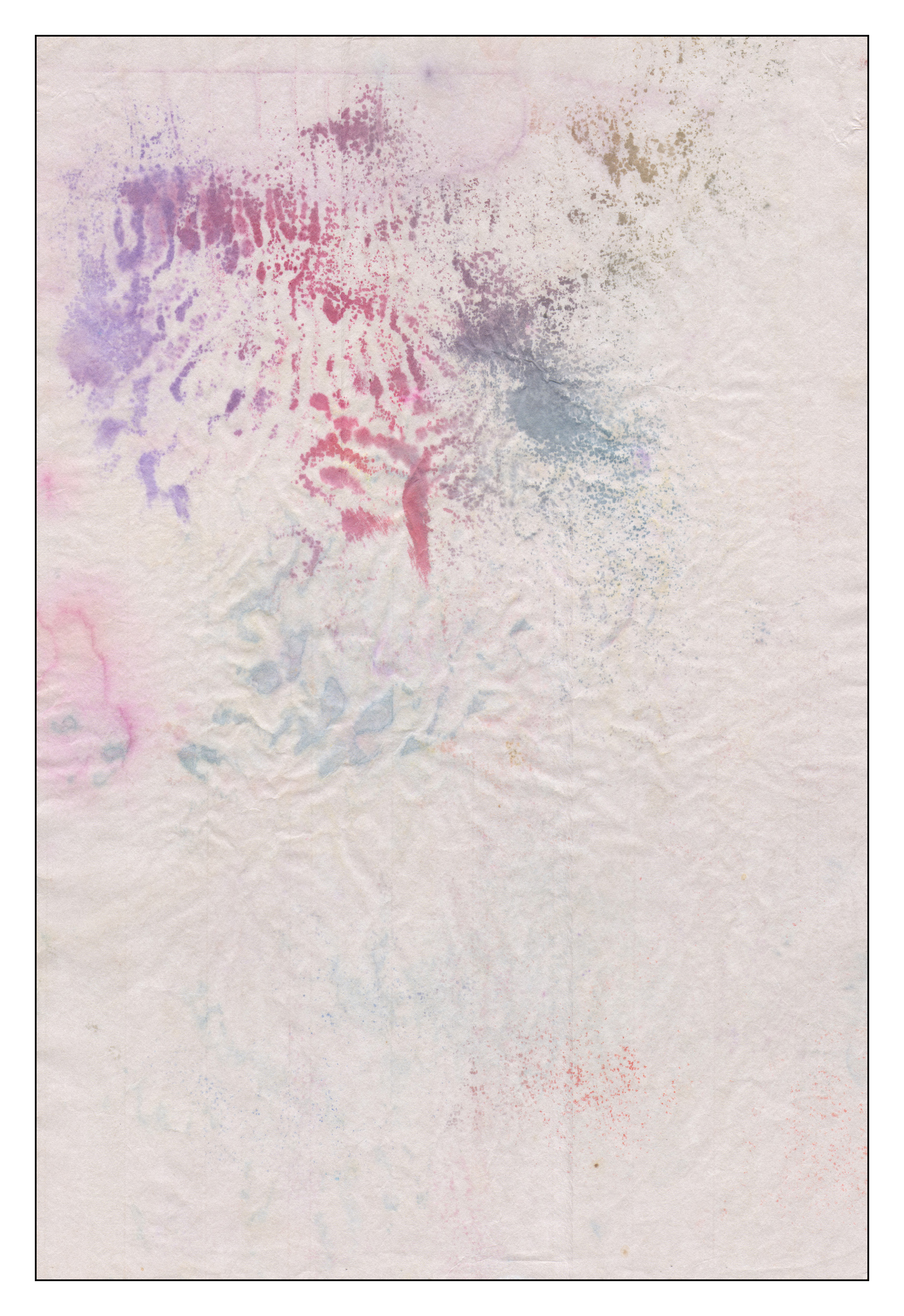

“Concealments”

January 10, 2026
Ricardo F. Morín
Erasures
Watercolor rub-offs on Japanese tissue paper
14″x20″
2005

Ricardo F. Morín

January 10, 2026

Oakland Park, Fl

*

1.

Public discussion often treats corruption as a series of discrete scandals attached to identifiable individuals.  That framing is misleading.  Investigative reporting and judicial records increasingly show that, particularly in the Venezuelan case, responsibility is displaced through repeatable actions that allow illicit benefit while obscuring accountability.

2.

The PBS Frontline documentary examining the rise and role of Alex Saab provides a clear point of entry.  Saab did not function as a policymaker or symbolic representative.  According to United States indictments and sustained investigative reporting, he acted as a testaferro—a fraudulent front man—through whom contracts, assets, and payments were routed to conceal the true beneficiaries.

3.

The diagnostic importance of Saab lies not in his personal profile but in the action he performed.  A testaferro is not a neutral intermediary.  He lends his name so that authority may receive benefit while denying responsibility for the consequences of its decisions.  The contractual signatory does not indicate decision-making authority.

4.

This action appears repeatedly in Venezuela across multiple domains:  oil sales conducted through intermediaries, food import programs delivering overpriced or tainted goods, housing projects funded and left incomplete, and financial transfers designed to evade sanctions and scrutiny.  Each domain differs in form, but the same action recurs:  authorization is granted, benefit accrues, and responsibility is displaced.

5.

The same displacement of responsibility appears in the use of irregular armed groups that exercise coercion without formal attribution.  Their actions do not require demonstrable command.   The absence of a traceable chain of authority is not incidental but integral:   force is applied while authorship remains deniable.

6.

At this stage, individual corruption gives way to criminal conduct sustained over time.  United States prosecutors have alleged that these financial and logistical actions coincide with narcotics trafficking and money laundering attributed to senior civilian and military officials, including Nicolás Maduro.  These allegations rest on claims of coordination, protection, and benefit.

7.

What U.S. indictments and investigative journalism describe as the Cartel de los Soles does not depend on the existence of a unified chain of command.  The term refers to a condition in which drug trafficking depends on permission, tolerance, or protection by state authorities rather than independent criminal initiative.

8.

Under this account, Saab is neither anomaly nor mastermind.  He is a replaceable participant whose removal does not interrupt the conduct described.  The persistence of the activity depends on substitution, not on loyalty or hierarchy.

9.

This clarification resolves a recurrent confusion in public debate.  Describing these actions does not constitute moral judgment or ideological hostility.  It identifies delegated fraud through which authority preserves outward legitimacy while transferring legal exposure to intermediaries.

10.

When these actions extend across ministries, borders, and markets and are sustained by coercive power, they exceed ordinary corruption.  They constitute organized criminal conduct exercised with the capacity of the State, regardless of whether a classic cartel form is present.

11.

The significance of the Frontline investigation is not that it adds another episode to a familiar narrative.  It shows how the use of front men allows this conduct to persist over time.  What follows from this recognition is not vindication but clarity about why accountability cannot be achieved by removing individuals alone.


References: