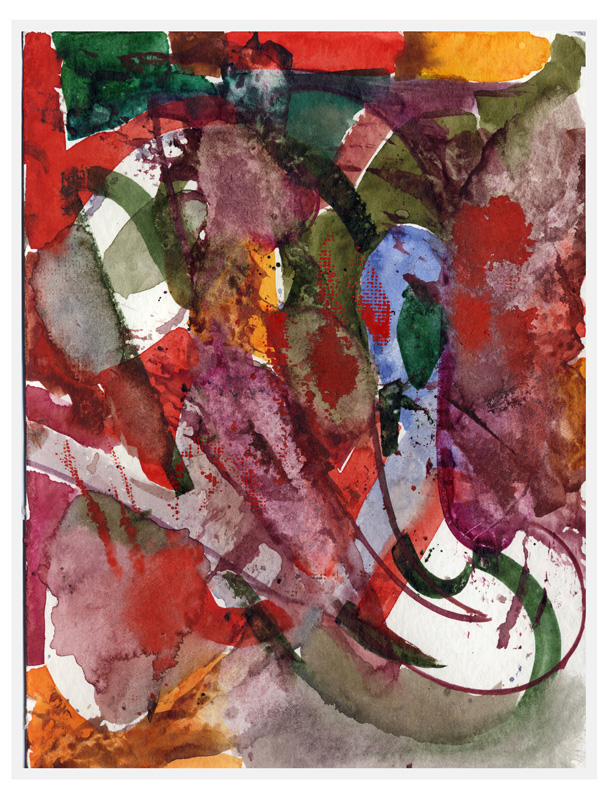
Ricardo F. Morín Templates 8” x 10” Watercolors on paper 2003
Ricardo F. Morín
January 31, 2026
Oakland Park, Fl.
People rely on memory because past experience cannot be returned to directly. What has already happened can only be approached again through recollection. Over time, memories are revisited under conditions that differ from those in which the original experience occurred. What once made sense in one moment must be made sense of again in another, and the standards used to judge it shift with present circumstances. As this happens, uncertainty enters the effort to rely on memory, not because people are careless, but because time alters the conditions under which understanding takes place.
In this respect, memory does not function differently from truth. Both remain exposed to time. What once appeared settled must be reconsidered as circumstances change, and neither memory nor truth remains fully governable by intention. What resists control is not honesty, but the displacement that time introduces between experience and its recall.
Memory as Justification
When direct access to experience is no longer possible, memory often takes its place as a source of explanation. People account for their decisions by referring to what they remember rather than to what can still be examined. Recollection is treated as evidence of continuity even when the conditions that produced it no longer exist. In this way, memory is asked to stabilize choices whose original context cannot be recovered.
As experiences recede further into the past, they are often invoked with greater confidence. This confidence does not arise because the memory has remained intact, but because distance shields it from challenge. What memory provides in such cases is not access to what happened, but a narrative sufficient to support judgment in the present.
Memory and Certainty
As experience becomes less accessible, certainty often increases rather than declines. Events that can no longer be tested against their original conditions become insulated from correction. Recollection hardens into conviction because comparison is no longer possible. Memory appears stable not because it is accurate, but because its sources cannot be revisited.
In this way, confidence attaches not to fidelity, but to distance. The past feels settled because it cannot be reentered. Certainty arises not from closeness to what occurred, but from the absence of any remaining means to contest what is remembered.
Memory and Repetition
As memories are repeated, they gain durability without preserving experience itself. Retelling does not restore original conditions; it refines what can be easily conveyed. Details that resist articulation fall away, while elements that can be narrated coherently are retained and reinforced. Through repetition, memory becomes less a trace of what occurred and more a stable account of what can be said.
What endures is not the experience itself, but a version shaped by its ability to be repeated without friction. After mediation is complete, the past yields no new facts, only new arrangements of what is already known.
Ricardo F. Morín Triangulation Series Nº59 12” x 15” Oil on linen 2009
* *
Knowledge enters common life through relations among persons. A proposition privately held may possess coherence, explanatory force, or evidentiary support, yet its public standing begins when the proposition becomes available to the examination of others. Agreement is only one possible response. Contradiction, revision, qualification, and the discovery of error also participate in the process through which a claim becomes intelligible beyond the judgment of the person who formed it. Validation, in this sense, does not mean approval. Validation refers to the exposure through which knowledge becomes subject to other judgments within a world no individual determines alone.
A claim, however, is never presented without the person who advances it. A response to the proposition consequently affects the claimant. Confirmation may establish credibility; correction may diminish it; and sustained attention may confer significance upon both the subject and the person addressing it. The validation of knowledge and the recognition of the knower remain distinguishable, but they do not remain separate. Each encounter with a claim contains the possibility that an examination of what is known will also become a judgment concerning the person who claims to know it.
Recognition is not an incidental intrusion into an otherwise impersonal activity. Language, instruction, and intellectual formation arise within relations through which individuals learn not only what may be known but whether their own perceptions merit expression. The need to be recognized accompanies the acquisition of knowledge because the person acquiring it also acquires a position from which to speak. Psychological vocabularies may identify intensified forms of reassurance seeking, contingent self-worth, or dependence upon approval, but the underlying condition precedes those definitions. The condition belongs neither to a diagnosis nor to a particular type of person. The condition is present wherever a human being submits a judgment to another consciousness and awaits a response whose meaning cannot be restricted to the judgment alone.
Repeated confirmation alters the relation between a claim and its source. A person whose judgments have proved reliable acquires credibility extending beyond the propositions already examined. Institutions formalize the extension of credibility through credentials, offices, publications, and titles; informal relations establish credibility through memory, reputation, and trust. Authority permits knowledge to circulate without requiring every proposition to be reconstructed from its foundations. The listener accepts that the speaker has previously undergone forms of examination whose repetition would be impracticable in every exchange. When the listener relies upon that prior credibility, the standing of the person may precede the standing of the claim. Confidence derived from particular judgments can therefore extend to the individual who produces them.
That extension of confidence may become more persuasive when extensive information, fluency across several vocabularies, and familiarity with multiple fields make intellectual breadth visible as a characteristic of the person. Such breadth may result from sustained study and may support comparisons among fields. Breadth alone does not disclose how knowledge from different fields has been organized. Information from several fields can coexist without mutual explanation; proficiency in those fields can coexist with uncertainty concerning the relations among the premises of those fields. The quantity and range of information may influence judgment apart from demonstrated organization. Accumulated knowledge may therefore be interpreted as comprehensive understanding.
That interpretation becomes more consequential when different fields are presented as a synthesis. Disciplines do not merely contain different information about a common reality. They establish objects through distinct methods, employ terms whose meanings depend upon particular histories, and recognize evidence according to standards that may not correspond. An explanation of human conduct, for example, may move from a neurological description to an ethical conclusion and from that conclusion to a theory of social order. Each transition may be intelligible, yet the evidence supporting the neurological description does not by itself establish the ethical conclusion, and the ethical conclusion does not by itself establish the theory of social order. Continuity of vocabulary may make the sequence appear complete before the relations have been demonstrated. The relation among fields may be demonstrated, remain provisional, or contain contradictions that no common vocabulary resolves. Describing the conjunction of the fields as synthesis does not reveal the status of that relation. The term synthesis indicates that coherence is being claimed, although the source of that coherence may still require examination.
Where the relations among fields remain incompletely demonstrated, acceptance of their asserted unity may depend partly upon confidence in the person presenting the synthesis. The range of the person’s knowledge, the fluency of the presentation, and the authority accumulated through previous exchanges can support acceptance of connections that the propositions themselves do not establish. Although this dependence does not demonstrate that the connections are mistaken, it discloses a change in the basis of coherence. The claim submitted for validation then concerns not only the relations among ideas but also the capacity of the person to comprehend those ideas as a totality.
Once acceptance depends partly upon the presenter, the passions of the knower may also affect the authority attributed to the synthesis. Acquiring information may alter how a person understands ambition, fear, attachment, resentment, and the desire for recognition without extinguishing any of them. A person may describe the operation of a passion while remaining subject to it; the capacity to identify a limitation does not confer command over its effects. Intellectual vocabularies may also make a passion more difficult to perceive: the desire for authority may be interpreted as service, the need for recognition as intellectual responsibility, and attachment to a conclusion as fidelity to truth. No clinical condition is required for these interpretations. They may arise from the influence of the knower’s motives upon the acquisition and presentation of knowledge.
Relational consequences arise when another person responds not only to what has been said but also to the authority attributed to the speaker. Agreement may confirm a proposition while also sustaining an identity organized around competence. Disagreement may concern a limited inference but be received as a withdrawal of confidence from a larger intellectual structure. The interlocutor then occupies more than one position: examiner of the claim, witness to the knower, and participant in the preservation or alteration of an established authority. These functions may coexist without becoming visible to either participant. The exchange continues to concern knowledge, but the response may also confirm or weaken the authority attributed to the claimant.
Unresolved relations among fields may also affect the understanding of a recipient. Confidence in the presenter may influence how the recipient evaluates those relations: a conjunction may be accepted as an established synthesis even when the recipient lacks the means to examine whether the constituent conclusions are compatible. The resulting confusion need not be recognized as confusion. The language supplied by the authority may give the conclusions internal consistency, and those conclusions may therefore be reproduced through subsequent explanations, instruction, or advice. The consequence does not depend upon deception. A person may sincerely transmit a coherence whose unresolved premises remain inaccessible to the recipient and perhaps insufficiently visible to the person who asserted it.
Recognition, however, is not sought only through the presentation of competence. A person may also disclose a limitation within a relation. An admission of imperfection may function as a request for reassurance or assistance, but the admission may also disclose a limitation without requesting either response. In the latter case, the speaker may neither deny the limitation nor experience the admission as an injury to self-worth. Fellowship may characterize an exchange in which the admission establishes trust between the speaker and the interlocutor. Both participants may then recognize vulnerability without interpreting the disclosure as a request for correction.
The interlocutor cannot determine the intended function of a disclosure from its content alone. An ordinary exchange may demonstrate this uncertainty. During a familiar conversation, a person may remark without distress that a notebook compensates for an unreliable memory. A companion may interpret the remark as self-denigration and respond by rejecting a judgment that the speaker had not experienced as injurious. An admission offered as trust may be heard as self-devaluation; an acknowledgment of limitation may be received as evidence of a distorted judgment requiring correction. A response may proceed from concern and still address a need that the speaker did not express. Through the disclosure, the speaker may establish trust, while the interlocutor may protect the speaker from a judgment considered harmful. Neither intention necessarily excludes regard for the other. The corrective response may convert disclosed vulnerability into an occasion for instruction.
The presentation of knowledge and the admission of limitation may perform different functions, yet both disclose the dependence of meaning upon response. A claim submitted for examination may be received as a demand for recognition of the claimant. A disclosure offered in fellowship may be received as a request for correction. In each instance, the interlocutor assigns a function to what has been communicated and thereby affects how the speaker and the interlocutor understand the exchange. Neither participant can determine that function alone: the person who speaks cannot control its attribution, and the interlocutor cannot recover intention without interpretation. Validation, recognition, and correction therefore arise not as fixed categories but as possible effects of an exchange whose participants may understand its purpose differently.
The attribution of wisdom may combine assessments of knowledge, passion, recognition, and limitation within a single judgment. Wisdom may be associated with the possession of extensive knowledge, the ability to relate different fields, composure before adversity, command over passion, or recognition of human limitation. These qualities can appear together, but their conjunction is not assured. Accumulated knowledge can coexist with unexamined assumptions; intellectual range can leave contradictions unresolved; apparent composure can depend upon the confirmation supplied by others; and acknowledgment of limitation can itself become part of an identity requiring recognition. The attribution of wisdom consequently reveals not only an assessment of the person but also an expectation concerning what knowledge is presumed to have accomplished within that person.
No separation of knowledge from recognition resolves the condition, since knowledge becomes social through responses that inevitably affect the person who speaks. Nor does the acknowledgment of vulnerability determine whether another person will receive the admission as fellowship, reassurance, or an occasion for correction. Greater awareness of these distinctions may itself become another claim to discernment and another position from which the conduct of others is evaluated. The analysis therefore does not yield a procedure by which validation can be purified of personal need or relations protected from every misalignment. The attempt to prescribe such a procedure would repeat the movement under examination by converting the recognition of a limitation into a claim of mastery over it.
Knowledge becomes public through examination, but the person who presents it remains exposed to what examination may confer or withdraw. A disclosure of vulnerability remains subject to the same uncertainty because its reception may convert an admission into a judgment the disclosure did not contain. Validation, correction, and recognition become distinguishable only after a response has altered the meaning attributed to the claim or disclosure. The analysis of those effects remains subject to the same condition: its distinctions become available for examination and may acquire authority through the recognition of those who receive them. Human beings require others to discover what their claims can sustain, yet neither the claim nor its analysis determines what follows from the presence of others.
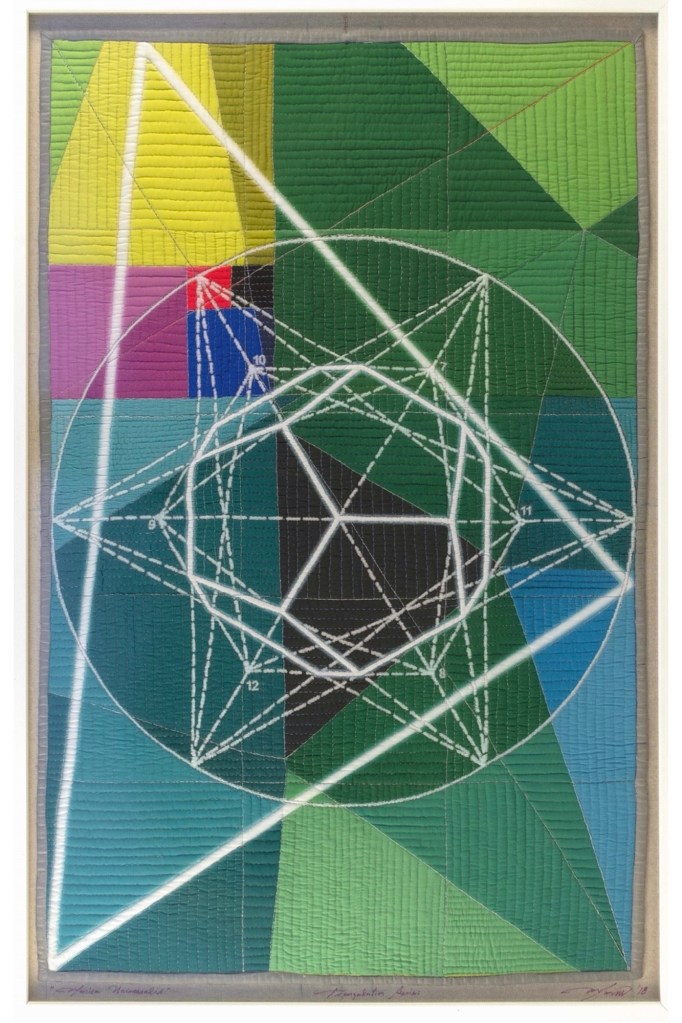
Ricardo Morín (Triangulation Series) Musica Universalis Silk quilt streched over linen 37″ x 60″ 2013-18
A geometrical construction of a dodecahedron within a Fibonacci composition, reinforced by a right-angle triangle: A meditation on the harmony of the universe, where mathematics and language converge yet never fully enclose reality.
Ricardo Morin, August 20, 2025
Abstract
This essay examines the interdependence of language and mathematics as the twin pillars of knowledge, each indispensable yet incomplete without the other. While mathematics secures precision and abstraction, language renders reasoning intelligible and shareable; together they approximate, but never fully capture, a reality richer than any formulation. The discussion situates artificial intelligence as a vivid case study of this condition. Marketed at premium cost yet marked by deficiencies in coherence, AI dramatizes what happens when mathematical power is privileged over linguistic rigor. Far from replacing human thought, such systems test our capacity to impose meaning, resist vagueness, and refine ideas. By weaving philosophical reflection with contemporary critique, the essay argues that both mathematics and language must be continually cultivated if knowledge is to progress. Their partnership does not close the gap between comprehension and reality; it keeps it open, ensuring that truth remains an unending pursuit.
Language, Mathematics, and the Price of Artificial Intelligence
Every society advances by refining its tools of thought. Two stand above all others: mathematics, which distills patterns with precision, and language, which gives form and meaning to reasoning. Neither is sufficient alone. To privilege one at the expense of the other is to weaken the very architecture of knowledge.
Artificial intelligence dramatizes both their promise and their limitations. The announcement of a $200 monthly fee for access to ChatGPT-5 is revealing. Marketed as a luxury service “for those who can afford it,” it underscores the widening gap between technological privilege and cultural necessity. Those with resources can fine-tune their productivity; those without are left behind. Yet even for the well-equipped, the question persists: what exactly is being purchased?
The machine dazzles with speed and scale, but its deficiencies are equally striking. Engineers may be virtuosos of algorithms, but grammar is not their instrument. The results are too often colloquial, vague, or lacking in rigor. To extract coherence, the user must not be a passive consumer but an editor—capable of clarifying, restructuring, and imposing meaning. The paradox is unmistakable: the tool marketed as liberation demands from its operator the very discipline it cannot supply.
This paradox reflects the larger truth about knowledge itself. Mathematics and language are both indispensable and both incomplete. Mathematics achieves abstraction but leaves its results inert unless language renders them intelligible and shareable. Language conveys thought but falters without the rigor that mathematics provides. What one secures, the other interprets.
Yet both are bound by a deeper condition: reality exceeds every formulation. Our theories—whether mathematical models or linguistic descriptions—are approximations shaped by the observer. Language cannot exhaust meaning; mathematics cannot capture finality. Knowledge is never absolute: it is a negotiation with a reality richer than any model or phrase.
Artificial intelligence exposes this condition with particular clarity. It can automate structures without supplying wisdom; it can reproduce language without securing meaning. Its proper value lies not in replacing the thinker, but in enlarging the field upon which judgment acts: disclosing relations, testing distinctions, formulating objections, establishing comparisons, resisting vagueness, imposing coherence, and refining thought. That enlargement demands vigilance in two directions: refusal may preserve familiar habits at the expense of intellectual reach, while submission may acquire fluency at the expense of autonomy.
To dismiss language and the humanities as secondary, or to imagine mathematics and computation as sufficient unto themselves, is to misunderstand their interdependence. These disciplines are not rivals but partners, each refining the other. AI magnifies both their strengths and their deficiencies; they remind us that progress depends on the continual refinement of both—mathematics to model reality, language to preserve its meaning.
The path of knowledge remains open-ended. Language and mathematics do not close the gap between our finite comprehension and the inexhaustible richness of reality; they keep it open. They allow us to approach truth without presuming to possess it. Artificial intelligence, as every tool of thought, shows us not the end of knowledge but its unending condition: a dialogue between what can be measured, what can be spoken, and what forever exceeds us.
*
Annotated Bibliography
Arendt, Hannah: The Life of the Mind. Vol. 1: Thinking. New York: Harcourt, Brace, Jovanovich, 1971. (Arendt examines the act of thinking and the limits of expression, which shows how thought requires language to become shareable while never able to exhaust reality. Her work reinforces the essay’s claim that reasoning without expression cannot advance knowledge.)
Bender, Emily M., and Koller, Alexander: “Climbing towards NLU: On Meaning, Form, and Understanding in the Age of Data.” Proceedings of ACL, 2020. (Bender and Koller argue that large language models process form without true understanding; this highlights the gulf between mathematical pattern recognition and linguistic meaning—it supports the essay’s caution that AI dazzles with form but falters in coherence.)
Chomsky, Noam: Language and Mind. 3rd ed. Cambridge: Cambridge University Press, 2006. (Chomsky explores the innate structures of language and their role in shaping cognition; this affirms that language conditions the possibility of thought while it still remains limited in capturing reality.)
Devlin, Keith: Introduction to Mathematical Thinking. Stanford: Keith Devlin, 2012. (Devlin explains how mathematical reasoning distills structure and pattern while acknowledging abstraction as approximation; this reinforces the idea that mathematics, as a safeguard of precision, cannot exhaust the world it models.)
Floridi, Luciano: The Fourth Revolution: How the Infosphere Is Reshaping Human Reality. Oxford: Oxford University Press, 2014. (Floridi situates digital technologies and AI within a broader history of self-understanding, which enriches the essay’s argument that mathematics and language—extended into computation—remain approximations of a reality beyond full control.)
Lakoff, George, and Núñez, Rafael: Where Mathematics Comes From: How the Embodied Mind Brings Mathematics into Being. New York: Basic Books, 2000. (Lakoff and Núñez argue that mathematics arises from metaphor and embodied cognition, which reveals how dependence on human interpretation and the affirmation that mathematical theories, as linguistic ones, remain bound to the observer.)
Mitchell, Melanie: Artificial Intelligence: A Guide for Thinking Humans. New York: Farrar, Straus and Giroux, 2019. (Mitchell provides a critical overview of AI’s capabilities and limits; it shows how the advancement of pattern recognition does not close fundamental gaps in understanding and parallels the essay’s critique of AI’s grammatical poverty.)
Polanyi, Michael: Personal Knowledge: Towards a Post-Critical Philosophy. Chicago: University of Chicago Press, 1962. (Polanyi emphasizes tacit knowledge and the need for articulation in validation; it echoes the view that mathematics and language refine understanding but never achieve closure.)
Snow, C. P.: The Two Cultures. Cambridge: Cambridge University Press, 1993 [1959]. (Snow diagnoses the divide between sciences and humanities; this undergirds the essay’s call to treat language and mathematics as complementary pillars of understanding.)