Archive for the ‘Judgement’ Category

“Lens of Procedural Incoherence”

November 30, 2025

*

Ricardo Morín
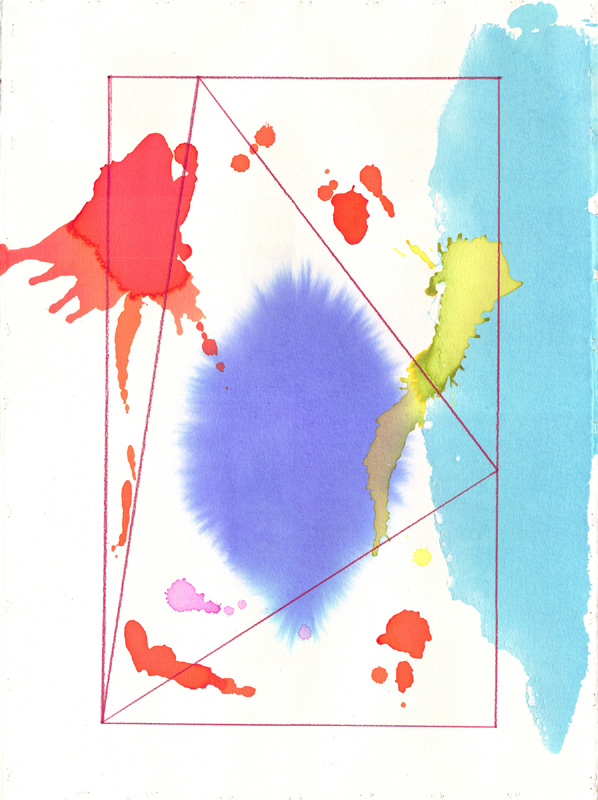
Triangulation 8: Lens of Procedural Incoherence
22″ x 30″
Watercolor and wax pencil on paper
2007

Ricardo Morín

November 2025

Oakland Park, Florida

This essay examines how procedures governing the use of force, the classification of conflict, and the articulation of self-defense diverge from declared principles in three areas of U.S. foreign policy:   the Trinidad maritime strike, the war involving Ukraine and Russia, and the conflict involving Israel, Palestine, and adjacent countries.   The analysis traces how inconsistencies arise when official language does not align with established norms, when criteria shift across comparable circumstances, and when the stated basis for action changes according to political need rather than procedural coherence.   The comparison highlights how these divergences contribute to instability and weaken interpretive clarity across international affairs.


1

The Washington Post report titled “‘Kill them all’: Hegseth’s battlefield rhetoric shaped Trump-era strike” (https://www.washingtonpost.com/national-security/2025/11/28/hegseth-kill-them-all-survivors-boat-strike/) describes a U.S. military operation near Trinidad in which a small vessel believed to be transporting narcotics was struck after being misidentified.   Defense Secretary Pete Hegseth issued a spoken directive “to kill everybody,” and the strike killed most individuals on board.   When surveillance identified two survivors clinging to debris, a second strike was ordered that killed them as well.   Subsequent explanations to Congress presented the follow-on strike as an effort to remove a navigational hazard, even though the presence of survivors had already been confirmed.   The Office of Legal Counsel (OLC), whose opinion later justified the actions as part of an armed conflict with designated narcoterrorist groups, introduced a legal classification that departed from the facts presented in the initial reports.   These elements create a single set of materials from which procedural coherence can be examined.

2

The procedural irregularity becomes visible once the chain of actions is placed in order:   an unverified assumption about the vessel’s identity, a directive that treated all occupants as combatants, a second strike executed after survivors were identified, and a later legal justification grounded in a classification that recast the operation as part of an armed conflict.   Each step relied on a different principle—assumption, directive, reinterpretation, and reclassification.   The divergence among these principles reveals how procedure shifted to accommodate the desired framing rather than guiding the action itself.   This shift does not imply motive; it demonstrates how administrative language can detach from the criteria that normally govern the use of force.

3

A similar procedural disjunction appears when U.S. positions regarding Ukraine and Russia are placed alongside the Trinidad case.  The United States publicly condemns Russia’s attacks on Ukrainian civilians and cites violations of distinction, proportionality, and accountability under the laws of armed conflict.   Yet discussions about scaling back support for Ukraine have introduced a reversal in which the procedural commitments used to justify condemnation of Russia are not consistently applied when considering the implications of reducing assistance to a State defending its sovereignty.  The shift from emphasizing legal norms to weighing political costs illustrates how procedures can be reshaped by circumstances, even when the stated principles remain unchanged.  The inconsistency does not rest in the declarations themselves but in the procedural reversals that appear when support for Ukraine becomes entangled with broader strategic calculations.

4

The conflict involving Israel, Palestine, and neighboring states such as Iran, Lebanon, and Yemen reveals another form of procedural divergence.   The United States affirms Israel’s right to self-defense and stops short of recognizing Palestine’s claim to self-determination in equal procedural terms.  The same criteria invoked to justify one party’s actions do not extend to the other party’s pursuit of sovereignty, even though both claims arise within a single territorial and political circumstance.   This asymmetry becomes more pronounced when regional attacks are considered:  the procedures invoked to justify Israeli strikes in response to threats from Iran, Lebanon, or Yemen differ from those applied to Palestinian actions, despite operating within an interconnected region where the consequences of one engagement affect all others.  The divergence reflects a procedural evasiveness that stabilizes one position while it leaves another without an articulated pathway toward recognition or resolution.

5

When the three circumstances—the Trinidad strike, the shifting position toward Ukraine and Russia, and the procedural asymmetry in the Israeli-Palestinian conflict—are examined together, their differences do not obscure the common pattern.   In each case, established procedures that ordinarily govern the use of force or the recognition of sovereignty diverge from the principles publicly invoked.   In Trinidad, the divergence takes the form of reclassification after the fact.   In Ukraine, it appears as a reversal in how the principles of civilian protection and territorial integrity are applied.   In Israel and Palestine, it emerges as a partial application of the right to self-defense without a corresponding recognition of the procedural requirements associated with sovereignty.   The alignment across cases arises from the way procedures shift to accommodate political needs rather than guiding action according to a stable set of criteria.

6

This alignment does not rest on the equivalence of the conflicts but on the consistency of the procedural departures.   Each case shows how the same vocabulary—armed conflict, self-defense, sovereignty, and civilian protection—operates differently when applied to different actors.   The procedures attached to these terms change according to circumstance rather than principle.   As a result, the meaning of each term becomes unstable.   What counts as an armed conflict in Trinidad, a sovereign defense in Ukraine, or a legitimate use of force in Gaza depends not on a uniform procedural standard but on the political frame selected in each instance.

7

A coherent foreign policy requires that procedures governing the use of force, recognition of sovereignty, and classification of conflict remain consistent across situations.   The Trinidad strike shows how procedures can be rearranged after the fact to protect the narrative of an operation.   The evolving position on Ukraine demonstrates how procedural commitments can weaken when strategic considerations gain priority.   The treatment of Palestinian claims and Israeli self-defense reveals how procedures can be selectively applied within the same region.   Together, these inconsistencies demonstrate how the absence of procedural coherence reduces interpretive clarity and complicates the relationships on which international stability depends.

8

The examination of these cases through a single lens does not equate them; it identifies the procedural incoherence that appears when the principles governing the use of force, recognition of sovereignty, and classification of conflict do not align with the actions taken.   The result is a field of international affairs in which the stated basis for action varies according to circumstance, and in which procedural language adapts to political needs rather than providing a stable standard for decision-making.   The inferences that follow are left to the reader, who can judge how the departure from procedural coherence shapes the credibility of U.S. conduct abroad.


 “The Human Condition”

January 18, 2025

 *


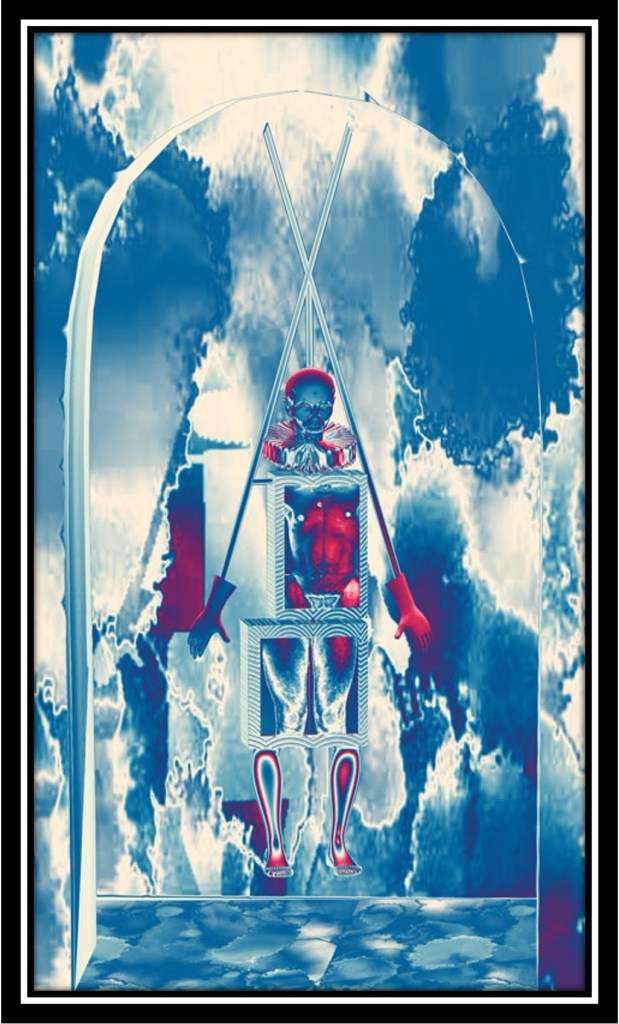
Ascension 3, 2005 CGI by Ricardo Morin

Introduction

*

In a world where we often demand certainty and control, we find ourselves fragmented, trapped in boxes of our own making, unable to embrace the fullness of our existence.    The image before you captures this tension: a body suspended in a delicate scaffold, exposed yet bound, vulnerable yet distant.    The crimson red that pulses through this figure’s radiography mirrors the emotional intensity of our internal conflicts—irrational beliefs, loneliness, and the distortion of our own feelings.    Here, we find a body that is both present and absent, much like the self we attempt to control through rigid dogmas, unfounded convictions, or the false security of unquestioned assumptions.


Such beliefs, pervasive in religion, politics, and culture, offer a semblance of control in a world we cannot fully comprehend.    Yet, they often bind us more tightly than we realize; they lead us away from self-compassion and deeper understanding.    We cling to them as anchors as we seek certainty, but in doing so, we only isolate ourselves further and obscure the possibility of transformation and healing.    Just as the body remains whole, though fragmented, so too can we find healing by letting go of the illusions that distort our sense of self.


This image invites you to reflect on the tension between our desires for control and the reality of our emotional vulnerability.    Our human condition urges a return to the boy, to ourselves, and to the truth of being—free from the distortions that prevent us from embracing the raw authenticity of life.


Section I


Irrationality

*


Ignorance is an essential condition of our existence, despite our hubristic desire to control knowledge.    We are like travelers in a dense fog as we glimpse shadows of trees that seem both near and far—each step reveals something new while obscuring what we thought we understood.    This fog invites exploration, not eradication, as its presence reminds us that certainty is an illusion.    The moment we attempt to dispel it entirely—to demand certainty and mastery—we reject the depth and richness of uncertainty and trade it for the rigidity of shallow, dogmatic beliefs.    To embrace this uncertainty is to accept the vastness of what remains unknown:    that which liberates us from the paralysis of false clarity.


Section II


The Transformative Power of Love and Self-Compassion

*


Love has the power to heal wounds unseen, but it is first a seed within oneself.    When nurtured, this seed grows into an awareness of the shared fragility of existence—the recognition that no one is immune to suffering.    Consider the quiet solidarity in a kind word offered to a stranger, the unspoken bond formed in moments of shared grief, or the simple grace of forgiving someone else’s faults, while knowing your own are equally imperfect.    These acts remind us that we are not isolated in our suffering but connected through it.    In acknowledging this interconnectedness, we cultivate a compassion that transcends individuality.    It allows us to honor the humanity in others as we learn to honor it in ourselves.


Section III


Aloneness Versus Loneliness

*


Think of aloneness as your defining character, a realm where your thoughts and feelings can exist unfiltered, untouched by comparison.    Loneliness, however, emerges when this solitude becomes an echo chamber of unmet desires, a distortion that amplifies the absence of external validation into a consuming need.    To perceive aloneness as loneliness is to conflate a natural state with an unhealthy yearning, much like mistaking silence for emptiness.    Aloneness offers clarity, a space to reflect and grow, while loneliness, though painful, can teach us where we most need to nurture ourselves.    By reframing loneliness as a symptom rather than a sentence, we can transform it into an opportunity for self-understanding.

PostScript

*

As I reflect on the journey of these ideas, I’m reminded of a time nearly 16 years ago when I found solace in the writings of Jiddu Krishnamurti, a spiritual teacher my mother had studied in my younger years.    His ideas, like Buddhism before it, served as a preamble—a glimpse into a deeper understanding that I did not fully grasp until later in life.    It was only in my fifties, after embracing writing as a form of creative expression, that I began to unravel the layers of truth hidden within his words.

During this period, my editor, with whom I shared my growing interest in Krishnamurti, referred to him as a “kook”—a label that seemed to reflect the contradictions inherent in Krishnamurti’s philosophy.    My admiration for both Krishnamurti and my editor was marked by an internal conflict.    I struggled to reconcile the imperfections I saw in both of them with my own sense of integrity and independence.    In time, I came to understand that their imperfections were no different from my own—and that the wisdom I sought was not in their perfection, but in the very acceptance of imperfection itself.

This acceptance allowed me to learn from both of them while retaining my own autonomy, a reminder that growth comes not from flawless certainty, but from the ability to navigate contradiction and complexity.    Just as we can find truth in our own imperfect understanding, so too can we extend compassion to others:    to acknowledge that their contradictions are part of the shared human experience.

In this journey, I’ve learned that the tension between certainty and uncertainty is not something to resolve but something to live with—a space where self-compassion and wisdom can grow, imperfect though they may be.

Ricardo F Morin Tortolero, January 18, 2025, Oakland Park, Florida.

Editor, Billy Bussell Thompson, February 14, 2025, New York City.

“A Conversation in Twelve Days: Reliquary of Remembrances”

March 24, 2023
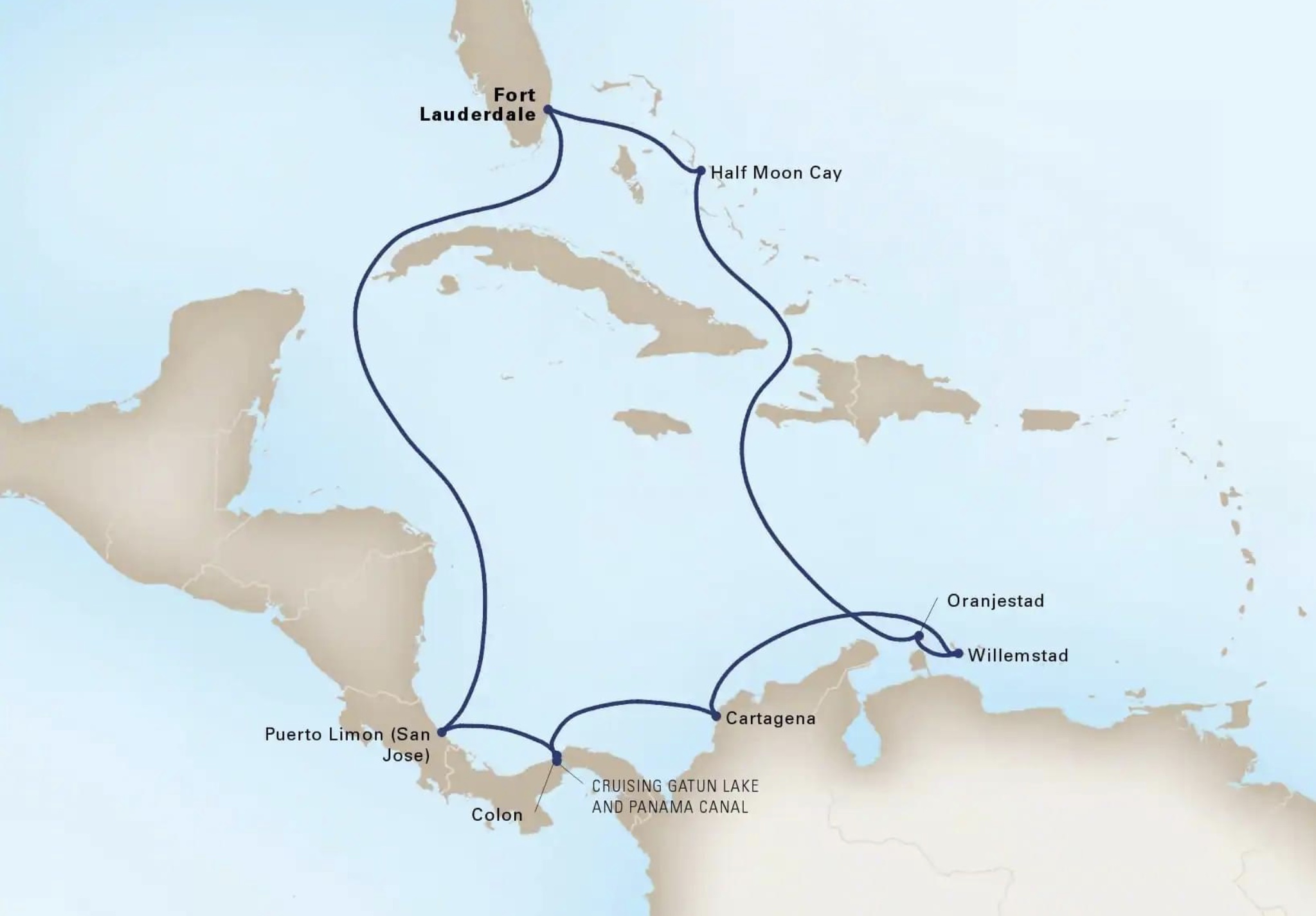
Line Holland America, Eurodam Cruise Itinerary

*

In Memoriam Papá

*

The ‘I’ believes in pleasure, laughter, good food, sex.   The ‘I’ believes in itself, sometimes it is proud of itself but sometimes ashamed of itself.   Who does not carry the stain of shame, a faux pas, a lost opportunity that, just remembering them, cures us of the threatening hubris of believing ourselves, in Mexican terms, the mero mero, the cat’s meow, the king of the forest, the bee’s knees?

Carlos Fuentes, This I Believe: An A-Z of a Writer’s Life; The I. p. 315. Bloomsbury Publishing, London; Translated by Kristina Cordero, Copyright 2004.

*


INTRODUCTION:

Writing for me is the result of reasoning through experience, sifting agenda whether mine or those of others.   In shaping my narratives, the process inevitably extends long beyond the scope of a story.   I cannot define my emotions unless I have spent time examining them.   Unlike a professional journalist, on purpose I avoid writing on commission or for any kind of financial gain.  For a few years now, owing to the Covid Pandemic, I have substituted writing for my brushes and painting studio.   Spontaneity defines these narratives just as it had my abstract paintings.   I struggle for disinterestedness:   a universality intrinsic to every work of art. 

Thus, a narrative’s introduction is ironically an epilogue.  Initially, the conversation taking place between David and me had not been set.  It is through the course of this cruise that evocations are gleaned from the past.  They are our way of understanding ourselves as spouses.

This exploration of the West Indies and the Caribbean held des énigmes.  For us, it was the exploration of an unknown continent. Among these southern lands resided that Little Venice [Venezuela], the source of my current distress:  Why did I have to leave there a half century ago for a frigid Western New York?  This story illustrates both my father’s culture and my own perspective.

In the mutability of time, confessions seek understanding.  Memory comes from/out of habit, opinion, desire, pleasure, pain, and fear.   Each manifests a change.  Like jetsam in times of distress each one of these resurfaces, though not preserved, but transformed into something new.  The succession of worn-out ideas is an act of replacement.  

A wanderer’s hope and prayers I add for those left behind.   In pondering these memories, I examine my own validity and ambiguities.  This reliquary of contradictions stands between intuition and fact.  I seek the readers’ empathy as a transition.

Each alliance of loyalty between fact and intuition can place us in a better universe.  It is our beliefs that the human spirit can rise above life’s vicissitudes.

Here, I wish to include special thanks to Professor Andrew Irving, Ph.D., head of the Department of Anthropology, University of Manchester, England, for his generous support and guidance.  I have known Andrew for the past 26 years, and once I had the opportunity to collaborate on a research project, entitled The Art of Life and Death: Radical Aesthetics and Ethnographic Practice (2017).  Since before the publication of my WordPress’s web page Observations on the Nature of Perception (Visual Art, Aesthetic Plasticity, and a Free Human Mind) – a repository for short stories published as of 2008 – I had already shared with him a number of testimonials on aesthetics, which became crystalized in my post Acts of Individual Talent (2009).    These had evolved over our conversations in the course of thirteen years, starting in 1997 since we met for the first time:

Ricardo realized that the true measure of a painter is the making of art despite the obstacles and challenges one has to endure.   Ricardo was particularly motivated by the fact that there have been innumerable artists whose accomplishments did not depend on engaging with the marketplace.   He was drawn to “all the great works by anonymous artists from Greek and Roman Antiquity, that were plundered, destroyed, and stigmatized during the Dark Ages,” as well as Cézanne, who endured forty years of obscure labor before landing a first one-man-show, and Van Gogh, whose sublimely “outsider” creations were only recognized after his death.   For Ricardo, the term “outsider art” often denotes a prejudice toward individuals perceived to be riddled by some sort of physical or psychological health impairment.   As such, both academia and the art establishment tend to divide art on the basis of its cultural import or through an underlying bias that Ricardo suggests evolves according to market demands.   Another term is folkloric art, deemed to refer to the art of the colonies or the cultural heritage of a nation, which is associated with ideas of shared roots and lived experiences.   “Are these terms in some way similar or different from the issues involved in art produced during the struggle over chronic or terminal disease?” Ricardo asked after reading this chapter, “and while the notion of mutuality is essential to understanding the shared human condition, can it also help to expand sensibilities about understanding human expression in an interdisciplinary scientific context, bound by the myriad circumstances that may engulf human pathos besides biology, be it in sociological survival to fit in or as an effort to therapeutically survive a chronic or terminal disease?”   Ricardo’s response and analysis continued:  “There is great intelligence in the creative efforts made by the human mind to survive any circumstance.   Besides, it is undeniable that bodily pain and mental pain are ubiquitous in life, be it one of privilege or alienation.   The logical concepts of cognitive science with averages, classifications, and algorithms will serve no other purpose than to provide a mere approximation to understanding the complexity of human expression, its diversity, heterogeneity, and inenarrable nature. Can we really come to understand the ways in which different modes of inner expression – such as people’s ongoing interior dialogues, un-articulated moods, imaginative life-worlds, and emotional reveries – if they remain hidden beneath the surface of public activities, hence hidden from research?   Ultimately, that which is mystical about the cycle of life and death may not be elucidated by a tactical approach, but through a profound introspection that is very difficult to articulate.”   In 2008, Ricardo was diagnosed with Non-Hodgkin Lymphoma, a cancer associated with AIDS that affects white blood cells and can emerge when the immune system is weakened for prolonged periods.   Throughout his illness, chemotherapy treatment, and convalescence, Ricardo spent many months sitting in silence in his chair. Beds and chairs are often dynamic sites of thought, expression, and memory for people living with an extended period of illness, whose thinking ranges freely across the past, present, and future.   People remain thinking and speaking beings even when lying or seated in silence for long periods and may be negotiating critical issues, dilemmas, and decisions regarding treatment, work, or faith and be engaged in emergent streams of interior dialogue, thought, and emotion.   It was during this state, which Ricardo describes as one of “high inertia” that he came to recognize the simplicity, power, and aesthetics of silence, especially “when compared with all the noise and visual cacophony of the tangible world at large.”   Of course, a silence is never simply a silence.   Different days are mediated by different silences; an uncertain silence, a good silence, a heroic silence, a surreal silence, a painful silence.   A silence can contain the faces of the people closest to you, thoughts of suicide, images of the world outside, daydreams, and future-orientated life projects.   After months of dwelling in silence, Ricardo wrote a Manifesto of Silence to help him think through and articulate his thoughts. It begins as follows:   “The verbalization of an aesthetic reality implies its own death; no matter how precise, its very accuracy of words resists the magnitude of that reality.   It is found in the open space of silence, in the virtuous stillness of a meditative contemplation, in the freedom itself of the known, free to observe with a heightened attention, where questions are unnecessary and responses trivialize the very observation.”  After finishing the chemotherapy, Ricardo came down with severe tendonitis, which meant he no longer had the requisite strength to stretch canvases in order to paint.   Consequently, when he started painting again he did so on hanging scrolls.   Ricardo came to understand the scroll material and how it behaved in its simplest of terms and in relation to his own physical limitations.   Between 2009 and 2010, Ricardo started to work on a scroll series called Metaphors of Silence, in which “it was this incidental simplicity of the medium of scrolls and my empathy for the nature of silence that produced the subject matter.”

Andrew Irving, The Art of Life and Death: Radical Aesthetics and Ethnographic Practice (2017), Chapter 3, To Live That Life; Observations on the Nature of Perception, pp. 119-24

When I last revised my post Acts of Individual Talent in 2020, I concluded:   What use would creativity or intellect be to us without compassion?, would we not need to assess our system of valuation, perhaps even our own cultural rationality?

More recently, on February 3, 2023, Andrew and I also had a long discussion via Zoom, which was based on my WordPress post Meditations on Ortega y Gasset (2022).  At that time, he provided a critical analysis with extensive bibliography, which, he felt, would enhance my perspective about the Enlightenment and its limitations. 

Furthermore, I extend my gratitude to my friend and editor for the past 36 years, Billy Bussell Thompson, Ph.D., professor emeritus, Hofstra University, Department of Romance Languages.  It is thanks to Billy that I remain hopeful in developing my skills as a writer.

Fort Lauderdale, March 24, 2023

*


Plato’s Symposium:  Diotima on the wisdom of love.

“So do not be amazed if everything honors by nature its offshoot; for it is for the sake of immortality that this zeal and eros attend everything.”   

“ . . . in as much as in the case of human beings, if you were willing to glance at their love of honor, you would be amazed at their irrationality, unless you understand what I have said and reflect how uncanny their disposition is made by their love of renown, ‘and their setting up immortal fame for eternity’; and for the sake of fame even more than for their children, they are ready to run all risks, to exhaust their money, to toil at every sort of toil, and to die.”   [Location p. 37, 207a-208]

Plato’s Symposium:   a translation by Seth Bernardete with commentaries by Allen Bloom and Seth Bernardete, Chicago:   University of Chicago Press, 2001.


*

I

Clouds loomed, as if mountains, over the horizon.  From the balcony of our stateroom, we watched the wake’s effervescent whiteness.  Gulls pierced rolling waves and cawed their disputes.


II

Our travels across the Bahamas and along the coasts of Central America had begun five days ago on the Eurodam.  On January 4th we had left Fort Lauderdale.  Already we have passed by north of Cuba and and south of Hispaniola.  Now, we are approaching Aruba, a mere 76 miles from Venezuela.  A pilot boat will guide us to moorage.  But a fire alarm has gone off, and the stench of diesel permeates the air.  A few minutes later the captain announces: Everything has been brought back to normal.  The emergency has been aborted.


III

David and I are speaking; emergency lights are still flashing.

  • It’s been fifty years since I left.  I was 17.  


IV

We disembark in Oranjestad.

  • Eighty-five years today my parents were ostracized from Germany.   Five years later they married in the United States, where they lived happily until their deaths.
  • For my parents, leaving the country was never an option and their marriage was unhappy.
  • Did you ever come with them to Aruba?
  • Only as a child.


V

  • How was your relationship with them at that time?
  • My parents emphasized independence.     For me they were a bridge to the country, still.     They understood I had to go abroad.   There was no other choice.   From my love for them, ties to Venezuela have never wavered.     Our proximity now, however, elicits no nostalgia, only recollections.    I do care, though. 


VI

  • You must have some memorable moments from then?
  • Camping out with the Boy Scouts on the Andean plateau.  That honed my vision.
  • Anything else? 
  • I remember the ashrams of the Universal Fraternity.  There were monks, followers of Serge Raynaud de la Ferrière (in Valencia, Maracay, and Caracas).  I frequented all three of them, during the summers.  These ashrams schooled its attendees in a mixture of natural sciences and Buddhism:  For me this was more stimulating than listening to church sermons, with their evocations of sin and the shadows of shame.  That’s when I began yoga and meditation.
  • What impressed you the most?
  • I was drawn by the emphasis in self-denial.  But I disliked being dependent on other people.  I just wanted to expand beyond myself.  


VII

  • In those years, I was attached to nothing in particular.  Was I a dilettante? 
  • You were inquisitive; it was a time for discovery. 
  • I went to seminars on musicology; I took German lessons; it was a time for Hesse, Kafka, Gibran, Thoreau’s Walden, and Skinner’s Walden Two.


VIII

  • I read, but unsystematically.  I liked philosophy, history, painting, and writing, but I wasn’t yet dedicated.  Only slowly, did it all become part of me. 
  • These things awakened your spirit.
  • I was free from obligations and they expressed my relationship to the world.
  • You were learning to be original.  You sought your own voice.  You didn’t mimic other people.
  • The more I felt, the greater my involvement.  It was just a way to express myself.  I wasn’t looking for success, or distraction. 


IX

We disembarked and walked over to the shopping malls.  From Main Street we veered into the side ones.  On both sides, most storefronts were boarded up.  The façades showed signs of a better time, perhaps, from when Venezuelans were flamboyant.  Now only makeshift stands crowded the sidewalk, manned by folk with a distinctive Venezuelan lilt:  In friendly conversation, the word marico floated amongst them.

  • Papá once watched me sitting on the curb of a street next to an old watchman who worked for us on weekends and was known for having an unpredictable temper.  The watchman awaited my family’s departure to the city.  I had often befriended him, peppering him with questions.  Later, Papá said I was the only person who related to this man.
  • Your resilience was your best attribute. 


X

  • In the late sixties, our family hosted the daughter of Venezuela’s President Rómulo Betancourt, Virginia.  She and her husband stayed in one of our houses in Valencia.   At that time, Virginia Pérez was the head of the National Library in Caracas.   I was thirteen and Papá asked me to take my paintings from the rooms where the guests were staying.   According to him they were out of place.   One day, after having finished lunch, I brought a framed watercolor over to Virginia and began to speak.   My father objected, but she said, disavowing him:  “No, please, leave him alone.”   I continued:   “It shows the spirit of a young man in search of freedom.”    Sweetly she responded:   “I like your way of thinking; I want to hear more.”   Words now failed me. 
  • (David chuckling), you told me this once before.


XI

  • Can you tell if you fit into a pattern, or is your life just a series of episodes?
  • I don’t see the disconnections; I can’t say if there’s a pattern.   I was just bold then.   My speech, vocabulary, and the way I looked must have seemed provocative, perhaps, even epicene.   I threatened expectations.   I was different from my older brother, who was athletic and had lots of friends.   I was a loner.   For my lack of sport, maybe Papá found me not only vulnerable, but also naïve.   Was it dissatisfaction or was it nonconformity?   I only found solace in my private inventions.  Shortly afterwards, I erased, slashed, tore two years of paintings, only to regret this later.   Papá said I was rebelling against my own culture.  
  • Your father knew you couldn’t survive a world of machismo and its deeply rooted biases.
  • That’s the point.   I hadn’t understood that yet.    Papá saw my creativity as a target for victimization.   He told me I couldn’t be a lawyer.   I wouldn’t fit in.   When I argued I could go into international law, he was equally incredulous. 
  • Perhaps, for that same reason, he never got involved in politics; he knew human imperfections carried their own risks; he recognized the kind of dishonesty that pervaded Venezuela.   He wanted you to be safe.  That’s why you had to leave.


XII

  • I’ve come to understand that exceptionalism is a myth.   Disappointment is powerful.   I had to leave. 


XIII

  • Even if I am surrounded by falsehood, I must not be cynical.   What does that serve?   Human imperfections can’t be freed from themselves.   I feel uncomfortable, however, when people ask where I am from, as if they are diagnosing who I am.
  • Most people don’t mean anything by it.
  • It’s my own reaction.   I suppose it proves I am not comfortable with English.   It feels as if people are placing me in a niche.
  • Most people can identify with that, I do for one.   Few of us ever get the questions right.
  • Does anyone, really?   If they did, answers would be unnecessary. 


XIV

That night, it rained.   A full moon unveiled itself from behind the clouds.    We stepped again onto the balcony and admired the kaleidoscope of twinkling lights across the island.

  • In the first few years outside of Venezuela, I was enamoured of life in the United States.   Long before going there, my Aunt Lina’s place in Buffalo had filled my dreams.   She was able to flee the Holocaust.   Her rose garden was just what I had imagined.   Her graciousness was the same as when I had met her in Venezuela.   Her garden left a lasting impression on me. 


XV

That morning we anchored in Willemstad, Curaçao, surrounded by a rumpus of pelicans near the pier. 

  • On my first visit back to Venezuela, Papá asked me what I thought about the inflation in the United States.   I never knew why he posed that question.   Its irony was not lost on me 50 years later, when Venezuela has accrued one of the highest rates in the history of the world.


XVI

We went sightseeing in Willemstad.   The city’s old buildings, streets, and bridges were reminiscent of Amsterdam.   We took photographs and wandered around slowly.   Then thinking of our families, we shopped for table linens.

  • Do you think your father foresaw the disintegration of Venezuela? 
  • The world where I grew up was always on the brink.   Papá used to say he did not know how we were going to manage without him.   He feared for every aspect of our lives, and even for every Venezuelans’ families.   He even feared a total civil brutality in that landscape of pervasive dishonesty.   How could it be prevented?


XVII

Keeping to ourselves, we had a full day at sea.   We ate alone.   We had little in common with the other passengers:   all two thousand of them.

  • After twenty-four years later, I came back.   Without a gallery’s contract, again I have thought about destroying my paintings.   This time, I was tempted to burn them, but the flames might have engulfed me and my home.   This thwarted me.   I could only store them.
  • Couldn’t somebody have helped?
  • Papá did the best he could, even inciting jealousy among my brothers and sisters.  Perhaps, he felt sorrier for me …. When I was interviewed by a local newspaper concerning my work in the United States, a lot of our neighbors thought the interview self-serving.   Then Papá died and I became even more of an outsider.
  • What happened to him?
  • By the age of 70, he had become delusional, untethered from his own will.   His last five years coincided with Venezuela’s disintegration, and family members sought safety in Europe and elsewhere in America.   For me art became secondary.


XVIII

  • What about your brothers and sisters?
  • It’s sad to say.   Their sense of entitlement has complicated matters.   My older brother claimed the right of primogeniture, though he had no legal authority for such.  We denied it to him, but lacked the resources to challenge him.  He kept the rents mostly for himself.  With the passing of years, the properties have lost value and some have been taken over by squatters, and some even expropriated by the government.  Out of concern for his safety, I made an offer to help him.  He rebuffed me saying he counted on the first Lady of Venezuela.  He added that he could not leave Venezuela and lose his identity as a lawyer.
  • These explanations are puzzling.   And what about your two sisters and younger brother?   What has happened to them?
  • My youngest sister moved to Madrid with her husband and two young daughters.   My other sister and younger brother have stayed in Venezuela.   They protect each other as well as they can.    For the last ten years, I have been helping them and my paternal aunts.
  • I remember meeting your aunts.   That was when I traveled to Venezuela with you.   We celebrated your mother’s eightieth birthday and your older brother’s remarriage.   I also remember his son’s grief.   He seemed inconsolable.   Didn’t he move to Argentina with his partner?
  • Yes.   We also did our best to console him, such as when he met my former partner, Nelson.   He felt reinforced by our presence, and my relationship with Nelson triggered a validation that his father had always feared.    All along my nephew sought his father’s acceptance.   I told them there was no place for shame.


XIX

Not too far from where we are, in a small fishing village on the Caribbean coast of Venezuela stands a plinth.  It pays homage to guerrillas sent by Cuba to Venezuela in the 1960’s.  Their campaign collapsed.  Five decades later, Hugo Chávez helped achieve Cuba’s fantasy – this time without firing a shot.

  • I cannot judge Venezuela nor its history, for I no longer am part of it.  I have not suffered the lash of Venezuelan repressions.  For the past 50 years, I have been in the United States, where measures of rectification constantly challenge authoritarianism and kleptocracy.  
  • Recently, you spoke to my friend Cindy, who is an analyst at the US treasury.  She told you quite frankly that the American government’s sanctions on corrupt Venezuelan individuals are not simple issues.  The flight of fortunes from countries like Venezuela cannot be easily controlled where there is flagrant corruption. 
  • Indeed, that’s a reality no one can manage.


XX

  • In your opinion, is there any hope for Venezuelan stability? 
  • It’s complex.   It is inexplicable how, for instance, billions of dollars are acquired out of nowhere by the children of local politicians.   They care not at all for its constituency or for their country:   A nation of laws has ceased to exist.  


XXI

  • Have you ever interacted with Venezuelan officials? 
  • Only indirectly, through second and third cousins (who worked in the executive branch and the Ministry of Foreign Relations) as well as my own brother (who was a legal advisor to a State governor).   Aside from them, I have only engaged a would-be reformer, who now lives in Florida.   In 1999, he was one of the congressmen involved in writing  the last Venezuelan constitution.   Currently, among expatriates, he has a large following.   In one of his podcasts, he took issue with me over the lack of maturity in Venezuelan politics.   He replied furiously to my allegations of self-interest:   ¿Y quién coño eres tú?” [And, who tha fuck are you?].   Later, I sent him a text “in general most reformers fail to address what they intend to reform,” and he replied:   ¡Ay, por Dios, éste es un gran maricón! [Oh, my God, this man is just a faggot].   Then he blocked me. 


XXII

We arrived in Cartagena, Colombia, where we toured the old walled city and the Fortress of San Felipe.   Long undulating promenades (covered by trellises draped in bougainvillea) were delightfull and hugged the walls of the malecón.  The guide spoke of the father of Greater Colombia, Simón Bolívar, who had died at Santa Marta.  He pointed out a wine-colored fortress where Gabriel García Márquez had resided.  

  • Even though I did not take part in the protests, with my keyboard I favored dissenters and insurrectionists alike.  This was my cri du cœur.  Though we have all failed, for me the morality of this call has never gone silent.
  • It’s your voice.
  • Time itself is an instrument that balances the absence of truth, the swing of delusion, and the debris of extremism.  As time unfurls, it allows us to come to an understanding. 
  • It heals our madness.
  • Maybe, justice will prevail.   Maybe, harmony will be achieved in a new generation.  
  • Also, when we least expect it, despots may usurp our freedoms.

XXIII

We were now in the Panama Canal about to enter the Gatún Locks.  Pulled by trains on each side, the ship climbed up through three locks until reaching the waters of Lake Gatún.  The architectural feat of the Canal sparked my imagination (suddenly I thought about the Egyptian Pyramids).   We reached the shore of the lake on tenders and from there we made a tour by bus.  We zigzagged through hundreds of military buildings and army barracks until we arrived at the Locks of Miraflores on the Pacific.  From there we drove to the Old City, where we photographed its colonial buildings and plazas.  Clustering across the bay, we could see the skyline of present day Panama City.  Then we drove to Colón on the Atlantic.   Just before boarding back on the Eurodam, we walked through a small zoo leading to the pier.  Roaming around, among mammals and tropical birds, we saw a giant anteater and its long tongue, swallowing a thousand morsels.    David brings up politics: 

  • No country is exempt from the excesses of partisanship.
  • But we don’t know the reasons.
  • Do you think an apolitical consciousness is called for?
  • I only know that extremism is no remedy for human uncertainty.
  • The danger is always that polarization can turn into warfare.


XXIV

We arrived in Costa Rica, anchoring in Limón.   We disembarked to board a tourist bus.   Then we got off to navigate in small boats through the channels that ran along the edges of the jungle.  In heavy, intermittent rain, we saw monkeys, sloths, toucans, snakes, alligators, and crocodiles.   Once the ride was completed, we got back on the bus, which took us to higher altitudes.  When we arrived, we took a cable car into the heart of the rainforest until reaching a research lab, a butterfly garden, and a trail that led to waterfalls.  The wooden stairs of the path were slippery from rain.   Unable to proceed farther, we heard the thunderous sound of the cataracts.

  • I was born in a land of wealth, which is what attracted my ancestors.   They came to Venezuela as early as 1745, both from Europe and the Canary Islands.   Between 1799 and 1804, the German geographer, Alexander von Humboldt, in his writings, lauded the colony as a paradise for the advancement of science.   Today this paradise struggles for its own survival.  


XXV

  • On May 13, 2014, I received an answer to one of my queries from the White House’s website for foreign relations, on behalf of President Obama.   The email bore the letterhead of the White House, though obviously pro forma.   In closing, it read … With our international partners, the United States is continuing to look at what more we can do in support of that effort [i.e. ‘for an honest dialogue between the Venezuelan government and the opposition’].   America has strong and historical ties with the Venezuelan people, and we remain committed to our relationship with them.   Their fundamental freedoms and universal human rights must be protected and respected.
  • To an impartial reader this email may seem either empathetic, or even propagandistic; but the reality is that Venezuela may need the United States, not the other way around, at least not at this time.


XXVI

The last two days at sea, we dined in private restaurants.   I took notes of our conversation.   David indulged my writing and editing until he complained that I wasn’t paying enough attention to eating.   Writing seemed to be the one habit I could not ignore.   It was my solace.   That last night, when passing along the southwest coast of Cuba, the rough waters of the sea made walking unstable.   Before midnight, we packed our bags and placed them in the hallway outside the cabin door.

  • Past, present, and future time collided:   Chávez’s death in 2013 led me to think about Papá’s in 1997.   The year before, I had taken him to urgent care at a private hospital.   A neurologist there said he had suffered a brain injury and there was little to be done.   He was 74.    He could no longer speak.   Suddenly, surprisingly, he sat up in anger; something obviously gnawed at him deeply.   He threatened.  
  • To the bitter end, your father was tormented.   You could neither appease nor redeem him.


XXVII

Next morning was our twelfth and last day, as we arrived in Fort Lauderdale.   We went to breakfast on deck two and, again, we ate alone.   Then, returning to deck eight, back in our stateroom, we waited to disembark.   We were the third group, color red, and, finally at 11 am, were summoned.   We went down to deck one and lined up with the other passengers.   After our ID’s were scanned, we walked down the ramp to the terminal, collected our luggage, and exited.   We called a Uber to take us home, where we arrived 12 minutes later.

  • Papá’s and Hugo Chávez’s death spared them both from the torment of national crisis.
  • For Venezuela’s new generation, social inequities are rooted in differences of ideology.
  • Is the new generation a throwback to the Cold War?
  • Can the new generation examine itself?
  • As long as the inquiry is not reactionary:   i.e. an inquiry into truth.
  • This dilemma is not unique to Venezuela.   Over this, the whole world struggles.


EPILOGUE

*


Plato’s Symposium:  Agathon’s encomium on Eros.

“And don’t we know that . . .  he whom Eros does not touch remains obscure?”

“. . .   he is the one who makes

            ‘Peace among human beings, on the sea calm/

             And cloudlessness, the resting of winds and sleeping/

             Of care”.   [Location p. 25, 197 a, c]

Plato’s Symposium:   a translation by Seth Bernardete with commentaries by Allen Bloom and Seth Bernardete, Chicago:   University of Chicago Press, 2001.


*

Love’s grace suggests a continuation of learning.   As David raised the shades (allowing the sun’s rays to stream into our living room), he hummed:   “Be it ever so humble, there’s no place like home.”    In response I:   “How precious did that grace appear, the hour I first believed.”   We continued:

  • Life is soaked in uncertainty.
  • The measure of our limitations is uncontrollable.
  • Hope is always an option.
  • Faith is bigger than ourselves.
  • Strife never conquers it.
  • Tranquility defines it.
  • Action fulfills it.
  • Least said. . . .


The End

Ricardo F Morin

Edited by Billy Bussell Thompson


“In Tenebris”

December 11, 2020

Coauthored by Billy Bussell Thompson

—————————————————————

In memoriam José Galdino: my father.

_________________________________________________

ACKNOWLEDGMENTS

I share with the reader my utmost sincere gratitude to Billy Bussell Thompson, PhD in Linguistics, Professor Emeritus at Hofstra University, who has been a lifelong mentor, editor, and closest friend. I also express my deep appreciation for the nuance of sensitive and perceptive editing contributed by both, my perspicacious sister Bonnie Morín, playwright, producer and director of the Madrid Method Workshop in Spain (https://www.metodomadrid.es/), and by her daughter, the talented niece Natalia Velarde (@nix.conbotas), graphic artist and author. I also give thanks for a much awaited reunion with her other daughter, the unequaled niece Camila Velarde, Lic. in philosophy and choreography. Last, I thank my dear husband David Lowenberger, whom I consider to be the most influential in every aspect of my life. Their perception and wisdom served as inspiration and guide for the realization of this short story.

Ricardo F. Morin T., 21 February 2021

_________________________________________________

PREFACE:

Choking On One’s Own Saliva

My father once said how dismal his life would be were his identity lost to the orthodoxy of religion. It was no coincidence that, in reaction to the pieties of five generations, my father was to become a criminologist. For most of his life, he thought that the traditional stories about complementary retribution, binary belief in reward and condemnation, were fantasies, harmless until they became radicalized as replacements for inquiry. As a young man he based his own doctoral dissertation on such principles. Unfortunately, those convictions he deemed delusional were ultimately his own at the end of his life.

I think that, except for the instigation of violence through the search for meaning and its attachment to fiction, whether the violence arises from retribution or self-preservation, a person has no reason to become fearful or destructive. The only remedy to violence is knowing the difference between fantasy and reality.

As I reflected on my own father’s contradictions, I remembered what he had told me when I was a child, that lying was a survival skill. It enabled a person to hide himself in secrecy, not necessarily out of moral incompetence. It arose either from charity or from the fear of being judged. For him lying was part of becoming a competent adult. It was a way to hide imperfections and vulnerabilities. However, if sincerity or honesty were to threaten my father’s survival, it would be because he wanted rather to invent a story instead of looking into his ignorance and diminished understanding of his own importance. Was it natural for him to hide behind lies, or was it his own hubris? Perhaps he was choking on his own saliva during his entire life. He suffered from the delusion that he could avoid truth, or that he could control not facing up to it. Was this a fear of loosing control? Was that a reason why he could not find self-understanding? The mystery was centered not in his self-questioning, but in his fictionalizing his own life, no differently from our forebears.

__________________________

Gangs of West Harlem

1

The Process

For the third time I was serving on jury duty. As on previous occasions, I introduced myself as a visual artist during the voir dire. This time the defense lawyer inquired if I was a portraitist. I reasoned to myself the question was intended to probe the degrees of observation a painter aspired to. I replied that my interest as a visual artist was in the conceptual processes of abstract art, no different from that of a portraitist or any other representational painter, seeking to observe and interpret the essence of a subject. What I chose to represent through abstraction or conception was just as concrete as that of a sitter for a portraitist.

2

The Rules

The trial concerned the murder of a fourteen-year-old boy, and I was selected juror number 12. Previously, I served on civil cases. In civil cases, the preponderance of the evidence is the determining principle. In a criminal trial, the ruling principle is the measure of reasonable doubt. The rules were cautionary and aimed to avoid bias on the part of the jury. In their deliberations jurors were to concentrate on the evidence presented and not on background. Also jurors were not to share information with other people outside of their own forum. I did not know how my participation in a murder trial would affect me. The day after the trial began, juror number 11 was replaced by an alternate.

Testimony lasted 17 days. During that time our electronic devices, cell phones, laptops, and tablets were allowed. On the 18th day, when jury’s deliberations started, these devices were taken away from us. Before this, we had been permitted to speak on matters not related to the trial. We were a diverse group and had very little in common. During court hearings, we had been allowed to take notes while we sat in the jury box. After the days’ proceedings, our note pads were left on our respective seats. When deliberations began, we could take our pads back and forth between the jury box and the jury room. Only then, were we able to study our notes and refer to our observations. Only then, could we begin to talk about the case with each other.

3

The Jurors

The foreman of the jury was an office manager, who felt comfortable in his role as moderator. His communication skills were excellent; even when he disagreed, his manner never expressed condescension. Some jurors were reticent and never voiced a judgment one way or the other. The youngest member of the jury did not find the witness of the crime unreliable. Other jurors were open minded. A teacher remained calm throughout; she listened to others before expressing her own views. Another juror was impatient about the length of the trial. She complained that she had a toddler to care for at home. Aside from myself, there were two other retirees, one of whom was a corporate lawyer, who reminded us of the distinction between civil and criminal cases. Reasonable doubt existed in varying degrees for every member of the jury, save for the youngest one.

4

The Defendant: In dubio pro reo

The defense lawyer had her client plead the fifth amendment. The accused gazed solicitously, with a kind of clawing eagerness. He looked seven years younger in his freshly starched white shirt and tie. His hair was a cropped Afro, and he had across his upper lip a straight mustache. His dress was conceived obviously to attest to his wholesomeness. Since the time of the murder, he has been a detainee at Rikers Island. Sitting barely 30 feet away from the jury, the accused bore a grin across his face whenever he looked towards the jurors. Some members of the jury interpreted his countenance as gloating. Others saw his expression as self pity or abjection, even an attempt at winning us over. His grin, a kind of twisted grimace, was unflappable and even disturbing to us. By the end, however, we dismissed our apprehensions. It was impossible to know whether the accused was remorseful or just trying to beguile us. More important, was the question of consistency. If doubt was to play a part in the case, it had to arise from the evidence. Key was whether the accused was a lone assailant or whether there might have been others involved. Certainty had to come from the assessment of facts, and not be based on appearances.

5

The Prosecution

The prosecution charged the defendant with “first degree” murder. This implied premeditation with malice aforethought. The prosecution added two other charges: murder in the “second degree,” suggesting lack of premeditation. The third charge was for felony murder: death caused during the commission of a felony using an illegal weapon and with extreme indifference to human life. Rendering judgment on these charges rested on intent. Each member of the jury would have to reach an approximation of the truth, and no other reasonable explanation could explain the evidence presented at the trial. The verdict, of course, would have to be unanimous. Proof of the direct involvement of the accused was paramount. The evidence had to show the accused had committed the crime. Was the victim’s death the result of self-defense or was it deliberate? The question before the jury was whether there were circumstances outside the control of the accused. How did his instincts and fears come into play with his own actions. Could the jurors differentiate all of these aspects?

6

Testimonies

I

July’s weather was overbearingly hot. The air conditioning in the jury room was old and as inefficient as it was in the court room; the jury room was even more stifling than the courtroom, particularly between the long intervals of each day’s proceedings. The room was barely large enough for the long table and its 12 uncomfortable chairs. In this tight space it was almost impossible for the jurors to walk around, to go to the water-fountain, or even to the single restroom available. Lunch breaks were much appreciated. On the few days when there was a breeze, we could open the windows, but had to put up with street noise. In the court room, no such liberties were permitted

II

By the third week of the proceedings, the judge began standing with his arms folded against his hips. With a baffled face, he would turn around and stand behind his chair, his black robe half unfurled, and his necktie loosened. At times, he assumed what seemed to be a meditative expression with both arms folded over the back of the chair. Other times, he supported himself with one of his elbows over the back of the chair. One of his hands was placed against his chin, giving him a certain look of abandon. For me, this informality broke up the monotony of the case, as if it were helping him stay awake, and mollified the stultifying heat.

III

The aspects of this case had been under investigation for seven years. We, the jurors, were astonished at the lack of cohesion to the accusations. The statements by the witnesses in no way corresponded to the arguments made by the prosecutor. In fact, the prosecution’s case was stale. One wondered if there was any justification for this trial. The only merit to the case seemingly was using the authority of a jury trial to render a verdict, either for exoneration or conviction.

IV

According to testimony given by the police, the crime resulted from two rival gangs. The gang members’ ages ranged from 12 to 40. The defendant’s lawyer provided their pictures to the jury. The pictures showed them in expensive clothing. Both groups seemed to be showing off, as if they were the source of the neighborhood’s pride. Each group had its own hand signs as mottoes. According to the police, on the night of the murder the two gangs fought over their territory for the peddling of drugs. The defendant became the prime suspect two years into the investigation. According to one of the detectives, the defendant sought to intimidate younger members of the opposing gang, as a means of establishing his own authority over them. The defendant’s motive was said to be an attempt to sooth his own anger for being “dissed.” The jury found these to be speculative. For us the only facts credible were those of the struggle between them.

V

The first eyewitness, aged 13 years at the time of the murder, was the centerpin of the prosecution’s defense. He had been a close friend of the victim, and his proximity to the deed made him valuable. During the course of several days of testimony, two officers escorted him in dressed in an orange jumpsuit, both hands and ankles shackled. They removed only his handcuffs when he sat down on the stand. From the defendant’s attorney, we learned that he had been in custody for two years on a different murder charge. The defendant’s attorney asked him: Are you here today in exchange for lenience for the indictment you face? He thrust his arms and shoulders forward. His answers seemed evasive while the prosecution objected. The question was withdrawn, but the jury would not forget it. His hand partly covered his face, especially his eyes and nose. His head shifted from side to side. He pointed to the defendant, rubbed his chin, and accused him of being the killer. Yet, his deportment was indiscernible and seemed manipulative. Obviously he had not seen from where the bullet had come. His allegations sounded implausible, as if they had been rehearsed. He had an air of entitlement, exuding hatred. During the prosecution’s examination, he revealed his conversion to Islam, and stated he had become a better person by the teachings of the Prophet. For the jury, however, his demeanor was that of an unrepentant malefactor. His lack of doubt hinted at a life of crime, without a sense of any morality.

VI

The prosecutor’s second witness spoke softly, yet his testimony seemed tentative. By his own account, he had been at the edges of the riotous horde. A circle had formed around the hooded individual and the victim. When questioned by the defense, he hesitated before admitting having seeing another armed buddy. But at the end, he relented. He recalled that other gang members had shot into the sky. He acknowledged that other guns had been used, thus accounting for multiple shells found by the police. The bullet, however, that pierced the victim’s heart was a mystery. The jury was at a loss as to what had gone on. Was it retaliation? Was it the shooter egging on accomplices? No answer was forthcoming, neither from this witness nor from the previous one.

VII

Even though, the defense attorney tried to unravel the credibility of the prosecutor’s two eyewitnesses, she tripped over her own words. Not unnoticed was her assertion that the gunman might have carried a gun inside the pocket of his hoodie. Since no one had yet claimed to having seen him draw a gun, her attention to this matter seemed out of place. Was she trying to negate the hooded man’s innocence, while at the same time admitting to her client’s involvement? Jurors never understood her purpose, since the identity of the person in the hood had never been made clear. For the defendant her digression was inconsequential. But not for the jury because it augmented our doubts. Nevertheless, the defense attorney rebutted the evidence gathered by the police.

VIII

On the night of the murder, a pedestrian called the neighborhood foot patrol’s attention to a commotion on the street. The patrol did nothing until the police arrived in their cars and found the body of some one killed. The crowd around the victim had already dispersed and none of the neighbors willingly spoke of what they had seen. The jury was dismayed that the arrest warrant was issued two years after the event. The defense lawyer emphasized that, in the course of those two years, any witnesses’ recollection surely must have faded. She argued: “… just to be pointing a finger at an alleged culprit, out of a desire to seek closure, should not be deemed evidentiary in and of itself.”

7

The Evidence

We asked to see the video evidence before and after the shooting. Witnesses had stated that the defendant on the night of the murder had gone to a tenement looking for a gun, which was shared by all members of his gang. There were two cameras, both of which had restrictive angles of vision. The video was grainy: the product of low resolution security cameras. There was no sound and the imagery was choppy. The lobby camera showed someone descending the stairs to exit, wearing a baseball cap underneath a hoodie. Only his lips and chin were visible. The jury’s dilemma was how to identify the person. The woman with the child at home emphasized “…those features could have been any member of either gang.”

The crime took placed at midnight. There was no traffic and the street was poorly lighted. For a second time, we examined the tape from the outside camera. We concentrated on the footage just before the shooting. It was murky and it showed the person in the hoodie stepping outside the building. The victim’s back was visible and his friend was behind him. There were several flashes of gun fire with one of them coming from next to the victim. A person in the hoodie faced the camera wielding a gun.

Ballistic evidence showed that the trajectory of the bullet came from a short distance before it entered the body of the victim. Maybe the shot came from the position of the hooded man but this was only a guess. More importantly, no guns were ever recovered and we still did not know who the gunman was. In summary, the testimonies, the analysis, and the written accounts were all useless to us.

8

The Community

Jurors were in agreement that the accounts given by the two gangs and the community were not to be trusted. The two gangs lived in two adjacent blocks. Drug infested, the community had become their victim. Solidarity showed itself as hostility. Assault not only on the street but at home was rife. Mothers, brothers and, sisters commonly were attacked. The death rate was high, which in and of itself was evidence that this community was sowing the seeds of its own destruction. Teenagers commonly stole and murdered. Only the rare adolescent was exempt. No social program could help. We, as jurors, were we only agents of retribution?

9

Blindness

From the first days of deliberation, the jurors were uncertain if the accused had taken any part at all. On our fourth day, the young woman who had been most adamant about the guilt of the accused began to waver. Most jurors still thought him to be innocent, but four remained unconvinced. The more jurors accepted their own limitations, the more difficult it became to form an opinion. The phrase blind justice turned piercingly poignant.

10

Unanimity

The majority argued with the four hold outs. Tensions rose with the thermometer. The heat of the midday, the humidity, and the noise from the street became increasingly unbearable. With the windows closed, we turned on the anemic air conditioner and became more fearful than ever of not measuring up to the task. Our disagreements put us on edge and were nerve racking. Slowly we moved towards common ground. One by one, concessions were made. By the time of the third vote, the foreman hesitantly voted against conviction. There were still three jurors holding strongly for conviction. We gave ourselves a minute of silence before voting again. The decision was unanimous innocent. Surprisingly, had we presented a wrongful conviction, or had we derailed the case?

11

Announcing the Verdict

Jurors summoned the guard and handed him a yellow manila envelope with the verdict. After we had returned to the court room, the judge polled us individually. Indelibly imprinted on us was the murdered child’s mother’s face. From the start she had sat alone on the back left corner of the court room. Her sorrow contrasted sharply with the defendant’s family. I felt wary of these families’ reactions. I was deflated, even felt inadequate, indeed insignificant. Knowledge here was slippery.

An uproar reigned in the courtroom. The cries of the murdered child’s mother collided with the joy of the defendant’s family. Repeatedly, the judge admonished the room to be silent. He closed by thanking the jurors for their service, who were in a state of shock. Were we right or were we wrong?, I asked myself.

12

The Randomness of Truth

Chance dominated the jury’s participation. I recalled with fear my father’s imperative about hiding behind fiction as an instrument of self reliance.

The jury broke up. The judge stared at us with a smile as we climbed down to the exit. We walked to where we had deliberated and collected our belongings. We moved to an elevator at the opposite end of the court house. Below, the family of the acquitted man awaited us and, as we approached, they shouted their deafening thanks. The corruption was now complete.

________________________________________________

Epilogue

Ended the theater of misalliance, jurors, the lawyers, and witnesses became actors in the absurd. Our verdict was uncertain: Lost of life and life was foremost. Society seems predetermined: Advantage and disadvantage are in confrontation. What a role do abandonment and darkness play in the human condition?, I pondered. It just seems as if indifference inflicts itself onto destiny.

Ricardo F Morín T and Billy Bussell Thompson