There’s a certain kind of person the world seems to admire—sharp-tongued, composed, deliberate. He moves through life as if he’s never doubted the sound of his own voice. His gestures are practiced, his opinions unshakable. It’s a performance of authority, and to many, it’s compelling.
But I’ve never fit that mold. I don’t hold myself like someone bracing for a fight with the world. I don’t presume to master a room. And more and more, I’ve come to believe that what makes a person is not how forcefully he presents himself, but how honestly he shows up.
Vulnerability has never been fashionable. It doesn’t draw applause or dominate the stage. But it’s where I’ve found the most truth. Not in being right, or revered, or untouchable—but in admitting how little I know, how often I’ve failed, and how much of life resists explanation.
We’re taught to act as if we’ve earned our place—through effort, through cleverness, through some innate worth. But I’ve lived long enough to see how much is assumed, how much is favored, how many doors open not because of merit but because of circumstance, appearance, proximity to power. The world flatters performance. It often mistakes loudness for depth, certainty for wisdom.
But beneath all that, we’re fallible—achingly so. We get things wrong. We hurt people. We retreat when we should have stayed, and speak when silence would have been kinder. We tell ourselves stories to survive, not always to understand.
And yet, that fallibility isn’t shameful. It’s not a flaw to be punished—it’s the most human part of us. The mistake is not in being wrong; it’s in pretending we’re not. Intimacy begins where performance ends—when we stop curating ourselves and let others see what is: our confusion, our fear, our imperfect love.
I’ve stopped wanting to impress. I want to be known. I want to know others—not through their accomplishments or their poses, but through the quiet truths they carry. I don’t need anyone to be flawless. I need them to be present, to meet me somewhere beneath the surface.
That, to me, is strength. Not the kind that commands a crowd, but the kind that sits across from others, unguarded, and says, “Me too. I don’t have it either.”
The world may never reward dishonesty with applause. But it will reward it with connection—with moments that feel real, human, and lasting. And in the end, I think that’s the only recognition that ever matters. Not the illusion of certainty or the performance of strength, but the willingness to return, again and again, to the quiet inside us—the one where we are fallible, open, and fully alive.
During the last decade of his life, Michael’s health declined steadily, much as his father’s had in the years before him, burdened by a succession of illnesses that gradually narrowed the ordinary horizons of living. Yet he continued to embrace each day with quiet resolve, even as the growing uncertainty of his own body became impossible to ignore. His suffering was never his alone. It was shared by the husband who remained at his side and by those who loved him. His final years revealed a condition that ultimately belongs to every human life.
*
I. The Burden of Awareness
Sometimes suddenly, sometimes almost imperceptibly through the passing years, there comes a moment when mortality ceases to be an abstraction. It is no longer a distant eventuality, safely concealed beneath the routines of ordinary life or softened by the expectation of time still remaining. It becomes immediate, undeniable, and inseparable from the consciousness through which we experience the world.
For some, this awakening begins with the quiet betrayals of the body. A stiffness that no longer disappears with rest, a memory that hesitates before returning, a step taken with unexpected caution, each becomes a subtle reminder that permanence was always an illusion. For others, it begins with loss. The death of a friend, a sibling, a parent, or a spouse quietly reveals that what has happened to another now belongs, inevitably, to oneself.
Such awareness alters the measure of time. The future no longer appears boundless, nor does the past remain merely a record of what has been. Each assumes a different proportion. Without consciously intending it, we begin to measure life less by what has been accomplished than by what still remains possible.
The mind instinctively resists this recognition. It seeks refuge in plans, obligations, familiar routines, and the reassuring continuity of ordinary existence, as though attention itself might postpone what reason already knows. Mortality becomes something acknowledged intellectually while remaining emotionally distant.
This awakening is neither an achievement nor a failure. It is simply one of the conditions of being human. From the moment mortality is no longer imagined but personally recognized, every subsequent experience of decline, suffering, endurance, and acceptance acquires a meaning it could not previously possess.
~
*
II. The Decline: Mind and Body
Decline rarely announces itself through a single decisive event. More often, it advances quietly, measured by changes so gradual that they are first mistaken for passing inconveniences. The body no longer responds with its former certainty. Movements once performed without thought require intention. Strength diminishes, endurance shortens, and the senses begin, almost imperceptibly, to surrender their former clarity.
The mind follows a similar course. Memory hesitates where it once answered effortlessly. Thoughts arrive more slowly or dissolve before reaching completion. Attention becomes increasingly fragile, interrupted by moments of uncertainty that were once unknown. Yet awareness often remains sufficiently intact to perceive these changes with unsettling precision. There is a particular solitude in witnessing the gradual alteration of one’s own faculties while still possessing the clarity to understand what is being lost.
Medicine seeks, rightly, to preserve function, relieve suffering, and extend the years in which life may continue with purpose. Its achievements have transformed the experience of aging and illness beyond what earlier generations could have imagined. Yet no intervention alters the fundamental condition from which every life begins. The body remains finite, and every effort to preserve it ultimately encounters limits beyond which restoration is no longer possible.
The deepest transformation, however, is neither physical nor intellectual. It lies in the gradual recognition that decline is not an interruption of life, but one of its final expressions. What first appeared exceptional slowly reveals itself to be part of the same natural order through which every living being passes.
~
*
III. The Distractions That Delay Acceptance
To recognize mortality is not the same as to accept it. Awareness may arrive suddenly, yet acceptance often remains distant, deferred by the mind’s persistent inclination to continue living as though time were still without measure. We do not turn away because we are incapable of understanding death. We turn away because we remain deeply attached to life.
This attachment reveals itself in countless ways. We make plans, pursue ambitions, strengthen the body, cultivate the mind, and seek new remedies for the illnesses that accompany advancing age. We continue to build, repair, organize, and anticipate tomorrow, not merely because these activities possess value in themselves, but because they reaffirm our place within a future we instinctively presume will continue.
The reluctance to let go arises from more than fear alone. Lives remain unfinished. Promises have yet to be fulfilled, conversations remain incomplete, responsibilities endure, and those we love continue to depend upon us. Even after a long and abundant life, there persists the quiet conviction that something essential still awaits completion. What binds us to life is often less the fear of dying than the unwillingness to leave unfinished what we believe still belongs to our care.
These attachments are neither weaknesses nor illusions to be dismissed. They are expressions of love, responsibility, curiosity, and hope, the very qualities through which life acquires meaning. Yet they also postpone the inward stillness from which acceptance may eventually emerge. Before the end can be received with peace, the mind must gradually relinquish not only its fear of death, but also its expectation that life must always continue.
~
*
IV. The Weight of Suffering and Endurance
Suffering is among the few certainties shared by every sentient being. It is neither rare nor exceptional, but woven into the fabric of existence from its first breath to its last. Yet, for all its universality, suffering remains profoundly individual. No two lives experience it in precisely the same way, nor can its weight be fully measured by those who do not bear it.
Pain assumes many forms. It may arise from illness, injury, or the gradual weakening of the body. It may also emerge from quieter losses, the diminishing of memory, the erosion of independence, the loneliness of watching the world continue without us, or the grief that accompanies every meaningful attachment. Some burdens are visible and readily acknowledged. Others remain concealed, carried in silence and known only to the one who endures them.
Suffering, however, is not the same as endurance. Suffering is what life imposes. Endurance is the human response to what has been imposed. It is the quiet capacity to continue despite pain, uncertainty, or loss. It allows ordinary lives to bear extraordinary burdens without surrendering the desire to remain engaged with the world.
The measure of endurance cannot be determined from the outside. What one person carries with apparent ease may overwhelm another. A burden once thought unbearable may gradually become part of daily existence, while a seemingly lesser sorrow may exhaust reserves that have long been silently diminishing. Endurance follows no universal scale, for it reflects not only the magnitude of suffering but also the unique history, temperament, relationships, and inner resources of the individual who bears it.
For this reason, suffering should never be confused with weakness, nor endurance with invulnerability. To endure is not to deny pain, but to continue living in its presence. It is one of the quietest expressions of human dignity, requiring neither recognition nor admiration to possess its full measure.
Every life eventually encounters the limits of endurance, although those limits cannot be predicted or judged by others. They reveal themselves only within the silent experience of the individual who bears them. Before acceptance becomes possible, one must first come to understand not only the reality of suffering, but also the extraordinary capacity to endure it.
~
*
V. The Unseen Threshold
Life does not depart all at once. It recedes quietly at first, almost imperceptibly in its withdrawal. The breath grows shallower, not in gasps but in a gradual easing, as though the body has begun to ask less of the world. Weight diminishes, not only in flesh but also in presence. The self appears to loosen its attachment to the demands that once defined ordinary existence. A once restless mind drifts more freely, its thoughts lingering less upon the past, the future, or even the urgency of the present.
These changes need not be understood as signs of failure or defeat. They often resemble a gradual lessening of effort. The body begins to relinquish tasks it once performed without thought. Rest occupies more of the day than activity. Silence becomes more welcome than conversation. Even the struggle to remain gradually yields to intervals of quiet that seem neither forced nor resisted. The body often appears to recognize this transition before the mind fully understands it.
There also comes a moment of recognition that seldom announces itself dramatically. It is rarely defined by a diagnosis or measured by the calendar. Rather, it emerges through lived experience. Some continue to resist its approach and devote their remaining strength to extending each day. Others seem gradually to accommodate its presence, much as one yields to sleep after a long period of wakefulness.
Within this progression, control itself begins to assume a different meaning. The effort to command every remaining moment often gives way to a willingness to accompany the body’s own course. What earlier appeared to demand resistance may gradually invite release. The conclusion of life comes to resemble not an interruption of its order, but one of its final expressions.
Death remains neither something to be conquered nor something that can be indefinitely postponed. It stands as the final threshold of every life, unseen until it is approached and fully known only by the one who crosses it.
~
*
VI. The Quiet Acceptance
To think of death without fear, to sit with it unguarded and allow it to be what it is, may represent one of the last transformations of consciousness. For much of life the mind recoils from its certainty, surrounding it with distractions, explanations, ambitions, and unfinished obligations. Yet there often comes a time when these gradually lose their urgency, and death no longer appears as an interruption but as the natural conclusion of a life that has followed its own course.
As this change unfolds, fear itself may begin to assume a different character. The body has already entered the work of relinquishment. The mind, more slowly, begins releasing its attachment to unfinished meanings, unresolved questions, and the expectation that one more day might alter what has already become complete. Acceptance does not arise from certainty. It emerges gradually as resistance itself becomes less necessary.
No single course belongs to every life. Some meet mortality with acceptance, others with fear, resistance, or uncertainty. Illness, circumstance, or the limits of consciousness may leave little opportunity for reflection. The experience admits no universal progression. Yet where acceptance gradually emerges, it reveals not a victory over death, but one possible way of inhabiting its certainty.
Stillness differs from resignation. Resignation suggests defeat before an unwanted circumstance. Stillness suggests something quieter, an increasing harmony between the body’s condition and the mind’s understanding of it. The effort to negotiate with what cannot be altered slowly diminishes. What remains is neither triumph nor surrender, but a growing reconciliation with the course life has taken.
From within that reconciliation, life may be seen differently. Its value no longer depends upon its indefinite continuation, but upon having been lived. The quiet that once seemed empty gradually becomes sufficient in itself. Little remains to be defended. Little remains to be explained. What has been given begins to appear complete.
~
*
VII. The Living Memory
No life is lived in solitude, and no journey toward acceptance is completed alone. Along the way we are shaped, guided, and sustained by those whose lives become inseparable from our own. Even after they are gone, their presence continues in memory, affection, and the countless ways they have altered the lives they touched.
Michael’s final years offered such a presence. Those who remained beside him witnessed not only the gradual demands of illness, but also the quiet persistence with which he continued to inhabit each day. His life, no less than his death, reminds us that mortality is never experienced by one person alone. It is shared by families, by companions, and by all who accompany another through the final chapters of life.
Death strips away much that once appeared essential. What remains is often simpler than we had imagined. Affection endures. Gratitude remains. Memory continues its work long after physical presence has departed.
To those who have accompanied us through life, we owe more than remembrance. We owe the recognition that much of who we have become was formed through their companionship, their patience, and their love. Their absence does not erase that gift. It leaves it more clearly visible.
They are no longer present as they once were. Yet what they entrusted to those who loved them continues beyond their lives, carried quietly within the memory and affection of others. In that continuing presence, gratitude finds its most enduring expression.
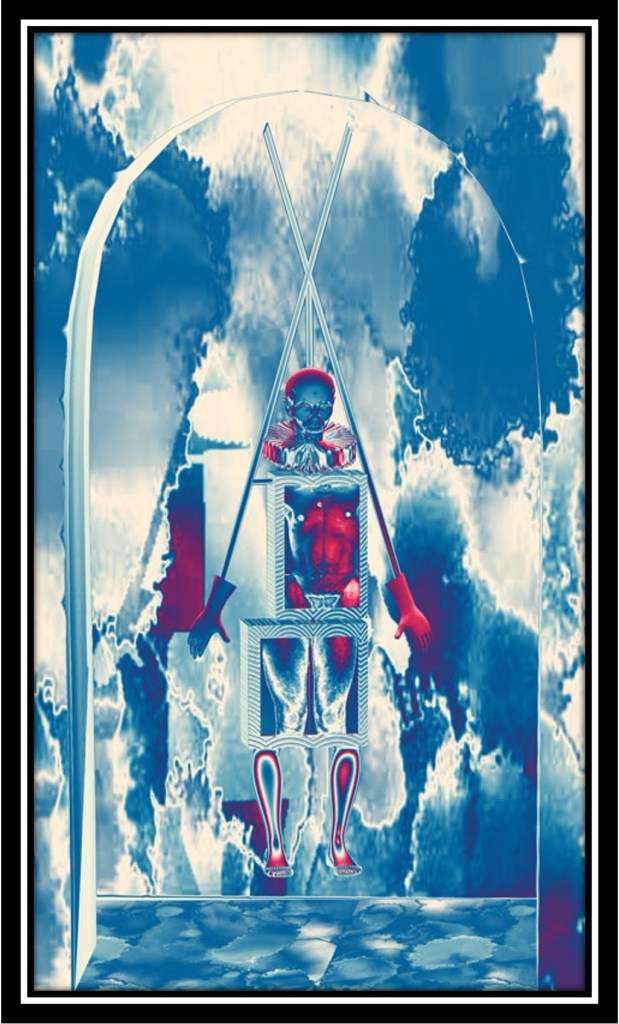
In a world where we often demand certainty and control, we find ourselves fragmented, trapped in boxes of our own making, unable to embrace the fullness of our existence. The image before you captures this tension: a body suspended in a delicate scaffold, exposed yet bound, vulnerable yet distant. The crimson red that pulses through this figure’s radiography mirrors the emotional intensity of our internal conflicts—irrational beliefs, loneliness, and the distortion of our own feelings. Here, we find a body that is both present and absent, much like the self we attempt to control through rigid dogmas, unfounded convictions, or the false security of unquestioned assumptions.
Such beliefs, pervasive in religion, politics, and culture, offer a semblance of control in a world we cannot fully comprehend. Yet, they often bind us more tightly than we realize; they lead us away from self-compassion and deeper understanding. We cling to them as anchors as we seek certainty, but in doing so, we only isolate ourselves further and obscure the possibility of transformation and healing. Just as the body remains whole, though fragmented, so too can we find healing by letting go of the illusions that distort our sense of self.
This image invites you to reflect on the tension between our desires for control and the reality of our emotional vulnerability. Our human condition urges a return to the boy, to ourselves, and to the truth of being—free from the distortions that prevent us from embracing the raw authenticity of life.
Section I
Irrationality
*
Ignorance is an essential condition of our existence, despite our hubristic desire to control knowledge. We are like travelers in a dense fog as we glimpse shadows of trees that seem both near and far—each step reveals something new while obscuring what we thought we understood. This fog invites exploration, not eradication, as its presence reminds us that certainty is an illusion.The moment we attempt to dispel it entirely—to demand certainty and mastery—we reject the depth and richness of uncertainty and trade it for the rigidity of shallow, dogmatic beliefs. To embrace this uncertainty is to accept the vastness of what remains unknown:that which liberates us from the paralysis of false clarity.
Section II
The Transformative Power of Love and Self-Compassion
*
Love has the power to heal wounds unseen, but it is first a seed within oneself. When nurtured, this seed grows into an awareness of the shared fragility of existence—the recognition that no one is immune to suffering. Consider the quiet solidarity in a kind word offered to a stranger, the unspoken bond formed in moments of shared grief, or the simple grace of forgiving someone else’s faults, while knowing your own are equally imperfect. These acts remind us that we are not isolated in our suffering but connected through it. In acknowledging this interconnectedness, we cultivate a compassion that transcends individuality. It allows us to honor the humanity in others as we learn to honor it in ourselves.
Section III
Aloneness Versus Loneliness
*
Think of aloneness as your defining character, a realm where your thoughts and feelings can exist unfiltered, untouched by comparison. Loneliness, however, emerges when this solitude becomes an echo chamber of unmet desires, a distortion that amplifies the absence of external validation into a consuming need. To perceive aloneness as loneliness is to conflate a natural state with an unhealthy yearning, much like mistaking silence for emptiness. Aloneness offers clarity, a space to reflect and grow, while loneliness, though painful, can teach us where we most need to nurture ourselves. By reframing loneliness as a symptom rather than a sentence, we can transform it into an opportunity for self-understanding.
PostScript
*
As I reflect on the journey of these ideas, I’m reminded of a time nearly 16 years ago when I found solace in the writings of Jiddu Krishnamurti, a spiritual teacher my mother had studied in my younger years. His ideas, like Buddhism before it, served as a preamble—a glimpse into a deeper understanding that I did not fully grasp until later in life. It was only in my fifties, after embracing writing as a form of creative expression, that I began to unravel the layers of truth hidden within his words.
During this period, my editor, with whom I shared my growing interest in Krishnamurti, referred to him as a “kook”—a label that seemed to reflect the contradictions inherent in Krishnamurti’s philosophy. My admiration for both Krishnamurti and my editor was marked by an internal conflict. I struggled to reconcile the imperfections I saw in both of them with my own sense of integrity and independence. In time, I came to understand that their imperfections were no different from my own—and that the wisdom I sought was not in their perfection, but in the very acceptance of imperfection itself.
This acceptance allowed me to learn from both of them while retaining my own autonomy, a reminder that growth comes not from flawless certainty, but from the ability to navigate contradiction and complexity. Just as we can find truth in our own imperfect understanding, so too can we extend compassion to others: to acknowledge that their contradictions are part of the shared human experience.
In this journey, I’ve learned that the tension between certainty and uncertainty is not something to resolve but something to live with—a space where self-compassion and wisdom can grow, imperfect though they may be.
Ricardo F Morin Tortolero, January 18, 2025, Oakland Park, Florida.
Editor, Billy Bussell Thompson, February 14, 2025, New York City.