“Acts of Individual Talent”

October 2, 2009
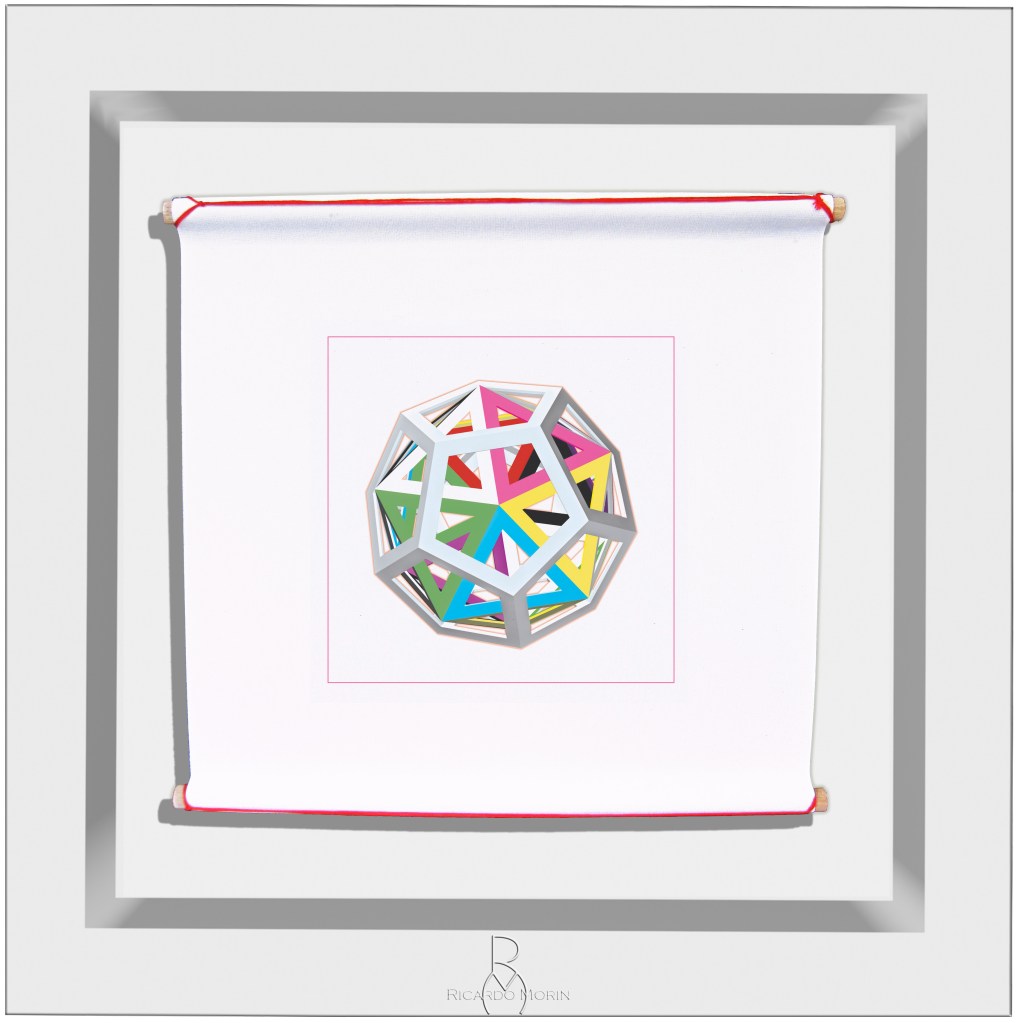
Triangulation Series 225

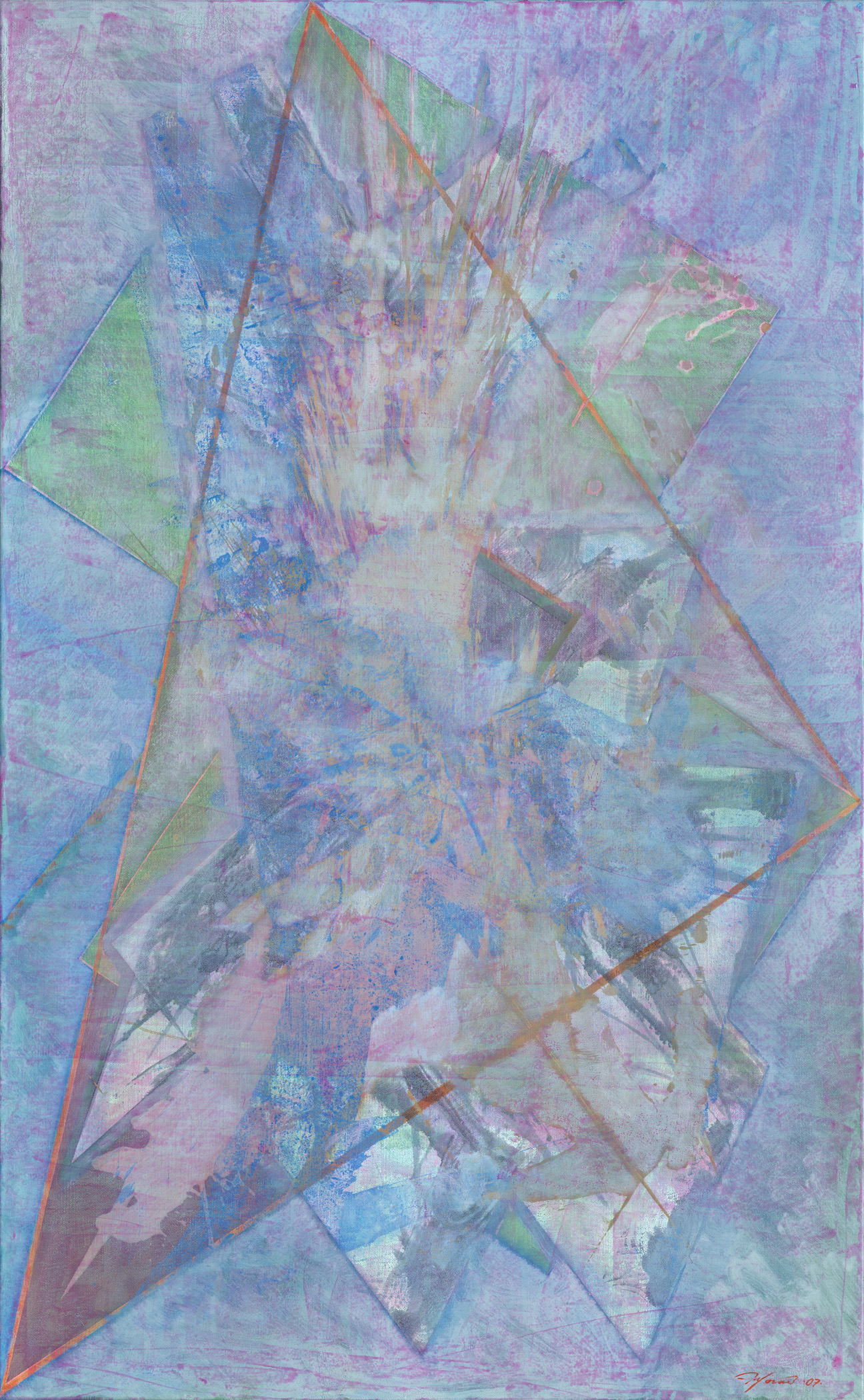
Triangulation Scroll Series Nº 225, 49 x 68 inches; oil on canvas; 2008

Origins of Modern Western Aesthetics

The concept of Aesthetics comes to us out of a wide variety of different traditions: from those of the West, the Chinese, the Japanese, the African, the Polynesian, and so forth. The Western traditions, of course, have different qualities from the others with regards to origins, to evaluative criteria, either in opposing or defending approaches to the making of art.

From its beginnings Western aesthetic theory has developed in parallel with art criticism. The concept, however, of Aesthetics, but not the word, was first talked about by Joseph Addison (1672–1719), in a series of essays in The Spectator in 1712, as a “pleasure that is derived from the imagination.” Thus, pleasure forms the basis that will serve as the foundation of modern aesthetics. Alexander Gottlieb Baumgarten (1714–62) most likely read Addison, and he sought to define Aesthetics as a science of that which is sensed or imagined in his master’s thesis Aesthetica, 2 Vol. (1750-58) at the Royal Prussian University in Halle. He coined the word for the German language; Aesthetics is derived from the New Latin aesthetica (the feminine adjective), and it is related to the Greek aesthetikos/aestheta (perceptible things) and related to the verb aesthetai (to perceive). Immanuel Kant (1724–1804), however, took issue with aesthetics as a science. Nonetheless, the term remained controversial, and it was not until much later in the 19th century when it was finally accepted in academic circles.

Aesthetics is a specific valuation theory, or a distinct convention of what beauty is. It is an individualizing characteristic or a particular taste for, or an approach to, what is of interest to the intellect or pleasing to the senses: both visual or auditory (as in literature, the plastic arts, architecture, and music). By extension, the term Aesthetics may be applied to many varieties of human behavior–toilette, cosmetology, interior design, and so forth.

For the avant-garde Aesthetics and Originality can be at odds with established social or political norms. Aesthetics, as valuation, is normative. Art criticism is the way in which the norms are established. Art criticism is transmitted both to collectors and to institutions (e.g., museums, in the case of the plastic arts and the market place, in the case of music and architecture).

Although art criticism dates from antiquity, analyses of visual aesthetics or the plastic arts began as a journalistic effort. The art critic and the artist became mutually dependent, and what had once been new and refreshing by the closing of the 20th century, became academic, routine, and repetitive. Contemporarily, Harold Bloom (1930–2019) expressed that art criticism had become confused with questions of social justice and politics, and was no longer about the art product itself.

Nothing, however, is really new; the concept of Aesthetics itself, as a means of expression, may be said to be a dominant force dating as far back to the origins of human cave paintings. At the turn of the 21st century, there no longer seems to exist an adherence to one current aesthetic or approach; art criticism now appears to evoke a wide variety of tendencies of the formal, moral, social, and spiritual.

In the following excerpt, “Confessions of an ever emerging visual artist” from a YouTube and WordPress-audio-visual Manifesto entitled “Metaphors of Silence” (2010), I have given my own point of view[1], [2]:

The usage which the visual arts serve is a complex demonstration of varying dimensions whose expression seeks not to explain meaning but to express its intent; to bring about a clearly independent act of interpretation, over which the artist exerts no control as creator. From this, arises the sublimity of the psychological condition that is partly visual delight and partly passion that renews and nourishes a spirit of partnership with the medium. The intent expresses one is what one perceives: i.e., it is a quality of energy and a temperament independent of the intellect, separate from the craft itself, and apart from the residue of the images.

[1] Manifesto: Metaphors of Silence (https://rfmorin.wordpress.com/2010/11/24/metaphors-of-silence/)

[2] Autobiographical Statement: Ricardo Morin – Art – Paintings and Watercolors (http://ricardomorin.com/Statement.html)

Read the rest of this entry »

“Cape Cod 2009”

September 9, 2009

To my beloved

On a bright sunny day with temperatures in the mid-seventies, we rambled along the trails surrounding the delta-like shape of Long Pond.   From there we continued on to the much larger adjoining Mashpee and Wakeby Ponds—first in the morning sun, before lunch, and later in the cooler light of the afternoon after three.   Along the shores, we saw men and women with their pets playing at the water’s edge.

The clearings, unforgettable amid the surrounding forest, were bathed in clean sunlight.   Their green patterns seemed to rival the timid Gothic forms that human hands have built in an effort to imitate nature.

Roots covered in emerald moss rose in steps toward translucent tunnels, leading us through a chance arrangement of natural colonnades and buttresses beneath open canopies.   The fresh, aromatic air revived the errant heart as we walked through gullies and groves, at ease with the rhythm of the soul beside me.


“Platonic Scroll Series 2009”

August 6, 2009

Platonic Series #99, 2009

Platonic Scroll Series #99, 2009

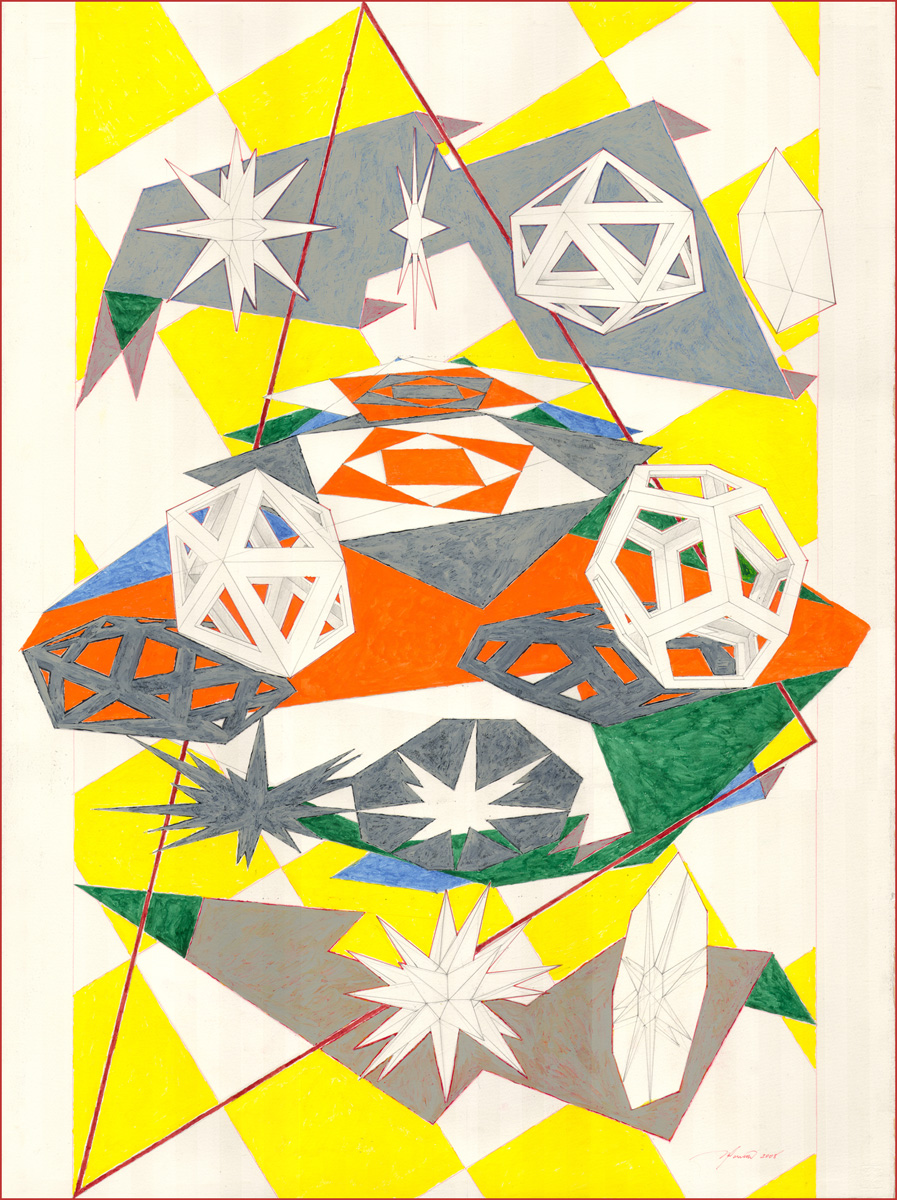
The aesthetic beauty and symmetry of the Platonic Solids have made them a favorite subject of geometers for thousands of years. They are named for the ancient Greek philosopher Plato who theorized that the classical elements were constructed from five regular solids: the dodecahedron, icosahedron, octahedron, hexahedron and tetrahedron–there are no other possible regular polyhedrons. The 92 Johnson Solids are irregular polyhedrons which, as the Platonic Solids, are also made out of triangles, squares and pentagons.

The Platonic Scroll Series serve as analogy to our inter-connectivity and the imponderable quality of harmony that unify us.  It is to be noticed that there is no set manner as to how these manifestations may be perceived by any observer. Our reality is ever so much more interesting than any image representing it or anything that can be explicated.

“A Dialogue On Truth and Beauty”

April 23, 2009

*

CGI 2025

MN> The film My Dinner with Andre was recently canceled in Caracas.

RM> This is coincidentally one of my favorite movies of all times.

MN> There is also  “Wings of Desire” (Der Himmel über Berlin),  one may see them apart but with some connection…

RM> Having a profound impact during the Eighties, I came to own DVD’s for both of these films; you have just reminded me to view them again, like re-reading a good book. These days I seek a better understanding by reading J. Krishnamurti’s innumerable publications [Krishnamurti Foundation of America].

MN> Have you read through Osho Rajneesh? or traditional G.I. Gurdjieff?
There is another movie kind of interesting Meeting with Remarkable Men by Peter Brook…

RM> I understand that in either instance leadership and methodology overshadow search for truth.

MN> That is right but the info is all about the same methods for increasing your consciousness…Sufi and new Indian…Interesting comments found on Powels book Gurdjieff. Also a very interesting approach to the knowledge in Ouspensky’s Fragments of an Unknown Teaching

RM> I am mostly leery of anyone who pretends the attainment of truth through a technique, a method or a system, a belief or a dogma, for in doing so he/she succumbs to divisiveness. As much as I admire Krishnamurti, I don’t follow anyone’s authority: neither Jesus’, nor Muhammad’s, nor Buddha’s and much less any ashram’s or famous guru’s.   I find it useful to recall a quote from J.K. which is very much apropos: “Beauty (truth) is in experiencing, not in experience.  Reality has no resting place.”   The understanding I take is that our collective past does not belong to anyone, though knowledge of it may be useful to establish its limits.

MN>Yes, the path is the one taken by a mind alone; I do share the same perspective about freedom.  I used to say to my friends that I was a man of no land and no heroes.. or maybe not only was I mentally ill but, perhaps, socially disabled.   It is very pleasant to communicate with you.  In rare occasions does one truly have a dialogue.

RM> You meant not inclined to gregariousness, as opposed to socially disabled or unsociable. Though disability in terms of sociability is tantamount to the inability of compassion, I do see you as a most compassionate human being.

MN> Thanks for your kindness.

RM> Be well

MN> And you too my friend.  We’ll talk again soon.

Artist Website

Abstract: Triangulation Series 2006-08

December 8, 2008

Platonic Triangulation, bodycolor on paper, 22 x 30 inches, 2008

Platonic Triangulation, bodycolor on paper, 22 x 30 inches, 2008

I choose the golden ratio 1 = 1618 as a consistent format which is clearly inherent of the infinite, to breakdown a dialogue on the fluidity of the vehicle of painting and its geometry.  At the same time, I establish a triangulation of the bare plane of the canvas which reaffirms its paradoxical nature as an object: where the fictitious flatness of the plane plays in suspension with the illusory spatial depth of forms expressed on it.

Ricardo Morín

http://www.ricardomorin.com

December 13, 2008

Art as a Byproduct of Neocolonialism

December 5, 2008

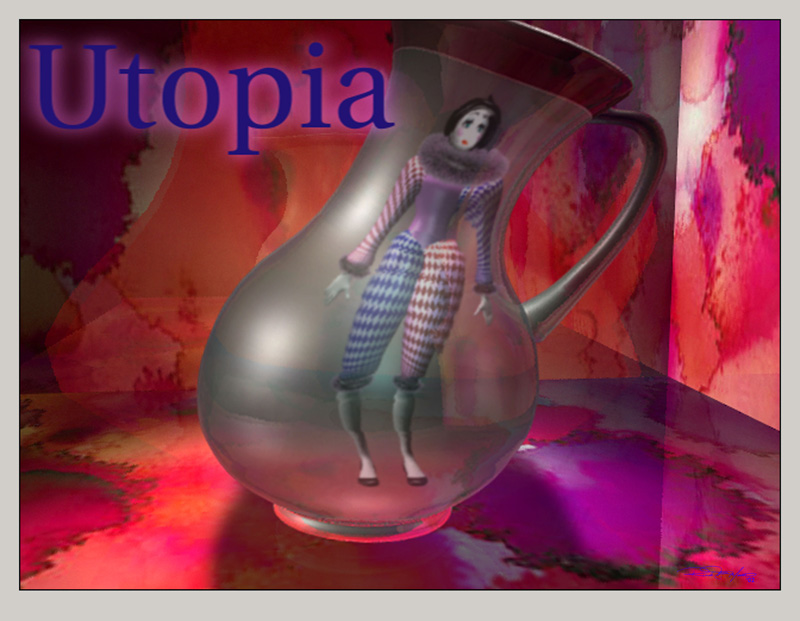
Digital Image created with Maya and Combustion Softwares”]Digital Image created with Maya and Combustion Softwares[/caption]

It’s like a goat tied to a post, who can wander only the length of its tether

Jiddu Krishnamurti, 1986

Anyone who aspires towards a career as a visual artist understands that the constraints for survival are questionable and that destiny often is one of the many factors that determines recognition. One’s mission is not about seeking recognition or even permanence, but about maturing and sharing one’s talent through exploration and inquiry. Congruency with one’s ancestry, identity, and oeuvre is not a matter of commercial interest for any given national identification. These elements  are irreducible aspects of signification, undefined against perspectives concerning conventional pieties–imponderable manifestations of one’s existence: neither up to meeting others’ expectations, nor up to appointed entities and their economic models used as marketing ploys.

Let me begin by addressing the frustration of visual-artists with dual nationalities, who sometimes suffer in the corral of Latin-American fundamentalism. Let me also question why their resulting frustrations are an order of business imposed by contemporary Medicis who seek to buy a parcel of history in the parochial institutionalization taking place inside these artists’ countries of origin. These merchants promote their wares by controlling, by and large, markets located abroad.

Certain philanthropic foundations—I speak especially of the Phelps-Cisneros—sell themselves to museums as influential and often Darwinian laboratories with their claims of heralding innovative programs focusing on Latin American issues and fostering its cultural heritage. The above cited institution takes its leadership from a wealthy socialite, and boasts about its founder, as an amalgamation of bourgeois society and contemporary scholarly erudition. Patricia Phelps de Cisneros, anthropologist amateuse and founder–deeply attached to her own ideas–, sees herself as neoembodiment of the 19-c. bio-geographer, Alexander von Humboldt: a man whom the contemporary Simón Bolívar (the Latin-American revolutionary and freedom fighter) cited as the real discoverer of South America.

Such portrayals, however, never yield balanced visions of pluralism. Only by peeling through layers of hubristic poshness, can one expose the foundation’s wish to create a dialogue about contemporary art with an historic nucleus set in Venezuela. But this desire simply reflects an aberrant fundamentalism; a rigidity whose aims are the preservation of certain regional traditions, which coincide with the institution’s own acquisitions. Undeniably, the preponderance of these cultural investments represents past meaningful movements, i.e., Kinetic, Op, and other neo-geometric derivatives. These movements, needless to say, are complaisantly popular, relatively noncontroversial artifacts among the political élites in Venezuela–from outright dictatorships, to feeble democracies, up to the presently evolving kleptocracy of the Bolivarian State of Hugo Chavez. They define as well the reoccurring themes coming out of this base which have found worldwide exhibitions and critiques. Contemporary art within this context exemplifies, nevertheless, exclusively the demagoguery of the ruling class’ claiming a national identity as stimulating and not one of imposed, antiquated historicism. This marketing ploy impoverishes both spontaneity and the local culture itself!

Succumbing to or courting this scheme is dangerous to artists and leads to alienation. Giving in promotes stagnation arising from these very institutionalized dictates. Such fashions segregate artists into a kind of regionalism and ideology, totally out of flux with the global community. Let me reflect on the raison d’être of any artist or, for that matter, of any human being; it must consist in a universal respect for dignity and freedom that cannot be sold, only shared. Let me underline that philanthropic societies that today yearn for an enforced authority through their wealth and through an enforced false sense of nationality and/or political or religious affiliation(s) are not only out of step with the transformative spirit of our times, but also with the globalized revolution taking placed in our culture, where the despotism of conventional borders and preconceived identities are lacking. This revolution is neither political nor economical; it is occurring within our very being, and it is the result of the change within ourselves of what is really important. We are dispensing with creative communities subjugated to a poisonous market place[1]. We have a new sensitivity and perception that will embrace cultural societies and producers alike. No simple answers arise; but we are growing in responsibility and self knowledge: we move to freedom and away from subjugation.

Ricardo Morín

http://www.ricardomorin.com

(Edited by Billy Bussell Thompson)


[1] The mythomania of stardom by definition examines only the few. Complacency fuels scarcity of resources while alienating 90% of active artists and assigning value to market indices, thus staggering self-sustenance.

Infinity

May 31, 2008

Pillared vision of instinctive passion

Sung by nightingales cradled in daylight

Dread neither consequence nor precedence

For it belongs to eternity.

Reverberating and plangent, masking no longer

A solar plexus in protest to one’s limitations

Cracked, felicitous interpretation to his freedom

Away from the perverse shadows of cynicism,

Doubt no more, a drought of discontent.

Upheaval to communicate what’s most dear

As he rises from turbulence.

What’s most consoling of his inner lament?

Apollo opening Dionisio into the abyss of infinitude,

Bells ceased without tower to cling.

Let me rest on nothing but your caressing whisper,

Mused and detached

Return and departing at once

Carry this song into our universe.

Artist Website

Manifesto 2008

May 7, 2008

Triangulation Series #25-- oil on linen, 60 x 37 inches, 2009

Triangulation Series #25-- oil on linen, 60 x 37 inches, 2009

My work Triangulation Series 2006-08 expands on questions dealing with perspectives synthesizing concepts of pictorial space and infinity:  something I have worked on over the years.  I have allowed painterly abstraction/plasticity to express both in form and content a kind of art that goes beyond a material world of signs; my paintings reach for the infinite—the mystery and the poetry in every man’s individual drama.  I choose the golden ratio 1 = 1618 as a consistent format for nonobjective abstraction which is clearly inherent of infinite congruency [a manifestation common to all known perspective methodologies], to breakdown a dialogue on the fluidity of the vehicle of painting and its geometry.  At the same time, I establish a triangulation of the bare plane of the canvas which reaffirms its paradoxical nature as an object: where the fictitious flatness of the plane plays in suspension with the illusory spatial depth of forms expressed on it.   Though immersed in 20th-century aesthetics, I neither strive for a specific historical movement nor for the postmodernist agenda.  Simply, I look at making art as a “fleshy” product of human experiencing, a resultant of the maker’s own passion.  Just as the idiosyncrasy of an individual, indivisible in nature, is blind to causality, an aesthetic frame embraces all its senses and the image is only the result or residue.

Non-objective, timeless, or even existential—in this sense—the image or Kunstgegenstand proposes not to explain what the meaning of experience is; rather, the image manifests itself, provoking interpretation from the observer.


There are no outside sources nor preconceived notions of the final composition.  Gesturally and intuitively, I use the plane of the canvas as an active platform (in other words, a conversation, so to speak, takes place among the paint, the canvas and me as I apply paint onto the canvas.)  In variegated densities, layer after layer—transparent or textural—the work transforms itself gradually by spectral accruement.  In continuous dialogue, I work on several pieces at the same time so all are able to inform the other.  An inner rhythm from each composition thus unfolds and guides the shifts and the construction of forms: burials, resurrections, exaltations, veilings, reattainments—all thanks to the gritty and sumptuous nature of the medium; a moodiness arises from the interlocutors with its acrid qualities of dissonance and complementary transparency. Indeed, it is color, as texture that establishes the emotional landscape of each piece.  The finished work stands on its own as a concentration of multiple layers; each of the numerous strata is essential to the completeness.  There is a sense of multidirectional movement in each of the works that acts on the viewer’s eye as he/she glances over the delineated shapes and peers through the entanglements of strokes and arabesques.  The viewer comes away, I hope, with the sense of the works’ generative completeness of a universe making and remaking itself.


As I said at the beginning, I embrace in my love of art a sense of universality; I do this not for my own self-fulfillment, but for the cosmic order and interconnectedness in our own awareness of humanity, the unifying mode from all masters.  As such, I am perennially emerging as I wander around in my space of today’s uncertain and leaderless being, where authority is seemingly derived from conflicting, and confusing powers of disbelief.  Freedom has come to us but its ethers and incongruities make us stagger.

Ricardo Morin [1]

Artist Website

December 8, 2008

[1] Edited by Billy Bussell Thompson, Professor Emeritus