Posts Tagged ‘civic ethics’

“The Masquerade of Small Government”

November 27, 2025

*

Ricardo Morín
Silent Quadtych: The Masquerade of Small Government
Each Panel: 22’ x 30”
Watercolor, graphite, gesso, acrylic on paper
2010

Ricardo F. Morín

November, 2025

Oakland Park, Florida

The idea of shrinking government in the United States has recurred across administrations, yet the national deficit persists and the central obligations of public life (Social Security, Medicare, rising healthcare costs, and the long-term fiscal imbalance) remain structurally unresolved.   Initiatives framed as efficiency programs often divert attention from these enduring commitments.   This essay examines the distance between the performance of reform and the realities that persist beneath that performance, and asks what remains concealed when a portrayal of reform is presented as transformation—particularly the corporate interests that benefit when regulatory and oversight functions are reduced.


1

The recent closure of the Department of Government Efficiency (DOGE) reveals more than an administrative shortfall.   The initiative began with the extravagant promise of saving several trillion dollars, yet concluded with an unverifiable claim equivalent to roughly three percent of the federal budget.  The disparity is not a technical miscalculation but a symbolic one.  The disparity exposes a political pattern in which sweeping reform is announced, performance is staged, and the result is a gesture that bears little relation to the scale of the aspiration.   What had appeared to be a disciplined restructuring of government became instead an example of how ambition can detach from feasibility.

2

The language of efficiency has long exerted a nearly irresistible appeal.   That language suggests a vision of governance freed from excess, guided by prudence, and aligned with fiscal virtue.   Yet efficiency functions as a metaphor rather than a principle.   The metaphor conceals assumptions about what government should do, what citizens require, and what modern complexity demands.   One assumption is that public obligations can be met with fewer instruments; another is that smaller institutions inherently serve the public better.   Both assumptions overlook the fact that intricate societies require robust capacity, and that such capacity necessarily entails cost.

3

When such programs collide with the operational realities of administration, their limits become evident.   Federal agencies exist because the responsibilities they discharge cannot be managed by private initiative alone.   These agencies coordinate infrastructure, regulate markets, monitor systemic risks, and mediate conflicts among large and often competing interests.   Attempts to severely curtail these functions rarely yield the projected savings, because the underlying needs do not disappear.   Reformers confront a simple truth:   indispensable functions cannot be eliminated without consequence.

4

What emerges instead is appearance without substance.   The promise of cutting government satisfies a cultural demand for acts that signal restraint, even if the result satisfies little else.   That promise affirms a narrative in which bureaucracy is imagined as the obstacle to national well-being and institutional reduction as the remedy.   Yet an appearance of reform often substitutes for substantive reform.   Procedural actions are elevated to the status of outcomes, and the declaration of change is treated as proof that change has occurred.

5

Behind this representation stands a deeper strategy.   When government is weakened, the scope of public oversight contracts.   Such contraction reallocates authority rather than removing it.   In the absence of robust public institutions, nongovernmental power centers (corporations, high-wealth individuals, and other privately controlled entities operating without electoral accountability) assume a wider sphere of influence, operating with fewer obligations and almost no transparency.   The rhetoric of shrinking the State therefore conceals a different movement entirely:   the expansion of discretion outside the channels of democratic accountability.

6

This expansion is most visible in the consolidation of wealth.   When regulatory and investigative capacities narrow, the constraints on large fortunes diminish.  Concentrated capital extends its reach across industries, infrastructure, data, and information systems.  Efforts to limit the scope of government therefore operate as a shield under which private power accumulates with minimal resistance.   What is framed as the removal of constraints becomes, in practice, the removal of limits on private authority from public scrutiny.

7

Such conditions foster the autocratic temptation.   When wealth operates beyond institutional counterweights, the boundary between influence and authority begins to fade.   Private actors acquire the ability to shape policy, steer public discourse, and redefine norms without democratic mandate.   The critique of ‘big government’ becomes a means of creating conditions in which private actors function as informal sovereigns—powerful, unelected, and increasingly indispensable to the ordinary functioning of civic life.

8

It is no coincidence that this rhetoric often appears in the language of populism.   Appeals to public frustrations convert structural imbalances into cultural grievances.   Bureaucracy is framed as the adversary, even when the real impediment to civic dignity lies in the widening distance between concentrated power and the public interest.   What presents itself as a defense of the people frequently advances interests far removed from those it claims to champion.

9

These dynamics reflect a recurring pattern:   the appeal of concentrated wealth, the weakening of public constraints, and the claim that progress can be invoked without being shared.   The call to shrink government fits within this broader pattern.   That call functions as a contemporary iteration of a familiar strategy in which reformist rhetoric obscures the concentration of advantage.   The pattern endures because its surface language is persuasive while its underlying mechanisms remain concealed.

10

If an effective path forward exists, it does not lie in diminishing institutions but in strengthening the mechanisms through which they remain accountable to a diverse society.   The measure of the State is not its size but its integrity—its ability to respond to complexity without ceding its responsibilities to private authority.  What weakens when institutions are diminished is not efficiency but democracy itself.  Defending the public sphere requires clarifying what is lost when reform devolves into appearance alone, when efficiency becomes a language intended to conceal power rather than distribute it.


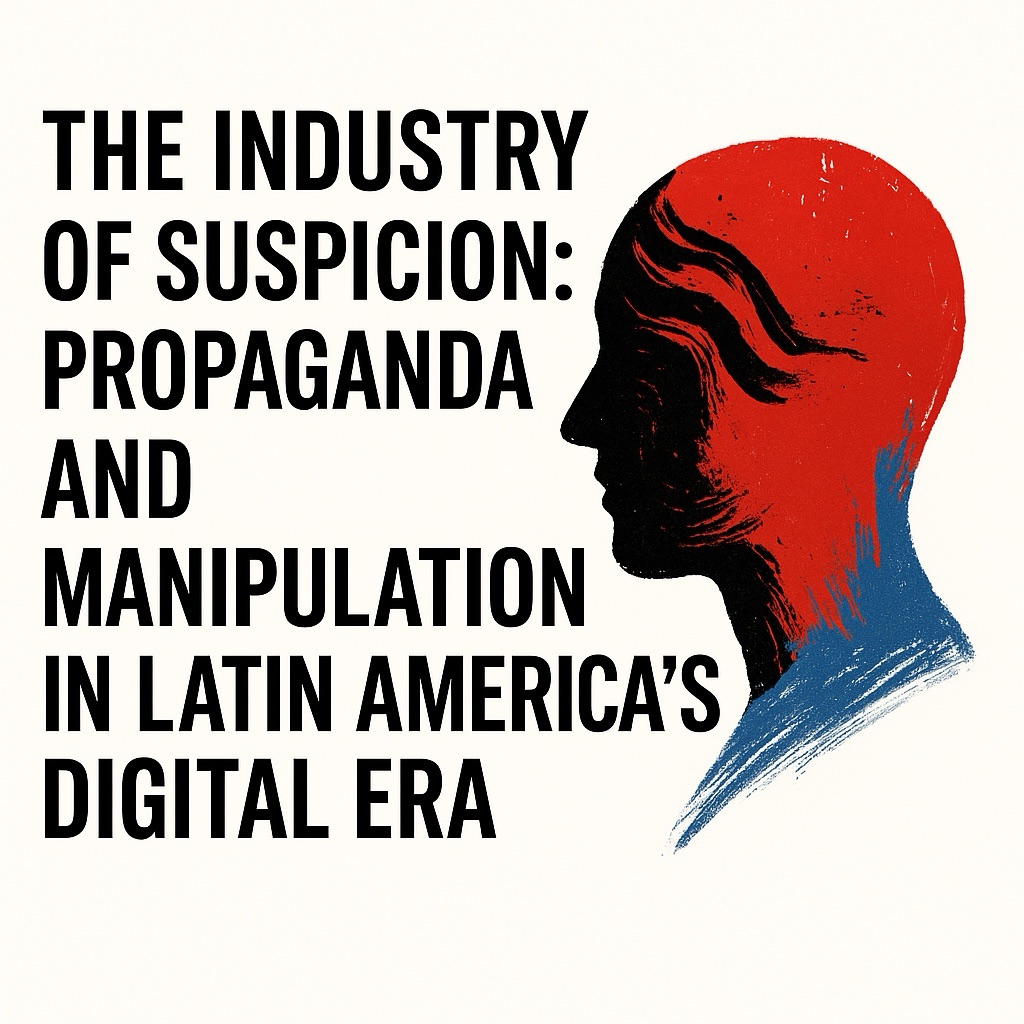
“The Industry of Suspicion: Propaganda and Manipulation of the Digital Era in Latin America”

October 15, 2025


By Ricardo F. Morín

Oct. 14, 2025

In the post-truth landscape of Latin American media, where outrage has become currency, few figures illustrate the fusion of ideology and marketing as clearly as Inna Afinogenova.    She has become the most recognizable voice of authoritarian suspicion in the Spanish-speaking sphere.    From platforms such as Canal Red Latinoamérica, her discourse forms part of a vast network of disinformation spreading across the region, cloaked in the rhetoric of critical thinking and popular emancipation.    These networks—spanning Moscow, Tehran, Beijing, and several Latin American governments—follow a single script: to dismantle trust in liberal democracy, to weaken institutions, and to turn permanent doubt into a substitute for conscience.    In the name of informational sovereignty, they replace debate with discredit, analysis with suspicion, and truth with narrative.    Their power lies not in blatant falsehoods but in the emotional manipulation that transforms confusion into conviction.    Within this context, Afinogenova stands not as an isolated commentator but as the emblem of a sophisticated propaganda apparatus—one that disguises obedience to twenty-first-century autocracies beneath the costume of dissent.

Inna Afinogenova, born in Dagestan in 1989, is a Russian journalist who worked as deputy director of RT en Español until May 2022.    She resigned citing her disagreement with the war in Ukraine and the imposition of a state-sanctioned narrative of aggression.    Since then, she has collaborated with geopolitical and Latin American media such as La Base, produced by the Spanish newspaper Público, and participates in Canal Red, an audiovisual project led by Pablo Iglesias (former vice-president of Spain and founder of the left-wing party Podemos, now active in political media).    There she directs and hosts programs like CaféInna and contributes to political analysis, particularly on Latin America.    Her audience is broad and her reach on digital platforms considerable, which makes her an influential figure in the political and informational debates of the Spanish-speaking world.

Her trajectory, however, has not escaped controversy.    During her tenure at RT en Español, she was one of the network’s most visible faces in Latin America, amplifying narratives that portrayed Western powers as inherently deceitful and predatory.    An opinion column in The Washington Post described her as “the Spanish voice of Russian propaganda,” citing her recurring defense of positions favorable to the Kremlin.    In December 2021, two months before the invasion of Ukraine, she used her program Ahí les va to mock Western intelligence warnings of an imminent attack and predicted that “January will come, then February, and still no invasion,” implying that the media hysteria served the interests of NATO.    Such episodes, though later overtaken by events, exemplify her rhetorical method:    to transform skepticism into disbelief and disbelief into persuasion.

Following her departure from RT, Afinogenova has continued to operate in media circles ideologically aligned with the Latin American left, reinforcing a discourse that equates the Western press with manipulation and imperialism.    Outlets such as Expediente Público have noted her role in shaping narratives within partisan campaigns, often echoing state-sponsored or geopolitically motivated lines from Russia, China, or Iran.    Through Canal Red and Diario Red, both associated with Pablo Iglesias, she participates in content ecosystems that frequently recycle material from international broadcasters like CGTN.    In countries such as Honduras, she has been accused of contributing to media strategies that favor left-wing candidates under the guise of “sovereign communication.”   While the evidence does not show a direct chain of command linking her to a specific regime, the pattern of thematic consistency reveals a coherent ideological alignment rather than independent journalism.

This alignment has provoked renewed debate since the release of her recent video, “¿Premio Nobel de la Paz… o de la Guerra?”, where she presents the Nobel Peace Prize awarded to María Corina Machado as a maneuver of geopolitical design rather than a moral recognition.    The video does not examine facts so much as it interprets intentions, suggesting that the award serves Western influence instead of honoring civic courage.   The argument, though rhetorically effective, confuses correlation with causality.    It is possible to acknowledge the imperfections of international institutions without denying the ethical weight of public bravery.   The Nobel Prize, like every human institution, reflects judgments; but in this case, it distinguishes a life of civic risk undertaken without weapons, privileges, or access to the coercive power of the State.

Questioning motives is legitimate; insinuating conspiracies without evidence is not.   Every critical voice bears responsibility, for truth demands proportion, not projection.   The struggle of María Corina Machado cannot be reduced to the rhetoric of “Western intervention” or dismissed as “fabricated dissent.”   It belongs to the conscience of a people seeking self-determination through legitimate means after decades of dispossession.    Respecting pluralism requires granting others the same intellectual good faith one demands for oneself.   Debate ennobles democracy only when grounded in verifiable facts and moral clarity, not when suspicion itself becomes the argument.    Between necessary skepticism and systematic suspicion lies a moral frontier:    crossing it is to pass from thinking freely to serving without knowing it.


“The Constitution Within”

August 10, 2025

*

Ricardo Morin
The Constitution Within
GCI
2025

*

Politics (from the Greek politikós, “of, by, or relating to citizens”) is the practice and theory of influencing people at the civic or individual level.

*

By Ricardo Morin

August 10, 2025.

~

From their earliest formulations, constitutional frameworks have been more than foundational legal agreements; they have stood as declarations of political philosophy, and defined how power should be organized, how it should be restrained, and to whom it must be answerable. Contemporary governance, to a large extent, continues those experiments, shaped over centuries of trial and adaptation. Yet these forms can endure in appearance while being emptied of substance. In more than a few States today, constitutions proclaim liberty while they narrow its scope, define rights in ways that exclude, and preserve the interests of a governing elite. Partisanship exploits the perceived limitations and vulnerabilities of others as grounds for exclusion; self-righteousness becomes a tool for domination, silences opposition, and suppresses dissent. The worth of a constitutional framework, therefore, is measured not only by its letter but by the ethical integrity of those who sustain it. Without ethics, politics loses its meaning; without civic virtue, the law ceases to serve peace and becomes an instrument of dominion.

The separation of powers, vigorously defended by Montesquieu, rests on the conviction that liberty survives when power is compelled to check power. This principle is distorted when institutions are subordinated to partisan or personal interests. In recent years, several States have formally preserved an independent judiciary while, in practice, subjected it to appointment processes controlled by the Executive or the ruling party. Such hollowing-out is not merely a technical failure; it reflects a political culture in which ambition, fear, or indifference among citizens permits the disfigurement of the very mechanisms designed to protect them. It also reveals how institutional strength and civic responsibility are bound together in ways that cannot be separated.

Historical constitutions continue to shape how political communities imagine authority. They bequeath principles that, at their best, offer adaptable frameworks for meeting new challenges without renouncing their essential core: that the legitimacy of a Government rests not on the strength of its rulers but on the solidity of the structures that limit them.

Yet these structures endure only when citizens reject duplicity and sectarianism. Divisions of ideology must not harden into exclusive loyalty to one’s own group at the expense of a shared civic framework. They endure only when citizens resist the idolatry of power, because authority loses its legitimacy once it is treated as sacred or unquestionable. And they endure only when citizens repudiate the cult of personality, in which a leader is raised above criticism through image-making, propaganda, and personal loyalty.

The durability of constitutional order, then, does not lie solely in written texts or institutional arrangements. It rests equally on the civic ethic of those who inhabit them. When ambition, fear, or indifference allow citizens to tolerate duplicity or surrender to sectarian loyalty, the limits on power become fragile. Conversely, when vigilance and responsibility prevail, constitutions retain their strength as both shield and compass—guarding against arbitrary rule while orienting political life toward justice and restraint.

True reform is not solely institutional but also internal: a revolution in the individual and collective sphere, in which each person accepts the responsibility to act with integrity, openness, and commitment to the common good, in harmony with oneself and with others. Only through the alignment of institutional structures with civic responsibility can any Constitution preserve its meaning and endure as a safeguard against arbitrary power.

*


Annotated Bibliography

~

  • Ginsburg, Tom, and Aziz Z. Huq.; How to Save a Constitutional Democracy. Chicago: University of Chicago Press, 2019. (Ginsburg and Aziz examine the legal and institutional pathways through which democracies weaken, from court-packing to the erosion of independent oversight. They draw on comparative examples from the United States, Hungary, and elsewhere to show how constitutional mechanisms can be used to consolidate power while preserving a façade of legality.)
  • Landau, David: “Abusive Constitutionalism.” UC Davis Law Review 47 (1), 2013: 189–260. (Landau develops the concept of “abusive constitutionalism” to describe how incumbents exploit constitutional change to entrench their rule. Uses Latin American and other global cases to illustrate how amendments and reinterpretations weaken checks and balances, alter electoral systems, and undermine judicial independence.)
  • Levitsky, Steven, and Way, Lucan A.: Competitive Authoritarianism: Hybrid Regimes after the Cold War. Cambridge: Cambridge University Press, 2010. (Levitsky and Way analyze regimes that preserve the formal institutions of democracy but manipulate them to ensure ruling-party dominance. They introduce the concept of “competitive authoritarianism” as a framework for understanding how constitutional norms are hollowed out while democratic forms are maintained.)
  • Levitsky, Steven, and Ziblatt, Daniel: How Democracies Die. New York: Crown, 2018. (Levitsky and Ziblatt argue that modern democracies often decline through the gradual decline of norms rather than coups. The book shows how leaders exploit constitutional ambiguities, stack courts, and weaponize law to suppress opposition, eroding both civic trust and institutional integrity.)

~