*
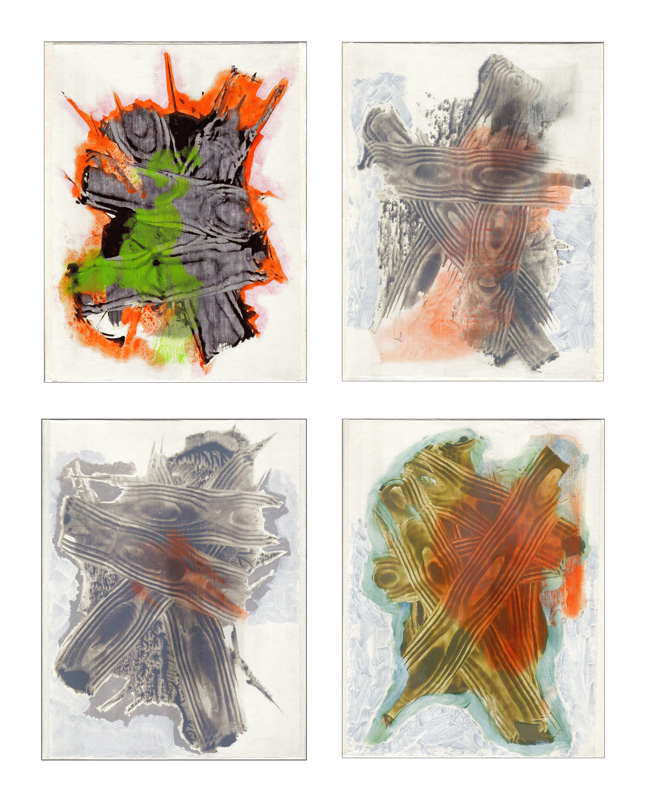
Teratological Topographies Series One: CIVIC AGENCY
Oil On Linen
Quadtych: Each panel: 14 by 18 by 3/4 inches
2009
Ricardo F. Morín
November, 2025
Oakland Park, Florida
Billy Bussell Thompson, Editor, NY, NY
*
AUTHOR’S NOTE
This essay examines conditions frequently distorted by ideology, moral inheritance, or historical narrative. Questions of sovereignty, occupation, revolution, exile, and national identity are often debated through claims that appeal to absolutes—religious entitlement, historical grievance, or revolutionary legitimacy. These claims differ in language but share the same structure: they place a single idea over civic realities of people whose lives are structured by such narratives.
To address what is obscured by these narratives, the essay turns to a structural factor that cuts across these differences: civic agency, understood as the capacity of people to shape the conditions of civic life through their participation, representation, and lawful processes. When civic agency is removed—whether through external control, internal authoritarianism, or deterrence directed at displaced populations; the form of the constraint may change, but the civic effect remains constant.
This essay does not compare political histories. It examines how State power, in its various configurations, regulates civic life. It considers how ideology obscures this regulation and how populations experience the consequences of decisions in which they have little or no role. The goal is not to reduce political conflict but to call attention to the structures that determine whether freedom is possible or remains beyond reach.
ABSTRACT
This essay will argue that the most reliable way to understand situations that appear politically incompatible—such as Palestinian statelessness and Cuban authoritarian sovereignty—is to examine the structural absence of the civic agency that defines both. Although the forms of constraint differ, the civic condition comes together: the State, whether external or internal, restricts the capacity of the population to shape its own civic life. By analyzing how State regulation limits participation, suppresses representation, or fragments jurisdiction, this essay will show how civic agency becomes the central measure of freedom. It will further examine how ideological narratives, policies of deterrence, and migratory pressures hide this structural reality. The aim is not to adjudicate political claims but to bring to light the conditions under which civic life can be formed, protected, or denied.
1
Every attempt to understand political life must begin with the recognition that populations do not experience freedom as an abstraction; they experience it through the structures regulating their civic existence. These structures determine how decisions are made, how authority is exercised, and whether or not people can participate in shaping the conditions for their own lives. Civic agency is therefore not an ideal but a condition that either exists or not. When it is absent, freedom appears as a formal claim rather than a lived condition.
2
Civic agency consists of three components: participation, representation, and lawful process. Participation allows individuals and communities to influence public decisions. Representation provides continuity between the governed and the governing body. Lawful processes ensure that authority is exercised within defined limits. When any of these components is removed, the people lose their capacity to shape the civic environment they inhabit. This loss may occur by external regulation, internal authoritarianism, or policies reducing civic life to a set of restrictions that diminishes a shared domain.
3
The absence of civic agency can take different forms. A population may be governed by institutions that do not recognize the communities’ sovereignty and thus leave civic agency subject to regulations that the people have no significant role in its shaping. Alternatively, a people may inhabit a sovereign State that suppresses political pluralism, restricts lawful dissent, and monopolizes institutional authority. In both cases, the civic condition is suppressed: the people are without the ability to influence the rules that govern them.
4
The Palestinian case illustrates the first form. Multiple authorities regulate movement, territory, and public life without providing unified jurisdiction or sovereign protection. Decisions made by external States define daily existence and leave the population without consistent civic rights or a stable institutional framework. The absence of sovereignty is not only territorial but civic; this absence takes away the mechanisms by which participation and representation are possible.
5
The situation with Cuba represents the second form. Although the State possesses sovereignty, it concentrates political authority within a single institutional apparatus and restricts lawful avenues for dissent, competition, or structural reform. Citizens live under a system that maintains political continuity by restricting avenues for participation. Sovereignty prevails; civic agency is limited.
6
Palestine and Cuba differ, of course, in history, structure, and origin; yet they align in one respect: the State, whether external or internal, restricts participation in ways that make civic agency unattainable. The absence of agency is the common element that marks the civic condition beneath political narratives. This absence also provides a framework through which populations that experience different forms of constraint are to be understood without conflation.
7
Ideological narratives frequently align with existing distributions of power. Religious entitlement asserts that land is secured by divine mandate rather than civic protection. Revolutionary rhetoric proclaims that political authority is justified by historical struggle rather than accountability. Both forms of narrative elevate an absolute over the civic realities of the population. They replace agency with allegiance, and they interpret restriction as necessity, and not as a failure of representation.
8
Migration provides a third lens through which the limits of civic agency become visible. People leave their countries when the structures regulating their lives collapse or become uninhabitable. They seek stability, protection, and the ability to rebuild civic participation in new surroundings. Yet policies of deterrence in host States often mirror the pressures that displaced them. The new States restrict the migrants’ movements, their access to social institutions, and narrow the possibilities of belonging to a civic order. These policies do not reproduce the original dilemma, but host States reintroduce the experience of living under rules that they cannot influence.
9
For many asylum seekers, these restrictive measures narrow the distance between the pressures that forced their departure and the pressures they encounter upon their arrival, a shift that makes stability hard to distinguish from exclusion. European examples such as Denmark and the United Kingdom reveal how deterrence is used to discourage asylum without acknowledging the civic vacancy it creates. The United States employs similar policies at its borders and presents deterrence as an instrument of order, which leaves migrants suspended between exclusion and unresolved civic status.
10
The structural argument is not that these situations are equivalent, but that the absence of civic agency creates a civic condition transcending political differences. Populations ruled without participation, governed without representation, or confined within systems that restrict lawful processes experience freedom as external to their civic environment. This condition cannot be explained by ideology because ideology addresses identity, justification, or legitimacy—not agency.
11
Understanding civic agency clarifies the difference between political claims and civic realities. Sovereignty does not guarantee freedom; revolution does not guarantee participation; religious entitlement does not guarantee protection. Civic agency exists only when people can shape the conditions that guide them. When this becomes impossible, the people do not inhabit a civic order but a regulated space.
12
When civic agency becomes the measure through which political life is understood, ideological narratives lose their authority, and the structure of constraint becomes visible. This visibility does not resolve conflict but reveals the conditions under which freedom can either emerge or remain unapproachable. Civic agency is where the possibility of civic life begins and where its absence becomes structurally apparent.
 Observations On Perception