*
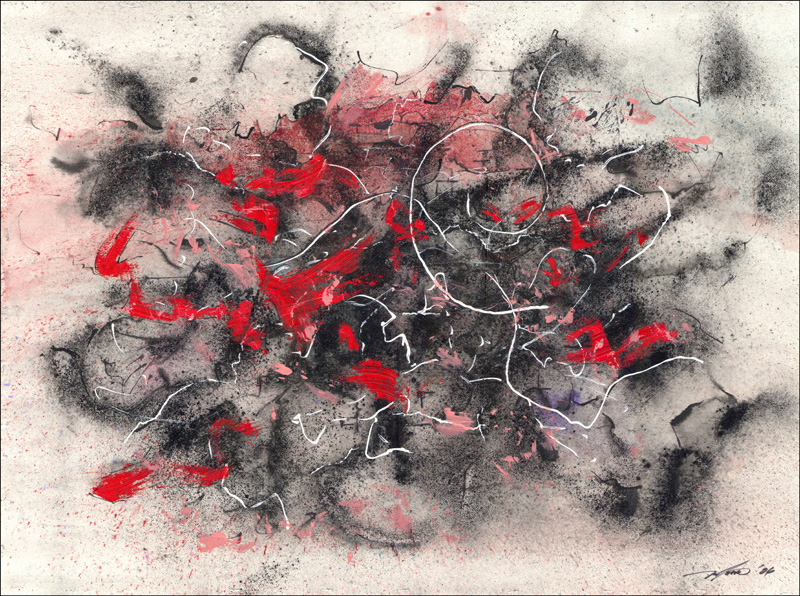
22″ x 30″
Watercolors, charcoal, oil, white-out and ink on paper
2006
There exists a threshold beyond which suffering ceases to be endurance and becomes something else—something raw, incommunicable. It is not simply a matter of pain, nor even of despair, but of a silent depletion where the self finds itself at the precipice of its own dissolution. Yet, how does one define this limit?
It is tempting to believe suffering has purpose, that it can be transmuted into wisdom or resilience. This belief sustains us through its early stages. We endure in the name of meaning, in the hope that suffering refines rather than annihilates. But there comes a point where suffering becomes a force unto itself, severed from justification. It no longer instructs, no longer dignifies—only persists.
The problem of suffering is not only how much one can bear, but how much one should reveal. Silence often protects both the sufferer and the witness. There are pains too intimate, too profound to translate into language without reducing them to spectacle. To expose suffering in its entirety risks transforming it into something unrecognizable, stripping it of the dignity that private endurance affords. Yet, concealment can create its own form of exile, a loneliness where pain festers unseen.
Some attempt to navigate this tension by offering fragments—enough to acknowledge suffering’s presence without inviting intrusion. Others say nothing at all. This is not cowardice but a final assertion of control, a refusal to be defined by pain. To impose the expectation of disclosure upon those who suffer is to misunderstand the nature of their burden. The gravity of suffering is not only in the experience itself but in the impossible task of making it understood.
We live under the illusion that the mind and body will hold, that endurance is limitless. But suffering reminds us otherwise. There is a breaking point, whether visible or silent, sudden or drawn out.
It is not the same for everyone. Some withstand more than others—not through superior strength, but through a different alchemy of circumstance, temperament, and sheer chance. What remains constant is that all thresholds, eventually, are met. There is no single way to live with suffering. Sometimes, what brings relief is not endurance, but the quiet act of self-recognition. To speak, when one can. To remain silent, when one must. In the space between what cannot be said and what must be accepted, a simple truth may emerge: even uncertainty can sustain us, if we meet it with honesty.
And when that release is impossible, when suffering stretches beyond its own limits, only the silent acknowledgment of its presence remains—a weight that, sooner or later, must either be laid down or consume what is left.
Ricardo Federico Morín Tortolero
March 16, 20025; Oakland Park, Florida
 Observations On Perception