*
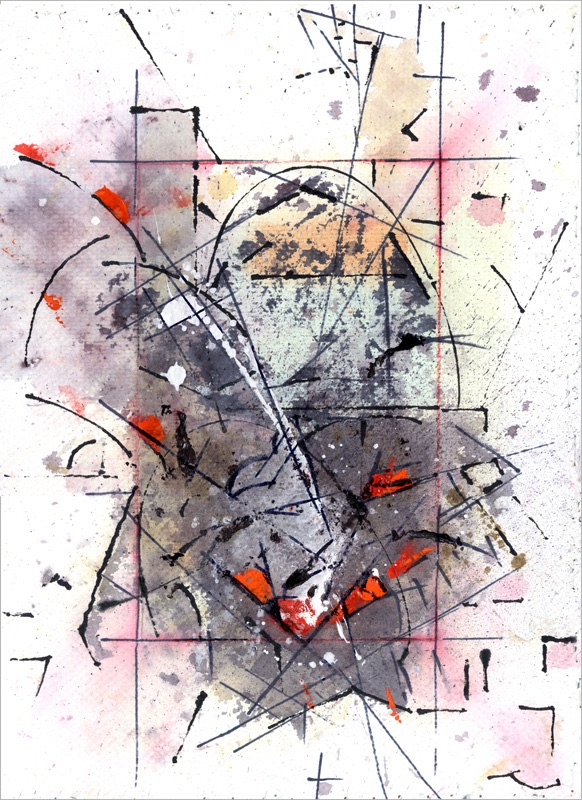
Window I
8” x 10”
Watercolor and ink on paper
2003
Ricardo F. Morín
February 18, 2026
Oakland Park, Fl
1
Most people first recognize vulnerability not through abstract reflection but when ordinary functions change. Sleep becomes fragmented. Movement requires calculation. Attention shifts toward signals that once remained unnoticed. Human life begins not from stability but from exposure. The body exists within conditions it does not fully control and must continuously adapt to forces that exceed intention. Vulnerability is not an exception. It is a structural condition of being alive. Wellbeing does not remove this condition. It reorganizes how one lives within it.
2
Attempts to explain healing often rely on simplified narratives of control, positivity, or emotional purification. Such narratives overlook the complexity through which biological systems regulate themselves. Hormones, neural pathways, immune responses, and behavioral patterns operate through feedback rather than command. The organism adjusts through interaction, not through absolute mastery. Understanding this distinction allows healing to be viewed less as conquest over illness and more as participation in an ongoing process of regulation.
3
Mental practices such as meditation, visualization, or structured breathing may influence physiological states. Their value lies not in eliminating difficulty but in altering how perception interacts with bodily response. Attention can change tension, breathing patterns can modify autonomic responses, and emotional framing can influence how stress signals are interpreted. These practices do not replace biological realities. They operate within existing physiological processes.
4
Many discussions of emotional life rely on familiar language about resentment or anger without examining how such patterns function in practice. Emotional fixation narrows perception because it reduces the range of possible interpretations available to the mind. When attention becomes rigid, the body often reflects that rigidity through muscular contraction, altered breathing, or disrupted sleep. Recognizing this does not deny legitimate grievances. It clarifies how sustained cognitive patterns shape physiological experience. What appears biologically as regulation appears conceptually as participation.
5
Healing must also acknowledge limits. Not all illness can be traced to emotional origin, and not all suffering yields explanation. Biological variability, environmental exposure, and genetic inheritance create outcomes that cannot be reduced to intention or belief. Humility recognizes that the absence of explanation neither invalidates the search for meaning nor guarantees it.
6
Contemporary medical technology introduces a further dimension into this landscape. Adaptive systems capable of measuring neural activity and adjusting stimulation in real time demonstrate that regulation is inherently dynamic. The nervous system functions through continuous feedback loops. Closed loop neuromodulation technologies reveal this principle by making adjustment visible and measurable. Rather than blocking pain entirely, such systems alter how signals are transmitted and interpreted, and allow the body to reorganize patterns that have become fixed through chronic strain.
7
Technology in this context does not replace the organism. It participates alongside it. The device measures electrical responses, modifies stimulation within clinical parameters, and supports gradual adaptation rather than immediate elimination of discomfort. This reflects a shift in how regulation is understood. Healing increasingly involves collaboration between biological systems and external adaptive tools. The boundary between internal regulation and technological assistance becomes relational rather than oppositional.
8
Because of this shift, improvement may appear indirectly. Functional changes such as more consistent sleep, increased movement, or reduced hesitation in daily tasks often emerge before subjective perception of pain changes significantly. The nervous system learns through repetition across time rather than through instant resolution. Observing patterns over days or weeks becomes more meaningful than evaluating isolated moments.
9
The language of self healing therefore requires revision. Healing does not imply independence from vulnerability. It involves learning to inhabit vulnerability with greater precision, supported by practices, relationships, and technologies that expand the range of possible responses. Faith, meditation, medical science, and personal discipline may each contribute, not as competing explanations but as complementary modes of engagement with the unknown.
10
Experience itself does not provide ultimate meaning. Meaning arises from how experience is integrated into awareness. When experience is treated as proof of certainty, rigidity follows. When experience is held as information rather than identity, adaptation remains possible. The aim is not to silence the mind or eliminate difficulty, but to allow perception to remain flexible enough to respond to change.
11
Healing, then, is neither purely psychological nor purely technological. It is the ongoing negotiation between organism and environment, perception and physiology, vulnerability and adaptation. Modern tools may refine this negotiation by providing new forms of feedback, yet the underlying condition remains unchanged. Human beings continue to live within limits while developing new ways to respond to them. The task is not to escape vulnerability but to regulate within it.
 Observations On Perception