*
… The Persistence of Francoist Nostalgia and the Discomfort Beneath It”
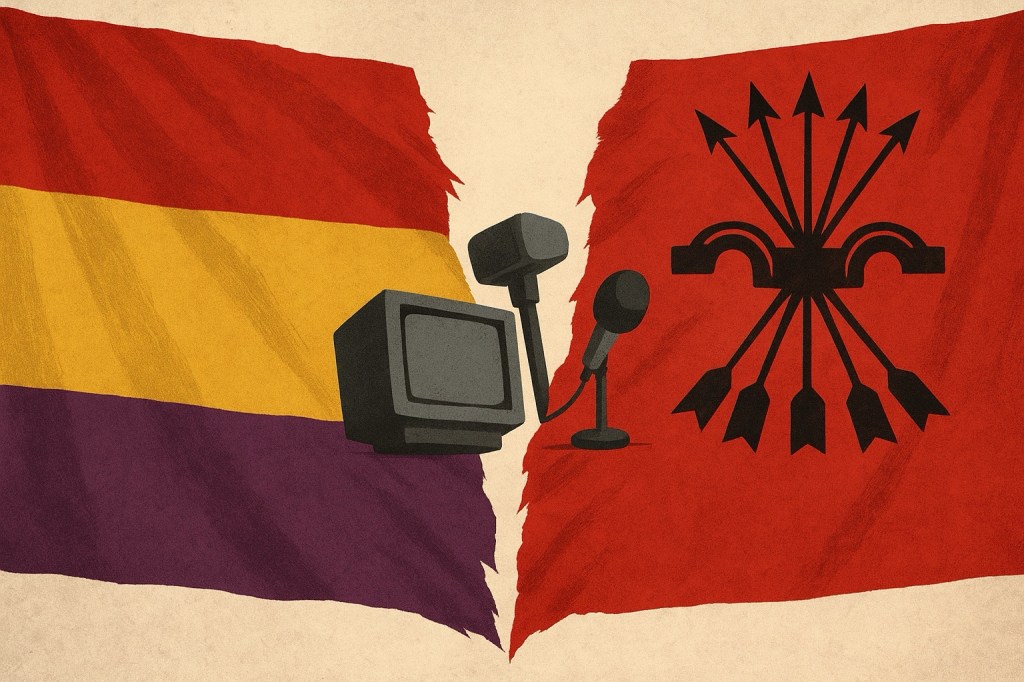
Half Republican, Half Falangist
CGI
2005
By Ricardo Morin
August 1, 2025
One cannot assess the Spanish political climate without acknowledging the rise of VOX, a far-right party founded in 2013 by former members of the conservative Partido Popular. Since 2018, VOX has gained traction by opposing regional autonomy, feminist legislation, and immigration, while defending a nationalist agenda that includes the revision—or outright rejection—of Spain’s historical reckoning with Francoism.
It is the symptom of a deeper democratic disillusionment. What resurfaces is not spontaneous historical memory, but a political and cultural framework that reasserts itself when the social agreements binding the present begin to fray. VOX’s references to the Franco regime are rarely doctrinaire or explicit, but they are unmistakable in the party’s rejection of the Democratic Memory Law, its exaltation of national unity as a sacred and untouchable principle, its condemnation of the autonomous state model, and its appeal to a so-called “natural order” that treats hierarchy, the traditional family, and social inequality as if they were objective facts of history.
What is most concerning is not that voices like these exist—they always have—but that they have regained institutional power and cultural legitimacy. Dissatisfaction with the political system, fatigue with ineffective parliamentary politics, and a growing sense of identity displacement feed into a shared national unease. This unease can be felt across a wide spectrum: small business owners who perceive the state as hostile, or young people who find no meaning in a hollow, bureaucratized political language. The grievances vary, but the far right offers a single channel: the emotional simplification of conflict—transforming fear into obedience, and uncertainty into wounded pride.
Within this framework, VOX presents itself as the only political actor with a unified narrative. Its strength does not lie in public policy, but in assertion. It offers no coherent platform of governance, but instead proposes a reactive, exclusionary identity. And here the progressive response often falters. While the institutional left—represented by the PSOE and remnants of Unidas Podemos—relies on rhetorical frames worn down by official discourse, segments of the academic and cultural intelligentsia (particularly university-affiliated think tanks and subsidized editorial circuits) have retreated into a ritualized defense of democracy, without reassessing its principles or renewing the language through which it is explained. Repeating just causes through exhausted formulas turns even the noblest ideas into noise.
Worse still, in the name of pluralism—or out of fear of being labeled sectarian—certain cultural institutions (El País, publishing houses like Taurus, or high-profile forums such as the Círculo de Bellas Artes) have offered platforms to reactionary voices under the pretext of open debate. In doing so, they have helped normalize a discourse that steadily unravels the ethical agreements underpinning democratic life. What is framed as tolerance may, in fact, be a form of structural surrender.
Spain’s history is burdened with wounds that were never fully closed. The political pacts of the Transition, born of necessity, opted for shared silence as the price of institutional stability. That silence allowed for peace, but left the past unresolved. Today, as new efforts—like the Democratic Memory Law—begin to reshape that narrative, fear returns: fear that to acknowledge historical violence might destabilize the present. VOX exploits this fear not with policy, but with symbolic refuge—offering a home to a version of Spain that feels lost.
The responsibility of the intellectual class is not to reassert inherited certainties or rehearse moral slogans. It is to sustain complexity: to resist the lure of simplification, to acknowledge the fatigue of progressive frameworks without falling into cynicism, and to offer new ways of thinking that preserve both rigor and empathy. Because while reactionary discourse gains ground through simplification, critical thought must hold its ground in nuance—even if nuance isn’t viral, even if it doesn’t win applause.
*
Annotated Bibliography
Preston, Paul: The Spanish Holocaust: Inquisition and Extermination in Twentieth-Century Spain. New York: W.W. Norton, 2012. (A comprehensive history of political and ideological violence during and after the Spanish Civil War, this work provides essential background for understanding the roots and continued appeal of Francoist narratives in Spain.)
Snyder, Timothy: On Tyranny: Twenty Lessons from the Twentieth Century. New York: Tim Duggan Books, 2017. (This compact, cautionary text distills key lessons from the collapse of democracies in 20th-century Europe and offers reflections that resonate strongly with contemporary authoritarian rhetoric.)
Stanley, Jason: How Fascism Works: The Politics of Us and Them. New York: Random House, 2018. (An incisive study of fascist techniques and psychological mechanisms, this book helps explain how divisive identity politics and historical denial function in modern ultranationalist movements.)
*
 Observations On Perception