Ricardo F. Morín
Dec. 2025
Oakland Park, Florida
Billy Bussell Thompson, Editor
Author’s Note
This text is not an argument for or against a political figure, nor an exercise in moral adjudication. It is a diagnostic portrait grounded in publicly documented actions, observable conduct, and historically verifiable record. Where legal distinctions matter, they are observed; where perception diverges from motive, that divergence is examined rather than dismissed.
The purpose of the portrait is not to negate the experiences of those who perceive sincerity or warmth in the subject, but to place such perceptions within a broader structure of behavior over time. Momentary affect (Affeck), private demeanor, and selective encounters are not treated here as evidence of character continuity, but as elements that coexist—sometimes uneasily—with patterns that have had public consequence.
This approach also governs how claims about exceptional capacity are handled. Assertions that substitute myth for evidence—such as declarations of near-superhuman intelligence—are not taken at face value. Whatever one makes of erratic reasoning, procedural confusion, or repeated misapprehension of legal and institutional constraints, such claims require the suspension of observable reality. In this sense, they function less as description than as compensation: they are attempts to reconcile dissonance with an image of mastery. When coherence falters, recourse shifts elsewhere. Validation through untruth does not illuminate capacity; it neutralizes contradiction.
No medical, psychological, or pathological claims are advanced. The analysis remains strictly within the realm of conduct, posture, and recurrence. Interpretation is offered where warranted; restraint is exercised where fact alone must suffice.
Readers inclined toward affirmation or rejection are invited to suspend both impulses. The text asks only that actions be considered in sequence, and that patterns be examined without haste. Agreement is not presumed; careful reading is.
Ricardo F. Morín
Oakland Park, F.
December 12, 2025
A Diagnostic Essay on Power, Posture, and Historical Pattern
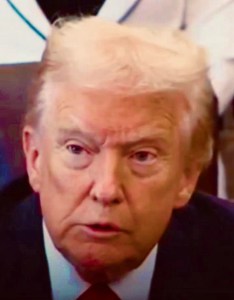
What follows does not treat the body as evidence of interior disposition, but as a public surface upon which habits of power, repetition, and assertion have settled over time.
At the threshold of his ninth decade, the president’s physiognomy does not merely register the natural course of aging, but a progressive separation between impulse and restraint, between reflex and those mechanisms that once might have moderated it. What appears is not absence, but misalignment: capacities that persist without coordination, reactions that proceed without mediation.
The depletion of mental reserves is visible in the face as sustained tension. Within it coexist—without reconciliation—ambition and denial, assertion and fragility. The friction between lived reality and unyielding aspiration registers as hardened pride, resistant to revision.
This disjunction was already visible decades ago. In 1989, during the Central Park gang-rape case in New York City, he acted publicly with a full-page newspaper advertisement that asserted guilt and called for severe punishment of five young men who had not yet been tried. That impulsive certainty contributed to the hardening of public condemnation and accompanied years of wrongful incarceration before their eventual exoneration. That judgment was not revisited. The episode did not merely reveal error; it revealed an instinctive structure: certainty displacing deliberation, accusation preceding process.
The same insistence on continuity over correction appears elsewhere, not only in conduct but in presentation. The carefully maintained architecture of the public image—down to the elaborate construction of the hair, preserved with remarkable consistency across decades—signals a preference for stabilization without altering course. Change is absorbed at the surface; the form is retained.
It is worth noting, however, that many among his followers—and even some who do not align with him politically but refrain from opposing him for reasons of self-preservation—describe him not as sycophants, but out of a genuine belief that there exists a side of him that is sincere, even warm. This perception should not be dismissed outright. It reflects an experienced reality for those who encounter him in limited or controlled contexts. Yet it merits examination, precisely because such impressions can collapse momentary demeanor with durable motive. Warmth, when unmoored from consistency or restraint, does not necessarily temper impulse; it may instead coexist with it, selectively deployed, while underlying patterns remain unchanged.
That same reflex remains latent now, seemingly undiminished by time. It reappears not as argument, but as posture.
The mouth, shaped by a retracted upper lip, indicates containment rather than speech. Impulse appears held in suspension rather than moderated. The eyes, asymmetrical and vigilant, remain oriented outward rather than inward, and register the surrounding environment less as a field of exchange than as a space to be assessed. The raised brows no longer convey conviction; they recur as a habitual assertion, repeatedly reaffirmed. The skin, excessively oxygenated and cast in a plated golden hue, emphasizes surface continuity over variation; it renders vitality as appearance rather than integration.
Breathing registers as effortful rather than relaxed, marked by insistence rather than ease. The slight forward inclination of the head does not solicit response; it precedes it and positions the surrounding world as something to be met rather than encountered.
Across these gestures, continuity replaces adjustment. The body sustains assertion even as conditions shift and preserves posture where recalibration might otherwise occur.
Subsequent years reinforce the structure already visible in earlier conduct. Civil findings, publicly documented associations, and recurring allegations—distinct in legal status yet convergent in pattern—consistently exhibit the same sequence: impulse preceding judgment, dominance supplanting restraint, consequence treated as incidental rather than corrective.
Taken as a whole, the portrait does not depict the disappearance of better instincts, but their displacement. They persist as non-operative remnants—present, yet sidelined—while more primitive reflexes increasingly shape gesture and response. What once might have moderated action now stands apart, as the figure continues to operate through inertia rather than integration.
*
On “Derangement,” Power, and the Loss of Measure
The term “derangement” entered public discourse not as a diagnosis, but as an accusation. It was used to explain opposition, dissent, and even tragedy. When a murdered individual was described as a victim of so-called “Trump Derangement Syndrome,” the phrase did not seek to describe belief. It functioned as displacement. Attention shifted away from the violent act and toward loyalty. The action was not examined; the critic was pathologized.
That inversion raises a broader question: whether the conduct it shields has precedents in American presidential history.
The United States has had impulsive, vindictive, and reckless presidents. Andrew Jackson governed through personal animus and disregarded judicial authority. Richard Nixon cultivated enemies and acted in secrecy against constitutional limits. Woodrow Wilson suppressed dissent and imposed ideological conformity during wartime. Each violated the ethical expectations of his time. Each altered the standards of the office.
In every case, however, an external measure remained. Jackson knew which law he defied. Nixon concealed his actions because concealment still mattered. Wilson justified repression by appealing to national unity and moral necessity. Their excesses were legible because the norms they breached were still recognized.
What distinguishes the present case is not the presence of ethical failure, but the absence of ethical reference altogether.
Disagreement is no longer treated as opposition, but as pathology. Responsibility is not debated; it is transferred. Facts are not rebutted; they are dismissed as hostile fabrications. Tragedy is neither examined nor mourned; it is absorbed as grievance. The categories that once structured judgment—truth, responsibility, proportion—are not merely violated. They are stripped of standing.
This is not only authoritarian behavior. It is governance by assertion. Repetition replaces justification. Loyalty replaces evaluation. The self becomes the measure through which reality is ordered.
Historical comparisons are tempting. Caligula. Genghis Khan. Other names surface by instinct. Not because the scale is comparable, but because the logic feels familiar.
Even so, tyrants governed within recognizable frameworks: divine right, conquest, destiny, lineage. Their cruelty operated within an order that produced meaning, however brutal.
No such framework is invoked here. Authority rests neither on the law nor tradition. It appeals to neither theology nor ideology. It rests solely on personal identification. Those who align are affirmed. Those who dissent are declared defective.
The danger does not lie in the breaking of norms—American history offers many such examples—but in the removal of the criteria by which a norm is recognized. When opposition is defined as illness, there is nothing left to debate. When tragedy is explained by belief rather than by action, there is nothing left to examine. The public is not asked to judge. It is asked to align.
This condition requires no diagnosis to be understood. It requires attention.
What is observable is sufficient: the language used, the repeated reversals, the ease with which responsibility dissolves into accusation. The portrait that emerges is neither one of exceptional intelligence nor of singular malice. It is that of a presidency exercised without measure, where contradiction no longer registers as contradiction and power asserts itself without external reference.
Such a presidency tests more than institutions. It tests whether citizens can still distinguish between disagreement and deviance, between explanation and excuse, between loyalty and judgment.
The portrait does not need to close with a warning. Observation is enough. What remains is a scene in which authority is sustained not by what is done, but by who aligns—and in which the office, stripped of measure, comes to reflect only the person who occupies it.
 Observations On Perception