*
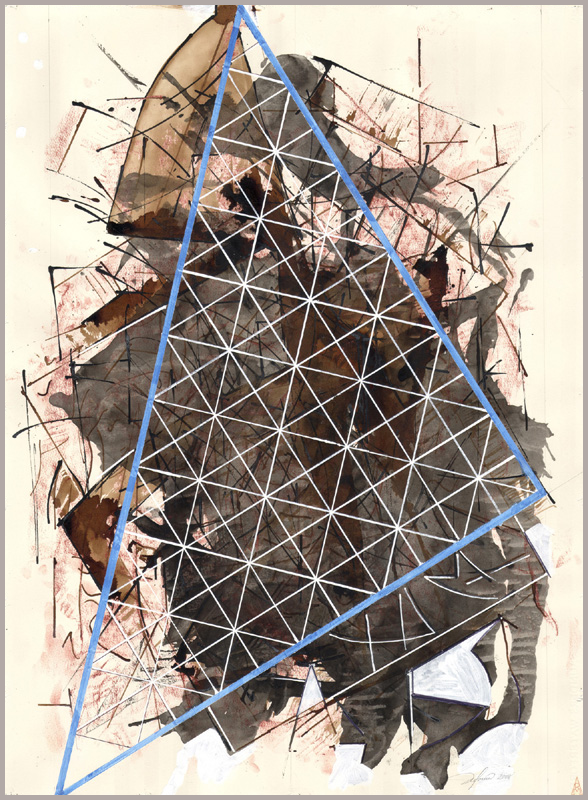
22″ x 30″
Body color, sanguine, sepia and Sumi ink on paper
2008
The Power of Myth and Storytelling
Storytelling has long served as a means through which individuals organize and interpret experience, particularly in situations where outcomes are uncertain or difficult to explain. Across cultures, narratives about gods, heroes, or exemplary figures provide structured accounts of conflict, endurance, and resolution. These accounts do not merely reflect imagination; they establish recognizable patterns through which individuals relate personal experience to shared forms of meaning. When events exceed immediate comprehension, such narratives offer a way to situate those events within an intelligible sequence. In this sense, myth does not function as an alternative to reality, but as a provisional framework through which uncertainty is rendered interpretable.
Uncertainty generates a need for explanation. When events cannot be readily understood or predicted, individuals seek to assign meaning in order to reduce ambiguity and regain a sense of orientation. In such conditions, belief systems—whether religious, cultural, or informal—provide interpretive frameworks that organize what would otherwise remain indeterminate. These frameworks do not arise arbitrarily; they develop where institutional or empirical forms of explanation are limited, inaccessible, or insufficient. Their function is not only to explain, but to stabilize perception by offering a coherent account of events. The question that follows is not whether such systems exist, but how they influence decisions, shape expectations, and operate within broader structures of authority.
Belief systems persist beyond their initial formation when they continue to provide explanatory value under changing conditions. In contemporary settings, practices commonly described as superstition emerge in situations where uncertainty remains unresolved despite the presence of institutional frameworks. These practices appear in repeated actions, ritualized behaviors, and shared expectations that guide decision-making in the absence of reliable outcomes. Their persistence does not indicate a simple opposition between tradition and modernity, but rather the coexistence of multiple interpretive frameworks operating at the same time. A society in which these frameworks overlap is not defined by the presence of belief alone, but by how such beliefs influence behaviors, shape choices, and interact with institutional forms that may not fully resolve uncertainty.
Santería and Spiritism in Venezuela
In Venezuela, practices commonly identified as Santería and Spiritism are present in both private and collective settings, particularly during periods of economic or institutional instability. These practices involve structured interactions with symbolic or spiritual intermediaries through rituals, consultations, and prescribed actions. Participants may seek guidance, protection, or resolution of specific problems when institutional responses are delayed, inaccessible, or perceived as ineffective. The recurrence of these practices can be observed in repeated visits to practitioners, the use of ritual objects, and the incorporation of prescribed behaviors into daily decision-making. Their presence does not displace institutional systems entirely (health and education), but operates alongside them, providing an additional interpretive framework through which individuals attempt to manage uncertainty and act within conditions that remain difficult to predict.
The Sect of María Lionza
Within Venezuela, the figure of María Lionza occupies a central place in a network of practices that combine elements from Indigenous, African, and Catholic traditions. Devotional activities associated with this figure include organized gatherings, ceremonial rituals, and the invocation of named entities identified as spirits of historical or symbolic figures. Participants report experiences in which mediums enter altered states and communicate messages attributed to these entities. These interactions are often sought in order to obtain guidance, address personal or familial concerns, or seek intervention in matters perceived as unresolved through conventional means. The recurrence of these practices can be observed in periodic ceremonies, the continued presence of recognized mediums, and the transmission of ritual knowledge across participants. Their function is not limited to belief alone, but extends to shaping decisions, reinforcing shared expectations, and providing an interpretive structure through which individuals respond to conditions that remain uncertain or difficult to control.
In conditions where access to medical care becomes limited or unreliable, individuals may turn to practitioners associated with spiritual or ritual frameworks. This shift occurs when healthcare systems are inaccessible, delayed or unable to provide satisfactory outcomes. Participants may seek these services when formal healthcare systems are delayed, inaccessible, or unable to provide satisfactory outcomes. This shift can be observed in the substitution of clinical consultations with ritual practices, the use of non-medical prescriptions, and the reliance on guidance attributed to spiritual intermediaries. The effect is not only a change in treatment choices, but a reorganization of decision-making processes, where perceived efficacy is evaluated through experience, testimony, and repetition rather than institutional validation. In this way, the expansion of such practices corresponds to identifiable constraints within institutional systems, rather than to belief alone.
In the case described, the distinction does not lie in the presence of belief, but in the moment when belief begins to guide decisions that previously depended on medical consultation or prescribed treatment. This can be observed when, in the absence of access to or confidence in healthcare services, clinical consultations are replaced by ritual consultations, or when non-medical indications substitute prescribed treatments. Although autosuggestion can produce observable biological effects, these cannot always be predicted or attributed to a single causal factor. In such cases, the issue shifts from how events are interpreted to how action is taken in response to them. The tension becomes visible in that substitution: when one form of guidance displaces another in decisions that carry verifiable consequences.
Superstition and Modernization
Belief-based practices and formal institutional frameworks often operate simultaneously rather than in direct opposition. In Venezuela, these practices can be observed not only in private settings but also in decisions that affect health, economic activity, and social coordination. Individuals who participate in belief-based systems may incorporate guidance derived from those systems into choices that would otherwise rely on formal procedures or institutional criteria. This influence does not require formal authority to be effective; it operates through personal conviction, shared expectations, and repeated validation within social networks. As a result, multiple interpretive frameworks may coexist within the same decision-making environment, sometimes reinforcing and at other times complicating the application of institutional rules. The outcome is not the replacement of one system by another, but the interaction of parallel structures that shape conduct under conditions where formal mechanisms do not fully resolve uncertainty.
In addition to belief-based practices that provide explanation or guidance, there are also practices in which individuals attribute intentional influence to unseen or non-observable forces. These practices are often described in terms of intervention, protection, or harm, and may involve the deliberate use of rituals, objects, or intermediaries believed to affect outcomes. The presence of such beliefs can be observed in precautionary behaviors, avoidance patterns, and decisions made in anticipation of perceived external influence. Individuals may seek practitioners not only to interpret events, but to alter expected outcomes through prescribed actions. Whether or not such influence can be demonstrated, the belief in its possibility affects behaviors by shaping expectations, redirecting choices, and reinforcing interpretive frameworks that extend beyond empirical verification. In this way, the significance of these practices lies in their observable impact on conduct, rather than in the validation of the forces they invoke.
Under conditions of sustained uncertainty, belief-based practices persist because they provide interpretive and practical responses where institutional systems remain incomplete or unreliable. These practices do not operate in isolation, but alongside institutional frameworks, influencing how individuals interpret events and make decisions within constrained environments. Their presence reflects not only continuity with past traditions, but also ongoing responses to present conditions in which outcomes remain difficult to predict. The question is not whether such beliefs should be reduced to or replaced by formal systems, but how their influence can be understood in relation to observable conduct, decision-making processes, and the limits of institutional capacity. In this sense, the analysis of belief-based practices requires attention to the conditions under which they arise, the mechanisms through which they operate, and the effects they produce, rather than reliance on symbolic or interpretive descriptions that remain ungrounded in demonstrable sequence.
Ricardo F Morin, February 8, 2025, Oakland Park, Fl.
 Observations On Perception