“Orientation and Method”
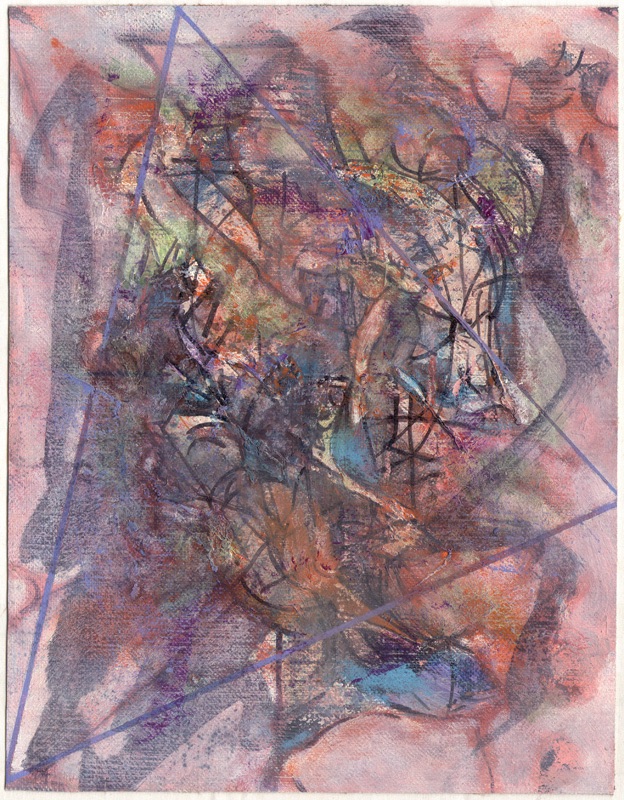
Triangulation Series Nº55
10″ × 12¾″
Oil on linen
2009
*
*
I rarely begin with a fixed structure in mind. More often, I write because a subject begins pressing upon perception with enough urgency that it feels necessary to follow wherever it leads. If the condition proves superficial or insufficiently generative, I abandon it quickly, sometimes within hours. The production itself remains largely instinctive. Only afterward do I begin examining how an essay belongs within the larger sequence of the work.
The architecture therefore emerges retrospectively rather than beforehand. I discover continuities after the writing has already disclosed them : continuity, recognition, attribution, fragmentation, authority, asymmetry, memory, proportionality, coordination, and the instability of interpretation itself. What initially appears as a series of separate essays often reveals itself later as participation within a larger field of recurring conditions. The retrospective intelligence does not impose structure upon the work so much as recognize relations the writing had already begun to disclose through its own movement.
For that reason, I do not regard published work as fixed. I revise older essays whenever the underlying method through which I perceive changes sufficiently to expose weaknesses in register, syntax, proportion, structure, or intelligibility. A sentence that once appeared adequate may later reveal itself as compressed, rhetorically excessive, insufficiently grounded, or abstract beyond necessity. Revision therefore becomes less a matter of stylistic preference than of proportionality between language and the condition it attempts to describe. The writing evolves because the discipline through which I see evolves with it.
What increasingly occupies me is the relation between perception and human conditions themselves : how continuity forms, how fragmentation obscures recognition, how authority stabilizes itself through language, how asymmetry alters judgment, how memory structures identity, and how technological acceleration weakens coherence faster than political or psychological comprehension can assimilate it. Even when the subject appears political, epistemological, artistic, or historical, the deeper concern remains the same : how perception defines, clarifies, mediates, or obscures the condition being examined.
I have come to understand that language itself cannot stand outside the conditions it attempts to describe. Its instability forms part of the condition. Syntax, cadence, abstraction, compression, and semantic precision therefore matter not merely stylistically, but structurally. The prose must remain proportionate to what it is attempting to recognize. Where language becomes excessive, abstract beyond necessity, rhetorically inflated, or insufficiently grounded, recognition weakens with it.
Phenomenology perhaps comes closest philosophically to describing this approach, though I do not begin from doctrine or system. I begin from conditions as they appear through lived experience and through the instability of language attempting to describe them. The challenge is therefore not merely to write, but to discover forms of language, whether diagnostic prose, narrative, or poetry, capable of remaining proportionate to the conditions from which they emerge.
The work itself remains exploratory rather than doctrinal. I am not attempting to construct a closed philosophical system or unified theory of human behavior. What interests me instead is the possibility that recurring conditions become perceptible across different scales of experience : interpersonal, political, historical, technological, linguistic, and civilizational. The continuity linking these scales does not arise from ideology, but from patterns of recognition and obscurity that reappear under changing forms.
In that sense, the work is less an effort to establish conclusions than an ongoing attempt to refine a discipline of perception through language itself.
Ricardo F. Morín
May 16, 2026
Bala Cynwyd, Pennsylvania

