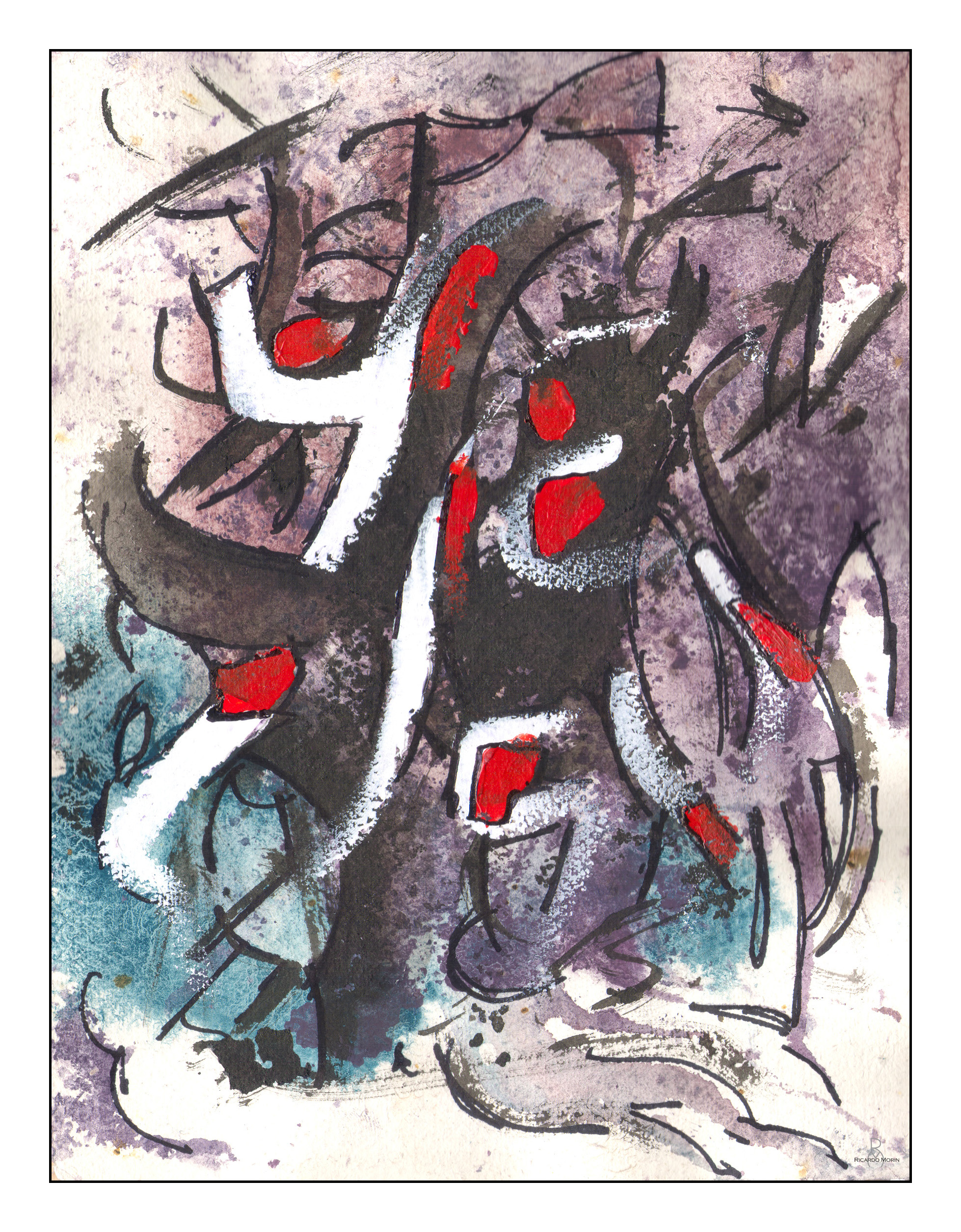
Ricardo Morin Untitled #5: The Paradigm of Extraction 10″x12″ Watercolor 2003
By Ricardo F. Morín
Oct. 2025
Oakland Park, Fl
*
The story of artificial intelligence is usually told as one of endless promise—a technology meant to transform economies and redefine human potential. Yet beneath the optimism lies an older reality: the conversion of human creativity into concentrated wealth. What is presented as progress often repeats the oldest economic pattern of all—the extraction of value from the many for the benefit of the few. The language surrounding AI hides this continuity. It turns innovation into a spectacle of inevitability, a vision of boundless gain that distracts from its unequal foundations.
The spectacle depends on persuasion. Words like manifested intelligence, the next trillion-dollar frontier, and inevitable transformation are not descriptions; they are marketing. They frame profit as destiny and invite participation not in discovery but in speculation. Numbers such as “$80 trillion” and “25,000 percent returns” echo through news cycles like prophecies, and turn investment forecasts into moral certainty. This rhetoric reshapes public imagination. AI stops being a tool for solving human problems and becomes a financial phenomenon—a story about wealth rather than understanding.
These promises do not mark a new beginning. They repeat the same cycle that accompanied every major invention. The Industrial Revolution produced machines that changed work but deepened social divides. The digital revolution spread information but concentrated ownership. AI now enters that history as its newest expression. Its power to expand knowledge and serve the public good is real, but its first allegiance remains to profit. Within existing systems, it accelerates the accumulation of capital instead of correcting its imbalance.
The mechanisms of this concentration are easy to see. Proprietary models fence off knowledge behind paywalls and patents. Data collected from the public becomes private property. The cost of computing power and specialized expertise limits who can participate. The outcome is predictable: the majority will experience AI not as empowerment but as dependency. Far from leveling inequality, it builds it into the infrastructure of tomorrow.
This direction grows more troubling when placed beside the world’s most urgent needs. Billions of people still live without reliable food, healthcare, or education—conditions technology could transform but rarely does. The most profitable uses of AI instead optimize advertising, influence behavior, and extend surveillance. These are not accidents. They are the logical results of a system that values profit over human welfare. When progress is measured only in shareholder value, technology loses its moral compass and society loses its claim to wisdom.
A newer and equally dangerous use of these systems has emerged in the political sphere. The same tools that target consumers now target citizens. Governments with autocratic tendencies have begun using generative models to flood public discourse with persuasive content, to blur the boundary between truth and fabrication, and to cultivate obedience through simulation. Recent reporting shows how executive offices deploy AI to craft political messages, to amplify loyal media, and to drown out dissenting voices. Such practices transform intelligence into propaganda and data into domination. When a state can algorithmically manage perception, democracy becomes performance. The concentration of wealth and the concentration of an engineered belief reinforce each other, both materially and mentally.
We have seen this pattern before. In every technological era, wealth has turned into political power and then used that power to protect itself. Railroad barons shaped monopolies in the nineteenth century. Oil empires steered foreign policy in the twentieth. Today, digital conglomerates write the rules that sustain their dominance. AI follows the same gravitational pull, guided less by human vision than by financial gravity.
In the present order, the union of technological power and financial speculation no longer produces discovery but dependence. Wealth circulates within an enclosed economy of influence and rewards those who design the mechanisms of access rather than those who expand the reach of knowledge. What appears as innovation is often a rehearsal of privilege:an exchange of capital between the same centers of authority, each validating the other while society absorbs the cost. When creativity becomes collateral and intelligence a lease, progress ceases to serve the public and begins to serve itself.
The most seductive illusion sustaining this order is the myth of inevitability—the belief that technological advance must produce inequality, and that no one is responsible for the outcome. It is a useful fiction. It spares those in power from moral scrutiny by turning exploitation into fate. Yet inevitability is a choice disguised as nature. Societies have always shaped the use of technology through their laws, values, and courage to intervene. To accept inequality as destiny is to abandon that responsibility.
Rejecting inevitability means reclaiming the idea of progress itself. Innovation is not progress unless it expands the freedom and security of human life. That requires intentional direction—through public investment, fair taxation, transparent standards, and strong international cooperation. These are not barriers to growth; they are the conditions that make genuine progress possible. Markets alone cannot guarantee justice, and technology without ethics is not advancement but acceleration without direction.
Measuring progress differently would change what we celebrate. If an AI system reduces medical errors in poor communities, strengthens education where resources are scarce, or helps citizens participate more fully in democracy, its worth exceeds that of one that merely increases profit margins. The true measure of intelligence—artificial or human—is the good it brings into the world. Profit is only one form of value; human dignity is another.
At the center of this order lies a quiet hypocrisy. Wealth is praised as the reward of discipline and intelligence, yet it depends on the continuous extraction of value from others—the worker, the consumer, the environment. What appears as merit often rests on inequality disguised as efficiency. The same pattern defines artificial intelligence. Built from shared human knowledge and creativity, it is enclosed within systems that sell access to what was freely given. Both forms of accumulation—financial and technological—draw their power from the very resources they diminish: human labor, attention, and imagination. In claiming to advance society, they reproduce the inequity that turns vitality into stagnation—the inversion of what progress is meant to be.
The fevered talk of trillion-dollar opportunities belongs to an old vocabulary—the language of extraction mistaken for evolution. The real question is whether intelligence will continue to serve wealth or begin to serve humanity. Artificial intelligence offers that choice: to repeat the logic that has long confused accumulation with advancement, or to build a future where knowledge and prosperity are shared. That decision will not emerge by itself. It depends on what societies demand, what governments regulate, and what values define success. The window to decide remains open, though it narrows each time profit is allowed to speak louder than conscience.
The preceding observations concern the consequences of extraction. The institutional logic that produces these consequences belongs to a wider historical pattern in modern economic development. That pattern is examined separately in “The Logic of Extraction.”
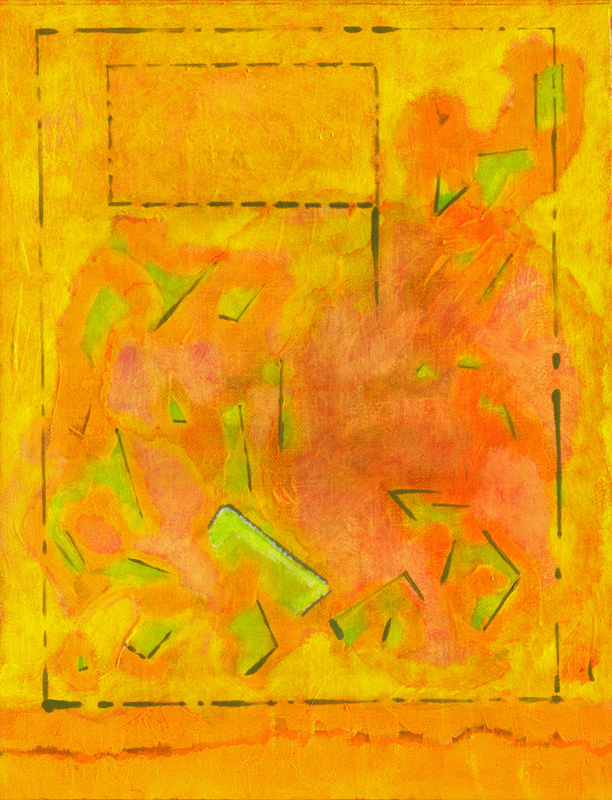
Ricardo Morín Still Six: The Arithmetic of Progress Oil On Linen 14 by 18 by 3/4 inches 2010
Ricardo F. Morín
November 2025
Oakland Park, Florida
Billy Bussell Thompson, Editor
Abstract
This essay examines the assumption that technological and scientific advances have produced a universal improvement in human life. While contemporary discourse often equates innovation with progress, the distribution of benefits remains deeply asymmetrical. Technological growth increases capacity but does not correct the structural inequities embedded in modern economic systems. What appears as collective advancement frequently reflects the consolidation of advantage among those already positioned to receive it. By distinguishing capability from justice, and aggregate trends from lived conditions, the essay argues that the notion of historical progress is less a measure of shared dignity than a narrative that obscures persistent hierarchies.
1
The modern argument for progress (understood as improvement) rests on a familiar premise: technological and scientific advances have made life better today than at any other point in human history. Thinkers such as Harvard’s Steven Pinker defend this view with empirical confidence—he points to increased life expectancy, reduced mortality, improved medical interventions, and the steady rise of global literacy. In this framing, innovation and macroeconomic expansion constitute not only evidence of historical progress but the very engines that produce it.
2
Yet the structure of this reasoning is fragile. It equates technical capacity with civic advancement and treats expanded tools as synonymous with expanded dignity. It assumes that the benefits of innovation distribute themselves naturally and uniformly across societies. It suggests that progress is a shared inheritance rather than a selective outcome. These assumptions flatten the complexities of economic life into a narrative that conceals the asymmetries on which contemporary systems depend.
3
The historical record offers a different picture. Technological growth has consistently increased the efficiency of extraction, the speed of accumulation, and the reach of centralized power. Growth has amplified productivity without altering the basic hierarchy of distribution. Knowledge expands, but the architecture of inequity persists. What appears as collective advancement is often a redistribution of advantage toward those already positioned to capture its rewards. This is not a failure of technology; it is the continuity of a primitive logic embedded within modern economic structures.
4
The Enlightenment promise—that reason and innovation would lift the condition of all—has, in practice, produced a dual economy. One part benefits from scientific capacity, medical improvement, and informational access. The other part experiences precarity, dispossession, and structural vulnerability despite living under the same technological horizon. Progress, in this sense, is not a universal fact but a statistical abstraction. It describes averages, not lived realities. It treats the mean as the measure of the moral.
5
Some defend the concentration of authority on the grounds that a virtuous ruler could achieve what plural institutions cannot. This argument, however substitutes character for structure. If justice depends on the accident of benevolence, it ceases to be a principle and becomes a contingency.
6
Macroeconomic narratives reinforce this illusion. Rising GDP is interpreted as evidence of collective ascent, even as wealth concentrates in increasingly narrow fractions of the population. Globalized production expands, but the gains consolidate among those with access to capital, infrastructure, and insulating privilege. The appearance of aggregate improvement obscures the internal asymmetry: growth for some, stagnation or decline for many. The arithmetic of progress becomes a rhetoric of reassurance rather than a diagnosis of social reality.
7
To question this framing is not to deny the achievements of science or the value of technological discovery. It is to refuse the conflation of capability with justice. It is to observe that our tools have advanced while our institutions have remained elementary—often primitive—in their allocation of power and opportunity. Inequity is no less entrenched today than in earlier eras; it has simply been rationalized under the banner of innovation.
8
If echoes of Thomas Paine emerge in this argument, they are not intentional. They arise from a shared intuition: that systems calling themselves enlightened can reproduce the conditions they claim to transcend. Paine confronted monarchy; we confront the monarchy of capital, which presents itself as progressive while it operates through concentration, asymmetry, and manufactured narratives of improvement.
9
The challenge is not to reject technological advancement but to assess its civic consequences without accepting its mythology. Progress exists, but its distribution is neither natural nor inevitable. Until the structures that allocate benefit are reexamined rather than presumed, the claim of historical improvement functions less as an account of justice than as a story societies tell themselves to avoid reckoning with its absence.
This essay is the second part of a trilogy that examines certainty, doubt, and ambivalence as conditions shaping our understanding of reality. It turns to doubt as both discipline and burden: a practice that unsettles claims of knowledge yet makes understanding possible. Here doubt is not treated as weakness but as a necessary stance within human communication. Its value lies not in closure but in keeping open the fragile line between appearance and reality. The trilogy begins with The Colors of Certainty and concludes with When All We Know Is Borrowed.
The Discipline of Doubt
Skepticism and doubt are often spoken of as if they were the same, yet they differ in essential ways. Skepticism inclines toward distrust: it assumes claims are false until proven otherwise. Doubt, by contrast, does not begin with rejection. It suspends judgment, while it withholds both assent and denial, so that questions may unfold. Skepticism closes inquiry prematurely; doubt preserves its possibility. Properly understood, inquiry belongs not to belief or disbelief, but to doubt.
This distinction matters because inquiry rarely follows a direct path to certainty. More often it is layered, restless, and incomplete. Consider the case of medicine. A patient may receive a troubling diagnosis and consult several physicians, while each offers a different prognosis. One may be more hopeful, another more guarded, yet none entirely conclusive. The temptation in such circumstances is to cling to the most reassuring answer or to dismiss all of them as unreliable. Both impulses distort the situation. Inquiry requires another path: to compare, to weigh, to test, and ultimately to accept that certainty may not be attainable. In this recognition, doubt demonstrates its discipline: it sustains investigation without promising resolution and teaches that the absence of finality is not failure but the condition for continued understanding.
Even within medicine itself, leaders recognize this tension. Abraham Verghese, together with other Stanford scholars, has pointed out that barely half of what is taught in medical schools proves directly relevant to diagnosis; the rest is speculative or unfounded. This observation does not aim to discredit medical education but rather to underline the need for a method that privileges verification over uncritical repetition. Clinical diagnosis, therefore, does not rest on an accumulation of certainties but on the constant practice of disciplined doubt: to question, to discard what is irrelevant, and to hold what is provisional while seeking greater precision.
History provides another vivid lesson in the figure of Galileo Galilei. When he trained his telescope on the night sky in 1609, he observed four moons orbiting Jupiter and phases of Venus that could only be explained if the planet circled the sun. These discoveries contradicted the Ptolemaic system, which for centuries had fixed the earth at the center of creation. Belief demanded obedience to tradition; skepticism might have dismissed all inherited knowledge as corrupt. Galileo’s path was different. He measured, documented, and published, while he knew that evidence had to be weighed rather than simply asserted or denied. The cost of this doubt was severe: interrogation, censorship, and house arrest. Yet it was precisely his refusal to assent too quickly—his suspension of judgment until the evidence was overwhelming—that made inquiry possible. Galileo shows how doubt can preserve the conditions of knowledge even under the heaviest pressure to believe.
Literature offers a parallel insight. In Shakespeare’s Hamlet, the young prince is confronted by the ghost of his murdered father, who demands vengeance. To believe would be to accept the apparition’s word at once and to kill the king without hesitation. To be skeptical would be to dismiss the ghost as hallucination or trickery. Hamlet does neither. He allows doubt to govern his response. He tests the ghost’s claim by staging a play that mirrors the supposed crime, as he watches the king’s reaction for confirmation. Hamlet’s refusal to act on belief alone, and his unwillingness to dismiss the ghost outright, illustrates the discipline of doubt. His tragedy lies not in doubting, but in stretching doubt beyond proportion, until hesitation itself consumes action. Shakespeare makes clear that inquiry requires balance: enough doubt to test what is claimed, enough resolve to act when evidence has spoken.
The demands of public life make the difference equally clear. In the early months of the COVID-19 pandemic, citizens were asked to place immediate trust in official pronouncements or, conversely, to dismiss them as deliberate falsehoods. Belief led some to cling uncritically to each reassurance, however inconsistent; skepticism led others to reject all guidance as propaganda. Doubt offered another course: to ask what evidence supported the claims, to weigh early reports against later studies, and to accept that knowledge was provisional and evolving. The uncertainty was uncomfortable, but it was also the only honest response to a rapidly changing reality.
A similar pattern emerged after the September 11 attacks. Governments urged populations to choose: either support military intervention or stand accused of disloyalty. Belief accepted the justification for war at face value; skepticism dismissed all official claims as manipulation. Doubt, however, asked what evidence existed for weapons of mass destruction, what interests shaped the rush to invasion, and what alternatives were excluded from consideration. To doubt in such circumstances was not disloyalty but responsibility: the attempt to withhold assent until claims could be verified. These examples show that doubt is not passivity. It is the active discipline of testing what is said against what can be known: to resist the lure of premature closure.
Verification requires precisely this suspension: not the comfort of belief, nor the dismissal of skepticism, but the discipline of lingering within uncertainty long enough for proof to take shape. One might say that verification becomes possible only when belief is held in abeyance. Belief craves closure, skepticism assumes falsehood, but doubt stills the mind in the interval—where truth may draw near without the illusion of possession.
The same principle extends to the temptations of success and recognition. Success and fame resemble ashes: the hollow remains of a fire once bright but now extinguished, incapable of offering true joy to an inquiring mind. Ashes evoke a flame that once burned but has spent itself. So it is with fame: when the applause fades, only residue lingers. Belief, too, provides temporary shelter, yet it grows brittle when never tested. Recognition and conviction alike promise permanence, yet both prove fragile. A mind intent on inquiry cannot find rest in them. It requires something less visible, more enduring: the refusal to define itself too quickly, the discipline of anonymity.
Anonymity here does not mean retreat from the world. It means withholding assertion or purpose until knowledge has ripened. To declare too swiftly what one is—or what one knows—is to foreclose discovery. By necessity, the inquiring mind remains anonymous. It resists capture by labels or the scaffolding of recognition. Its openness is its strength. It stays attuned to what has not yet been revealed.
Our present age makes such discipline all the more urgent. Technology hastens every demand for certainty: headlines must be immediate, opinions instantaneous, identities reduced to profiles and tags. Social media thrives on belief asserted and repeated, rarely on doubt considered and tested. Algorithms reward speed and outrage, punishing hesitation as weakness and contradiction as betrayal. To cultivate doubt and anonymity is therefore a form of resistance. It shelters the subtlety of thought from the pressure of velocity and spectacle. It refuses to allow inquiry to be diminished into slogans or certainty compressed into catchphrases.
The discipline of doubt teaches that truth is never possessed, only pursued. Success, fame, and belief may glitter briefly, but they collapse into ashes. What endures is the quiet labor of questioning, the patience of remaining undefined until knowledge gathers form. To believe is to settle into residue; to doubt is to stand within the living fire. To question is to stir the flame; to believe is to collect the ashes.
*
** Cover Design:
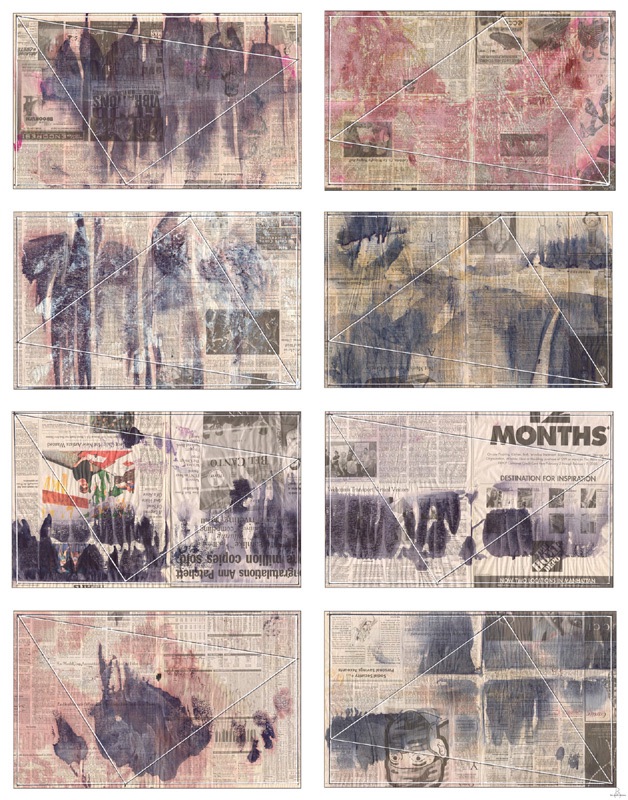
Ricardo Morín: Newsprint Series Nº 2 (2006). 51″ × 65″. Ink, white-out, and blotted oil paint on newsprint. From the Triangulation series.
Annotated Bibliography
Arendt, Hannah: Between Past and Future. New York: Viking Press, 1961. (Arendt examines the importance of thinking without absolute supports and illuminates how the discipline of doubt resists political and social certainties).
Bauman, Zygmunt: Liquid Modernity. Cambridge: Polity Press, 2000. (Bauman describes the fluidity and precariousness of certainties in modern life and reinforces the idea of doubt as a condition in the face of contemporary volatility).
Berlin, Isaiah: The Crooked Timber of Humanity. Princeton: Princeton University Press, 1991. (Berlin analyzes the pluralism of values and the impossibility of single certainties and supports the need to live with unresolved tensions).
Bitbol-Hespériès, Annie: Descartes’ Natural Philosophy. New York: Routledge, 2023. (Bitbol-Hespériès examines how Cartesian natural philosophy emerges from a constant exercise of methodical doubt; she offers a contemporary reading that links science and metaphysics in Descartes’ thought).
Han, Byung-Chul: In the Swarm: Digital Prospects. Cambridge, MA: MIT Press, 2017. (Han critiques the pressure of transparency and digital acceleration; he provides insights into how technology disfigures the patience required for doubt).
Han, Byung-Chul: The Disappearance of Rituals. Cambridge: Polity Press, 2020. (Han explores how digital society weakens spaces of repetition and anticipation to highlight the urgency of recovering anonymity and slowness in inquiry).
Croskerry, Pat, Cosby, Karen S., Graber, Mark, and Singh, Hardeep, eds.: Diagnosis: Interpreting the Shadows. Boca Raton, FL: CRC Press, 2017. (Croskerry, Cosby, Graber, and Singh address the cognitive complexity of diagnostic reasoning: they show how uncertainty is inherent in clinical practice and how disciplined doubt can reduce diagnostic error).
Elstein, Arthur S., and Schwartz, Alan: Clinical Problem Solving and Diagnostic Decision Making: Selective Review of the Cognitive Literature. New York: Oxford University Press, 2002. (A landmark study in medical decision-making, it shows how diagnostic reasoning is less about static knowledge and more about methodical doubt and verification).
Finocchiaro, Maurice: Retrying Galileo, 1633–1992. Berkeley: University of California Press, 2005. (Finocchiaro explores the trials and historical reinterpretations of Galileo’s case; he shows how scientific doubt clashed with religious authority and how it has been re-evaluated in modernity).
Gaukroger, Stephen: Descartes: An Intellectual Biography. Oxford: Oxford University Press, 2002. (An intellectual biography that situates Descartes in the cultural context of the seventeenth century and illuminates how Cartesian doubt was also a strategy against religious and scientific tensions).
Garber, Daniel: Descartes Embodied: Reading Cartesian Philosophy through Cartesian Science. Cambridge: Cambridge University Press, 2001. (Garber analyzes the close relationship between Descartes’ science and his philosophical method and underscores how scientific practice reinforced the discipline of doubt).
Graber, Mark L., Gordon D. Schiff, and Hardeep Singh: The Patient and the Diagnosis: Navigating Clinical Uncertainty. New York: Oxford University Press, 2020. (Graber explores how physicians manage uncertainty and emphasizes that precision in diagnosis emerges from structured methods rather than unquestioned knowledge).
Machamer, Peter, ed.: The Cambridge Companion to Galileo. Cambridge: Cambridge University Press, 1998. (In this collection of updated essays presenting Galileo’s work from historical, philosophical, and political perspectives, Machamer illuminates how empirical doubt transformed cosmology).
Nussbaum, Martha: Political Emotions: Why Love Matters for Justice. Cambridge, MA: Harvard University Press, 2013. (Nussbaum examines how liberal institutions can responsibly cultivate public emotions—such as love, tolerance, and solidarity. Her arguments enrich the section of the essay on civic-life, which shows how emotional cultivation, beyond belief or skepticism, supports societal inquiry).
Popkin, Richard: The History of Scepticism: From Savonarola to Bayle. Oxford: Oxford University Press, 2003. (In this historical study of skepticism, Popkin shows how skepticism evolved between radical distrust and the discipline of inquiry).
Shakespeare, William: Hamlet. New Haven: Yale University Press, 2003. (This play offers a literary embodiment of doubt as an ambivalent force: it functions both as the engine of inquiry and the risk of paralysis).
Shea, William, and Artigas, Mariano : Galileo in Rome: The Rise and Fall of a Troublesome Genius. Oxford: Oxford University Press, 2003. (An accessible and well-documented narrative of Galileo’s conflict with the Church; it illustrates how persistence in verifying doubt had vital and political consequences).
Verghese, Abraham, Saint, Sanjay, and Cooke, Molly: “Critical Analysis of the ‘One Half of Medical Education Is Wrong’ Maxim.” Academic Medicine 86, no. 4 (2011): 419–423. (Authored by Stanford-affiliated leaders in medical education, the report argues that much of medical teaching lacks direct relevance to diagnostic accuracy and underscores the necessity of disciplined doubt and re-evaluation).
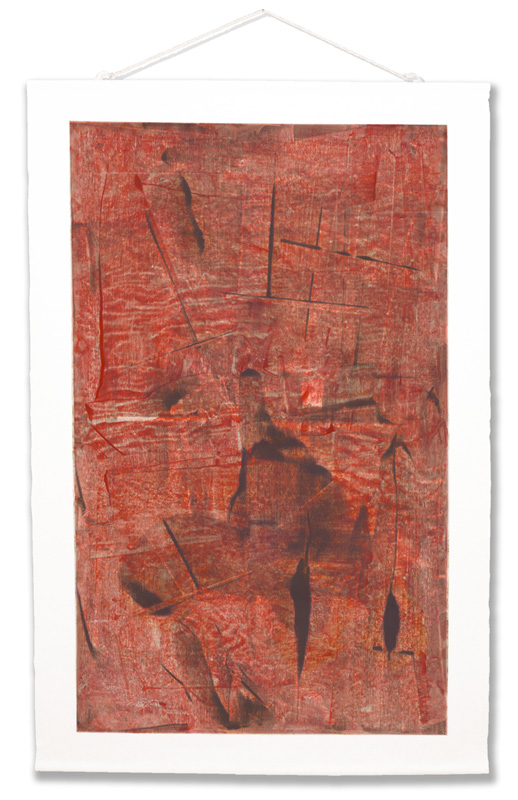
Silence Ten Ricardo Morín, Oil on linen scroll 43” x 72″ x 3/4″ 2012
*
~
Author’s Note
This is a work of fiction inspired by historical events.While the story is rooted in real-world dynamics, all characters, dialogues, and specific incidents are entirely fictional.Any resemblance to actual persons, living or dead, is purely coincidental.
This narrative is not intended to depict, portray, or comment on any real individuals or events with factual accuracy.It is a literary exploration of themes relevant to society, history, and the human experience.
Ricardo F. Morín Tortolero, February 10, 2025
Oakland Park, Florida
~
*
List of Characters:
1. The Champions of Order and Hope:
• Aurelia:A principled guardian of constitutional values.
Traits:Wise, steadfast, compassionate. She embodies the enduring spirit of order.
• Marcos:A dedicated public servant bridging tradition and modernity.
Traits: Honest, diligent, empathetic. He upholds institutional integrity.
• Elena:A unifying presence with calm resolve and moral clarity.
Traits: Reflective, compassionate, inspiring. She acts as the moral compass of her community.
2. The Figures of Disruption:
• Soren:A brilliant yet reckless young tech savant.
Traits: Intelligent but impulsive, morally ambiguous. His actions expose the risks of unvetted innovation.
• Vera: An ambitious bureaucrat exploiting emerging technologies for gain.
Traits: Charismatic, calculating. She represents the seductive nature of power when ethics are compromised.
• Xander:A populist firebrand unsettling the established order.
Traits: Persuasive, rebellious, unpredictable. He stokes division with promises of rapid change.
• Don Narciso Beltrán: An impetuous, self-indulgent octogenarian.
Traits: Arrogant, narcissistic. He parades his delusions of “perfection,” and embodies the dangers of unchecked ego.
Ideology: Seeks to displace marginalized groups to impose his distorted vision of order.
3. The Keepers of Balance:
• Renato: A pragmatic administrator between innovation and tradition.
Traits: Level-headed, fair, resourceful. He exemplifies compromise without ethical sacrifice.
Traits: Nurturing, experienced, reflective. She bridges past lessons with current challenges.
• Iker:A dedicated technician ensuring system stability.
Traits: Conscientious, methodical, courageous. He represents the unsung heroes of critical infrastructure.
*
Act I
A Nation at the Precipice
The air crackles with change—raw, electric, untempered. It surges through the avenues where history’s stones, heavy with forgotten oaths, bear silent witness to promises now unraveling. Beneath the alabaster facades of institutions once tempered by order, a quiet assault spreads. The people feel it in the marrow of their days, in the uneasy hush between headlines, in the glint of urgency behind every argument.
Once, the land moved to a measured cadence, set by laws unyielding to fleeting tempers. Now, the streets pulse with a different rhythm—a fevered drive toward something new, unburdened by the slow wisdom of the past. Progress and tradition, each staking its claim, wrestle in the dust of a nation standing on the edge of itself.
In the halls of power, where marble once stood as a bulwark against unchecked tides, whispers stir—of systems too rigid to bend, of minds too restless to wait. The parchment of governance, crisp with centuries of deliberation, meets the friction of unfettered innovation. Some call it progress, others self-destruction.
Yet beneath this clash, a deeper question remains: Does a nation endure by perfecting its foundations or by discarding them altogether? The answer, suspended between past and future, waits to be spoken—if only the voices of the present dare to choose.
*
Act II
The Shattering
It begins not with an explosion, but with a single breach—silent, insidious, precise. A door left ajar in the corridors of power, a signature scrawled where it should not be, a system once thought inviolable suddenly laid bare. The nation awakens to the aftermath, uncertain whether the ground beneath them has merely shifted or collapsed entirely.
In the din of speculation, two figures emerge—Soren, the architect of controlled chaos, and Don Narciso, the whisperer of gilded lies. One wields disruption as a scalpel, cutting through the sinews of governance with cold precision. The other, a master illusionist, cloaks upheaval in the fabric of righteousness and bends perception until even the most steadfast begin to doubt the contours of reality.
The people watch, rapt and confused. Some see salvation in the rise of these forces, a chance to shed the weight of old constraints. Others, those who still listen for the heartbeat of the republic, sense the tremor beneath their feet and wonder: Is this the moment when the foundation finally gives way?
The stage is set. The struggle is no longer abstract. The breach is real, and the hands that hold the future are already at work to reshape it in their own image.
*
Act III
The Gathering Storm
The breach widens. What was once an isolated fracture in the nation’s foundation now spreads and courses through institutions like veins turned septic. The days grow heavier with uncertainty, and in the void where order falters, new forces emerge—some to defend, others to dismantle, and a few to navigate the shifting ground.
The Call to Defend
Aurelia moves first, a voice of clarity in the rising chaos.Where others falter in fear or cynicism, she stands unyielding, wielding conviction like a torch against the encroaching dark. By her side, Marcos, a man of reasoned strength, gathers those who refuse to let history slip into ruin. And Elena, keen-eyed and relentless, sharpens truth into a blade that cuts through the veils of distortion spun by those who seek to reshape reality to suit their designs.
The Forces of Disruption
But against them rise the architects of disorder. Soren, ever the master of fracture, feeds the discord, to ensure no side gains enough ground to restore stability. Vera, a specter of unrepentant ambition, twists uncertainty into leverage to secure power in the shadows where the law’s reach begins to blur. Xander moves openly, charismatic and mercurial, a revolutionary to some, a destroyer to others. And Don Narciso, ever the weaver of illusions, speaks in riddles that soothe even as they deceive.
The Balance Seekers
Yet not all choose a side in the battle unfolding before them. Renato, the quiet strategist, watches, waits, and seeks the threads that might yet be rewoven before the fabric tears beyond repair. Carmen, pragmatic, negotiates between factions, desperate to slow the slide toward chaos. And Iker, burdened by both past and present, works in the shadows—not to seize power, but to ensure that whatever future emerges still bears the echoes of what was once whole.
The tension thickens. Every movement, every decision, tips the scale. And as the storm gathers on the horizon, one truth becomes clear: no one will emerge unchanged.
*
Chapter IV
The Masses
The masses do not lead; they follow, but with a fervor that shakes the very bones of the nation. Their cries rise in streets and squares, across glowing screens and whispered corners. What began as discontent has become something more—an anthem of anger, stripped of nuance, sharpened into conviction.
Their grievances, once tethered to reality, now drift free, shaped by the voices they have chosen to trust. Soren’s rhetoric courses through them like wildfire, his calculated fractures swelling into irreparable chasms. Vera’s ambition feeds their hunger for upheaval and promises power to those who feel unseen. Xander, the relentless provocateur, transforms their resentment into action, while Don Narciso shrouds them in visions of grandeur, while whispering to their ears that history bends to the will of those bold enough to seize it.
They speak not in dialogue, but in echoes—those that amplify what stirs their fury and silence what does not. To them, compromise is betrayal, and reflection is weakness. They are the force that makes destruction possible, not by design, but by sheer, unrelenting belief.
The Guardians of Common Sense
But against the tide stand those who refuse to be swept away. They are quieter, less visible, but no less resolute. They do not rally for glory or scream for vengeance; instead, they guard the ground beneath their feet, as they hold firm against the storm.
Aurelia’s voice reaches them, measured and unwavering and cut through the noise like a distant bell. Marcos gives them structure and remind them that reason is not passivity, but discipline. Elena arms them with truth and asserts that in an age of distortion, clarity itself is a weapon.
They are the ones who ask, What is gained? What is lost? They are not blinded by the promise of a new order nor lulled into complacency by the old. They see both the cracks and the foundation, and they stand—not to defend power, but to defend sense.
The Tipping Scales
The two factions watch each other with wary eyes, their struggles intertwining in ways neither fully understands. The Reason Without Reason surges forward to force change and break barriers, tgough often without knowing what they will build in the wreckage. The Guardians of Common Sense push back, not against progress, but against the recklessness that would see wisdom discarded in the name of speed.
And in this battle for the nation’s soul, it is neither the heroes nor the antiheroes who decide the outcome. It is these voices from below—the masses, the multitude, the unseen tide—that will tip the scales.
Which way they fall remains uncertain.
*
Chapter V
The Breaking Point
The streets tremble beneath the weight of decision. What once simmered in whispers and warnings now roars in the open—ideals no longer debated but brandished like weapons. The air, thick with the residue of old promises and new betrayals, pulses with the certainty that whatever comes next will leave nothing untouched.
The antiheroes make their final gambit. Soren, the tactician, moves like a shadow to orchestrate disorder where unity threatens to form. Vera stands at the precipice, poised to seize the moment, her ambition a blade sharpened by the chaos she helped ignite. Xander, the firebrand, revels in the combustion, his voice rising above the masses as they lurch toward destiny. And Don Narciso, the illusionist, offers the vision of victory—and never reveals for whom.
Across the divide, the heroes hold their ground. Aurelia, the last sentinel of reason, refuses to yield to hysteria. Marcos, steadfast and deliberate, gathers the scattered fragments of law and order and will them into an unbreakable shield. Elena, undeterred by the tide of misinformation, hurls truth into the storm and hopes that it will land where eyes have not yet closed.
The Final Blow
The masses surge, a force neither entirely controlled nor entirely free. The Reason Without Reason, pushed to their limits, demand collapse or conquest, their fury unshaken by consequence. The Guardians of Common Sense, though fewer, stand firm, their resistance not in rage but in resolve. The weight of their struggle shifts the balance, their voices merge into a single question: Will we break the foundation, or will we stand upon it?
The Reckoning
From the depths of the nation’s memory, the constitutional order awakens. The slow machinery of governance, thought too feeble to withstand the tide, begins to move. Checks long ignored now make themselves known. Laws, institutions, the silent architecture of balance—these rise, not as relics, but as forces unto themselves. The battle is no longer merely between men and their ambitions; it is between the transient and the enduring, the fleeting impulse and the structure that has weathered centuries.
In this moment, the outcome is not determined by strength alone, nor by passion, nor even by strategy. It is decided by what the nation remembers of itself—and whether it chooses to preserve that memory or cast it into the void.
The final choice looms. And once made, there will be no turning back.
*
Chapter VI
The Restoration
The dust settles, though the echoes of upheaval still linger in the air. The streets, once filled with the clamor of irreconcilable voices, now murmur with something quieter—fatigue, reflection, the tentative steps of a people relearning their own rhythm.
The battle did not end in conquest, nor in ruin, but in something subtler: the slow, stubborn reassertion of order. Not imposed from above, nor demanded by force, but reclaimed—piece by piece—by the quiet mechanisms that have long bound the nation together.
The institutions that once seemed fragile now reveal their hidden strength—not in their invincibility, but in their ability to bend without breaking. The checks, once dismissed as relics, prove their purpose—not by preventing crisis, but by ensuring that no single force, no matter how fervent, may hold absolute sway.
The antiheroes do not vanish. Soren retreats into the shadows and wait for another fracture to exploit. Vera, calculating, pivots to survive and adapts her ambitions to the shifting landscape. Xander’s voice dims but does not disappear, a reminder that dissent, even when reckless, is never truly extinguished. And Don Narciso? He smiles, enigmatic, because he knows that perception is never fixed—it only shifts.
Nor do the heroes claim triumph. Aurelia, weary but unbowed, understands that victory in democracy is never final. Marcos, pragmatic, turns to the long work of rebuilding what was shaken. Elena, relentless as ever, ensures that truth remains the foundation upon which all else is built.
The people—the masses who had been both the fuel and the fire—find themselves changed. Some remain embittered, unable to accept that the world they envisioned has not come to pass. But others, those who stood against destruction not out of fear but out of faith in something steadier, see that the foundation still holds.
The nation breathes again. Not in perfect harmony, not without scars, but with the knowledge that it has endured. That it will always endure—not through force or fury, but through the resilience of principles that, though tested, remain unbroken.
The storm has passed. But the sky, though clearing, holds the memory of what has been.
And what may come again.
*
Epilogue
The Quiet Turning
Time does not erase conflict, nor does it promise resolution. What it offers, instead, is distance—a vantage from which to see not only what was lost, but what endured.
The nation stands, as it always has, not unchanged, but unbroken. The tides of extremism will rise again, as they always do, for there is no final victory over the impulses of fear, ambition, and unrest. The masses, shifting, will be drawn to extremes, then back toward balance, as if testing the edges of reason before returning to the center.
Yet within this ceaseless motion lies the quiet rhythm of renewal. Accountability, once threatened, reasserts itself. Balance, though fragile, holds. And hope—fragile, tested, but unwavering—persists, not as illusion, but as choice.
The shroud that once veiled perfection has lifted and reveals not flawlessness, but resilience. Not certainty, but the will to seek it.Not a world without discord, but one where unity is still possible—not through sameness, but through a shared commitment to something greater than division.
The story does not end. It continues, written in the choices yet to be made. And within those choices lies the promise that, though the storm may return, so too will the light.
 Observations On Perception