
Posts Tagged ‘civic life’

“The Impossibility of Conviction”

May 14, 2026


Ricardo F. Morín
Buffalo Series, Nº 5
48″ x 56″
Oil on canvas
1979

*

Author’s Note

The conditions examined in this text continue those explored in “The Proportion of Boredom” and “The Impossibility of Recognition.”

+

Ricardo F. Morín
April 17 through May 14, 2026
In transit


1.  There are people who aspire to live as individuals of conviction because conviction appears inseparable from dignity, seriousness, or moral substance.  To remain faithful to certain principles despite uncertainty, pressure, or consequence may seem necessary for self-respect itself.  A person capable of conviction may appear less vulnerable to confusion, fear, or circumstance than someone who changes too easily with events or opinion.

2.  Under certain conditions, conviction permits endurance.  A person may continue acting despite danger, exhaustion, or sacrifice because something appears more important than comfort, approval, or self-preservation.  Communities may also remain bound together through convictions strong enough to survive hardship, loss, or instability.

3.  Yet convictions do not remain private for long.  They shape how people judge conduct, loyalty, responsibility, and trust.  What appears principled to one person may appear rigid, dangerous, or intolerant to another.  The same conviction capable of sustaining courage may also narrow the conditions under which people continue recognizing one another outside allegiance alone.

4.  At times, uncertainty becomes difficult to bear.  A person may seek convictions not only because they appear true, but because they provide continuity when circumstances no longer seem stable enough to endure without certainty.

5.  A conviction does not remain merely an opinion once a person begins to depend on it for self-respect.  It enters conduct.  It shapes what can be admitted without humiliation and what must be resisted so the person can remain coherent before himself.  At that point, disagreement no longer arrives only as difference.  It may also arrive as exposure.

6.  Under such conditions, a person may defend not only certain principles, but the self organized around them.  Contradiction becomes difficult to tolerate because uncertainty no longer threatens a single idea alone.  It threatens the sense that one’s life still holds together, belonging, judgment, and the sense that one’s conduct remains justified before others and before oneself.

7.  Yet convictions are not sustained only through conflict.  They also persist through familiarity.  Families, friendships, religious communities, political movements, and nations may remain bound together through convictions strong enough to survive sacrifice, hardship, or historical change.  A person may inherit convictions long before examining them fully, just as another person may remain unable to abandon certain convictions despite prolonged doubt or disappointment.

8.  Convictions cannot be understood through logic alone.  People may continue defending ideas that no longer correspond fully with circumstance because conviction does not depend only upon evidence.  It may also depend upon memory, loyalty, fear, gratitude, suffering, or the need to preserve continuity with those through whom life first acquired meaning.

9.  At times, conviction permits a person to resist conditions that would otherwise reduce conduct to convenience or fear.  Someone may continue defending another person despite public hostility, remain faithful to a responsibility despite exhaustion, or refuse participation in what appears degrading even when conformity would be safer.  Under such conditions, conviction may preserve dignity because it resists adaptation to circumstance alone.

10.  Yet the same conviction capable of sustaining courage may also narrow perception without announcing the change.  A person may begin judging conduct through allegiance before attending to the singularity of those involved.  What confirms conviction appears trustworthy more easily; what unsettles it begins requiring justification before it can even be considered fairly.

11.  This change does not always emerge through fanaticism.  It may appear through ordinary habits of interpretation.  Certain words begin carrying fixed meanings before conversations fully unfold.  Certain people appear predictable before they have spoken long enough to become recognizable outside inherited assumptions.  Conviction then ceases remaining only a way of judging what should be trusted, defended or refused.  It begins organizing perception itself.

12.  Under those conditions, plurality becomes difficult to sustain.  Not because difference disappears, but because difference no longer appears as something through which judgment may widen.  It begins appearing instead as instability, confusion, or moral weakness.

13.  A person may still believe himself fair under such conditions.  He may continue listening, speaking calmly, or permitting disagreement while the boundaries of what appears acceptable have already narrowed inwardly.  Conviction does not always announce the moment in which judgment begins organizing itself around allegiance.  The change may remain gradual enough to appear compatible with the image a person preserves of himself as reasonable, principled, or humane.

14.  At times, convictions survive less because they remain unquestioned than because abandoning them would require a person to reinterpret too much of his own life.  Friendships, sacrifices, loyalties, humiliations, and hopes may remain bound to convictions that helped organize the meaning of earlier experience.  Under such conditions, doubt no longer threatens a single conclusion alone.  It threatens continuity with the self that endured through those experiences.

15.  People may therefore defend convictions that no longer correspond fully with what they privately perceive.  Public allegiance and inward uncertainty may coexist for long periods without reconciling themselves.  A person may continue repeating certain beliefs because abandoning them appears more disorienting than preserving them despite contradiction.

16.  Yet uncertainty carries dangers of its own.  A person incapable of conviction may become vulnerable to every immediate pressure, every shifting opinion, or every promise of acceptance.  Conduct begins adapting too easily to circumstance because nothing remains stable enough to resist convenience, fear, or belonging.  Under such conditions, openness itself may lose coherence.

17.  Human beings therefore remain exposed to opposing dangers that do not resolve one another.  Conviction may preserve dignity while narrowing plurality; uncertainty may preserve openness while weakening conduct.  The difficulty does not disappear by choosing one condition entirely over the other, because both arise from needs inseparable from human life.

18.  This tension becomes visible during periods of instability.  Under fear, humiliation, rapid social change, or prolonged uncertainty, people often seek convictions capable of restoring continuity quickly.  A movement, a nation, a faith, an ideology, or a leader may then appear not merely persuasive, but necessary for preserving coherence against conditions that no longer seem bearable without certainty.

19.  Under such circumstances, plurality may begin appearing less as a condition of civic life than as an obstacle to stability itself.  Disagreement becomes associated with fragmentation; hesitation with weakness; ambiguity with danger.  What once appeared compatible with coexistence may begin appearing incompatible with order, belonging, or survival.

20.  Yet even under those conditions, convictions do not become complete.  Contradictions continue appearing within every system of certainty because human experience exceeds the structures through which people attempt to hold experience together.  A person may defend convictions publicly while remaining inwardly confronted by experiences that resist full reconciliation with them.

21.  Convictions can preserve and disrupt human relations at the same time.  They allow people to sacrifice, endure, remain faithful, and act decisively under uncertainty.  Yet they may also separate human beings before they have encountered one another outside inherited loyalties, beliefs, or fears.  The same convictions capable of sustaining responsibility may also prevent people from perceiving one another except through the boundaries conviction has already established.

22.  Convictions do not disappear because people cannot live long without believing that certain things must be defended, preserved, or remained faithful to despite uncertainty.  Under those conditions, conviction may permit courage, sacrifice, or endurance where fear alone would otherwise prevail.  Yet the same convictions may also separate human beings before they have fully encountered one another outside inherited loyalties, beliefs, or fears.

“The Discipline of Doubt”

August 24, 2025

*

**

Author’s Note:

This essay is the second part of a trilogy that examines certainty, doubt, and ambivalence as conditions shaping our understanding of reality. It turns to doubt as both discipline and burden: a practice that unsettles claims of knowledge yet makes understanding possible. Here doubt is not treated as weakness but as a necessary stance within human communication. Its value lies not in closure but in keeping open the fragile line between appearance and reality. The trilogy begins with The Colors of Certainty and concludes with When All We Know Is Borrowed.

The Discipline of Doubt

Skepticism and doubt are often spoken of as if they were the same, yet they differ in essential ways. Skepticism inclines toward distrust: it assumes claims are false until proven otherwise. Doubt, by contrast, does not begin with rejection. It suspends judgment, while it withholds both assent and denial, so that questions may unfold. Skepticism closes inquiry prematurely; doubt preserves its possibility. Properly understood, inquiry belongs not to belief or disbelief, but to doubt.

This distinction matters because inquiry rarely follows a direct path to certainty. More often it is layered, restless, and incomplete. Consider the case of medicine. A patient may receive a troubling diagnosis and consult several physicians, while each offers a different prognosis. One may be more hopeful, another more guarded, yet none entirely conclusive. The temptation in such circumstances is to cling to the most reassuring answer or to dismiss all of them as unreliable. Both impulses distort the situation. Inquiry requires another path: to compare, to weigh, to test, and ultimately to accept that certainty may not be attainable. In this recognition, doubt demonstrates its discipline: it sustains investigation without promising resolution and teaches that the absence of finality is not failure but the condition for continued understanding.

Even within medicine itself, leaders recognize this tension. Abraham Verghese, together with other Stanford scholars, has pointed out that barely half of what is taught in medical schools proves directly relevant to diagnosis; the rest is speculative or unfounded. This observation does not aim to discredit medical education but rather to underline the need for a method that privileges verification over uncritical repetition. Clinical diagnosis, therefore, does not rest on an accumulation of certainties but on the constant practice of disciplined doubt: to question, to discard what is irrelevant, and to hold what is provisional while seeking greater precision.

History provides another vivid lesson in the figure of Galileo Galilei. When he trained his telescope on the night sky in 1609, he observed four moons orbiting Jupiter and phases of Venus that could only be explained if the planet circled the sun. These discoveries contradicted the Ptolemaic system, which for centuries had fixed the earth at the center of creation. Belief demanded obedience to tradition; skepticism might have dismissed all inherited knowledge as corrupt. Galileo’s path was different. He measured, documented, and published, while he knew that evidence had to be weighed rather than simply asserted or denied. The cost of this doubt was severe: interrogation, censorship, and house arrest. Yet it was precisely his refusal to assent too quickly—his suspension of judgment until the evidence was overwhelming—that made inquiry possible. Galileo shows how doubt can preserve the conditions of knowledge even under the heaviest pressure to believe.

Literature offers a parallel insight. In Shakespeare’s Hamlet, the young prince is confronted by the ghost of his murdered father, who demands vengeance. To believe would be to accept the apparition’s word at once and to kill the king without hesitation. To be skeptical would be to dismiss the ghost as hallucination or trickery. Hamlet does neither. He allows doubt to govern his response. He tests the ghost’s claim by staging a play that mirrors the supposed crime, as he watches the king’s reaction for confirmation. Hamlet’s refusal to act on belief alone, and his unwillingness to dismiss the ghost outright, illustrates the discipline of doubt. His tragedy lies not in doubting, but in stretching doubt beyond proportion, until hesitation itself consumes action. Shakespeare makes clear that inquiry requires balance: enough doubt to test what is claimed, enough resolve to act when evidence has spoken.

The demands of public life make the difference equally clear. In the early months of the COVID-19 pandemic, citizens were asked to place immediate trust in official pronouncements or, conversely, to dismiss them as deliberate falsehoods. Belief led some to cling uncritically to each reassurance, however inconsistent; skepticism led others to reject all guidance as propaganda. Doubt offered another course: to ask what evidence supported the claims, to weigh early reports against later studies, and to accept that knowledge was provisional and evolving. The uncertainty was uncomfortable, but it was also the only honest response to a rapidly changing reality.

A similar pattern emerged after the September 11 attacks. Governments urged populations to choose: either support military intervention or stand accused of disloyalty. Belief accepted the justification for war at face value; skepticism dismissed all official claims as manipulation. Doubt, however, asked what evidence existed for weapons of mass destruction, what interests shaped the rush to invasion, and what alternatives were excluded from consideration. To doubt in such circumstances was not disloyalty but responsibility: the attempt to withhold assent until claims could be verified. These examples show that doubt is not passivity. It is the active discipline of testing what is said against what can be known: to resist the lure of premature closure.

Verification requires precisely this suspension: not the comfort of belief, nor the dismissal of skepticism, but the discipline of lingering within uncertainty long enough for proof to take shape. One might say that verification becomes possible only when belief is held in abeyance. Belief craves closure, skepticism assumes falsehood, but doubt stills the mind in the interval—where truth may draw near without the illusion of possession.

The same principle extends to the temptations of success and recognition. Success and fame resemble ashes: the hollow remains of a fire once bright but now extinguished, incapable of offering true joy to an inquiring mind. Ashes evoke a flame that once burned but has spent itself. So it is with fame: when the applause fades, only residue lingers. Belief, too, provides temporary shelter, yet it grows brittle when never tested. Recognition and conviction alike promise permanence, yet both prove fragile. A mind intent on inquiry cannot find rest in them. It requires something less visible, more enduring: the refusal to define itself too quickly, the discipline of anonymity.

Anonymity here does not mean retreat from the world. It means withholding assertion or purpose until knowledge has ripened. To declare too swiftly what one is—or what one knows—is to foreclose discovery. By necessity, the inquiring mind remains anonymous. It resists capture by labels or the scaffolding of recognition. Its openness is its strength. It stays attuned to what has not yet been revealed.

Our present age makes such discipline all the more urgent. Technology hastens every demand for certainty: headlines must be immediate, opinions instantaneous, identities reduced to profiles and tags. Social media thrives on belief asserted and repeated, rarely on doubt considered and tested. Algorithms reward speed and outrage, punishing hesitation as weakness and contradiction as betrayal. To cultivate doubt and anonymity is therefore a form of resistance. It shelters the subtlety of thought from the pressure of velocity and spectacle. It refuses to allow inquiry to be diminished into slogans or certainty compressed into catchphrases.

The discipline of doubt teaches that truth is never possessed, only pursued. Success, fame, and belief may glitter briefly, but they collapse into ashes. What endures is the quiet labor of questioning, the patience of remaining undefined until knowledge gathers form. To believe is to settle into residue; to doubt is to stand within the living fire. To question is to stir the flame; to believe is to collect the ashes.

*

** Cover Design:

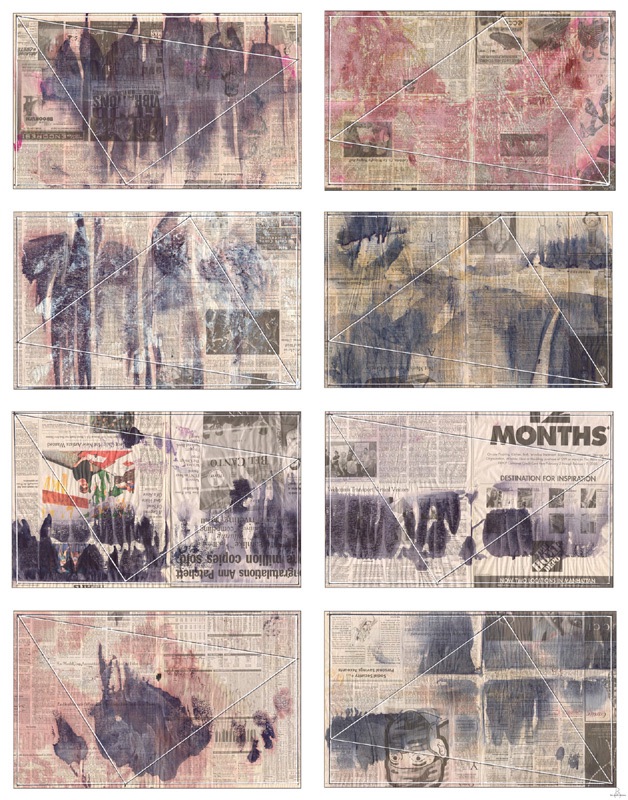
Ricardo Morín: Newsprint Series Nº 2 (2006). 51″ × 65″. Ink, white-out, and blotted oil paint on newsprint. From the Triangulation series.


Annotated Bibliography

  • Arendt, Hannah: Between Past and Future. New York: Viking Press, 1961. (Arendt examines the importance of thinking without absolute supports and illuminates how the discipline of doubt resists political and social certainties).
  • Bauman, Zygmunt: Liquid Modernity. Cambridge: Polity Press, 2000. (Bauman describes the fluidity and precariousness of certainties in modern life and reinforces the idea of doubt as a condition in the face of contemporary volatility).
  • Berlin, Isaiah: The Crooked Timber of Humanity. Princeton: Princeton University Press, 1991. (Berlin analyzes the pluralism of values and the impossibility of single certainties and supports the need to live with unresolved tensions).
  • Bitbol-Hespériès, Annie: Descartes’ Natural Philosophy. New York: Routledge, 2023. (Bitbol-Hespériès examines how Cartesian natural philosophy emerges from a constant exercise of methodical doubt; she offers a contemporary reading that links science and metaphysics in Descartes’ thought).
  • Han, Byung-Chul: In the Swarm: Digital Prospects. Cambridge, MA: MIT Press, 2017. (Han critiques the pressure of transparency and digital acceleration; he provides insights into how technology disfigures the patience required for doubt).
  • Han, Byung-Chul: The Disappearance of Rituals. Cambridge: Polity Press, 2020. (Han explores how digital society weakens spaces of repetition and anticipation to highlight the urgency of recovering anonymity and slowness in inquiry).
  • Croskerry, Pat, Cosby, Karen S., Graber, Mark, and Singh, Hardeep, eds.: Diagnosis: Interpreting the Shadows. Boca Raton, FL: CRC Press, 2017. (Croskerry, Cosby, Graber, and Singh address the cognitive complexity of diagnostic reasoning: they show how uncertainty is inherent in clinical practice and how disciplined doubt can reduce diagnostic error).
  • Elstein, Arthur S., and Schwartz, Alan: Clinical Problem Solving and Diagnostic Decision Making: Selective Review of the Cognitive Literature. New York: Oxford University Press, 2002. (A landmark study in medical decision-making, it shows how diagnostic reasoning is less about static knowledge and more about methodical doubt and verification).
  • Finocchiaro, Maurice: Retrying Galileo, 1633–1992. Berkeley: University of California Press, 2005. (Finocchiaro explores the trials and historical reinterpretations of Galileo’s case; he shows how scientific doubt clashed with religious authority and how it has been re-evaluated in modernity).
  • Gaukroger, Stephen: Descartes: An Intellectual Biography. Oxford: Oxford University Press, 2002. (An intellectual biography that situates Descartes in the cultural context of the seventeenth century and illuminates how Cartesian doubt was also a strategy against religious and scientific tensions).
  • Garber, Daniel: Descartes Embodied: Reading Cartesian Philosophy through Cartesian Science. Cambridge: Cambridge University Press, 2001. (Garber analyzes the close relationship between Descartes’ science and his philosophical method and underscores how scientific practice reinforced the discipline of doubt).
  • Graber, Mark L., Gordon D. Schiff, and Hardeep Singh: The Patient and the Diagnosis: Navigating Clinical Uncertainty. New York: Oxford University Press, 2020. (Graber explores how physicians manage uncertainty and emphasizes that precision in diagnosis emerges from structured methods rather than unquestioned knowledge).
  • Machamer, Peter, ed.: The Cambridge Companion to Galileo. Cambridge: Cambridge University Press, 1998. (In this collection of updated essays presenting Galileo’s work from historical, philosophical, and political perspectives, Machamer illuminates how empirical doubt transformed cosmology).
  • Nussbaum, Martha: Political Emotions: Why Love Matters for Justice. Cambridge, MA: Harvard University Press, 2013. (Nussbaum examines how liberal institutions can responsibly cultivate public emotions—such as love, tolerance, and solidarity. Her arguments enrich the section of the essay on civic-life, which shows how emotional cultivation, beyond belief or skepticism, supports societal inquiry).
  • Popkin, Richard: The History of Scepticism: From Savonarola to Bayle. Oxford: Oxford University Press, 2003. (In this historical study of skepticism, Popkin shows how skepticism evolved between radical distrust and the discipline of inquiry).
  • Shakespeare, William: Hamlet. New Haven: Yale University Press, 2003. (This play offers a literary embodiment of doubt as an ambivalent force: it functions both as the engine of inquiry and the risk of paralysis).
  • Shea, William, and Artigas, Mariano : Galileo in Rome: The Rise and Fall of a Troublesome Genius. Oxford: Oxford University Press, 2003. (An accessible and well-documented narrative of Galileo’s conflict with the Church; it illustrates how persistence in verifying doubt had vital and political consequences).
  • Verghese, Abraham, Saint, Sanjay, and Cooke, Molly: “Critical Analysis of the ‘One Half of Medical Education Is Wrong’ Maxim.” Academic Medicine 86, no. 4 (2011): 419–423. (Authored by Stanford-affiliated leaders in medical education, the report argues that much of medical teaching lacks direct relevance to diagnostic accuracy and underscores the necessity of disciplined doubt and re-evaluation).