*
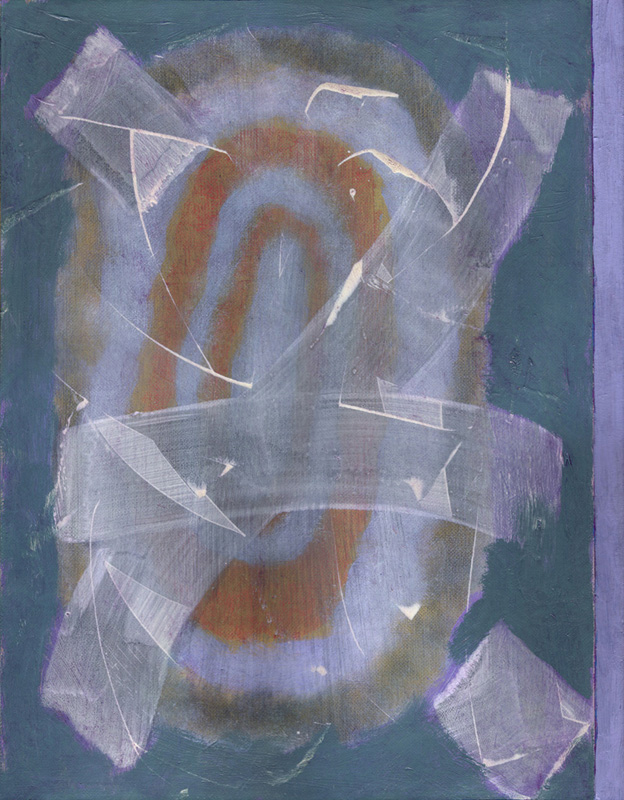
Still Forty-three
Oil on linen
14″ x 18″ x 3/4″
2012
For those who know that the sharpest word cannot replace the simple act of responding with tenderness.
Ricardo Morin — August 13, 2025 — Bala Cynwyd, Pennsylvania
*
Tenderness is a deliberate openness that seeks the well-being of another through a gesture of welcome, through gentleness and respect. Aggression, by contrast, is the forceful assertion of one’s will in a way that can wound, constrain, or dominate. Each can exist without the other, yet they often meet in the same moment, altering the course of a conflict or softening its edge. One sees this when, in the middle of an argument, a person instinctively offers a chair to the other. The dispute remains, but its weight has shifted.
In a world haunted by resentment and the fear of being hurt—feelings as real as they are sometimes exaggerated—tenderness emerges not as a denial of those forces but as their modulation. It interrupts the cycle of suspicion, as when two adversaries, after heated words, lower their voices to hear one another. The hostility remains, but it is tempered, displaced by the recognition that another’s presence is not solely a threat.
Where causality would claim to measure our emotions as predictable reactions, what becomes evident are instead our habits and inclinations—patterns that oscillate between the delicate pull that calms and the impulse that wounds. These shifts reveal that tenderness is not the opposite of aggression, but a mirror exposing how both are woven together from the same human ground.
Tenderness, then, is not the absence of aggression but a mirror showing the weave in which both share a common origin. Consider the exhausted nurse who, after an endless shift, still takes the time to straighten a patient’s blanket. The act is small, yet it springs from the same human ground where impatience and fatigue could just as easily have given way to harshness.
Tenderness carries an ambiguity that makes itself as disarming as it is unsettling. Its apparent fragility dismantles aggression without force, compelling it to see itself in an unexpected reflection: a gentle act that interrupts the urge to harm and leaves it without footing.
Tenderness is not a calculated ruse but a natural pull toward memories older than mistrust—when contact was a need rather than a threat. One sees this when, after years of silence and estrangement, a son returns to care for his ailing father. Resentment remains, yet in the act of tending beats the same root that once sustained closeness.
In such moments, fear loosens, hostility softens, and what seemed a battlefield becomes an uncertain but open passage toward relief. Tenderness does not erase conflict, but shows how—even within it—something older and deeper still binds us. I witnessed this once on the New York City subway. A man, angered when a disabled stranger asked for help, turned his glare on me as our eyes met. He moved toward me as if to strike, bringing his face close to mine. I closed my eyes and eased my expression. Deprived of the stare that had fueled his aggression, he stepped back—uneasy, but no longer advancing. I walked away, marked by how a single gesture can quiet the arc of a confrontation.
There lies a primary bond that ties us to the source of life, where tenderness and aggression are not isolated poles but two expressions of the same human fabric. A sister, in a tense exchange, tells her older brother that she learned her combative stance from him. He bristles at the remark, yet both know they have carried that same hardness for years, and neither can fully blame the other. The recognition does not bring easy reconciliation, but it narrows the distance between them.
From the first bond, the body learns to read the smallest signals: the warmth that welcomes, the pressure that threatens, the pulse that quickens or slows. One sees it when, in the midst of battle, a soldier offers water to a prisoner who only moments before was his enemy. Long before words exist, such gestures shape the habits we later call preferences or fears. This is why tenderness can yield to aggression without conceding defeat: it exposes aggression to an involuntary recognition, restoring the memory of its own root. And in that recognition, even the most hostile impulse finds, if only for a moment, its disarmament.
Tenderness does not eliminate conflict or erase its causes, but it can shift its course. It opens a moment where the certainty of harm gives way to the possibility of presence and care. It is not a cure for all, yet in its quiet way of calling and being heard, tenderness shows that even the firmest aggression seeks acknowledgment. In that acknowledgment, both tenderness and aggression reveal that they spring from the same human ground.
The presence of tenderness in our exchanges is not merely a private virtue but a civic necessity. It sustains the trust and recognition without which communities fracture and cannot endure.
*
Annotated Bibliography
- Arendt, Hannah: The Human Condition. Chicago: University of Chicago Press, 1958. (Hannah Arendt examines the active life of human beings—labor, work, and action—tracing their historical meanings and showing how modern society has altered the conditions for political and civic engagement.)
- Girard, René: Violence and the Sacred. Baltimore: Johns Hopkins University Press, 1977. (René Girard explores the role of violence in human culture, arguing that ritual sacrifice emerged as a mechanism to contain social conflict, and linking these dynamics to myths and religious practices.)
- MacIntyre, Alasdair: After Virtue. Notre Dame: University of Notre Dame Press, 1981. (Alasdair MacIntyre critiques modern moral philosophy, contending that the loss of a shared Aristotelian framework has left moral discourse fragmented and emotive, and proposing a return to virtue ethics.)
- Nussbaum, Martha C.: Political Emotions: Why Love Matters for Justice. Cambridge: Harvard University Press, 2013. (Martha Nussbaum investigates the emotional foundations of a just society, arguing that cultivating compassion, love, and a sense of shared humanity is essential for sustaining democratic institutions.)
*
 Observations On Perception