Posts Tagged ‘ethics’

“Legitimacy”

July 17, 2026
Ricardo F. Morín
CGI 2026

Ricardo F. Morin
CGI 2026

Life does not begin with power.  It begins with dependence.  Before a human being becomes capable of judgment, choice, consent, or resistance, existence already unfolds within relationships upon which survival depends.  No one enters the world invested with autonomy.  Every human life begins by being sustained through the action of another.

Dependence, however, is not sufficient to explain authority.  Whoever possesses greater strength may preserve another’s life, abandon it, or destroy it.  Physical superiority alone cannot explain the character of the relationship through which human life ordinarily comes to develop.  If force alone governed the bond between the one who requires protection and the one capable of providing it, care would cease to be distinguishable from domination.

Care begins to reveal itself as something different from domination through an experience so ordinary that it seldom becomes an object of reflection.  The child gradually discovers a world in which the guidance received is not experienced solely as a limitation imposed from without, but as guidance properly exercised by the person who provides it.  Before authority becomes an object of understanding, it constitutes a lived experience.  Its first appearance assumes not the form of command, but that of care.

Care makes possible a form of dependence that force could never produce:  a dependence that does not extinguish future freedom, but prepares the conditions for its emergence.  The guidance received becomes intelligible because it is exercised for the benefit of a life still in formation, rather than for the immediate satisfaction of the person possessing greater power.

Power and authority operate jointly in the development of civilized life.  Power designates the capacity to act.  Authority designates the acknowledged right to guide, direct, judge, or decide.  Both may be present in the same person, but neither necessarily implies the existence of the other.  Power may exist without authority, just as authority may endure even after power has considerably diminished.

Obedience does not resolve the problem either.  Human beings obey for many different reasons.  They obey because they fear punishment.  They obey because custom has rendered the alternatives invisible.  They obey because deception has concealed the true nature of what is being required of them.  They obey because every form of resistance appears futile.  None of these circumstances constitutes authority.  They explain only submission.

Authority begins only where recognition becomes possible.  The guidance offered by one who leads must possess a title that renders its recognition justifiable independently of force.  A person who accepts the guidance of another does not merely yield before a more powerful will.  The person recognizes that such guidance possesses a title extending beyond the mere fact that it can be imposed.

That recognition constitutes legitimacy.  Legitimacy is not identical with effectiveness, popularity, success, antiquity, or duration.  Nor does it arise from the mere assertion of the person claiming obedience.  It designates the condition under which authority may be recognized as due, rather than merely acknowledged as existing.

Because legitimacy depends upon recognition rather than upon the possession of power, it is more fragile than power itself.  Force may remain intact after legitimacy has already begun to disappear.  Armies may continue to obey.  Institutions may continue to function.  Laws may continue to be enforced.  Yet the basis of recognition has already changed:  what was once acknowledged as due begins to be experienced only as imposed.

From that moment onward, human relationships begin to change without commotion.  Guidance approaches coercion.  Trust yields to calculation.  Responsibility begins to be confused with control.  Instruction approaches indoctrination.  Judgment begins to be perceived as domination.  Authority remains visible while the intelligibility that once made it recognizable gradually recedes.  A son may continue to obey his father from habit long after he has ceased to trust his judgment.  From the outside, the relationship between father and son may appear scarcely altered.  The same words continue to be spoken.  The same decisions continue to be obeyed.  Yet what inwardly sustained the father’s authority has already begun to disappear.

The disappearance of legitimacy does not bring about the immediate collapse of social life.  Human relationships begin to reorganize themselves through means that no longer rest upon recognition.  Where recognition ceases to sustain authority, substitutes arise to take its place.  Force attempts to compensate for what recognition no longer grants.  Fear seeks to secure the obedience that trust has withdrawn.  Custom prolongs practices that scarcely continue to rest upon recognition.  Manipulation manufactures the appearance of consent after genuine recognition has ceased to exist.

None of those means, however, constitutes authority.  Force obtains conduct, but not recognition.  Fear silences resistance, but does not produce assent.  Custom prolongs forms whose intelligibility has weakened.  Manipulation imitates legitimacy because it can no longer produce it.  All such means depend upon the absence of the recognition they seek to replace.

What makes it possible for one human being to recognize the authority of another without reducing that recognition to force, fear, custom, or manipulation?  Every subsequent form of authority will receive its intelligibility from the answer given to that question.

The first manifestation of authority remains inseparable from care because life still depends upon the constant presence of another.  As the child grows, however, dependence begins to change.  Survival ceases to occupy the center of the relationship.  Understanding gradually begins to take its place.

No experience reveals more clearly than language how survival ceases to occupy the center of dependence and understanding begins to assume its place.  No child invents the language through which the world begins to become intelligible.  Words are received before they are used.  Meanings are recognized before they are examined.  Grammar is obeyed long before it can be explained.  Every act of speech therefore presupposes an inheritance that no individual has produced independently.

The transmission of that inheritance cannot be obtained by force.  A child may be compelled to repeat a word, but repetition does not yet amount to understanding.  Language becomes one’s own because correction eventually comes to be recognized as something distinct from imposition.  The child does not merely reproduce sounds.  The child learns that certain words name the world more faithfully than others.  Correction therefore always refers to a reality that transcends the person who corrects.

The acquisition of language also changes the nature of authority.  The dependence characteristic of early childhood ceases to constitute its principal foundation.  Authority now begins to arise from shared participation in an order that precedes both teacher and pupil.  The language existed before either of them.  Neither may claim it as an exclusive possession.  Both remain subject to the same structure that makes communication possible.

For that reason, the teaching of language can never be reduced to the exercise of command.  Whoever corrects an expression ultimately answers to the language itself, and not merely to personal will.  The legitimacy of correction does not arise from the speaker’s desire, but from the fidelity with which the transmitted word corresponds to the language held in common.  Authority then ceases to rest principally upon the person who teaches and begins to rest upon the reality to which that person remains subordinate.

Authority may be recognized even after the personal dependence characteristic of the earliest years of life has disappeared.  The child begins to discover that someone deserves to be heard, not because that person is stronger or continues to provide care, but because that person permits faithful access to a reality existing independently of them both.  Recognition thus ceases to be directed exclusively toward the person and begins to be directed toward what that person makes accessible.

The redirection of recognition toward the reality transmitted, rather than exclusively toward the person transmitting it, profoundly alters human experience.  Authority may now be examined without thereby being abolished.  Correction itself may be corrected.  The teacher may be mistaken.  Neither the examination of authority, nor the correction of what has been taught, nor the teacher’s error destroys the legitimacy of teaching, because legitimacy no longer resides exclusively in the person who teaches, but in the fidelity with which that person transmits what transcends both teacher and pupil.

Civilization begins to be constructed upon this displacement of authority from the person who transmits toward the integrity of what is transmitted.  Once authority becomes attributable to the integrity of what is transmitted rather than simply to the person transmitting it, every higher form of learning becomes possible.  Education, scientific inquiry, moral life, judgment, and constitutional government will each reproduce, within its own sphere, the subordination of authority to an antecedent reality that governs its exercise and makes its recognition possible.

Language, however, does not yet constitute education.  It provides only the possibility of communicating the understanding upon which education may act.  Through language, understanding may be communicated.  Education pursues a different purpose:  the deliberate formation of the understanding.

A teacher corrects a mistaken line of reasoning.  The pupil first recognizes the error in the answer before fully understanding the truth of the explanation received.  Correction does not require obedience alone.  It requires sufficient trust to accept that another person may guide the understanding toward a reality it cannot yet perceive.  With education, authority undergoes a further transformation.  The child no longer depends upon the adult solely in order to inhabit a shared language, but in order to gain access to bodies of knowledge that cannot be acquired through individual experience alone.  Every generation receives a world whose complexity vastly exceeds the duration of any single human life.  Education exists because no human being can always begin again from the beginning.

The authority of the educator cannot therefore derive from age, office, or membership in an institution.  None of those circumstances confers, by itself, the right to guide another person’s intelligence.  The teacher acquires legitimacy only by making accessible a form of knowledge whose validity does not proceed from the teacher.  Where teaching turns the teacher into the true object of learning, education has already ceased to exist.

Intellectual formation therefore requires a discipline common to teacher and pupil.  The teacher answers to the truth of what is taught.  The pupil answers to the effort required to understand it.  Neither governs the educational relationship unilaterally, because both appear before a body of knowledge that neither has created.

Education therefore differs radically from indoctrination.  Indoctrination seeks adherence to the teacher or the preservation of a doctrine irrespective of whether that doctrine retains its intelligibility.  Education pursues the opposite end.  It seeks to enable the pupil to recognize the truth even when that recognition ultimately surpasses the understanding of the teacher.  The success of teaching consists in rendering the authority of the teacher progressively less necessary.

Education thereby reveals one of the least noticed characteristics of legitimate authority.  The more faithfully knowledge is transmitted, the less the pupil depends upon the person who served as mediator.  Education does not perpetuate dependence.  It prepares autonomy without destroying the legitimacy of the relationship through which that autonomy became possible.

Legitimate authority and domination reveal here with greater clarity the contrary directions toward which they move.  Domination needs to perpetuate itself because it depends upon the continuing subordination of the person subjected to it.  Legitimate authority, by contrast, works so that recognition may ultimately sustain itself.  It does not fear the intellectual maturity of the pupil, because it never sought possession of the pupil, but formation.

When teaching attempts to prevent examination, discourages correction, or seeks indefinitely to prolong the pupil’s dependence, it begins to depart from the subordination to knowledge that justified its authority.  Corruption begins when the teacher ceases to understand the self as subordinate to the knowledge transmitted and demands recognition solely by virtue of the continued possession of authority.

A new question arises from the displacement of educational legitimacy away from the person of the teacher and toward fidelity to knowledge.  If the legitimacy of education depends upon fidelity to knowledge rather than exclusively upon the educator, what makes it possible for knowledge to possess authority without becoming another form of institutional power?  That question leads naturally from education toward scientific inquiry.

A researcher devotes years to developing a hypothesis.  The results of new experiments eventually contradict it.  The researcher may ignore them in order to preserve personal prestige or publicly acknowledge that reality has disproved the conclusions.  That decision reveals whether the researcher remains subordinate to the evidence obtained or instead employs the institutional authority of science to preserve personal standing.  Scientific inquiry arises from the obligation to submit the researcher’s conclusions to evidence capable of disproving them.  No proposition becomes true because it was formulated by a prestigious scholar, approved by a renowned institution, or accepted by the majority of specialists.  The authority of science does not proceed from those who practice it.  It proceeds from the discipline through which every assertion remains exposed to examination, replication, correction, or rejection by others.  The scientist therefore appears under the same requirements imposed upon every conclusion.

For that reason, scientific authority possesses a singular character.  The possibility of error does not weaken it; it constitutes one of the conditions that make its legitimacy possible.  An inquiry remains scientifically legitimate because it permits the public correction of its own results.  Error belongs to the ordinary life of science.  What delegitimizes inquiry is not the fact of being mistaken, but the withdrawal of conclusions from the procedure through which they might be shown to be mistaken.

An erroneous conclusion does not destroy the authority of science so long as it remains exposed to demonstration and correction through the same procedures that justify the inquiry.  Error assumes another character when examination is no longer possible, when institutional prestige replaces demonstration, or when assent is demanded independently of any further verification.  At that moment the researcher ceases to mediate knowledge of reality and begins instead to mediate recognition of the self.

Scientific authority, consequently, never resides in the scientist.  It resides in the continuing fidelity of inquiry to the reality it seeks to understand.  The researcher retains authority only while remaining subject to that reality.  From the moment the researcher seeks exemption from that subordination, legitimacy begins to withdraw, even though the institutional power of science may appear to remain intact.

The temptation disclosed within scientific inquiry does not belong exclusively to science.  Every enduring institution eventually confronts the danger of confusing the preservation of its own authority with the preservation of the reality that originally justified its existence.  Institutions seldom lose legitimacy merely by exercising authority.  They begin to lose it when their principal concern ceases to be what was entrusted to them and becomes their own permanence.  Fidelity then yields to self-preservation.  Mediation becomes self-reference.  Authority, which formerly allowed the reality justifying it to be seen with transparency, gradually begins to obscure it.

Scientific inquiry thus leads toward the problem of moral authority.  If science receives legitimacy from its fidelity to truth, does a similar structure govern those forms of authority that cannot be demonstrated experimentally and yet remain indispensable to common life?  That question introduces the problem of moral authority.

A person who exhorts others to tell the truth is discovered in a lie.  The principle remains.  The authority of the person who invoked it disappears.  That ordinary experience introduces a question distinct from all the preceding ones.  What permits one person legitimately to guide the conscience of another?  Moral authority presents greater difficulties than scientific authority because the goods to which it refers cannot be reproduced experimentally or reduced to measurement.

The answer cannot be found in the intensity of conviction.  Every society knows individuals who proclaim virtue while contradicting through their conduct the very principles they affirm.  Neither eloquence, reputation, prestige, nor office confers moral authority by itself.  Before a judgment concerning the good merits recognition, there must exist a correspondence between the life of the speaker and the principles invoked.

Integrity makes that correspondence visible.  It does not guarantee that every judgment will be true.  Nor does it transform anyone into a perfect example.  It permits moral authority to become intelligible because the person who exhorts others remains equally subject to the norms whose observance is proposed.  What human beings recognize is not perfection, but coherence.

Hypocrisy therefore possesses an incomparable power of dissolution.  It does not destroy the moral principle invoked.  It destroys the authority of the person claiming to speak in its name.  A moral requirement may retain its full truth while a particular person loses the right to formulate it.  The contradiction resides not in the principle, but in the rupture between the principle and the conduct of the person invoking it.

Here too, error must be carefully distinguished from corruption.  A morally serious person may err, correct a judgment, or retrospectively discover the insufficiency of earlier conclusions.  So long as that person remains subject to the principles acknowledged, legitimacy remains intact.  Hypocrisy is not a moral error susceptible to correction, but the deliberate claim to an exemption from the norms imposed upon others.  From that moment onward, the principle ceases to govern the person’s conduct, and the person begins to govern the principle.

The experience accumulated thus far reveals a constant.  The father remains subordinate to the good of the child.  The teacher remains subordinate to knowledge.  The researcher remains subordinate to truth.  Whoever speaks in the name of the good remains subordinate to the principles proposed.  In none of these cases does authority arise from personal superiority.  It arises from sustained fidelity to a reality antecedent and superior to the person exercising it.

When that subordination is reversed, corruption begins to manifest itself without any visible rupture.  The good ceases to govern conduct.  Truth ceases to govern inquiry.  Knowledge ceases to govern teaching.  Principles cease to govern conscience.  What originally justified authority begins to be used to preserve authority itself.  The person becomes the source of an authority previously received from the reality to which that person remained subordinate.

Two persons appear with incompatible claims.  Both believe themselves to be right.  Both appeal to justice.  Neither can independently decide which of the two claims should prevail.  There the need for judgment first appears.  Moral life thus leads toward another and still more complex requirement.  Where several persons advance mutually incompatible claims, the guidance of an individual conscience is no longer sufficient.  It becomes necessary to discern between competing rights.  The need to discern between competing rights gives rise to judgment.

Judgment introduces a mode of authority distinct from all those previously considered.  The father guides the child.  The teacher leads the pupil.  The researcher investigates the truth.  The person who lives according to principles seeks to order personal conduct and guide the conduct of others.  The judge, by contrast, appears where two or more incompatible claims simultaneously demand recognition.  Authority then ceases to stand before one person alone and takes its place between persons whose claims must be weighed according to justice.

The complexity of that function does not alter the structure of legitimacy.  No judge acquires authority by occupying a bench, wearing a robe, or possessing the power necessary to enforce decisions.  Such circumstances make the institutional exercise of judgment possible, but they do not explain why that judgment deserves to be recognized as due.  Judicial authority becomes intelligible only when those appearing before it may recognize that the decision remains subject to justice rather than to the interests, preferences, or convenience of the person judging.

Impartiality, consequently, does not constitute a virtue added to the exercise of jurisdiction.  It constitutes a requirement inherent in the act of judgment itself.  The parties seek not merely a decision.  They seek a decision whose authority proceeds from its conformity with a justice that neither judge nor litigants have created.  Justice thereby occupies the place toward which judicial authority points without ever becoming the possession of the person exercising it.

For that reason, even the appearance of partiality may profoundly erode the legitimacy of judgment.  When those who come before the courts begin to perceive that decisions respond principally to the interests of the judge, the institution, or an external power, authority begins to separate itself from justice.  Judgments continue to be issued.  Obedience may continue.  The judicial machinery remains in operation.  Yet recognition gradually ceases to be directed toward the justice of the decision and begins to be directed toward the force ensuring its enforcement.

Within judgment as well, error must be distinguished from the loss of legitimacy.  Judges remain human beings whose understanding is necessarily limited.  An erroneous judgment does not by itself destroy judicial authority so long as the legal order preserves public procedures capable of correcting it.  Appeal, review, and reasoned dissent do not weaken justice.  They manifest the continued subordination of the judicial function to it.

The corruption of judgment begins in an entirely different place.  It begins when the person judging ceases to understand the self as a servant of justice and begins to understand justice as whatever confirms personal authority.  The exercise of jurisdiction then ceases to disclose the law and begins instead to disclose the power of the judge.  Fidelity once more yields to self-reference.  Office occupies the place formerly belonging to justice.

The same reversal has already recurred under successive forms.  Care degenerates when it transforms another life into an object of possession.  Education degenerates when it replaces formation with indoctrination.  Scientific inquiry degenerates when prestige replaces demonstration.  Moral authority degenerates when principles are used to exempt from them the person invoking them.  Judgment degenerates when justice ceases to constitute the end to which judicial authority remains subordinate.

The recurrence of the displacement through which authority occupies the place of what ought to govern it reveals that the inquiry has reached another threshold.  The question is no longer the examination of particular instances of authority.  What now appears is the common subordination of all legitimate authority to what precedes it and governs its exercise.  The inquiry ceases to ask what makes a particular authority legitimate and begins to ask what makes the legitimacy of all authority possible.

Care, language, education, scientific inquiry, moral conscience, and judgment belong to widely different domains of human experience.  Care belongs to the beginning of life.  Language makes a common world possible.  Education transmits knowledge.  Scientific inquiry disciplines the search for truth.  Moral conscience orders conduct.  Judgment restores justice between conflicting claims.  Despite their diversity, all these experiences remain united by a common structure.

In none of them does authority find its origin in the person who exercises it.  The father does not constitute the good of the child.  The speaker does not constitute the language.  The teacher does not constitute knowledge.  The researcher does not constitute truth.  Conscience does not constitute moral principles.  The judge does not constitute justice.  Each receives legitimacy only while remaining faithful to what precedes the exercise of authority and continues to govern it.

Power and legitimacy thus reveal that they proceed from entirely different conditions.  Power exists wherever someone possesses sufficient capacity to impose conduct.  Legitimacy exists only where authority remains intelligible as the faithful mediation of a reality that does not belong to it.  Power may assert itself through possession.  Legitimacy can be sustained only through fidelity.

Legitimacy is therefore at once more fragile and more enduring than power.  It is more fragile because recognition may disappear while institutions continue effectively to perform their functions.  It is more enduring because the realities from which authority receives legitimacy remain beyond those who exercise it temporarily.  Persons disappear.  Institutions change.  Truth, justice, knowledge, the good, and care continue to judge all those who claim to represent them.

The inquiry undertaken thus far has shown the conditions under which legitimacy arises.  The examination must now turn toward the inverse movement.  It becomes necessary to ask how authority begins to lose the very quality that originally rendered it worthy of recognition.

The corruption of authority does not begin with the abuse of power.  Abuse merely makes visible a corruption already under way.  The true deterioration appears at the moment when authority ceases to refer to the reality that legitimized it and begins to demand recognition for itself.  What formerly remained transparent to truth, care, justice, or knowledge slowly begins to obscure them.  The institution, office, person, or tradition occupies the place belonging to the care, knowledge, truth, justice, or common good that originally justified its authority.

The abandonment of the reality that legitimized authority, followed by the demand that authority itself be recognized, is seldom announced by spectacular ruptures.  It almost always proceeds through imperceptible substitutions.  Fidelity yields to preservation.  Mediation becomes representation.  Representation eventually identifies itself with what it claimed to represent.  Little by little, the distance disappears between authority and the reality from which it received legitimacy.  Authority begins to present itself as though it were the source of what it was merely called upon to preserve.

When authority begins to claim itself as the source of its own legitimacy, legitimacy begins gradually to dissolve even while external stability appears intact.  Recognition ceases to be directed toward the good protected, the truth investigated, the justice administered, or the knowledge transmitted.  It begins instead to be directed toward the prestige of office, the permanence of the institution, the continuity of a tradition, or the influence of particular persons.  Trust is demanded because authority exists, rather than because authority remains faithful to what justified its existence.

The consequences reach every form of civilized life.  Where authority loses the capacity to refer beyond itself, the substitutes encountered at the beginning of this inquiry inevitably reappear.  Force attempts to replace lost recognition.  Fear seeks to preserve obedience.  Custom prolongs practices whose foundation has weakened.  Manipulation manufactures the appearance of a legitimacy it can no longer produce.

Civilization does not therefore consist in the mere accumulation of institutions.  It consists in a complex network of authorities whose legitimacy depends upon continuing fidelity to the realities that gave rise to them.  The health of a civilization is not measured by the magnitude of the power it concentrates, but by the degree of transparency with which its authorities continue to refer to care, knowledge, truth, justice, and the common good.

Only at this point does political authority acquire its full meaning.  Constitutional government does not constitute a problem separate from all that precedes it.  Within the sphere of public life, it gathers together all the forms of legitimacy examined thus far.  The question is no longer whether political power possesses a legitimacy peculiar to itself.  It is whether the constitutional order remains subject to the same requirement of fidelity to a reality that precedes and transcends it.

Civilization preserves these forms of authority through institutions.  No generation could transmit language, knowledge, justice, or political order by itself.  Institutions extend the transmission of language, knowledge, justice, and political order through time.

An institution, however, never possesses legitimacy in itself.  A school exists to educate.  A university exists to cultivate knowledge.  A court exists to administer justice.  A research center exists to conduct inquiry.  Constitutional government exists to order the political life of a community through law.  None of these institutions constitutes the principle from which its authority derives.  All remain subordinate to the reality entrusted to their care.

Institutions therefore combine a strength and a vulnerability that do not appear with equal intensity in personal relationships.  Their permanence permits the preservation of achievements extending beyond the duration of any individual life.  Yet that same permanence introduces a constant temptation.  What endures eventually develops interests of its own.  The preservation of what the institution was meant to protect gradually gives way to the preservation of the institution itself.

The subordination of an institutional mission to the preservation of the institution seldom begins through a deliberate act of corruption.  Institutions initially seek to secure the conditions necessary for the continued fulfillment of their mission.  That concern remains legitimate so long as it remains subordinate to the purpose that justified the institution’s existence.  The problem appears when preservation ceases to serve the mission and the mission begins to serve preservation.  Means occupy the place of ends.  The continuity of the institution gradually occupies the place of fidelity to the purpose that justified its existence.

When institutional preservation begins to prevail over mission, the institution ceases to ask whether it continues to make present the reality entrusted to its care.  Its principal concern becomes its own survival.  A university may continue to inaugurate buildings, expand its programs, increase enrollment, and improve its position in the rankings while the formation of the understanding gradually ceases to occupy the center of academic life.  Nothing appears to indicate an institutional crisis.  Yet the purpose that justified the institution’s existence has begun to yield to the preservation of the institution itself.  Truth, justice, knowledge, or the common good ceases to constitute the supreme criterion of institutional examination.  The center of gravity shifts toward the preservation of the organization.

The loss of legitimacy rarely manifests itself immediately because institutional power ordinarily survives the weakening of legitimacy for a considerable period.  Buildings remain open.  Procedures continue to be applied.  Offices remain occupied.  Decisions continue to be produced.  External forms remain recognizable while the foundation that rendered them intelligible begins to withdraw from public experience.

Institutional deterioration is therefore frequently attributed to secondary causes.  Political hostility, economic difficulties, cultural change, or external pressure is blamed.  All these factors may accelerate decline.  None constitutes its origin.  Decline begins when the institution ceases to measure itself by fidelity to the reality it was meant to preserve and begins instead to measure itself by the effectiveness with which it secures its own continuity.

To understand that decline begins when an institution privileges its continuity over the reality entrusted to its care is to clarify one of the most persistent confusions of public life.  Criticism directed toward an institution is often mistaken for hostility toward it.  Yet genuine institutional fidelity may require precisely such criticism when it seeks to restore the institution to the purpose that justified its origin.

Conversely, the most impassioned defense of an institution may contribute to its delegitimation when it seeks to preserve the institution independently of the good it was called upon to serve.

Recognition, consequently, does not necessarily follow permanence, nor does it inevitably accompany change.  It follows fidelity.  Institutions remain legitimate only so long as they continue to make present what originally conferred authority upon them.

Among all institutions, one bears a responsibility greater than the rest.  Unlike the school, the court, or the laboratory, the constitutional order does not administer one particular sphere of human experience.  It establishes the juridical framework within which all other authorities may legitimately exercise their respective functions.  Constitutional legitimacy therefore constitutes the broadest expression of the same structure that has unfolded from the earliest relationships of care.

Constitutional authority does not constitute an exception to the preceding forms of legitimacy.  On the contrary, it presupposes and gathers them within the organization of public life.  What care accomplishes within the family, teaching within the formation of the understanding, inquiry within the knowledge of truth, moral conscience within conduct, and judgment within the administration of justice, the constitutional order must accomplish in relation to the political community as a whole.

Government therefore never acquires legitimacy merely by governing.  To govern demonstrates the existence of power.  Constitutional legitimacy raises a different question.  The existence of a government does not answer that question.  It merely makes the question impossible to evade.

The answer cannot depart from the structure already disclosed within every preceding form of authority.  Just as the teacher does not constitute knowledge, the researcher does not constitute truth, and the judge does not constitute justice, government does not constitute the origin of the public authority it exercises.  Political authority necessarily remains subordinate to a reality that precedes and transcends it.

That reality is not the government itself, the organs composing it, administrative continuity, the effectiveness of public policy, institutional permanence, international recognition, partisan support, or the practical necessity of maintaining order.  All these circumstances may accompany the exercise of power.  None is sufficient to confer legitimacy upon it.

Public authority remains legitimate only so long as it continues to be attributable to the political community from which it proceeds.  A government may retain control over ministries, public administration, the armed forces, and international relations.  None of those circumstances yet answers the decisive question.  All describe who exercises power.  None yet demonstrates to whom public authority is constitutionally attributable.  Government is not the owner of public power.  It exercises that power in the capacity of a derivative authority.  The source of that authority always remains outside government itself.

That same subordination protects the constitutional order from one of the oldest temptations of politics.  Every government tends spontaneously to identify the continuity of its own existence with the continuity of the political community it administers.  Yet the two can never be identical.  The political community remains.  Governments pass away.  Public power does not belong to those who temporarily exercise it.

When government begins to identify the continuity of its own existence with the continuity of the political community, the corruption through which authority occupies the place of the reality that ought to govern it reappears.  Government gradually ceases to refer to the political community from which it receives legitimacy.  It begins to claim recognition because it governs, because it administers, because it preserves order, because it has survived, or because no immediate alternative appears to exist.  The source of legitimacy begins to yield its place to the exercise of power itself.

At that moment, constitutional attribution begins to be replaced by mere political effectiveness.  Public recognition ceases to be directed toward the constitutional conditions from which authority arises and begins instead to be directed toward the continued possession of power.  Administration replaces attribution.  Continuity replaces legitimacy.  Possession replaces title.  Elections may continue to be held.  Courts may continue to issue judgments.  The budget may continue to be executed.  Yet public discussion may already have ceased to inquire into the constitutional title of power and begun to concern itself solely with the administration of those exercising it.  There the substitution begins to become visible.

The replacement of constitutional attribution by political effectiveness does not require the immediate collapse of the constitutional order.  Constitutions may continue to be invoked.  Institutions may continue to function.  Elections may continue to be held.  Governments may continue to administer the state.  The visible forms of constitutionalism remain standing while the legitimacy that gave them meaning gradually withdraws from public consciousness.

The consequence extends beyond the political sphere.  When public authority begins to claim recognition by virtue of its mere permanence, subordinate institutions eventually reproduce the same reversal.  The subordination of authority to the good, knowledge, truth, justice, and the political community weakens throughout civilized life.  The substitution of control for care, first perceived within relationships of dependence, ultimately reaches its broadest political expression when the permanent exercise of power occupies the place of constitutional attribution.  Civilization then begins to reorganize its understanding of authority around power rather than legitimacy.  The displacement seldom manifests itself simultaneously within every sphere.  It may begin in the family, continue within the school, become visible in institutions, and eventually reach the political order.  Wherever authority begins to justify itself through the permanence of the person exercising it rather than through the reality to which it remains subordinate, permanence occupies the place of legitimacy.

No civilization can sustain itself exclusively upon power.  Power organizes conduct, secures obedience, protects borders, administers resources, and represses disorder.  None of this explains, however, why authority continues to be recognized as due after fear disappears, circumstances change, or a greater force arises.  Power governs conduct.  Legitimacy governs recognition.  Where recognition disappears, power must rely with increasing intensity upon the substitutes that legitimacy had rendered unnecessary.

The most profound danger confronting a civilization therefore seldom appears initially in the form of violence.  It begins when attention ceases to be directed toward the realities that justified authority.  Care is replaced by control.  Knowledge by prestige.  Truth by consensus.  Justice by decision.  Constitutional attribution by the administration of power.  Little by little, attention ceases to be directed toward what conferred legitimacy and becomes fixed exclusively upon the person exercising authority.

None of this need assume a revolutionary appearance.  Parents continue to raise their children.  Teachers continue to teach.  Researchers continue their work.  Judges continue to issue decisions.  Governments continue to govern.  Outwardly, civilization appears to preserve the same physiognomy.  Yet beneath those familiar forms, another source of recognition has been established, founded upon utility, influence, identity, necessity, or mere permanence, which begins to occupy the place formerly belonging to legitimacy.

When the substitution of legitimating reality by the authority that claimed to represent it becomes habitual, the nature of disagreement itself changes.  Discussion ceases to ask whether authority remains faithful to the reality that legitimized it.  It begins to ask only whether authority is effective, convenient, representative, or sufficiently powerful to impose itself.  Inquiry into legitimacy slowly disappears from the public horizon.  Power begins to explain itself.

From that moment onward, every authority bears an increasing burden.  No institution can indefinitely replace through force what legitimacy alone can sustain.  Fear is eventually exhausted.  Custom loses force with the passing of generations.  Manipulation ultimately reveals the will directing it.  Even force encounters limits beyond which obedience ceases to produce recognition.  Authority that has ceased to refer to a superior reality ultimately depends upon itself alone.

The decisive question has never consisted in determining whether civilization requires authority.  No form of common life can exist without it.  The true question is whether authority will continue to recognize the realities from which it derives legitimacy or whether it will ultimately replace them with itself.  No generation is exempt from answering that question anew.

The abolition of legitimacy destroys more than governments or institutions.  It destroys the very possibility that one human being might recognize the authority of another without being reduced to force, fear, custom, or manipulation.  The loss does not belong exclusively to the political order.  It reaches every relationship through which a common world may come into existence.

Legitimacy therefore does not constitute an incidental attribute of civilization or a quality reserved for constitutionalism.  It constitutes the silent condition permitting human beings to inhabit a common world without having to explain every form of authority through domination.  So long as that condition remains alive, authority will continue to be transparent to the reality that legitimizes it.  When it disappears, civilization will not perish immediately.  It will simply begin to forget why authority existed.

July 15, 2026
In transit through Pennsylvania
“The Limits of Responsibility”

July 9, 2026

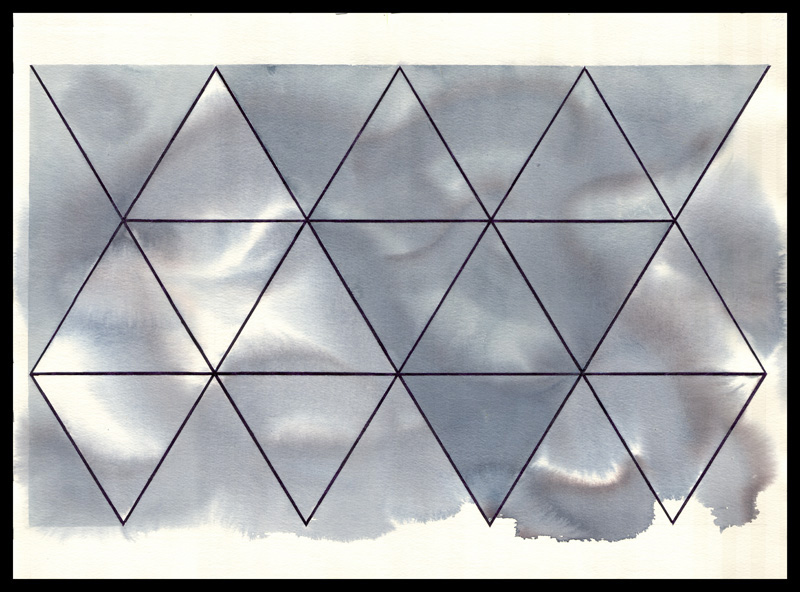
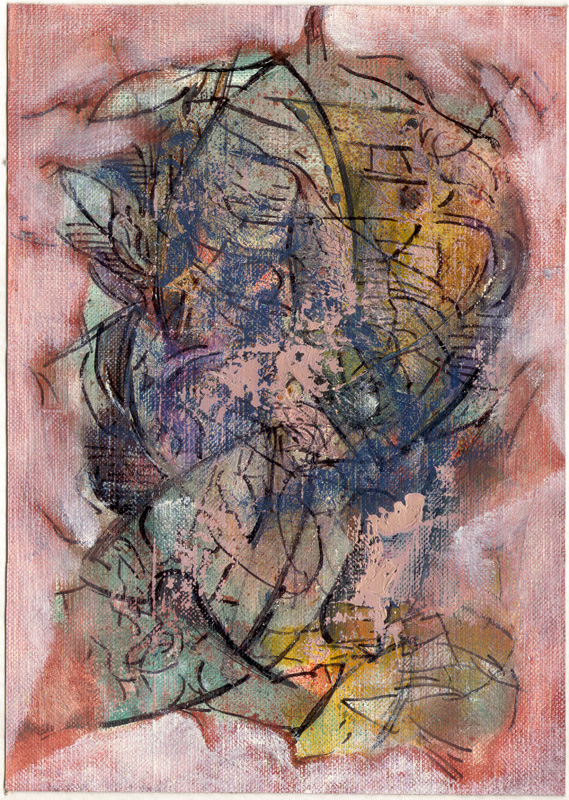
Triangulation Series Nº 49
9“ x 13”
Oil on linen
2009

The decision to authorize the destruction of a collection of 145 paintings completed over many years is neither sudden nor simple.  The paintings have remained in Venezuela for more than two decades under conditions favorable to the growth of mold and the spread of termites.  Their recovery would require technical evaluation, laboratory analysis, conservation studies, specialized storage, transportation, and an eventual destination.  None of those steps can proceed independently.  Each depends upon the successful completion of the preceding one.

The paintings were created without any of those concerns.  They appeared under ordinary conditions of artistic work.  Time gradually altered those conditions until preservation itself became the principal question.

The physical condition of the paintings, however, does not by itself determine the decision.  Even if technical studies concluded that recovery remained possible, every subsequent stage would continue to involve uncertainty.  Technical reports cannot determine future deterioration.  Restoration cannot guarantee permanence.  Storage cannot ensure an eventual destination.  Each solution introduces another condition whose fulfillment depends upon circumstances that remain beyond the creator’s control.

The cost of such an undertaking also extends beyond financial resources.  No decision concerning the collection can be separated from the responsibilities it would place upon those expected to carry it out.  A work created by one person cannot indefinitely become the burden of another.  Under those circumstances, the question gradually changes.  It no longer concerns only the condition of the paintings.  It also concerns the responsibilities assumed in attempting to preserve them.

Those responsibilities do not remain abstract.  Under particular circumstances, they acquire an identifiable human dimension.  In the present case, they would rest upon members of my own family whose personal circumstances no longer permit burdens of that magnitude.  The condition of the paintings therefore cannot be separated from the condition of those expected to preserve them.

The present circumstances recall an earlier period under conditions altogether different.  In 1995, the possibility of destroying the work arose from the expectation that my life itself might be approaching its end.  The paintings then appeared inseparable from the prospect of my own disappearance.  Their destruction seemed a final act over which I alone retained authority.

More than three decades have elapsed since that time.  The external possibility has returned.  The internal circumstances have not.  The present decision proceeds from no expectation of imminent death.  It arises while health remains stable and life continues its ordinary course.  The resemblance therefore exists only in appearance.  The same decision arises from different circumstances.

The difference lies not in the paintings but in the conditions surrounding them.  In 1995 the question concerned the relation between the work and its creator.  The present question concerns the relation between the work and the circumstances required for its preservation.

The paintings in Venezuela present a different situation, but they raise the same question.  A work may remain physically intact while its future depends increasingly upon circumstances outside the creator’s immediate care.  Physical deterioration, financial resources, institutions, heirs, markets, and time each become part of that process.  Their influence cannot be excluded by artistic intention alone.

During those intervening years another experience introduced a different consideration.  In 2017, two hundred later paintings entered public auction in the United States.  The opening bid of one dollar established neither their artistic merit nor their significance.  It established only the conditions under which the market would receive them.  Some were acquired for considerably more than the opening bid and continue to circulate through online auctions.  From that moment forward, decisions concerning those works no longer belonged exclusively to their creator.

The question therefore extends beyond painting.  The same responsibilities accompany paintings, manuscripts, digital archives, institutional collections, libraries, and executors, although each assumes a different practical form.  Every body of work eventually reaches a point at which its continued existence depends less upon the act that produced it than upon conditions arising afterward.  Responsibility gradually passes from the act of creation to the circumstances governing preservation.

That observation neither diminishes the work nor determines its eventual fate.  Some works survive for centuries.  Others disappear within a generation.  Neither outcome alters the fact that they were created.  What changes is the responsibility for their continued existence.

The present decision concerning the paintings belongs to those circumstances.  It does not establish a general rule regarding preservation, nor does it diminish the importance of conservation where conservation remains reasonable.  It defines only the limits imposed by a particular set of circumstances.  Beyond those limits, preserving the work would require responsibilities no longer justified by the conditions under which the decision must be made.

The same consideration applies to a literary corpus.  Libraries, executors, institutional deposits, and digital repositories may extend the life of a body of work.  They cannot remove it from the ordinary conditions that govern every human undertaking.  Responsibility does not consist in exhausting every conceivable means of preservation.  It consists in recognizing the point at which preservation itself no longer remains a responsible undertaking.

The work begins under the care of its creator.  It does not remain there indefinitely.  Circumstances gradually assume a greater role than intention, until the future of the work depends upon decisions made by others and under conditions the creator neither established nor controls.  Recognizing that transition acknowledges the point at which responsibility for the continued existence of the work no longer rests with the person who created it.

The question therefore does not consist in quieting the emotions naturally accompanying such a decision.  It consists in accepting what circumstances no longer make possible.  The two are not the same.  One concerns the inner life of the individual.  The other concerns the conditions under which responsibility can still be honestly exercised.

Ricardo F. Morin

July 9, 2026

Bala Cynwyd, Pennsylvania


“The Paradigm of Extraction”

March 18, 2026

*

Ricardo Morin
Untitled #5: The Paradigm of Extraction
10″x12″
Watercolor
2003

The story of artificial intelligence is usually told as one of endless promise—a technology meant to transform economies and redefine human potential.   Yet beneath the optimism lies an older reality:   the conversion of human creativity into concentrated wealth.   What is presented as progress often repeats the oldest economic pattern of all—the extraction of value from the many for the benefit of the few.   The language surrounding AI hides this continuity. It turns innovation into a spectacle of inevitability, a vision of boundless gain that distracts from its unequal foundations.

The spectacle depends on persuasion.   Words like manifested intelligence, the next trillion-dollar frontier, and inevitable transformation are not descriptions; they are marketing.   They frame profit as destiny and invite participation not in discovery but in speculation.  Numbers such as “$80 trillion” and “25,000 percent returns” echo through news cycles like prophecies, and turn investment forecasts into moral certainty.  This rhetoric reshapes public imagination.   AI stops being a tool for solving human problems and becomes a financial phenomenon—a story about wealth rather than understanding.

These promises do not mark a new beginning.   They repeat the same cycle that accompanied every major invention.   The Industrial Revolution produced machines that changed work but deepened social divides.   The digital revolution spread information but concentrated ownership.   AI now enters that history as its newest expression.   Its power to expand knowledge and serve the public good is real, but its first allegiance remains to profit.   Within existing systems, it accelerates the accumulation of capital instead of correcting its imbalance.

The mechanisms of this concentration are easy to see.  Proprietary models fence off knowledge behind paywalls and patents.   Data collected from the public becomes private property.   The cost of computing power and specialized expertise limits who can participate.   The outcome is predictable:   the majority will experience AI not as empowerment but as dependency.  Far from leveling inequality, it builds it into the infrastructure of tomorrow.

This direction grows more troubling when placed beside the world’s most urgent needs.  Billions of people still live without reliable food, healthcare, or education—conditions technology could transform but rarely does.   The most profitable uses of AI instead optimize advertising, influence behavior, and extend surveillance.   These are not accidents.   They are the logical results of a system that values profit over human welfare.   When progress is measured only in shareholder value, technology loses its moral compass and society loses its claim to wisdom.

A newer and equally dangerous use of these systems has emerged in the political sphere.   The same tools that target consumers now target citizens.  Governments with autocratic tendencies have begun using generative models to flood public discourse with persuasive content, to blur the boundary between truth and fabrication, and to cultivate obedience through simulation.   Recent reporting shows how executive offices deploy AI to craft political messages, to amplify loyal media, and to drown out dissenting voices.   Such practices transform intelligence into propaganda and data into domination.  When a state can algorithmically manage perception, democracy becomes performance.  The concentration of wealth and the concentration of an engineered belief reinforce each other, both materially and mentally.

We have seen this pattern before.   In every technological era, wealth has turned into political power and then used that power to protect itself.   Railroad barons shaped monopolies in the nineteenth century.  Oil empires steered foreign policy in the twentieth.  Today, digital conglomerates write the rules that sustain their dominance.   AI follows the same gravitational pull, guided less by human vision than by financial gravity.

In the present order, the union of technological power and financial speculation no longer produces discovery but dependence.  Wealth circulates within an enclosed economy of influence and rewards those who design the mechanisms of access rather than those who expand the reach of knowledge.  What appears as innovation is often a rehearsal of privilege:  an exchange of capital between the same centers of authority, each validating the other while society absorbs the cost.  When creativity becomes collateral and intelligence a lease, progress ceases to serve the public and begins to serve itself.

The most seductive illusion sustaining this order is the myth of inevitability—the belief that technological advance must produce inequality, and that no one is responsible for the outcome.   It is a useful fiction.  It spares those in power from moral scrutiny by turning exploitation into fate.  Yet inevitability is a choice disguised as nature.  Societies have always shaped the use of technology through their laws, values, and courage to intervene.   To accept inequality as destiny is to abandon that responsibility.

Rejecting inevitability means reclaiming the idea of progress itself.  Innovation is not progress unless it expands the freedom and security of human life.   That requires intentional direction—through public investment, fair taxation, transparent standards, and strong international cooperation.   These are not barriers to growth; they are the conditions that make genuine progress possible.   Markets alone cannot guarantee justice, and technology without ethics is not advancement but acceleration without direction.

Measuring progress differently would change what we celebrate.   If an AI system reduces medical errors in poor communities, strengthens education where resources are scarce, or helps citizens participate more fully in democracy, its worth exceeds that of one that merely increases profit margins.  The true measure of intelligence—artificial or human—is the good it brings into the world.   Profit is only one form of value; human dignity is another.

At the center of this order lies a quiet hypocrisy.   Wealth is praised as the reward of discipline and intelligence, yet it depends on the continuous extraction of value from others—the worker, the consumer, the environment.   What appears as merit often rests on inequality disguised as efficiency.   The same pattern defines artificial intelligence.   Built from shared human knowledge and creativity, it is enclosed within systems that sell access to what was freely given.  Both forms of accumulation—financial and technological—draw their power from the very resources they diminish: human labor, attention, and imagination.   In claiming to advance society, they reproduce the inequity that turns vitality into stagnation—the inversion of what progress is meant to be.

The fevered talk of trillion-dollar opportunities belongs to an old vocabulary—the language of extraction mistaken for evolution.   The real question is whether intelligence will continue to serve wealth or begin to serve humanity.  Artificial intelligence offers that choice:  to repeat the logic that has long confused accumulation with advancement, or to build a future where knowledge and prosperity are shared.   That decision will not emerge by itself.   It depends on what societies demand, what governments regulate, and what values define success.  The window to decide remains open, though it narrows each time profit is allowed to speak louder than conscience.

The preceding observations concern the consequences of extraction.  The institutional logic that produces these consequences belongs to a wider historical pattern in modern economic development.  That pattern is examined separately in “The Logic of Extraction.

By Ricardo F. Morín, Oct. 2025, Oakland Park, Florida.


“Lines That Divide”

March 1, 2026
Ricardo Morin
Silence III
22’ x 30” 
Watercolor, graphite, gesso, acrylic on paper 
2010

  • Rethinking Identity and Entitlement in Civic Life


The phrase “my people” draws lines.  It signals allegiance before argument begins.  It may express familiarity, shared memory, or recognition.  Yet the same words separate one group from another.  A boundary forms, often without intention.  Those inside feel affirmed; those outside may feel unseen.

Such moments rarely begin as acts of exclusion.  They arise from ordinary human impulses:  the desire to protect what feels familiar, to defend what has been wounded, or to claim space where one has felt overlooked.  But when identity becomes the primary language through which claims are made, conversations change.  Disagreement becomes personal.  Listening becomes strategic.  The space where people meet as equals contracts.

Group identity has long provided people with strength and protection.  It helps individuals recover dignity when they feel ignored or misunderstood, and it offers language through which shared experiences can be recognized.  Yet the same force can also narrow perception.  When group identity becomes the main lens through which people judge one another, ideas are weighed less on their merit and more on the speaker’s affiliation.

When ideas begin to be judged primarily through identity rather than merit, the change is often subtle.  An exchange that begins openly can become defensive as participants look for signs of alignment or opposition.  Words are weighed for allegiance.  Questions are interpreted as challenges rather than invitations to examine ideas together.  Over time, dialogue shifts from exploration toward defense of positions. Judgment shifts from the merit of an idea to the standing of the speaker.

Many people carry an expectation into public life that they will be treated consistently.  Uneven rules are recognized quickly.  When identity determines whose voice counts before ideas are heard, trust weakens not only among those excluded, but also among those unsure whether they are seen as individuals or as representatives of a category.

Problems deepen when identity stops being one part of a person’s experience and begins to overshadow all others.  Public debate narrows.  Arguments are interpreted as attacks on identity rather than disagreements over ideas.  People feel compelled to defend positions not because they are persuaded by them, but because reconsidering publicly may be treated as betrayal.  The result is not stronger community, but increasing rigidity, where listening carries risk and reconsideration feels unsafe.

People turn toward simplification and absolutism to reduce uncertainty and relieve the strain of complexity.  This tendency does not permanently define human interaction; it marks moments when ambiguity feels intolerable and certainty appears easier to sustain.  Certainty offers relief, but it reduces the space in which plurality can endure.  The tension itself does not disappear; only the way people attempt to manage it changes.

Contemporary communication technologies accelerate the circulation and visibility of opinion.  Expressions that promise certainty or provoke fear travel farther and faster; expressions that sustain ambiguity move more slowly.  This circulation amplifies tendencies toward simplification, reinforcing what attracts attention rather than what withstands examination.

When identity becomes the basis for deciding who others are before dialogue takes shape, examination gives way to labeling.  Nuance is set aside.  Individuals become symbols of larger struggles, and ordinary encounters carry the weight of broader conflicts.  Under these conditions, disagreement resembles confrontation even when intentions remain sincere.

Public life rests on an expectation that the same rules apply to all.  Uneven application becomes visible when some voices are heard more readily than others or when identity determines credibility before ideas are considered.  Under these conditions, conversation shifts from exchange toward competition for recognition, and the possibility of shared judgment becomes more difficult to sustain.

The tension does not belong to one group alone; this situation affects everyone who participates in public life.  Each person seeks recognition while fearing misinterpretation.  Attempts to resolve disagreement through persuasion alone often reach limits beyond individual control.  Listening, under these conditions, does not erase distance but allows interaction to continue despite it.

Differences remain, and disagreement persists.  The lines that divide do not disappear; they shift, harden, or soften as people respond to one another in ordinary encounters.  Living together does not remove tension; living together reveals tension.  No shared answer resolves the matter.  Each person must decide how to respond and how to live alongside others within limits no one fully controls.

Ricardo F. Morín, February 15, 2026, Oakland Park, Florida.


“REFUSAL”

February 4, 2026

Ricardo F. Morín
My Nest
24′”x30″
Oil on linen
1999

Help was not offered casually.  It was offered over time,   shaped by history,   familiarity,   and a belief that loyalty required staying present when circumstances were unsettled.  Unclear commitments were accepted with the expectation that steadiness might compensate for instability,   and that patience would allow clarity to arrive where it had not yet appeared.

As time passed,   those commitments became harder to anticipate.  Plans shifted after they were accepted.  Expectations changed without being stated.  What had been agreed to one week was revised the next.  Each adjustment was absorbed rather than challenged.  Meetings no longer produced decisions.  Agreements no longer survived the week.  The effort to remain fair became an effort to remain adaptable.  What was not confronted was carried.

There was hesitation in naming what was occurring.  Doing so felt severe.  It risked appearing uncharitable or impatient.  Silence often seemed preferable to objection,   not because nothing was seen,   but because what was seen resisted easy articulation.  Silence,   once a form of restraint,   had ceased to clarify anything.  Endurance appeared safer than judgment.

Gradually,   the effects of that endurance became visible.  Loyalty did not stabilize the situation.  It prolonged it.  The more uncertainty was accommodated,   the more it became the organizing condition.  Commitments lost their edges.  Responsibility dispersed.  Care,   extended without limit,   ceased to correct anything and instead made instability easier to sustain.

At one point,   a friend chose a different posture.  He remained attentive,   but at a distance.  He did not intervene repeatedly or attempt to steady what showed no sign of holding.  At the time,   that distance was easy to misread.  Commitment,   as it was then understood,   appeared to require proximity.  Restraint looked like withdrawal.

Only later did the significance of that posture become clear.  What had appeared passive was a form of orientation.  Limits had been recognized earlier,   and conduct adjusted accordingly.  Distance had not signaled indifference,   but an understanding that presence,   under unstable conditions,   does not always improve outcomes.  The difference lay not in intention,   but in timing.

This recognition unsettled earlier assumptions.  Proximity had been mistaken for responsibility.  Endurance had been treated as virtue without asking whether it was sustaining anything beyond the appearance of care.  What felt like loyalty had,   in part,   become permission.  The most difficult admission was not about the actions of others,   but about the role played in allowing those actions to continue without consequence.

Distance did not follow immediately.  It came after repeated attempts to restore proportion,   after explanations failed to hold,   and after silence ceased to clarify anything.  Withdrawing was not a rejection of concern.  It was the only remaining way to prevent concern from being consumed by unpredictability.  It was a way of preserving judgment, preventing concern from being consumed by unpredictability, and leaving open the possibility that conditions might yet change

Refusal,   understood in this way,   is not dramatic.  It does not accuse or announce itself.  It does not seek recognition.  It withdraws consent quietly and allows arrangements either to stabilize or to reveal their own limits.  What ends is not care,   but participation in conditions that require self-deception to endure.

This form of refusal is not moral superiority.  It is responsibility turned inward.  It begins when remaining present requires abandoning one’s own judgment,   and when loyalty,   left unchecked,   undermines what it was meant to protect.  Silence,   at that point,   does not evade obligation.  It restores coherence.

The act is restrained.  Its consequences are durable.  By stepping back,   one ceases to supply the energy on which instability depends.  What remains intact is judgment without foreclosing the possibility of renewal should proportion be restored.  What is relinquished is the belief that endurance is always ethical—and refusal becomes the means by which clarity, rather than rupture, is maintained.

*

Ricardo F. Morín, January 1, 2026, Oakland Park, Florida.


“River Grass”

December 7, 2025

Ricardo Morin
Landscape II: River Grass
18” x 24”
Sepia on newsprint 
2003

Ricardo F Morin

Dec. 6, 2025

Naples. Florida

*

This diptych, “River Grass” and “Naples in the Morning,” brings together a reflection on continuity and a brief observation of everyday life.  Two scenes—one sustained, the other fleeting—register how experience, silence, and attention shape presence.  The first part, “River Grass,” does not present an argument, a confession, or a theory.  It offers an observation shaped over time by proximity rather than distance.   The focus is not on individual psychology or relational conflict, but on patterns that take form across generations and persist quietly within everyday life.

What follows avoids moral explanation and narrative resolution.   It attends instead to continuity—how restraint, generosity, and presence may be transmitted not through instruction or memory, but through posture, habit, and orientation.   The intention is to describe without adjudicating, and to clarify without assigning cause where cause cannot be cleanly isolated.   What is traced here represents one possible orientation among many, shaped by inheritance but not exhaustive of its effects—an invitation not to mistake the channel for the ocean.


Orientation of “River Grass”

What follows attends to what persists when lives are shaped by continuity rather than interruption.

Not all inheritance arrives as memory.   Some is conveyed without story, without date, without language.   It enters through atmosphere rather than narrative—through cadence, restraint, posture, and a preference for continuity over display.   In such cases, history is not recalled; it is carried.

This form of inheritance does not announce itself as trauma.   It leaves no single scene to revisit, no episode that can be isolated and explained.   Instead, it appears as a way of moving through the world:   measured, attentive, resistant to excess.   The past exerts influence not by instruction but by shaping what feels permissible, sustainable, or necessary.

Under these conditions, restraint is not experienced as loss.  It functions as orientation.  Accommodation does not signal submission but competence.   Stability reflects not the absence of desire but the quiet placement of desire among other priorities.   What is transmitted is not fear but caution—an ethic of endurance refined over time.

Because no event is foregrounded, little invites interpretation.   The absence of visible distress encourages the assumption of ease.   Life appears ordered, generous, and intact.   Yet the inheritance remains active and structures conduct without requiring acknowledgment.   It persists not as memory but as form.

Such inheritance often resists recognition precisely because it has succeeded.   The past has not repeated itself.   Continuity has been preserved.   What remains is a posture oriented toward sustaining that continuity—a vigilance so normalized that it passes as temperament rather than history.

Restraint, in this context, does not operate as inhibition or denial.   It functions as a stabilizing orientation—an internal calibration shaped over time.   Action is guided less by expression than by proportion and durability.   What governs choice is not moral judgment but coherence.

Such restraint often coexists with clarity and decisiveness.   Boundaries are maintained without conflict; decisions are made without excess emphasis.   What is avoided is not agency but surplus.   Expression is moderated not through fear of consequence, but through an internal sense of sufficiency.

Accommodation here is frequently misread.   It does not arise from compliance or uncertainty, but from an assessment of impact.   Space yielded to others reflects confidence in structure rather than retreat from position.   Presence remains intact even when it is not foregrounded.

This orientation produces a stability that can appear effortless.   Friction is minimized.   Demands are rare.   The absence of insistence is readily mistaken for ease or contentment.   Yet the restraint at work is active, not passive—and continuously shapes what is articulated, deferred, or left unspoken.

Over time, restraint becomes difficult to distinguish from identity.   It ceases to register as a choice among alternatives and hardens into posture.   The question of expression recedes, replaced by an emphasis on responsibility, proportion, and non-disruption.

Generosity shaped by inherited restraint rarely announces itself.   It does not seek recognition or reciprocation, nor does it depend on visibility for validation.   It appears instead as availability, as the quiet removal of obstacles, as the willingness to yield space without narrative or sacrifice.

In this form, giving is non-transactional.   No balance is tracked; no return anticipated.   What is offered is steadiness rather than favor.   Support unfolds without appeal, often unnoticed, absorbed into ordinary conduct.   The absence of demand is integral rather than incidental.

Because it imposes no weight, such generosity leaves little trace.   Others encounter freedom without sensing its source.   Autonomy is enabled without attribution.   The one who gives remains present yet unmarked.

Over time, the habit of making room for others becomes more practiced than the habit of entering it.   Attention turns outward and refines responsiveness while narrowing self-directed articulation.   What persists is not loss, but redirection.

This configuration resists conventional readings of imbalance.   No grievance emerges; no conflict announces asymmetry.   Generosity remains intact, even exemplary.   What shifts subtly is internal emphasis: presence exercised through allowance rather than assertion.

Desire, within this orientation, is neither denied nor suppressed.   It is repositioned.   Its legitimacy is not questioned, but its urgency is diminished.   What is set aside is not longing itself, but the expectation that longing must organize life.

Desire is acknowledged yet rarely centered.   Expression is permitted elsewhere more readily than inwardly claimed.   Attention gravitates toward what preserves stability rather than what intensifies experience.   Satisfaction arises from coherence rather than culmination.

This produces no vacancy.   Life remains engaged and responsive.   What diminishes is insistence.   Continuity comes to matter more than appetite; durability more than immediacy.

Because this arrangement is not framed as renunciation, it escapes notice.   No moral language surrounds it.   Nothing is named as sacrifice.   Desire persists at a distance—observed, managed, deferred without struggle.

Over time, identity becomes shaped less by pursuit than by maintenance.   Expression gives way to stewardship.   Meaning accrues not through arrival, but through the avoidance of rupture.

Patterns organized around restraint and continuity are often mistaken for moral attainment.   Composure is read as wisdom; accommodation as maturity; silence as depth.   Because no disturbance arises, the orientation escapes examination.   What functions smoothly is presumed complete.

This misreading is reinforced by social frameworks that reward stability over inquiry.   Absence of conflict is taken as evidence of balance.   Generosity without demand is praised rather than interrogated.   Its costs remain obscured precisely because they impose nothing on others.

Virtue, in this setting, becomes indistinguishable from habit.   Adaptive orientation solidifies into character, and character into expectation.   Reliability is affirmed repeatedly, deepening its hold.

The result is not deception but omission.   The steadiness is genuine.   What goes unrecognized is how fully such an arrangement organizes life around preservation rather than presence.   The question of displacement remains unasked, not refused.

Misreading occurs through success.   Relations endure.   Structures hold.   No obvious harm appears.   And so the deeper configuration—quiet, durable, historically shaped—continues beneath the language of virtue.

At a certain threshold, continuity shifts from supporting means to governing end.   Life becomes organized not around fulfillment, but around preservation.   What matters most is that nothing essential is exposed to rupture, whether through excess demand or through untested assertion.

Fulfillment is not rejected, but subordinated.   Satisfaction arises from duration rather than intensity.   Time is oriented toward extension, not culmination.   What is valued is the capacity to carry forward intact.

This proves effective.   The past does not recur.   Stability holds.   Loss is contained rather than amplified.   Inherited imperatives are honored not through recollection, but through conduct.

Yet when continuity occupies this position, the range of permissible movement narrows.   Change must justify itself in advance.   Desire must demonstrate durability before enactment.   Expression yields to maintenance.

The future is approached as responsibility rather than as open terrain.   Meaning accumulates through safeguarding what is essential rather than through the exploration of possibilities.   Success becomes synonymous with the preservation of continuity.

Presence, in its final form here, does not organize itself around position or priority.   It functions laterally and sustains structure without becoming its focus.   Life is held together through attentiveness rather than through claims to authority or justification.   The course of life proceeds without pressure to arrive at an explanation that secures its coherence.

This mode of presence resists visibility.  It does not seek recognition or assert precedence.   Its efficacy lies in what remains intact rather than in what is achieved.  Others move freely, often unaware of the support permitting such freedom.

To remain outside the center is not withdrawal.   Engagement continues—measured, responsive, intact.   What is avoided is domination, not participation.  Influence is exercised through stability rather than direction.

The image implied by the title takes form.   A river that advances without force, reshaping terrain through the sustained persistence of its course.  Motion without spectacle.  Endurance without inscription.  The course is maintained by flowing around obstruction rather than confronting it.

What remains is continuity itself—quietly sustained, seldom noticed, and difficult to name.


*

“Naples in the Morning”

I sat across from my husband at a breakfast place in Naples, Florida.  Diagonally behind him sat a young couple.  The woman was small—almost childlike in scale—next to her husband, who stood well over six feet.

None of us had ordered yet.  She carefully arranged her silverware and napkin, aligning them with deliberate precision, almost ritualistic.   Her hair fell forward, parted to either side of her face like curtains drawn closed.  When she lifted her chin, her facial features—Asian in appearance—came briefly into view.  Despite her slightness, her posture suggested control rather than fragility.

When our glances crossed, she held my gaze longer than expected, nearly staring.  She then lowered her head, hiding again behind her hair.   Moments later, she lifted it once more and made the sign of the cross—forehead, chest, shoulder to shoulder—before turning fully back toward her husband.   No words were exchanged.

When the food arrived, she resumed the same careful demeanor.   She sliced her omelet into small, uniform squares, placed the knife down, and paused.  Each piece was lifted individually, slowly, with unbroken repetition, as if rehearsed.  The sequence carried the quality of performance.   Though she remained oriented toward her husband, her torso shifted intermittently, angling slightly in my direction.

When they finished and moved toward the register, she rose first and walked ahead, chin lowered, hair once again masking her surroundings.  He followed—tall, broad, moving through the room with visible ease.  His stride was expansive, unguarded.

They left without speaking.


“The Ethics of Perception, Part I”

November 20, 2025

Ricardo Morín
Triangulation 4: The Ethics of Perception
22″ x 30″
Graphite on paper
2006

Ricardo F. Morín

October 2025

Oakland Park, Fl

Introduction

Perception often seems immediate and uncomplicated.    We see, we hear, we react.    Yet between that first contact with the world and the choices we make in response, something slower and more fragile takes place:    the formation of meaning.    In that interval—between what appears and what we assert—not only understanding is at stake, but ethics as well.

This essay begins with a simple question:    what changes when understanding matters more than assertion?    In a culture that prioritizes reaction, utility, and certainty, pausing to perceive can seem inefficient.    Yet it is precisely this pause that allows experience to take shape without force and keeps the relationship between consciousness and the shared world in proportion.

The Ethics of Perception does not propose rules or moral systems.    It examines how sustained attention—able to receive before imposing—can restore coherence between inner life and external reality.    From this basic gesture, ethics ceases to operate as an external norm and becomes a way of being in relation.

Perception

Perception may be understood as the emergent outcome of mechanisms collectively designated as intelligence in the abstract.    These mechanisms do not operate solely as interior cognitive functions, nor are they reducible to external systems, conventions, or instruments.    Perception arises at the continuous interface between interior awareness and exterior structure, where sensory intake, pattern recognition, and interpretive ordering converge through sustained attunement.

Such a relation does not presume opposition between internal and external domains.    Cognitive processes and environmental conditions function as co-present and mutually generative forces.    Disruptions frequently described as pathological more accurately reflect misalignment within this reciprocal relation rather than intrinsic deficiency in any constituent mechanism.    When normative frameworks privilege particular modes of perceptual attunement, divergence is reclassified as deviation and difference is rendered as dysfunction.

Models grounded in categorization or spectral positioning provide descriptive utility but often presuppose hierarchical centers.    An account oriented toward attunement redirects emphasis away from comparative placement and toward relational orientation.    Perceptual coherence depends less on position within a classificatory schema than on sensitivity to the ongoing exchange between interior processing and exterior configuration.

Claims of authority over perceptual normality weaken under recognition of ubiquity.    If the interaction between cognitive mechanism and environmental structure constitutes a universal condition rather than an exceptional trait, no institution, metric, or discipline retains exclusive legitimacy to define deviation.    Evaluation becomes contextual, norms provisional, and classification descriptive rather than prescriptive.

Within this framework, perception is not measured by conformity, efficiency, or accommodation to dominant systems.    Perception denotes the sustained capacity to remain aligned with the dynamic interaction of interior awareness and exterior articulation without collapsing one domain into the other.    Such an understanding accommodates analytical abstraction, scientific modeling, artistic discernment, contemplative depth, and systemic reasoning without elevating any singular mode of intelligence above others.

Considered in this light, perception resists enclosure within diagnostic, cultural, or hierarchical boundaries.    What persists is not a ranked spectrum of cognitive worth but a field of relational variance governed by emergence, attunement, and reciprocal presence.


Understanding begins with seeing the world as it is, before any claim or assertion shapes its meaning.    My disposition turns toward perceiving, attending, and responding rather than toward struggle or untested impulse.    This orientation works as a discipline through which clarity and proportion take form.    Thought, in this sense, does not impose significance; it receives it through the living exchange of experience.    Perceiving gathers the immediate presence of the world, and understanding shapes that presence into sense.    Both arise from the same motion of awareness, where observation ripens into comprehension.    Philosophy then ceases to be an act of mastery and becomes a way of seeing that restores balance between mind and existence.

Philosophy has long been driven by the impulse to assert rather than to understand.    From antiquity to modern times, thinkers built systems meant to secure certainty and protect thought from doubt.    Nietzsche inherited that impulse and inverted it by turning volition into affirmation.    His view freed reason from dogma yet confined it within self-assertion.    Understanding, by contrast, grows from recognizing that meaning arises in relation.    The act of grasping does not depend on force but on perception.    When thought observes instead of imposing, the world reveals its own coherence.    Ethics springs from that revelation, because to understand is already to enter into relation with what is seen.    Comprehension is therefore not passive; it is active participation in the unfolding of reality.

Perception becomes ethical when it recognizes that every act of seeing carries responsibility.    To perceive is to acknowledge what stands before us—not as an object to be mastered but as a presence that coexists with our own.    Awareness is never neutral; it bears the weight of how we attend, interpret, and respond.    When perception remains steady, recognition deepens into connection.    A single moment makes this visible:    watching an elderly person struggle with opening a door, the mind perceives first, then understands, and then responds—not out of impulse, but out of the recognition of a shared human condition.    Art enacts this same movement.    The painter, the writer, and the musician do not invent the world; they meet it through form.    Each creative gesture records a dialogue between inner and outer experience, where understanding becomes recognition of relation.    The moral value of art lies not in a message but in the quality of attention it sustains.    To live perceptively is to practice restraint and openness together:    restraint keeps volition from overpowering what is seen, and openness lets the world speak through its details.    In that steady practice, ethics ceases to be rule and becomes a way of living attentively within relation.

Modern life tempts the mind to react before it perceives.    The speed of information, the immediacy of communication, and the constant surge of stimuli fragment awareness.    In that climate, unexamined volition regains its force; it asserts, selects, and consumes out of bias rather than understanding.    What vanishes is the interval between experience and reflection—the pause in which perception matures into thought.    Ethical life, understood as living with awareness of relation, re-emerges when that interval is restored.    A culture that values perception above reaction can recover the sense of proportion that technology and ideology often distort.    The task is not to reject innovation but to exercise discernment within it.    Every act of attention becomes resistance to distraction, and every moment of silence reclaims the depth that noise obscures.    When perception reaches the point of recognizing another consciousness as equal in its claim to reality, understanding acquires moral weight.    Such recognition requires patience—the willingness to see without appropriation and to remain present without possession.

All philosophy begins as a gesture toward harmony.    The mind seeks to know its bond with the world yet often confuses harmony with control.    When understanding replaces conquest, thought rediscovers its natural proportion.    The world is not a stage for self-assertion but a field of correspondence where awareness meets what it perceives.    To think ethically is to think in relation.    The act of grasping restores continuity between inner and outer life and shows that knowing itself is participation.    Each meeting with reality—each moment of seeing, listening, or remembering—becomes an occasion to act with measure.    The reflective mind neither retreats from the world nor dominates it.    It stands within experience as both witness and participant, and lets perception reach its human fullness:    the ability to recognize what lies beyond oneself and to respond without domination.    When thought arises from attention instead of struggle, it reconciles intelligence with presence and restores the quiet balance that modern life has displaced.    In that reconciliation, philosophy fulfills its oldest task—to bring awareness into harmony with existence.


“The Primary Bond”

August 21, 2025

*

Ricardo Morin
Still Forty-three
Oil on linen
14″ x 18″ x 3/4″
2012

For those who know that the sharpest word cannot replace the simple act of responding with tenderness.


Ricardo Morin — August 13, 2025 — Bala Cynwyd, Pennsylvania

*

Tenderness is a deliberate openness that seeks the well-being of another through a gesture of welcome, through gentleness and respect. Aggression, by contrast, is the forceful assertion of one’s will in a way that can wound, constrain, or dominate. Each can exist without the other, yet they often meet in the same moment, altering the course of a conflict or softening its edge. One sees this when, in the middle of an argument, a person instinctively offers a chair to the other. The dispute remains, but its weight has shifted.

In a world haunted by resentment and the fear of being hurt—feelings as real as they are sometimes exaggerated—tenderness emerges not as a denial of those forces but as their modulation. It interrupts the cycle of suspicion, as when two adversaries, after heated words, lower their voices to hear one another. The hostility remains, but it is tempered, displaced by the recognition that another’s presence is not solely a threat.

Where causality would claim to measure our emotions as predictable reactions, what becomes evident are instead our habits and inclinations—patterns that oscillate between the delicate pull that calms and the impulse that wounds. These shifts reveal that tenderness is not the opposite of aggression, but a mirror exposing how both are woven together from the same human ground.

Tenderness, then, is not the absence of aggression but a mirror showing the weave in which both share a common origin. Consider the exhausted nurse who, after an endless shift, still takes the time to straighten a patient’s blanket. The act is small, yet it springs from the same human ground where impatience and fatigue could just as easily have given way to harshness.

Tenderness carries an ambiguity that makes itself as disarming as it is unsettling. Its apparent fragility dismantles aggression without force, compelling it to see itself in an unexpected reflection: a gentle act that interrupts the urge to harm and leaves it without footing.

Tenderness is not a calculated ruse but a natural pull toward memories older than mistrust—when contact was a need rather than a threat. One sees this when, after years of silence and estrangement, a son returns to care for his ailing father. Resentment remains, yet in the act of tending beats the same root that once sustained closeness.

In such moments, fear loosens, hostility softens, and what seemed a battlefield becomes an uncertain but open passage toward relief. Tenderness does not erase conflict, but shows how—even within it—something older and deeper still binds us. I witnessed this once on the New York City subway. A man, angered when a disabled stranger asked for help, turned his glare on me as our eyes met. He moved toward me as if to strike, bringing his face close to mine. I closed my eyes and eased my expression. Deprived of the stare that had fueled his aggression, he stepped back—uneasy, but no longer advancing. I walked away, marked by how a single gesture can quiet the arc of a confrontation.

There lies a primary bond that ties us to the source of life, where tenderness and aggression are not isolated poles but two expressions of the same human fabric. A sister, in a tense exchange, tells her older brother that she learned her combative stance from him. He bristles at the remark, yet both know they have carried that same hardness for years, and neither can fully blame the other. The recognition does not bring easy reconciliation, but it narrows the distance between them.

From the first bond, the body learns to read the smallest signals: the warmth that welcomes, the pressure that threatens, the pulse that quickens or slows. One sees it when, in the midst of battle, a soldier offers water to a prisoner who only moments before was his enemy. Long before words exist, such gestures shape the habits we later call preferences or fears. This is why tenderness can yield to aggression without conceding defeat: it exposes aggression to an involuntary recognition, restoring the memory of its own root. And in that recognition, even the most hostile impulse finds, if only for a moment, its disarmament.

Tenderness does not eliminate conflict or erase its causes, but it can shift its course. It opens a moment where the certainty of harm gives way to the possibility of presence and care. It is not a cure for all, yet in its quiet way of calling and being heard, tenderness shows that even the firmest aggression seeks acknowledgment. In that acknowledgment, both tenderness and aggression reveal that they spring from the same human ground.

The presence of tenderness in our exchanges is not merely a private virtue but a civic necessity. It sustains the trust and recognition without which communities fracture and cannot endure.

*


Annotated Bibliography

  • Arendt, Hannah: The Human Condition. Chicago: University of Chicago Press, 1958. (Hannah Arendt examines the active life of human beings—labor, work, and action—tracing their historical meanings and showing how modern society has altered the conditions for political and civic engagement.)
  • Girard, René: Violence and the Sacred. Baltimore: Johns Hopkins University Press, 1977. (René Girard explores the role of violence in human culture, arguing that ritual sacrifice emerged as a mechanism to contain social conflict, and linking these dynamics to myths and religious practices.)
  • MacIntyre, Alasdair: After Virtue. Notre Dame: University of Notre Dame Press, 1981. (Alasdair MacIntyre critiques modern moral philosophy, contending that the loss of a shared Aristotelian framework has left moral discourse fragmented and emotive, and proposing a return to virtue ethics.)
  • Nussbaum, Martha C.: Political Emotions: Why Love Matters for Justice. Cambridge: Harvard University Press, 2013. (Martha Nussbaum investigates the emotional foundations of a just society, arguing that cultivating compassion, love, and a sense of shared humanity is essential for sustaining democratic institutions.)

*


“The Withering of Culture: Goodness and Civility”

July 24, 2025

*

Ricardo Morin
“The Void of a Symbol”
CGI
2025

To all that suffer

By Ricardo Morin

July 2025

Abstract

This essay examines the ethical decline at the heart of contemporary civic life and its consequences for culture.   It argues that culture is not merely the preservation of artistic or intellectual forms, but the public expression of moral purpose.   Drawing from Hannah Arendt’s The Human Condition (1958)—in particular, her critique of the “worldlessness” of mass society—the essay traces how symbolic and institutional forms have become detached from ethical responsibility.   In place of a culture grounded in shared moral commitments, it identifies the rise of anticulture:   a spectacle-driven imitation of cultural life, stripped of civic responsibility and moral depth.   Rejecting nostalgia, the essay calls for a cultural renewal based on solidarity, public compassion, and ethical engagement.

The Withering of Culture: Goodness and Civility

Culture’s crisis is a moral one before it is a political one.

A society’s cultural life is not sustained by museums, literature, or festivals alone.   These may serve as symbols of identity or refinement, but culture, in its fullest sense, demands a deeper moral orientation.   If goodness—understood as a commitment to the dignity of others—does not animate civic life, culture loses its grounding and becomes a decorative shell.   It may preserve the language, symbols, and rituals of a healthy society, but without ethical vitality, these forms risk becoming performative—or even deceptive.   What withers first in such decline is not expression but conscience—the inner faculty that gives culture its ethical weight.

The current state of American public life illustrates this decline.   Public discourse has grown coarse.   It is now common for political actors to brand their opponents not merely as mistaken, but as dangerous or depraved.   During his first presidency—and again since returning to office—Donald Trump has labeled critics as “traitors,” “scum,” and “evil.”   At rallies and across social media, he has referred to political adversaries as “vermin,” language historically used by authoritarian regimes to delegitimize opposition.   The press has been repeatedly cast as “the enemy of the people,” a phrase long employed to undermine public accountability.

This style of politics has become normalized.   In school board meetings, legislative chambers, and campaign platforms, elected officials accuse their counterparts of being “groomers,” “communists,” or “un-American”—language that transforms disagreement into moral condemnation.   In 2023, when Republican Utah Governor Spencer Cox publicly supported protections for LGBTQ youth and called for civil dialogue, far-right commentators denounced him as a ‘Republican in name only’—a supposed traitor to conservative values.   His appeal to empathy was interpreted not as strength of character but as political surrender.   In such an environment, even measured gestures of respect are read as weakness—or worse, betrayal.

Conspiracy theories once relegated to fringe pamphlets now echo in congressional hearings.   Representative Marjorie Taylor Greene has accused political opponents of orchestrating “Satanic rituals”, while Senator J.D. Vance suggested that cultural and academic elites pose an existential threat to the nation.   In such an environment, political opposition is recast as moral deviance.   The result is not merely polarization, but a systematic dismantling of the civic imagination.

What is promoted in this environment is not only a political ideology, but a form of power centered on the humiliation of others—a self-glorifying posture sustained by the denigration it requires.   This type of leadership rests not on principle or public vision but on the glorification of one’s own image. It is a form of narcissistic power—not in clinical terms, but as the conversion of symbolic authority into a vehicle for grievance, personality cult, and systematic contempt for difference.

The consequences of this climate are not confined to rhetoric.   In 2022, Paul Pelosi, the husband of then–Speaker of the House Nancy Pelosi, was attacked in their home by an intruder radicalized by online conspiracies.   In 2025, Minnesota state senator Melissa Hortman and her husband were murdered by a man reportedly enraged by progressive legislative agendas.   Around the same time, a lone assailant attacked attendees at a local Pride event, citing ideological grievances as justification.  More recently, on September 10, 2025, the high profile influencer Charlie Kirk was assassinated by a young radical inflamed by the very rhetoric he opposed.   These acts are not isolated tragedies.  They reveal a civic landscape in which anger is not only normalized but weaponized.  Dehumanizing discourse is not idle speech; it becomes license for violence.

Online platforms amplify these dynamics.  What began as tools for connection have become engines of outrage.  Algorithms on platforms like X (formerly Twitter) promote content that inflames rather than informs.   Verbal take-downs, personal attacks, and tribal affirmations generate more engagement than thoughtfulness or restraint.   The loudest voices—not the wisest—are the most amplified.  As a result, cruelty is often rewarded as candor, and ridicule is mistaken for insight.

The effects are tangible.   A mayor receives death threats for enforcing public health policies.   A schoolteacher is harassed online for adopting inclusive language.   A librarian resigns after refusing to censor materials that affirm pluralism.  Columbia University pays over $200 million in penalties to the federal government under political pressure from the Trump administration—forced to signal partisan compliance in order to continue its cancer research.  These are not anecdotal exceptions.   They reveal a broader decline of democratic sensibility:   a failure to recognize fellow citizens as worthy of care, dialogue, or even basic dignity.

Nowhere is this inversion of moral language more visible than in two of the most enduring national failures:   the absence of universal healthcare and the unchecked circulation of firearms.  In both, the language of freedom conceals the logic of profit.   Insurance and weapons industries, fortified by investors and political patrons, convert dependency and fear into revenue while legislators invoke “choice” and “rights” as moral cover for their complicity.  The result is a civic inversion:  health and safety—once understood as the moral responsibilities of a just society—are administered as markets.   When interest acquires the vocabulary of conscience, democracy begins to speak its own undoing.

Yet this crisis is frequently mischaracterized.   To name it is not to indulge in nostalgia.   The diagnosis does not propose a return to an idealized past, but instead demands a reckoning with the ethical foundations of culture itself.   A society may build monuments, publish literature, and preserve archives—but if it no longer cultivates compassion, humility, and the habit of care, its culture has already begun to wither.

When Aaron Copland composed Fanfare for the Common Man in 1942, the phrase “the common man” carried a sense of moral optimism—the embodiment of democratic dignity, sacrifice, and inclusion.  Today, detached from that wartime faith in shared purpose, the same title sounds almost ironic, as if questioning whether the “common man” still exists amid inequality, manipulated populism, and performative patriotism.  What was once an anthem of unity now lingers as an echo of the ideal—equality, justice, and shared responsibility—and that echo reveals, beneath its noble resonance, a critique of how those virtues have been hollowed out and repurposed by demagogic politics and consumer spectacle.  The fanfare no longer celebrates; it laments.  It stands as an elegy for the loss of democratic sincerity masquerading as triumph, capturing with quiet precision the tension between moral aspiration and civic disillusionment.

This moral decay gives rise to what may be called anticulture:   not the absence of cultural forms, but their inversion—their use as instruments of division, branding, or control.   Anticulture offers performance without substance, heritage without responsibility, and visibility without ethical vision.   It mimics meaning but does not generate it.  Its language flatters rather than guides.   Its stories entertain but do not bind.

When conviction forgets to breathe, it mistakes endurance for moral strength. In time, it becomes a ritual of loyalty to its own image. Aspiration, however, is the current that keeps conviction alive—the movement that returns it to conscience. Without conviction, aspiration drifts without form; without aspiration, conviction calcifies into creed. The moral imagination depends on their continual exchange: hope that remembers, and memory that still dares to imagine.

To rebuild culture is to recover its moral essence.   It is not enough to preserve institutions, sponsor festivals, or fund the arts if the ethical spirit is neglected.   Culture without goodness becomes hollow—easily co-opted by spectacle, tribalism, or power.  Acts of public courage, the rehumanization of discourse, and the refusal to normalize contempt are not ornamental gestures; they are essential conditions for renewal.  Like democracy, culture must be tended—not merely inherited or displayed.   When culture mistakes approval for virtue, morality becomes a mirror for power.   At its core, culture and goodness are not separate.   Nurturing one gives life to the other.   Where goodness falters, culture loses its vitality; where it is cultivated, culture may yet be renewed. The work of rehumanization is therefore never complete; it must remain a continual labor of conscience.


Annotated Bibliography

Arendt, Hannah: The Human Condition. Chicago: University of Chicago Press, 1958. (Arendt explores the distinction between labor, work, and action, offering a foundational critique of how modern life has eroded meaningful public engagement).

Bellah, Robert N., et al: Habits of the Heart: Individualism and Commitment in American Life. Berkeley: University of California Press, 1985. (This sociological study examines the tensions between individualism and civic responsibility in American culture).

Berman, Marshall: All That Is Solid Melts into Air: The Experience of Modernity. New York: Simon & Schuster, 1982. (Berman traces the psychological and cultural disorientation caused by modernity, especially in urban life).

Girard, René: Violence and the Sacred. Baltimore: Johns Hopkins University Press, 1977. (Girard’s theory of mimetic desire and sacrificial violence clarifies how cultural forms can devolve into mechanisms of exclusion or aggression).

Lasch, Christopher: The Culture of Narcissism: American Life in an Age of Diminishing Expectations. New York: W. W. Norton, 1979. (Lasch critiques the rise of therapeutic individualism and the erosion of civic virtue).

MacIntyre, Alasdair: After Virtue: A Study in Moral Theory. Notre Dame: University of Notre Dame Press, 1981. (MacIntyre’s argument that modern moral discourse is fragmented and incoherent lays the philosophical groundwork for the essay).

Nussbaum, Martha C.: Political Emotions: Why Love Matters for Justice. Cambridge: Harvard University Press, 2013. (Nussbaum argues that cultivating emotional capacities—such as compassion and solidarity—is essential for a just society).

Putnam, Robert D.: Bowling Alone: The Collapse and Revival of American Community. New York: Simon & Schuster, 2000. (Putnam presents a comprehensive study of declining civic engagement in the United States).

Sandel, Michael J.: What Money Can’t Buy: The Moral Limits of Markets. New York: Farrar, Straus and Giroux, 2012. (Sandel critiques the intrusion of market logic into spheres of life traditionally governed by ethical norms).

Taylor, Charles: A Secular Age. Cambridge: Harvard University Press, 2007. (Taylor examines the moral and cultural consequences of secular modernity, particularly the fragmentation of shared meaning).


“The Ethics of Expression, Part II”

June 13, 2025

*


Ricardo Morín
Triangulation 4
22″ x 30″
Graphite on paper
2006

To my sister Bonnie

*

Ricardo F. Morín

June 2025

Oakland Park, Florida

Author’s Note

This reflection was originally drafted before The Ethics of Perception, Part I, yet it belongs to the same inquiry into attention, understanding, and ethical relation.


There are moments when the truest form of intimacy is silence.
At other times, it’s the quiet labor of reaching for the right word—however incomplete—that brings us closer.
Expression, in this light, is not just a vehicle for communication, but an act of care.

To speak, to withhold, to write, to listen—each choice carries a particular weight.   
Intimacy lives in these gestures:    not in grand declarations, but in the ethics of how we reveal ourselves—and how we receive what another dares to offer.
What follows is not a theory, but a reflection on how intimacy appears in expression—and in its absence.

It’s hard to pinpoint the moment when something becomes intimate.
It isn’t always a touch, or a glance, or even a confession.
Sometimes, it’s just a pause—a shared pause—between one word and the next, when both people sense that something true is either about to be said or has just been said, without quite naming it.

Once, sitting face to face, I watched someone I cared for stare silently out the window.
I said nothing either.
There was no gesture, no disclosure, no clarifying words.
And yet the silence didn’t feel empty—it felt full.
In that stillness, something passed between us—not a message, not even an understanding, but a kind of permission:

To exist without explanation.
To be present without having to perform.

That moment stayed with me not because it was dramatic, but because it was unplanned.
I hadn’t expected it, and I couldn’t have recreated it.
I only knew, afterward, that I had been in the presence of something rare:
an intimacy that asked nothing more than to be.

And yet, not all intimacy is born in silence or in someone else’s presence.
Some comes later, through writing—in that long interval between feeling and saying.
Some is only possible thanks to the quiet distance that makes reflection possible.

The word intimacy often evokes physical closeness:
the realm of touch, proximity, lovers, secrets shared in the dark.
But what if intimacy were less about closeness than about permission?
The permission to be undefended.
To move slowly.
To be unclear—and still be trusted.

To be intimate with someone is not merely to be known, but to be seen—
seen without the pressure to explain yourself quickly or justify what you feel.
It’s an opening, and it’s also a risk:
the risk of being misunderstood, and the deeper risk of being understood too well.

Some forms of intimacy unfold face to face.
Others require distance.
Some happen through dialogue.
Others need a single voice, speaking on one’s own in a quiet room.

That’s where writing begins—
not as performance, but as a long conversation, uninterrupted.

Intimacy shifts with context, with time,
with the shape of the self we bring to another.
It is not one thing—
not just closeness, or tenderness, or vulnerability—
but a set of ways we allow ourselves to be known,
and sometimes, to know another.

There’s the intimacy of the body—
perhaps the most visible and least understood.
It belongs to touch, proximity,
the instinctive draw toward another’s presence.
But this form can deceive:
physical closeness without emotional resonance is common—
and easily faked.
Yet when body and emotion align,
there’s a wordless attunement:
a hand resting on a shoulder for just the right amount of time;
a breath falling into rhythm without intention.

Then there’s emotional intimacy:
the slow courage to say what one feels—
not just when it’s beautiful or convenient,
but when it’s awkward, incomplete, or raw.
This kind of intimacy isn’t given—it’s earned.
It may take years, or a single night.
Trust lives here—or breaks.

There’s also intellectual intimacy:
what arises in conversation
when ideas flow without anyone guarding their ground.
It’s rare.
Most social spaces reward speed,
the need to shine, or the safety of politeness.
But sometimes, with someone equally curious,
thought expands in the presence of the other—
not in agreement, but in response.
There’s nothing to prove—
only the pleasure of discovery.
That’s intellectual intimacy.
It creates a different kind of closeness—
not of feeling, but of perception.

Stranger still is narrative intimacy—
the kind that forms not between two people in the same room,
but between the one who writes and the one who reads,
separated by silence and time.
It isn’t immediate—
but it isn’t less real.
A voice emerges from the page
and seems to speak directly to you,
as if it knew the contours of your mind.
You feel understood—without being seen.
You may never meet the person who wrote those words,
but something in you shifts.
You are no longer alone.

These are not rigid categories.
They overlap, interrupt, evoke one another.
One may deepen another.
Physical presence can create emotional safety.
Intellectual closeness can open into unexpected tenderness.
And still, each has its own rhythm,
its own grammar—
and its own risks.

In that complexity, intimacy ceases to be a condition.
It becomes a practice:
something we learn,
lose,
revise,
and sometimes write
when no other form is possible.

Writing, too, is a kind of intimacy—
not only with others,
but with oneself.
Especially when it’s honest—
when what’s written is not just clever or correct,
but true.
That kind of writing doesn’t flatter.
It doesn’t argue.
It reveals.

We write to bring something forth—
not just for an audience,
but to hear ourselves think,
to see what we didn’t yet know we felt.
In writing, we become witnesses to our own consciousness—
both its lucidity and its evasions.

We follow a sentence
not only for its logic,
but for the feeling it carries.
And when that feeling falters,
we know we’ve lost the thread.

So we begin again, and again—
trying not just to explain,
but to say something that feels just.

In that sense, writing is an ethical act.
It demands attention.
It requires patience.
It invites us to inhabit our own experience
with precision—
even when that experience is fragmented or unresolved.

And if we are lucky—
if we are honest—
something in that effort will reach someone else.
Not to impress.
Not to convince.
But to accompany.

Sometimes you reach out—carefully, sincerely—and receive silence, indifference, or a response so misaligned it makes you feel naïve for having tried.
Other times, the failure is subtler:
a conversation that scatters just as something real begins to take shape—or a listener who hears your words, but not your meaning.

Those moments stay with us.
Not because they’re dramatic, but because they remind us how precarious intimacy can be.
It can’t be forced—just as humility can’t.
Both require a quiet letting go—a willingness to offer something without knowing how it will be received.
We can prepare the ground, make the gesture, risk the truth—but the rest depends on the other: their timing, their capacity, their willingness to meet us there.

There’s also the experience of being misunderstood—not just in fact, but in essence.
You try to say something that matters, and the other person responds to what they think you said—or to a version of you that never was.
It’s a blow—
that mismatch between what you tried to share and what actually landed.
The desire for intimacy becomes exposure without connection—a wound instead of a bridge.

Sometimes we avoid intimacy not because we don’t want it, but because we fear what it might cost.
We’ve been made to feel clumsy—for caring too much, or for being too visible.
Or we’ve shared something intimate, only to have it treated lightly—or analyzed without feeling.
After that, we grow cautious.
We speak less—or in fragments—or not at all.

It’s in the wake of such rejections—large or small—that writing ceases to be mere expression.
It becomes repair.
Writing allows us to recover what was lost in the moment—
to name what never reached its destination,
to finish the thought no one waited for,
to say it again—this time without interruption, without assumptions, without fear.

And while writing cannot undo the failure of a shared moment, it can offer something else:
coherence.
A record.
A form of truth that endures—even if it wasn’t heard.

In this way, writing becomes a quiet act of insistence—not against the world, but on behalf of the self.
It’s a way of saying:
What I tried to share still matters—even if it wasn’t received.

In the end, intimacy is not a state but a gesture—
repeated again and again—
toward understanding,
toward presence,
toward a shared sense that may arrive… or may not.

Sometimes that gesture is a word spoken at the right moment.
Sometimes it’s a silence held just long enough for the other to speak.
And sometimes it’s the act of writing—solitary, patient, unfinished—
offered not to a crowd,
but to a single imagined reader
who, one day, might need what you are now trying to say.

Writing, at its core, is a form of listening.
Not only to others,
but to the self that doesn’t rush,
doesn’t perform,
doesn’t need to persuade.

To the self that waits—
that wants to be known not by what it manages to say in quick response,
but by what it keeps trying to say with care.

That’s why I return to the page:
not because it guarantees connection,
but because it keeps the door open.
Because in a world that demands speed, certainty, and charm,
writing makes room for something slower and more faithful:
the long, unfinished gesture of trying to reach someone—
perhaps even oneself—
with something resonant.

And when intimacy happens—on the page or in life—
it’s never because we found the perfect words.
It’s because someone stayed.
Someone listened.
Someone let the moment open—without rushing to close it.

That’s what I’m doing now:
writing not to end something,
but to leave it open—
so that something of greater consequence might enter.

*

Ricardo F Morín Tortolero

Capitol Hill, D.C., June 9, 2025