*
Introduction
*
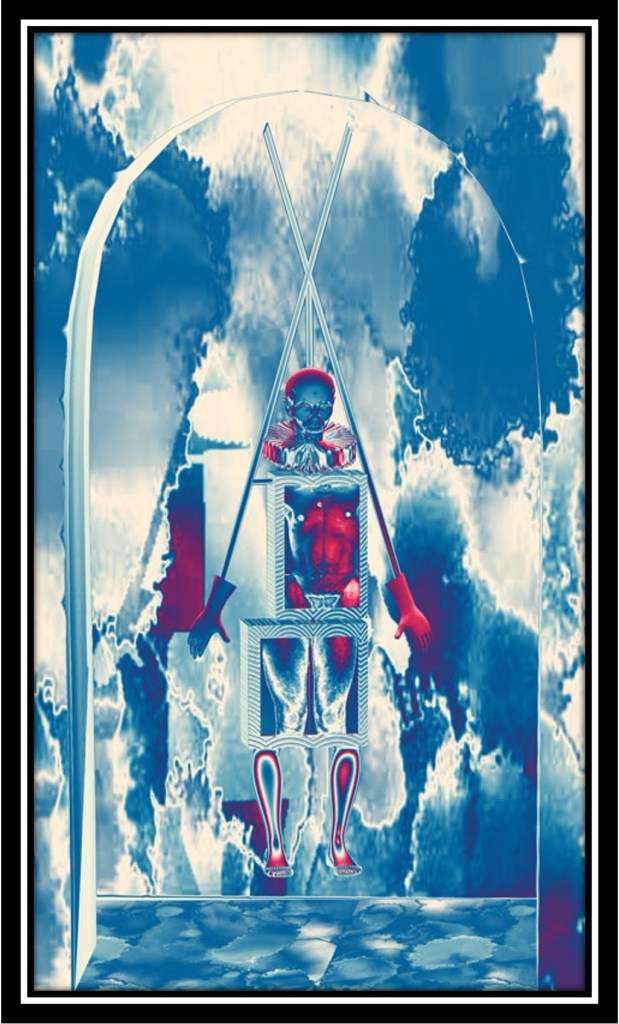
In a world where we often demand certainty and control, we find ourselves fragmented, trapped in boxes of our own making, unable to embrace the fullness of our existence. The image before you captures this tension: a body suspended in a delicate scaffold, exposed yet bound, vulnerable yet distant. The crimson red that pulses through this figure’s radiography mirrors the emotional intensity of our internal conflicts—irrational beliefs, loneliness, and the distortion of our own feelings. Here, we find a body that is both present and absent, much like the self we attempt to control through rigid dogmas, unfounded convictions, or the false security of unquestioned assumptions.
Such beliefs, pervasive in religion, politics, and culture, offer a semblance of control in a world we cannot fully comprehend. Yet, they often bind us more tightly than we realize; they lead us away from self-compassion and deeper understanding. We cling to them as anchors as we seek certainty, but in doing so, we only isolate ourselves further and obscure the possibility of transformation and healing. Just as the body remains whole, though fragmented, so too can we find healing by letting go of the illusions that distort our sense of self.
This image invites you to reflect on the tension between our desires for control and the reality of our emotional vulnerability. Our human condition urges a return to the boy, to ourselves, and to the truth of being—free from the distortions that prevent us from embracing the raw authenticity of life.
Section I
Irrationality
*
Ignorance is an essential condition of our existence, despite our hubristic desire to control knowledge. We are like travelers in a dense fog as we glimpse shadows of trees that seem both near and far—each step reveals something new while obscuring what we thought we understood. This fog invites exploration, not eradication, as its presence reminds us that certainty is an illusion. The moment we attempt to dispel it entirely—to demand certainty and mastery—we reject the depth and richness of uncertainty and trade it for the rigidity of shallow, dogmatic beliefs. To embrace this uncertainty is to accept the vastness of what remains unknown: that which liberates us from the paralysis of false clarity.
Section II
The Transformative Power of Love and Self-Compassion
*
Love has the power to heal wounds unseen, but it is first a seed within oneself. When nurtured, this seed grows into an awareness of the shared fragility of existence—the recognition that no one is immune to suffering. Consider the quiet solidarity in a kind word offered to a stranger, the unspoken bond formed in moments of shared grief, or the simple grace of forgiving someone else’s faults, while knowing your own are equally imperfect. These acts remind us that we are not isolated in our suffering but connected through it. In acknowledging this interconnectedness, we cultivate a compassion that transcends individuality. It allows us to honor the humanity in others as we learn to honor it in ourselves.
Section III
Aloneness Versus Loneliness
*
Think of aloneness as your defining character, a realm where your thoughts and feelings can exist unfiltered, untouched by comparison. Loneliness, however, emerges when this solitude becomes an echo chamber of unmet desires, a distortion that amplifies the absence of external validation into a consuming need. To perceive aloneness as loneliness is to conflate a natural state with an unhealthy yearning, much like mistaking silence for emptiness. Aloneness offers clarity, a space to reflect and grow, while loneliness, though painful, can teach us where we most need to nurture ourselves. By reframing loneliness as a symptom rather than a sentence, we can transform it into an opportunity for self-understanding.
PostScript
*
As I reflect on the journey of these ideas, I’m reminded of a time nearly 16 years ago when I found solace in the writings of Jiddu Krishnamurti, a spiritual teacher my mother had studied in my younger years. His ideas, like Buddhism before it, served as a preamble—a glimpse into a deeper understanding that I did not fully grasp until later in life. It was only in my fifties, after embracing writing as a form of creative expression, that I began to unravel the layers of truth hidden within his words.
During this period, my editor, with whom I shared my growing interest in Krishnamurti, referred to him as a “kook”—a label that seemed to reflect the contradictions inherent in Krishnamurti’s philosophy. My admiration for both Krishnamurti and my editor was marked by an internal conflict. I struggled to reconcile the imperfections I saw in both of them with my own sense of integrity and independence. In time, I came to understand that their imperfections were no different from my own—and that the wisdom I sought was not in their perfection, but in the very acceptance of imperfection itself.
This acceptance allowed me to learn from both of them while retaining my own autonomy, a reminder that growth comes not from flawless certainty, but from the ability to navigate contradiction and complexity. Just as we can find truth in our own imperfect understanding, so too can we extend compassion to others: to acknowledge that their contradictions are part of the shared human experience.
In this journey, I’ve learned that the tension between certainty and uncertainty is not something to resolve but something to live with—a space where self-compassion and wisdom can grow, imperfect though they may be.
Ricardo F Morin Tortolero, January 18, 2025, Oakland Park, Florida.
Editor, Billy Bussell Thompson, February 14, 2025, New York City.

 Observations On Perception