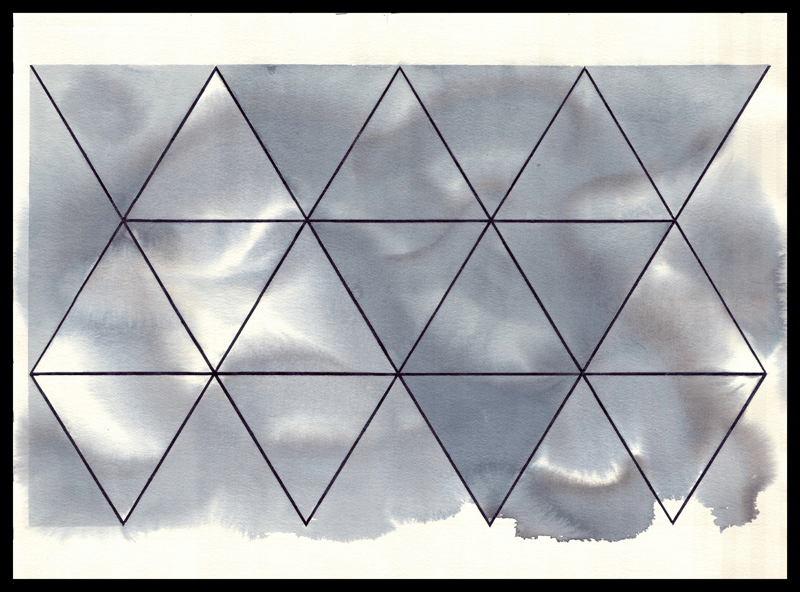
22″ × 30″
Watercolor, graphite, gesso, acrylic on paper
2010
IX. The Commission
In the days that followed she did very little, and it was in doing very little that she began to see.
She had not known how much of her life had been occupied with being somewhere. Now there was nowhere she was expected, and the hours, released from appointment, came back to her with things in them she had not put there: a word, a glance across a hall, a man at a window with nothing to put into a silence. She did not go looking for these. They arrived, as the light arrived in the apartment in the mornings, from the direction of his tower, and lay upon things until she noticed them.
She noticed, for instance, that she had kept Nexys’s glance at the gala as though it were the first fact of something, and that she did not know, now, what it had been the first fact of. She had thought, that night, that she had seen something in him. It occurred to her, turning it over on the fourth or fifth morning, that he might rather have seen something in her, and that the flicker she had kept was his recognition and not her discovery. The thought did not distress her. It interested her, as a painting interests one on the second visit, when one sees that the figure one took for the subject is looking out of the frame at something one had not thought to look at.
The commission reported on a Thursday. She had not meant to watch. She told herself she would watch only to know what was said, and she sat down before the screen in the posture she used for watching her own appearances, a little forward, one hand at her throat, and recognized the posture, and did not change it.
The chairman spoke. The figures were given. The word was used, several times, in ways that made it sound like a thing that had been mislaid and found. And then the chairman turned, with a gesture she knew because she had once suggested it to Nexys, and introduced someone who would speak to what the promise had always meant.
She had expected the footage. She had expected her own face, and had prepared for it as one prepares for cold water. It was not her face.
The woman was younger: not by much, but by enough. She was dark where Astra was dark, and composed where Astra was composed, and she was not, in any feature Astra could have named, like her. The caption gave her name as Astrid.
Astra heard the name as one hears a word one has repeated too often, so that it comes apart into sound. Then the woman began to read.
It was the statement. It had been altered, very slightly, to fit another mouth: the promise was still larger than any one man, and would still, at last, be kept, but the person who had helped to bring the truth to light was now one who had stood “beside those who sold the dream, and could not bear to watch it betrayed.” Astra listened to the alteration with professional attention and found it right. Then she stopped attending to the words, because she could attend to nothing but the voice.
The delay before the key word. The soft ending. The breath taken not where the sentence needed it but where the listener would need it, half a beat before the listener knew. The young woman had all of it. She had not been taught it from footage; or if she had, she had been taught it so thoroughly that it no longer looked taught. It looked like candor. It looked, Astra thought, with a sensation for which she had no name, exactly as she had always supposed it looked from the other side of the screen, where she had never once sat to see.
She sat there now. And she believed it.
That was what she could not get past. Not that it had been done, or done well, or done without her; but that for the length of a sentence, perhaps two, sitting forward with her hand at her throat, she had believed the woman on the screen meant what she said; had been moved by it; had felt the old warm motion toward the promise; and had felt it from the place where she had always supposed the crowd felt it, and where she had never, in all her years of producing that motion in others, once stood.
The broadcast ended. The screen showed the weather. She sat for a long time without moving, and the light from his tower, which had come on at dusk as it always did, lay across the floor between her chair and the window.
The woman in the café had said that she was the only one who needed to believe. She had taken it as a judgment on her sincerity. She wondered now whether it had been something plainer: a description of where she had always stood, which was where belief was made and never where it was received. She could not tell whether that was the whole of it. She knew only that she had stood, for two sentences, among those who received it, and had found something there waiting for her, warm, ready-made, and not her own.
She thought she would like to see the young woman. She did not know what she would say. She was not sure, examining the wish, that she wished to say anything; it seemed rather that she wished to look, from close by and in an ordinary light, at the face that had done this to her, and to learn whether, at that distance, it would look like anyone she knew.
X. Astrid
The message came from Astrid herself, three days after the broadcast, and was so plainly worded that Astra read it twice for the trick in it and found none. She would be in the public garden by the river on Sunday morning, early, before the paths filled. If Astra wished to come, she would be glad.
Astra went. She arrived before the hour, as she had never arrived anywhere, and walked the gravel paths while the gardeners were still at work. The light was the ordinary light she had wished for: grey, even, without direction, falling on the benches and the backs of the gardeners and the surface of the river with no preference among them.
Astrid was on a bench near the water with a paper cup in her hands. She rose when she saw Astra, not quickly. In the plain light she was younger than on the screen, and less finished; there was a small scar at her hairline that the broadcast had not shown, and her coat was good but not new.
“You came,” she said, and then, as if hearing herself, smiled. “That isn’t what I meant to say first. I’d rehearsed something better.”
“So had I,” said Astra. It was not true until she said it, and then she found that it had been.
They sat. For a time neither spoke, and Astra was aware of being looked at, closely, by someone who knew precisely what she was looking at; and it was the first time this had happened to her in such a light, with no screen between.
“I watched you for years,” Astrid said at last. “Before any of this. I was fourteen the first time. You were on a screen in a shop window, talking about the ledger that no one owns, and I stood in the street until the shop closed.” She turned the cup in her hands. “I’m not telling you that so you’ll feel anything. It’s why they found me. I’d learned you without meaning to. They only had to finish it.”
“And you let them.”
“I needed the work.” She said it as the woman in the café had named a distance. “And I wanted to see whether I could. You’ll understand that.”
Astra did.
“Do you want to know what was hardest?” Astrid asked. Astra said nothing, and Astrid, who had learned her, seemed to take the silence correctly, as yes. “Not the voice. The voice is only music; anyone can learn music. It was something you do with your eyes.” She looked away briefly, to the side, toward the river, and back. “Just before the important word. Every time. As if you were checking whether someone had come into the room. I had to learn not to do it. They said it read as doubt.”
Astra sat very still.
She had watched herself, she supposed, a thousand times. She had studied her appearances as she studied everything, for their effect; she had corrected her hands, her posture, the angle of her chin. She had never seen that. She thought of the gala, of Nexys’s eyes finding hers across the hall, of what had passed between them that she had kept as the first fact; and she understood, on the bench in the even light, that he had seen it long before. Perhaps others had: the crowd, with its patient look; the late man at the table, with his physician’s interest. It was possible that anyone who had watched her closely had seen her look aside before the word, as though someone might come in, and that only she, who had made the word, had never once been placed to see it.
“Did it?” she said. “Read as doubt?”
Astrid considered her with the frank attention of a craftsman. “Not to most people. To most people it read as sincerity. That’s what made it dangerous. Doubt that looks like sincerity is the most convincing thing there is.” She paused. “They didn’t want convincing. They wanted calm.”
A gardener passed with a barrow. Both women watched him go, and Astra noticed, as he went, that Astrid’s eyes moved to the side, toward the path behind them, quickly, before she spoke again; and that Astrid caught herself doing it; and that something in her face closed.
Astra did not remark on it. She could not have said whether it was the trace of a habit learned and not quite unlearned, or something of Astrid’s own, older than the lessons, which the lessons had failed to remove. She found she could not tell. She found, too, that she had no right to ask, and that it was the first time in a long while she had recognized such a limit as belonging to another person and not to the situation.
“Why did you write to me?”
Astrid looked at the water. “Because you’re the only person who would know what I was doing while I did it.” A small movement of her shoulders. “It’s lonely, otherwise. You’ll know that too.”
They sat a while longer. There seemed to be nothing further either of them needed to say, and Astra, who had spent her life in rooms where silence was a move, discovered that here it was not; it was only the time two people take to finish sitting together.
When they rose, Astrid held out her hand, and Astra took it, and for a moment they stood as they would have stood for a photograph, and both of them knew it, and neither turned toward a camera, because there was none.
Astra walked home along the river. She did not look at the water, though it was there the whole way, grey and plain and willing to show her anything. She was thinking of a glance to the side before an important word, and of how many years a thing can be visible on one’s own face to everyone but oneself; and she was thinking that she would have to look, sooner or later, and that she was not yet ready, and that this, at least, she could see.
XI. The Tower
She went to see him because he had asked, and because she found, examining the reasons she might have given for not going, that each of them was a sentence she would have spoken to an audience.
The tower admitted her without question. The doorman knew her; the elevator knew her floor; the glass of the lobby, where his name was cut, had been cleaned that morning, and the name stood in it as clearly as ever. On the wall beside the elevators a new portrait had been hung, large, a little idealized, in the manner of portraits commissioned for institutions, and beneath it a small plate gave his name and two dates. The first was the year the city’s first tower had risen. The second was this year. She looked at the second date for some time. He was not dead. She understood that the plate did not mean he was dead.
He received her in the office. Nothing in it had been moved: the dark wood, the cold metal, the angles that admitted no doubt. The screen on the desk was lit and showed the price, which had recovered nearly half of what it had lost. He rose this time. He came round the desk and took both her hands and looked at her with an expression of open warmth. It was the expression he used for donors.
“You came back,” he said.
“You asked me to.”
“I did. I hoped.” He released her hands and went to the window. “Look at it. Nothing has changed.”
She looked. Nothing had. The towers stood in their silver order, and the avenues ran with light, and below them the people moved with the ease of those who believe themselves looked after; and from this height the doorways and the debris could not be seen at all.
He talked. He talked well; he had always talked well. He told her that the commission was in good hands, that several of its members had been his friends for twenty years, that the reform would be named, as was only fitting, for the founder, and he smiled at the word as he said it, as if it were a garment someone had given him that fit better than he had expected. He told her he had been consulted at every stage. He told her the mediator was an able man. He did not tell her when he had first met the mediator, and she found she did not need to be told; she was watching his hands, which rested on the sill and did not drum.
“You knew,” she said. “Before the gala.”
He did not turn. “I knew it was coming. Someone was always going to come. A man who builds a thing like this and imagines he’ll be allowed to keep it is a fool, and I am not a fool.” He paused. “I chose how it would end. That’s all anyone can choose. I chose that my name would stay on the glass.”
“And me?”
Now he turned, and his face held something she had seen once before, across a hall, and kept. “You were going anyway,” he said. “I saw it long before you did. You used to look aside before you said the word: every time, for years, as if you were expecting someone. I used to watch for it. I thought someone would notice, and it would be over.” He shook his head. “No one ever did. They thought it was sincerity.”
“Someone did,” she said, and did not say who.
He waited, and when she said nothing further he took it, as he had always taken her silences, for agreement; and she let him, and noticed that she let him, and that it no longer felt like a move.
“It went perfectly,” he said. “Considering.”
She heard the word fall. It did not ring false this time. It did not ring at all; it lay where it fell, as a coin lies on carpet, and she understood that he meant it, and that he would go on meaning it, in this office, with the screen on the desk showing him a number that recovered by the day, beneath a portrait whose second date he had not yet gone down to read.
She stayed a little longer, because leaving at once would have been a kind of speech. They spoke of nothing: of a dinner years ago, of a city abroad where they had once been photographed together. He was charming. He had always been charming. When she rose to go he kissed her hand, which he had never done, and she understood that it was a gesture from a part he had begun to play, the founder, gracious and retired, and that he would play it well and for a long time, and that the playing would spare him from ever standing at the window long enough to see the doorways.
In the elevator she did not look at the steel.
In the lobby the light was going. As she passed the portrait, the tower’s lights came on, all at once, floor upon floor above her, at the hour they always came on; and she thought of him upstairs at the window, watching them come on, and believing, as she was almost certain he would, that he had switched them on himself.
XII. The Window
It was evening when she reached the apartment, and she did not turn on the lamps at once. She sat in the chair facing the window, as she had sat to watch the commission, and let the room go dark around her while the city came up outside it, tower by tower, until the glass held nothing but the city: entire, luminous, composed, as it had offered itself to her from the balcony, as it offered itself to anyone who could afford the height.
She found that she was waiting, and did not know for what, and did not try to know.
When at last she rose and turned on the lamp beside the chair, the window changed. It did so all at once, as such windows do: the city withdrew behind the glass, still there but faint, and in its place the room appeared, the chair, the lamp, the table where she had set down the device on the first night, and a woman standing in the middle of it.
She had seen her reflection in that window a thousand times. She had used it, at night, before going out, to check the line of a dress. She had never stood before it with nothing to check.
She looked at the woman. The woman was not young and not old; she was composed; she was, Astra supposed, what people meant when they said she was beautiful, and the word did not seem to attach to anything in particular. She held herself as Astra held herself, a little forward, as if about to be addressed. Astra watched her for a long time. It was not difficult. It was only unfamiliar, like the light in the garden, which had preferred nothing.
Then, because there was no one else in the room, and because she had spent her life saying things aloud before she knew she believed them, she began to say something to the woman in the glass, she did not afterward know what; and before the word that mattered, she saw the woman’s eyes go aside.
It was very quick. It was, as Astrid had said, as if someone might have come into the room. Nobody had. She saw the glance, and saw the eyes come back, and the face around them settle again into what it had been. She did not know what it had been looking for. It might have been doubt, as they had said. It might have been the habit of a performer listening for her audience, or of someone keeping watch on a door she did not mean to open. It occurred to her that it might have been looking for her, and the thought stayed, and she did not try to make it the only one.
She did not finish the sentence she had begun. She thought of the stars, which she had once seen above the city and then said, and found that she could no longer tell how much of the seeing had been for the sake of the saying. Something else spoke then, in her own voice, though not the one she used on screens: the voice she would have used to tell a stranger the time. It did not tell her what she must do. It did not tell her that she was forgiven, or free, or that anything would now be otherwise. It did not explain her to herself.
It said her name.
It was not loud. It was not the name as the crowd had said it, nor as Nexys had said it. It was said as one says the name of someone in the same room, plainly, to establish that she is there.
“Yes,” she said.
Outside, faint behind her reflection, the towers kept their silver order, and the avenues ran with light, and nothing in the city had changed or would change because a woman in one of its windows had answered to her name. She knew that. She did not look past the glass to confirm it. She stood where she was and let the woman in the glass look at her for as long as it lasted, and found that she could stand there, which was not the same as being at peace there.
The lamp burned beside her. She did not turn it off.
Ricardo F. Morín
October 15, 2026
Oakland Park, Florida
Tags: conscience, Dolos Principle, Identity, Perception, responsibility, self-deception, self-recognition, Silence


PLease leave a Reply