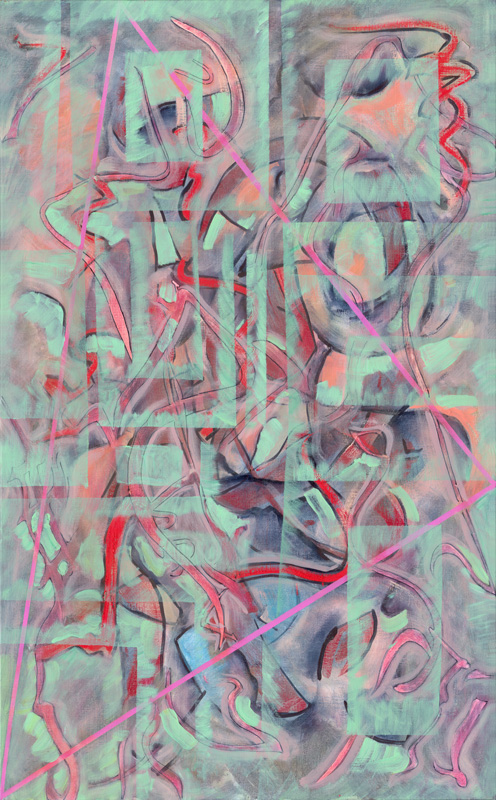
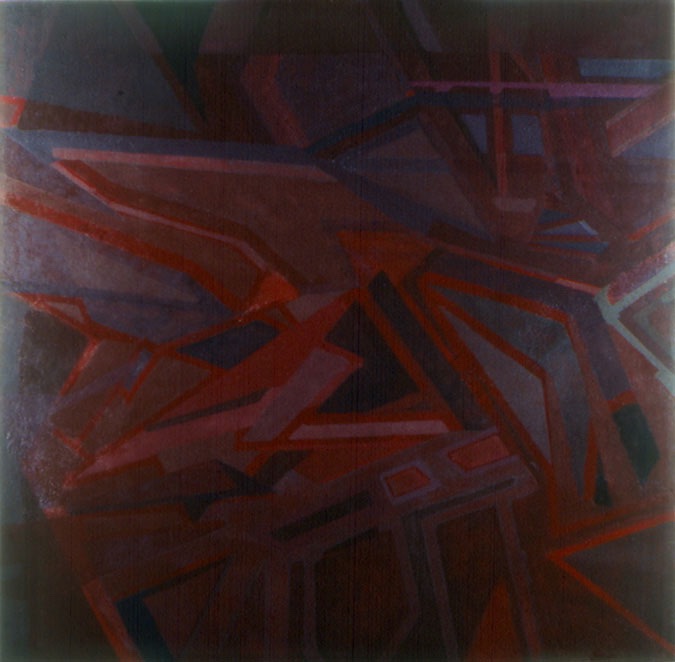
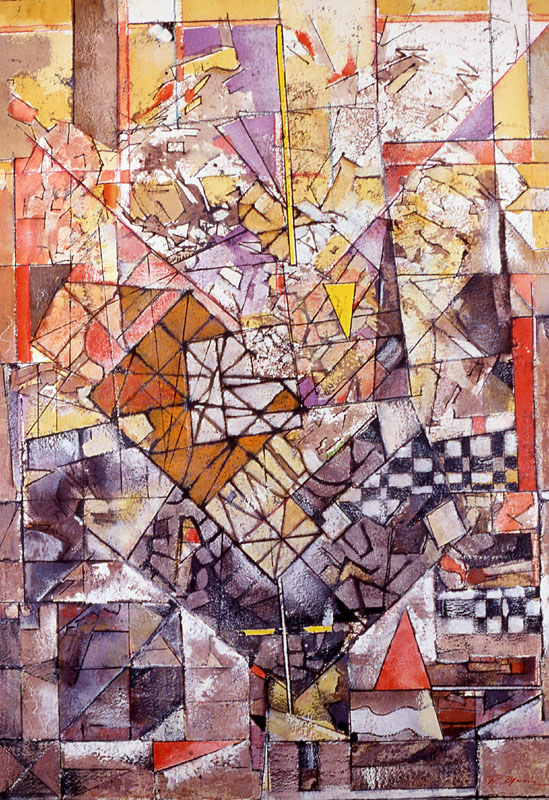
Ricardo F. Morín Triangulation Series Nº 7 37″ x 60″ x 2″ Oil on linen 2006
An elderly man stands beside a piece of luggage near the edge of a wide sidewalk at a public bus stop. A younger man notices him from a distance, and as he approaches, his attention remains fixed upon the older man rather than upon the bus stop itself. The older man perceives the stare as calculating, purposeful, and determined. There is room to pass. Instead, he changes course and strikes the older man with enough force to displace him from his position, then continues walking without explanation or apology. No dispute precedes the contact, and no serious injury follows.
The change of course makes the contact appear directed, though the encounter reveals little of what prompted it. Contempt, irritation, resentment, or the wish to impose upon someone may be imagined. None becomes certain merely because it would make the action intelligible. The younger man’s attention can be followed as far as the contact; his motive cannot be followed with the same assurance.
The older man was noticed before he was struck. Whatever the younger man perceived was sufficient to direct an approach, yet being noticed does not establish how much of a person has been acknowledged. Attention may be exact about where an act will arrive while remaining indifferent to the life upon which it intrudes.
Ordinarily, one passes a stranger without requiring an account of his presence. The man waiting beside his luggage need not explain where he is going or why he has stopped there. Almost nothing about him has to become known for the simple accommodation of passing without contact to occur.
Someone who would make that accommodation elsewhere may withhold it from a person expected to offer little resistance or to impose no consequence. Restraint weakens selectively, and another’s vulnerability can become an opportunity to act. Whether age or an expectation of impunity influenced the younger man’s choice remains unknown. Even if resentment were established, the question would remain why it found this particular recipient who is a total stranger.
The younger man had only to pass. Those charged with protecting a population face circumstances in which leaving the source of danger undisturbed may expose others to further injury. They may have to use force, and those awaiting their decision may have urgent reasons to demand it.
A government defending its territory, one invading another country, and one acting upon a danger it anticipates do not confront the same circumstances or bear the same responsibility. The suffering that follows cannot erase responsibility for how a war began. Neither can responsibility for its beginning settle every judgment concerning its subsequent conduct.
Those making the next decision must confront what remains dangerous, what has changed, and what another action could accomplish. People still exposed to attack may require defense long after the initial injury, while a brief operation may inflict harm for which no adequate ground ever existed. Neither the duration of a war nor the depth of the loss already suffered can settle what should happen next.
For those who have endured an attack, however, the first injury may remain more immediate than the changing circumstances through which a response proceeds. A danger recedes, an objective is reached, or further action creates risks absent at the beginning, while what happened continues to demand an answer. Asked what another strike would accomplish, a leader can return to the losses already sustained. The answer may be entirely sincere and still leave the question unanswered.
Grief may preserve a fidelity to the dead that no change in circumstances can satisfy. Political action nevertheless proceeds among the living. The demand that a loss receive an answer can persist after a particular response has ceased to serve the protection for which it was undertaken. At that point, reconsideration may be experienced as disloyalty even when the conditions of protection require it.
Those who receive the force may meanwhile become known chiefly through where they live or the people with whom they are associated. The person who directed an attack, the person who supported it, and the person who happened to live where it originated can be brought within the same field of action, though they do not bear the same responsibility. No one need deny that each has a history or a capacity to suffer. Those facts can be acknowledged and then set aside as having no bearing upon what is to be done.
The people exposed to an operation may be known to those directing it only through briefings, surveillance, casualty reports, and the observations passed through a chain of command. These can disclose what those deciding cannot see for themselves. Through a report, someone far from danger may learn what those enduring it have no means of bringing before him themselves. The distance between them can be reduced by the very procedures through which the decision is made.
Yet the reports may continue to arrive after the decision to proceed has ceased to admit reconsideration. Someone can register a loss accurately and still receive it only as something to be entered before the next authorization. The people affected remain visible in the record, while what becomes known about them is denied any bearing upon continuation. The information has arrived; the grounds of action have been protected from it.
Someone entrusted with the safety of others may knowingly cause harm while believing that refusing to act would cause more. The conflict may be real, and a clearer account of the consequences may not resolve it. But when those acting become certain that their responsibility supplies its own justification, the people who will bear the harm can appear only as a cost already accepted. Those who question the harm may then be treated as though they were opposing the protection itself.
An official may possess the authority to order an action and the means to carry it through, while those who will bear its consequences have little power to contest either. He can make the decision prevail without answering what he owes them. The question of justice remains, even when he acts with a sincere intention to protect others.
The older man was close enough to be deliberately approached. A distant population may be described in exhaustive detail. Neither proximity nor information establishes how another’s presence has entered a decision. Attention may narrow to what facilitates an act; an understanding of the suffering it will cause may also remain clear while the act proceeds. The failure can occur within attention itself.
A person may understand an injury, condemn its infliction, and nevertheless permit a comparable injury against someone placed outside the protection of that judgment. What is understood remains intact while its reach contracts. An account of the person’s fear, grievance, or conviction may make his conduct more intelligible without resolving how he accommodates what he condemns.
The younger man continues on his way without explaining himself. The absence of an explanation leaves a question about him; it does not make the force of the encounter disappear. What prompted him might become clearer if more were known, but he owed the older man the ordinary restraint that would have left him standing where he was.
The other remains someone whose life exceeds the terms under which he has been encountered. Grievance, threat, procedure, and necessity can each restrict what is permitted to matter about him. The person has not become fully known. The decision to act as though nothing further about him could matter may nevertheless already have been made.
Ricardo F. Morín October 6. 2026 Bala Cynwyd, Pennsylvania
Author’s Note: The conditions described here were examined earlier, through the structure of language rather than through particular encounters, in “The Grammar of Conflict”.
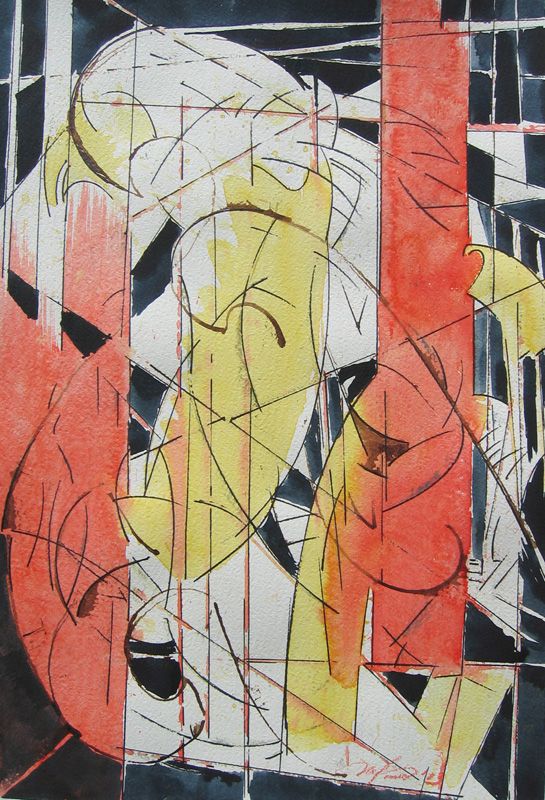
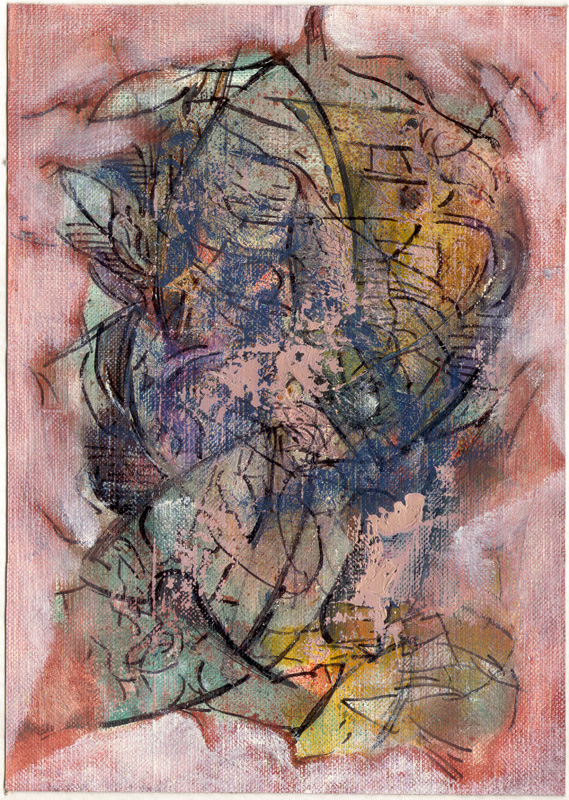
Ricardo F. Morín Templates III 14” x 20” Watercolor and ink on paper 2003
People often discover that what they say or do does not remain where they placed it. A remark made in passing is repeated elsewhere. A decision taken for one purpose is later cited for another. Words meant to clarify are reused to justify actions the speaker never anticipated. Once expressed, what has been authored moves beyond the situation in which it was produced and enters contexts the author does not control.
What is written, declared, or enacted does not retain its meaning by remaining tied to intention. Readers, listeners, colleagues, and institutions receive what has been authored through their own expectations, needs, and circumstances. As situations change, the same words or actions are taken up differently. Meaning migrates not because authors relinquish care, but because interpretation unfolds wherever what has been authored circulates.
As interpretation accumulates, the link between origin and significance loosens. What an author sought to express does not vanish, yet it no longer governs how the expression will be understood or used. Each act of reception introduces new relations, drawing on conventions and pressures that exceed the author’s horizon. Over time, layers of meaning form that cannot be reduced to a single originating moment without loss.
Under these conditions, authority persists without control. Authored material continues to shape understanding and guide action even as the author’s capacity to direct its meaning diminishes. Texts, decisions, and gestures acquire standing not because their origin remains present, but because their effects endure within systems that rely on them. Authority attaches to circulation and use rather than to command.
When authorship is mistaken for sovereignty over meaning, confusion follows. Attempts to fix interpretation by appealing to origin fail to account for the fact that meaning arises through use rather than preservation. Efforts to reclaim control often generate conflict instead of clarity, as different contexts assert incompatible claims on what has been authored. What collapses in such moments is not meaning itself, but the assumption that meaning can be governed from a single point.
Authorship therefore functions as an unavoidable condition rather than a position of mastery. To author is to introduce words or actions into a field where interpretation proceeds independently of intent. What remains with the author is not ownership of meaning, but exposure to its unfolding. Authorship binds the author to consequences that continue to develop as what has been authored acquires significance beyond its initial articulation.
Authorship persists not as sovereignty over meaning, but as exposure to the ongoing movement of significance as what is authored circulates beyond its origin.
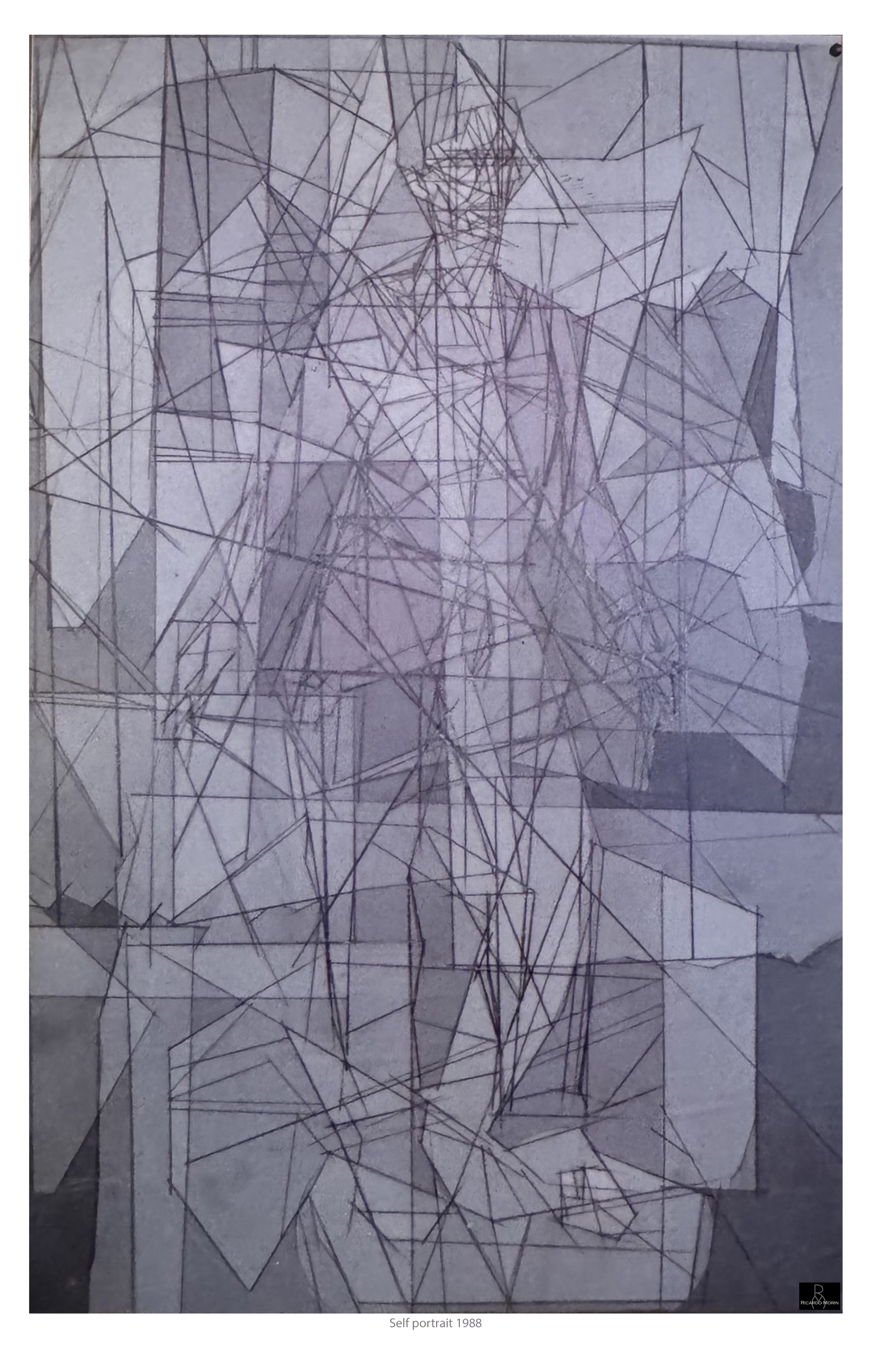
Ricardo F. Morín. Self-Portrait, 1988. Mixed media: collage, charcoal, and ink pen. 30 × 48 inches.
The traditions and rituals through which we identify ourselves should remain open to questioning, particularly when they concern guilt, repentance, and forgiveness. An inquiry into the meaning of fasting on Yom Kippur led me to ask how a practice of atonement relates to the conduct of daily life. The question can be asked of any such practice, within or outside a religion: does observing it deepen our attention to others, or can the observance take the place of that attention? Why should reflection occupy a separate place in a life whose every relationship already calls for awareness?
The difficulty begins when we treat living and examining how we live as separate activities. We act, withdraw, assess, and seek release from what we have done. Looking back is necessary because our understanding is incomplete and consequences often become apparent only later. But the limits of what we can know at any moment do not remove our responsibility to pay attention while acting. How we speak, decide, listen, or withhold a response already matters to other people. Reflection belongs within those acts, while we can still influence what happens, as well as afterwards, when we consider the consequences.
The observance that prompted this inquiry explicitly guards against allowing ritual to replace responsibility towards another person. Mishnah Yoma 8:9 (https://www.sefaria.org/Mishnah_Yoma.8.9) states that Yom Kippur does not atone for wrongs committed against another person until the wronged person has been appeased. The teaching requires us to address the person we have injured; observing the day alone cannot fulfil that obligation. The question of how reflection belongs within living nevertheless remains. Addressing an injury is a responsibility that follows wrongdoing. Attention to another person is already required within the relationship before any injury occurs.
A day devoted to repentance may renew an awareness that continues throughout the year. The distinction that concerns me is between reflecting from time to time and making reflection part of everything we do. An observance can support attention throughout daily life. Speaking, working, eating, and living with others already involve choices through which we acknowledge or disregard their circumstances. Where reflection is separated from daily conduct, sincerity in observing a ritual does not resolve the separation.
Questioning a ritual can be difficult because the practice may express commitments we hold deeply. A person may observe it out of religious conviction, loyalty to family customs, or a wish to be recognised as a member of a religious community. Belief in a teaching, loyalty to one’s family, and recognition by others are distinct considerations, even when they lead to the same observance. If questioning the practice feels like betraying one’s family or risking a community’s acceptance, defending the practice may take precedence over examining it. Careful examination can also express a serious commitment to understanding one’s faith. The reasons for valuing a ritual therefore need to be distinguished from the question of how observing it affects our conduct towards others.
Fasting may help someone concentrate by interrupting familiar habits. Even so, why should deprivation have a privileged role in making us more aware? Whatever attention a fast encourages must continue within daily life. When deprivation is understood as punishment, attention may shift from daily conduct to the intensity of one’s own suffering. My suffering does not, by itself, repair suffering I have caused. I may become absorbed in how much I can endure and pay less attention to the person affected by my conduct. The effort to become worthy again can then displace the work of understanding another person’s experience and making whatever repair is possible.
The preoccupation with recovering one’s own moral worth becomes especially restrictive when a wrong action is taken as proof of a defective human nature. Recognising our limitations can make us more receptive to correction. But a belief in our own defectiveness can keep us occupied with whether we are guilty, purified, forgiven, or restored. Our relation to others does not begin with an injury for which we must answer. When I listen to another person, I may discover how much my assumptions have left out. When we make a decision together, I need to consider the other person’s circumstances as well as my own. The other person’s reality precedes my judgment of how well I have responded to it. Responsibility develops within the relationship and includes answering for harm when harm occurs. A satisfactory judgment of myself does not bring my responsibility within the relationship to an end.
Confession can interrupt denial by acknowledging an injury we have concealed or refused to face. Naming the injury can make an honest conversation with the person affected possible. An apology may relieve the person who offers it while leaving the injured person’s loss or distrust unresolved. In admitting what I did, I show a willingness to answer for my conduct. The admission alone cannot establish that I have fulfilled my responsibility.
No one owes me forgiveness so that I may consider my moral account settled. Forgiveness may change a relationship profoundly, allowing affection or trust to become possible again. But forgiveness does not erase the consequences of what happened. Trust may need to be rebuilt, a loss may remain irreparable, and the injured person may still need to maintain boundaries within the relationship. My responsibility continues even if I am not forgiven. Nor can I demand that reconciliation take the form I desire.
To live consciously does not require us to sit in constant judgment of ourselves. Constant self-judgment would reproduce the self-absorption that can make penitence an obstacle to understanding others. Attention to others requires a willingness to notice, to listen, and to reconsider a judgment. Our intentions do not fully explain what our actions mean to someone else. Continuing attention means allowing what we learn from another person to influence how we proceed, even when that knowledge unsettles our understanding of ourselves. We will sometimes fail to pay attention. Recognising a failure can help us respond more adequately without turning the acknowledgment into a ceremony of self-condemnation.
The separation of reflection from daily conduct can arise within the most familiar relationships. We may presume that familiarity tells us what another person needs, or that good intentions spare us from reconsidering a decision. Confidence in our own understanding can then replace attention to a person whose needs or views may have changed. Confession, forgiveness, and observance belong within our relationships, but none can account for everything those relationships require of us. The daily acts of listening, choosing together, and responding to change have an ethical significance of their own, whether or not an injury ever occurs.
I cannot conceive of reflection as an interval after which one returns to living relieved of its demands. Reflection belongs to our participation in one another’s lives, through which we continually develop and revise our understanding. A ritual’s importance to our religious commitments or family customs does not settle the question of how observing it affects our conduct towards others. Another person’s reality remains before us after the words have been spoken and the appointed day has ended.
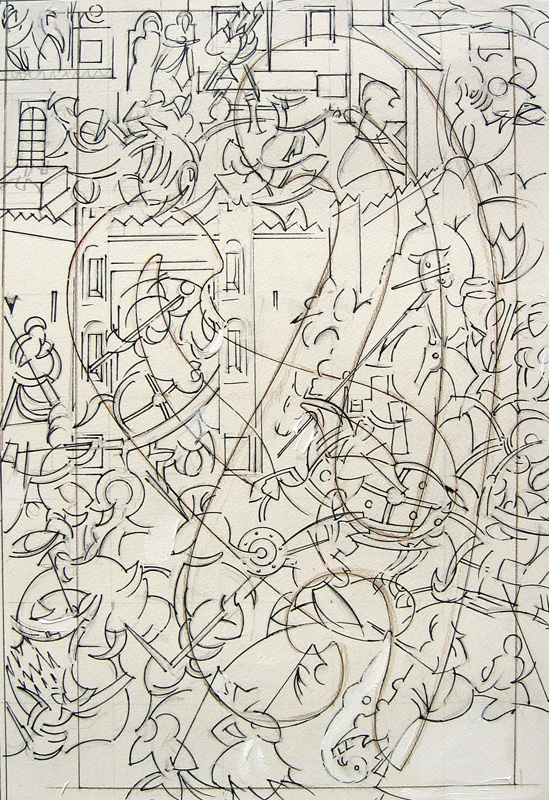
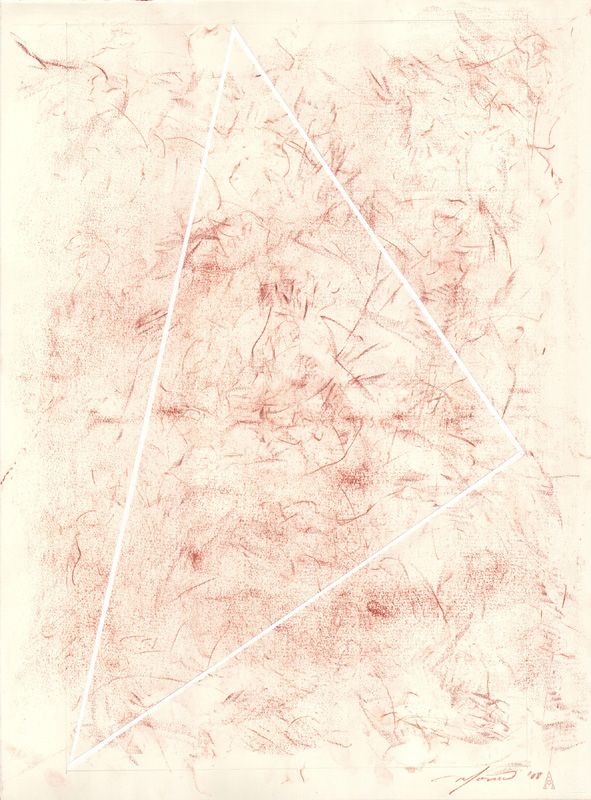
Ricardo F. Morín Persian One 19” x 28” Graphite, sanguine and Sumi ink on watercolor paper 2003
People act before they fully know what their actions will bring about. Decisions are made with limited information, divided attention, and signals whose importance cannot be fully assessed at the moment of choice. A person commits to a course of action without being able to see all the conditions that action will set in motion. Only later do the effects of that action make clear what mattered and what could have been altered.
Because action proceeds under uncertainty, error does not appear at the moment of decision. At the time of choice, available information remains partial, situations remain ambiguous, and attention remains finite. Action therefore binds the agent to consequences whose full implications cannot be known in advance. What later appears obvious was not fully visible when the action began.
Responsibility begins to take shape as consequences disclose relations that action itself has revealed. Effects expose dependencies, constraints, and vulnerabilities that were previously unnoticed or underestimated. What emerges after the fact is not merely additional information, but a shift in relevance. Elements that once seemed secondary acquire weight, while assumptions that once guided action lose authority. Recognition follows commitment rather than preceding it.
As understanding develops after action, foresight is often overestimated in retrospect. Later awareness projects coherence backward onto moments that were shaped by uncertainty. Signs that appear decisive after consequences unfold are treated as though they had been unmistakable beforehand. This compression creates the impression that error resulted from neglect, rather than from the limits of perception under action.
Practices that depend on anticipation—such as planning, prediction, precaution, and control—assume a level of foresight that action itself cannot provide. These practices stabilize expectations, yet they remain vulnerable to the fact that relevance is often disclosed only through outcome. When results diverge from intention, the gap reflects not a failure of responsibility, but the temporal structure within which responsibility operates.
Responsibility matures through recognition rather than certainty. It develops as people acknowledge how their actions have bound conditions that now require response. What responsibility sustains is not the illusion of complete control, but the capacity to remain answerable to consequences that exceed prior understanding. Responsibility therefore does not end at the moment of decision; it continues as recognition adjusts agency to what action has revealed.
Responsibility does not arise from foresight that precedes action, but from recognition that follows commitment, as agency responds to consequences that could not be fully anticipated.
We seldom think about gravity until something falls. A glass slips from a hand, rain descends through the air, our knees remind us that climbing stairs is not the same as coming down. Most of the time we simply accept weight as one of the conditions of being here. We stand because there is ground beneath us. We walk because our bodies remain attached to the surface of the Earth. We grow tired because carrying ourselves requires effort. Gravity seems so familiar that we hardly consider what it means.
We may know how to live within a condition without understanding what that condition reveals about us.
For centuries it was possible to imagine gravity as an attraction between bodies. A stone falls toward the Earth because the Earth pulls it downward. The image works well enough for ordinary purposes, and Newton gave that intuition mathematical power of extraordinary precision. Einstein did not simply improve the calculation.He altered the picture. In general relativity, gravity is expressed in the geometry of spacetime itself.Matter and energy affect that geometry, and a body in free fall follows the path determined by it.
When we stand motionless on the floor, we say that gravity is pressing us downward. But the pressure we actually feel comes from the floor pressing upward against us. If the floor disappeared and we began to fall freely, the sensation of weight would disappear as well, even though gravity had not gone away. What we call weight is the sensation produced when the floor prevents our body from following the path it would take in free fall.
We ask what time it is as though the question had a single answer.A call between London and Sydney gives the question different answers at the same moment.Morning in one place is already evening in another.We accept the discrepancy without difficulty because each clock names the hour from a different position on a rotating Earth.The clocks do not announce different realities.They reveal that even our most familiar account of time depends upon where we are.
Relativity carries that dependence further than ordinary experience suggests. The time accumulated by clocks depends not only upon the conventions by which we name the hour, but upon motion and gravity. Two perfectly accurate clocks separated by height do not accumulate exactly the same amount of time. A clock farther from the surface of the Earth runs imperceptibly faster than one below it. The difference within the height of a human body is extraordinarily small, yet it is real.
We do not feel it. Nothing in our nervous system announces that time accumulates at a slightly different rate near our head than near our feet. Our senses give us a practical world, not an exhaustive one.
The clock does more than organize appointments. Where we are enters into what we measure, first through the conventions of daily life and, at a deeper level, through the physical conditions in which the clock itself exists.
What suffices for living is not always enough for understanding.
We wake each morning within the apparent boundary of a body. We remember what happened yesterday. We anticipate what may happen tomorrow. We identify a continuous person who has survived changes of place, age, opinion, health, desire and circumstance. That continuity is indispensable. Without it we could scarcely conduct a life. But continuity does not mean immobility.
The body whose persistence we call ourselves is continually exchanging matter with its surroundings. We breathe, eat, excrete, shed cells, repair tissue, alter proteins, replace molecules and reorganize connections. The apparent solidity of the organism depends upon activity. What persists is not an untouched collection of material preserved from birth, but an organization maintained through change.
We distinguish the tree from the soil, rain, atmosphere and sunlight because the distinction is useful and because the tree possesses an organization unmistakably its own. Yet remove those exchanges and there is no tree. Its individuality does not require isolation. The boundary is real, but what it encloses remains dependent upon what crosses it.
We are no exception.
The elements in our bones, blood and nervous tissue did not begin with us. The carbon, calcium, oxygen, phosphorus and iron assembled into our bodies preceded every memory we possess. They entered a temporary organization capable of metabolism, sensation and thought. Eventually that organization will cease to maintain itself, and the materials that composed it will continue under other arrangements.
Nothing mystical needs to be added to this fact. Its difficulty comes from how directly it contradicts the scale at which we normally conduct our lives.
We naturally experience ourselves as centers. Vision opens from here. Pain occurs here. Memory gathers around this history. Desire points outward from this body. Every conscious life therefore begins from a perspective it cannot abandon. We cannot see without seeing from somewhere.
The mistake begins only when perspective becomes rank.
Because experience is centered upon us, we can begin to imagine that reality is centered upon us as well. What begins as an unavoidable condition of perception becomes an assumption about significance. Our plans acquire urgency because they are ours. Our losses appear uniquely intolerable because we undergo them. Our victories expand in importance because we remember the effort required to obtain them. The world gradually takes the form of a field across which we measure advantage, recognition, possession and control.
Much of human life must operate at this scale. We need homes, work, protection, institutions, agreements and some capacity to shape circumstances rather than merely submit to them. There is nothing inherently misguided in agency. The confusion occurs when the capacity to act becomes evidence of independence, or when the ability to control a portion of our circumstances is mistaken for mastery over the conditions that make control possible.
We may command a room, own a building, govern a company, direct an institution or exercise authority over millions of people, yet none of these distinctions alters the geometry in which our bodies exist. The most powerful person and the least visible pedestrian remain equally unable to suspend the passage of their own time. No title arrests metabolism. No possession negotiates with gravity. No reputation follows matter as an intrinsic property when the organization that sustained a person comes to an end.
This does not make human distinctions unreal. It places them.
A contract matters within human relations. An injustice matters to the person subjected to it. A work of art may alter perceptions long after the artist dies. A decision taken in an office can change a river, destroy a forest, preserve a neighborhood or determine whether strangers live under security or fear. Scale does not abolish consequence.
But consequence and cosmic importance are not the same thing.
We often seem caught between two unsatisfactory possibilities. Either we exaggerate ourselves until human desire becomes the measure of reality, or we look at the immensity of the universe and conclude that nothing we do can matter. Both responses preserve the same assumption. Both imagine that significance must be proportional to size or duration.
It need not be.
A brief event can alter everything that follows from it. A mutation occurs within a microscopic structure. A seed germinates in a crack. A sentence changes a judgment. A decision made in minutes affects people who were never present when it was made. Duration does not determine consequence any more than physical size determines complexity.
Our lives can therefore be transient without being negligible.
Much of human culture has been built around resistance to transience. We preserve names on buildings. We accumulate objects beyond use. We construct genealogies, monuments, archives and institutions. We seek recognition from people we do not know and sometimes from generations that will never meet us. Even power often carries beneath its practical advantages an obscure promise that importance might somehow protect us against disappearance.
Yet permanence is not what continuity means.
A wave continues through water without preserving the same water. A forest persists while individual trees germinate, mature, fall and decompose. A language survives because speakers who did not invent it alter it while using it. Continuity can depend upon transformation rather than resist it.
We usually speak of beginnings and endings as though they marked opposite conditions of reality. Something begins when a form appears and ends when that form can no longer sustain itself. The distinction remains real at the scale of the form, yet becomes less absolute when we ask what, precisely, has begun or ended. The wave subsides while the water continues in motion. The tree dies while its matter enters other exchanges. A body ceases to maintain the organization by which we recognized a person, while its materials continue under conditions the person no longer inhabits.
The same uncertainty widens with the scale. Roger Penrose has proposed, through conformal cyclic cosmology, that the remote future of one cosmic era may be conformally continuous with what appears as the beginning of another. Whether that proposal survives observation remains unresolved. Its relevance here lies less in asking us to accept a cyclic universe than in exposing how readily we treat beginning and ending as absolute properties of reality when they may also describe transitions between forms whose continuity exceeds the scale from which we observe them.
Every beginning we encounter already depends upon conditions that preceded it, and every ending alters the conditions that follow. A beginning can therefore be genuine without being an emergence from nothing, just as an ending can be final for a particular organization without becoming the disappearance of the reality from which that organization arose.
Continuity does not abolish beginning or ending. It places both within transformation.
We participate in such continuities everywhere, although our attention gravitates toward the individual form.
Birth gathers matter into an organization capable of sustaining a particular history. Death ends that organization. Between them something genuinely singular occurs. There is perception. There is memory. There is the astonishing capacity not merely to undergo events but to recognize relations among them.
Consciousness occurs within that same continuity.
We still do not possess an agreed physical account of how subjective experience arises. Penrose has also suggested that the problem may expose limits in our present understanding of quantum mechanics and perhaps connect consciousness with processes deeper than ordinary computation. Those proposals remain disputed.The more elementary point does not depend upon them:whatever consciousness ultimately proves to be, it does not occur outside nature.
Our thoughts are not spectators admitted into the universe from another realm.
They happen here.
The brain that distinguishes a star against surrounding darkness was assembled from the same physical world it observes. The eye that receives the light belongs to an organism formed on a planet orbiting one star among hundreds of billions in a galaxy that is itself one among an immense number of galaxies. The mathematical symbols with which we describe curvature, time and matter arise within nervous systems subject to the very conditions those symbols attempt to understand.
We are therefore in a peculiar position. We cannot step outside the universe to inspect it, yet within the universe a form has arisen capable of asking what the universe is.
This need not mean that the cosmos is conscious. The claim would exceed what we know. A more modest claim is already extraordinary enough: portions of matter can become organized in such a way that the resulting organism acquires sensation, memory, inference and the ability to examine its own conditions of existence.
For a while, matter can ask what matter is.
For a while, a temporal organism can investigate time.
For a while, beings held to the Earth by a geometry they cannot perceive directly can discover that geometry and revise an intuition that had seemed obvious.
Consciousness also allows consequences to be imagined before they occur.
A stone changes what it strikes. A river reshapes its banks. A storm destroys without intending destruction. We also alter what surrounds us, but sometimes we can foresee the alteration.
That difference is small in cosmic scale and enormous in human consequence.
The ability to anticipate does not guarantee wisdom. It also permits calculation, exploitation and forms of domination unavailable to creatures incapable of abstraction. We can organize resources on scales no individual could command alone. We can convert forests into numbers, populations into categories and distant consequences into tolerable abstractions. The same intelligence that discovers our dependence upon intricate systems can devise increasingly efficient ways of extracting from them.
Our problem may therefore be less a shortage of intelligence than a disorder in the scale at which intelligence is applied.
We become extraordinarily attentive to what enlarges immediate agency and strangely inattentive to the conditions that make agency possible. We learn how to increase production before asking what its continuation requires. We perfect means of influence without examining what influence is for. We celebrate the enlargement of personal power while rarely asking whether the self being enlarged has been understood.
We are temporary organizations of matter attempting to secure permanence by accumulating temporary arrangements of matter. We seek independence through systems of dependence. We pursue control while inhabiting bodies whose most elementary processes remain beyond voluntary command. We measure ourselves against one another while all of us participate in conditions none of us established.
Perhaps this is why cosmic perspective can become sentimental so easily. We look at photographs of galaxies, pronounce ourselves small and then return unchanged to the same hierarchies of importance. Smallness alone teaches very little.
The more consequential recognition is not that we are small. It is that we are situated.
We exist here, under conditions.
The word here contains more than location. It includes a particular planet, atmosphere, gravitational field, evolutionary history, network of organisms, inherited language and moment in time. None was chosen by us. Yet through them we acquired the capacity to choose other things.
We often speak of freedom as though it required independence from conditions, although nothing we observe possesses that kind of independence. What we call freedom therefore takes place within circumstances we did not choose and cannot entirely command.
Use is not identical with entitlement, nor ambition with domination. Individuality does not require separation from what sustains it, just as singularity does not by itself confer supremacy.
None of this diminishes human achievement. The ability to understand even a fragment of the cosmos is itself one of those achievements. What changes is the meaning of achievement when it no longer serves as evidence that we stand above the reality from which it arose.
Gravity remains an ordinary condition of the body.
We may speculate about consciousness, argue about the origin of the universe and construct theories extending billions of years into the past and future, but while doing so we remain seated in chairs, standing on floors, carrying the weight of bodies whose organization must continuously be maintained. The cosmic does not begin somewhere beyond ordinary life. It is already present in the conditions that make ordinary life possible.
The distance between our feet and the ground is enough.
The interval between one heartbeat and the next is enough.
The fact that we are changing while calling ourselves the same is enough.
The universe becomes less an enormous object surrounding us than the continuity within which our distinctions arise. We do not disappear into that continuity. We become more precisely located within it.
And perhaps location is a better beginning for human significance than grandeur.
We do not need to imagine ourselves as the purpose of the universe. We do not need the universe to certify our importance. We need only recognize that, during the brief organization we call a life, we can become aware of relations that extend beyond our immediate interests and sometimes choose our actions in light of them.
Gravity gives us weight without telling us what deserves weight.
Consciousness cannot release us from the conditions of existence, but it allows us to examine the measures by which we assign importance within them.
Between those two facts, a human life takes place.
Triangulation Series Nº 49 9“ x 13” Oil on linen 2009
The decision to authorize the destruction of a collection of 145 paintings completed over many years is neither sudden nor simple. The paintings have remained in Venezuela for more than two decades under conditions favorable to the growth of mold and the spread of termites. Their recovery would require technical evaluation, laboratory analysis, conservation studies, specialized storage, transportation, and an eventual destination. None of those steps can proceed independently. Each depends upon the successful completion of the preceding one.
The paintings were created without any of those concerns. They appeared under ordinary conditions of artistic work. Time gradually altered those conditions until preservation itself became the principal question.
The physical condition of the paintings, however, does not by itself determine the decision. Even if technical studies concluded that recovery remained possible, every subsequent stage would continue to involve uncertainty. Technical reports cannot determine future deterioration. Restoration cannot guarantee permanence. Storage cannot ensure an eventual destination. Each solution introduces another condition whose fulfillment depends upon circumstances that remain beyond the creator’s control.
The cost of such an undertaking also extends beyond financial resources. No decision concerning the collection can be separated from the responsibilities it would place upon those expected to carry it out. A work created by one person cannot indefinitely become the burden of another. Under those circumstances, the question gradually changes. It no longer concerns only the condition of the paintings. It also concerns the responsibilities assumed in attempting to preserve them.
Those responsibilities do not remain abstract. Under particular circumstances, they acquire an identifiable human dimension. In the present case, they would rest upon members of my own family whose personal circumstances no longer permit burdens of that magnitude. The condition of the paintings therefore cannot be separated from the condition of those expected to preserve them.
The present circumstances recall an earlier period under conditions altogether different. In 1995, the possibility of destroying the work arose from the expectation that my life itself might be approaching its end. The paintings then appeared inseparable from the prospect of my own disappearance. Their destruction seemed a final act over which I alone retained authority.
More than three decades have elapsed since that time. The external possibility has returned. The internal circumstances have not. The present decision proceeds from no expectation of imminent death. It arises while health remains stable and life continues its ordinary course. The resemblance therefore exists only in appearance. The same decision arises from different circumstances.
The difference lies not in the paintings but in the conditions surrounding them. In 1995 the question concerned the relation between the work and its creator. The present question concerns the relation between the work and the circumstances required for its preservation.
The paintings in Venezuela present a different situation, but they raise the same question. A work may remain physically intact while its future depends increasingly upon circumstances outside the creator’s immediate care. Physical deterioration, financial resources, institutions, heirs, markets, and time each become part of that process. Their influence cannot be excluded by artistic intention alone.
During those intervening years another experience introduced a different consideration. In 2017, two hundred later paintings entered public auction in the United States. The opening bid of one dollar established neither their artistic merit nor their significance. It established only the conditions under which the market would receive them. Some were acquired for considerably more than the opening bid and continue to circulate through online auctions. From that moment forward, decisions concerning those works no longer belonged exclusively to their creator.
The question therefore extends beyond painting. The same responsibilities accompany paintings, manuscripts, digital archives, institutional collections, libraries, and executors, although each assumes a different practical form. Every body of work eventually reaches a point at which its continued existence depends less upon the act that produced it than upon conditions arising afterward. Responsibility gradually passes from the act of creation to the circumstances governing preservation.
That observation neither diminishes the work nor determines its eventual fate. Some works survive for centuries. Others disappear within a generation. Neither outcome alters the fact that they were created. What changes is the responsibility for their continued existence.
The present decision concerning the paintings belongs to those circumstances. It does not establish a general rule regarding preservation, nor does it diminish the importance of conservation where conservation remains reasonable. It defines only the limits imposed by a particular set of circumstances. Beyond those limits, preserving the work would require responsibilities no longer justified by the conditions under which the decision must be made.
The same consideration applies to a literary corpus. Libraries, executors, institutional deposits, and digital repositories may extend the life of a body of work. They cannot remove it from the ordinary conditions that govern every human undertaking. Responsibility does not consist in exhausting every conceivable means of preservation. It consists in recognizing the point at which preservation itself no longer remains a responsible undertaking.
The work begins under the care of its creator. It does not remain there indefinitely. Circumstances gradually assume a greater role than intention, until the future of the work depends upon decisions made by others and under conditions the creator neither established nor controls. Recognizing that transition acknowledges the point at which responsibility for the continued existence of the work no longer rests with the person who created it.
The question therefore does not consist in quieting the emotions naturally accompanying such a decision. It consists in accepting what circumstances no longer make possible. The two are not the same. One concerns the inner life of the individual. The other concerns the conditions under which responsibility can still be honestly exercised.
Ricardo F. Morín Buffalo Series, Nº 5 48″ x 56″ Oil on canvas 1979
*
Author’s Note
The conditions examined in this text continue those explored in “The Proportion of Boredom” and “The Impossibility of Recognition.”
+
Ricardo F. Morín April 17 through May 14, 2026 In transit
1. There are people who aspire to live as individuals of conviction because conviction appears inseparable from dignity, seriousness, or moral substance. To remain faithful to certain principles despite uncertainty, pressure, or consequence may seem necessary for self-respect itself. A person capable of conviction may appear less vulnerable to confusion, fear, or circumstance than someone who changes too easily with events or opinion.
2. Under certain conditions, conviction permits endurance. A person may continue acting despite danger, exhaustion, or sacrifice because something appears more important than comfort, approval, or self-preservation. Communities may also remain bound together through convictions strong enough to survive hardship, loss, or instability.
3. Yet convictions do not remain private for long. They shape how people judge conduct, loyalty, responsibility, and trust. What appears principled to one person may appear rigid, dangerous, or intolerant to another. The same conviction capable of sustaining courage may also narrow the conditions under which people continue recognizing one another outside allegiance alone.
4. At times, uncertainty becomes difficult to bear. A person may seek convictions not only because they appear true, but because they provide continuity when circumstances no longer seem stable enough to endure without certainty.
5. A conviction does not remain merely an opinion once a person begins to depend on it for self-respect. It enters conduct. It shapes what can be admitted without humiliation and what must be resisted so the person can remain coherent before himself. At that point, disagreement no longer arrives only as difference. It may also arrive as exposure.
6. Under such conditions, a person may defend not only certain principles, but the self organized around them. Contradiction becomes difficult to tolerate because uncertainty no longer threatens a single idea alone. It threatens the sense that one’s life still holds together, belonging, judgment, and the sense that one’s conduct remains justified before others and before oneself.
7. Yet convictions are not sustained only through conflict. They also persist through familiarity. Families, friendships, religious communities, political movements, and nations may remain bound together through convictions strong enough to survive sacrifice, hardship, or historical change. A person may inherit convictions long before examining them fully, just as another person may remain unable to abandon certain convictions despite prolonged doubt or disappointment.
8. Convictions cannot be understood through logic alone. People may continue defending ideas that no longer correspond fully with circumstance because conviction does not depend only upon evidence. It may also depend upon memory, loyalty, fear, gratitude, suffering, or the need to preserve continuity with those through whom life first acquired meaning.
9. At times, conviction permits a person to resist conditions that would otherwise reduce conduct to convenience or fear. Someone may continue defending another person despite public hostility, remain faithful to a responsibility despite exhaustion, or refuse participation in what appears degrading even when conformity would be safer. Under such conditions, conviction may preserve dignity because it resists adaptation to circumstance alone.
10. Yet the same conviction capable of sustaining courage may also narrow perception without announcing the change. A person may begin judging conduct through allegiance before attending to the singularity of those involved. What confirms conviction appears trustworthy more easily; what unsettles it begins requiring justification before it can even be considered fairly.
11. This change does not always emerge through fanaticism. It may appear through ordinary habits of interpretation. Certain words begin carrying fixed meanings before conversations fully unfold. Certain people appear predictable before they have spoken long enough to become recognizable outside inherited assumptions. Conviction then ceases remaining only a way of judging what should be trusted, defended or refused. It begins organizing perception itself.
12. Under those conditions, plurality becomes difficult to sustain. Not because difference disappears, but because difference no longer appears as something through which judgment may widen. It begins appearing instead as instability, confusion, or moral weakness.
13. A person may still believe himself fair under such conditions. He may continue listening, speaking calmly, or permitting disagreement while the boundaries of what appears acceptable have already narrowed inwardly. Conviction does not always announce the moment in which judgment begins organizing itself around allegiance. The change may remain gradual enough to appear compatible with the image a person preserves of himself as reasonable, principled, or humane.
14. At times, convictions survive less because they remain unquestioned than because abandoning them would require a person to reinterpret too much of his own life. Friendships, sacrifices, loyalties, humiliations, and hopes may remain bound to convictions that helped organize the meaning of earlier experience. Under such conditions, doubt no longer threatens a single conclusion alone. It threatens continuity with the self that endured through those experiences.
15. People may therefore defend convictions that no longer correspond fully with what they privately perceive. Public allegiance and inward uncertainty may coexist for long periods without reconciling themselves. A person may continue repeating certain beliefs because abandoning them appears more disorienting than preserving them despite contradiction.
16. Yet uncertainty carries dangers of its own. A person incapable of conviction may become vulnerable to every immediate pressure, every shifting opinion, or every promise of acceptance. Conduct begins adapting too easily to circumstance because nothing remains stable enough to resist convenience, fear, or belonging. Under such conditions, openness itself may lose coherence.
17. Human beings therefore remain exposed to opposing dangers that do not resolve one another. Conviction may preserve dignity while narrowing plurality; uncertainty may preserve openness while weakening conduct. The difficulty does not disappear by choosing one condition entirely over the other, because both arise from needs inseparable from human life.
18. This tension becomes visible during periods of instability. Under fear, humiliation, rapid social change, or prolonged uncertainty, people often seek convictions capable of restoring continuity quickly. A movement, a nation, a faith, an ideology, or a leader may then appear not merely persuasive, but necessary for preserving coherence against conditions that no longer seem bearable without certainty.
19. Under such circumstances, plurality may begin appearing less as a condition of civic life than as an obstacle to stability itself. Disagreement becomes associated with fragmentation; hesitation with weakness; ambiguity with danger. What once appeared compatible with coexistence may begin appearing incompatible with order, belonging, or survival.
20. Yet even under those conditions, convictions do not become complete. Contradictions continue appearing within every system of certainty because human experience exceeds the structures through which people attempt to hold experience together. A person may defend convictions publicly while remaining inwardly confronted by experiences that resist full reconciliation with them.
21. Convictions can preserve and disrupt human relations at the same time. They allow people to sacrifice, endure, remain faithful, and act decisively under uncertainty. Yet they may also separate human beings before they have encountered one another outside inherited loyalties, beliefs, or fears. The same convictions capable of sustaining responsibility may also prevent people from perceiving one another except through the boundaries conviction has already established.
22. Convictions do not disappear because people cannot live long without believing that certain things must be defended, preserved, or remained faithful to despite uncertainty. Under those conditions, conviction may permit courage, sacrifice, or endurance where fear alone would otherwise prevail. Yet the same convictions may also separate human beings before they have fully encountered one another outside inherited loyalties, beliefs, or fears.
It may be enough that we do not turn away from what stands before us, even when it exceeds what we believe we can endure. What lies ahead is not lessened by our hesitation. If there is any measure left to us, it is in seeing what is there without withdrawing from it. Let it not pass unnoticed. In facing what we fear, something in us has already given way, though we continue as if it had not. Still, something must hold, even where we cannot name it.
Let it not be said that we did not see what we became. No tyranny stands apart from those who allow it to stand. What prevails does so not by force alone, but through what remains unexamined in each of us. If there is anything to be undone, it does not begin elsewhere. It begins in the refusal to see what we are when we turn away. If there is mercy, it is not in judgment, but in the possibility that one might still face what has been done without turning from it.
We do not stand outside this. What we condemn is not separate from us. If we fail, it is not only through action, but through what we leave unexamined. Indifference does not remain contained. It spreads, quietly, until nothing resists it. What we become in that condition is not imposed. It is allowed. And in that allowance, something essential gives way.
Before it is too late, there is only this: to see what is there, within and without, without division. Not in parts, not in sequence, but all at once. To see it without turning it into something else. In that seeing, there is no method, no progression, no assurance. Only the fact of it. And where that fact is seen without distortion, something acts, not as decision, but as the ending of what cannot continue once it is fully seen.
*
Ricardo F. Morín, recast from 2014, April 25, 2026, Bala Cynwyd, Pennsylvania.
Ricardo F. Morín Triangulation II 22″ x 30″ Body color, sanguine, sepia, and white out on paper 2008
Societies rarely recognize when language begins to prepare the conditions for hatred. Long before violence appears, speech has already changed how people see what is in front of them. A group is no longer described by what it does, but by what it is made to stand for: a “threat,” an “invasion,” a “corruption.” Description yields to designation.
In “Language, Judgment, and Freedom of Conscience: On the Architecture of an Intellectual Position,” I examined how freedom of conscience depends on a steady link between what is seen, what is said, and how it is judged. That link is not sustained by itself. Seeing something does not ensure naming it precisely, and naming it does not ensure judging it clearly. When that link breaks, language stops following experience and begins to direct it. Words no longer come after what happens; they tell people in advance what they are supposed to see, think, or conclude. In that shift, the ability to judge for oneself begins to weaken, long before courts are bypassed or rights are set aside.
Once perception is shaped in advance, judgment no longer moves on its own. Hostility no longer appears as a break but as something already contained in the way things are said. A neighbor becomes “one of them.” A disagreement becomes “an attack.”
Societies speak easily about hatred, yet rarely ask where it begins. When violence becomes visible, the instinct is to find someone to blame. The tyrant appears sufficient. Yet this explanation soothes more than it explains. It confines wrongdoing to individuals while leaving intact what made it possible: repeated phrases, accepted labels, words no longer questioned.
It is easier for the Castros, Putins, and Maduros of the world to incite hatred against imaginary enemies than to confront the state of shame and confusion they themselves generate.
A distinction is required. To see clearly is not to hate. To name brutality is not resentment but clarity. To say “this act destroys a life” remains a description. Hatred begins when the person is reduced to what must be removed. Whoever speaks in that way adopts the same language he claims to reject.
Ideologies that organize hostility do not arise in isolation. They differ in name but share a simple rule: people define who they are by pushing others out. Where this rule governs how people define themselves, human worth no longer serves as a shared measure. Public life divides between those who belong and those who do not. Nazism in Europe, Chavismo in Venezuela, the MAGA movement in the United States, and forms of theocracy show how entire populations come to speak of others as enemies and to treat that division as necessary for order or purity.
What appears in Trump is not new. It is what no longer needs to disguise itself.
Once this way of speaking is taken up and repeated, it does not remain confined to leaders or doctrine. It spreads. Some repeat it because they believe it. Others repeat it to avoid trouble, to fit in, or to protect themselves. Language changes. Words stop pointing to people and begin to assign them a place. The adversary becomes a threat; the threat becomes someone to despise. A person is no longer called by name but by a label: “illegal,” “traitor,” “infidel,” “enemy.”
Another confusion follows. In the name of understanding, some begin to describe those who defend such ideas as misunderstood or wounded. This posture appears balanced, yet it shifts attention toward those who exercise power and away from those who live under it.
This confusion rests on a deeper habit of thought. Violence is often explained by pointing to personal wounds or exclusion. There is truth in this. Yet when applied everywhere, it removes responsibility. Everyone is vulnerable. Not everyone participates in organized harm. That requires decisions, repeated words, and people willing to act on them.
The difference between ethics and moralizing appears here. Moralizing sorts people into good and bad. Ethics looks at what allows certain actions to take place and spread. It does not turn the adversary into a monster, but it does not excuse what is done.
Those who suffer the consequences rarely appear in these arguments. They do not belong to factions or slogans. They are those who must live with what others decide: the family forced to move, the worker shut out, the person who learns to remain silent.
The question, then, cannot be answered by pointing to a tyrant. Hatred is fed when people accept the lowering of language, treat humiliation as normal, and allow their judgment to be replaced by ready-made explanations.
At that point, hatred no longer appears exceptional. It becomes a habit. It repeats itself in ordinary speech: “that is how things work,” “everyone does it,” “we have no choice,” “we were forced,” “it is for the nation.” It appears in the language of order and protection: “to restore order,” “for your safety,” and in the steady stirring of fear: fear of losing place, fear of difference, fear of those seen as outsiders, even in societies shaped by mixture.
These expressions do not simply describe what is happening. They shape how it is understood. They make exclusion seem reasonable. What once required justification begins to sound like common sense.
When this way of speaking settles in, hostility no longer needs to be defended. It becomes expected, repeated, routine. Responsibility does not vanish through denial; it fades through repetition: through explanations that excuse and fears no one stops to question.
This is how hatred continues: not only through those who declare it, but through those who repeat it, accept it, or let it pass without objection.
The question remains.
Who feeds hatred?
*
Ricardo F. Morín, March 16, 2026, Oakland Park, Florida.
Ricardo F. Morín Still Life 22″ x 30″ Mixed media on paper 2000
A relation between two individuals may appear stable even when it rests on a false premise. A decision is put forward without support and accepted before it is tested. One speaks; the other adjusts. A claim is introduced and taken in without examination. When contradiction appears, it is set aside. The relation holds because one asserts and the other accepts. An account of two individuals may appear exceptional, but the relation it reveals is not confined to them.
A wider relation between individuals, sustained by excluding contradiction, does not require agreement. It requires direction and alignment. A statement is repeated as if it were already settled and is carried forward as something to maintain. A speaker states a position with certainty and without qualification, and others accept that certainty as evidence of its validity rather than examine the claim itself. A shared account sets what may be said; questioning it is excluded. A decision holds because it confirms what is already assumed. The relation continues without being questioned.
At what point does such a relation stop interpreting reality and begin to act in its place? Not when a false claim appears, but when the relation no longer allows it to be tested. As long as claims are tested, disagreement examined, and adjustment follows evidence, the relation remains open. The shift occurs when alignment replaces testing. A claim is carried forward before it is checked and no longer stands as something to be tested.
Contradiction no longer interrupts the relation. It is dismissed or set aside and does not enter the decision. What does not fit is excluded from what follows.
A claim holds because it repeats what has already been said. Affirmation arises within the relation itself. Correction becomes unlikely.
A decision formed within the relation is carried out beyond it without being checked, and a person who did not take part in forming it is required to comply. The effect on that person is not examined and is treated as secondary to keeping the claim in place. Each participant encounters the effect on the person subject to the decision. Each participant continues to act in accordance with the claim and sets that recognition aside in order to maintain alignment. The action continues before either law or ethics can take hold.
Decisions are then measured against what has already been affirmed rather than against what is present. Behavior proceeds without testing. Judgments form within closed circles of affirmation. In an investment partnership, a senior partner advances a thesis under time pressure and incomplete information, and others commit capital on the strength of that authority rather than on outside validation. Elsewhere, under unresolved uncertainty, in a clinical setting, available tests do not resolve the diagnosis, and a physician advances a working assumption; care proceeds on that basis as it is repeated and affirmed, while conflicting signs are set aside. What appears consistent within produces actions that do not fit the conditions they are meant to address.
A relation of this kind also defines responsibility in a limited way. Each participant attends to the other within the relation, but not to those affected by it. Agreement between participants does not extend to those who are subject to what the relation produces. Within the relation, nothing presents itself as a breach: the claim is affirmed, the decision follows, and alignment is maintained, so no point of interruption arises from which it could be judged. Responsibility would require that each participant consider how the claim and the decision affect those outside the relation and allow that effect to alter or halt what follows. Where that does not occur, responsibility remains contained within the relation, and those outside it are acted upon without their situation entering into the decision.
The difference between shared belief and shared distortion lies in whether the relation allows correction. Where contradiction can enter and be considered, the relation remains open. Where it is excluded, the relation closes.
The problem does not begin when a claim is false. It begins when the relation that sustains it no longer allows it to be tested.
*
Ricardo F. Morín, March 31, 2026, Oakland Park, Florida.