
Posts Tagged ‘civic agency’

“Bulwark”

January 25, 2026

Ricardo Morín
Bulwark
Formerly titled Buffalo Series, Nº 3
Oil on linen, 60 × 88 in.
1980
Exhibited: Hallwalls Contemporary Arts Center, Buffalo, New York, May 1980
Destroyed while in third-party custody; extant as digital archival record only.

Ricardo F. Morin

December 23, 2025

Kissimmee, Fl

*

I did not encounter the boundaries that would later govern my writing either through instruction or doctrine, but through a remark made in passing by my father when I was still a child.   He stated, without hesitation or elaboration, that he could not imagine existing under a political system that threatened individual liberty and private autonomy, and that life under such conditions would no longer be a life he could inhabit.  The formulation was extreme, yet even then it was clear that it was not intended as a proposal, a threat, or a performance.   It functioned instead as a boundary:   an indication of where survival, once stripped of dignity, would no longer merit the name of living.

The force of that remark did not reside in its literal content, but in the clarity with which it established a limit.   Extreme statements often draw attention by excess, but this one operated differently.  It did not seek reaction or allegiance.  It closed a door.   What it marked was the point at which judgment ceased to be negotiable—not because compromise becomes difficult, but because continuation itself loses coherence. What it marked was not expression but diagnosis.  It identified a threshold beyond which endurance would amount to acquiescence in one’s own negation.

That distinction—between living and merely persisting—would take years to acquire its full weight.  One can remain alive and yet no longer inhabit the conditions under which action, responsibility, and choice remain intelligible.  The body endures; the terms of authorship do not.  What is surrendered in such cases is not comfort or advantage, but authorship over one’s own conduct:  the capacity to remain the source and bearer of one’s actions.

Only later did historical irony give that childhood memory a broader frame.  My father died one year before Venezuela entered a prolonged political order that normalized civic humiliation and displaced individual responsibility.   This coincidence does not confer foresight or vindication.   It merely underscores the nature of the limit he articulated.   He did not claim to predict outcomes or to possess superior insight.  He identified a condition he would not inhabit, regardless of how common, administratively justified, or socially enforced it might become.

What was transmitted through that remark was not an ideology, nor even a political position, but a refusal.  It was a refusal to treat dignity as contingent, and a refusal to accept adaptation as inherently neutral.  Such refusals are not dramatic.   They do not announce themselves as virtues.   They operate quietly, shaping what one will not do, what one will not say, and what one will not permit to pass through one’s actions in exchange for continuity, safety, or approval.

Writing, I have come to understand, is not exempt from the constraints that govern action.   Symbolic form does nor suspend responsibility.   Language acts.   It frames possibilities, distributes responsibility, and licenses certain responses while it forecloses others.   To write without regard for what one’s words enable is to treat expression and conduct as if they belonged to different orders.   They do not.   The same boundary that governs action governs language:   one must not inhabit forms that require the habitual abandonment of autonomy.

Authorial responsability does not entail moral exhibition or the performance of virtue.   Responsibility in writing does not consist in adopting the correct posture or aligning with approved conclusions.   It consists in refusing methods that rely on coercion, humiliation, or rhetorical pressure in place of clarity.   It requires attention not only to what is asserted, but to what is permitted to continue through tone, implication, and omission.   Precision here is not a stylistic preference; it is a moral discipline.

Restraint, in this sense, is not passivity but a method of authorship.  It is a form of interruption in the circulation of what one does not consent to carry forward.   To decline to amplify what one does not consent to carry is an act of selection, and an exercise of agency.   In an environment where excess, outrage, and reactive urgency are often mistaken for seriousness, restraint becomes a way of maintaining authorship over one’s participation.   Restraint limits reach, but it preserves coherence between what is said and what is lived.

Such restrain inevitably carries a cost.   Urgency is more than speed; it is the condition under which reflection itself begins to appear as a liability.   Reflection serves as a procedural safeguard of agency and authorship—and, with them, of ethical responsibility—even when circumstances cannot be governed and one is compelled to choose within constraint.  Restraint resists urgency, narrows reach, and foregoes certain forms of recognition.   These losses are not incidental; they are constitutive.  To accept all available registers or platforms in the name of relevance is to treat survival as the highest good.   The boundary articulated long ago indicates otherwise:   that there are conditions under which continuation exacts a price too high to pay.

Authorial responsibility, then, is not a matter of expression but of alignment between language and action.   It asks whether one’s language inhabits the same ethical terrain as one’s conduct.  It asks whether the forms one adopts require compromises one would refuse in action.   The obligation is not to persuade or to prevail, but to remain answerable to the limits one has acknowledged.

What remains is not a doctrine but a stance:   a stance standing without dramatization, without escape, and without concession to forms that promise endurance at the expense of dignity.   Such a posture does not announce itself as resistance, nor does it seek exemption from consequence.   It holds its ground without appeal.   In doing so, it affirms that authorship—like autonomy—begins where certain lines are no longer crossed.


*

What remains unaddressed is the more fragile condition beneath authorship itself:   the way thinking precedes command, and at times repositions the author before any stance can be assumed.

The memory of my father appears as a moving target—not an idea slipping out of control, but it is a standard shifting under my feet while I was still advancing.   I did not invite it in the sense of intention or plan.   Nor did I resist it.   I noticed it moving before I could decide what it demanded.

That experience is unsettling because it violates a comforting assumption:   that thought is something we deploy, rather than something that displaces us.

The uncertainty about whether I had invited it is itself a sign that I was not instrumentalizing my thinking.   When thought is summoned as a tool, it remains fixed.   When it emerges in response to something that matters, it moves, because it is adjusting to reality rather than arranging it.   That movement feels like a loss of control only if authorship is understood as command.

I allowed the discomfort of not knowing whether I had summoned what was now demanding attention only if authorship is understood as control.   This was resistance under motion, not paralysis of judgment.   The question arises only when thinking is still alive enough to be displaced.

The target moved because it was attached to the terrain of perception, not to the self doing the perceiving.
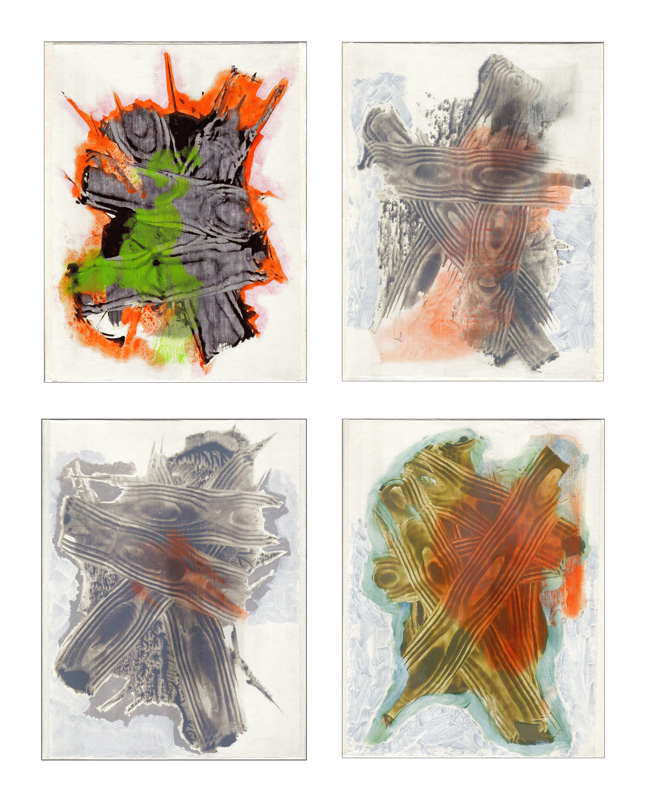

“CIVIC AGENCY”

December 9, 2025

*

Ricardo Morín
Teratological Topographies Series One: CIVIC AGENCY
Oil On Linen
Quadtych: Each panel: 14 by 18 by 3/4 inches
2009

Ricardo F. Morín

November, 2025

Oakland Park, Florida

Billy Bussell Thompson, Editor, NY, NY

This essay examines conditions frequently distorted by ideology, moral inheritance, or historical narrative.   Questions of sovereignty, occupation, revolution, exile, and national identity are often debated through claims that appeal to absolutes—religious entitlement, historical grievance, or revolutionary legitimacy.   These claims differ in language but share the same structure:   they place a single idea over civic realities of people whose lives are structured by such narratives.

To address what is obscured by these narratives, the essay turns to a structural factor that cuts across these differences:   civic agency, understood as the capacity of people to shape the conditions of civic life through their participation, representation, and lawful processes.   When civic agency is removed—whether through external control, internal authoritarianism, or deterrence directed at displaced populations; the form of the constraint may change, but the civic effect remains constant.

This essay does not compare political histories.   It examines how State power, in its various configurations, regulates civic life.   It considers how ideology obscures this regulation and how populations experience the consequences of decisions in which they have little or no role.   The goal is not to reduce political conflict but to call attention to the structures that determine whether freedom is possible or remains beyond reach.

This essay will argue that the most reliable way to understand situations that appear politically incompatible—such as Palestinian statelessness and Cuban authoritarian sovereignty—is to examine the structural absence of the civic agency that defines both.   Although the forms of constraint differ, the civic condition comes together:   the State, whether external or internal, restricts the capacity of the population to shape its own civic life.   By analyzing how State regulation limits participation, suppresses representation, or fragments jurisdiction, this essay will show how civic agency becomes the central measure of freedom.   It will further examine how ideological narratives, policies of deterrence, and migratory pressures hide this structural reality.   The aim is not to adjudicate political claims but to bring to light the conditions under which civic life can be formed, protected, or denied.


1

Every attempt to understand political life must begin with the recognition that populations do not experience freedom as an abstraction; they experience it through the structures regulating their civic existence.   These structures determine how decisions are made, how authority is exercised, and whether or not people can participate in shaping the conditions for their own lives.   Civic agency is therefore not an ideal but a condition that either exists or not.   When it is absent, freedom appears as a formal claim rather than a lived condition.

2

Civic agency consists of three components:   participation, representation, and lawful process.   Participation allows individuals and communities to influence public decisions.   Representation provides continuity between the governed and the governing body.   Lawful processes ensure that authority is exercised within defined limits.   When any of these components is removed, the people lose their capacity to shape the civic environment they inhabit.   This loss may occur by external regulation, internal authoritarianism, or policies reducing civic life to a set of restrictions that diminishes a shared domain.

3

The absence of civic agency can take different forms.   A population may be governed by institutions that do not recognize the communities’ sovereignty and thus leave civic agency subject to regulations that the people have no significant role in its shaping.   Alternatively, a people may inhabit a sovereign State that suppresses political pluralism, restricts lawful dissent, and monopolizes institutional authority.   In both cases, the civic condition is suppressed:   the people are without the ability to influence the rules that govern them.

4

The Palestinian case illustrates the first form.   Multiple authorities regulate movement, territory, and public life without providing unified jurisdiction or sovereign protection.   Decisions made by external States define daily existence and leave the population without consistent civic rights or a stable institutional framework.   The absence of sovereignty is not only territorial but civic; this absence takes away the mechanisms by which participation and representation are possible.

5

The situation with Cuba represents the second form.   Although the State possesses sovereignty, it concentrates political authority within a single institutional apparatus and restricts lawful avenues for dissent, competition, or structural reform.   Citizens live under a system that maintains political continuity by restricting avenues for participation.   Sovereignty prevails; civic agency is limited.

6

Palestine and Cuba differ, of course, in history, structure, and origin; yet they align in one respect:   the State, whether external or internal, restricts participation in ways that make civic agency unattainable.   The absence of agency is the common element that marks the civic condition beneath political narratives.   This absence also provides a framework through which populations that experience different forms of constraint are to be understood without conflation.

7

Ideological narratives frequently align with existing distributions of power.   Religious entitlement asserts that land is secured by divine mandate rather than civic protection.   Revolutionary rhetoric proclaims that political authority is justified by historical struggle rather than accountability.   Both forms of narrative elevate an absolute over the civic realities of the population.   They replace agency with allegiance, and they interpret restriction as necessity, and not as a failure of representation.

8

Migration provides a third lens through which the limits of civic agency become visible.  People leave their countries when the structures regulating their lives collapse or become uninhabitable.  They seek stability, protection, and the ability to rebuild civic participation in new surroundings.   Yet policies of deterrence in host States often mirror the pressures that displaced them.   The new States restrict the migrants’ movements, their access to social institutions, and narrow the possibilities of belonging to a civic order.   These policies do not reproduce the original dilemma, but host States reintroduce the experience of living under rules that they cannot influence.

9

For many asylum seekers, these restrictive measures narrow the distance between the pressures that forced their departure and the pressures they encounter upon their arrival, a shift that makes stability hard to distinguish from exclusion.  European examples such as Denmark and the United Kingdom reveal how deterrence is used to discourage asylum without acknowledging the civic vacancy it creates.  The United States employs similar policies at its borders and presents deterrence as an instrument of order, which leaves migrants suspended between exclusion and unresolved civic status.

10

The structural argument is not that these situations are equivalent, but that the absence of civic agency creates a civic condition transcending political differences.   Populations ruled without participation, governed without representation, or confined within systems that restrict lawful processes experience freedom as external to their civic environment.   This condition cannot be explained by ideology because ideology addresses identity, justification, or legitimacy—not agency.

11

Understanding civic agency clarifies the difference between political claims and civic realities.   Sovereignty does not guarantee freedom; revolution does not guarantee participation; religious entitlement does not guarantee protection.   Civic agency exists only when people can shape the conditions that guide them.   When this becomes impossible, the people do not inhabit a civic order but a regulated space.

12

When civic agency becomes the measure through which political life is understood, ideological narratives lose their authority, and the structure of constraint becomes visible.  This visibility does not resolve conflict but reveals the conditions under which freedom can either emerge or remain unapproachable.   Civic agency is where the possibility of civic life begins and where its absence becomes structurally apparent.