Posts Tagged ‘diagnostic analysis’

“Eschatology”

January 11, 2026

Ricardo F. Morin
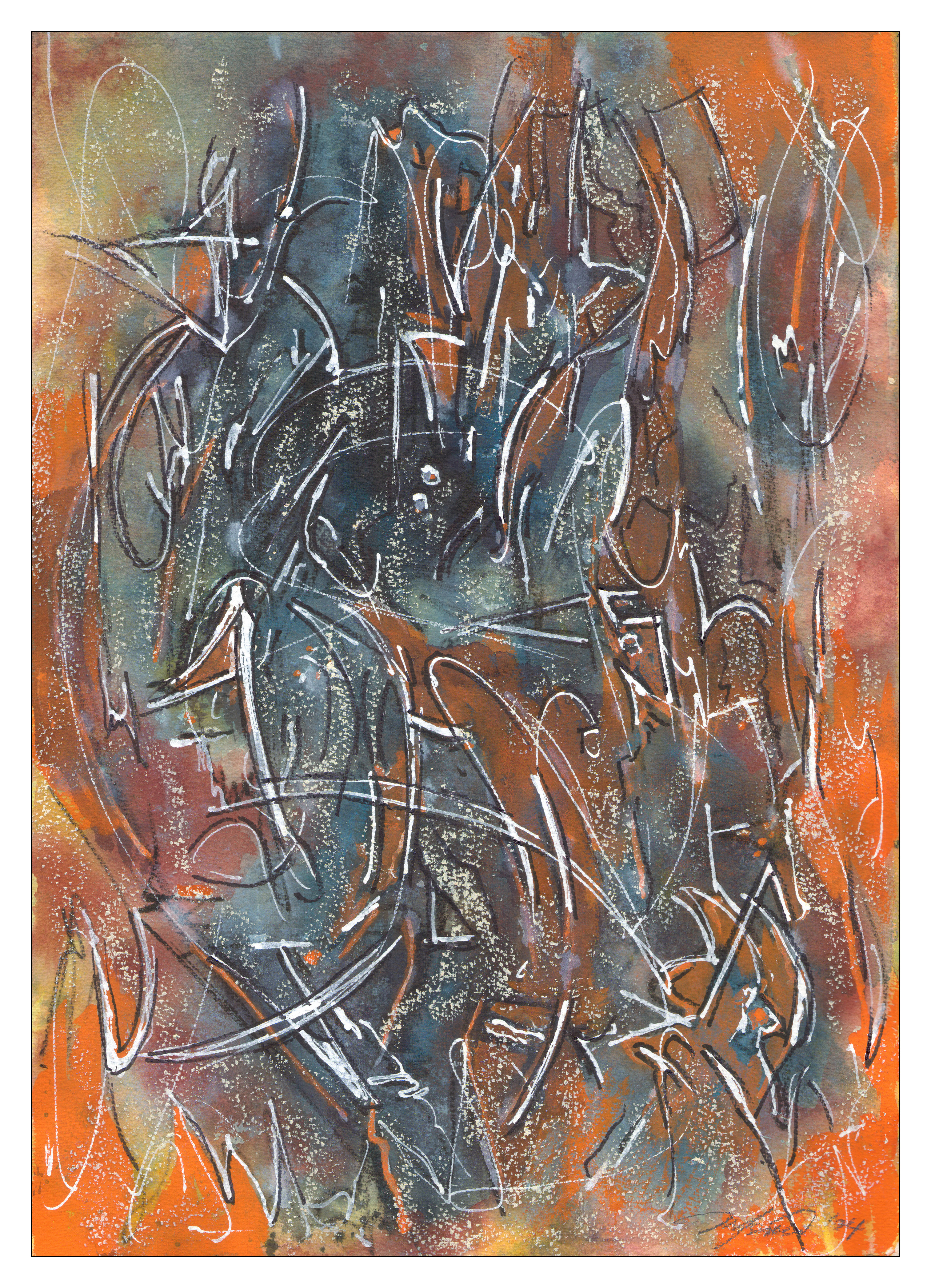
Eschatology
Watercolor, gouache, oil sticks, white correction fluid, and black ink on paper
14″ x 20″
2004

Ricardo F. Morín

January 11, 2026

Oakland Park, Fl

1.  Civilizations periodically describe their present as uniquely perilous.  Such claims are rarely grounded in historical comparison or institutional analysis.  They arise instead from a failure of scale:  the inability to distinguish disruption from collapse, uncertainty from termination, and incoherence from apocalypse.

2.  Moments of genuine civilizational danger are not hypothetical.  The Black Death removed a third of Europe’s population.  The Thirty Years’ War devastated entire regions.  The twentieth century combined industrialized warfare, genocide, and the advent of nuclear annihilation.  These events did not require prophetic language to be understood as catastrophic.  Their magnitude was measurable.  Their effects were material.  Their causes were traceable.

3.  Apocalyptic rhetoric appears not when danger is greatest, but when comprehension falters.  It converts uncertainty into moral drama.  When political processes appear opaque, when outcomes resist prediction, and when authority behaves without an intelligible pattern, explanation withdraws.  In its place enters eschatology:  a narrative that simplifies complexity, assigns absolute blame, and promises closure.

4.  The figure of the Antichrist belongs to this register.  It is not an analytical category.  It is a symbolic condensation of fear.  By locating total danger in a single person, eschatological thinking relieves societies of the obligation to examine institutions, incentives, and limits.  It replaces causal inquiry with revelation.

5.  Such framing also distorts responsibility.  Civilizations do not disintegrate because of individuals alone.  They deteriorate through cumulative failures of governance, adaptation, and legitimacy.  These processes unfold unevenly, often reversibly, and without finality.  They do not announce themselves with signs.  They do not culminate on schedule.

6.  Eschatology thrives where explanation retreats.  It offers emotional certainty where analysis requires patience.  It persuades by promising an end to ambiguity, not by clarifying causes.  By transforming political disorder into cosmic struggle, it diverts attention away from conditions that can be examined and toward myths that cannot be corrected.

7.  The danger of apocalyptic thinking is not that it exaggerates risk, but that it misdirects attention.  It trains citizens to search for omens rather than causes, villains rather than conditions, destiny rather than decisions.  In doing so, it deepens the very helplessness it claims to describe.

8.  What the present requires is not prophecy, but proportion.  Not moral theater, but discernment.  Not the language of revelation, but the discipline of understanding how power operates, where it fails, and how it can be constrained.

9.  Where explanation returns, superstition recedes.  Where clarity is restored, apocalypse loses its hold.


“Viability”

January 11, 2026

Ricardo F. Morín
Viability
Watercolor frottage and white corrector on drafting vellum
20″x30″
2005


1.  The question is often posed as to why certain corrupt regimes become objects of political action while others, no less compromised, do not.  At first glance, this appears to demand a comparative moral explanation.  In fact, it does not.  The difficulty lies not in the absence of information, but in the assumption that such actions are guided by a coherent and generalizable system of principles.

2.  What can be observed is not the application of a principle across cases, but decisions taken one case at a time.   Political action does not follow a rule that can be applied in advance to different regimes.   For that reason, comparisons between Venezuela, Saudi Arabia, Russia, or Argentina obscure more than they clarify.  They assume a standard of decision-making that is not, in practice, a guiding action.

3.  The actions examined here are those taken by Donald Trump in his capacity as a political actor.  His name is introduced not to explain behavior through personality or intention, but to locate responsibility.  The analysis proceeds from observable decisions and the circumstances in which those decisions were taken, rather than from suppositions about character, motive, or disposition.

4.  The more relevant question is therefore not why some regimes are confronted and others ignored, but under what circumstances a country presents few obstacles to action, and which immediate interests align to make that action feasible.  This reframing shifts the analysis away from moral judgment and toward observable circumstances.

5.  Understood in these terms, the issue admits a response—not as a rule, but as an account of how decisions are made in specific cases.   There is no way to infer, from the level of corruption alone, whether action will occur.  There is, however, a way to explain why, in particular circumstances, action proceeds.

6.  In the Venezuelan case, several conditions converge.

7.  First, immediate external resistance is limited.  Venezuela lacks allies willing to impose material, military, or economic consequences in response to pressure or limited intervention.

8.  Second, state institutions do not act in a coordinated manner.  Administrative agencies, security forces, and political authorities do not reliably operate under a single command, reducing the ability to mount a unified response and making external action easier to pursue.

9.  Third, Venezuela can be publicly described as an exceptional case—marked by collapse, criminal conduct, and administrative failure—which allows actions to be presented to domestic audiences without invoking a general principle that would need to apply elsewhere.

10.  Fourth, economic interests operate through short-term negotiation rather than long-term alignment. Venezuelan oil, under sanctions and administrative disorder, can be folded into ad hoc bargaining without requiring stable commitments or enduring partnerships.

11.  Finally, pressure on Venezuela does not trigger immediate disruption to major markets or strategic balances. Unlike cases involving Saudi Arabia or Russia, action does not risk cascading economic or military responses.

12.  None of these factors amounts to a moral explanation or a guiding doctrine. Taken together, they describe when an administration acts through foreign policy: not because corruption is greater, but because resistance is limited, interests converge quickly, and a domestic account of the action can be sustained—conditions absent in many cases of equally severe corruption.

13.  This does not explain the world.  It explains a decision.