•
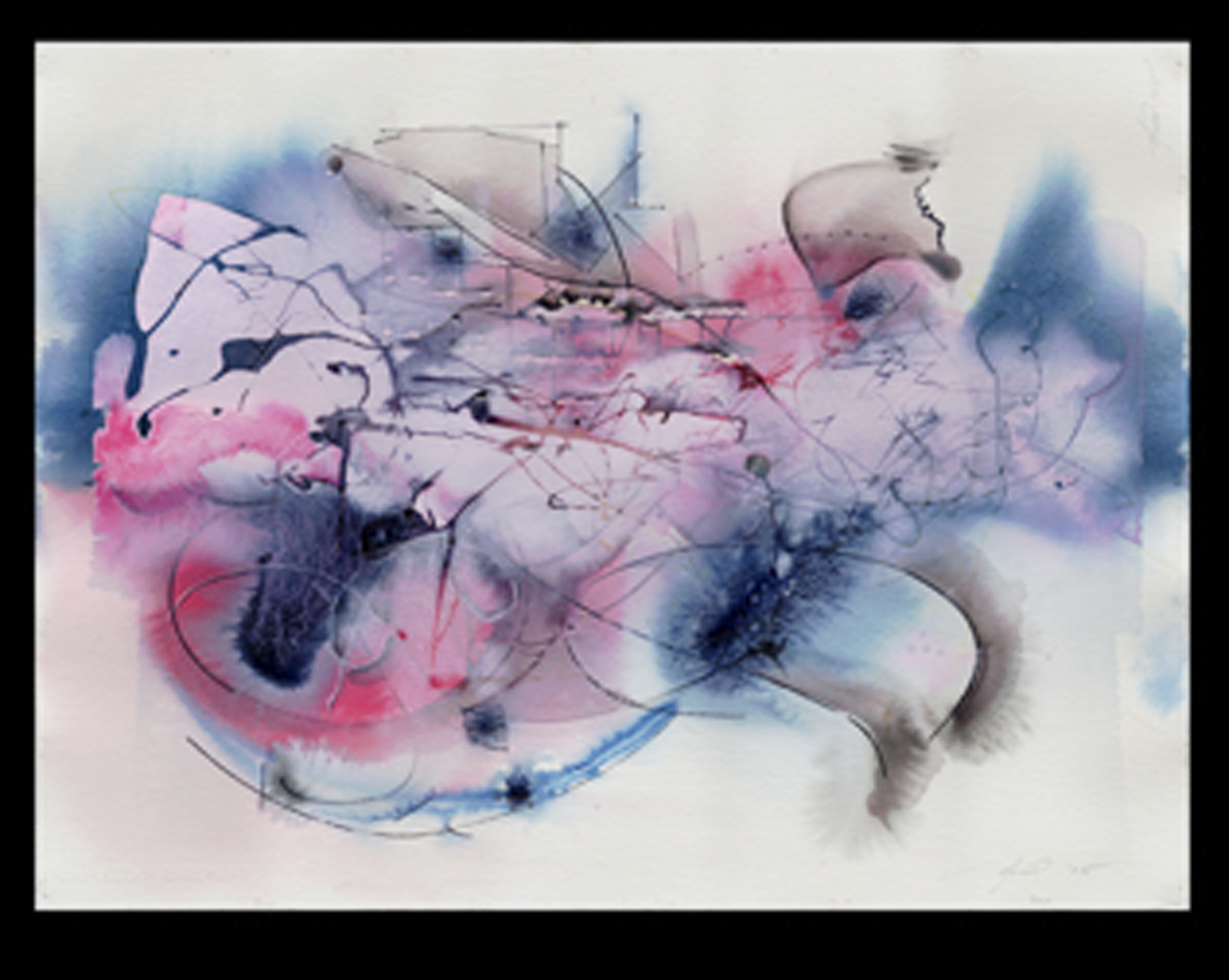
The Mirage of Exceptionalism
(Template Series)
1st out of six
Each 30″x 22″ = 66″h x 66″ overall
Watercolor on paper
2005
To the paradox that divides in the very act of seeking unity.
~
By Ricardo Morin
August 18, 2025, Bala Cynwyd, PA
*
Across traditions, faith has sought to articulate humanity’s highest aspirations. Scriptures, rituals, and doctrines were meant to give form to gratitude, humility, and reverence for creation. Yet time and again, these same legacies have been drawn into the service of division. The paradox lies in how beliefs that profess universal truth harden into claims of exceptional status and turn revelation into rivalry.
The Abrahamic faiths—Judaism, Christianity, and Islam—rooted themselves in texts anchored in antiquity. This permanence can inspire continuity, but when transposed into political life, belief risks becoming dogma, and dogma exclusion. What began as a celebration of humanity and its creator becomes instead an engine of contention.
Exceptionalism is not confined to any single tradition. It arises wherever uniqueness is mistaken for superiority, wherever the memory of a chosen people or a sacred covenant becomes a license to deny the dignity of others. Creationism, visions of Heaven, doctrines of righteousness—all contain the seeds of inspiration, but also of antagonism when set against rival paths.
In this sense, exceptionalism is less about the divine than about the human need to define boundaries. By exalting one path as singular, communities cast shadows on others. They forget that the multiplicity of belief might reveal instead the vastness of what humanity seeks to comprehend. The question is not whether one tradition is more luminous than another, but whether clarity itself can be hoarded without dimming the shared horizon of human dignity.
The tragedy of conflating exceptionalism with uniqueness is that it mistakes a gift for a weapon. To be unique is not to be superior; to inherit a tradition is not to monopolize truth. Religions, when true to their essence, point toward a mystery larger than themselves. When they lapse into rivalry, they obscure it.
The challenge before us is whether humanity can learn to let religions serve as languages of gratitude rather than banners of conquest. If belief is to celebrate creation, it must embrace the unity of humanity rather than sabotage it. Otherwise, the promise of transcendence is reduced to a struggle for dominance, and what was meant to honor the creator becomes instead a mirror of our most destructive instincts.
*
Annotated Bibliography
- Armstrong, Karen. The Battle for God: A History of Fundamentalism. New York: Ballantine Books, 2001. (Armstrong explores how traditions across Judaism, Christianity, and Islam have produced militant forms of fundamentalism. She shows how claims of absolute truth often distort original spiritual intent and feed conflict instead of unity.)
- Girard, René: Violence and the Sacred. Baltimore: Johns Hopkins University Press, 1977. (Girard argues that societies often channel violence into ritualized sacrifice. His insights illuminate how religious exceptionalism, rather than reducing violence, can redirect it toward outsiders deemed threatening to communal “uniqueness.”)
- Küng, Hans: Christianity and the World Religions: Paths of Dialogue with Islam, Hinduism, and Buddhism. New York: Doubleday, 1986. (Küng advocates for dialogue across faiths, stressing that no single religion can claim monopoly on truth. His work directly challenges exceptionalist claims and encourages the search for shared ethical ground.)
- Said, Edward W.: Covering Islam: How the Media and the Experts Determine How We See the Rest of the World. New York: Vintage, 1997. (Said critiques the portrayal of Islam as uniquely threatening, showing how narratives of exceptionalism become entrenched in political and cultural discourse. His analysis highlights how external perceptions reinforce divisions.)
- Taylor, Charles: A Secular Age. Cambridge, MA: Belknap Press of Harvard University Press, 2007. (Taylor examines how modernity has shifted the role of religion and has complicated claims of universality. He shows how belief persists in pluralist societies, while exceptionalist frameworks struggle to adapt within a diverse human landscape.)
*
Edited by Billy Bussell Thompson, August 18, 2025, NY, NY.
 Observations On Perception