*
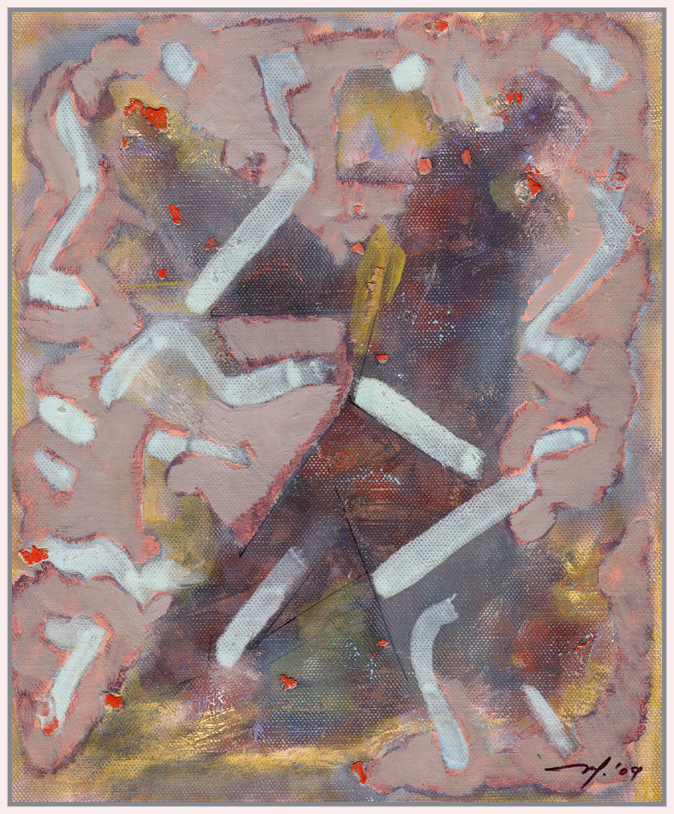
Infinity 32
13 “ x 15 ¾”
Oil on linen
2009
Ricardo F. Morín
February 16, 2026
Oakland Park, Fl.
Religious belief and democratic life often meet within diverse societies where traditions, rituals, and outward identities differ, even as individuals share deeper ethical concerns. People turn to religion for meaning and conscience, while democratic life asks them to live alongside others whose practices and expressions vary. Tension becomes visible when superficial distinctions shape perception more than shared ethical ground, and when claims of moral authority seek to govern the shared civic space of others.
Plurality is a constant feature of democratic life. Individuals speak, listen, and respond in public meetings, civic gatherings, online exchanges, and everyday encounters where limits and freedom of expression meet. Expression that invites response, allows disagreement, or makes room for reconsideration can sustain coexistence, while expression framed as accusation, exclusion, or moral finality can narrow it. Political life adjusts to shifting advantage and immediate circumstance, while religious conscience often draws individuals toward standards held to endure across conflicts. Individuals move between these two demands, rarely able to resolve the tension between them. Religious and political judgment can align while remaining open to disagreement, even as individuals draw from moral frameworks that shape their conduct and traditions.
Religious expression often appears in public life through appeals to fairness, responsibility, and the dignity of persons. Such expressions shape how individuals frame their claims without requiring agreement on doctrine. When religious language enters public conversation as part of a shared ethical vocabulary, it can widen recognition without demanding uniform belief. People may not agree on belief, yet they may recognize common ground in the use of moral language. At times, religious communities identify ethical similarities across traditions, allowing plurality to remain workable within that recognition. When partisan pressures reframe difference as threat, markers such as creed, race, or culture become dividing lines, and shared ground recedes from view.
Difficulty emerges when religious identity becomes inseparable from partisan alignment and when public language becomes structured around accusation rather than mutual examination of ideas. Under such conditions, freedom of expression is interpreted less as civic difference and more as personal rejection. Expression itself is treated as evidence of allegiance rather than as an invitation to examination.
Another condition appears when citizens continue to recognize one another as legitimate participants despite differences that remain unresolved. Religious conviction shapes conscience, while democratic life maintains a space in which competing claims can exist without coercion. Individuals move between these spheres, sometimes comfortably and sometimes with strain, as they adjust boundaries, widen or narrow participation, and renegotiate coexistence over time.
People continue to move between religious conviction and democratic participation without resolving the tension between them. Some draw boundaries more firmly; others widen the space for coexistence, and many shift between both over time. The tension remains visible not as a problem to eliminate, but as part of how individuals understand themselves, claim authority, and live alongside others within a shared civic world.
 Observations On Perception