Ricardo F. Morin New York Series, Untitled 24″ x 36″ Oil on canvas 1992
1. A person withdrawn from interruption, judgment, dependency, and noise may begin to believe that solitude clarifies the self. Removed from the continual presence of others, one becomes more aware of habits, memories, reactions, and inward movement ordinarily dispersed through daily relation. Silence appears to gather experience into greater clarity. Yet prolonged isolation reveals something less expected: inward life does not remain still simply because it happens alone.
2. Thought begins circling within its own continuity without resistance. Reflection loses proportion when nothing interrupts it from beyond itself. A memory repeated often enough begins to feel increasingly complete when it is not. A fear unanswered by another perspective deepens within its own enclosure. Even silence changes character. No response arrives. No interruption. Nothing enters from outside oneself.
3. This may be why solitude eventually begins searching for relation again, even where no person is present. The hermit speaks to God, to memory, to nature, or to silence itself. The mind reaches beyond its own enclosure not necessarily from weakness, but because inward life alone cannot fully restore proportion to itself.
4. We do not discover ourselves in abstraction alone. Much of what we call individuality becomes perceptible through relation. Patience, resentment, tenderness, vanity, courage, forgiveness, and responsibility do not fully disclose themselves in separation from others. They emerge through contact, disappointment, affection, misunderstanding, dependence, and care. Another person does not diminish individuality. Something in us becomes more visible in relation than in withdrawal.
5. Communication does not eliminate distance between human beings. It reveals it. No person entirely crosses the interior distance separating one consciousness from another. Suffering, mortality, memory, and perception remain singular experiences. Yet it is often through the effort to communicate that this separateness becomes recognizable at all. We discover how far we remain from one another precisely in the attempt to reach across that distance.
6. Another person is neither an extension of oneself nor a symbolic abstraction. The other remains distinct, vulnerable, and finite. Love therefore cannot consist merely in attachment, possession, or dependence. Its deeper force lies in the capacity to recognize another existence without attempting to dissolve it into one’s own needs, fears, or projections. Compassion arises quietly from this condition.
7. Isolation becomes impossible not because solitude lacks value, but because human life continually reaches beyond private continuity. Even withdrawal retains traces of relation: language, memory, longing, recognition, prayer, imagination. The mind does not merely enclose itself. It responds. Seeks. Recalls. Addresses what remains beyond it.
8. Perhaps this is why the deepest forms of love do not abolish aloneness. They allow it to stand without hardening into enclosure. Compassion does not overcome distance by eliminating difference. Each person remains singular and ultimately unreachable in totality, yet still worthy of care. In that recognition, isolation no longer appears possible as a final condition of human life.
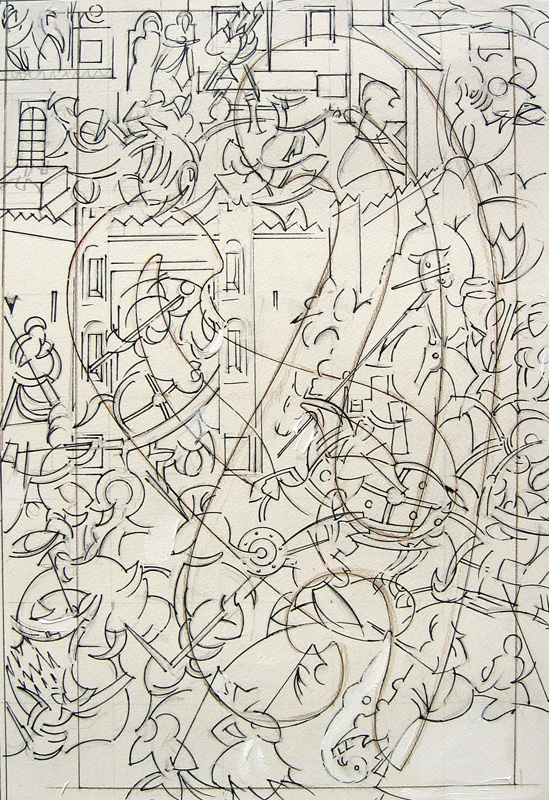
Ricardo F. Morín Persian One 19” x 28” Graphite, sanguine and Sumi ink on watercolor paper 2003
People act before they fully know what their actions will bring about. Decisions are made with limited information, divided attention, and signals whose importance cannot be fully assessed at the moment of choice. A person commits to a course of action without being able to see all the conditions that action will set in motion. Only later do the effects of that action make clear what mattered and what could have been altered.
Because action proceeds under uncertainty, error does not appear at the moment of decision. At the time of choice, available information remains partial, situations remain ambiguous, and attention remains finite. Action therefore binds the agent to consequences whose full implications cannot be known in advance. What later appears obvious was not fully visible when the action began.
Responsibility begins to take shape as consequences disclose relations that action itself has revealed. Effects expose dependencies, constraints, and vulnerabilities that were previously unnoticed or underestimated. What emerges after the fact is not merely additional information, but a shift in relevance. Elements that once seemed secondary acquire weight, while assumptions that once guided action lose authority. Recognition follows commitment rather than preceding it.
As understanding develops after action, foresight is often overestimated in retrospect. Later awareness projects coherence backward onto moments that were shaped by uncertainty. Signs that appear decisive after consequences unfold are treated as though they had been unmistakable beforehand. This compression creates the impression that error resulted from neglect, rather than from the limits of perception under action.
Practices that depend on anticipation—such as planning, prediction, precaution, and control—assume a level of foresight that action itself cannot provide. These practices stabilize expectations, yet they remain vulnerable to the fact that relevance is often disclosed only through outcome. When results diverge from intention, the gap reflects not a failure of responsibility, but the temporal structure within which responsibility operates.
Responsibility matures through recognition rather than certainty. It develops as people acknowledge how their actions have bound conditions that now require response. What responsibility sustains is not the illusion of complete control, but the capacity to remain answerable to consequences that exceed prior understanding. Responsibility therefore does not end at the moment of decision; it continues as recognition adjusts agency to what action has revealed.
Responsibility does not arise from foresight that precedes action, but from recognition that follows commitment, as agency responds to consequences that could not be fully anticipated.
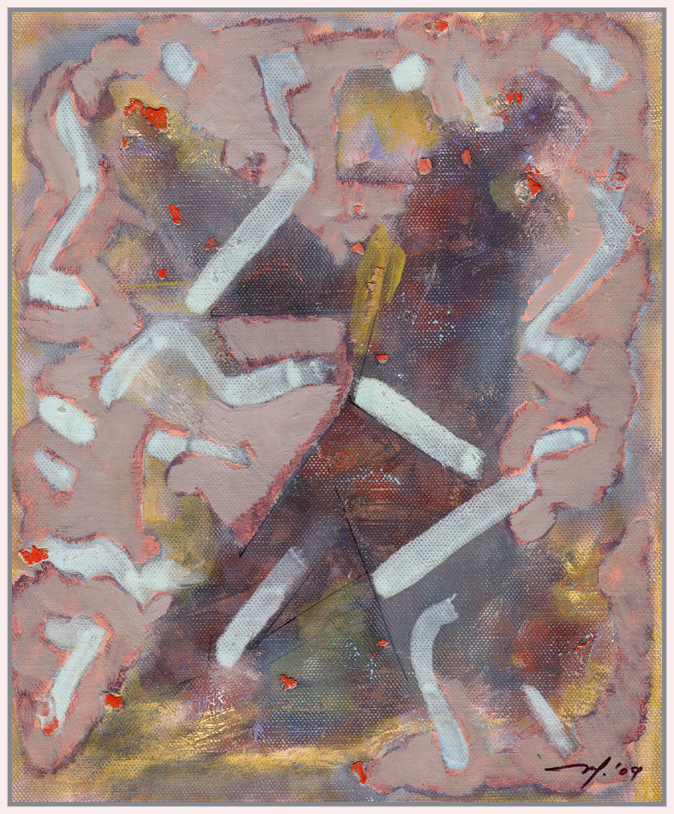
Ricardo F. Morín Triangulation Series Nº59 12” x 15” Oil on linen 2009
* *
Knowledge enters common life through relations among persons. A proposition privately held may possess coherence, explanatory force, or evidentiary support, yet its public standing begins when the proposition becomes available to the examination of others. Agreement is only one possible response. Contradiction, revision, qualification, and the discovery of error also participate in the process through which a claim becomes intelligible beyond the judgment of the person who formed it. Validation, in this sense, does not mean approval. Validation refers to the exposure through which knowledge becomes subject to other judgments within a world no individual determines alone.
A claim, however, is never presented without the person who advances it. A response to the proposition consequently affects the claimant. Confirmation may establish credibility; correction may diminish it; and sustained attention may confer significance upon both the subject and the person addressing it. The validation of knowledge and the recognition of the knower remain distinguishable, but they do not remain separate. Each encounter with a claim contains the possibility that an examination of what is known will also become a judgment concerning the person who claims to know it.
Recognition is not an incidental intrusion into an otherwise impersonal activity. Language, instruction, and intellectual formation arise within relations through which individuals learn not only what may be known but whether their own perceptions merit expression. The need to be recognized accompanies the acquisition of knowledge because the person acquiring it also acquires a position from which to speak. Psychological vocabularies may identify intensified forms of reassurance seeking, contingent self-worth, or dependence upon approval, but the underlying condition precedes those definitions. The condition belongs neither to a diagnosis nor to a particular type of person. The condition is present wherever a human being submits a judgment to another consciousness and awaits a response whose meaning cannot be restricted to the judgment alone.
Repeated confirmation alters the relation between a claim and its source. A person whose judgments have proved reliable acquires credibility extending beyond the propositions already examined. Institutions formalize the extension of credibility through credentials, offices, publications, and titles; informal relations establish credibility through memory, reputation, and trust. Authority permits knowledge to circulate without requiring every proposition to be reconstructed from its foundations. The listener accepts that the speaker has previously undergone forms of examination whose repetition would be impracticable in every exchange. When the listener relies upon that prior credibility, the standing of the person may precede the standing of the claim. Confidence derived from particular judgments can therefore extend to the individual who produces them.
That extension of confidence may become more persuasive when extensive information, fluency across several vocabularies, and familiarity with multiple fields make intellectual breadth visible as a characteristic of the person. Such breadth may result from sustained study and may support comparisons among fields. Breadth alone does not disclose how knowledge from different fields has been organized. Information from several fields can coexist without mutual explanation; proficiency in those fields can coexist with uncertainty concerning the relations among the premises of those fields. The quantity and range of information may influence judgment apart from demonstrated organization. Accumulated knowledge may therefore be interpreted as comprehensive understanding.
That interpretation becomes more consequential when different fields are presented as a synthesis. Disciplines do not merely contain different information about a common reality. They establish objects through distinct methods, employ terms whose meanings depend upon particular histories, and recognize evidence according to standards that may not correspond. An explanation of human conduct, for example, may move from a neurological description to an ethical conclusion and from that conclusion to a theory of social order. Each transition may be intelligible, yet the evidence supporting the neurological description does not by itself establish the ethical conclusion, and the ethical conclusion does not by itself establish the theory of social order. Continuity of vocabulary may make the sequence appear complete before the relations have been demonstrated. The relation among fields may be demonstrated, remain provisional, or contain contradictions that no common vocabulary resolves. Describing the conjunction of the fields as synthesis does not reveal the status of that relation. The term synthesis indicates that coherence is being claimed, although the source of that coherence may still require examination.
Where the relations among fields remain incompletely demonstrated, acceptance of their asserted unity may depend partly upon confidence in the person presenting the synthesis. The range of the person’s knowledge, the fluency of the presentation, and the authority accumulated through previous exchanges can support acceptance of connections that the propositions themselves do not establish. Although this dependence does not demonstrate that the connections are mistaken, it discloses a change in the basis of coherence. The claim submitted for validation then concerns not only the relations among ideas but also the capacity of the person to comprehend those ideas as a totality.
Once acceptance depends partly upon the presenter, the passions of the knower may also affect the authority attributed to the synthesis. Acquiring information may alter how a person understands ambition, fear, attachment, resentment, and the desire for recognition without extinguishing any of them. A person may describe the operation of a passion while remaining subject to it; the capacity to identify a limitation does not confer command over its effects. Intellectual vocabularies may also make a passion more difficult to perceive: the desire for authority may be interpreted as service, the need for recognition as intellectual responsibility, and attachment to a conclusion as fidelity to truth. No clinical condition is required for these interpretations. They may arise from the influence of the knower’s motives upon the acquisition and presentation of knowledge.
Relational consequences arise when another person responds not only to what has been said but also to the authority attributed to the speaker. Agreement may confirm a proposition while also sustaining an identity organized around competence. Disagreement may concern a limited inference but be received as a withdrawal of confidence from a larger intellectual structure. The interlocutor then occupies more than one position: examiner of the claim, witness to the knower, and participant in the preservation or alteration of an established authority. These functions may coexist without becoming visible to either participant. The exchange continues to concern knowledge, but the response may also confirm or weaken the authority attributed to the claimant.
Unresolved relations among fields may also affect the understanding of a recipient. Confidence in the presenter may influence how the recipient evaluates those relations: a conjunction may be accepted as an established synthesis even when the recipient lacks the means to examine whether the constituent conclusions are compatible. The resulting confusion need not be recognized as confusion. The language supplied by the authority may give the conclusions internal consistency, and those conclusions may therefore be reproduced through subsequent explanations, instruction, or advice. The consequence does not depend upon deception. A person may sincerely transmit a coherence whose unresolved premises remain inaccessible to the recipient and perhaps insufficiently visible to the person who asserted it.
Recognition, however, is not sought only through the presentation of competence. A person may also disclose a limitation within a relation. An admission of imperfection may function as a request for reassurance or assistance, but the admission may also disclose a limitation without requesting either response. In the latter case, the speaker may neither deny the limitation nor experience the admission as an injury to self-worth. Fellowship may characterize an exchange in which the admission establishes trust between the speaker and the interlocutor. Both participants may then recognize vulnerability without interpreting the disclosure as a request for correction.
The interlocutor cannot determine the intended function of a disclosure from its content alone. An ordinary exchange may demonstrate this uncertainty. During a familiar conversation, a person may remark without distress that a notebook compensates for an unreliable memory. A companion may interpret the remark as self-denigration and respond by rejecting a judgment that the speaker had not experienced as injurious. An admission offered as trust may be heard as self-devaluation; an acknowledgment of limitation may be received as evidence of a distorted judgment requiring correction. A response may proceed from concern and still address a need that the speaker did not express. Through the disclosure, the speaker may establish trust, while the interlocutor may protect the speaker from a judgment considered harmful. Neither intention necessarily excludes regard for the other. The corrective response may convert disclosed vulnerability into an occasion for instruction.
The presentation of knowledge and the admission of limitation may perform different functions, yet both disclose the dependence of meaning upon response. A claim submitted for examination may be received as a demand for recognition of the claimant. A disclosure offered in fellowship may be received as a request for correction. In each instance, the interlocutor assigns a function to what has been communicated and thereby affects how the speaker and the interlocutor understand the exchange. Neither participant can determine that function alone: the person who speaks cannot control its attribution, and the interlocutor cannot recover intention without interpretation. Validation, recognition, and correction therefore arise not as fixed categories but as possible effects of an exchange whose participants may understand its purpose differently.
The attribution of wisdom may combine assessments of knowledge, passion, recognition, and limitation within a single judgment. Wisdom may be associated with the possession of extensive knowledge, the ability to relate different fields, composure before adversity, command over passion, or recognition of human limitation. These qualities can appear together, but their conjunction is not assured. Accumulated knowledge can coexist with unexamined assumptions; intellectual range can leave contradictions unresolved; apparent composure can depend upon the confirmation supplied by others; and acknowledgment of limitation can itself become part of an identity requiring recognition. The attribution of wisdom consequently reveals not only an assessment of the person but also an expectation concerning what knowledge is presumed to have accomplished within that person.
No separation of knowledge from recognition resolves the condition, since knowledge becomes social through responses that inevitably affect the person who speaks. Nor does the acknowledgment of vulnerability determine whether another person will receive the admission as fellowship, reassurance, or an occasion for correction. Greater awareness of these distinctions may itself become another claim to discernment and another position from which the conduct of others is evaluated. The analysis therefore does not yield a procedure by which validation can be purified of personal need or relations protected from every misalignment. The attempt to prescribe such a procedure would repeat the movement under examination by converting the recognition of a limitation into a claim of mastery over it.
Knowledge becomes public through examination, but the person who presents it remains exposed to what examination may confer or withdraw. A disclosure of vulnerability remains subject to the same uncertainty because its reception may convert an admission into a judgment the disclosure did not contain. Validation, correction, and recognition become distinguishable only after a response has altered the meaning attributed to the claim or disclosure. The analysis of those effects remains subject to the same condition: its distinctions become available for examination and may acquire authority through the recognition of those who receive them. Human beings require others to discover what their claims can sustain, yet neither the claim nor its analysis determines what follows from the presence of others.
Life does not begin with power. It begins with dependence. Before a human being becomes capable of judgment, choice, consent, or resistance, existence already unfolds within relationships upon which survival depends. No one enters the world invested with autonomy. Every human life begins by being sustained through the action of another.
Dependence, however, is not sufficient to explain authority. Whoever possesses greater strength may preserve another’s life, abandon it, or destroy it. Physical superiority alone cannot explain the character of the relationship through which human life ordinarily comes to develop. If force alone governed the bond between the one who requires protection and the one capable of providing it, care would cease to be distinguishable from domination.
Care begins to reveal itself as something different from domination through an experience so ordinary that it seldom becomes an object of reflection. The child gradually discovers a world in which the guidance received is not experienced solely as a limitation imposed from without, but as guidance properly exercised by the person who provides it. Before authority becomes an object of understanding, it constitutes a lived experience. Its first appearance assumes not the form of command, but that of care.
Care makes possible a form of dependence that force could never produce: a dependence that does not extinguish future freedom, but prepares the conditions for its emergence. The guidance received becomes intelligible because it is exercised for the benefit of a life still in formation, rather than for the immediate satisfaction of the person possessing greater power.
Power and authority operate jointly in the development of civilized life. Power designates the capacity to act. Authority designates the acknowledged right to guide, direct, judge, or decide. Both may be present in the same person, but neither necessarily implies the existence of the other. Power may exist without authority, just as authority may endure even after power has considerably diminished.
Obedience does not resolve the problem either. Human beings obey for many different reasons. They obey because they fear punishment. They obey because custom has rendered the alternatives invisible. They obey because deception has concealed the true nature of what is being required of them. They obey because every form of resistance appears futile. None of these circumstances constitutes authority. They explain only submission.
Authority begins only where recognition becomes possible. The guidance offered by one who leads must possess a title that renders its recognition justifiable independently of force. A person who accepts the guidance of another does not merely yield before a more powerful will. The person recognizes that such guidance possesses a title extending beyond the mere fact that it can be imposed.
That recognition constitutes legitimacy. Legitimacy is not identical with effectiveness, popularity, success, antiquity, or duration. Nor does it arise from the mere assertion of the person claiming obedience. It designates the condition under which authority may be recognized as due, rather than merely acknowledged as existing.
Because legitimacy depends upon recognition rather than upon the possession of power, it is more fragile than power itself. Force may remain intact after legitimacy has already begun to disappear. Armies may continue to obey. Institutions may continue to function. Laws may continue to be enforced. Yet the basis of recognition has already changed: what was once acknowledged as due begins to be experienced only as imposed.
From that moment onward, human relationships begin to change without commotion. Guidance approaches coercion. Trust yields to calculation. Responsibility begins to be confused with control. Instruction approaches indoctrination. Judgment begins to be perceived as domination. Authority remains visible while the intelligibility that once made it recognizable gradually recedes. A son may continue to obey his father from habit long after he has ceased to trust his judgment. From the outside, the relationship between father and son may appear scarcely altered. The same words continue to be spoken. The same decisions continue to be obeyed. Yet what inwardly sustained the father’s authority has already begun to disappear.
The disappearance of legitimacy does not bring about the immediate collapse of social life. Human relationships begin to reorganize themselves through means that no longer rest upon recognition. Where recognition ceases to sustain authority, substitutes arise to take its place. Force attempts to compensate for what recognition no longer grants. Fear seeks to secure the obedience that trust has withdrawn. Custom prolongs practices that scarcely continue to rest upon recognition. Manipulation manufactures the appearance of consent after genuine recognition has ceased to exist.
None of those means, however, constitutes authority. Force obtains conduct, but not recognition. Fear silences resistance, but does not produce assent. Custom prolongs forms whose intelligibility has weakened. Manipulation imitates legitimacy because it can no longer produce it. All such means depend upon the absence of the recognition they seek to replace.
What makes it possible for one human being to recognize the authority of another without reducing that recognition to force, fear, custom, or manipulation? Every subsequent form of authority will receive its intelligibility from the answer given to that question.
The first manifestation of authority remains inseparable from care because life still depends upon the constant presence of another. As the child grows, however, dependence begins to change. Survival ceases to occupy the center of the relationship. Understanding gradually begins to take its place.
No experience reveals more clearly than language how survival ceases to occupy the center of dependence and understanding begins to assume its place. No child invents the language through which the world begins to become intelligible. Words are received before they are used. Meanings are recognized before they are examined. Grammar is obeyed long before it can be explained. Every act of speech therefore presupposes an inheritance that no individual has produced independently.
The transmission of that inheritance cannot be obtained by force. A child may be compelled to repeat a word, but repetition does not yet amount to understanding. Language becomes one’s own because correction eventually comes to be recognized as something distinct from imposition. The child does not merely reproduce sounds. The child learns that certain words name the world more faithfully than others. Correction therefore always refers to a reality that transcends the person who corrects.
The acquisition of language also changes the nature of authority. The dependence characteristic of early childhood ceases to constitute its principal foundation. Authority now begins to arise from shared participation in an order that precedes both teacher and pupil. The language existed before either of them. Neither may claim it as an exclusive possession. Both remain subject to the same structure that makes communication possible.
For that reason, the teaching of language can never be reduced to the exercise of command. Whoever corrects an expression ultimately answers to the language itself, and not merely to personal will. The legitimacy of correction does not arise from the speaker’s desire, but from the fidelity with which the transmitted word corresponds to the language held in common. Authority then ceases to rest principally upon the person who teaches and begins to rest upon the reality to which that person remains subordinate.
Authority may be recognized even after the personal dependence characteristic of the earliest years of life has disappeared. The child begins to discover that someone deserves to be heard, not because that person is stronger or continues to provide care, but because that person permits faithful access to a reality existing independently of them both. Recognition thus ceases to be directed exclusively toward the person and begins to be directed toward what that person makes accessible.
The redirection of recognition toward the reality transmitted, rather than exclusively toward the person transmitting it, profoundly alters human experience. Authority may now be examined without thereby being abolished. Correction itself may be corrected. The teacher may be mistaken. Neither the examination of authority, nor the correction of what has been taught, nor the teacher’s error destroys the legitimacy of teaching, because legitimacy no longer resides exclusively in the person who teaches, but in the fidelity with which that person transmits what transcends both teacher and pupil.
Civilization begins to be constructed upon this displacement of authority from the person who transmits toward the integrity of what is transmitted. Once authority becomes attributable to the integrity of what is transmitted rather than simply to the person transmitting it, every higher form of learning becomes possible. Education, scientific inquiry, moral life, judgment, and constitutional government will each reproduce, within its own sphere, the subordination of authority to an antecedent reality that governs its exercise and makes its recognition possible.
Language, however, does not yet constitute education. It provides only the possibility of communicating the understanding upon which education may act. Through language, understanding may be communicated. Education pursues a different purpose: the deliberate formation of the understanding.
A teacher corrects a mistaken line of reasoning. The pupil first recognizes the error in the answer before fully understanding the truth of the explanation received. Correction does not require obedience alone. It requires sufficient trust to accept that another person may guide the understanding toward a reality it cannot yet perceive. With education, authority undergoes a further transformation. The child no longer depends upon the adult solely in order to inhabit a shared language, but in order to gain access to bodies of knowledge that cannot be acquired through individual experience alone. Every generation receives a world whose complexity vastly exceeds the duration of any single human life. Education exists because no human being can always begin again from the beginning.
The authority of the educator cannot therefore derive from age, office, or membership in an institution. None of those circumstances confers, by itself, the right to guide another person’s intelligence. The teacher acquires legitimacy only by making accessible a form of knowledge whose validity does not proceed from the teacher. Where teaching turns the teacher into the true object of learning, education has already ceased to exist.
Intellectual formation therefore requires a discipline common to teacher and pupil. The teacher answers to the truth of what is taught. The pupil answers to the effort required to understand it. Neither governs the educational relationship unilaterally, because both appear before a body of knowledge that neither has created.
Education therefore differs radically from indoctrination. Indoctrination seeks adherence to the teacher or the preservation of a doctrine irrespective of whether that doctrine retains its intelligibility. Education pursues the opposite end. It seeks to enable the pupil to recognize the truth even when that recognition ultimately surpasses the understanding of the teacher. The success of teaching consists in rendering the authority of the teacher progressively less necessary.
Education thereby reveals one of the least noticed characteristics of legitimate authority. The more faithfully knowledge is transmitted, the less the pupil depends upon the person who served as mediator. Education does not perpetuate dependence. It prepares autonomy without destroying the legitimacy of the relationship through which that autonomy became possible.
Legitimate authority and domination reveal here with greater clarity the contrary directions toward which they move. Domination needs to perpetuate itself because it depends upon the continuing subordination of the person subjected to it. Legitimate authority, by contrast, works so that recognition may ultimately sustain itself. It does not fear the intellectual maturity of the pupil, because it never sought possession of the pupil, but formation.
When teaching attempts to prevent examination, discourages correction, or seeks indefinitely to prolong the pupil’s dependence, it begins to depart from the subordination to knowledge that justified its authority. Corruption begins when the teacher ceases to understand the self as subordinate to the knowledge transmitted and demands recognition solely by virtue of the continued possession of authority.
A new question arises from the displacement of educational legitimacy away from the person of the teacher and toward fidelity to knowledge. If the legitimacy of education depends upon fidelity to knowledge rather than exclusively upon the educator, what makes it possible for knowledge to possess authority without becoming another form of institutional power? That question leads naturally from education toward scientific inquiry.
A researcher devotes years to developing a hypothesis. The results of new experiments eventually contradict it. The researcher may ignore them in order to preserve personal prestige or publicly acknowledge that reality has disproved the conclusions. That decision reveals whether the researcher remains subordinate to the evidence obtained or instead employs the institutional authority of science to preserve personal standing. Scientific inquiry arises from the obligation to submit the researcher’s conclusions to evidence capable of disproving them. No proposition becomes true because it was formulated by a prestigious scholar, approved by a renowned institution, or accepted by the majority of specialists. The authority of science does not proceed from those who practice it. It proceeds from the discipline through which every assertion remains exposed to examination, replication, correction, or rejection by others. The scientist therefore appears under the same requirements imposed upon every conclusion.
For that reason, scientific authority possesses a singular character. The possibility of error does not weaken it; it constitutes one of the conditions that make its legitimacy possible. An inquiry remains scientifically legitimate because it permits the public correction of its own results. Error belongs to the ordinary life of science. What delegitimizes inquiry is not the fact of being mistaken, but the withdrawal of conclusions from the procedure through which they might be shown to be mistaken.
An erroneous conclusion does not destroy the authority of science so long as it remains exposed to demonstration and correction through the same procedures that justify the inquiry. Error assumes another character when examination is no longer possible, when institutional prestige replaces demonstration, or when assent is demanded independently of any further verification. At that moment the researcher ceases to mediate knowledge of reality and begins instead to mediate recognition of the self.
Scientific authority, consequently, never resides in the scientist. It resides in the continuing fidelity of inquiry to the reality it seeks to understand. The researcher retains authority only while remaining subject to that reality. From the moment the researcher seeks exemption from that subordination, legitimacy begins to withdraw, even though the institutional power of science may appear to remain intact.
The temptation disclosed within scientific inquiry does not belong exclusively to science. Every enduring institution eventually confronts the danger of confusing the preservation of its own authority with the preservation of the reality that originally justified its existence. Institutions seldom lose legitimacy merely by exercising authority. They begin to lose it when their principal concern ceases to be what was entrusted to them and becomes their own permanence. Fidelity then yields to self-preservation. Mediation becomes self-reference. Authority, which formerly allowed the reality justifying it to be seen with transparency, gradually begins to obscure it.
Scientific inquiry thus leads toward the problem of moral authority. If science receives legitimacy from its fidelity to truth, does a similar structure govern those forms of authority that cannot be demonstrated experimentally and yet remain indispensable to common life? That question introduces the problem of moral authority.
A person who exhorts others to tell the truth is discovered in a lie. The principle remains. The authority of the person who invoked it disappears. That ordinary experience introduces a question distinct from all the preceding ones. What permits one person legitimately to guide the conscience of another? Moral authority presents greater difficulties than scientific authority because the goods to which it refers cannot be reproduced experimentally or reduced to measurement.
The answer cannot be found in the intensity of conviction. Every society knows individuals who proclaim virtue while contradicting through their conduct the very principles they affirm. Neither eloquence, reputation, prestige, nor office confers moral authority by itself. Before a judgment concerning the good merits recognition, there must exist a correspondence between the life of the speaker and the principles invoked.
Integrity makes that correspondence visible. It does not guarantee that every judgment will be true. Nor does it transform anyone into a perfect example. It permits moral authority to become intelligible because the person who exhorts others remains equally subject to the norms whose observance is proposed. What human beings recognize is not perfection, but coherence.
Hypocrisy therefore possesses an incomparable power of dissolution. It does not destroy the moral principle invoked. It destroys the authority of the person claiming to speak in its name. A moral requirement may retain its full truth while a particular person loses the right to formulate it. The contradiction resides not in the principle, but in the rupture between the principle and the conduct of the person invoking it.
Here too, error must be carefully distinguished from corruption. A morally serious person may err, correct a judgment, or retrospectively discover the insufficiency of earlier conclusions. So long as that person remains subject to the principles acknowledged, legitimacy remains intact. Hypocrisy is not a moral error susceptible to correction, but the deliberate claim to an exemption from the norms imposed upon others. From that moment onward, the principle ceases to govern the person’s conduct, and the person begins to govern the principle.
The experience accumulated thus far reveals a constant. The father remains subordinate to the good of the child. The teacher remains subordinate to knowledge. The researcher remains subordinate to truth. Whoever speaks in the name of the good remains subordinate to the principles proposed. In none of these cases does authority arise from personal superiority. It arises from sustained fidelity to a reality antecedent and superior to the person exercising it.
When that subordination is reversed, corruption begins to manifest itself without any visible rupture. The good ceases to govern conduct. Truth ceases to govern inquiry. Knowledge ceases to govern teaching. Principles cease to govern conscience. What originally justified authority begins to be used to preserve authority itself. The person becomes the source of an authority previously received from the reality to which that person remained subordinate.
Two persons appear with incompatible claims. Both believe themselves to be right. Both appeal to justice. Neither can independently decide which of the two claims should prevail. There the need for judgment first appears. Moral life thus leads toward another and still more complex requirement. Where several persons advance mutually incompatible claims, the guidance of an individual conscience is no longer sufficient. It becomes necessary to discern between competing rights. The need to discern between competing rights gives rise to judgment.
Judgment introduces a mode of authority distinct from all those previously considered. The father guides the child. The teacher leads the pupil. The researcher investigates the truth. The person who lives according to principles seeks to order personal conduct and guide the conduct of others. The judge, by contrast, appears where two or more incompatible claims simultaneously demand recognition. Authority then ceases to stand before one person alone and takes its place between persons whose claims must be weighed according to justice.
The complexity of that function does not alter the structure of legitimacy. No judge acquires authority by occupying a bench, wearing a robe, or possessing the power necessary to enforce decisions. Such circumstances make the institutional exercise of judgment possible, but they do not explain why that judgment deserves to be recognized as due. Judicial authority becomes intelligible only when those appearing before it may recognize that the decision remains subject to justice rather than to the interests, preferences, or convenience of the person judging.
Impartiality, consequently, does not constitute a virtue added to the exercise of jurisdiction. It constitutes a requirement inherent in the act of judgment itself. The parties seek not merely a decision. They seek a decision whose authority proceeds from its conformity with a justice that neither judge nor litigants have created. Justice thereby occupies the place toward which judicial authority points without ever becoming the possession of the person exercising it.
For that reason, even the appearance of partiality may profoundly erode the legitimacy of judgment. When those who come before the courts begin to perceive that decisions respond principally to the interests of the judge, the institution, or an external power, authority begins to separate itself from justice. Judgments continue to be issued. Obedience may continue. The judicial machinery remains in operation. Yet recognition gradually ceases to be directed toward the justice of the decision and begins to be directed toward the force ensuring its enforcement.
Within judgment as well, error must be distinguished from the loss of legitimacy. Judges remain human beings whose understanding is necessarily limited. An erroneous judgment does not by itself destroy judicial authority so long as the legal order preserves public procedures capable of correcting it. Appeal, review, and reasoned dissent do not weaken justice. They manifest the continued subordination of the judicial function to it.
The corruption of judgment begins in an entirely different place. It begins when the person judging ceases to understand the self as a servant of justice and begins to understand justice as whatever confirms personal authority. The exercise of jurisdiction then ceases to disclose the law and begins instead to disclose the power of the judge. Fidelity once more yields to self-reference. Office occupies the place formerly belonging to justice.
The same reversal has already recurred under successive forms. Care degenerates when it transforms another life into an object of possession. Education degenerates when it replaces formation with indoctrination. Scientific inquiry degenerates when prestige replaces demonstration. Moral authority degenerates when principles are used to exempt from them the person invoking them. Judgment degenerates when justice ceases to constitute the end to which judicial authority remains subordinate.
The recurrence of the displacement through which authority occupies the place of what ought to govern it reveals that the inquiry has reached another threshold. The question is no longer the examination of particular instances of authority. What now appears is the common subordination of all legitimate authority to what precedes it and governs its exercise. The inquiry ceases to ask what makes a particular authority legitimate and begins to ask what makes the legitimacy of all authority possible.
Care, language, education, scientific inquiry, moral conscience, and judgment belong to widely different domains of human experience. Care belongs to the beginning of life. Language makes a common world possible. Education transmits knowledge. Scientific inquiry disciplines the search for truth. Moral conscience orders conduct. Judgment restores justice between conflicting claims. Despite their diversity, all these experiences remain united by a common structure.
In none of them does authority find its origin in the person who exercises it. The father does not constitute the good of the child. The speaker does not constitute the language. The teacher does not constitute knowledge. The researcher does not constitute truth. Conscience does not constitute moral principles. The judge does not constitute justice. Each receives legitimacy only while remaining faithful to what precedes the exercise of authority and continues to govern it.
Power and legitimacy thus reveal that they proceed from entirely different conditions. Power exists wherever someone possesses sufficient capacity to impose conduct. Legitimacy exists only where authority remains intelligible as the faithful mediation of a reality that does not belong to it. Power may assert itself through possession. Legitimacy can be sustained only through fidelity.
Legitimacy is therefore at once more fragile and more enduring than power. It is more fragile because recognition may disappear while institutions continue effectively to perform their functions. It is more enduring because the realities from which authority receives legitimacy remain beyond those who exercise it temporarily. Persons disappear. Institutions change. Truth, justice, knowledge, the good, and care continue to judge all those who claim to represent them.
The inquiry undertaken thus far has shown the conditions under which legitimacy arises. The examination must now turn toward the inverse movement. It becomes necessary to ask how authority begins to lose the very quality that originally rendered it worthy of recognition.
The corruption of authority does not begin with the abuse of power. Abuse merely makes visible a corruption already under way. The true deterioration appears at the moment when authority ceases to refer to the reality that legitimized it and begins to demand recognition for itself. What formerly remained transparent to truth, care, justice, or knowledge slowly begins to obscure them. The institution, office, person, or tradition occupies the place belonging to the care, knowledge, truth, justice, or common good that originally justified its authority.
The abandonment of the reality that legitimized authority, followed by the demand that authority itself be recognized, is seldom announced by spectacular ruptures. It almost always proceeds through imperceptible substitutions. Fidelity yields to preservation. Mediation becomes representation. Representation eventually identifies itself with what it claimed to represent. Little by little, the distance disappears between authority and the reality from which it received legitimacy. Authority begins to present itself as though it were the source of what it was merely called upon to preserve.
When authority begins to claim itself as the source of its own legitimacy, legitimacy begins gradually to dissolve even while external stability appears intact. Recognition ceases to be directed toward the good protected, the truth investigated, the justice administered, or the knowledge transmitted. It begins instead to be directed toward the prestige of office, the permanence of the institution, the continuity of a tradition, or the influence of particular persons. Trust is demanded because authority exists, rather than because authority remains faithful to what justified its existence.
The consequences reach every form of civilized life. Where authority loses the capacity to refer beyond itself, the substitutes encountered at the beginning of this inquiry inevitably reappear. Force attempts to replace lost recognition. Fear seeks to preserve obedience. Custom prolongs practices whose foundation has weakened. Manipulation manufactures the appearance of a legitimacy it can no longer produce.
Civilization does not therefore consist in the mere accumulation of institutions. It consists in a complex network of authorities whose legitimacy depends upon continuing fidelity to the realities that gave rise to them. The health of a civilization is not measured by the magnitude of the power it concentrates, but by the degree of transparency with which its authorities continue to refer to care, knowledge, truth, justice, and the common good.
Only at this point does political authority acquire its full meaning. Constitutional government does not constitute a problem separate from all that precedes it. Within the sphere of public life, it gathers together all the forms of legitimacy examined thus far. The question is no longer whether political power possesses a legitimacy peculiar to itself. It is whether the constitutional order remains subject to the same requirement of fidelity to a reality that precedes and transcends it.
Civilization preserves these forms of authority through institutions. No generation could transmit language, knowledge, justice, or political order by itself. Institutions extend the transmission of language, knowledge, justice, and political order through time.
An institution, however, never possesses legitimacy in itself. A school exists to educate. A university exists to cultivate knowledge. A court exists to administer justice. A research center exists to conduct inquiry. Constitutional government exists to order the political life of a community through law. None of these institutions constitutes the principle from which its authority derives. All remain subordinate to the reality entrusted to their care.
Institutions therefore combine a strength and a vulnerability that do not appear with equal intensity in personal relationships. Their permanence permits the preservation of achievements extending beyond the duration of any individual life. Yet that same permanence introduces a constant temptation. What endures eventually develops interests of its own. The preservation of what the institution was meant to protect gradually gives way to the preservation of the institution itself.
The subordination of an institutional mission to the preservation of the institution seldom begins through a deliberate act of corruption. Institutions initially seek to secure the conditions necessary for the continued fulfillment of their mission. That concern remains legitimate so long as it remains subordinate to the purpose that justified the institution’s existence. The problem appears when preservation ceases to serve the mission and the mission begins to serve preservation. Means occupy the place of ends. The continuity of the institution gradually occupies the place of fidelity to the purpose that justified its existence.
When institutional preservation begins to prevail over mission, the institution ceases to ask whether it continues to make present the reality entrusted to its care. Its principal concern becomes its own survival. A university may continue to inaugurate buildings, expand its programs, increase enrollment, and improve its position in the rankings while the formation of the understanding gradually ceases to occupy the center of academic life. Nothing appears to indicate an institutional crisis. Yet the purpose that justified the institution’s existence has begun to yield to the preservation of the institution itself. Truth, justice, knowledge, or the common good ceases to constitute the supreme criterion of institutional examination. The center of gravity shifts toward the preservation of the organization.
The loss of legitimacy rarely manifests itself immediately because institutional power ordinarily survives the weakening of legitimacy for a considerable period. Buildings remain open. Procedures continue to be applied. Offices remain occupied. Decisions continue to be produced. External forms remain recognizable while the foundation that rendered them intelligible begins to withdraw from public experience.
Institutional deterioration is therefore frequently attributed to secondary causes. Political hostility, economic difficulties, cultural change, or external pressure is blamed. All these factors may accelerate decline. None constitutes its origin. Decline begins when the institution ceases to measure itself by fidelity to the reality it was meant to preserve and begins instead to measure itself by the effectiveness with which it secures its own continuity.
To understand that decline begins when an institution privileges its continuity over the reality entrusted to its care is to clarify one of the most persistent confusions of public life. Criticism directed toward an institution is often mistaken for hostility toward it. Yet genuine institutional fidelity may require precisely such criticism when it seeks to restore the institution to the purpose that justified its origin.
Conversely, the most impassioned defense of an institution may contribute to its delegitimation when it seeks to preserve the institution independently of the good it was called upon to serve.
Recognition, consequently, does not necessarily follow permanence, nor does it inevitably accompany change. It follows fidelity. Institutions remain legitimate only so long as they continue to make present what originally conferred authority upon them.
Among all institutions, one bears a responsibility greater than the rest. Unlike the school, the court, or the laboratory, the constitutional order does not administer one particular sphere of human experience. It establishes the juridical framework within which all other authorities may legitimately exercise their respective functions. Constitutional legitimacy therefore constitutes the broadest expression of the same structure that has unfolded from the earliest relationships of care.
Constitutional authority does not constitute an exception to the preceding forms of legitimacy. On the contrary, it presupposes and gathers them within the organization of public life. What care accomplishes within the family, teaching within the formation of the understanding, inquiry within the knowledge of truth, moral conscience within conduct, and judgment within the administration of justice, the constitutional order must accomplish in relation to the political community as a whole.
Government therefore never acquires legitimacy merely by governing. To govern demonstrates the existence of power. Constitutional legitimacy raises a different question. The existence of a government does not answer that question. It merely makes the question impossible to evade.
The answer cannot depart from the structure already disclosed within every preceding form of authority. Just as the teacher does not constitute knowledge, the researcher does not constitute truth, and the judge does not constitute justice, government does not constitute the origin of the public authority it exercises. Political authority necessarily remains subordinate to a reality that precedes and transcends it.
That reality is not the government itself, the organs composing it, administrative continuity, the effectiveness of public policy, institutional permanence, international recognition, partisan support, or the practical necessity of maintaining order. All these circumstances may accompany the exercise of power. None is sufficient to confer legitimacy upon it.
Public authority remains legitimate only so long as it continues to be attributable to the political community from which it proceeds. A government may retain control over ministries, public administration, the armed forces, and international relations. None of those circumstances yet answers the decisive question. All describe who exercises power. None yet demonstrates to whom public authority is constitutionally attributable. Government is not the owner of public power. It exercises that power in the capacity of a derivative authority. The source of that authority always remains outside government itself.
That same subordination protects the constitutional order from one of the oldest temptations of politics. Every government tends spontaneously to identify the continuity of its own existence with the continuity of the political community it administers. Yet the two can never be identical. The political community remains. Governments pass away. Public power does not belong to those who temporarily exercise it.
When government begins to identify the continuity of its own existence with the continuity of the political community, the corruption through which authority occupies the place of the reality that ought to govern it reappears. Government gradually ceases to refer to the political community from which it receives legitimacy. It begins to claim recognition because it governs, because it administers, because it preserves order, because it has survived, or because no immediate alternative appears to exist. The source of legitimacy begins to yield its place to the exercise of power itself.
At that moment, constitutional attribution begins to be replaced by mere political effectiveness. Public recognition ceases to be directed toward the constitutional conditions from which authority arises and begins instead to be directed toward the continued possession of power. Administration replaces attribution. Continuity replaces legitimacy. Possession replaces title. Elections may continue to be held. Courts may continue to issue judgments. The budget may continue to be executed. Yet public discussion may already have ceased to inquire into the constitutional title of power and begun to concern itself solely with the administration of those exercising it. There the substitution begins to become visible.
The replacement of constitutional attribution by political effectiveness does not require the immediate collapse of the constitutional order. Constitutions may continue to be invoked. Institutions may continue to function. Elections may continue to be held. Governments may continue to administer the state. The visible forms of constitutionalism remain standing while the legitimacy that gave them meaning gradually withdraws from public consciousness.
The consequence extends beyond the political sphere. When public authority begins to claim recognition by virtue of its mere permanence, subordinate institutions eventually reproduce the same reversal. The subordination of authority to the good, knowledge, truth, justice, and the political community weakens throughout civilized life. The substitution of control for care, first perceived within relationships of dependence, ultimately reaches its broadest political expression when the permanent exercise of power occupies the place of constitutional attribution. Civilization then begins to reorganize its understanding of authority around power rather than legitimacy. The displacement seldom manifests itself simultaneously within every sphere. It may begin in the family, continue within the school, become visible in institutions, and eventually reach the political order. Wherever authority begins to justify itself through the permanence of the person exercising it rather than through the reality to which it remains subordinate, permanence occupies the place of legitimacy.
No civilization can sustain itself exclusively upon power. Power organizes conduct, secures obedience, protects borders, administers resources, and represses disorder. None of this explains, however, why authority continues to be recognized as due after fear disappears, circumstances change, or a greater force arises. Power governs conduct. Legitimacy governs recognition. Where recognition disappears, power must rely with increasing intensity upon the substitutes that legitimacy had rendered unnecessary.
The most profound danger confronting a civilization therefore seldom appears initially in the form of violence. It begins when attention ceases to be directed toward the realities that justified authority. Care is replaced by control. Knowledge by prestige. Truth by consensus. Justice by decision. Constitutional attribution by the administration of power. Little by little, attention ceases to be directed toward what conferred legitimacy and becomes fixed exclusively upon the person exercising authority.
None of this need assume a revolutionary appearance. Parents continue to raise their children. Teachers continue to teach. Researchers continue their work. Judges continue to issue decisions. Governments continue to govern. Outwardly, civilization appears to preserve the same physiognomy. Yet beneath those familiar forms, another source of recognition has been established, founded upon utility, influence, identity, necessity, or mere permanence, which begins to occupy the place formerly belonging to legitimacy.
When the substitution of legitimating reality by the authority that claimed to represent it becomes habitual, the nature of disagreement itself changes. Discussion ceases to ask whether authority remains faithful to the reality that legitimized it. It begins to ask only whether authority is effective, convenient, representative, or sufficiently powerful to impose itself. Inquiry into legitimacy slowly disappears from the public horizon. Power begins to explain itself.
From that moment onward, every authority bears an increasing burden. No institution can indefinitely replace through force what legitimacy alone can sustain. Fear is eventually exhausted. Custom loses force with the passing of generations. Manipulation ultimately reveals the will directing it. Even force encounters limits beyond which obedience ceases to produce recognition. Authority that has ceased to refer to a superior reality ultimately depends upon itself alone.
The decisive question has never consisted in determining whether civilization requires authority. No form of common life can exist without it. The true question is whether authority will continue to recognize the realities from which it derives legitimacy or whether it will ultimately replace them with itself. No generation is exempt from answering that question anew.
The abolition of legitimacy destroys more than governments or institutions. It destroys the very possibility that one human being might recognize the authority of another without being reduced to force, fear, custom, or manipulation. The loss does not belong exclusively to the political order. It reaches every relationship through which a common world may come into existence.
Legitimacy therefore does not constitute an incidental attribute of civilization or a quality reserved for constitutionalism. It constitutes the silent condition permitting human beings to inhabit a common world without having to explain every form of authority through domination. So long as that condition remains alive, authority will continue to be transparent to the reality that legitimizes it. When it disappears, civilization will not perish immediately. It will simply begin to forget why authority existed.
Ricardo F Morin April 17 through May 14, 2026 In transit
A thank you may be spoken and still leave little behind it. The words are said, the gesture acknowledged, yet what follows continues almost unchanged.
What resolves a necessity that could not otherwise have been resolved leaves more than a momentary obligation behind it. It alters conduct. The difficulty is not always in recognizing what has been received, but in remaining openly shaped by it afterward.
At times, what is received passes nearly unnoticed. It is recognized in the moment, then absorbed into ordinary expectation. Nothing changes.
At other times, acknowledgment is followed almost immediately by the resumption of guarded conduct, as though nothing had passed between them requiring either person to remain changed by what is owed to them.
Something similar occurs when acknowledgment becomes routine. The words remain intact while their force weakens. What once carried weight becomes part of ordinary exchange.
Resentment may emerge from the same movement. Withdrawal does not always arise because nothing was received, but because remaining openly affected by it becomes difficult to sustain over time.
The change does not announce itself directly. Replies shorten. Warmth recedes into formality. Attention weakens without disappearing. Continuity remains while something within it becomes less available.
Part of the difficulty lies in the human capacity to narrow perception around self-preservation while remaining partially aware of what is being diminished, avoided, or abandoned.
None of this proves that recognition was false. Yet when guardedness repeatedly restores itself before acknowledgment can continue altering conduct, relations gradually persist more through form than through the openness that once gave them force.
What remains active through form alone may continue outwardly for long periods while gradually losing the openness that first allowed recognition to alter conduct.
To remain capable of recognition is not to magnify what is given, but to allow what has been received to continue altering conduct without immediately reducing it to balance, habit, irritation, or distance.
Could it be safe to take a shower between 7 and 8 am?
He will take his morning medication just before the shower.
It is 43 degrees Fahrenheit outside, rising to 64 by the time he arrives at Penn Medicine in University City.
He considers scheduling an Uber for 11:45 am; his husband will say it is too early.
It’s 7:05. He hears his husband making the beds in the next room. He goes to shower.
His husband asks whether he would be up to taking a ride tomorrow, the day before departure.
He says he would decide based on how he felt.
Each choice has required assessment.
Two bowel movements. A familiar pattern, a sense of incomplete evacuation. An anti-diarrheal may be needed.
Not diarrhea. An accelerated colon.
He does not exceed 2 mg unless it becomes continuous.
Propulsion. Heartburn. Hiatal hernia. Micro-aspirations. They do not occur separately, especially while recovering from a respiratory infection.
It’s 8:40 am. Three hours before the Uber arrives.
Would a warm compress help?
His husband hears him cough and asks if he wants tea.
The N95 mask was used recently at the ER. The new ones are in the carry-on. Is it necessary to look for them?
His husband helps. He will keep a mask for the flight to London. It is reassuring, even in business class.
Should he take a nasal cleanser on the cruise to the British Isles?
He switches shoes. Cold feet persist. No marked improvement.
With an hour and a half before leaving, better not to wear shoes. Wool slippers instead. Cold feet persist. He will decide on the spot before leaving: the clogs.
The interior temperature is 66 degrees with the humidifier on.
He is dressed warmly, but the air feels nippy.
He does not turn up the heat.
He turns off the humidifier, rests his feet over the yoga bolster, and covers them with a blanket.
*
Scene Two: Monday Afternoon
When he spoke to the physician, she asked, in a friendly tone, how often he visited his family in Venezuela. He said he would not assume she was unfamiliar with Venezuela. For over three decades, it had not been safe for him to return.*
She stated that his resilience was a testament to how far HIV treatment had advanced. He did not respond immediately. When he did, he was not entirely sure whether medication or sheer DNA disposition had protected him from opportunistic infections, though he had developed full AIDS.
She was eager to know who he was. At the same time, he detected a degree of vulnerability in her: a young, enthusiastic virologist, a mother of seven months.
He asked about the baby’s name. She shared it. She said the child was struggling to walk and that the intensity of it felt overwhelming.
When he brought up his infectious disease doctor before moving from New York to Florida, he mentioned that both she and her husband were HIV positive. She had treated him for twenty-five years. Her care was not only clinical. It was also informed by lived knowledge, though she never made it the center of her care. He held that knowledge as a standard to meet.
The physician widened her eyes. She said she knows this was her first child and that much lay ahead; right now it felt demanding. He said she will eventually look back on this time with affection. She completed his sentence.
What he is now talking about is not diagnostic, analytic, or logical. It is something else.
Before they part, she says she looks forward to learning from him. He quips: learning from each other.
The physician led the consultation from the moment she stated her objectives. She said she wanted to show herself and hoped he would do the same. It was unusual. She was poised, centered. He had not experienced this kind of rapport before. Was it his letter of introduction? The way he had organized his clinical history and his team of caregivers?
Afterward, his husband asks whether she is the right fit. He answers with hesitation. Her eagerness repeats itself. Time will tell.
He wonders whether his husband sees himself reflected in his responses, and about his own perception, whether there is intent behind it.
Shortly after they return home, his husband comes to him. He wants to hug and kiss him, pleased with how it went. He says, “we did it; we are now safe to travel with everything in the right place.” Then he returns seconds later to tell him it was because of his generosity.
*
Scene Three: Monday Night
*
After he left the office of the infectious disease doctor at Penn Medicine, and before returning home past 4 pm, he was hungry. They stopped at the hospital cafeteria, where he had chicken noodle soup loaded with condiments, more than he would normally have.
The soup was saltier than his preference.
When he took the first spoonful, his throat and esophageal sphincter contracted, and he paused.
He remembered that small sips, spaced a few minutes apart, were necessary. After a few sips, he reached a level of comfort that allowed him to finish the soup.
They walked outside, and by the main entrance he ordered an Uber back home. He arrived just in time to consider the next meal after the soup.
He had two consecutive meals without heartburn.
He had been weighed at 126 pounds. He had lost six to eight pounds since contracting a viral infection.
At 9:34 pm, he was watching a movie about bodies living with severe disabilities.
His rib cage felt as if it were pressing on his liver.
He had been dealing with a medication-induced fatty liver and elevated enzymes.
He realized that liver failure is possible, though he had been a long-term HIV survivor without ever facing a major opportunistic infection, even when he experienced wasting syndrome thirty years ago and had only thirty-four T cells.
He cannot account for his good fortune, but he knows he has it.
Ricardo F. Morín
April 29, 2026
Bala Cynwyd, Pa
Video portrait set to a Piazzolla tango composition. Mixed media drawing rendered in Maya. Red and black figure study with rotating fields; hair and flame introduced in sequence, drawing from a classical descent motif.
Young people grow up hearing a language of promise. School principals, teachers, and commencement speakers present the civic language of freedom, equal worth, and opportunity in classrooms, school assemblies, and commencement ceremonies. Young people enter life expecting that dignity belongs to them not by achievement but by right.
The world in which adolescents grow up reveals another measure of value. Universities select applicants. Employers choose candidates. Newspapers, screens, and social media present visible distinction as a standard of value. In this environment value becomes linked less to the fact of being alive than to results obtained: grades, admission, income, recognition. Public language affirms equal dignity and opportunity, while everyday life rewards distinction.
The consequences of this tension in adolescence cannot be reduced to a single cause. Yet the statistics describing adolescent suicide provide an observable point from which to examine the pressures affecting young lives. In the United States, suicide ranks among the leading causes of death for those between fifteen and nineteen years of age. Thousands of adolescents take their own lives each year. Similar figures appear in other countries whose laws and public speech affirm freedom and dignity. These figures do not reveal the thoughts of any single adolescent, yet they show that many young people reach a point at which life appears closed to them.
Each suicide carries its own history. Parents search for reasons in school pressure, humiliation, loneliness, or despair that no one recognized in time. Physicians prescribe medicine. Counselors offer guidance. These efforts help some adolescents and fail to reach others. The continued rise of these deaths directs attention to the world in which adolescents grow up.
From early childhood many students learn that recognition follows visible success. Teachers and schools praise the highest scores and celebrate the strongest performers. Young people watch classmates receive awards and admission letters while others receive neither. Under such conditions adolescents begin to measure their own lives against the success of others.
The acquisitive and ostentatious character of contemporary life becomes visible on screens, in the media, and across social networks. In them, mastery and social status predominate. Young people learn to present themselves as exceptional before they come to know themselves, and they learn not only to observe these images but also to reproduce them. The surrounding culture celebrates achievement while leaving little room for hesitation or failure, even though both belong to the passage into adulthood.
Failure forms part of learning, and discovery begins with uncertainty. That understanding arises from repeated observation across history and from the process of discovery itself. Within that process, error is gradually set aside until what is intelligible and comprehensible comes into view. Yet the surrounding environment continues to place visible honor on success. The young therefore encounter two messages at once: encouragement to endure failure and a public display that celebrates achievement.
Within this environment the work of forming human relations grows difficult. Friendships break. Intimate relations begin with uncertainty. Sexual experience rarely matches the images that circulate in public view. These difficulties belong to the slow formation of adult life. Yet the contrast between public images of fulfillment and the experience of life can lead some adolescents to judge themselves as failures.
The judgment of value does not remain external. It becomes shame. Shame seeks concealment. An adolescent who carries shame may continue to appear among friends, classmates, and family while inwardly withdrawing. Recognition promises to confirm value, yet it awakens a need for worth that cannot be founded by recognition itself. Beneath that shame lies another absence: the absence of self-love. Without some measure of regard for one’s own existence, recognition from others becomes the only source of worth, and failure becomes a verdict upon the self.
Family expectations may deepen this burden. Parents often transmit hopes formed by their own experience. They may believe that success will protect their children from the difficulties they themselves encountered. When the achievements of the young appear to confirm the sacrifices or aspirations of earlier generations, the pressure can grow heavier than a simple wish for well-being.
Communication surrounds young people with images and activity. An adolescent may sit among many signals and still face distress alone. Social encounters become occasions for display rather than opportunities for trust to form through time. The adolescent appears present in social life while carrying a sense of emptiness. When the language of dignity no longer corresponds to the experience of life, the public words themselves begin to lose their meaning.
Adolescence does not create this condition; adolescence reveals it. Many adults live under the same pressure to prove worth through success and recognition. Work, family, and routine allow life to continue, yet the sense of insufficiency does not always disappear. Some carry it for decades. Adolescents encounter the condition before such supports take hold. Some confront it before they possess the strength required to bear it.
This condition does not belong to the present alone. Records from earlier centuries describe the same despair, the same shame, and the same act of self-destruction among the young. The forms surrounding life have changed across time. Religious authority once imposed its judgments. Family honor and inherited status placed other burdens on the young. Human vulnerability has remained constant even as the surrounding environment has changed.
The question does not lie in whether despair among the young is new. The question lies in how the conditions of the present shape that vulnerability within a society that speaks often of dignity and opportunity yet still produces circumstances in which some young people come to believe that life offers no place for them.
A society may create conditions that intensify despair, shame, and pressure. Those conditions deserve examination and criticism. Yet the act of ending one’s life cannot be assigned to others in the same way that those conditions can be examined collectively.
Over time many people come to recognize a difficult distinction: to feel another person’s pain deeply is not the same as bearing responsibility for their choice. One may carry empathy, grief, and even a lingering sense of connection to that suffering without having been the agent of the act itself.
When deaths accumulate in this way, observers turn to specialized language in search of explanation. Academic terms attempt to describe the problem through categories and theories. Such language may organize discussion, yet the words themselves do not remove the fact that thousands of adolescents take their own lives each year. The numbers remain visible without the help of technical vocabulary.
*
Ricardo F. Morín, March 12, 2026, Kissimmee, Florida
Ricardo F. Morín Infinity 32 13 “ x 15 ¾” Oil on linen 2009
Religious belief and democratic life often meet within diverse societies where traditions, rituals, and outward identities differ, even as individuals share deeper ethical concerns. People turn to religion for meaning and conscience, while democratic life asks them to live alongside others whose practices and expressions vary. Tension becomes visible when superficial distinctions shape perception more than shared ethical ground, and when claims of moral authority seek to govern the shared civic space of others.
Plurality is a constant feature of democratic life. Individuals speak, listen, and respond in public meetings, civic gatherings, online exchanges, and everyday encounters where limits and freedom of expression meet. Expression that invites response, allows disagreement, or makes room for reconsideration can sustain coexistence, while expression framed as accusation, exclusion, or moral finality can narrow it. Political life adjusts to shifting advantage and immediate circumstance, while religious conscience often draws individuals toward standards held to endure across conflicts. Individuals move between these two demands, rarely able to resolve the tension between them. Religious and political judgment can align while remaining open to disagreement, even as individuals draw from moral frameworks that shape their conduct and traditions.
Religious expression often appears in public life through appeals to fairness, responsibility, and the dignity of persons. Such expressions shape how individuals frame their claims without requiring agreement on doctrine. When religious language enters public conversation as part of a shared ethical vocabulary, it can widen recognition without demanding uniform belief. People may not agree on belief, yet they may recognize common ground in the use of moral language. At times, religious communities identify ethical similarities across traditions, allowing plurality to remain workable within that recognition. When partisan pressures reframe difference as threat, markers such as creed, race, or culture become dividing lines, and shared ground recedes from view.
Difficulty emerges when religious identity becomes inseparable from partisan alignment and when public language becomes structured around accusation rather than mutual examination of ideas. Under such conditions, freedom of expression is interpreted less as civic difference and more as personal rejection. Expression itself is treated as evidence of allegiance rather than as an invitation to examination.
Another condition appears when citizens continue to recognize one another as legitimate participants despite differences that remain unresolved. Religious conviction shapes conscience, while democratic life maintains a space in which competing claims can exist without coercion. Individuals move between these spheres, sometimes comfortably and sometimes with strain, as they adjust boundaries, widen or narrow participation, and renegotiate coexistence over time.
People continue to move between religious conviction and democratic participation without resolving the tension between them. Some draw boundaries more firmly; others widen the space for coexistence, and many shift between both over time. The tension remains visible not as a problem to eliminate, but as part of how individuals understand themselves, claim authority, and live alongside others within a shared civic world.
*
Ricardo F. Morín, February 16, 2026, Oakland Park, Florida
Ricardo Morin Silence III 22’ x 30” Watercolor, graphite, gesso, acrylic on paper 2010
Rethinking Identity and Entitlement in Civic Life
The phrase “my people” draws lines. It signals allegiance before argument begins. It may express familiarity, shared memory, or recognition. Yet the same words separate one group from another. A boundary forms, often without intention. Those inside feel affirmed; those outside may feel unseen.
Such moments rarely begin as acts of exclusion. They arise from ordinary human impulses: the desire to protect what feels familiar, to defend what has been wounded, or to claim space where one has felt overlooked. But when identity becomes the primary language through which claims are made, conversations change. Disagreement becomes personal. Listening becomes strategic. The space where people meet as equals contracts.
Group identity has long provided people with strength and protection. It helps individuals recover dignity when they feel ignored or misunderstood, and it offers language through which shared experiences can be recognized. Yet the same force can also narrow perception. When group identity becomes the main lens through which people judge one another, ideas are weighed less on their merit and more on the speaker’s affiliation.
When ideas begin to be judged primarily through identity rather than merit, the change is often subtle. An exchange that begins openly can become defensive as participants look for signs of alignment or opposition. Words are weighed for allegiance. Questions are interpreted as challenges rather than invitations to examine ideas together. Over time, dialogue shifts from exploration toward defense of positions. Judgment shifts from the merit of an idea to the standing of the speaker.
Many people carry an expectation into public life that they will be treated consistently. Uneven rules are recognized quickly. When identity determines whose voice counts before ideas are heard, trust weakens not only among those excluded, but also among those unsure whether they are seen as individuals or as representatives of a category.
Problems deepen when identity stops being one part of a person’s experience and begins to overshadow all others. Public debate narrows. Arguments are interpreted as attacks on identity rather than disagreements over ideas. People feel compelled to defend positions not because they are persuaded by them, but because reconsidering publicly may be treated as betrayal. The result is not stronger community, but increasing rigidity, where listening carries risk and reconsideration feels unsafe.
People turn toward simplification and absolutism to reduce uncertainty and relieve the strain of complexity. This tendency does not permanently define human interaction; it marks moments when ambiguity feels intolerable and certainty appears easier to sustain. Certainty offers relief, but it reduces the space in which plurality can endure. The tension itself does not disappear; only the way people attempt to manage it changes.
Contemporary communication technologies accelerate the circulation and visibility of opinion. Expressions that promise certainty or provoke fear travel farther and faster; expressions that sustain ambiguity move more slowly. This circulation amplifies tendencies toward simplification, reinforcing what attracts attention rather than what withstands examination.
When identity becomes the basis for deciding who others are before dialogue takes shape, examination gives way to labeling. Nuance is set aside. Individuals become symbols of larger struggles, and ordinary encounters carry the weight of broader conflicts. Under these conditions, disagreement resembles confrontation even when intentions remain sincere.
Public life rests on an expectation that the same rules apply to all. Uneven application becomes visible when some voices are heard more readily than others or when identity determines credibility before ideas are considered. Under these conditions, conversation shifts from exchange toward competition for recognition, and the possibility of shared judgment becomes more difficult to sustain.
The tension does not belong to one group alone; this situation affects everyone who participates in public life. Each person seeks recognition while fearing misinterpretation. Attempts to resolve disagreement through persuasion alone often reach limits beyond individual control. Listening, under these conditions, does not erase distance but allows interaction to continue despite it.
Differences remain, and disagreement persists. The lines that divide do not disappear; they shift, harden, or soften as people respond to one another in ordinary encounters. Living together does not remove tension; living together reveals tension. No shared answer resolves the matter. Each person must decide how to respond and how to live alongside others within limits no one fully controls.
*
Ricardo F. Morín, February 15, 2026, Oakland Park, Florida.