Posts Tagged ‘resilience’

“Resilience:  What It Is—and What It Is Not”

January 28, 2026
Ricardo F. Morin
What It Is; What Is Not
CGI
2026

Ricardo F. Morín

January 5, 2026

Oakland Park, Fl.

Wannabe Axiom IV


Resilience is often introduced as a descriptive term.  It names a capacity observed under pressure, a tendency to endure when conditions cannot immediately be altered.  In this sense, resilience appears neutral, even commendable.  It signals survival where collapse was possible, continuity where interruption was expected.  

Over time, however, resilience ceases to be merely observed and begins to be praised.  What was once noted becomes celebrated.  Endurance is elevated into virtue, and the ability to persist under strain is held up as evidence of strength.  In this shift, attention subtly moves away from the conditions that necessitated endurance in the first place.  

Once resilience is praised, it becomes expectable.  The language of admiration gives way to the language of obligation.  What some managed to do under duress is gradually treated as what all should do.  Endurance stops being exceptional and becomes normative.  The capacity to withstand replaces the question of why endurance is required.  

At this point, resilience performs a quiet inversion.  Conditions remain intact, while responsibility migrates toward those exposed to them.  Structures are left unexamined as individuals are encouraged to adapt.  Adjustment is relocated from systems to subjects.  What cannot be repaired is to be endured.  

This inversion carries a temporal dimension.  Resilience is framed as forward-looking strength, a promise that persistence will eventually be rewarded.  Harm is deferred rather than addressed.  Recovery is invoked in place of repair, and time is asked to absorb what policy or structure does not resolve.  

The ethical weight of this shift is unevenly distributed.  Those with the least capacity to alter their circumstances are most frequently called upon to be resilient.  Those with the greatest power to change conditions are least exposed to the demands of adaptation.  Resilience, though praised as universal, is imposed asymmetrically.  

As resilience becomes an expectation, dissent softens rather than disappears.  Complaint is not forbidden, but it is recoded.  Questioning conditions is treated as impatience.  Refusal to endure is framed as deficiency.  Endurance itself becomes a measure of maturity, and silence is mistaken for consent.  

What resilience is, then, is a capacity to endure conditions not of one’s making.  It is a descriptive fact of human behavior under pressure.  It names survival where alternatives are limited.  

What resilience is not is an ethic.  It is not a justification for harm, nor evidence that conditions are acceptable.  The ability to endure does not confer legitimacy on what is endured.  

“Intervals”

September 2, 2025

*

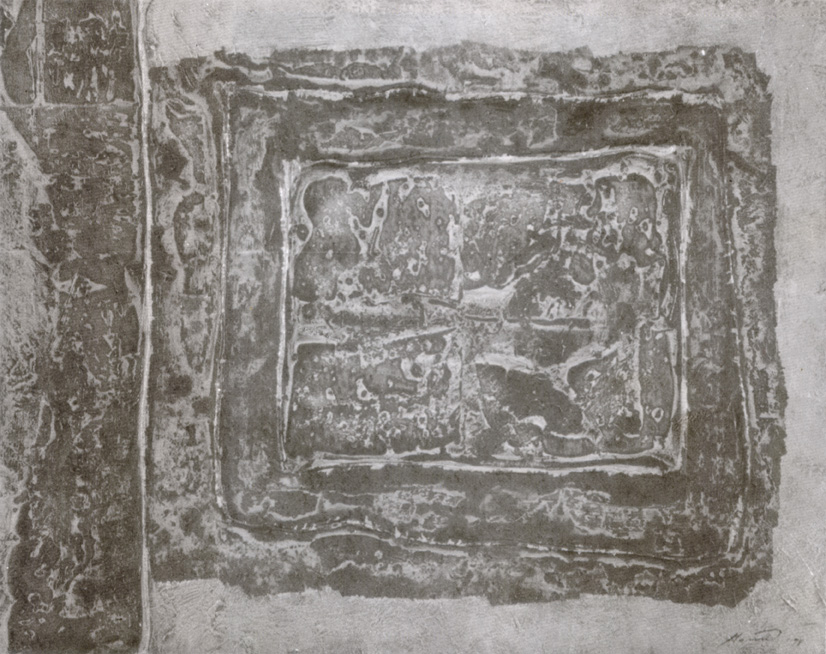
Design cover by Ricardo Morín
Aposento Nº 2
29″ x 36″
Oil on canvas
1994

Author’s Note

Intervals is written in a cadence held taut at the threshold of life and death.   It does not withhold itself, though its language remains stripped of explanation.   Ambivalence may be inescapable, but it is not the aim.   The anonymity of the speaker is deliberate, to keep attention on what is spoken rather than on who speaks.

Ricardo Morín, September 11, 2025. Bala Cynwyd, Pa.

Intervals

To heal himself, he would cover his body in mud and then rinse it away.    Crouched beneath the burning sun, he stared diagonally from a corner across the far end of the yard.   From the clothesline he hung a black umbrella, upside down.    Into it he cast the last handful of potions. From its collapse, heavy with weight, he hoped to avoid his own death.

He covered his books with a black sheet; blindly he pulled one out at a time and, after finding a sentence giving meaning to his thoughts, he put it back.   He waited for revelation.    His mother, now old, took another book out and searched for a better reply.

Exhausted and sleepless, he lay wrapped in a red blanket with his back to the mirror.    Drenched in tears, he felt undone.   Shivers traced his spine, as though his entrails were on fire.

He woke to the sound of running water.   His mother would scrub his garments until the fabric began to fray.    He had painted the walls white; the doors ceased to be brown.    An intruder leapt over the fence.   Then, with a surprising strength, he tore up the garden.

Nights followed without sleep.    He was unaware of sunken cheekbones; only his neighbors’ gaze could see him wasting away.     He managed to fly afar.     Though attentive to life, he found disappointment.

On arrival the hotel summoned an ambulance.    After a ten-hour flight, septic shock seized him; a nurse asked him to choose a destination.    Shivers returned.    He saw many dying, though it was not his turn.     Days later, his flesh returned to life.

With the memory of past ties, he departed again disappointed.    He crossed another distance and knew how fragile his solitude was.

You rescued him and he you.    A bridge was built out of longing.    Three years of passion did not mend the abyss; he took his life and you remained.

A Roman curate attended his mother’s cries, while he twisted her son’s.     Little did the curate know that it was by his own design.     He called for you, a new love, to come.    To love, to sustain the bond of the moment.


Epilogue

Intervals rests on our fearful perception of death, solitude, survival, and rupture (an interval is the rhythm of time and its ending is the emptying of what the consciousness of fear carries in it).    An interval seeks neither consolation nor resolution; it remains with what occurs, in the exposure where solitude and fracture reveal the fragility of existence.


“The Limits of Suffering”

March 14, 2025

*

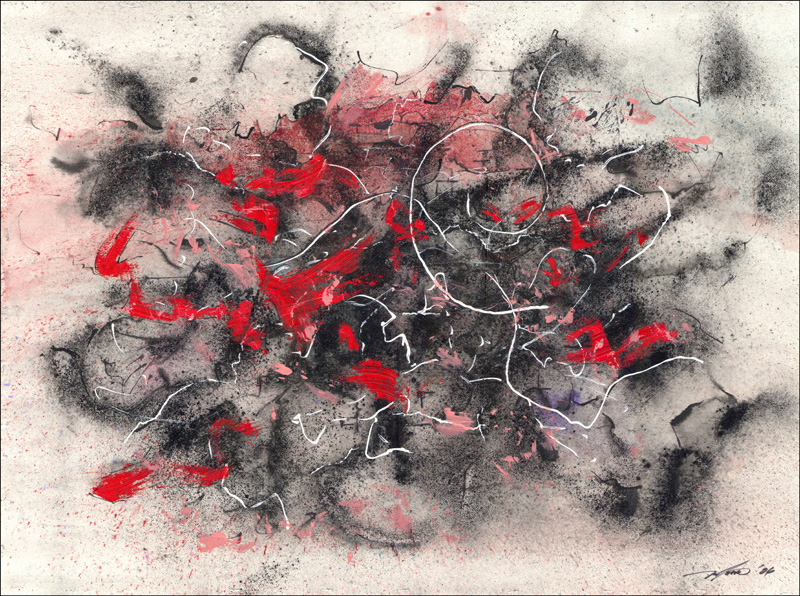
Untitled 012 by Ricardo Morín
22" x 30"
Watercolors, charcoal, oil, white-out and ink on paper
2006
Untitled 012 by Ricardo Morín
22″ x 30″
Watercolors, charcoal, oil, white-out and ink on paper
2006

There exists a threshold beyond which suffering ceases to be endurance and becomes something else—something raw, incommunicable.      It is not simply a matter of pain, nor even of despair, but of a silent depletion where the self finds itself at the precipice of its own dissolution.      Yet, how does one define this limit?

It is tempting to believe suffering has purpose, that it can be transmuted into wisdom or resilience.      This belief sustains us through its early stages.      We endure in the name of meaning, in the hope that suffering refines rather than annihilates.      But there comes a point where suffering becomes a force unto itself, severed from justification.      It no longer instructs, no longer dignifies—only persists.

The problem of suffering is not only how much one can bear, but how much one should reveal.      Silence often protects both the sufferer and the witness.      There are pains too intimate, too profound to translate into language without reducing them to spectacle.      To expose suffering in its entirety risks transforming it into something unrecognizable, stripping it of the dignity that private endurance affords.      Yet, concealment can create its own form of exile, a loneliness where pain festers unseen.

Some attempt to navigate this tension by offering fragments—enough to acknowledge suffering’s presence without inviting intrusion.      Others say nothing at all.      This is not cowardice but a final assertion of control, a refusal to be defined by pain.      To impose the expectation of disclosure upon those who suffer is to misunderstand the nature of their burden.      The gravity of suffering is not only in the experience itself but in the impossible task of making it understood.

We live under the illusion that the mind and body will hold, that endurance is limitless.      But suffering reminds us otherwise.      There is a breaking point, whether visible or silent, sudden or drawn out.     

It is not the same for everyone.      Some withstand more than others—not through superior strength, but through a different alchemy of circumstance, temperament, and sheer chance.      What remains constant is that all thresholds, eventually, are met. There is no single way to live with suffering.    Sometimes, what brings relief is not endurance, but the quiet act of self-recognition.    To speak, when one can.    To remain silent, when one must.    In the space between what cannot be said and what must be accepted, a simple truth may emerge: even uncertainty can sustain us, if we meet it with honesty.

And when that release is impossible, when suffering stretches beyond its own limits, only the silent acknowledgment of its presence remains—a weight that, sooner or later, must either be laid down or consume what is left.

Ricardo Federico Morín Tortolero

March 16, 20025; Oakland Park, Florida