Fidelity
approx. 30″ x 47″
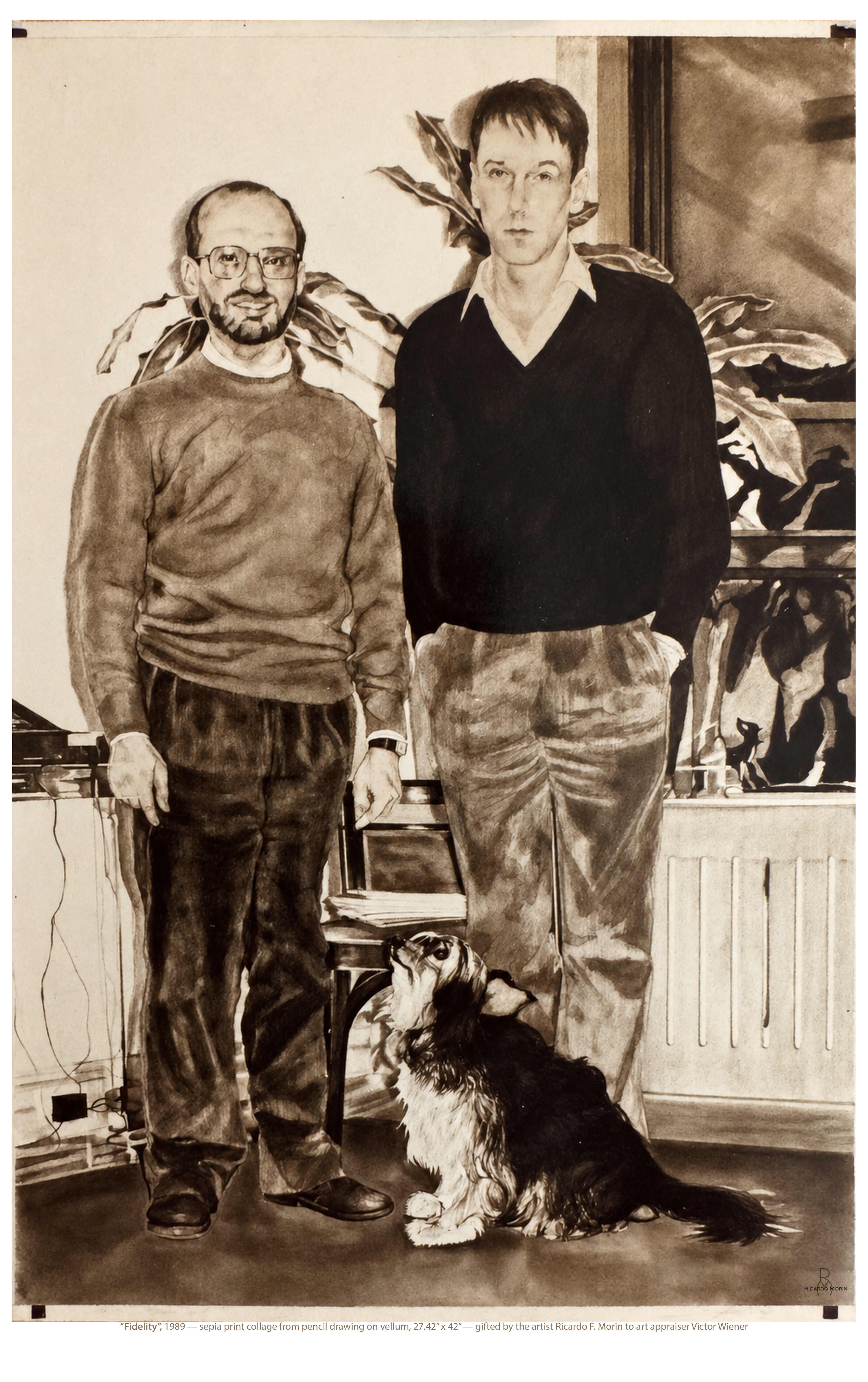
Sepia-printed collage from a translucent graphite drawing
1990
Between 1987 and 1990, I conceived Fidelity, a portrait of Victor Wiener, his Dutch partner, and their dog. Victor stands on the right. The two men face the viewer while the dog, seated at their feet, looks upward. The drawing preserves an early moment in their companionship, more than three decades ago, when much of the life they would share still lay ahead.
The finished work was a composite collage. I assembled the figures and the dog in two layers, with the background occupying a third. On smooth beige paper, the sepia varies in density and texture according to the handling of the medium. White chalk brings light to the men’s heads and to the dog, while soft tonal transitions preserve the drawing’s sfumato. The narrow beige edges at the top and bottom, with their sepia tabs, belong to the work itself.
I gave the finished composite to Victor. There was a history behind that gift.
In 1987, four of my paintings disappeared after being rented for The Clinic, a Lorimar production filmed at Kaufman Studios in Astoria, Queens, subsequently released as Hothouse. Through Volunteer Lawyers for the Arts, a law firm accepted my case pro bono and assigned a junior attorney to represent me in pursuing a lawsuit. Victor, then executive director of the Appraisers Association of America, prepared the evaluation and rationale presented to Lorimar’s insurance adjusters concerning the lost works. His professional judgment helped establish the value of paintings I could no longer produce for examination.
I received fifteen thousand dollars in partial compensation. The amount fell short of the paintings’ full value, but it helped me continue working during one of the most difficult periods of my life. I was living with AIDS and paying for experimental drugs. The compensation helped sustain my painting and cover those expenses during the five years before I went on disability.
The money became time in which I could paint, obtain treatment, and persist through a period whose outcome I could not foresee. The paintings remained lost. Something of their value returned to the conditions that allowed other work to exist.
My legal and tax records from 1987–1993 accompanied me to Venezuela when I believed I was approaching death and sought refuge with my family. None of those papers has survived. With them went the documents that would now allow me to name the firm, the young lawyer, and the insurer. I remember the assistance and what it made possible, but I am still trying to recover the names of those who provided it.
In the years following my transition to disability, Victor’s life and mine grew apart amid difficult circumstances. We suffered, each within a life whose particulars remain private.
Around 2004, an unexpected encounter brought us together again. We agreed to have dinner at my place, where Victor and his partner met my life partner, David. The evening briefly restored a familiarity that years of separation had interrupted.
During dinner, Victor spoke of my work in relation to accomplished artists he knew, recognizing a strength comparable to theirs. I remember the distinction he made between resemblance and accomplishment. His words have stayed with me alongside the earlier assistance that had helped me continue painting.
When I look at Fidelity now, I see Victor beside the person with whom he was building a life, their dog looking up at them. Their companionship has its own history; my gratitude enters the circumstances of the portrait’s making and its passage into their lives. The work preserves a moment we can still look upon, although much of what surrounded it has become difficult to recover.
I have recently written to Victor, hoping that his recollection or surviving correspondence might help identify the lawyer and firm. I would like to give their assistance the acknowledgment it deserves. The loss of my papers has made that task uncertain, but the consequences of their work remain part of my life.
Today, when I play memory-building games on LinkedIn, Victor’s name occasionally appears alongside mine in a comparison of our scores. That is all I see of him now. His name brings back the circumstances in which we knew one another, his assistance, and the portrait I gave him. I hope that he and his partner are doing well.