*
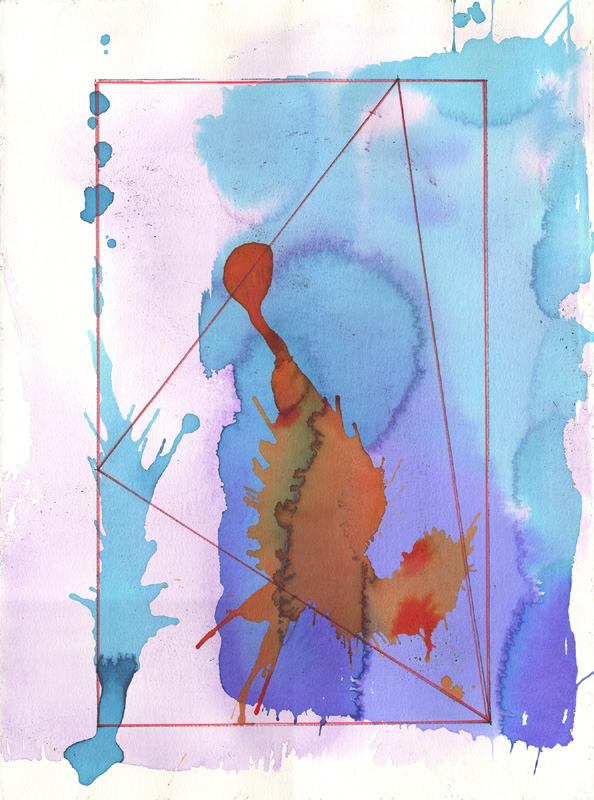
Triangulation 10: A Planetary Proposal
22″ x 30″
Watercolor and wax pencil on paper
2007
Ricardo F. Morín
November 2025
Oakland Park, Florida
Billy Bussell Thompson, Editor
PREFACE
This essay proceeds from a simple recognition: the political structures inherited by humanity no longer correspond to the forces that now shape its survival. Climate volatility, digital acceleration, economic interdependence, and cross-border vulnerability operate at a planetary scale. They pass through air, water, data, and supply chains without regard for territorial boundaries. Yet the world remains organized as a collection of discrete sovereignties, each responsible for risks it can neither contain nor resolve alone.
What follows does not issue from optimism, inevitability, or visions of harmony. It begins instead from insufficiency. The institutions that once stabilized political life were not designed for conditions in which disruption propagates globally and instantaneously. The proposal set out here—a layered system of planetary coordination, universal provisioning, and protections for cultural autonomy—does not attempt to predict what political forms will emerge. It offers, rather, a conceptual architecture for what has become thinkable if human continuity is to remain plausible under conditions of deep interdependence.
The essay unfolds in three movements. First, it outlines a framework proportionate to the scale of contemporary risk. Second, it confronts the strongest objections—psychological, cultural, geopolitical, economic, and historical—that constrain any such reorganization. The analysis turns to transitional forms through which local identity may persist and coordination may emerge under conditions where fragmentation has already introduced risk. The work does not prescribe a future; it remains within the horizon in which political imagination operates.
*
FRAMING WITHIN CONTEMPORARY POLITICAL THEORY
i
This essay draws on a growing body of political theory concerned with the widening gap between global pressures and the limited reach of the nation-State. Thinkers such as Ulrich Beck (World Risk Society, 1999), David Held (Democracy and the Global Order, 1995), Jürgen Habermas (The Postnational Constellation, 2001), and Saskia Sassen (Territory, Authority, Rights, 2006) have traced how climate change, digital systems, and economic interdependence now exceed the capacities of territorial governance. Beck identifies risk itself as global; Held and Habermas explore multilevel governance; Sassen traces how authority migrates across networks that bypass borders. This essay remains aligned with these insights and grounds its argument in material conditions already in force, rather than in the likelihood that existing States will unify.
ii
World-risk theorists—particularly Beck and Anthony Giddens (Runaway World, 1999)—describe a world bound by shared vulnerability: climate instability, pandemics, financial contagion, and digital exposure. No State can contain these alone. This essay takes that diagnosis as given by treating shared risk as the central justification for institutional redesign. Research on overlapping sovereignty, including the work of Anne-Marie Slaughter (A New World Order, 2004) and Neil Walker (Intimations of Global Law, 2015), demonstrates that authority is already dispersed across levels. What follows is an observation: dispersion without structure produces fragility; shared authority depends on deliberate design rather than on processes that accumulate without coordination.
iii
Philosophers of global justice such as Martha Nussbaum (Frontiers of Justice, 2006), Amartya Sen (Development as Freedom, 1999), and Thomas Pogge (World Poverty and Human Rights, 2002) argue that basic human capabilities can no longer be secured solely within national borders. Welfare and opportunity have become transnational facts. Environmental political theorists such as Bruno Latour (Facing Gaia, 2017) and Robyn Eckersley (The Green State, 2004) further show that ecological systems impose demands no single government can meet. This essay treats as consequential these claims by proposing institutions scaled to ecological and technological interdependence rather than inherited jurisdiction.
iv
Debates on digital power reinforce this necessity. Scholars such as Shoshana Zuboff (The Age of Surveillance Capitalism, 2019), Kate Crawford (Atlas of AI, 2021), and Helen Nissenbaum (Privacy in Context, 2010) document how artificial intelligence, data infrastructures, and algorithmic systems operate across borders while they evade national oversight. Technological power now moves independently of the frameworks intended to regulate it. The proposal places technological governance at the core of planetary coordination, not as an auxiliary concern.
v
Taken together, these strands suggest that neither nationalist retrenchment nor abstract universalism is adequate to present conditions. This essay proceeds from contemporary theory to articulate a political horizon grounded in necessity: viz. governance scaled to the forces that now shape human survival. It is not oriented toward abstraction, but toward a readable and coherent proposal calibrated to the realities already unfolding.
*
I. The Proposal: A New World for a Species in Convergence
1
Humanity now occupies a threshold at which inherited political forms can no longer absorb the pressures shaping collective life. Climate instability, digital acceleration, migratory displacement, and economic interdependence operate at planetary scale. They traverse borders with a velocity that state-based systems were never designed to manage. Under such conditions, the question of survival converges with the question of institutional redesign.
2
The proposal proceeds from the recognition that sovereign States fragment responsibility at the very moment when coherence becomes necessary. Risks propagate globally; accountability remains local. A planetary framework emerges not as aspiration, but as a proportionate response to vulnerabilities that exceed national capacity.
3
Such a framework is limited to exercising authority only where fragmentation produces systemic exposure: viz. public health, climate stabilization, migration, resource governance, and global technologies. Cultural, legal, and administrative autonomy would remain firmly vested in regional and local institutions.
4
Universal welfare forms the structural foundation of this arrangement. It functions not as charity, but as stabilization. In an interconnected world, deprivation in one region generates instability across many. Access to healthcare, essential resources, and meaningful education defines the minimum threshold for participation in collective life.
5
A reconfiguration of value follows. Markets continue to operate, but certain goods—health, education, environmental security, and digital access—are guaranteed as rights. Universal income gives way to universal provisioning: a commitment to the material and intellectual conditions required for dignity and resilience.
6
As these changes take shape, borders assume a different role. They persist as administrative markers, but their capacity to regulate risk diminishes. Climate systems ignore boundaries; pathogens cross unchecked; digital infrastructures dissolve territorial limits. A planetary architecture emerges not as an endpoint, but as an adjustment to conditions already in motion.
7
Articulating such a world is not an act of idealism, but of proportional reasoning. Contemporary pressures demand political imagination commensurate with their scale. This proposal does not predict the future; it remains within the horizon.
*
II. The Counterarguments: A Devil’s Advocate Examination
8
The first objection concerns identity. Sovereignty functions not only as law, but as a vessel of memory, history, and emotional continuity. A planetary framework introduces an additional layer of identification without historical precedent.
9
Geopolitical resistance follows. States—particularly powerful ones—have little incentive to dilute strategic advantage. Any global authority risks being perceived as erosion rather than coordination.
10
A third objection concerns scale. Institutions operating at planetary scope risk opacity, inertia, or capture. Coordination at such magnitude may introduce new forms of fragility.
11
Economic critiques question feasibility. Universal provisioning demands distributive mechanisms of unprecedented complexity. Markets, despite distortion, remain adaptive; alternatives risk inefficiency or coercion.
12
Cultural arguments register homogenization. Even with formal protections, global systems may exert subtle pressures toward uniformity, diluting linguistic and cultural specificity.
13
Psychological objections emphasize limits of restraint. Planetary cooperation presumes capacities for empathy and self-limitation that may not persist without enforcement.
14
Historical memory sharpens skepticism. Integrative projects have often provoked fragmentation. A planetary framework could generate resistance precisely because of its scale.
15
Taken together, these objections outline a dense field of constraint—psychological, cultural, geopolitical, organizational, and historical—that complicates any transition toward planetary organization.
III. The Resolution: A Movement Toward Planetary Organization
16
A credible resolution requires incorporation of these objections rather than dismiss them. Planetary coherence must be built where resistance is strongest, not where agreement is easiest.
17
The first element takes the form of architecture. Governance must be layered, not monolithic. Global authority is limited to narrow domains of shared vulnerability; States retain internal autonomy. Legal boundaries, transparency, and distributed representation constrain concentration of power.
18
The second element concerns welfare. Universal provisioning establishes a structural baseline financed through global levies and coordinated national systems. Markets operate above this floor; essential goods are insulated from volatility.
19
The third element addresses identity. Planetary citizenship functions as a complementary affiliation rather than a replacement. Education and the media cultivate awareness of shared ecological and technological systems without erasing cultural distinction.
20
The fourth element concerns power. Institutions are distributed across functions, protected by rotating leadership, independent oversight, and digital transparency. Authority remains limited, visible, and divisible.
21
The fifth element concerns tempo. Transition unfolds through intermediary arrangements: enforceable climate compacts, standardized digital governance, pandemic protocols, and regional unions experimenting with cross-border welfare.
22
Across these arrangements sovereignty becomes layered, welfare foundational, identity dual, and governance proportionate to vulnerability.
23
What emerges is not a utopian design, but a navigable movement from fragmentation toward coherence—one by which organization becomes possible.
*
EPILOGUE
This essay was written from within a condition of recognition rather than from a position of outcome. It observed the emergence of planetary interdependence as a factual state—environmental, technological, and economic—without assuming that recognition itself would compel coordination, restraint, or shared action. The proposal rested on the visibility of scale, not on the expectation of response.
What has since become clearer is not that the planetary condition was misread, but that its implications were overestimated. Interdependence does not suspend political habit. Global exposure does not dissolve national calculation. The existence of shared risk does not neutralize mistrust, nor does it override the logic by which States preserve autonomy through delay, insulation, or selective engagement.
The absence that now stands out is not empirical but structural. A planetary condition can be acknowledged while responsibility remains local, fragmented, or deferred. Systems adapt to crisis without reorienting their priorities. Cooperation becomes conditional, provisional, or transactional, rather than binding. What persists is adjustment, not alignment.
This does not negate the planetary frame. It clarifies its limits. The world does not move toward coherence by recognition alone. It moves through negotiation, withdrawal, recalibration, and self-protection—often simultaneously. Balance, when it appears, is not designed; it is reached unevenly, through constraint rather than consensus.
Seen from this angle, A Planetary Proposal records a moment of clarity rather than a program. It marks the point at which global exposure became unmistakable, without presuming that such exposure would produce a corresponding form of action. What follows in later essays does not extend that proposal. It narrows the lens, attending instead to the conditions under which recognition stalls, agency fragments, and adjustment replaces resolution.


 Observations On Perception