*
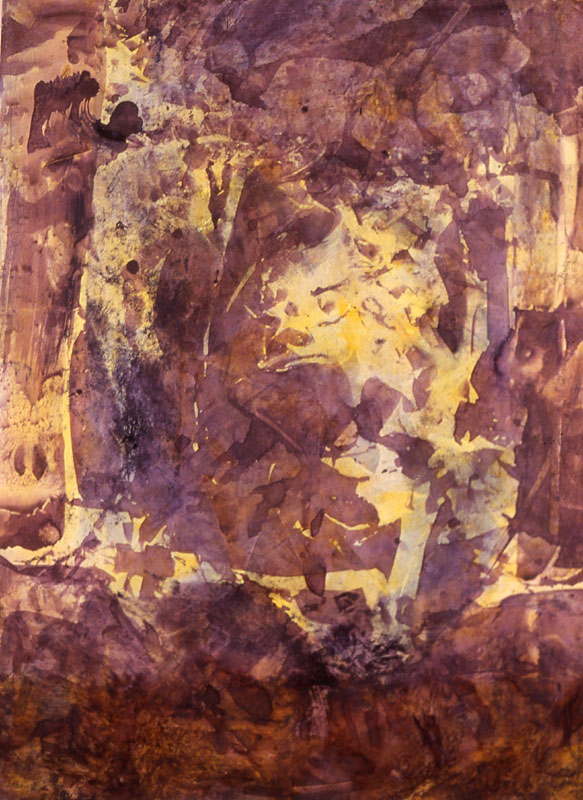
Landscape II
18″ x 24″
Oil on board
2000
Ricardo F. Morín
February 1, 2026
Oakland Park, Fl.
*
The word activism now functions in public language as a device for disqualification rather than description. It appears when someone protests, reports, or questions how power is being exercised. The word does not explain what occurred or whether rules were followed. It assigns suspicion to the person who speaks. Once the word enters a sentence, attention shifts from facts to motive, and inquiry is halted before it can proceed.
This linguistic use of activism depends on presenting the existing order as beyond legitimate question. What already exists is described as normal, lawful, and necessary. What challenges it is labeled activism. The structure of the sentence assumes that authority does not need to justify itself, while those affected by authority do. Language thus distributes legitimacy in advance and shields power from explanation.
Recent executive orders on immigration make this mechanism concrete and visible. Policies once described as border enforcement have been extended deep into the interior of the country. Federal agents now operate in cities, towns, workplaces, and private homes far from any border. This shift is not merely about location. It changes who is exposed to the power of the State and under what assumptions.
Interior immigration enforcement now treats distinct categories of people as interchangeable in practice. The stated objective is to arrest people with criminal records and to take custody of those already detained. At the same time, operations are designed to collect anyone present, nearby, or loosely associated. Non-criminal residents are taken alongside those accused of crimes. Long-term residents, elderly people, workers with families, and even citizens are drawn into the same encounters. Legal distinctions remain on paper but collapse in execution.
This operational blending is presented by authorities as coherent, but its coherence is asserted rather than demonstrated. Arresting a person convicted of a violent offense and detaining a neighbor with no criminal history are described as parts of a single mission. The language suggests unity and purpose. In reality, different objectives are combined for scale, not clarity. The result is that no one can know where enforcement ends, and uncertainty itself becomes the governing condition.
Profiling supplies the practical method by which interior enforcement sustains itself. Away from the border, agents cannot rely on crossings or documented violations. They rely instead on appearance, accent, location, or association. People are stopped not because of what they have done, but because of what they are assumed to be. Citizenship, residency, and legality cease to function as reliable protections at the moment of encounter.
Community response emerges when these practices become visible in daily life. In places such as Montana, residents have watched neighbors taken from their homes in early hours, elderly people removed while barely dressed, children detained alongside adults, and towns unsettled by large federal deployments. In other parts of the country, citizens have died during enforcement operations. As such events repeat, they cease to appear exceptional and begin to register as conditions people are expected to endure.
Public protest arises from this recognition of harm rather than from ideological performance. People gather, speak, and demand answers because something familiar has been crossed. Their response is rooted in what they have seen and experienced. Yet this response is often dismissed as activism, a term that avoids addressing the conduct that provoked it and instead questions whether reaction itself was permissible.
The label activism redirects responsibility away from state action and toward civic response. The word does not ask whether enforcement was lawful, proportionate, or humane. It asks whether people should have objected. In doing so, the conduct of authority recedes from scrutiny while dissent becomes the subject of judgment. Accountability is reversed.
The same linguistic device is applied to journalism that documents these events. When reporters record raids, publish testimony, or show images of arrests, the work is sometimes dismissed as activist reporting. The accusation is not that the facts are false, but that they were assembled with improper intent. Accuracy is displaced by suspicion, and the act of documentation itself is treated as a breach.
This pattern of language gradually alters how democracy is understood. Democratic life depends on questioning authority, reviewing decisions, and objecting when harm occurs. Under the grammar of activism, these actions are treated as disruptions. Quiet acceptance is praised. Scrutiny is framed as excess. Stability is elevated above fairness.
The ethical consequence of this shift is the denial of ordinary civic agency. When workers, parents, and neighbors are told that speaking up makes them activists, they are no longer addressed as reasoning citizens. They are treated as obstacles to be managed. Authority ceases to explain itself and instead asserts continuity as its own justification.
A narrowing definition of national belonging advances alongside this linguistic shift. Belonging is measured by silence. Loyalty is measured by compliance. Difference is treated as threat. Supremacy enters not through open declaration, but through repetition, as people are asked again and again to accept what they are no longer permitted to question.
A plural society cannot endure under a grammar that treats challenge as deviance. Such a society does not depend on shared origin, culture, or uniform belief. It depends on the recognition that no single group owns the meaning of the nation. When language is used to dismiss those who expose harm or demand explanation, democracy is not defended. It is quietly redefined against the people it exists to serve.
![This image has an empty alt attribute; its file name is 0005.jpg
Decantation [2003], CGI by Ricardo Morín](https://observationsonthenatureofperception.com/wp-content/uploads/2025/03/0005.jpg)
 Observations On Perception