Ricardo F. Morín Breaking Away Computer-generated image (CGI) 2026
Laws are written in the language of peace, but peace does not follow from them alone. A statute specifies the conduct it requires: it forbids violence, protects the vulnerable, and assigns duties to those who govern. Sanctions can restrain conduct where ethical conviction is absent, and the law can give the injured a means of redress. Yet the application of the law depends on people who obey, evade, or manipulate it. Where its administration serves the interests it was meant to restrain, the distance between what is written and what is done widens.
The same distance appears among nations. The Convention on the Prevention and Punishment of the Crime of Genocide was adopted in 1948, and genocide has been committed since. Slavery and forced labor are prohibited under international law, yet both persist throughout the world. In the United Nations Security Council, the five permanent members hold veto power, which has been used to block draft resolutions concerning mass atrocities. The institution’s procedures follow their regular course: sessions are held, reports are submitted, and resolutions are numbered. What those procedures were established to prevent continues alongside them. Where economic or strategic interests prevail, the obligation to act yields, and that capitulation is recorded in the same orderly form as everything else.
Political doctrines can conceal this distance and justify arrangements that cause harm. A democracy proclaims the equality of its citizens and tolerates their exclusion. Capitalism invokes the promise of reward for effort as its justification, while ownership confers advantages that effort alone cannot secure. Communism promises the abolition of classes and installs a class that administers the rest of society. Fascism promises national unity and greatness; submission to its rulers is demanded as proof of loyalty to the nation. The doctrines differ, as does the worth of what they profess. A promise may be betrayed, or it may make subordination acceptable. Left, center, and right accuse one another and seldom examine the loyalties that govern their own judgment. When accusation replaces examination, political debate is caught in a vortex of accusation and counteraccusation: the exchange continues, but the loyalties governing judgment remain fixed.
Silence in the face of injustice has different sources. A person worn down by the demands of survival may recognize injustice yet lack the strength or means to oppose it. A person with the means to act may be so absorbed in entertainment that unease at injustice is dulled before it gives rise to judgment. Exhaustion and indifference can produce the same public silence, though they entail different responsibilities. Those who benefit from that silence have no need to distinguish its causes.
Meanwhile, common goods pass into private hands, and some cell lines developed from human tissue are patented and sold. A patent does not establish that the person whose tissue made the research possible understood or consented to the commercial use of that material. Where consent is bypassed, appropriation extends to the substance of the body itself. Here, the law both limits conduct and assigns control. Compliance with a rule does not establish the ethical legitimacy of what it authorizes.
Each person acquires attachments before the capacity to judge them has developed: a nation, a region, a sect, a sacred text, a party, the loyalties an institution cultivates through its propaganda. These attachments give a person a place to stand and others to stand with. When loyalty overrides judgment, belonging to the group serves as a measure of another person’s worth. The outsider then appears as a rival, an inferior, or someone whose fate is of no concern. The sense of superiority that follows does not feel like an affront to another person’s humanity. It feels like belonging. Reformers and leaders may remain bound by the same loyalties as those they lead, and exploitation persists when fidelity to an institution excuses its conduct.
The division within the person and the division among nations are connected through the institutions people sustain. The fear a person carries into a negotiation, the greed that weighs a contract against a life, the envy that measures one nation by another’s wealth: these enter public life through decisions, contracts, and policies. An institution can restrain these dispositions or give them enduring force. Its rules can preserve an advantage beyond the lifetimes of those who secured it. The power to sustain or alter those rules is unevenly distributed, and responsibility varies accordingly. The impasse sustained by this vortex of political accusation recurs in the person whose judgment remains bound by loyalty.
To recognize this correspondence is to lose the assurance that the disorder belongs entirely elsewhere. Recognition offers no guarantee of repair. It locates the division in both the institution and the person and reveals how each sustains that division in the other. The deadlock in the Council is present in you, and yours is present there.
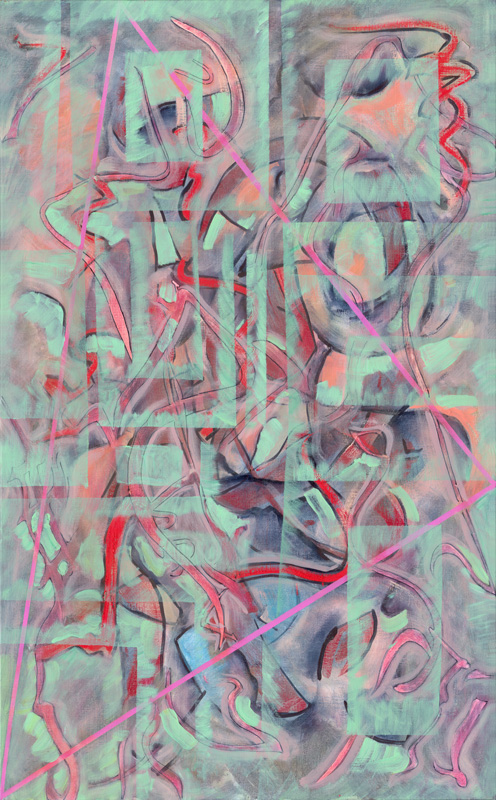
Ricardo F. Morín Triangulation Series Nº 7 37″ x 60″ x 2″ Oil on linen 2006
An elderly man stands beside a piece of luggage near the edge of a wide sidewalk at a public bus stop. A younger man notices him from a distance, and as he approaches, his attention remains fixed upon the older man rather than upon the bus stop itself. The older man perceives the stare as calculating, purposeful, and determined. There is room to pass. Instead, he changes course and strikes the older man with enough force to displace him from his position, then continues walking without explanation or apology. No dispute precedes the contact, and no serious injury follows.
The change of course makes the contact appear directed, though the encounter reveals little of what prompted it. Contempt, irritation, resentment, or the wish to impose upon someone may be imagined. None becomes certain merely because it would make the action intelligible. The younger man’s attention can be followed as far as the contact; his motive cannot be followed with the same assurance.
The older man was noticed before he was struck. Whatever the younger man perceived was sufficient to direct an approach, yet being noticed does not establish how much of a person has been acknowledged. Attention may be exact about where an act will arrive while remaining indifferent to the life upon which it intrudes.
Ordinarily, one passes a stranger without requiring an account of his presence. The man waiting beside his luggage need not explain where he is going or why he has stopped there. Almost nothing about him has to become known for the simple accommodation of passing without contact to occur.
Someone who would make that accommodation elsewhere may withhold it from a person expected to offer little resistance or to impose no consequence. Restraint weakens selectively, and another’s vulnerability can become an opportunity to act. Whether age or an expectation of impunity influenced the younger man’s choice remains unknown. Even if resentment were established, the question would remain why it found this particular recipient who is a total stranger.
The younger man had only to pass. Those charged with protecting a population face circumstances in which leaving the source of danger undisturbed may expose others to further injury. They may have to use force, and those awaiting their decision may have urgent reasons to demand it.
A government defending its territory, one invading another country, and one acting upon a danger it anticipates do not confront the same circumstances or bear the same responsibility. The suffering that follows cannot erase responsibility for how a war began. Neither can responsibility for its beginning settle every judgment concerning its subsequent conduct.
Those making the next decision must confront what remains dangerous, what has changed, and what another action could accomplish. People still exposed to attack may require defense long after the initial injury, while a brief operation may inflict harm for which no adequate ground ever existed. Neither the duration of a war nor the depth of the loss already suffered can settle what should happen next.
For those who have endured an attack, however, the first injury may remain more immediate than the changing circumstances through which a response proceeds. A danger recedes, an objective is reached, or further action creates risks absent at the beginning, while what happened continues to demand an answer. Asked what another strike would accomplish, a leader can return to the losses already sustained. The answer may be entirely sincere and still leave the question unanswered.
Grief may preserve a fidelity to the dead that no change in circumstances can satisfy. Political action nevertheless proceeds among the living. The demand that a loss receive an answer can persist after a particular response has ceased to serve the protection for which it was undertaken. At that point, reconsideration may be experienced as disloyalty even when the conditions of protection require it.
Those who receive the force may meanwhile become known chiefly through where they live or the people with whom they are associated. The person who directed an attack, the person who supported it, and the person who happened to live where it originated can be brought within the same field of action, though they do not bear the same responsibility. No one need deny that each has a history or a capacity to suffer. Those facts can be acknowledged and then set aside as having no bearing upon what is to be done.
The people exposed to an operation may be known to those directing it only through briefings, surveillance, casualty reports, and the observations passed through a chain of command. These can disclose what those deciding cannot see for themselves. Through a report, someone far from danger may learn what those enduring it have no means of bringing before him themselves. The distance between them can be reduced by the very procedures through which the decision is made.
Yet the reports may continue to arrive after the decision to proceed has ceased to admit reconsideration. Someone can register a loss accurately and still receive it only as something to be entered before the next authorization. The people affected remain visible in the record, while what becomes known about them is denied any bearing upon continuation. The information has arrived; the grounds of action have been protected from it.
Someone entrusted with the safety of others may knowingly cause harm while believing that refusing to act would cause more. The conflict may be real, and a clearer account of the consequences may not resolve it. But when those acting become certain that their responsibility supplies its own justification, the people who will bear the harm can appear only as a cost already accepted. Those who question the harm may then be treated as though they were opposing the protection itself.
An official may possess the authority to order an action and the means to carry it through, while those who will bear its consequences have little power to contest either. He can make the decision prevail without answering what he owes them. The question of justice remains, even when he acts with a sincere intention to protect others.
The older man was close enough to be deliberately approached. A distant population may be described in exhaustive detail. Neither proximity nor information establishes how another’s presence has entered a decision. Attention may narrow to what facilitates an act; an understanding of the suffering it will cause may also remain clear while the act proceeds. The failure can occur within attention itself.
A person may understand an injury, condemn its infliction, and nevertheless permit a comparable injury against someone placed outside the protection of that judgment. What is understood remains intact while its reach contracts. An account of the person’s fear, grievance, or conviction may make his conduct more intelligible without resolving how he accommodates what he condemns.
The younger man continues on his way without explaining himself. The absence of an explanation leaves a question about him; it does not make the force of the encounter disappear. What prompted him might become clearer if more were known, but he owed the older man the ordinary restraint that would have left him standing where he was.
The other remains someone whose life exceeds the terms under which he has been encountered. Grievance, threat, procedure, and necessity can each restrict what is permitted to matter about him. The person has not become fully known. The decision to act as though nothing further about him could matter may nevertheless already have been made.
Ricardo F. Morín October 6. 2026 Bala Cynwyd, Pennsylvania
Author’s Note: The conditions described here were examined earlier, through the structure of language rather than through particular encounters, in “The Grammar of Conflict”.
Suprematism functions as the universal grammar of repressive justification. Suprematism is less a doctrine than a habit of explanation: the manner in which domination comes to sound necessary, privilege comes to appear orderly, and exclusion comes to be described as preservation. Its forms vary—race, religion, nation, civilization, party, historical destiny—but its logic remains constant: some are presumed fit to decide, others to comply.
This habit is not confined to any one society or system. It appears wherever hierarchy can be narrated as natural or deserved, and wherever authority is spared the burden of explanation. What distinguishes societies is not their immunity to suprematism, but the degree to which it is restrained. Progress does not consist in its disappearance, but in limiting the circumstances under which supremacy can excuse itself.
When that restraint weakens, advantage acquires moral cover, grievance hardens into entitlement, and authority reorganizes itself around exception rather than obligation. Suprematism then ceases to be merely a social tendency and becomes a principle of coherence—one that prepares the ground for repression not by force, but by familiarity.
Suprematism is rarely named at the moment it takes hold. It enters social life quietly, through habit rather than declaration, and through permission rather than force. Most people encounter it not as a belief, but as a pattern: who is trusted without question, whose mistakes are forgiven, whose grievances are taken seriously, and whose presence is treated as a complication. Long before it becomes political, suprematism arranges everyday expectations.
At its core, suprematism is the assumption that order depends on hierarchy—that some are naturally entitled to decide, while others must adapt. This assumption has appeared in every form of organized society. It attaches itself easily to existing distinctions, but does not depend on any of them. Its content changes. Its function does not. Wherever it takes root, it relieves power of the burden of explanation and replaces justification with inheritance.
Historically, efforts to restrain such arrangements have rarely depended upon the actions of those most affected by them alone. Groups subjected to discrimination often possess the least access to the institutions capable of altering laws, customs, and public attitudes. As a result, challenges to entrenched hierarchies have frequently depended upon the participation of individuals and institutions situated within the very structures being contested. The durability of supremacy lies not only in the injuries it imposes, but also in its capacity to limit the means through which those injuries can be redressed.
No society outgrows this impulse. What matters is whether it is constrained. Where restraint holds, authority remains conditional, rules survive inconvenience, and grievance does not harden into entitlement. Where it weakens, dominance reappears under new names, and inequality begins to feel practical rather than dangerous.
Suprematism becomes most persuasive in moments of strain. Economic uncertainty, cultural change, and political fragmentation make procedural life feel slow and fragile. In such moments, hierarchy offers clarity. It promises stability without negotiation and coherence without equality. What it conceals is the cost of that promise: the quiet replacement of shared obligation with selective privilege. These conditions do not create suprematism; they reveal how readily it adapts to the language through which societies interpret threat.
In contemporary American politics, strands of conservatism increasingly function not as custodians of institutional continuity but as vehicles through which suprematist reasoning finds renewed expression. The language of preservation — tradition, order, cultural defense — often serves to frame hierarchy as necessity rather than preference. Within segments of the Republican Party, populist rhetoric recasts political disagreement as a struggle between an authentic people and forces portrayed as alien or corrupt. This framing does not merely mobilize support; it reorganizes legitimacy itself, narrowing the field of acceptable plurality while presenting exclusion as protection.
Historically, populism has not always culminated in authoritarian forms, yet its grammar lends itself to them when grievance becomes the organizing principle of political identity. Suprematism thrives precisely in such moments, because it does not require explicit doctrine; it operates through the normalization of unequal standing and through narratives that portray dominance as restoration. What appears as resistance to change thus becomes a mechanism by which hierarchy is reaffirmed under the guise of necessity and allows power to concentrate while it retains the appearance of democratic expression.
Because the premise concerns order rather than identity, it travels easily across contexts. In one place it is spoken plainly; in another it is implied through custom or history. Everywhere it functions by the same means: by presenting inequality as inheritance rather than choice, and by treating dominance as continuity rather than imposition. Its strength lies not in what it claims, but in how little it needs to explain.
What has been accepted socially soon reorganizes authority. Once unequal power is experienced as stabilizing, its concentration no longer appears alarming. Decisions migrate upward with little resistance, justified less by argument than by temperament, experience, or presumed fitness. Exception enters quietly, not as a rupture but as an adjustment, a temporary deviation said to protect what remains intact. Law continues to exist, but its role shifts. It no longer governs in advance. It follows explaining afterward what authority has already decided.
When this reorganization occurs, authority begins to act directly rather than procedurally. Executive power is justified as the fulfillment of popular expectation and treated as license to bypass legislative and judicial mediation. Enforcement expands inward, organized around targets rather than warrants, and selection shifts from proven violation to presumed risk. At the same time, electoral administration is recast as a security problem, with authority drawn upward from the states on the claim that existing safeguards cannot be trusted. In both cases, an asserted threat is used to replace prior limits with command, to concentrate power, and to present the change as necessity rather than choice.
As this pattern settles, restraint becomes uneven. Rules remain visible, but their force depends increasingly on who invokes them and against whom. Obligation is emphasized downward, while discretion accumulates upward. What was once justified as exception begins to feel ordinary, even prudent. The expectation that authority must submit itself to procedure weakens, replaced by a belief that outcomes matter more than the means by which they are reached. Constitutional life does not disappear; it thins. It survives as language and form, while its discipline is quietly set aside.
Suprematism does not announce itself as cruelty or ambition. It presents itself as common sense. It appears whenever power no longer feels obliged to explain itself, and whenever inequality is treated as a condition of order rather than a failure of it. Societies do not collapse because they lack ideals, but because they grow accustomed to exemption. When supremacy is permitted to justify itself—by history, identity, urgency, or fear—law becomes selective, authority becomes personal, and procedure becomes a formality observed only when convenient. The disorder that follows is not chaos, but a disciplined imbalance in which restraint is asked of some and entitlement is granted to others. This is how constitutional life ends: not in rupture, but in acceptance.
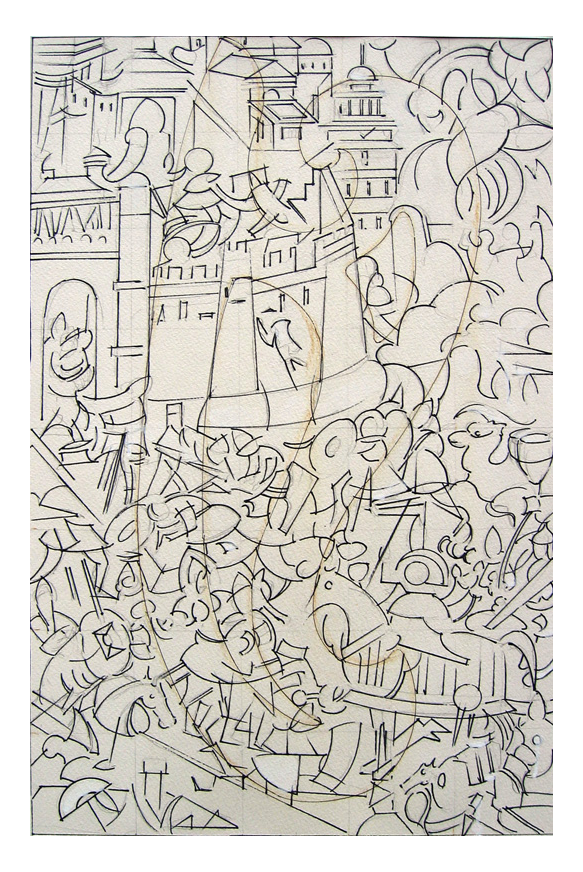
Ricardo F. Morín Persian Three 19” × 29” Graphite, sanguine and Sumi ink on watercolor paper 2003
The present crisis does not begin with soldiers in the streets or laws being openly suspended. It begins earlier, in our thoughts and conversations, as words change their meaning. Before courts are bypassed or elections are challenged, the language used to describe legality begins to shift. Words once tied to injury become tools of accusation. Authority moves first by changing how things are said, long before procedures are changed.
The shift is often noticed first not in statutes, but in how accusations are repeated on television, in hearings, and in everyday conversation, long before any ruling is issued.
A person opens an official notice declaring that a “violation” has occurred, yet the document contains no description of the act, no evidence to examine, and no process by which the finding might be contested. What is presented is not an allegation awaiting review, but a conclusion that now governs what actions are permitted next.
In earlier constitutional systems, a violation referred to a specific act. Evidence had to be gathered. Law had to be applied. A process had to be followed. Today, a violation is increasingly declared rather than demonstrated. The word no longer signals a legal test. It signals that judgment has already been made. What once required adjudication can become an instrument of command.
A rule can then be enforced before the disputed premise on which it rests has been adjudicated. The affected party may retain a right of review, but review occurs after the language of violation, necessity, security, or compliance has already supplied a reason for action.
Language and procedure meet at that point. A disputed condition is named as though established; governmental action proceeds upon the name; review follows.
This logic became visible on January 6, 2021. An election certified through legal procedures was declared illegitimate by assertion. A lawful transfer of power was described as theft. Defeat was renamed a violation. What followed was not confusion. It was narrative replacing legal process.
The legal aftermath did not produce a single institutional resolution. The federal prosecution concerning efforts to overturn the 2020 election was dismissed in November 2024 after Donald Trump’s reelection, pursuant to the Department of Justice’s longstanding position concerning prosecution of a sitting President. On January 20, 2025, presidential clemency commuted the sentences of fourteen people convicted of offenses related to January 6, granted full pardons to the other individuals convicted of such offenses, and directed the Attorney General to seek dismissal with prejudice of pending indictments arising from January 6. The Georgia election-interference prosecution against Trump was dismissed in November 2025.
Different proceedings ended through different constitutional and procedural mechanisms. None produced a final adjudication of the federal election-interference charges against the returning President.
The sequence also appears in administrative government.
In 2026, the Department of Homeland Security made full receipt of specified counterterrorism grants conditional upon changes to state and local election administration, with 20 percent of an award subject to withholding for noncompliance. Six cities and counties challenged those conditions. On September 28, a federal court held that the Federal Emergency Management Agency lacked congressional authority to impose them and vacated the election-related requirements.
The judgment demonstrates that constitutional restraint had not disappeared. Judicial review remained capable of making restraint effective. The disputed condition nevertheless existed as an administrative command before judicial review determined whether the agency possessed authority to impose it.
The constitutional difficulty lies in that interval. Governmental action and its prospective consequences can precede the institutional judgment that determines the lawful limits of the authority asserted.
The same sequence appears in less formal civic encounters. A courthouse remains open. Hearings are scheduled. Filings are accepted. Yet a consequential determination may already govern the person who seeks review. Procedure remains available, but it begins after the disputed condition has acquired practical effect.
Beyond the United States, a related distinction separates power from sovereign authority. Military or diplomatic power may alter the circumstances in which another State decides. It does not itself determine the sovereign competence by which that decision becomes lawful.
Earlier claims about acquiring Greenland treated territorial control as an object of strategic necessity. On September 22, 2026, the United States, Denmark, and Greenland signed an agreement that instead proceeds through the existing defense relationship. It would permit new American facilities at Narsarsuaq and Mestersvig, expansion of Pituffik Space Base, and broader American military access while leaving Greenland within the Danish realm and affirming its right to self-determination. The agreement remains subject to parliamentary approval in Greenland and Denmark.
Pressure did not itself transfer sovereignty. The arrangement that followed requires agreement and constitutional process.
On September 1, Venezuela’s National Assembly approved an oil agreement between Venezuela and the United States involving 17 fields and approximately one-fifth of the country’s oil reserves. Some opposition legislators abstained because they had not been able to examine the written terms of the agreement. The legislative act is part of the constitutional record; it cannot simply be disregarded. It also does not answer a different question: what constitutional competence the Venezuelan institutions presently exercising power possess to create rights intended to endure far beyond the present government. American recognition can determine whom the United States treats as Venezuela’s government. It cannot answer that Venezuelan constitutional question.
Across these cases, law has not disappeared. Courts adjudicate. Legislatures enact. Agreements remain subject to constitutional process. The difficulty appears in two related forms: power may act before review determines its lawful limits, and power may alter the circumstances in which another sovereign must exercise its own authority.
Language gives the first condition institutional force and can accompany the second. A disputed premise described as a violation, necessity, security requirement, or act of compliance can begin to govern conduct before the institutions charged with determining its legal consequences have completed that determination.
What emerges is power that remains procedurally recognizable as lawful while the limits of its authority remain subject to determination. Procedure survives. The sequence changes.
The danger lies in what language permits power to present as already decided. When accusation becomes violation, necessity becomes authority, and compliance becomes evidence of legality, judgment begins after its vocabulary has been supplied by power.
The first freedom is judgment.
Freedom survives only where judgment remains possible. Judgment survives only where language has not yet been taken over by power.
Ricardo F. Morín September 30, 2026 Bala Cynwyd, Pennsylvania
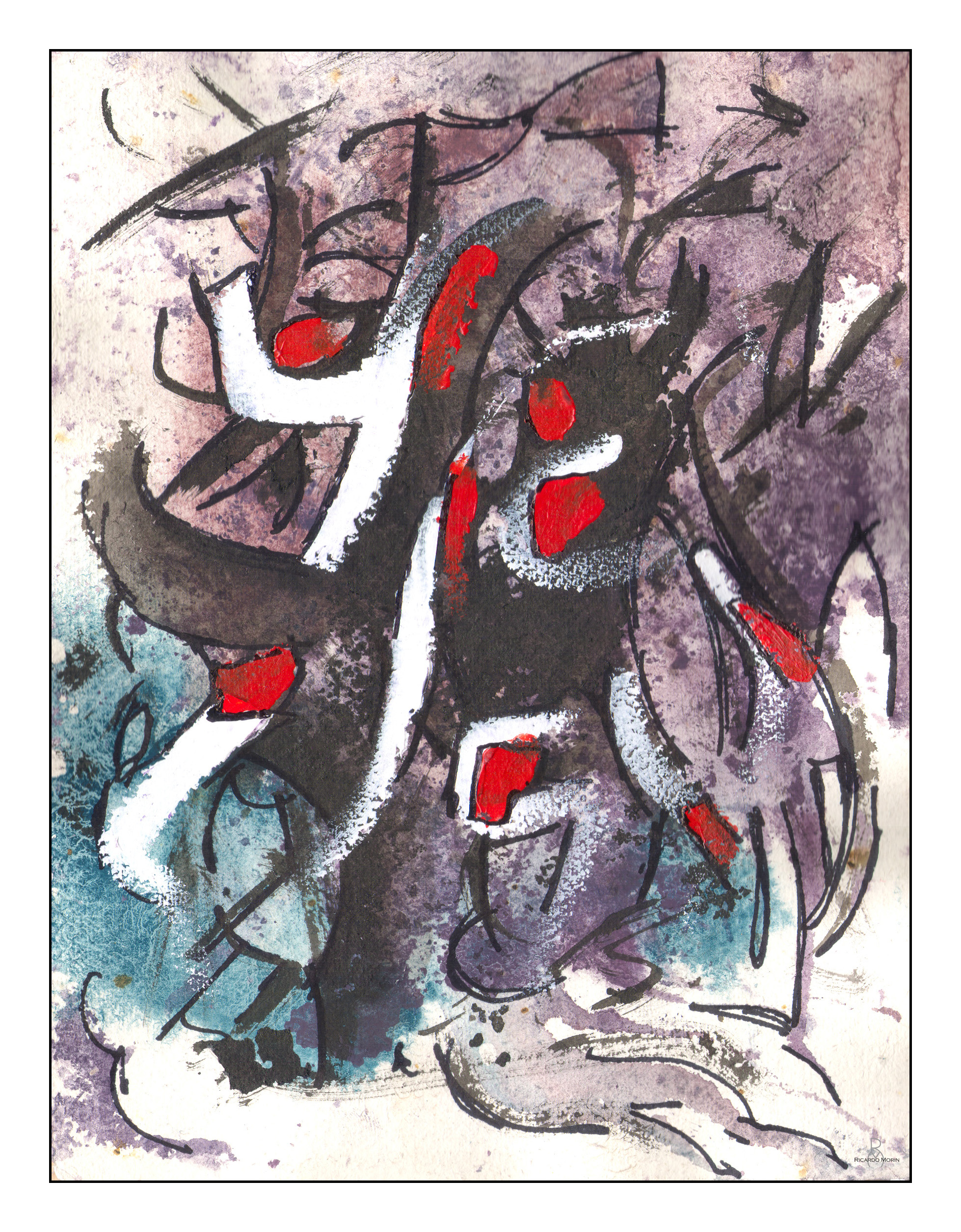
Ricardo Morín Untitled #4: The Forge of Aphoristic Thought 10″ x 12″ Watercolor, Sharpie pen, and gesso 2003
Author’s Note
Here, consciousness does not denote a subjective experience, but the recognition of the relation between the visible forms of civic life and the institutional conditions that govern the operation of those civic forms. Perception is a foundational faculty that registers those forms, and scrutiny measures them against the distribution of power they purport to represent. Recognition begins where that correspondence can no longer be assumed and institutional appearance discloses the limits of what institutions profess to embody.
This essay is a diagnostic inquiry, not a theoretical construction: it examines how the concentration of wealth conditions access to resources, how private interests influence institutional decisions and the organization of public attention, and how the resulting concentration of economic and institutional power weakens the effectiveness of constitutional restraints. This diagnosis does not presuppose a unitary conspiracy. Systems of incentives, legislation, administration, regimes of property, and diffused responsibility enable institutions and decision-makers to present deliberate choices as necessities. Under those conditions, democratic forms may retain formal validity even when institutional practice no longer guarantees self-government.
Perception enters the forge of thought, where scrutiny submits appearance to the fire of consciousness. Aphoristic thought does not fabricate what it seeks to disclose: it condenses observations intended to distinguish democratic form from its exercise, visible participation from its capacity to affect the distribution of authority, and proclaimed sovereignty from the people’s capacity to determine the order under which they live.
The observations that follow examine how institutions normalize dependence within societies that retain democratic forms. Here, the constitutional mandate requires public power to remain limited, equally answerable to citizens, and subject to the people’s capacity for self-government. The coherence of these observations lies not in offering a total explanation, but in making intelligible the divergence between that mandate and a distribution of power that restricts the exercise of the self-government the mandate requires. Like the sculptor’s incision, each observation adds no form of its own: it reveals one.
Ricardo F. Morín
August 1, 2026
Bala Cynwyd, Pennsylvania
*
*
What form does dependence take within a plural and democratic society? Within such a society, dependence acquires political force when control over wealth determines access to the material and institutional conditions of civic life. This relation between wealth and dependence has long animated the same ethical questions: Who depends upon whom for survival? Is that dependence reciprocal or unilateral? Does wealth circulate or remain immobilized? Does wealth sustain or supplant civic life?
Democracy derives its legitimacy from the aspiration to reconcile equality with freedom. Yet when those who concentrate ownership condition access to resources and direct the operation of institutions, equality ceases to govern the public order and yields to relations of dependence. Democratic institutions retain their public character, but private interests condition the decisions through which those institutions perform their public functions. Economic inequality then denotes not only a disparity of resources but also a relation of dependence. Even when the process is gradual, concentrated ownership and its influence upon institutions reproduce through institutional means what ancient despotisms secured by force: the rule of the few. Those who concentrate wealth may invoke the language of democracy while diminishing the service democratic institutions render to the common good.
Private financing sustains political campaigns and conditions legislation. Collective decisions consequently rest less upon public deliberation than upon incentives defined by those who finance access to authority. Funding, public visibility, and organized networks of support increasingly determine who may compete for political authority and attain it, to the detriment of civic judgment. Participation remains formally open to citizens, but those who finance access to political authority also delimit the available choices and thereby preserve the existing distribution of control.
Political and economic institutions may present the expansion of productive, technological, and financial capacity as civic progress even when the distribution of control remains unchanged. Claims of progress lose their civic meaning when expanded capacity alters neither who directs its use nor who receives the resulting benefits. Institutions retain the public character of the provision of services while reserving to private interests the decisions that orient institutional operation. The companies and entities that administer networks of energy, transport, communications, and finance subordinate essential services to criteria of private profitability. Through prices, tariffs, and debt, those companies and entities extend access to some and restrict it for others where the law proclaims common access. Material independence then yields to economic dependence, even when institutions present that dependence under the name of autonomy. Through contracts, the companies that control access to those services impose conditions that once would have required the force of decree.
Under these conditions, institutions treat citizenship as an economic relation rather than as an autonomous civic condition. They likewise treat the vote as an object of exchange and an emblem of conformity rather than as an exercise of civic choice. Populist movements link grievance to access to power, while their leaders make loyalty a condition of access to opportunity and reward. Through the reiteration of slogans, grievances, and public rewards, those leaders associate loyalty with acceptance within the political community and immediate response with participation. Political institutions and movements thus condition both access to resources and the terms under which they recognize civic participation.
Once institutions establish relations of dependence through control of energy, transport, communications, and finance, the exercise of power extends into the administration of perception. Organs of the State select and disseminate public information, while media organizations and digital platforms favor what captures attention over what encourages scrutiny. By repeatedly circulating content that elicits immediate reaction, these actors can lend claims an appearance of certainty and reduce the space available for scrutiny. By favoring continuous reaction, they impede sustained attention until institutions and political movements can treat immediate response as evidence of participation. Overt coercion loses its centrality. Through the sustained selection and repetition of information, those actors narrow the conditions under which citizens can recognize relations of subordination.
Institutions of the State and private institutions preserve concentrated power when they protect the advantages of those who exercise it and diffuse responsibility for the consequences of that exercise. Legislative rules, administrative decisions, and regimes of property reproduce the concentration of wealth, sustain accumulation, and impede the attribution of responsibility. Institutions disguise deliberate decisions as inescapable imperatives.
Where continued access depends upon loyalty, the worker safeguards a livelihood; the journalist preserves access; the citizen defends an interest upon which the citizen’s position depends. Each decision appears justified when considered in isolation, but together those decisions sustain an order in which diffused responsibility makes accountability harder to assign as relations of dependence deepen. The question is not whether wealth exists, but whether those who control wealth use it in service of the common good. When they make accumulation an end in itself, they direct wealth away from the enlargement of freedom and institutionalize relations of dependence.
Differences among political orders preclude treating them as equivalent. The examples that follow do not equate them, but show the diverse mechanisms through which political authorities organize relations of dependence and subordination. In Russia, authorities present the concentration of authority in the State as a guarantee of stability. By restricting political autonomy and distributing opportunities selectively, those authorities bind material security to loyalty to power. In China, administrative authorities connect the distribution of opportunities and prospects of social advancement to mechanisms of political supervision. These authorities thereby subordinate economic opportunity to administrative order.
In the United States, economic success carries social legitimacy: wealth serves as proof of merit, while public and economic institutions often attribute failure to individual deficiency rather than to the conditions that distribute opportunity and risk. This judgment presents inequality as the consequence of individual conduct rather than the product of institutional conditions. To this legitimation of economic success, populist nationalism adds another source of political legitimacy by defining the national community through economic and cultural grievance and promising to restore a sovereignty portrayed as diminished. In several Latin American countries, populist movements of differing orientations give political expression to inequality and historical exclusion through promises of restoration. In both political settings, populist forces bind grievance to loyalty and present the promise of restoration as a foundation of authority.
Beneath these variations lies a common principle: those with greater economic and political capacity influence decisions concerning access to resources, the distribution of benefits, and the allocation of costs. Legislation, the administration of the State, regimes of private property, and institutional management give effect to those decisions, channel the resulting benefits toward sectors with greater capacity for influence, and distribute the corresponding costs across broader sectors of the citizenry. When institutions present that outcome as a natural consequence of the existing order, they remove from public judgment the decisions that produce it and preserve the relation of subordination.
In the speculative economy, the possibility of enrichment depends upon unequal access to information, the timing of entry and exit, liquidity, and the capacity to absorb losses. Promoters and operators of digital currencies and speculative financial instruments present them as means of emancipation from centralized power, yet the organization of those markets distributes information, liquidity, and exposure to loss unequally among those who administer transactions, those who possess the means to exploit fluctuation, and those who bear its consequences.
Within these markets, value ceases to be grounded in labor and comes to depend upon volatility; financial actors multiply wealth through fluctuation rather than production. Behind the rhetoric of decentralization stand brokers, major investors, and platforms that control information, liquidity, and the execution of transactions, thereby distributing the prospects of gain and loss unequally. Platforms and financial actors that proclaim the transparency of these markets nevertheless depend upon uncertainty, which they exploit rather than reduce. Those who design and employ certain financial instruments and practices deliberately convert volatility into a source of profit and make instability a commodity. Market advocates may present that instability as freedom, yet only those who command sufficient resources can absorb the losses without forfeiting their position.
The idea of community ceases to govern institutional operation when institutions appropriate shared resources and institutionalize relations of dependence. By converting access to those resources into a source of unilateral advantage, institutions replace reciprocity with exploitation and collaboration with submission. Institutions in the service of concentrated wealth present as order a distribution that produces deprivation. When the State bases institutional stability, or holders of private wealth base their economic position, upon the needs of others, they can present the resulting arrangement as legitimate while binding those who depend upon it to the unequal conditions on which that arrangement rests.By reorganizing who depends upon whom for access to shared resources, institutions alter the public terms through which citizens judge order, justice, freedom, and citizenship.
Institutions alter the terms of citizenship as well when material dependence conditions access to employment, essential services, and civic participation. Institutions and public discourse then treat purchasing power as a measure of freedom and present the ability to choose among predetermined options as a sufficient measure of citizenship. Democratic forms remain, while concentrated power restricts the effective scope of choice.
The restriction of choice constitutes a constitutional deviation when public authorities exercise power through legislation, the administration of the State, and the regime of private property in ways that depart from the constitutional mandate, and the organs charged with limiting power fail to contain that departure. Legislative bodies deepen the divergence between mandate and exercise when they allow legal norms to consolidate the concentration of power they are charged with limiting. The constitutional framework then remains formally in force, while the effective distribution of power contradicts the direction established by that same framework.
Examining this divergence makes it possible to distinguish the formal validity of the constitutional mandate from the realization of that mandate in the exercise of power. Perception registers the visible continuity of institutions; scrutiny determines whether institutional exercise still answers to the mandate that legitimates them. Recognition begins when scrutiny ceases to regard that continuity as sufficient proof of correspondence between mandate and exercise. Scrutiny then reveals when institutions preserve the terms of freedom, participation, and consent while reducing freedom to permission, participation to visibility, and consent to conformity.
The extent of this divergence varies among societies. In Switzerland, Norway, Denmark, Sweden, and Estonia, as well as Costa Rica and Uruguay, political representation, public oversight, and the rule of law contribute in differing degrees to containing the concentration of power, subject the administration of the State to supervision, and limit the influence of private wealth upon public decisions. Taken together, these mechanisms bring the exercise of power closer to the constitutional mandate without eliminating the influence of private wealth upon public decisions or securing complete correspondence between the constitutional mandate and the actual exercise of power. These mechanisms contain the divergence, but do not eliminate it.
Institutionalized dependence endures wherever constitutional restraints, public oversight, and the institutions charged with limiting concentrated power cease to operate effectively. It endures when constitutional restraints fail to contain concentrated power, when the institutions charged with enforcing those restraints permit that power to expand, and when democratic procedures retain their formal validity while the effective scope of choice diminishes. The vote then retains its civic form, but a distribution of power that electoral exercise itself cannot alter limits the vote’s capacity to modify the distribution of authority.
Under these conditions, democratic forms remain, although they cease to contain the concentration of power. Participation remains visible, but loses the capacity to alter the distribution of authority. Scrutiny recognizes this divergence, but cannot by itself eliminate it or restore self-government. Democracy may perish without the disappearance of its institutions: public action yields to administration, judgment to necessity, and the people, though still proclaimed sovereign, cease to determine the order under which they live.
Aristotle. Politics. Translated by Carnes Lord. 2nd ed. Chicago: University of Chicago Press, 2013.
Augustine. The City of God against the Pagans. Edited and translated by R. W. Dyson. Cambridge: Cambridge University Press, 1998.
Carr, E. H. What Is History? Edited by R. W. Davies. 2nd ed. New York: Penguin Books, 1987.
Marx, Karl. Capital: A Critique of Political Economy. Vol. 1. Translated by Ben Fowkes. London: Penguin Books, 1976.
Polanyi, Karl. The Great Transformation: The Political and Economic Origins of Our Time. Boston: Beacon Press, 2001.
Rousseau, Jean-Jacques. Discourse on the Origin and Foundations of Inequality among Men. In The Discourses and Other Early Political Writings. Edited and translated by Victor Gourevitch. Cambridge: Cambridge University Press, 1997.
Smith, Adam. An Inquiry into the Nature and Causes of the Wealth of Nations. Edited by R. H. Campbell and A. S. Skinner. 2 vols. Indianapolis: Liberty Fund, 1981.
Thomas Aquinas.Summa Theologiae. Latin-English Edition. Cambridge: Blackfriars in conjunction with Cambridge University Press, 1964–1981.
Tocqueville, Alexis de. Democracy in America. Translated by Harvey C. Mansfield and Delba Winthrop. Chicago: University of Chicago Press, 2000.
Life does not begin with power. It begins with dependence. Before a human being becomes capable of judgment, choice, consent, or resistance, existence already unfolds within relationships upon which survival depends. No one enters the world invested with autonomy. Every human life begins by being sustained through the action of another.
Dependence, however, is not sufficient to explain authority. Whoever possesses greater strength may preserve another’s life, abandon it, or destroy it. Physical superiority alone cannot explain the character of the relationship through which human life ordinarily comes to develop. If force alone governed the bond between the one who requires protection and the one capable of providing it, care would cease to be distinguishable from domination.
Care begins to reveal itself as something different from domination through an experience so ordinary that it seldom becomes an object of reflection. The child gradually discovers a world in which the guidance received is not experienced solely as a limitation imposed from without, but as guidance properly exercised by the person who provides it. Before authority becomes an object of understanding, it constitutes a lived experience. Its first appearance assumes not the form of command, but that of care.
Care makes possible a form of dependence that force could never produce: a dependence that does not extinguish future freedom, but prepares the conditions for its emergence. The guidance received becomes intelligible because it is exercised for the benefit of a life still in formation, rather than for the immediate satisfaction of the person possessing greater power.
Power and authority operate jointly in the development of civilized life. Power designates the capacity to act. Authority designates the acknowledged right to guide, direct, judge, or decide. Both may be present in the same person, but neither necessarily implies the existence of the other. Power may exist without authority, just as authority may endure even after power has considerably diminished.
Obedience does not resolve the problem either. Human beings obey for many different reasons. They obey because they fear punishment. They obey because custom has rendered the alternatives invisible. They obey because deception has concealed the true nature of what is being required of them. They obey because every form of resistance appears futile. None of these circumstances constitutes authority. They explain only submission.
Authority begins only where recognition becomes possible. The guidance offered by one who leads must possess a title that renders its recognition justifiable independently of force. A person who accepts the guidance of another does not merely yield before a more powerful will. The person recognizes that such guidance possesses a title extending beyond the mere fact that it can be imposed.
That recognition constitutes legitimacy. Legitimacy is not identical with effectiveness, popularity, success, antiquity, or duration. Nor does it arise from the mere assertion of the person claiming obedience. It designates the condition under which authority may be recognized as due, rather than merely acknowledged as existing.
Because legitimacy depends upon recognition rather than upon the possession of power, it is more fragile than power itself. Force may remain intact after legitimacy has already begun to disappear. Armies may continue to obey. Institutions may continue to function. Laws may continue to be enforced. Yet the basis of recognition has already changed: what was once acknowledged as due begins to be experienced only as imposed.
From that moment onward, human relationships begin to change without commotion. Guidance approaches coercion. Trust yields to calculation. Responsibility begins to be confused with control. Instruction approaches indoctrination. Judgment begins to be perceived as domination. Authority remains visible while the intelligibility that once made it recognizable gradually recedes. A son may continue to obey his father from habit long after he has ceased to trust his judgment. From the outside, the relationship between father and son may appear scarcely altered. The same words continue to be spoken. The same decisions continue to be obeyed. Yet what inwardly sustained the father’s authority has already begun to disappear.
The disappearance of legitimacy does not bring about the immediate collapse of social life. Human relationships begin to reorganize themselves through means that no longer rest upon recognition. Where recognition ceases to sustain authority, substitutes arise to take its place. Force attempts to compensate for what recognition no longer grants. Fear seeks to secure the obedience that trust has withdrawn. Custom prolongs practices that scarcely continue to rest upon recognition. Manipulation manufactures the appearance of consent after genuine recognition has ceased to exist.
None of those means, however, constitutes authority. Force obtains conduct, but not recognition. Fear silences resistance, but does not produce assent. Custom prolongs forms whose intelligibility has weakened. Manipulation imitates legitimacy because it can no longer produce it. All such means depend upon the absence of the recognition they seek to replace.
What makes it possible for one human being to recognize the authority of another without reducing that recognition to force, fear, custom, or manipulation? Every subsequent form of authority will receive its intelligibility from the answer given to that question.
The first manifestation of authority remains inseparable from care because life still depends upon the constant presence of another. As the child grows, however, dependence begins to change. Survival ceases to occupy the center of the relationship. Understanding gradually begins to take its place.
No experience reveals more clearly than language how survival ceases to occupy the center of dependence and understanding begins to assume its place. No child invents the language through which the world begins to become intelligible. Words are received before they are used. Meanings are recognized before they are examined. Grammar is obeyed long before it can be explained. Every act of speech therefore presupposes an inheritance that no individual has produced independently.
The transmission of that inheritance cannot be obtained by force. A child may be compelled to repeat a word, but repetition does not yet amount to understanding. Language becomes one’s own because correction eventually comes to be recognized as something distinct from imposition. The child does not merely reproduce sounds. The child learns that certain words name the world more faithfully than others. Correction therefore always refers to a reality that transcends the person who corrects.
The acquisition of language also changes the nature of authority. The dependence characteristic of early childhood ceases to constitute its principal foundation. Authority now begins to arise from shared participation in an order that precedes both teacher and pupil. The language existed before either of them. Neither may claim it as an exclusive possession. Both remain subject to the same structure that makes communication possible.
For that reason, the teaching of language can never be reduced to the exercise of command. Whoever corrects an expression ultimately answers to the language itself, and not merely to personal will. The legitimacy of correction does not arise from the speaker’s desire, but from the fidelity with which the transmitted word corresponds to the language held in common. Authority then ceases to rest principally upon the person who teaches and begins to rest upon the reality to which that person remains subordinate.
Authority may be recognized even after the personal dependence characteristic of the earliest years of life has disappeared. The child begins to discover that someone deserves to be heard, not because that person is stronger or continues to provide care, but because that person permits faithful access to a reality existing independently of them both. Recognition thus ceases to be directed exclusively toward the person and begins to be directed toward what that person makes accessible.
The redirection of recognition toward the reality transmitted, rather than exclusively toward the person transmitting it, profoundly alters human experience. Authority may now be examined without thereby being abolished. Correction itself may be corrected. The teacher may be mistaken. Neither the examination of authority, nor the correction of what has been taught, nor the teacher’s error destroys the legitimacy of teaching, because legitimacy no longer resides exclusively in the person who teaches, but in the fidelity with which that person transmits what transcends both teacher and pupil.
Civilization begins to be constructed upon this displacement of authority from the person who transmits toward the integrity of what is transmitted. Once authority becomes attributable to the integrity of what is transmitted rather than simply to the person transmitting it, every higher form of learning becomes possible. Education, scientific inquiry, moral life, judgment, and constitutional government will each reproduce, within its own sphere, the subordination of authority to an antecedent reality that governs its exercise and makes its recognition possible.
Language, however, does not yet constitute education. It provides only the possibility of communicating the understanding upon which education may act. Through language, understanding may be communicated. Education pursues a different purpose: the deliberate formation of the understanding.
A teacher corrects a mistaken line of reasoning. The pupil first recognizes the error in the answer before fully understanding the truth of the explanation received. Correction does not require obedience alone. It requires sufficient trust to accept that another person may guide the understanding toward a reality it cannot yet perceive. With education, authority undergoes a further transformation. The child no longer depends upon the adult solely in order to inhabit a shared language, but in order to gain access to bodies of knowledge that cannot be acquired through individual experience alone. Every generation receives a world whose complexity vastly exceeds the duration of any single human life. Education exists because no human being can always begin again from the beginning.
The authority of the educator cannot therefore derive from age, office, or membership in an institution. None of those circumstances confers, by itself, the right to guide another person’s intelligence. The teacher acquires legitimacy only by making accessible a form of knowledge whose validity does not proceed from the teacher. Where teaching turns the teacher into the true object of learning, education has already ceased to exist.
Intellectual formation therefore requires a discipline common to teacher and pupil. The teacher answers to the truth of what is taught. The pupil answers to the effort required to understand it. Neither governs the educational relationship unilaterally, because both appear before a body of knowledge that neither has created.
Education therefore differs radically from indoctrination. Indoctrination seeks adherence to the teacher or the preservation of a doctrine irrespective of whether that doctrine retains its intelligibility. Education pursues the opposite end. It seeks to enable the pupil to recognize the truth even when that recognition ultimately surpasses the understanding of the teacher. The success of teaching consists in rendering the authority of the teacher progressively less necessary.
Education thereby reveals one of the least noticed characteristics of legitimate authority. The more faithfully knowledge is transmitted, the less the pupil depends upon the person who served as mediator. Education does not perpetuate dependence. It prepares autonomy without destroying the legitimacy of the relationship through which that autonomy became possible.
Legitimate authority and domination reveal here with greater clarity the contrary directions toward which they move. Domination needs to perpetuate itself because it depends upon the continuing subordination of the person subjected to it. Legitimate authority, by contrast, works so that recognition may ultimately sustain itself. It does not fear the intellectual maturity of the pupil, because it never sought possession of the pupil, but formation.
When teaching attempts to prevent examination, discourages correction, or seeks indefinitely to prolong the pupil’s dependence, it begins to depart from the subordination to knowledge that justified its authority. Corruption begins when the teacher ceases to understand the self as subordinate to the knowledge transmitted and demands recognition solely by virtue of the continued possession of authority.
A new question arises from the displacement of educational legitimacy away from the person of the teacher and toward fidelity to knowledge. If the legitimacy of education depends upon fidelity to knowledge rather than exclusively upon the educator, what makes it possible for knowledge to possess authority without becoming another form of institutional power? That question leads naturally from education toward scientific inquiry.
A researcher devotes years to developing a hypothesis. The results of new experiments eventually contradict it. The researcher may ignore them in order to preserve personal prestige or publicly acknowledge that reality has disproved the conclusions. That decision reveals whether the researcher remains subordinate to the evidence obtained or instead employs the institutional authority of science to preserve personal standing. Scientific inquiry arises from the obligation to submit the researcher’s conclusions to evidence capable of disproving them. No proposition becomes true because it was formulated by a prestigious scholar, approved by a renowned institution, or accepted by the majority of specialists. The authority of science does not proceed from those who practice it. It proceeds from the discipline through which every assertion remains exposed to examination, replication, correction, or rejection by others. The scientist therefore appears under the same requirements imposed upon every conclusion.
For that reason, scientific authority possesses a singular character. The possibility of error does not weaken it; it constitutes one of the conditions that make its legitimacy possible. An inquiry remains scientifically legitimate because it permits the public correction of its own results. Error belongs to the ordinary life of science. What delegitimizes inquiry is not the fact of being mistaken, but the withdrawal of conclusions from the procedure through which they might be shown to be mistaken.
An erroneous conclusion does not destroy the authority of science so long as it remains exposed to demonstration and correction through the same procedures that justify the inquiry. Error assumes another character when examination is no longer possible, when institutional prestige replaces demonstration, or when assent is demanded independently of any further verification. At that moment the researcher ceases to mediate knowledge of reality and begins instead to mediate recognition of the self.
Scientific authority, consequently, never resides in the scientist. It resides in the continuing fidelity of inquiry to the reality it seeks to understand. The researcher retains authority only while remaining subject to that reality. From the moment the researcher seeks exemption from that subordination, legitimacy begins to withdraw, even though the institutional power of science may appear to remain intact.
The temptation disclosed within scientific inquiry does not belong exclusively to science. Every enduring institution eventually confronts the danger of confusing the preservation of its own authority with the preservation of the reality that originally justified its existence. Institutions seldom lose legitimacy merely by exercising authority. They begin to lose it when their principal concern ceases to be what was entrusted to them and becomes their own permanence. Fidelity then yields to self-preservation. Mediation becomes self-reference. Authority, which formerly allowed the reality justifying it to be seen with transparency, gradually begins to obscure it.
Scientific inquiry thus leads toward the problem of moral authority. If science receives legitimacy from its fidelity to truth, does a similar structure govern those forms of authority that cannot be demonstrated experimentally and yet remain indispensable to common life? That question introduces the problem of moral authority.
A person who exhorts others to tell the truth is discovered in a lie. The principle remains. The authority of the person who invoked it disappears. That ordinary experience introduces a question distinct from all the preceding ones. What permits one person legitimately to guide the conscience of another? Moral authority presents greater difficulties than scientific authority because the goods to which it refers cannot be reproduced experimentally or reduced to measurement.
The answer cannot be found in the intensity of conviction. Every society knows individuals who proclaim virtue while contradicting through their conduct the very principles they affirm. Neither eloquence, reputation, prestige, nor office confers moral authority by itself. Before a judgment concerning the good merits recognition, there must exist a correspondence between the life of the speaker and the principles invoked.
Integrity makes that correspondence visible. It does not guarantee that every judgment will be true. Nor does it transform anyone into a perfect example. It permits moral authority to become intelligible because the person who exhorts others remains equally subject to the norms whose observance is proposed. What human beings recognize is not perfection, but coherence.
Hypocrisy therefore possesses an incomparable power of dissolution. It does not destroy the moral principle invoked. It destroys the authority of the person claiming to speak in its name. A moral requirement may retain its full truth while a particular person loses the right to formulate it. The contradiction resides not in the principle, but in the rupture between the principle and the conduct of the person invoking it.
Here too, error must be carefully distinguished from corruption. A morally serious person may err, correct a judgment, or retrospectively discover the insufficiency of earlier conclusions. So long as that person remains subject to the principles acknowledged, legitimacy remains intact. Hypocrisy is not a moral error susceptible to correction, but the deliberate claim to an exemption from the norms imposed upon others. From that moment onward, the principle ceases to govern the person’s conduct, and the person begins to govern the principle.
The experience accumulated thus far reveals a constant. The father remains subordinate to the good of the child. The teacher remains subordinate to knowledge. The researcher remains subordinate to truth. Whoever speaks in the name of the good remains subordinate to the principles proposed. In none of these cases does authority arise from personal superiority. It arises from sustained fidelity to a reality antecedent and superior to the person exercising it.
When that subordination is reversed, corruption begins to manifest itself without any visible rupture. The good ceases to govern conduct. Truth ceases to govern inquiry. Knowledge ceases to govern teaching. Principles cease to govern conscience. What originally justified authority begins to be used to preserve authority itself. The person becomes the source of an authority previously received from the reality to which that person remained subordinate.
Two persons appear with incompatible claims. Both believe themselves to be right. Both appeal to justice. Neither can independently decide which of the two claims should prevail. There the need for judgment first appears. Moral life thus leads toward another and still more complex requirement. Where several persons advance mutually incompatible claims, the guidance of an individual conscience is no longer sufficient. It becomes necessary to discern between competing rights. The need to discern between competing rights gives rise to judgment.
Judgment introduces a mode of authority distinct from all those previously considered. The father guides the child. The teacher leads the pupil. The researcher investigates the truth. The person who lives according to principles seeks to order personal conduct and guide the conduct of others. The judge, by contrast, appears where two or more incompatible claims simultaneously demand recognition. Authority then ceases to stand before one person alone and takes its place between persons whose claims must be weighed according to justice.
The complexity of that function does not alter the structure of legitimacy. No judge acquires authority by occupying a bench, wearing a robe, or possessing the power necessary to enforce decisions. Such circumstances make the institutional exercise of judgment possible, but they do not explain why that judgment deserves to be recognized as due. Judicial authority becomes intelligible only when those appearing before it may recognize that the decision remains subject to justice rather than to the interests, preferences, or convenience of the person judging.
Impartiality, consequently, does not constitute a virtue added to the exercise of jurisdiction. It constitutes a requirement inherent in the act of judgment itself. The parties seek not merely a decision. They seek a decision whose authority proceeds from its conformity with a justice that neither judge nor litigants have created. Justice thereby occupies the place toward which judicial authority points without ever becoming the possession of the person exercising it.
For that reason, even the appearance of partiality may profoundly erode the legitimacy of judgment. When those who come before the courts begin to perceive that decisions respond principally to the interests of the judge, the institution, or an external power, authority begins to separate itself from justice. Judgments continue to be issued. Obedience may continue. The judicial machinery remains in operation. Yet recognition gradually ceases to be directed toward the justice of the decision and begins to be directed toward the force ensuring its enforcement.
Within judgment as well, error must be distinguished from the loss of legitimacy. Judges remain human beings whose understanding is necessarily limited. An erroneous judgment does not by itself destroy judicial authority so long as the legal order preserves public procedures capable of correcting it. Appeal, review, and reasoned dissent do not weaken justice. They manifest the continued subordination of the judicial function to it.
The corruption of judgment begins in an entirely different place. It begins when the person judging ceases to understand the self as a servant of justice and begins to understand justice as whatever confirms personal authority. The exercise of jurisdiction then ceases to disclose the law and begins instead to disclose the power of the judge. Fidelity once more yields to self-reference. Office occupies the place formerly belonging to justice.
The same reversal has already recurred under successive forms. Care degenerates when it transforms another life into an object of possession. Education degenerates when it replaces formation with indoctrination. Scientific inquiry degenerates when prestige replaces demonstration. Moral authority degenerates when principles are used to exempt from them the person invoking them. Judgment degenerates when justice ceases to constitute the end to which judicial authority remains subordinate.
The recurrence of the displacement through which authority occupies the place of what ought to govern it reveals that the inquiry has reached another threshold. The question is no longer the examination of particular instances of authority. What now appears is the common subordination of all legitimate authority to what precedes it and governs its exercise. The inquiry ceases to ask what makes a particular authority legitimate and begins to ask what makes the legitimacy of all authority possible.
Care, language, education, scientific inquiry, moral conscience, and judgment belong to widely different domains of human experience. Care belongs to the beginning of life. Language makes a common world possible. Education transmits knowledge. Scientific inquiry disciplines the search for truth. Moral conscience orders conduct. Judgment restores justice between conflicting claims. Despite their diversity, all these experiences remain united by a common structure.
In none of them does authority find its origin in the person who exercises it. The father does not constitute the good of the child. The speaker does not constitute the language. The teacher does not constitute knowledge. The researcher does not constitute truth. Conscience does not constitute moral principles. The judge does not constitute justice. Each receives legitimacy only while remaining faithful to what precedes the exercise of authority and continues to govern it.
Power and legitimacy thus reveal that they proceed from entirely different conditions. Power exists wherever someone possesses sufficient capacity to impose conduct. Legitimacy exists only where authority remains intelligible as the faithful mediation of a reality that does not belong to it. Power may assert itself through possession. Legitimacy can be sustained only through fidelity.
Legitimacy is therefore at once more fragile and more enduring than power. It is more fragile because recognition may disappear while institutions continue effectively to perform their functions. It is more enduring because the realities from which authority receives legitimacy remain beyond those who exercise it temporarily. Persons disappear. Institutions change. Truth, justice, knowledge, the good, and care continue to judge all those who claim to represent them.
The inquiry undertaken thus far has shown the conditions under which legitimacy arises. The examination must now turn toward the inverse movement. It becomes necessary to ask how authority begins to lose the very quality that originally rendered it worthy of recognition.
The corruption of authority does not begin with the abuse of power. Abuse merely makes visible a corruption already under way. The true deterioration appears at the moment when authority ceases to refer to the reality that legitimized it and begins to demand recognition for itself. What formerly remained transparent to truth, care, justice, or knowledge slowly begins to obscure them. The institution, office, person, or tradition occupies the place belonging to the care, knowledge, truth, justice, or common good that originally justified its authority.
The abandonment of the reality that legitimized authority, followed by the demand that authority itself be recognized, is seldom announced by spectacular ruptures. It almost always proceeds through imperceptible substitutions. Fidelity yields to preservation. Mediation becomes representation. Representation eventually identifies itself with what it claimed to represent. Little by little, the distance disappears between authority and the reality from which it received legitimacy. Authority begins to present itself as though it were the source of what it was merely called upon to preserve.
When authority begins to claim itself as the source of its own legitimacy, legitimacy begins gradually to dissolve even while external stability appears intact. Recognition ceases to be directed toward the good protected, the truth investigated, the justice administered, or the knowledge transmitted. It begins instead to be directed toward the prestige of office, the permanence of the institution, the continuity of a tradition, or the influence of particular persons. Trust is demanded because authority exists, rather than because authority remains faithful to what justified its existence.
The consequences reach every form of civilized life. Where authority loses the capacity to refer beyond itself, the substitutes encountered at the beginning of this inquiry inevitably reappear. Force attempts to replace lost recognition. Fear seeks to preserve obedience. Custom prolongs practices whose foundation has weakened. Manipulation manufactures the appearance of a legitimacy it can no longer produce.
Civilization does not therefore consist in the mere accumulation of institutions. It consists in a complex network of authorities whose legitimacy depends upon continuing fidelity to the realities that gave rise to them. The health of a civilization is not measured by the magnitude of the power it concentrates, but by the degree of transparency with which its authorities continue to refer to care, knowledge, truth, justice, and the common good.
Only at this point does political authority acquire its full meaning. Constitutional government does not constitute a problem separate from all that precedes it. Within the sphere of public life, it gathers together all the forms of legitimacy examined thus far. The question is no longer whether political power possesses a legitimacy peculiar to itself. It is whether the constitutional order remains subject to the same requirement of fidelity to a reality that precedes and transcends it.
Civilization preserves these forms of authority through institutions. No generation could transmit language, knowledge, justice, or political order by itself. Institutions extend the transmission of language, knowledge, justice, and political order through time.
An institution, however, never possesses legitimacy in itself. A school exists to educate. A university exists to cultivate knowledge. A court exists to administer justice. A research center exists to conduct inquiry. Constitutional government exists to order the political life of a community through law. None of these institutions constitutes the principle from which its authority derives. All remain subordinate to the reality entrusted to their care.
Institutions therefore combine a strength and a vulnerability that do not appear with equal intensity in personal relationships. Their permanence permits the preservation of achievements extending beyond the duration of any individual life. Yet that same permanence introduces a constant temptation. What endures eventually develops interests of its own. The preservation of what the institution was meant to protect gradually gives way to the preservation of the institution itself.
The subordination of an institutional mission to the preservation of the institution seldom begins through a deliberate act of corruption. Institutions initially seek to secure the conditions necessary for the continued fulfillment of their mission. That concern remains legitimate so long as it remains subordinate to the purpose that justified the institution’s existence. The problem appears when preservation ceases to serve the mission and the mission begins to serve preservation. Means occupy the place of ends. The continuity of the institution gradually occupies the place of fidelity to the purpose that justified its existence.
When institutional preservation begins to prevail over mission, the institution ceases to ask whether it continues to make present the reality entrusted to its care. Its principal concern becomes its own survival. A university may continue to inaugurate buildings, expand its programs, increase enrollment, and improve its position in the rankings while the formation of the understanding gradually ceases to occupy the center of academic life. Nothing appears to indicate an institutional crisis. Yet the purpose that justified the institution’s existence has begun to yield to the preservation of the institution itself. Truth, justice, knowledge, or the common good ceases to constitute the supreme criterion of institutional examination. The center of gravity shifts toward the preservation of the organization.
The loss of legitimacy rarely manifests itself immediately because institutional power ordinarily survives the weakening of legitimacy for a considerable period. Buildings remain open. Procedures continue to be applied. Offices remain occupied. Decisions continue to be produced. External forms remain recognizable while the foundation that rendered them intelligible begins to withdraw from public experience.
Institutional deterioration is therefore frequently attributed to secondary causes. Political hostility, economic difficulties, cultural change, or external pressure is blamed. All these factors may accelerate decline. None constitutes its origin. Decline begins when the institution ceases to measure itself by fidelity to the reality it was meant to preserve and begins instead to measure itself by the effectiveness with which it secures its own continuity.
To understand that decline begins when an institution privileges its continuity over the reality entrusted to its care is to clarify one of the most persistent confusions of public life. Criticism directed toward an institution is often mistaken for hostility toward it. Yet genuine institutional fidelity may require precisely such criticism when it seeks to restore the institution to the purpose that justified its origin.
Conversely, the most impassioned defense of an institution may contribute to its delegitimation when it seeks to preserve the institution independently of the good it was called upon to serve.
Recognition, consequently, does not necessarily follow permanence, nor does it inevitably accompany change. It follows fidelity. Institutions remain legitimate only so long as they continue to make present what originally conferred authority upon them.
Among all institutions, one bears a responsibility greater than the rest. Unlike the school, the court, or the laboratory, the constitutional order does not administer one particular sphere of human experience. It establishes the juridical framework within which all other authorities may legitimately exercise their respective functions. Constitutional legitimacy therefore constitutes the broadest expression of the same structure that has unfolded from the earliest relationships of care.
Constitutional authority does not constitute an exception to the preceding forms of legitimacy. On the contrary, it presupposes and gathers them within the organization of public life. What care accomplishes within the family, teaching within the formation of the understanding, inquiry within the knowledge of truth, moral conscience within conduct, and judgment within the administration of justice, the constitutional order must accomplish in relation to the political community as a whole.
Government therefore never acquires legitimacy merely by governing. To govern demonstrates the existence of power. Constitutional legitimacy raises a different question. The existence of a government does not answer that question. It merely makes the question impossible to evade.
The answer cannot depart from the structure already disclosed within every preceding form of authority. Just as the teacher does not constitute knowledge, the researcher does not constitute truth, and the judge does not constitute justice, government does not constitute the origin of the public authority it exercises. Political authority necessarily remains subordinate to a reality that precedes and transcends it.
That reality is not the government itself, the organs composing it, administrative continuity, the effectiveness of public policy, institutional permanence, international recognition, partisan support, or the practical necessity of maintaining order. All these circumstances may accompany the exercise of power. None is sufficient to confer legitimacy upon it.
Public authority remains legitimate only so long as it continues to be attributable to the political community from which it proceeds. A government may retain control over ministries, public administration, the armed forces, and international relations. None of those circumstances yet answers the decisive question. All describe who exercises power. None yet demonstrates to whom public authority is constitutionally attributable. Government is not the owner of public power. It exercises that power in the capacity of a derivative authority. The source of that authority always remains outside government itself.
That same subordination protects the constitutional order from one of the oldest temptations of politics. Every government tends spontaneously to identify the continuity of its own existence with the continuity of the political community it administers. Yet the two can never be identical. The political community remains. Governments pass away. Public power does not belong to those who temporarily exercise it.
When government begins to identify the continuity of its own existence with the continuity of the political community, the corruption through which authority occupies the place of the reality that ought to govern it reappears. Government gradually ceases to refer to the political community from which it receives legitimacy. It begins to claim recognition because it governs, because it administers, because it preserves order, because it has survived, or because no immediate alternative appears to exist. The source of legitimacy begins to yield its place to the exercise of power itself.
At that moment, constitutional attribution begins to be replaced by mere political effectiveness. Public recognition ceases to be directed toward the constitutional conditions from which authority arises and begins instead to be directed toward the continued possession of power. Administration replaces attribution. Continuity replaces legitimacy. Possession replaces title. Elections may continue to be held. Courts may continue to issue judgments. The budget may continue to be executed. Yet public discussion may already have ceased to inquire into the constitutional title of power and begun to concern itself solely with the administration of those exercising it. There the substitution begins to become visible.
The replacement of constitutional attribution by political effectiveness does not require the immediate collapse of the constitutional order. Constitutions may continue to be invoked. Institutions may continue to function. Elections may continue to be held. Governments may continue to administer the state. The visible forms of constitutionalism remain standing while the legitimacy that gave them meaning gradually withdraws from public consciousness.
The consequence extends beyond the political sphere. When public authority begins to claim recognition by virtue of its mere permanence, subordinate institutions eventually reproduce the same reversal. The subordination of authority to the good, knowledge, truth, justice, and the political community weakens throughout civilized life. The substitution of control for care, first perceived within relationships of dependence, ultimately reaches its broadest political expression when the permanent exercise of power occupies the place of constitutional attribution. Civilization then begins to reorganize its understanding of authority around power rather than legitimacy. The displacement seldom manifests itself simultaneously within every sphere. It may begin in the family, continue within the school, become visible in institutions, and eventually reach the political order. Wherever authority begins to justify itself through the permanence of the person exercising it rather than through the reality to which it remains subordinate, permanence occupies the place of legitimacy.
No civilization can sustain itself exclusively upon power. Power organizes conduct, secures obedience, protects borders, administers resources, and represses disorder. None of this explains, however, why authority continues to be recognized as due after fear disappears, circumstances change, or a greater force arises. Power governs conduct. Legitimacy governs recognition. Where recognition disappears, power must rely with increasing intensity upon the substitutes that legitimacy had rendered unnecessary.
The most profound danger confronting a civilization therefore seldom appears initially in the form of violence. It begins when attention ceases to be directed toward the realities that justified authority. Care is replaced by control. Knowledge by prestige. Truth by consensus. Justice by decision. Constitutional attribution by the administration of power. Little by little, attention ceases to be directed toward what conferred legitimacy and becomes fixed exclusively upon the person exercising authority.
None of this need assume a revolutionary appearance. Parents continue to raise their children. Teachers continue to teach. Researchers continue their work. Judges continue to issue decisions. Governments continue to govern. Outwardly, civilization appears to preserve the same physiognomy. Yet beneath those familiar forms, another source of recognition has been established, founded upon utility, influence, identity, necessity, or mere permanence, which begins to occupy the place formerly belonging to legitimacy.
When the substitution of legitimating reality by the authority that claimed to represent it becomes habitual, the nature of disagreement itself changes. Discussion ceases to ask whether authority remains faithful to the reality that legitimized it. It begins to ask only whether authority is effective, convenient, representative, or sufficiently powerful to impose itself. Inquiry into legitimacy slowly disappears from the public horizon. Power begins to explain itself.
From that moment onward, every authority bears an increasing burden. No institution can indefinitely replace through force what legitimacy alone can sustain. Fear is eventually exhausted. Custom loses force with the passing of generations. Manipulation ultimately reveals the will directing it. Even force encounters limits beyond which obedience ceases to produce recognition. Authority that has ceased to refer to a superior reality ultimately depends upon itself alone.
The decisive question has never consisted in determining whether civilization requires authority. No form of common life can exist without it. The true question is whether authority will continue to recognize the realities from which it derives legitimacy or whether it will ultimately replace them with itself. No generation is exempt from answering that question anew.
The abolition of legitimacy destroys more than governments or institutions. It destroys the very possibility that one human being might recognize the authority of another without being reduced to force, fear, custom, or manipulation. The loss does not belong exclusively to the political order. It reaches every relationship through which a common world may come into existence.
Legitimacy therefore does not constitute an incidental attribute of civilization or a quality reserved for constitutionalism. It constitutes the silent condition permitting human beings to inhabit a common world without having to explain every form of authority through domination. So long as that condition remains alive, authority will continue to be transparent to the reality that legitimizes it. When it disappears, civilization will not perish immediately. It will simply begin to forget why authority existed.
Ricardo F. Morín Infinity 28 10“ x 16 ½” Oil on linen 2009
Ricardo F. Morín
March 4, 2026
Oakland Park, Fl
Periods of concentrated authority generate structural pressure. When power is centralized within identifiable institutions, imbalance accumulates in visible form. In imperial systems, authority was embodied in monarchies or colonial administrations whose command over territory and taxation was direct and hierarchical. Constraint could be traced to a center, and responsibility could be assigned to that center.
When constraint is focal, resistance becomes focal. Revolution arises within this concentration. It invokes volition as the capacity to begin anew and to alter institutions through deliberate action. It articulates collective will as capable of remaking arrangements that appear fixed. Because authority is visible and centralized, collective action can be directed toward a specific structure.
Yet revolutionary moments do not emerge outside causation. Industrial dislocation alters patterns of labor. Political exclusion restricts participation. Economic strain intensifies inequality. These pressures accumulate within existing systems and make rupture conceivable. Revolution takes shape within these pressures and remains subject to them even after institutions change. The removal of a regime does not remove the conditions that made opposition necessary.
When centralized authority recedes or is dismantled, power does not disappear. It reorganizes. Control that once operated through territorial command becomes distributed across interacting systems. Production depends on supply chains that cross borders. Financial decisions in one capital affect markets elsewhere. Communication networks link populations in real time. Constraint no longer emanates from a single command structure; it emerges from the interaction of multiple arrangements.
This reorganization alters the terrain of rupture. When authority is concentrated, opposition can focus upon a sovereign center. When authority is distributed, constraint persists across multiple domains at once. Action directed at one site does not dissolve the conditions sustained elsewhere. The object of transformation becomes diffuse because causation is no longer confined to a single locus.
Constraint diffused across systems does not eliminate causation; it multiplies its channels. Structural pressure persists even when its sources are dispersed. What changes is not the presence of constraint, but the manner in which it operates.
Determinism, in this context, does not negate action. It names the continuity of condition across transformation. Institutions may change. Authority may reorganize. Yet causation remains operative within new arrangements. Revolution marks a threshold within structure. Determinism marks the field that structure continues to impose.
When constraint is distributed across interacting systems, civic agency operates within that distribution. Action cannot assume a single locus of control where none exists. Recognition of segmentation becomes part of responsibility. Individual and collective decisions take place within arrangements that no single act can dissolve.
The forms that emerge reflect the interaction between structural condition and human response.
This essay examines abuse as a distortion of entrusted authority within hierarchical life. It traces how authority expands when restraint weakens, how insulation forms through identifiable decisions, and how dispersed responsibility allows misuse to persist. The purpose is to clarify sequence rather than to invoke scandal or moral spectacle.
Authority arises when one person holds decision-making power over another. A parent directs a child. A teacher evaluates a student. A supervisor assigns tasks. An elected official issues orders. In each case, the authority holder receives discretion, which means the capacity to act without seeking approval from those subject to the decision. Discretion allows coordination. Without discretion, hierarchy cannot function. In this essay, authority refers to entrusted discretion assigned for coordination, not to an unlimited right to command. Power, by contrast, refers to the capacity to compel compliance regardless of entrusted purpose.
Discretion requires restraint. Law sets boundaries by defining prohibited conduct. Independent review limits authority by examining decisions. Shared norms discourage conduct that violates expectation. When these restraints operate together, authority remains aligned with its assigned purpose. Distortion begins when one restraint weakens or disappears.
Review weakens when those assigned to examine authority depend upon the same hierarchy for position or advancement. Dependence alters evaluation. A reviewer who risks institutional harm may weigh that harm against corrective action. If preservation appears safer than exposure, the reviewer delays intervention. Delay increases the time during which authority operates without correction.
Norms weaken when questioning authority is treated as disloyal. When disloyalty carries social penalty, individuals hesitate before raising concern. Hesitation reduces the number of reports. Fewer reports reduce information available for review. Reduced information limits corrective response. In this sequence, silence expands discretion.
Expanded discretion alters conditions so that violation becomes visible only later. An authority holder can increase private access under legitimate pretext. Repeated unsupervised interaction lowers perception of irregularity. Lowered perception reduces scrutiny. Reduced scrutiny allows further access. The sequence proceeds incrementally rather than abruptly.
Sexual exploitation of minors reveals this structure in its most asymmetric form. A minor lacks equal agency and depends upon adult control for safety and approval. When an adult initiates sexual conduct under these conditions, the adult converts dependency into leverage. If the minor expects disbelief or punishment, disclosure decreases. Decreased disclosure permits repetition. Repetition consolidates control. The ethical consequence follows from this sequence: a role assigned for protection has been used for domination.
Institutions can reproduce similar dynamics. An administrator receives complaint against a respected employee. Termination may expose the institution to litigation or public criticism. To reduce immediate harm, the administrator reassigns the employee. Reassignment preserves institutional standing. It also preserves access to potential victims. Preserved access permits further misconduct. A decision intended to protect reputation becomes the mechanism through which harm continues.
Several amplifiers intensify insulation without changing the underlying sequence. Wealth and status reinforce insulation through identifiable actions. They narrow disclosure: legal advisors limit disclosure to reduce liability. Communication advisors shape public explanation to maintain standing. Financial stakeholders discourage exposure that threatens shared investment. Each decision reduces transparency. Reduced transparency raises the evidentiary threshold required to initiate investigation. A raised threshold delays review. Delayed review extends unexamined discretion.
Charisma alters evaluation by causing observers to treat visible success as evidence of reliability. When a leader demonstrates visible success, observers associate success with reliability. When allegation arises, observers compare the allegation to established image. If image contradicts allegation, doubt attaches first to the accuser. Doubt slows inquiry. Slowed inquiry protects authority.
Political authority magnifies these mechanisms. An elected leader commands loyalty from supporters. Supporters interpret oversight as threat to collective identity. Legislators who share affiliation hesitate to initiate review because review may weaken political position. Reduced review expands executive discretion. Expanded discretion reduces transparency. Reduced transparency limits correction. Scale changes magnitude, not sequence.
Responsibility disperses across layered roles. One office receives complaint. Another evaluates evidence. Another communicates publicly. Each actor performs a defined task within assigned boundaries. No single actor carries full accountability for outcome. Fragmented accountability lowers the felt cost of inaction. Lower pressure favors procedural completion over substantive correction.
Communities assign cost to dissent. In some settings, questioning elders invites isolation. In others, criticizing leadership risks employment or status. When anticipated penalty exceeds anticipated benefit, individuals choose silence. Silence reduces information flow. Reduced information impairs review. Impaired review allows discretion to persist.
Structural prevention requires interruption at identifiable points. Separate investigative authority from the hierarchy under examination. Limit unsupervised access where dependency exists. Require reporting through defined channels with enforceable timelines. Protect complainants from retaliation through formal sanction. Each measure restores restraint. Restored restraint narrows discretion. Narrowed discretion reduces opportunity for misuse.
After exposure, institutions often adopt reform. New policies increase oversight. Over time, enforcement may relax because urgency declines or leadership changes. Relaxed enforcement returns discretion to previous level. When discretion returns without external review, earlier mechanisms reactivate. Recurrence follows diminished restraint rather than inevitable vice.
Hierarchy and vulnerability remain features of organized life. Authority cannot be removed without dissolving coordination. The decisive condition concerns review. When authority remains subject to review that it does not control, discretion operates within limit. When authority controls its own review or evades it through delay, discretion expands. In that expansion, conditions for abuse reappear.
Ricardo Morin Untitled #5: The Paradigm of Extraction 10″x12″ Watercolor 2003
*
The story of artificial intelligence is usually told as one of endless promise—a technology meant to transform economies and redefine human potential. Yet beneath the optimism lies an older reality: the conversion of human creativity into concentrated wealth. What is presented as progress often repeats the oldest economic pattern of all—the extraction of value from the many for the benefit of the few. The language surrounding AI hides this continuity. It turns innovation into a spectacle of inevitability, a vision of boundless gain that distracts from its unequal foundations.
The spectacle depends on persuasion. Words like manifested intelligence, the next trillion-dollar frontier, and inevitable transformation are not descriptions; they are marketing. They frame profit as destiny and invite participation not in discovery but in speculation. Numbers such as “$80 trillion” and “25,000 percent returns” echo through news cycles like prophecies, and turn investment forecasts into moral certainty. This rhetoric reshapes public imagination. AI stops being a tool for solving human problems and becomes a financial phenomenon—a story about wealth rather than understanding.
These promises do not mark a new beginning. They repeat the same cycle that accompanied every major invention. The Industrial Revolution produced machines that changed work but deepened social divides. The digital revolution spread information but concentrated ownership. AI now enters that history as its newest expression. Its power to expand knowledge and serve the public good is real, but its first allegiance remains to profit. Within existing systems, it accelerates the accumulation of capital instead of correcting its imbalance.
The mechanisms of this concentration are easy to see. Proprietary models fence off knowledge behind paywalls and patents. Data collected from the public becomes private property. The cost of computing power and specialized expertise limits who can participate. The outcome is predictable: the majority will experience AI not as empowerment but as dependency. Far from leveling inequality, it builds it into the infrastructure of tomorrow.
This direction grows more troubling when placed beside the world’s most urgent needs. Billions of people still live without reliable food, healthcare, or education—conditions technology could transform but rarely does. The most profitable uses of AI instead optimize advertising, influence behavior, and extend surveillance. These are not accidents. They are the logical results of a system that values profit over human welfare. When progress is measured only in shareholder value, technology loses its moral compass and society loses its claim to wisdom.
A newer and equally dangerous use of these systems has emerged in the political sphere. The same tools that target consumers now target citizens. Governments with autocratic tendencies have begun using generative models to flood public discourse with persuasive content, to blur the boundary between truth and fabrication, and to cultivate obedience through simulation. Recent reporting shows how executive offices deploy AI to craft political messages, to amplify loyal media, and to drown out dissenting voices. Such practices transform intelligence into propaganda and data into domination. When a state can algorithmically manage perception, democracy becomes performance. The concentration of wealth and the concentration of an engineered belief reinforce each other, both materially and mentally.
We have seen this pattern before. In every technological era, wealth has turned into political power and then used that power to protect itself. Railroad barons shaped monopolies in the nineteenth century. Oil empires steered foreign policy in the twentieth. Today, digital conglomerates write the rules that sustain their dominance. AI follows the same gravitational pull, guided less by human vision than by financial gravity.
In the present order, the union of technological power and financial speculation no longer produces discovery but dependence. Wealth circulates within an enclosed economy of influence and rewards those who design the mechanisms of access rather than those who expand the reach of knowledge. What appears as innovation is often a rehearsal of privilege:an exchange of capital between the same centers of authority, each validating the other while society absorbs the cost. When creativity becomes collateral and intelligence a lease, progress ceases to serve the public and begins to serve itself.
The most seductive illusion sustaining this order is the myth of inevitability—the belief that technological advance must produce inequality, and that no one is responsible for the outcome. It is a useful fiction. It spares those in power from moral scrutiny by turning exploitation into fate. Yet inevitability is a choice disguised as nature. Societies have always shaped the use of technology through their laws, values, and courage to intervene. To accept inequality as destiny is to abandon that responsibility.
Rejecting inevitability means reclaiming the idea of progress itself. Innovation is not progress unless it expands the freedom and security of human life. That requires intentional direction—through public investment, fair taxation, transparent standards, and strong international cooperation. These are not barriers to growth; they are the conditions that make genuine progress possible. Markets alone cannot guarantee justice, and technology without ethics is not advancement but acceleration without direction.
Measuring progress differently would change what we celebrate. If an AI system reduces medical errors in poor communities, strengthens education where resources are scarce, or helps citizens participate more fully in democracy, its worth exceeds that of one that merely increases profit margins. The true measure of intelligence—artificial or human—is the good it brings into the world. Profit is only one form of value; human dignity is another.
At the center of this order lies a quiet hypocrisy. Wealth is praised as the reward of discipline and intelligence, yet it depends on the continuous extraction of value from others—the worker, the consumer, the environment. What appears as merit often rests on inequality disguised as efficiency. The same pattern defines artificial intelligence. Built from shared human knowledge and creativity, it is enclosed within systems that sell access to what was freely given. Both forms of accumulation—financial and technological—draw their power from the very resources they diminish: human labor, attention, and imagination. In claiming to advance society, they reproduce the inequity that turns vitality into stagnation—the inversion of what progress is meant to be.
The fevered talk of trillion-dollar opportunities belongs to an old vocabulary—the language of extraction mistaken for evolution. The real question is whether intelligence will continue to serve wealth or begin to serve humanity. Artificial intelligence offers that choice: to repeat the logic that has long confused accumulation with advancement, or to build a future where knowledge and prosperity are shared. That decision will not emerge by itself. It depends on what societies demand, what governments regulate, and what values define success. The window to decide remains open, though it narrows each time profit is allowed to speak louder than conscience.
The preceding observations concern the consequences of extraction. The institutional logic that produces these consequences belongs to a wider historical pattern in modern economic development. That pattern is examined separately in “The Logic of Extraction.”
*
By Ricardo F. Morín, Oct. 2025, Oakland Park, Florida.
Venezuela’s transition and Ukraine’s survival now constitute a single test: whether power can be constrained without illusion, and whether the United States can act coherently even when its president cannot perceive coherence himself.
This text does not argue for a policy or predict an outcome. It marks the threshold at which coherence ceases to be discretionary and becomes a condition of survival.
The United States cannot act in one theater in a way that invalidates the principles it claims to defend in another. If sovereignty, territorial integrity, institutional continuity, and legal accountability are treated as binding in Ukraine, they cannot become flexible, provisional, or strategically inconvenient in Venezuela. And the reverse must also hold: if those principles are treated as binding in Venezuela, they cannot be relaxed, reinterpreted, or selectively applied in Ukraine. Once that line is crossed in either direction, coherence collapses—not only rhetorically, but structurally. Power ceases to stabilize outcomes and instead begins to manage decay.
This is not a moral claim; it is a functional one. Modern power does not fail because it lacks force, but because it loses internal consistency. When the same instruments—sanctions, indictments, military pressure, diplomatic recognition—are applied according to circumstance rather than principle, they no longer constrain adversaries. They instruct them. Russia and China do not need to prevail militarily if they can demonstrate that legality itself is selective, contingent, and subject to reinterpretation by whoever holds advantage in the moment.
For this reason, no transition can rest on personalization. Trust between leaders is not a substitute for verification, nor can rapport replace institutions. This vulnerability is well known in personality-driven diplomacy and has been particularly visible under Donald Trump in his repeated misreading of Vladimir Putin. Yet the deeper danger is not psychological; it is procedural. Policy that depends on who speaks to whom cannot survive stress. Only policy that remains legible when personalities are removed can endure.
Nor can outcomes be declared before institutions exist to carry them. Territorial control without civilian authority is not stability. Elections conducted without enforceable security guarantees are not legitimacy. Resource access without escrow, audit, and legal review is not recovery, but extraction under a different name. When the United States accepts results without structures, it postpones collapse rather than preventing it.
Equally corrosive is legal improvisation. Law applied after action—indictments justified retroactively, sanctions reshaped to accommodate faits accomplis—does not constrain power; it performs it. Once legality becomes explanatory rather than directive, it loses its disciplining force. Adversaries learn that rules are narrative instruments, not boundaries.
Finally, there can be no tolerance for proxy preservation. A transition that leaves intact militias, shadow financiers, or coercive intermediaries is not a transition at all. It is a redistribution of risk that guarantees future rupture. External backers may be delayed, constrained, or audited, but they cannot be placated through ambiguity without undermining the entire process.
The test is stark and unforgiving. If an action taken in either Venezuela or Ukraine could not be defended, word for word, if taken in the other—or if a compromise tolerated in one would be condemned if replicated in the other—then the axiom has already been broken.
What must therefore remain true, in both places at once, is this: power must submit to the same standard it invokes—without exception, without personalization, and without retreat into expediency disguised as realism.
*
Authority Where Legitimacy Has Not Yet Converged
*
This section does not assess democratic legitimacy or political merit. It observes how authority is presently constituted and enforced when coherence is under stress.
A question posed during a press conference—regarding the opposition coalition led by María Corina Machado and the electoral victory of Edmundo González Urrutia—elicited a dismissive response from President Donald Trump. Asked why a transitional leadership would not center on that coalition, he replied that there was “no respect for her,” implying an absence of authority within the country.
Taken at face value, the remark appears personal. Read diagnostically, it exposes a more consequential distinction: legitimacy does not presently translate into authority inside Venezuela. The same distinction—between legitimacy and enforceable authority—has shaped Ukraine’s resistance to Russian invasion, where legitimacy was established internally but had to be defended materially against external aggression.
Electoral victory, international recognition, and moral credibility confer legitimacy. They do not, by themselves, confer enforceable power. Authority, as it exists on the ground, flows from the capacity to compel compliance—whether through control of coercive institutions, resource chokepoints, or the operational machinery of the state. In Ukraine, that authority is exercised defensively to preserve an already legitimate sovereign order against external aggression. In Venezuela, it persists independently of electoral outcome, sustained by institutions and mechanisms detached from legitimacy.
In this sense, the question raised by Trump’s remark is not whether Machado’s coalition is legitimate, but what presently lends authority within the country—and who is capable of enforcing decisions, preventing fragmentation, or compelling compliance. The answer is neither rhetorical nor normative. It is about how authority is currently constituted and exercised under present conditions.
Recent commentary surrounding U.S. engagement with Venezuelan actors has made this distinction operational rather than abstract. The marginalization of María Corina Machado has not turned on questions of democratic legitimacy, electoral mandate, or international recognition. It has turned on her unwillingness to participate in transactional arrangements with the existing technocratic and financial strata that currently exercise control within the State. In contrast, figures such as the Vice President Delcy Rodríguez are treated as viable interlocutors precisely because they command enforceable authority through continuity with those mechanisms—coercive, financial, and administrative—that persist independent of legitimacy. Criminality, in this logic, is not disqualifying. It is evidence of control. What is being selected for is not moral credibility, but negotiability under pressure.
This distinction matters because transitions that confuse legitimacy with authority tend to collapse into disorder or entrenchment. Authority negotiated without legitimacy produces repression. Legitimacy asserted without authority produces paralysis. Durable transition requires that the two converge—but they do not begin from the same place, nor do they converge through the same means.
In Ukraine, legitimacy and authority are aligned but strained by external aggression; in Venezuela, authority persists in the absence of legitimacy. Treating these conditions as morally or procedurally equivalent obscures the obligations they impose. When support is conditioned more heavily where legitimacy is intact than where it is absent, coherence gives way to ethical imbalance.
Trump’s comment does not clarify U.S. strategy. It does, however, expose the fault line along which policy now risks fracturing: whether authority is assessed and transformed in relation to legitimacy, or accommodated independently of it in the name of order. The choice is not neutral. It determines whether power reinforces or undermines the principles it invokes.
The distinction between legitimacy and authority does not negate the requirement of coherence. It sharpens it. When coherence is abandoned selectively, collapse is no longer an accident of transition but a consequence of duplicity.